
Research article · 2024 · Full text
International Journal of Agriculture Extension and Social DevelopmentCommunication training needs of scientists at Krishi Vigyan Kendras in western India: A comprehensive evaluation
Volume 7(8) · Pages 170–173 · DOI: 10.33545/26180723.2024.v7.i8c.896 ↗
Research areasViral Infections and Outbreaks Research
Abstract
Author-writtenThe present research study on assessing the training needs of scientists at Krishi Vigyan Kendras in Western India which was conductedas a part of Ph.D. (Ag.) programme in the state of Gujarat during 2021-22. The study was conducted in Western India which consists of Gujarat, Rajasthan, Maharashtra and Goa states. All the KVKs in the Western India were purposively selected for the study. Considering the total number of KVKs in Western India, 160 respondents were selected for the study. The Ex-post facto research design was followed for carrying out the study. The KVK scientists perceived that greater need for training in respect of communication methods: Conducting demonstrations andabout the training in presentation skills: Effective preparation of presentation. Regarding training related to visual aids: Designing power point and concerned to the training in preparation of communication literature: Technical writing. In respect to training related to ICT’s: Website design and regarding training related to mobilization farmers: Motivating farmers was very much needed.
Summary
Source-checkedPlain-language reading of the full paper, prepared with AI and checked against the text. Each point links to the authors' own words.
Why it matters
- Agricultural development is critical for reducing poverty and promoting the general economic growth of a nation. View evidence ↗
- The speed at which new agricultural technologies are transferred from researchers to farmers depends heavily on the communication methods used by scientists and extension staff. View evidence ↗
- To achieve effective communication, scientists require training tailored to their specific needs to remove existing communication barriers. View evidence ↗
The question
- The study aimed to identify the specific communication training needs of scientists working at Krishi Vigyan Kendras (KVKs) in Western India. View evidence ↗
What they did
- The research was carried out across the Western Indian states of Gujarat, Rajasthan, Maharashtra, and Goa. View evidence ↗
- A total of 160 respondents from KVKs in the region were selected for the study. View evidence ↗
- The researchers used a structured questionnaire containing open-ended questions to identify the training needs of the scientists. View evidence ↗
- Training needs were ranked based on the mean scores derived from the respondents' replies. View evidence ↗
What they found
- Among communication methods, conducting demonstrations was ranked as the highest need with a mean score (MS) of 2.84. View evidence ↗
- For presentation skills, the most urgent need was the effective preparation of presentations, which received the first rank (mean score 2.73). View evidence ↗
- Designing PowerPoint presentations was identified as the primary need for visual aids training (mean score 2.57). View evidence ↗
- Technical writing was ranked as the most needed skill for preparing communication literature (mean score 2.63). View evidence ↗
- In the area of Information and Communication Technologies (ICT), website design was ranked as the top training need (mean score 2.66). View evidence ↗
- For farmer mobilization, motivating farmers was identified as the most critical training need (mean score 2.72). View evidence ↗
What it means
- The authors conclude that targeted training programs focusing on modern communication methods, skills, and technologies are essential to improve the communication behavior of scientists. View evidence ↗
- Policymakers and administrators are recommended to prioritize training in ICT tools, extension teaching methods, e-learning module development, and professional writing. View evidence ↗
Visual summary
3 visualsIllustrations explain the paper; charts are replotted from the paper's own table values.
Hierarchy of Training Needs
AI-generated conceptual illustration (Agricultural scientists in a rural Indian field office setting). It explains the idea and does not show study data.
View source evidence ↗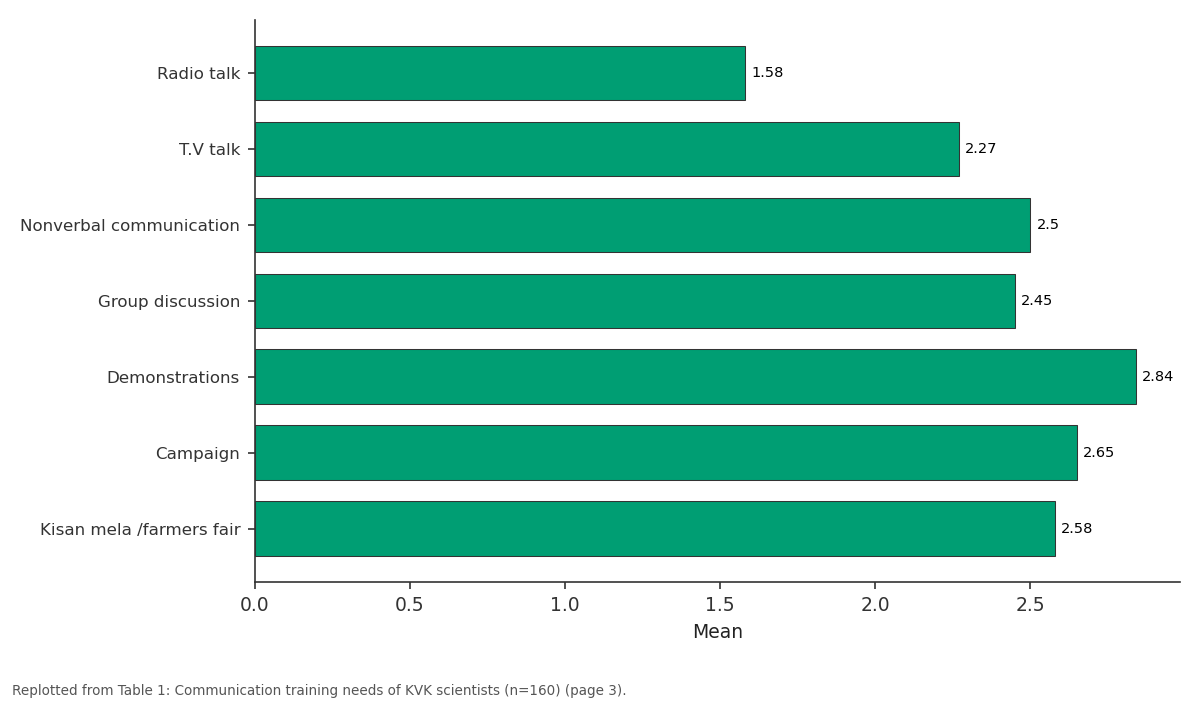
Mean: Radio talk vs T.V talk vs Nonverbal communication vs Group discussion vs Demonstrations
Replotted from Table 1 (page 3) of the original paper. Every bar is the paper's own table value.
View source evidence ↗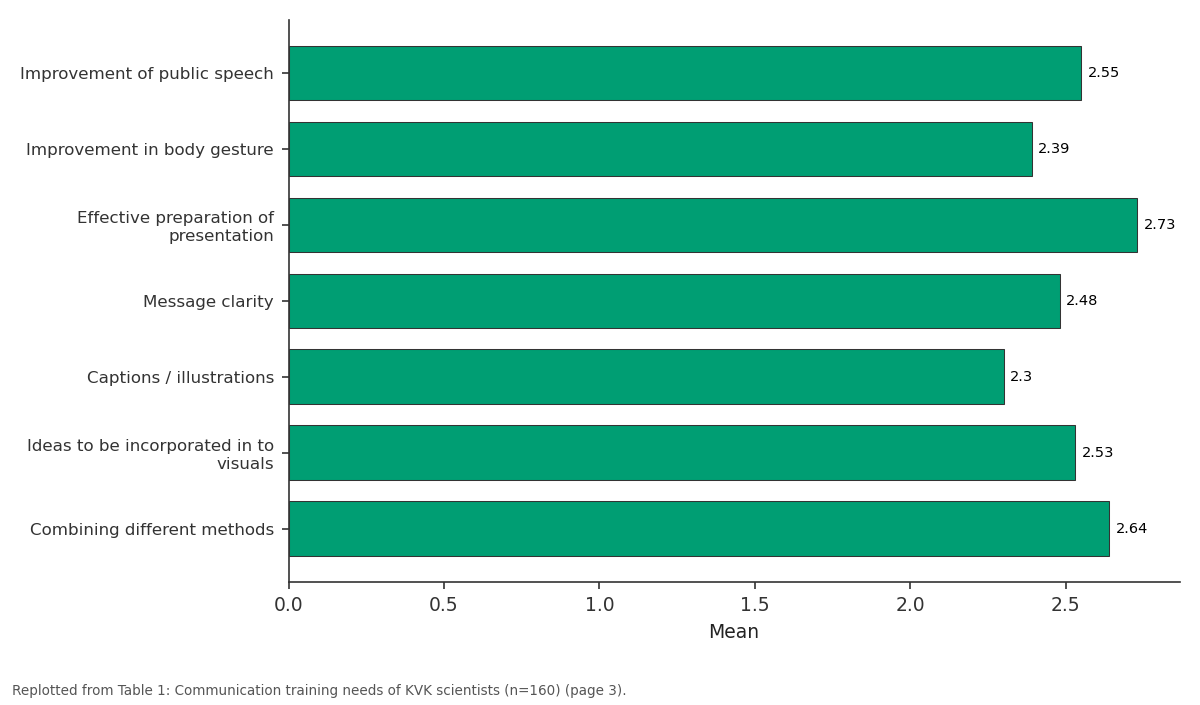
Mean: Improvement of public... vs Improvement in body... vs Effective preparation... vs Message clarity vs Captions / illustrations
Replotted from Table 1 (page 3) of the original paper. Every bar is the paper's own table value.
View source evidence ↗Figures & tables
From the original paper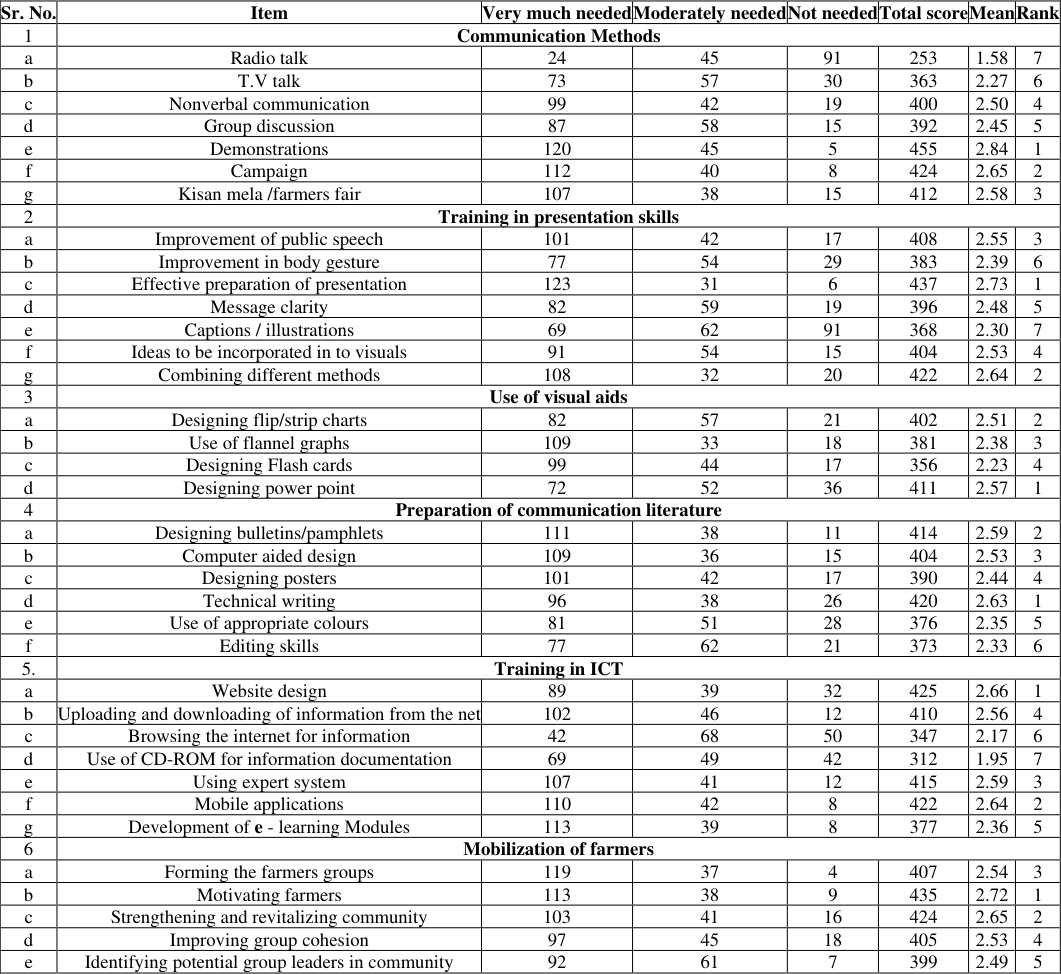 Table 1
Introduction
The agricultural development is very essential for poverty alleviation and overall economic development of any country. Agricultural sector in India has been successful in on par with the rising food demand of a growing population, which has crossed one billion marks. The green revolution has been the milestone of India's agricultural achievement, transforming the country from one of the dependencies to self-sufficiency. Agricultural research and extension played a major role in green revolution and food self-sufficiency. The changing economic scenario in India need an appropriate technology and agro management practices to respond to food and nutritional security, diversified market demands, export opportunities and environment concern posing new challenges to technology dissemination systems. The Indian agricultural landscape faces many challenges, including a high percentage of smallholder farmers, lack of supply chain infrastructure, and extreme weather conditions. In the present era of technology explosion, a steady flow of agricultural knowledge leads to the gap what is generated by the researcher and what is practiced by the users. A rapid transfer of technology from research scientists to farmers largely depends upon the communication techniques used by extension personnel and scientists. There is a continuing need to provide right information to people to take decisions that make the difference to their livelihoods. The information need of the farmers is diverse and they also searched different sources for getting information on agriculture and scientists of KVKs were one of the important sources of knowledge of the farmers in Nagaland (Jamir and Sharna, 2018) [5] . It was observed that 88.33 per cent of the respondents perceived that the extension services implemented by Krishi Vigyan Kendra were useful to more useful for them whereas one-tenth (11.67%) of the respondents were not satisfied with the efforts of the KVKs regarding the dissemination of knowledge (Sarnaik et al., 2020) [9] . KVK is an Agro-based capacity building institution for the farmers to provide need based teaching on various aspects of agriculture and allied sectors. KVKs impart latest technical know-how and do-how to different clientele by formulating various programmes with the principles of learning by doing, seeing is believing, earn while you learn to achieve the desirable changes pertaining to their knowledge, skills and attitude with a view to help them live better by improving their farm and allied enterprises. With www.extensionjournal.com the advancement of science and technology day by day new technologies are blooming in agriculture field and Agricultural research stations are engaged in checking the location specificity of these new technologies. These location specific technologies those are suitable to particular area should be communicated effectively to farmers for wider adoption to harvest the better returns and to bring out them from distress and drudgery. With this view, Indian council of agricultural research had established KVKs for the effective transfer of location specific information to the farmers. The extension worker (Scientist of KVK) cannot expect change among farmers unless he/she is able to communicate effectively to them. Effective communication could be possible when obstacles in communication should be removed through need-based trainings to the scientists. Keeping this in view, the study "Training Needs of Scientists at Krishi Vigyan Kendras in Western India" was carried out.
Objective
Objective
To study the communication training needs of the scientists of Krishi Vigyan Kendra in Western India
To study the communication training needs of the scientists of Krishi Vigyan Kendra in Western India
Materials and Methods
The study was conducted in Western India consisting of Gujarat, Rajasthan, Maharashtra and Goa states. A simple random sampling technique was used for this study. All the states of the Western India i.e., Gujarat, Rajasthan, Maharashtra and Goa were selected purposely for the study and all the KVKs of Gujarat, Rajasthan, Maharashtra and Goa were purposely selected for the study. Considering the total number of KVKs in Western India, 160 respondents were selected for the study. Communication training need areas of KVK scientists were identified by structured questionnaire with open ended questions. These areas were divided into six major areas. Each area was further divided into sub area of communication and the choices of KVK scientists were sought about each sub area of communication. On the basis of their replies rank orders were given to each sub area based on their mean scores.
Results and Discussion
The table 1 focuses on communication training needs of KVK scientists. It could be concluded from the table that training in conducting demonstrations with 2.84 MS, was on first rank. Campaign was on second rank with 2.66 MS, whereas, kisan mela was on third rank with 2.58 MS. The fourth rank was occupied by Nonverbal communication, followed by focused group discussion (V), T.V presentation skills (VI) and radio talk presentation skills (VII). It can be concluded that they require training on conducting demonstrations, followed by organizing campaigns and kisan melas. The implication of the afore mentioned result is that the KVK scientists had indicated greater need for training in respect of demonstrations and the campaigns were the next preferred areas in the need hierarchy. This trend can be explained in the context of the latest strategy of agricultural extension that, during the visits of KVK scientists to farmers, it is mandatory to initiate demonstrations to teach skills involved in agricultural technologies.
| Sr. No. | Item | Very much needed | Moderately needed | Not needed | Total score | Mean | Rank |
|---|---|---|---|---|---|---|---|
| 1 | Communication Methods | ||||||
| a | Radio talk | 24 | 45 | 91 | 253 | 1.58 | 7 |
| b | T.V talk | 73 | 57 | 30 | 363 | 2.27 | 6 |
| c | Nonverbal communication | 99 | 42 | 19 | 400 | 2.50 | 4 |
| d | Group discussion | 87 | 58 | 15 | 392 | 2.45 | 5 |
| e | Demonstrations | 120 | 45 | 5 | 455 | 2.84 | 1 |
| f | Campaign | 112 | 40 | 8 | 424 | 2.65 | 2 |
| g | Kisan mela /farmers fair | 107 | 38 | 15 | 412 | 2.58 | 3 |
| 2 | Training in presentation skills | ||||||
| a | Improvement of public speech | 101 | 42 | 17 | 408 | 2.55 | 3 |
| b | Improvement in body gesture | 77 | 54 | 29 | 383 | 2.39 | 6 |
| c | Effective preparation of presentation | 123 | 31 | 6 | 437 | 2.73 | 1 |
| d | Message clarity | 82 | 59 | 19 | 396 | 2.48 | 5 |
| e | Captions / illustrations | 69 | 62 | 91 | 368 | 2.30 | 7 |
| f | Ideas to be incorporated in to visuals | 91 | 54 | 15 | 404 | 2.53 | 4 |
| g | Combining different methods | 108 | 32 | 20 | 422 | 2.64 | 2 |
| 3 | Use of visual aids | ||||||
| a | Designing flip/strip charts | 82 | 57 | 21 | 402 | 2.51 | 2 |
| b | Use of flannel graphs | 109 | 33 | 18 | 381 | 2.38 | 3 |
| c | Designing Flash cards | 99 | 44 | 17 | 356 | 2.23 | 4 |
| d | Designing power point | 72 | 52 | 36 | 411 | 2.57 | 1 |
| 4 | Preparation of communication literature | ||||||
| a | Designing bulletins/pamphlets | 111 | 38 | 11 | 414 | 2.59 | 2 |
| b | Computer aided design | 109 | 36 | 15 | 404 | 2.53 | 3 |
| c | Designing posters | 101 | 42 | 17 | 390 | 2.44 | 4 |
| d | Technical writing | 96 | 38 | 26 | 420 | 2.63 | 1 |
| e | Use of appropriate colours | 81 | 51 | 28 | 376 | 2.35 | 5 |
| f | Editing skills | 77 | 62 | 21 | 373 | 2.33 | 6 |
| 5. | Training in ICT | ||||||
| a | Website design | 89 | 39 | 32 | 425 | 2.66 | 1 |
| b | Uploading and downloading of information from the net | 102 | 46 | 12 | 410 | 2.56 | 4 |
| c | Browsing the internet for information | 42 | 68 | 50 | 347 | 2.17 | 6 |
| d | Use of CD-ROM for information documentation | 69 | 49 | 42 | 312 | 1.95 | 7 |
| e | Using expert system | 107 | 41 | 12 | 415 | 2.59 | 3 |
| f | Mobile applications | 110 | 42 | 8 | 422 | 2.64 | 2 |
| g | Development of e - learning Modules | 113 | 39 | 8 | 377 | 2.36 | 5 |
| 6 | Mobilization of farmers | ||||||
| a | Forming the farmers groups | 119 | 37 | 4 | 407 | 2.54 | 3 |
| b | Motivating farmers | 113 | 38 | 9 | 435 | 2.72 | 1 |
| c | Strengthening and revitalizing community | 103 | 41 | 16 | 424 | 2.65 | 2 |
| d | Improving group cohesion | 97 | 45 | 18 | 405 | 2.53 | 4 |
| e | Identifying potential group leaders in community | 92 | 61 | 7 | 399 | 2.49 | 5 |
Table text extracted from the original PDF; superscript letters are shown inline. The original table image is below.
View original table image
About the training in presentation skills the respondents had given first rank to effective preparation of presentation (I), followed by combining different methods (II), improvement of public speech (III), ideas to be incorporated in to visuals (IV), message clarity (V), improvement in body gesture (VI), captions / illustrations (VII) are given the least ranks. Thus, it can be summarized that there is an urgent need for the training on effective preparation of presentation and combining different methods in addition they require training on use of captions/illustrations, these training on the above methods should be organized.
Regarding training related to visual aids the first rank was given to designing power point, followed by designing flip/strip charts (II), use of flannel graphs (III), designing flash cards (IV). It infers that designing power point was given first rank because this is the mostly used for the presentation whenever they have opportunity, they use power point presentations secondly, they use charts but the other two not regularly used by the respondents hence there is an urgent need to organize training on the designing power point and designing charts. Concerned to the training in preparation of communication literature technical writing was placed first among all, followed by computer aided design (II), designing bulletins/pamphlets (III), designing posters (IV), use of appropriate colours (V), editing skills (VI). The KVK scientists require training mostly in technical writing and for computer aided design and designing pamphlets. The KVK scientists mostly depending on DTP shop persons on payment basis. Hence the department should organize training in these methods as it saves money and moreover the respondents can design on their own and include the exact thought. Further, they can also incorporate some innovative ideas. With the advent of the flex printing the usage of the posters has drastically reduced even though some KVK scientists preparing the posters on their own. Hence the training should be given on the above areas. In respect to training related to ICT's website design was given first rank, followed by mobile applications usage. Mobile applications were increased enormously. The government is releasing the apps without training. They are giving namesake training to the extension personnel. Effective trainings should be imparted. The training in using expert system was given third rank as most of the respondents doesn't know how to use the expert system. A less proportion of the respondents needed training in browsing the internet for information (IV), development of e-learning Modules (V), uploading and downloading of information from the internet (VI) and use of CD-ROM for information documentation (VII).
Regarding training related to mobilization of farmers the respondents felt motivating farmers was very important hence given first rank, followed by strengthening and revitalizing community was given second rank, forming the farmers groups (III), improving group cohesion (IV) and identifying potential group leaders in community (V). Hence trainings should be organized on aforesaid areas. These findings are in line with Kharde et al. (2014) [7] , Kehinde and Ayobami (2015) [6] , Said and Gokul (2015) [8] , Timothy (2015) [10] , Al-Zahrani et al. (2017) [1] , Babu (2017) [3] and Bhattacharjee and Saravanan (2018) [4] . www.extensionjournal.com
References
8 in the original paper- Al-Zahrani FO, Aldosari MB, Baig MY, Shalaby M, Straquadine GS. Assessing the competencies and training needs of agricultural extension workers in Saudi Arabia. J Agric Sci Technol. 2017;19:33-46.
- Bhattacharjee S, Saravanan R. The online culture of agriculture: Exploring social media readiness of agricultural professionals. CSI Trans ICT. 2018;6:289299.
- Jamir J, Sharma A. Socio-economic and constraint assessment of Krishi Vigyan Kendra training programme in Nagaland. Int J Curr Microbiol Appl Sci. 2018;7(11):1759-1770.
- Kehinde AT, Ayobami AL. Training needs assessment on the use of social media among extension agents in Oyo state, Nigeria. J Agric Informatics. 2015;6:100111.
- Kharde PB, Patil SD, Potawade BT. Training needs of scientists of agricultural university. Indian Res J Ext Educ. 2014;14(3):103-107.
- Said RH, Gokul KRW. Training needs of agricultural assistants working in state department of agriculture. Int J Sci Res. 2015;4(5):1547-1549.
- Sarnaik SD, Bhople PP, Mankar DM, Tekale VS. Perception of farmers towards effectiveness of extension services of KVK. Indian J Ext Educ. 2020;56(4):43-48.
- Timothy AO. Analysis of competency and training needs among agricultural extension personnel in Lagos State. Int J For Horticulture. 2015;1(2):14-21.