
Research article · 2024 · Full text
International Journal of Agriculture Extension and Social DevelopmentA study on constraints faced by farmers under contract farming in Kumaon division of Uttarakhand
Volume 7(8) · Pages 191–192 · DOI: 10.33545/26180723.2024.v7.i8c.901 ↗
Research areasAgricultural Economics and PracticesLivestock Management and Performance ImprovementAgricultural risk and resilience
Abstract
Author-writtenContract farming is a method in which a corporation that processes or exports agricultural products purchases the harvest output from farmers and sets up pre-direct purchasing agreements. It was important to know that how and to what extent contract farming has affected the farming community. Thus a study was conducted to assess the constraints faced by farmers under contract farming system in which, two blocks each from the districts of Udham Singh Nagar and Nainital were specifically chosen from the state of Uttarakhand. A total of 200 respondents were selected for the investigation. The majority of respondents, 71.00%, named insects, pests, and diseases as their top concern. This was followed by 67.50% who rated a shortage of water for irrigation and 61.00% who ranked a shortage of labour during peak hours.
Summary
Source-checkedPlain-language reading of the full paper, prepared with AI and checked against the text. Each point links to the authors' own words.
Why it matters
- Contract farming is used to ensure price stability, facilitate the adoption of innovations, and manage the timely delivery and marketing of high-quality agricultural produce. View evidence ↗
- Small farmers can use contract farming to profit from the commercial production of high-value goods, including flowers, vegetables, fruits, and medicinal or aromatic plants. View evidence ↗
- Contracting serves as a risk-allocation mechanism where the farmer (producer) takes on the production risk and the company (processor) takes on the marketing risk. View evidence ↗
The question
- The study aimed to assess the specific constraints encountered by farmers operating under a contract farming system. View evidence ↗
What they did
- The research was conducted in the Kumaon Division of Uttarakhand, specifically selecting the districts of Nainital and Udham Singh Nagar due to their high concentration of contract farmers. View evidence ↗
- The investigation involved a sample size of 200 respondents. View evidence ↗
- The study employed a descriptive research design using surveys and fact-finding inquiries. View evidence ↗
What they found
- The most significant constraint reported by farmers was the problem of insects, pests, and diseases, cited by 71.00% of respondents (Rank I). View evidence ↗
- Scarcity of irrigation water was the second highest constraint, reported by 67.5% of the farmers. View evidence ↗
- A shortage of labor during peak periods was ranked third, affecting 61.00% of respondents. View evidence ↗
- The lack of storage facilities was the fourth most common constraint, reported by 60.50% of farmers. View evidence ↗
- Uncertainty in crop yield (56.00%) and adverse climatic conditions (44.50%) were ranked as the fifth and sixth constraints, respectively. View evidence ↗
- Input-related issues included high prices (30.00%), poor quality (28.00%), and lack of credit availability (23.00%). View evidence ↗
- Financial and procurement constraints included lower crop prices (20.00%), delayed payments (17.50%), and delays in procurement (15.00%). View evidence ↗
- The least reported constraints were lack of government control (7.50%), poor firm service (7.00%), quality-based rejections (3.0%), and market price fluctuations (2.50%). View evidence ↗
What it means
- The authors conclude that reduced produce prices and fluctuating market prices are the primary sources of financial hardship for these farmers. View evidence ↗
- The authors recommend that the government create a robust and efficient ecosystem to ensure mutual gain and free interaction between farmers and contracting enterprises. View evidence ↗
Visual summary
2 visualsIllustrations explain the paper; charts are replotted from the paper's own table values.
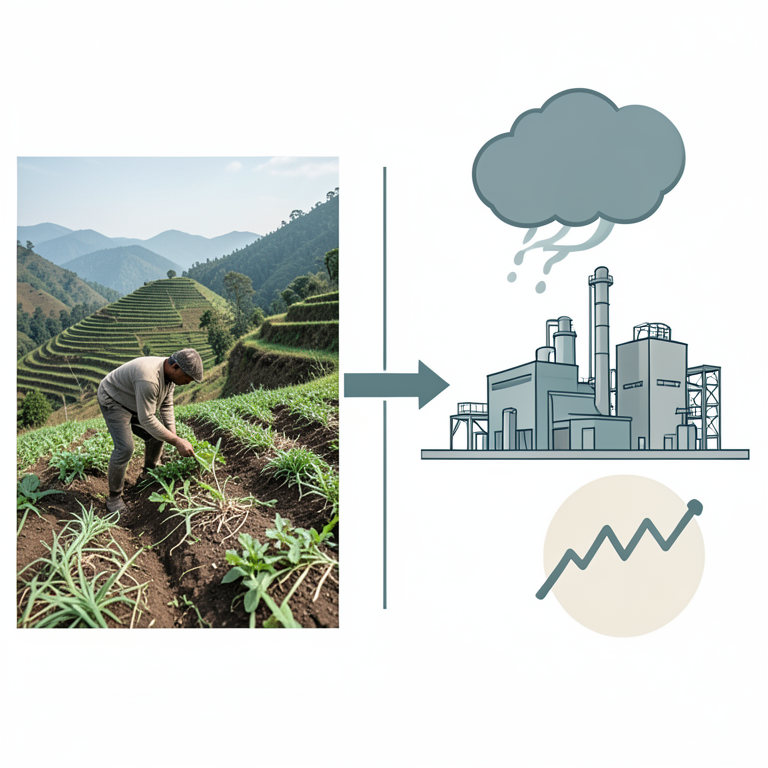
Risk Allocation in Contract Farming
AI-generated conceptual illustration (Uttarakhand hill farmers and a food processing factory). It explains the idea and does not show study data.
View source evidence ↗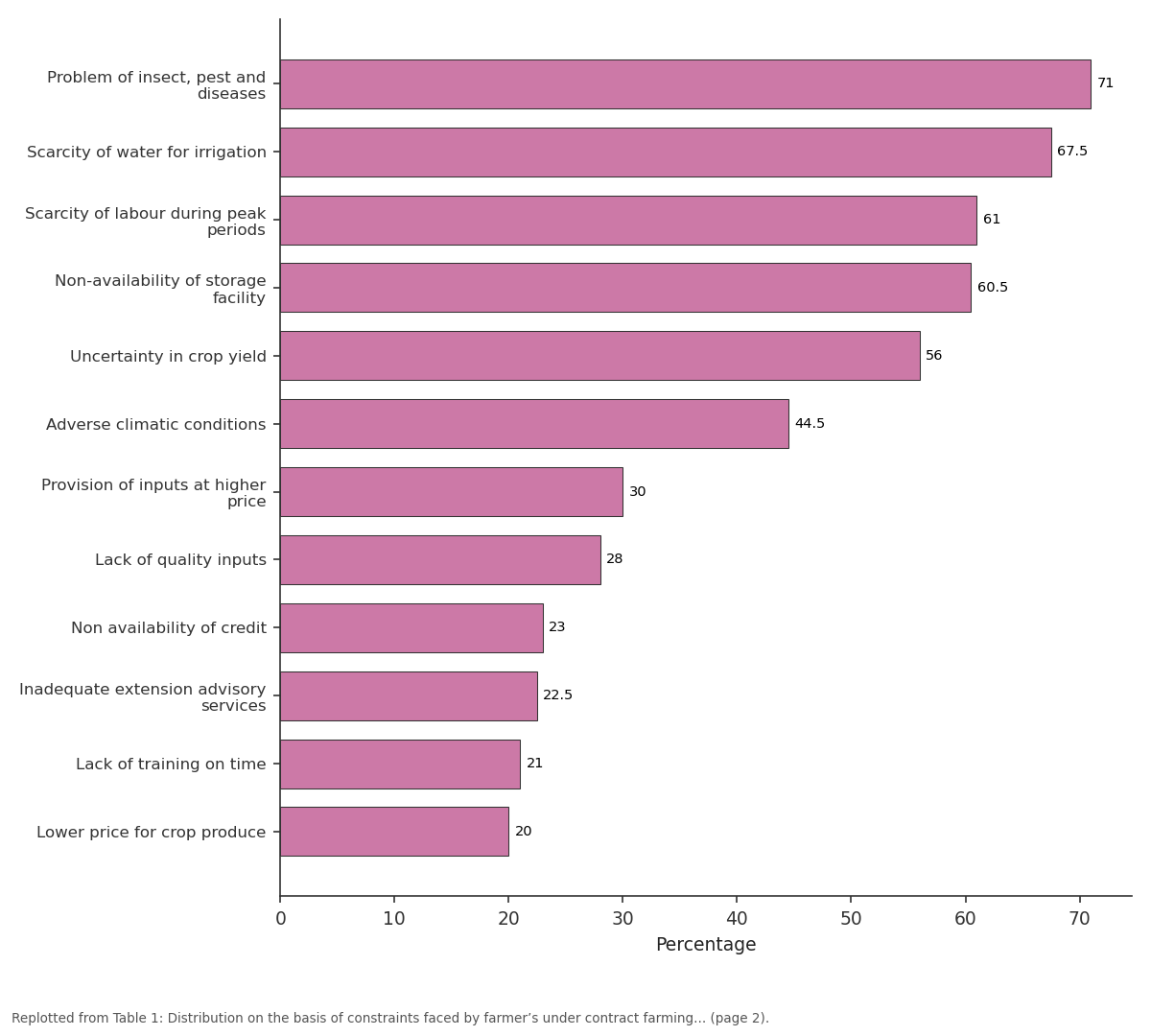
Percentage: Problem of insect, pest... vs Scarcity of water for... vs Scarcity of labour... vs Non-availability of... vs Uncertainty in crop...
Replotted from Table 1 (page 2) of the original paper. Every bar is the paper's own table value.
View source evidence ↗Figures & tables
From the original paper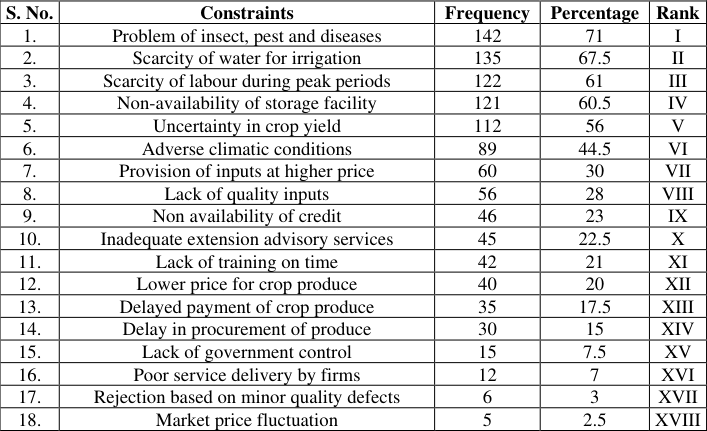 Table 1
Introduction
Baumann (2000) [7] defined contract farming as a system where an agricultural processing or exporting company procure the harvest production from the farmers and the agreement of buying are arranged in pre direct contracts. The terms of the contract vary and generally determine how much produce the contractor will purchase and what price they will pay for it. The contractor rapidly provides credit for inputs and skill development. In essence, contracting is a means of allocating risk between producer and processor; the former assumes production risk, while the latter bears marketing risk. Farmers are open to raising their standard of living. Small farmers in particular can participate in the production of high-value goods like fruits, vegetables, flowers, medicinal and aromatic plants, and so forth and profit from commercial under contract farming. The farmers' profit margin will be maximised through contract farming. Contract farming is necessary to maintain price stability, adopt new innovations, deliver high-quality produce on time, handle and market produce after harvest, and so on. The problems are confronted under contract farming system, when a corporation makes inaccurate projections about the size or price range of the market, there may be market hazards. The introduction of advanced machinery could lead to the overcapitalization of contract farmers and the loss of local jobs. Corruption persists and problems occurs when staff is responsible for issuing contracts and buying crops by taking undue advantages of their position which may result in collapse of trust and communication between the contracted parties. In a large contract, the sponsors can be dishonest or corrupt, "fly-by-night" companies who have seen the opportunity for a quick profit. Therefore, in every case farmers who make investments in production and primary processing facilities run the risk of losing everything. The government should ensure to strengthen the farmers by building a robust, competitive, and efficient ecosystem in which contracting enterprises and farmers interact freely and are motivated by mutual gain.
Materials and Methods
The Kumaon Division of Uttarakhand state serves as the study's universe. The districts of Udham Singh Nagar and Nainital were specifically chosen due to the high number of farmers who work under contract to produce crops, and the creation of several integrating businesses with a sophisticated network of contract farming systems for a range of commodities. As a result, 200 respondents in all were chosen for interview based on a variety of predetermined criteria in accordance with the study's goals. Descriptive research design, comprising several forms of fact-finding enquiries and surveys, was chosen for this study. www.extensionjournal.com The majority of respondents (71.00%) identified diseases, pests, and insects as their main concern, ranking them first. Sixty-five per cent reported a shortage of water for irrigation, sixty per cent reported a labour shortage during peak hours (61.00%), ranking third, and 60.50% reported the absence of storage facilities which was ranked IV. In terms of crop yield uncertainty, 56.00% was ranked V, adverse climatic conditions 44.50% was ranked VI, provision of inputs at higher prices 30.00% was ranked VII, lack of quality inputs 28.00% ranked VIII, non-availability of credit 23.00% ranked IX, lack of training on time 21.00% was ranked X, inadequate extension advisory services 22.50% was ranked XI, lower price for agricultural yield 20.00% was categorised as XII, delayed payment of crop produce XIII, ranking at 17.50%, delay in procurement of produce 15.00% ranked as XIV, lack of government control 7.50% ranked as XV, poor service delivery by firms 7.00% ranked as XVI, rejection based on minor quality defects 3.0% ranked as XVII, market price fluctuation. 2.50% was ranked as XVIII.
Results and Discussion
Results and Discussion
Summary and Conclusion
A system for producing and supplying agricultural products under contract is known as contract farming. A contract of this kind essentially commits parties to supply agricultural produce at a predetermined location, cost, quantity, quality, and delivery time. The respondents' two main sources of financial hardship under the contract farming system were fluctuating market prices and reduced agricultural produce prices. Their decision to choose contract farming was influenced by support service-related limitations, such as the higher cost of inputs, low quality of inputs, the lack of credit availability, delayed payment of crop produce, delay in produce procurement, absence of government control, the poor service provided by businesses, rejection of applications due to small quality flaws, lack of adequate extension advisory services, and the delayed training. Among the limitations connected to management, shortage water for irrigation, scarcity of labour during peak period and non-availability of storage facility affected their choice in undertaking contract farming. Natural constraint such as problem of insect, pest and diseases, uncertainty of crop yield and adverse climatic condition were major constraints faced by them under contract farming system.
Figures and tables from the paper
| S. No. | Constraints | Frequency | Percentage | Rank |
|---|---|---|---|---|
| 1. | Problem of insect, pest and diseases | 142 | 71 | I |
| 2. | Scarcity of water for irrigation | 135 | 67.5 | II |
| 3. | Scarcity of labour during peak periods | 122 | 61 | III |
| 4. | Non-availability of storage facility | 121 | 60.5 | IV |
| 5. | Uncertainty in crop yield | 112 | 56 | V |
| 6. | Adverse climatic conditions | 89 | 44.5 | VI |
| 7. | Provision of inputs at higher price | 60 | 30 | VII |
| 8. | Lack of quality inputs | 56 | 28 | VIII |
| 9. | Non availability of credit | 46 | 23 | IX |
| 10. | Inadequate extension advisory services | 45 | 22.5 | X |
| 11. | Lack of training on time | 42 | 21 | XI |
| 12. | Lower price for crop produce | 40 | 20 | XII |
| 13. | Delayed payment of crop produce | 35 | 17.5 | XIII |
| 14. | Delay in procurement of produce | 30 | 15 | XIV |
| 15. | Lack of government control | 15 | 7.5 | XV |
| 16. | Poor service delivery by firms | 12 | 7 | XVI |
| 17. | Rejection based on minor quality defects | 6 | 3 | XVII |
| 18. | Market price fluctuation | 5 | 2.5 | XVIII |
Table text extracted from the original PDF; superscript letters are shown inline. The original table image is below.
View original table image
References
7 in the original paper- Asokan SR. A perspective of contract farming with special reference to India. Indian J Agric Mktg. 2005;19(2):94-106.
- Eaton C, Shephard AW. Contract farming: Partnership for growth. Agric Serv Bull. 2001;145(1):43-56.
- Gohain N, Singh S. An analysis of problems and constraints faced by farmers in marketing of agricultural produce in Punjab. Econ Affairs. 2018;63(3):671-678.
- Kolekar DV, Meena HR, Bangar YC. Constraints perceived by the contract farmers and integrating firm under contract dairy farming, Tamil Nadu. J Vet Anim Sci. 2012;9(2):104-112.
- Kumar AS, Singh P. Perceived constraints of contract farmers and apprehensions of non-contract farmers in Tamil Nadu. Pusa Agric Sci. 2009;32(2):75-78.
- Roy D, Tripathi G, Islam AHMS. Contract farming, profitability, and adoption of food safety measures in broiler production in Bangladesh. Discussion Paper (2027). Washington, DC: IFPRI; c2021.
- Baumann M. Diaspora: genealogies of semantics and transcultural comparison. Numen. 2000 Jan 1;47(3):313-337.