
Research article · 2024 · Full text
International Journal of Agriculture Extension and Social DevelopmentUtilization of information regarding improved wheat cultivation practices through Kisan Call Centre (KCC) among the farmers of Prayagraj district (UP)
Volume 7(8) · Pages 30–33 · DOI: 10.33545/26180723.2024.v7.i8a.888 ↗
Research areasAgricultural Economics and Practices
Abstract
Author-writtenThe present study was conducted district of Uttar Pradesh to assess the utilization of the respondents towards utilization of information regarding improved wheat cultivation practices through Kisan Call Centre. A total number of 123 respondents were selected purposively from 8 villages under Chaka block. The data were collected by interview method by using pre structured schedule and later appropriate statistical analysis was done to find out the meaningful results. The findings revealed that majority of the respondents were living in medium level of socio economic status such source of information, social participation, economic motivation, progressiveness and mass media exposure and also revealed that majority (58.53%) of the respondents have medium utilization level followed by 22.76 percent having high and those 18.69 percent having low of utilization level of information regarding improved wheat cultivation practices through kisan call centre.
Summary
Source-checkedPlain-language reading of the full paper, prepared with AI and checked against the text. Each point links to the authors' own words.
Why it matters
- Agriculture is a fundamental human practice essential for sustaining life and shaping societies. View evidence ↗
- Information and communication technology (ICT) is now a critical component across various sectors, including the agricultural industry. View evidence ↗
- The Kisan Call Centre (KCC), launched by the Indian government in 2004, uses ICT to provide farmers with agricultural information via toll-free calls in local dialects. View evidence ↗
The question
- The study aimed to examine how farmers utilize information provided by the Kisan Call Centre regarding improved wheat cultivation practices. View evidence ↗
What they did
- The research was conducted in the Chaka block of Prayagraj district, Uttar Pradesh, with 123 randomly selected respondents from eight villages. View evidence ↗
- The study employed a descriptive research design, collecting data through personal interviews conducted at the farmers' homes, fields, or community locations. View evidence ↗
- Data was gathered using a pre-structured interview schedule and analyzed using frequency and percentage distributions. View evidence ↗
What they found
- The majority of respondents (58.53%) showed a medium level of KCC information utilization, while 22.76% had low utilization and 18.69% had high utilization. View evidence ↗
- A significant majority of farmers (66.67%) found the KCC very helpful in providing information in their own language. View evidence ↗
- The most common specific aspect of wheat cultivation for which farmers obtained KCC information was pest and disease control (69.11%). View evidence ↗
- Approximately 74.79% of the respondents reported that they benefited from the information provided by the KCC. View evidence ↗
- Several socio-economic factors, including age, annual income, and mass media exposure, showed a positive and significant association with the utilization of KCC information at a 5% significance level. View evidence ↗
- Social participation was found to have a positive but non-significant association with KCC information utilization, indicating it does not influence utilization. View evidence ↗
What it means
- The authors concluded that the utilization of KCC information for improved wheat cultivation is positively and significantly correlated with the socio-economic status of the farmers. View evidence ↗
Visual summary
2 visualsIllustrations explain the paper; charts are replotted from the paper's own table values.
KCC Information Flow
AI-generated conceptual illustration (wheat plants and a mobile phone). It explains the idea and does not show study data.
View source evidence ↗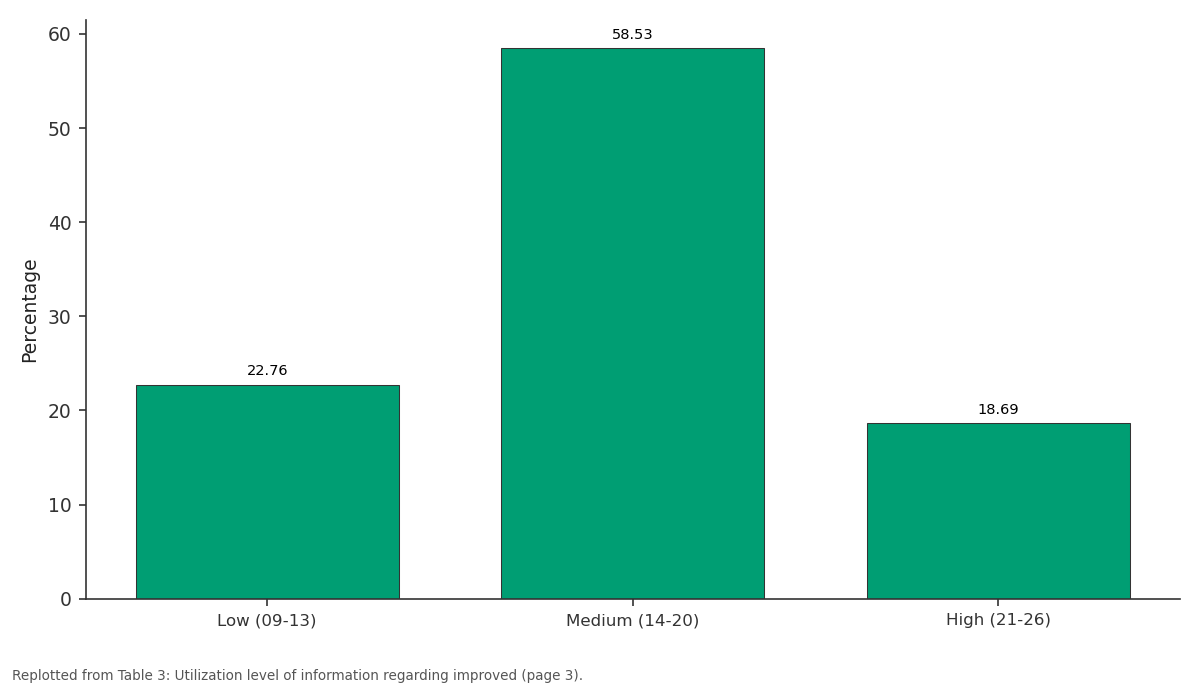
Percentage: Low (09-13) vs Medium (14-20) vs High (21-26)
Replotted from Table 3 (page 3) of the original paper. Every bar is the paper's own table value.
View source evidence ↗Figures & tables
From the original paper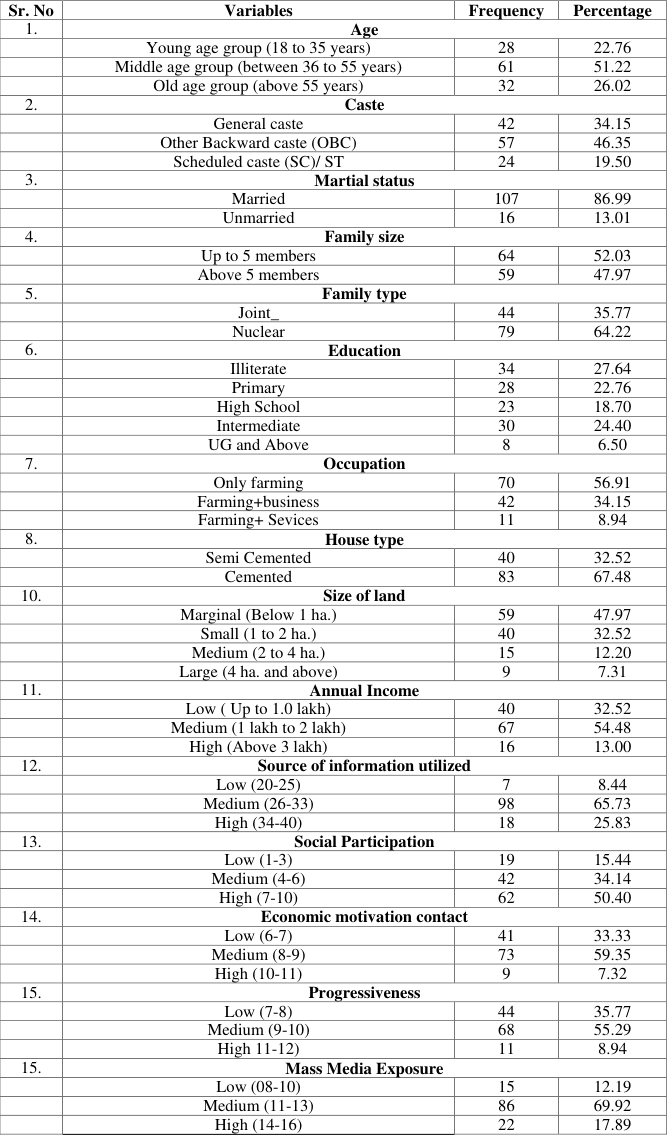 Table 1
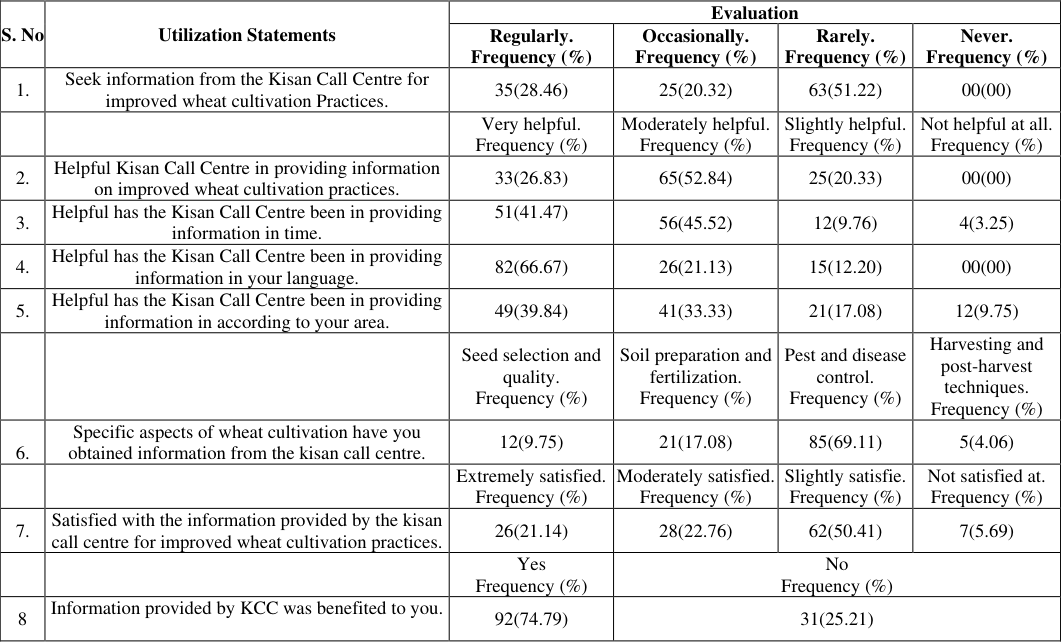 Table 2
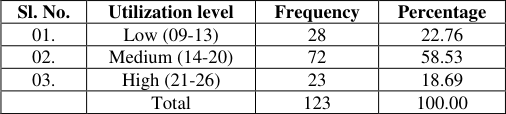 Table 3
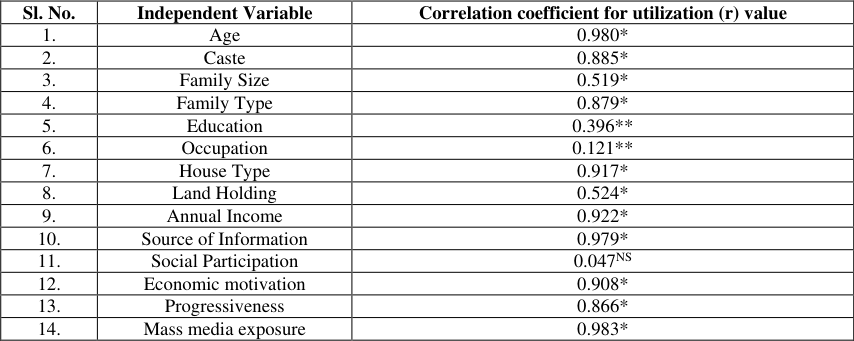 Table 4
Introduction
Agriculture is one of the oldest and most essential practices of humanity, it has played a significant role in shaping societies and sustaining life on Earth. From the early farming communities to the advanced farming practices of the Neolithic era, agriculture has continuously evolved, driven by technological innovations, economic challenges, and environmental factors. Today, agriculture not only feeds a global population of over 8 billion people but also serves as a cornerstone of economic development and environmental stewardship. Agriculture is the systematic practice of cultivating plants, raising animals, and utilizing other natural resources to produce food, fiber, and other products essential for sustaining human life and economic development. The people living in 21st century with the revolution of information communication technology which is responsible for wide spread access of computer technology as well as mobile services in to the social structure. The technology is turn influenced the society, development and social environment. Information and communication technology (ICT) plays a crucial role across all sectors, including agriculture. India boasts a vast telephone telecom network with numerous subscribers, facilitating rapid information exchange. This advancement has significantly eased the transfer of agricultural technology, a central goal of extension education historically challenged by slow communication methods. The Kisan Call Centre (KCC), established by the Ministry of Agriculture and Farmers' Welfare, Government of India on January 21, 2004, exemplifies this ICT integration. It addresses farmers' queries via toll-free calls in their local dialect. Utilizing basic mobile telephony technologies such as SMS, IVRS, OBD, and USSD, KCCs provide personalized information accessible through a nationwide toll-free number, 1800-180-1551. Key features include support in local languages, availability from 6 am to 10 pm throughout the year, conferencing capabilities with experts, and compatibility across all mobile networks. The IFFCO Kisan Sanchar Nigam is the execution partner of KCCs. The KCC has become the instant ICT solution for the farmers due to real time interaction with the advisors that too in local languages with just a mobile phone. Studies have proved that farmers are immensely benefitted by following the suggestions given at KCCs.
Mechanism of Kisan call centre
Level I: Farm Tail Advisors (FTAs), who are agricultural graduates, take calls and provide basic solutions. If they can't resolve the issue, they escalate it to Level II.
Level II: Subject Matter Specialists handle unresolved issues from Level I and aim to provide answers within 72 hours. If they can't solve the problem, it is escalated to Level III. www.extensionjournal.com Level III: Nodal officers (scientists) and a group of specialists provide advanced solutions with better resources. They respond to the caller within 72 hours through various communication methods.
Research Methodology
The present study was conducted in Chaka block of Prayagraj district of Uttar Pradesh. Total 123 respondents were selected randomly from 08 villages of one blocks i.e. Chaka in Prayagraj district. Personal interview method was utilised by investigator himself, either at their home or at community place or at their field. Descriptive research design has been used in the present study. The data was collected from respondents by using the pre structured interview schedule. Data analysis is done through frequency and percentage distribution using statistical tools. For calculating percentage, frequency was multiplied by 100 and divided by total number of Respondents.
Objective
To examine the utilization of information regarding improved Wheat Cultivation Practices through Kisan Call Centre. Mass media exposure 0.983* ** Significant at 0.1 Percent level ofprobability, * Significant at 0. Percent level probability, NS = Not significant From table 4. it can be observed that 14 socio-economic characteristics has been studied among which characteristics like age, caste, family size, family type, house type, land holding annual income, source of information, economic motivation, progressiveness and mass media exposure, had positive and significant association with the utilization level of information regarding improved wheat cultivation practices through kisan call centre at 5 percent level of significance. Meanwhile, education, and occupation, had positive and significant association with utilization level of www.extensionjournal.com information regarding improved wheat cultivation practices through kisan call centre at 1 percent level of significance. Whereas, social participation are postive and non-significant association with utilization of information regarding improved wheat cultivation practices through kisan call centre. Thus, it accepts the null hypothesis. So it can be concluded that social participation is not influence the utilization of information regarding improved wheat cultivation practices through kisan call centre.
| Sl. No. | Independent Variable | Correlation coefficient for utilization (r) value |
|---|---|---|
| 1. | Age | 0.980* |
| 2. | Caste | 0.885* |
| 3. | Family Size | 0.519* |
| 4. | Family Type | 0.879* |
| 5. | Education | 0.396** |
| 6. | Occupation | 0.121** |
| 7. | House Type | 0.917* |
| 8. | Land Holding | 0.524* |
| 9. | Annual Income | 0.922* |
| 10. | Source of Information | 0.979* |
| 11. | Social Participation | 0.047NS |
| 12. | Economic motivation | 0.908* |
| 13. | Progressiveness | 0.866* |
| 14. | Mass media exposure | 0.983* |
Table text extracted from the original PDF; superscript letters are shown inline. The original table image is below.
View original table image
Results and Discussion
Results and Discussion
Conclusion
It is concluded that majority of the respondents were living in medium level of socio economic status. The study clearly brought out that the majority (58.53%) of the respondents have medium utilization level followed by 22.76 percent of those having low and those 18.69 percent having low of information regarding improved wheat cultivation practices through kisan call centre. It was also found that utilization level of information regarding improved wheat cultivation practices was positively and significantly correlated with socio economic status.
Figures and tables from the paper
| Sr. No | Variables | Frequency | Percentage |
|---|---|---|---|
| 1. | Age | ||
| Young age group (18 to 35 years) | 28 | 22.76 | |
| Middle age group (between 36 to 55 years) | 61 | 51.22 | |
| Old age group (above 55 years) | 32 | 26.02 | |
| 2. | Caste | ||
| General caste | 42 | 34.15 | |
| Other Backward caste (OBC) | 57 | 46.35 | |
| Scheduled caste (SC)/ ST | 24 | 19.50 | |
| 3. | Martial status | ||
| Married | 107 | 86.99 | |
| Unmarried | 16 | 13.01 | |
| 4. | Family size | ||
| Up to 5 members | 64 | 52.03 | |
| Above 5 members | 59 | 47.97 | |
| 5. | Family type | ||
| Joint | 44 | 35.77 | |
| _ Nuclear | 79 | 64.22 | |
| 6. | Education | ||
| Illiterate | 34 | 27.64 | |
| Primary | 28 | 22.76 | |
| High School | 23 | 18.70 | |
| Intermediate | 30 | 24.40 | |
| UG and Above | 8 | 6.50 | |
| 7. | Occupation | ||
| Only farming | 70 | 56.91 | |
| Farming+business | 42 | 34.15 | |
| Farming+ Sevices | 11 | 8.94 | |
| 8. | House type | ||
| Semi Cemented | 40 | 32.52 | |
| Cemented | 83 | 67.48 | |
| 10. | Size of land | ||
| Marginal (Below 1 ha.) | 59 | 47.97 | |
| Small (1 to 2 ha.) | 40 | 32.52 | |
| Medium (2 to 4 ha.) | 15 | 12.20 | |
| Large (4 ha. and above) | 9 | 7.31 | |
| 11. | Annual Income | ||
| Low ( Up to 1.0 lakh) | 40 | 32.52 | |
| Medium (1 lakh to 2 lakh) | 67 | 54.48 | |
| High (Above 3 lakh) | 16 | 13.00 | |
| 12. | Source of information utilized | ||
| Low (20-25) | 7 | 8.44 | |
| Medium (26-33) | 98 | 65.73 | |
| High (34-40) | 18 | 25.83 | |
| 13. | Social Participation | ||
| Low (1-3) | 19 | 15.44 | |
| Medium (4-6) | 42 | 34.14 | |
| High (7-10) | 62 | 50.40 | |
| 14. | Economic motivation contact | ||
| Low (6-7) | 41 | 33.33 | |
| Medium (8-9) | 73 | 59.35 | |
| High (10-11) | 9 | 7.32 | |
| 15. | Progressiveness | ||
| Low (7-8) | 44 | 35.77 | |
| Medium (9-10) | 68 | 55.29 | |
| High 11-12) | 11 | 8.94 | |
| 15. | Mass Media Exposure | ||
| Low (08-10) | 15 | 12.19 | |
| Medium (11-13) | 86 | 69.92 | |
| High (14-16) | 22 | 17.89 |
Table text extracted from the original PDF; superscript letters are shown inline. The original table image is below.
View original table image
| Sl. No. | Utilization level | Frequency | Percentage |
|---|---|---|---|
| 01. | Low (09-13) | 28 | 22.76 |
| 02. | Medium (14-20) | 72 | 58.53 |
| 03. | High (21-26) | 23 | 18.69 |
| Total | 123 | 100.00 |
Table text extracted from the original PDF; superscript letters are shown inline. The original table image is below.
View original table image
References
8 in the original paper- Kumar R, Singh SP. Factors influencing knowledge of farmers about Kisan Call Centre in Haryana. Indian Journal of Extension Education. 2013;49(3):12-16.
- Singh R, Kumar A. Socio-economic determinants of Kisan Call Centre utilization among farmers in Bihar. Bihar Journal of Agricultural Economics. 2015;7(1):5563.
- Verma N, Singh V. Role of Kisan Call Centres in reducing crop losses: A study of wheat farmers in Uttar Pradesh. Journal of Agricultural Risk Management. 2016;12(2):89-98.
- Gupta R, Sharma P. The role of Kisan Call Centers in enhancing agricultural knowledge among farmers in Haryana and Punjab. Journal of Agricultural Extension and Rural Development. 2020;12(5):123-134.
- Kumar S, Choudhary A. Awareness and utilization of Kisan Call Centres in wheat farming: A case study from Uttar Pradesh. International Journal of Agricultural Sciences. 2019;11(4):345-352.
- Jain R, Sinha M. The effectiveness of Kisan Call Centers in promoting wheat cultivation innovations in Punjab. Agricultural Innovations and Technology Management Journal. 2023;7(2):89-101.
- Das A, Bhatia R. Enhancing wheat cultivation practices through Kisan Call Centres: A comparative study in West Bengal. Journal of Agricultural Research and Extension. 2019;23(5):91-104.
- Sharma A, Joshi N. Understanding the utilization of Kisan Call Centre services by wheat farmers in Himachal Pradesh. Himachal Journal of Agricultural Research. 2021;17(2):145-154.