
Research article · 2024 · Full text
International Journal of Agriculture Extension and Social DevelopmentAgri management behaviour of rural youth towards agribusiness
Volume 7(8) · Pages 22–25 · DOI: 10.33545/26180723.2024.v7.i8a.873 ↗
Research areasAgricultural Economics and PracticesLivestock Management and Performance Improvement
Abstract
Author-written“Agri–business is a concept of economics which includes total sum of all activities involved in the manufacturing and distribution of farm supplies production operations on the farm and the storage processing and distribution of farm commodities and items made from them. The pivotal role of agribusiness at the nexus of agriculture and the rural sector cannot be understated. This stems from its potential to significantly impact employment rates, income levels, poverty alleviation, and the fulfillment of Corporate Social Responsibility (CSR) obligations through essential infrastructure. Therefore, keeping all this in mind the present study was undertaken with the objective to explore the Agri business management behaviour of Agriprenuers towards Agribusiness Activities. The study was conducted in four districts of Haryana state where Agri Business Centers were located. Thus from Bhiwani, Jind, Hisar, and Kurukshetra districts a sample of 240 rural youth from 16 villages formed the sample of the study. It was found that Majority of rural youth exhibited a moderate level of planning orientation, production orientation and moderate proficiency with respect to market orientation. Self confidence level of most of them was of moderate level. While, 52.51 percent rural youth had high proficiency level for utilization of available assistance.
Summary
Source-checkedPlain-language reading of the full paper, prepared with AI and checked against the text. Each point links to the authors' own words.
Why it matters
- Agribusiness is critical to the rural sector because it can improve income levels, reduce poverty, and increase employment rates. View evidence ↗
- Rural youth are viewed as ideal candidates for agribusiness due to their creativity, energy, and ability to adapt quickly to new technologies. View evidence ↗
- Agribusiness management involves the intentional organization of agricultural production activities to create and distribute wealth. View evidence ↗
The question
- The study aimed to explore the agribusiness management behavior of rural youth (agripreneurs) regarding their activities. View evidence ↗
What they did
- The research was conducted in four purposively selected districts of Haryana, India: Bhiwani, Jind, Hisar, and Kurukshetra. View evidence ↗
- The sample consisted of 240 rural youth with agribusiness knowledge, drawn from 16 different villages. View evidence ↗
- Data collection was performed using a tested interview schedule and direct interactions with the participants. View evidence ↗
- Agri management behavior was measured based on planning, production, and marketing orientations using a modified scale from Samantha (1977). View evidence ↗
What they found
- Most rural youth (62.92%) showed a moderate level of planning orientation, while 32.92% showed a high level. View evidence ↗
- A majority of the youth (70.41%) demonstrated moderate proficiency in marketing orientation. View evidence ↗
- Self-confidence levels were primarily moderate (49.30%), with 28.70% high and 22.00% low. View evidence ↗
- Over half of the rural youth (52.51%) showed high proficiency in utilizing available assistance. View evidence ↗
- Factors such as education, family size, family occupation, family education status, and social participation were significantly correlated with agribusiness management behavior. View evidence ↗
What it means
- The authors conclude that rural youth generally possess moderate management behaviors in planning, production, and marketing, but are highly proficient in using available assistance. View evidence ↗
Figures & tables
From the original paper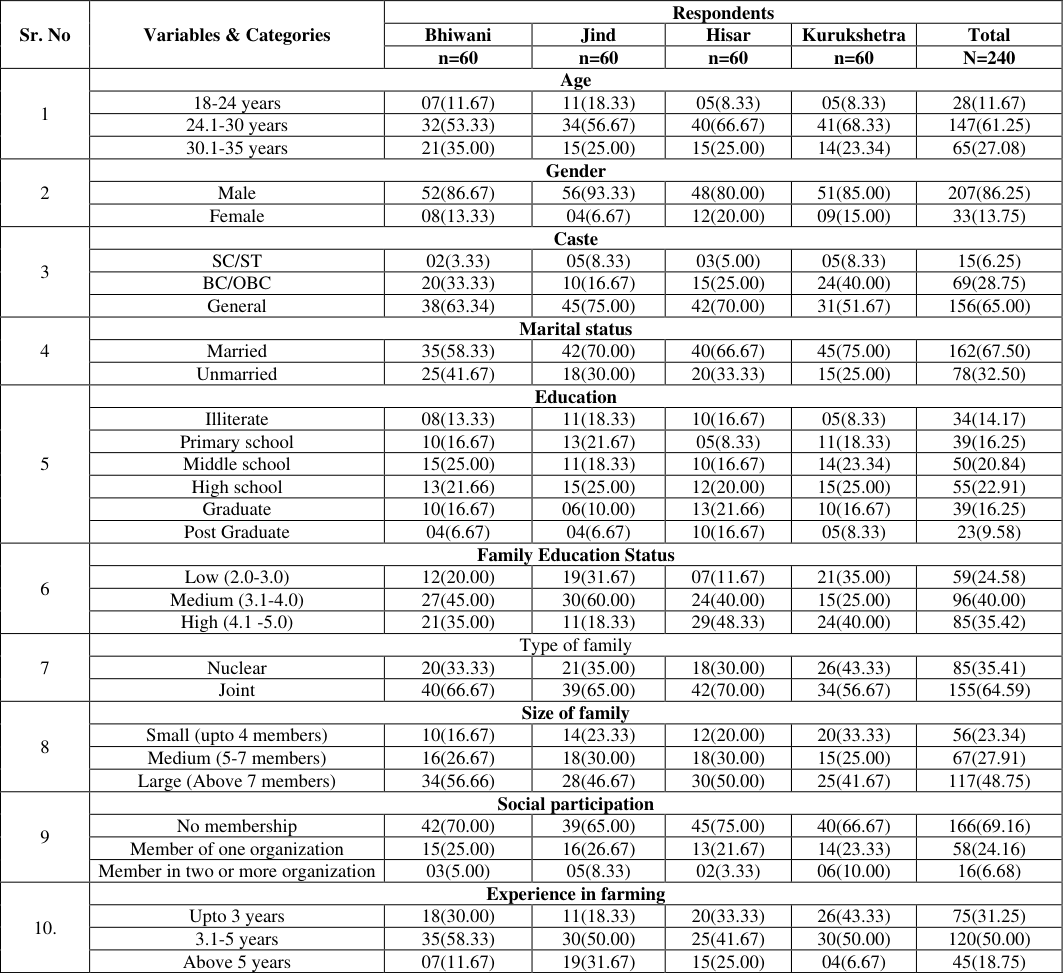 Table 1
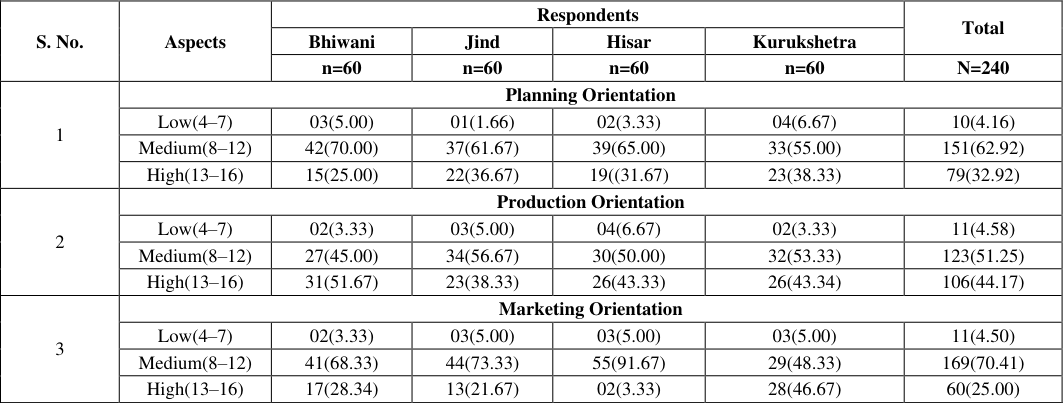 Table 2
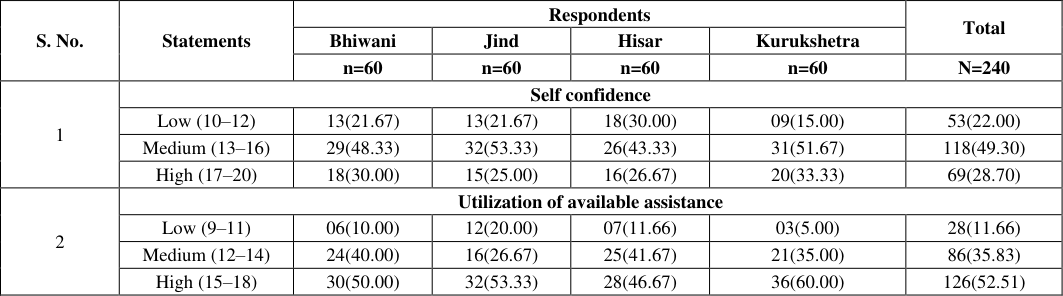 Table 3
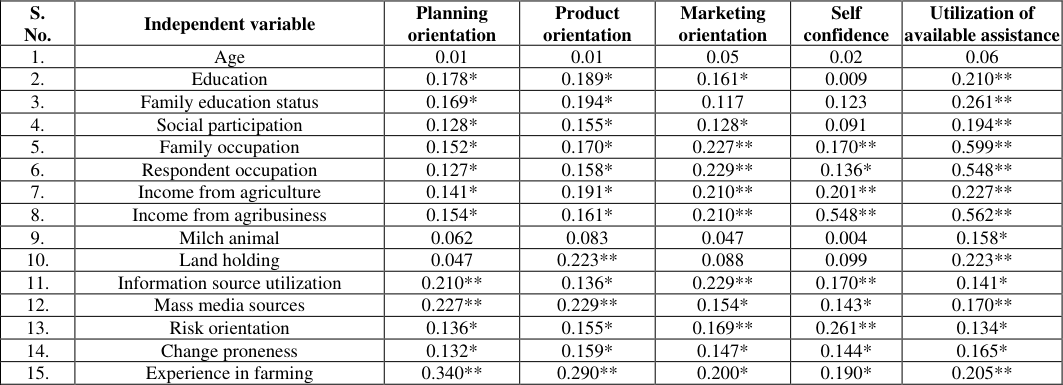 Table 4
Introduction
Youth are energetic, courageous with a fresh mindset that can generate new ideas, they are faster in adapting to new technologies, and possess the highest degree of creativity compared to the elders (Msigwa & Kipesha 2013; Nyabam et al., 2018) [3,5] . In this case, developing youth agribusiness requires an appropriate support framework and relevant technologies that can attract and motivate youth engagement in agribusiness activities for income generation. In the years to come, the increase in agricultural production will mainly come from the growth in productivity which will invite intervention of agricultural extension activities in providing farmers information, training and support for adopting improved production technologies. The Ministry of Agriculture and Farmers' Welfare, Government of India, in association us with NABARD and MANAGE has launched unique agribusiness scheme to take better methods of farming to each and every farmer across the country. Agribusiness functions as a conduit for supplying inputs to farmers and establishing connections between them and consumers across various stages including handling, processing, transportation, marketing, and distribution of agricultural products. Agribusiness management refers to purposeful activities aimed at initiating, promoting, and maintaining economic activities related to agricultural production for the creation and distribution of wealth. The individual acting as an agribusiness manager plays a critical role in economic development and is integral to socio-economic transformation. Therefore, the fundamental concept of agribusiness management emphasizes effectiveness and efficiency in turning activities into profitable business ventures.
Methodology
The study was conducted in Haryana state. From Haryana state, four districts were selected purposively where the Agri Business Centres were located i.e. Bhiwanii, Jind, Hisar, and Kurukshetra. A total sample of 240 rural youth having knowledge of Agribusiness from 16 villages from selected districts formed the sample of the study. The data for the study were collected through a well-tested interview schedule and intimate interaction with each of them. Data so collected were statistically treated to reveal relevant information.
Agrri Management Behaviour was operationalized as the degree to which the respondents were oriented towards managing their income generating activities regarding planning, production and marketing functions. The scale developed by Samantha (1977) [6] with suitable modifications was used for the study.
Results and Discussion
Results and Discussion
Socio-personal profile of the rural youth
Results regarding socio personal profile of rural youth shows that most of the respondents were between the age group of 24.1-30 years and majority were male, 65.00% respondents belonged to general category, 67.50% were www.extensionjournal.com married, around one fifth of the respondents were educated up to high school followed by middle school, 40.00% of respondents having medium education status of family, 64.59% respondents having joint family type and large family size, 69.16% respondents had no participation in any social activity and half of the respondents (50.00%) had 31.-5 years of experience in farming.
Agri Management Behavior of Rural Youth
Table 2 elucidated that with regards to planning orientation, a majority of the respondents, specifically 62.92 percent, exhibited a moderate level, followed by 32.92 percent displaying a high level, while a mere 4.16 percent demonstrated a low proficiency in planning. The identical pattern was observed across all districts. Regarding production orientation, over half of the respondents (51.25%) exhibited a moderate proficiency, trailed by 44.17 percent demonstrating a high level, while a mere 4.58 percent of the respondents displayed a low aptitude in production. In the context of marketing orientation, a predominant proportion (70.41%) of the respondents demonstrated a moderate proficiency, followed by a quarter of the respondents exhibiting a high level, with only 4.50 percent of the participants displaying a low competence in marketing. www.extensionjournal.com The results are in line with Ram et al. (2013) [4] pointed out that 58.67 percent of entrepreneurs belonged to medium agri management behaviour followed by 24.66 percent belonged to low level of agri management behaviour and 16.67 percent belonged to high level of agri management behaviour.
| S. No. | Aspects | Respondents | — | — | — | Total |
|---|---|---|---|---|---|---|
| Bhiwani | Jind | Hisar | Kurukshetra | |||
| n=60 | n=60 | n=60 | n=60 | N=240 | ||
| 1 | Planning Orientation | |||||
| Low(4–7) | 03(5.00) | 01(1.66) | 02(3.33) | 04(6.67) | 10(4.16) | |
| Medium(8–12) | 42(70.00) | 37(61.67) | 39(65.00) | 33(55.00) | 151(62.92) | |
| High(13–16) | 15(25.00) | 22(36.67) | 19((31.67) | 23(38.33) | 79(32.92) | |
| 2 | Production Orientation | |||||
| Low(4–7) | 02(3.33) | 03(5.00) | 04(6.67) | 02(3.33) | 11(4.58) | |
| Medium(8–12) | 27(45.00) | 34(56.67) | 30(50.00) | 32(53.33) | 123(51.25) | |
| High(13–16) | 31(51.67) | 23(38.33) | 26(43.33) | 26(43.34) | 106(44.17) | |
| 3 | Marketing Orientation | |||||
| Low(4–7) | 02(3.33) | 03(5.00) | 03(5.00) | 03(5.00) | 11(4.50) | |
| Medium(8–12) | 41(68.33) | 44(73.33) | 55(91.67) | 29(48.33) | 169(70.41) | |
| High(13–16) | 17(28.34) | 13(21.67) | 02(3.33) | 28(46.67) | 60(25.00) |
Table text extracted from the original PDF; superscript letters are shown inline. The original table image is below.
View original table image
Self-Confidence and Utilization of Available Assistance of Rural Youth:
In terms of self-Confidence, less than half of the respondents, specifically 49.30 percent, demonstrated a moderate level, while 28.70 percent and 22.00 percent exhibited levels categorized as moderate and low, respectively. In the utilization of available assistance, the majority of respondents, totaling 52.51 percent, demonstrated a high proficiency level. This was followed by 35.83 percent displaying a moderate level, while only 11.66 percent exhibited a low competence in this regard.
Relationship between Independent Variable with their Agri Management Behavior
The results in Table-4 revealed that Education, family education status, family size, social participation and family occupation had significant correlation with agribusiness management behaviour of rural youth. Most of the economic, communication, psychological variables and agriprenuerial variables were found to have significant relationship with agri management behaviour of rural youth.
The present finding are in turned with the finding of Jaiswal and Patel (2012) [2] reported in their study that factors like education, family income, risk taking capacity and training received had association with the entrepreneurial behaviour. Further study also revealed that age, occupation, owing responsibility for failure, family type and size, land holding, socio economic status and material possession were independent from entrepreneurial behaviour. www.extensionjournal.com
Conclusion
From the analysis and interpretation, it can be concluded that Majority of rural youth were between the age group of 25-30 years, were married, educated up to high school having medium family education status with joint large size of family. Majority of rural youth exhibited a moderate level of planning orientation, production orientation and moderate proficiency with respect to market orientation. Self confidence level of most of them was of moderate level. While, 52.51 percent rural youth had high proficiency level for utilization of available assistance. Education, family education status, family size, social participation and family occupation had significant correlation with agribusiness management behaviour of rural youth. Most of the economic, communication, psychological variables and agriprenuerial variables were found to have significant relationship with agri management behaviour of rural youth.
Figures and tables from the paper
| Sr. No | Variables & Categories | Respondents | — | — | — | — |
|---|---|---|---|---|---|---|
| Bhiwani | Jind | Hisar | Kurukshetra | Total | ||
| n=60 | n=60 | n=60 | n=60 | N=240 | ||
| 1 | Age | |||||
| 18-24 years | 07(11.67) | 11(18.33) | 05(8.33) | 05(8.33) | 28(11.67) | |
| 24.1-30 years | 32(53.33) | 34(56.67) | 40(66.67) | 41(68.33) | 147(61.25) | |
| 30.1-35 years | 21(35.00) | 15(25.00) | 15(25.00) | 14(23.34) | 65(27.08) | |
| 2 | Gender | |||||
| Male | 52(86.67) | 56(93.33) | 48(80.00) | 51(85.00) | 207(86.25) | |
| Female | 08(13.33) | 04(6.67) | 12(20.00) | 09(15.00) | 33(13.75) | |
| 3 | Caste | |||||
| SC/ST | 02(3.33) | 05(8.33) | 03(5.00) | 05(8.33) | 15(6.25) | |
| BC/OBC | 20(33.33) | 10(16.67) | 15(25.00) | 24(40.00) | 69(28.75) | |
| General | 38(63.34) | 45(75.00) | 42(70.00) | 31(51.67) | 156(65.00) | |
| 4 | Marital status | |||||
| Married | 35(58.33) | 42(70.00) | 40(66.67) | 45(75.00) | 162(67.50) | |
| Unmarried | 25(41.67) | 18(30.00) | 20(33.33) | 15(25.00) | 78(32.50) | |
| 5 | Education | |||||
| Illiterate | 08(13.33) | 11(18.33) | 10(16.67) | 05(8.33) | 34(14.17) | |
| Primary school | 10(16.67) | 13(21.67) | 05(8.33) | 11(18.33) | 39(16.25) | |
| Middle school | 15(25.00) | 11(18.33) | 10(16.67) | 14(23.34) | 50(20.84) | |
| High school | 13(21.66) | 15(25.00) | 12(20.00) | 15(25.00) | 55(22.91) | |
| Graduate | 10(16.67) | 06(10.00) | 13(21.66) | 10(16.67) | 39(16.25) | |
| Post Graduate | 04(6.67) | 04(6.67) | 10(16.67) | 05(8.33) | 23(9.58) | |
| 6 | Family Education Status | |||||
| Low (2.0-3.0) | 12(20.00) | 19(31.67) | 07(11.67) | 21(35.00) | 59(24.58) | |
| Medium (3.1-4.0) | 27(45.00) | 30(60.00) | 24(40.00) | 15(25.00) | 96(40.00) | |
| High (4.1 -5.0) | 21(35.00) | 11(18.33) | 29(48.33) | 24(40.00) | 85(35.42) | |
| 7 | Type of family | |||||
| Nuclear | 20(33.33) | 21(35.00) | 18(30.00) | 26(43.33) | 85(35.41) | |
| Joint | 40(66.67) | 39(65.00) | 42(70.00) | 34(56.67) | 155(64.59) | |
| 8 | Size of family | |||||
| Small (upto 4 members) | 10(16.67) | 14(23.33) | 12(20.00) | 20(33.33) | 56(23.34) | |
| Medium (5-7 members) | 16(26.67) | 18(30.00) | 18(30.00) | 15(25.00) | 67(27.91) | |
| Large (Above 7 members) | 34(56.66) | 28(46.67) | 30(50.00) | 25(41.67) | 117(48.75) | |
| 9 | Social participation | |||||
| No membership | 42(70.00) | 39(65.00) | 45(75.00) | 40(66.67) | 166(69.16) | |
| Member of one organization | 15(25.00) | 16(26.67) | 13(21.67) | 14(23.33) | 58(24.16) | |
| Member in two or more organization | 03(5.00) | 05(8.33) | 02(3.33) | 06(10.00) | 16(6.68) | |
| 10. | Experience in farming | |||||
| Upto 3 years | 18(30.00) | 11(18.33) | 20(33.33) | 26(43.33) | 75(31.25) | |
| 3.1-5 years | 35(58.33) | 30(50.00) | 25(41.67) | 30(50.00) | 120(50.00) | |
| Above 5 years | 07(11.67) | 19(31.67) | 15(25.00) | 04(6.67) | 45(18.75) |
Table text extracted from the original PDF; superscript letters are shown inline. The original table image is below.
View original table image
| S. No. | Statements | Respondents | — | — | — | Total |
|---|---|---|---|---|---|---|
| Bhiwani | Jind | Hisar | Kurukshetra | |||
| n=60 | n=60 | n=60 | n=60 | N=240 | ||
| 1 | Self confidence | |||||
| Low (10–12) | 13(21.67) | 13(21.67) | 18(30.00) | 09(15.00) | 53(22.00) | |
| Medium (13–16) | 29(48.33) | 32(53.33) | 26(43.33) | 31(51.67) | 118(49.30) | |
| High (17–20) | 18(30.00) | 15(25.00) | 16(26.67) | 20(33.33) | 69(28.70) | |
| 2 | Utilization of available assistance | |||||
| Low (9–11) | 06(10.00) | 12(20.00) | 07(11.66) | 03(5.00) | 28(11.66) | |
| Medium (12–14) | 24(40.00) | 16(26.67) | 25(41.67) | 21(35.00) | 86(35.83) | |
| High (15–18) | 30(50.00) | 32(53.33) | 28(46.67) | 36(60.00) | 126(52.51) |
Table text extracted from the original PDF; superscript letters are shown inline. The original table image is below.
View original table image
| S. No. | Independent variable | Planning orientation | Product orientation | Marketing orientation | Self confidence | Utilization of available assistance |
|---|---|---|---|---|---|---|
| 1. | Age | 0.01 | 0.01 | 0.05 | 0.02 | 0.06 |
| 2. | Education | 0.178* | 0.189* | 0.161* | 0.009 | 0.210** |
| 3. | Family education status | 0.169* | 0.194* | 0.117 | 0.123 | 0.261** |
| 4. | Social participation | 0.128* | 0.155* | 0.128* | 0.091 | 0.194** |
| 5. | Family occupation | 0.152* | 0.170* | 0.227** | 0.170** | 0.599** |
| 6. | Respondent occupation | 0.127* | 0.158* | 0.229** | 0.136* | 0.548** |
| 7. | Income from agriculture | 0.141* | 0.191* | 0.210** | 0.201** | 0.227** |
| 8. | Income from agribusiness | 0.154* | 0.161* | 0.210** | 0.548** | 0.562** |
| 9. | Milch animal | 0.062 | 0.083 | 0.047 | 0.004 | 0.158* |
| 10. | Land holding | 0.047 | 0.223** | 0.088 | 0.099 | 0.223** |
| 11. | Information source utilization | 0.210** | 0.136* | 0.229** | 0.170** | 0.141* |
| 12. | Mass media sources | 0.227** | 0.229** | 0.154* | 0.143* | 0.170** |
| 13. | Risk orientation | 0.136* | 0.155* | 0.169** | 0.261** | 0.134* |
| 14. | Change proneness | 0.132* | 0.159* | 0.147* | 0.144* | 0.165* |
| 15. | Experience in farming | 0.340** | 0.290** | 0.200* | 0.190* | 0.205** |
Table text extracted from the original PDF; superscript letters are shown inline. The original table image is below.
View original table image
References
6 in the original paper- Davis JH, Goldberg RA. A concept of agribusiness. Am J Agric Econ. 1956;39(4):1042-1045.
- Jaiswal A, Patel MM. Entrepreneurial behaviour of rural women. Indian J Ext Educ. 2012;12:55-59.
- Msigwa R, Kipesha EF. Determinants of youth unemployment in developing countries: Evidences from Tanzania. J Econ Sustain Dev. 2013;4(14):67-77.
- Ram D, Singh MK, Chaudhary KP, Jayarani L. Entrepreneurship behavior of women entrepreneurs in Imphal of Manipur. Indian Res J Ext Educ. 2013;13:3135.
- Nyabam VS, Tarawali G, Ijie BA. Empirical analysis of IITA youth in agribusiness model as a panacea for solving youth unemployment problem in Nigeria. International Journal of Governance and Development. 2018 Sep 30;5(1 & 2):117-121.
- Samantha NP. The effect of foreign direct investment on trade: empirical evidence from Sri Lanka. Global Journal of Economics and Business. 2018 Jul 12;5(1):87-95.