
Research article · 2024 · Full text
International Journal of Veterinary Sciences and Animal HusbandryA field documentation of constraints and challenges faced by migratory herders of Pulikulam breed of cattle
Volume 9(4) · Pages 328–330 · DOI: 10.22271/veterinary.2024.v9.i4f.1565 ↗
Research areasLivestock Management and Performance ImprovementAgricultural Economics and PracticesAgricultural Systems and Practices
Abstract
Author-writtenThe present field study was carried out to document the constraints and challenges faced by the herders of Pulikulam breed of cattle in its native breeding tracts. The on-field in-person survey was done among thirty Pulikulam herd keepers in Sivagangai and Madurai districts. Water scarcity, dwindling grazing lands, denial to forest, unforeseen losses, lack of veterinary care, lack of organized marketing channel, limited research and developments were the major issues identified. Acceptance and assessment of problems, brain storming, changes in policy at local administration level, floating of special schemes for herders were few possible recommendations towards the safeguarding the herders.
Summary
Source-checkedPlain-language reading of the full paper, prepared with AI and checked against the text. Each point links to the authors' own words.
Why it matters
- The Pulikulam cattle breed is characterized by its dominance in the Jallikattu sport and its unique migratory herding behavior, known as Kidai. View evidence ↗
- Pulikulam bulls are more aggressive and ferocious than other breeds in Tamil Nadu, which allows them to remain uncaught in the Jallikattu arena for longer periods. View evidence ↗
- Urbanization and commercialization have made migratory herding difficult due to conflicts over shared resources like water, forests, and grazing lands. View evidence ↗
The question
- The study aimed to document the challenges and constraints faced by Pulikulam cattle herders in their native breeding tracts to better understand the breed's conservation needs. View evidence ↗
What they did
- Data collection was performed using a preset questionnaire, which was then analyzed. View evidence ↗
What they found
- Every herder surveyed identified water scarcity, particularly during the summer, as a major issue. View evidence ↗
- The reduction of grazing land due to real estate development, infrastructure expansion, and fencing was reported as the most pressing issue for herders. View evidence ↗
- Herders have faced challenges due to forest authorities denying them access to forests for grazing. View evidence ↗
- All respondents agreed that lightning, thunderstorms, heavy rain, and transit accidents on railways and highways pose serious threats to the herds. View evidence ↗
- The constant movement of the migratory herds prevents herders from accessing local veterinary care centers. View evidence ↗
- Organized milk marketing is non-existent because the cows produce meager quantities sufficient only for calves and the herds are migratory for most of the year. View evidence ↗
- The primary income sources for herders are the sale of male calves for Jallikattu and the night-time penning of herds in fields. View evidence ↗
- Income is also generated from selling dried dung at one to two rupees per kg and penning animals at two rupees per animal per night. View evidence ↗
What it means
- The authors recommend safeguarding herders through policy changes at the local administration level, the creation of special schemes, and the formal assessment of their problems. View evidence ↗
Visual summary
1 visualsIllustrations explain the paper; they do not show study data.
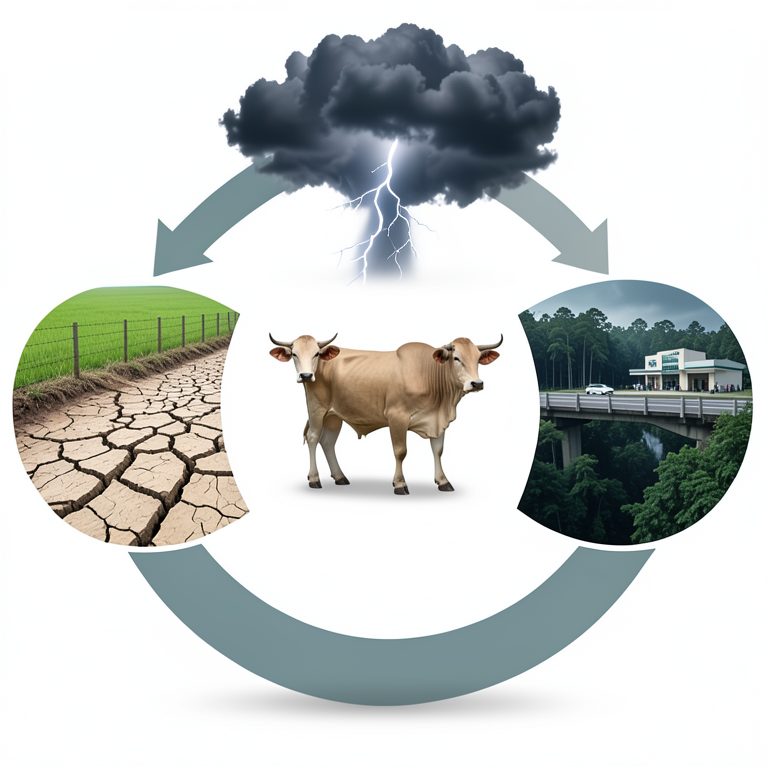
Constraints of Migratory Herding
AI-generated conceptual illustration (Pulikulam breed of cattle). It explains the idea and does not show study data.
View source evidence ↗Introduction
Pulikulam cattle breed is known for its migratory herding behavior (Kidai in Tamil) and dominance in Jallikattu sport. Its breeding tract included Sivagangai, Madurai and Virudhunagar districts of southern Tamil Nadu. Comparatively, this breed shows more aggression and ferocity than any other breeds of Tamil Nadu. This aggressive behavior made this Pulikulam bulls to stay uncaught in Jallikattu arena longer duration than the bulls of any other breeds (Priyadharsini, R., et al., 2019a) [5] . The estimated purebred population size of Pulikulam breed in 2013 and 2019 were 7352 and 10495 in numbers, respectively (GoI Report, 2013 and 2019) [2,3] . The upward trend in population can arguably attributed to the fact of Jallikattu protest happened in 2017. However, since migration being the unique attribute of this hardy breed it needs special attentions from the scientific community, policy makers, and stakeholders to address the issues related with movement of herds. Srinivasan et al., (2021) [8] reported that 83.33% of the Pulikulam population was reared as migratory herd and 16.67% as the stationary nucleus heads in households. Unlike other mainland stationary cattle breeds of Tamil Nadu, the major chunk of this migratory population had been owned and herded by the people from two communities only viz. Konars and Thevars (Singh, P., et al., 2013) [7] . In the scenario of ever rising commercialization and urbanization, leading the large migratory herds in search of forages across the different places at different seasons of the year become a herculean task due to confrontations with other stakeholders in sharing the common resources such as grazing lands, water bodies, forests, foot hills, highways, etc. The ever growing hardships in keeping the migratory herds push the traditional herders (or Keetharis who is a chief of a group of local herders) to abandon their breed and switch to other livelihood options. In this backdrop, the present field study was carried out to document the constraints and challenges faced by the herders of Pulikulam breed of cattle in its native breeding tracts in order to understand the issues surrounding the conservation of Pulikulam breed comprehensively.
Materials and Methods
The on-field in-person survey was done among thirty Pulikulam herd keepers in Sivagangai (Milaganur, Manangathan, Pulikulam, Vallarendal, Mennatchipuram in Melapasalai, and Thirupachethi) and Madurai districts (Sakkuli, Uchapatti, Chinna Udaippu, Nilaiyur).
The preset questionnaire was designed and used. The collected data were analysed appropriately.
Results and Discussion
Water scarcity Water scarcity especially in summer was the major issue faced by every herder. Water scarcity and shrinkage of grazing land were the major adversities adversely affected the population (Singh, P., et al., 2013) [7] . The breeding tract of Pulikulam exhibits semi-arid tropical climate with average summer temperature of 43 °C and relative humidity of 40-45% (Srinivasan et al., 2021) [8] . Occasionally, mortality in weak animals due to dehydration was also experienced by the herders. The herders' expectations from the government side were to have borewell water facilities along the standard migratory routes. This would help them to avoid spending some lump sum expenditure towards bringing the water through trucks in grazing fields for their animals. SEVA a NGO based in Madurai, Tamil Nadu carried out the establishment of ponds and borewell facilities along the migratory routes of Umblachery and found the positive impact in restoring the population (Vivekanandan, P, et al., 2024) [11] .
Dwindling grazing land
Reportedly the ever-shrinking grazing area was the most pressing issue among the migratory herders. Conversion of grazing land into real estate purpose, fencing of unused lands, expansion of highway roads, railway tracks, construction of bridges and big buildings, etc. were some of the reasons for the reduction of grazing land spelled by the respondents. In some places, the grazing land was used as dump yard by the local people and administration.
Denial of access to forest and foothills
Lately, otherwise the regular entrants to the forest for grazing their herds had been denied by the forest authority were another challenge the herders had to face. One such a case was by Srivilliputhur Squirrel sanctuary documented by Ilse Köhler-Rollefson and the LIFE Network (2007) [4] . This was because of the possibility of deforestation and conflict with wild animals. But, the scientific study revealed that livestock grazing in the forest actually reduces the occurrence of forest fires by reducing the dry forages, potential dried wooden fuels, etc. Also, livestock trails formed along the grazing fields prevent the spread of fire across the forest (Campbell, 1954) [1] . A few studies reported that the denial of livestock into the forest made the respective predators to emigrate from the forest in search of prey. As a result, the wild life ecosystem get disturbed further. In Tamil Nadu, how the different forestry development programmes led to decline of population of domestic breeds viz., Pulikulam, Malaimadu, Kachakatti black sheep, Toda buffaloes was compiled and reported by Ilse Köhler-Rollefson and the LIFE Network (2007) [4] . Assessment of local forest resources, convention of regular stakeholders meeting, issuance of permit license for genuine breed keepers, assigning of responsibility to herders, nominal charging for grazing, etc. were some of the potential solutions that can be tried shared by the herders.
Unforeseen losses
Heavy rainfall, transit accidents in highways and railways, thunderstorm and lightning had been the serious threats for the migratory herds and herders shared by all the respondents in one voice. The loss due to these unforeseen factors had been a significant size. The mental agony of the herders sometime made them to abandon this occupation shared griefly by a few young herders. Shifting of herds from one place to another place in daytime became the issue especially when the migration had to cross the highways and/or railways. On the other hand, night time shifting sometime led to huge accidents especially in winter season. In such accidents, the local administration grants no compensation to the gene keepers. Night time penning had been the revenue generating option for the migratory herders. The penning had to set in fields that may be located faraway from residential area. In that circumstance, threat of predators like wild fox, wild dogs, etc. was the real challenge. Particularly, in rainy season with limited light facilities in the field, guarding the herd through the murky dark nights required unreal confidence and determination. Snakes, poisonous flies, etc. were the menace for the accompanying herd keepers. Successful penning during rainy season had been a daunting task reported by majority of the surveyees. Incentives for Pulikulam gene keepers would be one of the solutions for the losses (Vivekanandan, P, et al., 2024) [11] .
Lack of veterinary services
Though the traditional herders were involved in keeping the herds for so many years, sometime they are in need of some veterinary care for their animals to manage the issues like bleeding, fracture, horn breakage, bruises, eye injuries, etc. Since, they were always in movement their access to the local veterinary care centres could not be possible. Supplying of first aid kit along with some skill trainings to use the medicines would empower them further in saving their herds. Herders' indigenous knowledge on ethno-veterinary practices were to be fully understood by the researchers. The annual mortality in the Pulikulam herd was around 5% (Sudeep Kumar, N.K., et al., 2016) [9] .
Lack of organized marketing channels
In general, Pulikulam gene keepers neither milk the animals nor sell the milk. But, they offer milk freely to those who seek milk for some medical reasons. Singh, P., et al., (2013) [7] reported that only 10-15% of lactating animals were milked in the herd. Further Singh, P., et al., (2013) [7] suggested for having milking of all the lactating animals and selling the milk for commercial consumption as that of any other dairy breeds. Though, it was a logical recommendation from the economic point of view, this would not yield the success because, the herd was in migration during the most part of the year. The meager quantities of milk secreted by cows were enough for its calves only. In the nomadic system, the suckling calves get its energy, nutrients, disease resistance only through the milk. Srinivasan et al., (2021) [8] reported the average daily milk yield as less than one litre and one to two litres in 30% and 70% of the lactating animals, respectively. Milking required additional work force which was not possible. Further, suckling behavior of calves was essential for maintaining the behavioural identity of the breed. Pulikulam keepers never wean the suckling calves (Srinivasan et al., 2021) [8] . The two major sources of income were through selling of male calves for Jallikattu purpose and penning of herds in the field during night time. When there was no penning especially during the cultivation seasons, the voided dung were collected, sun dried, crumbled and sold for organic farming. The demand for dried dung was huge for organic spice farming in Kerala state. The existed rate for dried dung was one to two rupees per kg (Srinivasan et al., 2021) [8] . Similarly, the rate for penning reportedly it was two rupees per animal per night. Selling excess male calves for Jallikattu sport had been the important source of income for the herders. Calves with good health, right body confirmation, agility were the deciding features at the time of marketing. Priyadharsini, R., et al., (2019b) [6] reported that 52.27% of the Pulikulam breed of Jallikattu bulls rearers selected the calves during six month to one year of age. Further, 27.84% of the rearers purchased Jallikattu bull calves directly from the herders while 51.70% of them preferred to purchase from the sandy / livestock market.
Research and development
Since, the Pulikulam is a non-commercial breed there was an expectation from the herders to have a research and development centre with the objective of conservation of this breed. Tamil Nadu Veterinary and Animal Science University got established the Pulikulam Cattle Research Centre (PCRS) at Manamadurai in 2017. Its objectives were to maintain and improve the nucleus herd; to propagate the elite bulls; to carry out the activities towards conservation of the breed (TANUVAS webpage, 2024) [10] . Singh, P., et al., (2013) [7] insisted to establish nucleus herds, breeding the animals for disease resistance, adaptation to hot and humid climatic condition. This was very much essential to keep the breed identity matching to its ecosystem.
Conclusion
Water scarcity, dwindling grazing lands, denial to forest, unforeseen losses, lack of veterinary care, lack of organized marketing channel, limited research and developments were the major issues identified. Acceptance and assessment of problems, brain storming, changes in policy at local administration level, floating of special schemes for herders were few possible recommendations towards the safeguarding the herders.
Acknowledgement
AcknowledgementThe administrative help rendered by Veterinary College and Research Institute (VCRI), Orathanadu to carry out the survey is acknowledged.
References
6 in the original paper- Campbell RS. Fire in relation to forest grazing. Unasylva, 1954, 8(4). Available from: www.fao.org/docrep/x5373e/x5373e02.html
- Priyadharsini R, Gopinathan A, Karthickeyan SMK, Jagatheesan PN. Demographic and social status of sporting bull rearers and rearing of Jallikattu bulls. Int J Curr Microbiol App Sci. 2019b;8(8):2799-806. DOI: https://doi.org/10.20546/ijcmas.2019.808.322
- Singh P, Pundir R, Kumarasamy P, Vivekanandan P, Madu P, Madu N, et al. Management and physical features of migratory Pulikulam cattle of Tamil Nadu. Indian J Anim Sci. 2013;82:1587-1590. DOI: 10.56093/ijans.v82i12.25701.
- Srinivasan G, Chinnamani V, Chellapandian M, Leela M, Sathiamoorthy T. Feeding and other management practices of Pulikulam cattle rearers in its native tract. Indian J Dairy Sci, 2021, 74(4). Available from: https://epubs.icar.org.in/index.php/IJDS/article/view/113
- Sudeepkumar NK, Nisha PR, Sethu S, Ganesamoorthy SK, Thilakar P. Community rearing system of Pulikulam cattle: A case study in Tamil Nadu, India. Indian Vet J. 2016;93:82-84.
- Vivekanandan P, Sadana DK, Gupta A, Singh PK, Köhler-Rollefson I. Strengthening the role of traditional livestock keeping communities towards conservation and development of breeds, practices and rights. Agric Biodivers Community, 2024, 2(2). Available from: https://dhan.org/abcwebsite/i2article4.php