
Research article · 2024 · Full text
International Journal of Agriculture and NutritionEvaluation of the performance of dinitroaniline herbicide on growth and yield of soybeans Glycine max L when different planting dates after spraying
Volume 6(2) · Pages 04–07 · DOI: 10.33545/26646064.2024.v6.i2a.171 ↗
Research areasSoybean genetics and cultivationAgricultural Science and FertilizationCrop Yield and Soil Fertility
Abstract
Author-writtenThe research was conducted during 2022-2023 at the Rashedia Research Station in order to evaluate performance of the dinitroaniline herbicide when the Glycine max L. crop planting dates differed. The research encompassed two factors, the use of dinitroaniline herbicide is discussed at two levels, second: Planting date of the crop after spraying the herbicide is determined at three levels: immediate, a week, and two weeks post-spray. Research was applied using the method of the study utilized global experiments and a Randomized Complete Block Design (RCBD) with three replications. The data was collected and analyzed using the SAS program at the end of the season. The Duncan multiple range test was used to distinguish different averages with different alphabet letters in research. The results showed: that treatment dinitroaniline herbicide is being used achieved a decrease significant increase in the dry weight of the weed and percentage of germination, and a significant increase in plant height, number of pods, and weight of 100 seeds. Planting two weeks after spraying the herbicide significantly reduced the weed's dry weight, and a significant increase in both plant height, the number of pods, and the weight of 100 seeds. Interaction between the control treatment and planting two weeks after spraying the herbicide resulted in a significant increase the dry weight of the weed. is measured (g). Interaction between herbicide treatment and planting immediately after spraying resulted in a significant decrease in the percentage of germination. The herbicide treatment and planting interaction led to significant increases in plant height, pod number, and seed weight two weeks post-spray.
Summary
Source-checkedPlain-language reading of the full paper, prepared with AI and checked against the text. Each point links to the authors' own words.
Why it matters
- Soybeans (Glycine max L.) are important annual summer field crops because their seeds are rich in oil, protein, and essential amino acids for growth. View evidence ↗
- Dinitroaniline herbicides, such as Treflan, are commonly used to control weeds that are resistant to herbicides applied after germination. View evidence ↗
- Treflan works by causing rapid cell swelling and spherical thickening in the roots and shoots of plants it contacts. View evidence ↗
The question
- The study aims to determine the optimal planting date after applying a soil-added dinitroaniline herbicide to avoid negative effects on soybean germination and growth. View evidence ↗
What they did
- The research was carried out at the Rashedia Research Station in Mosul during the 2023/2024 agricultural season. View evidence ↗
- The experiment used a factorial design with two factors: herbicide application (control vs. recommended concentration) and three planting dates (immediately, 1 week, and 2 weeks after spraying). View evidence ↗
- The Shaima variety was planted at 36 kg/ha with 50 cm spacing, and the herbicide was applied at a concentration of 1248 cm³/ha using a 16-liter backpack sprayer. View evidence ↗
- The study employed a Randomized Complete Block Design (RCBD), with data analyzed via SAS software and the Duncan multiple range test (p < 0.05). View evidence ↗
What they found
- The lowest weed dry weight (38.33 g/m²) occurred when the herbicide was used and planting was delayed by two weeks, compared to 83.33 g/m² for the control group at the same planting date. View evidence ↗
- Herbicide treatment significantly reduced the germination percentage to 64.7%, compared to 95.2% in the control group. View evidence ↗
- The lowest germination rate (42.4%) was observed when planting occurred immediately after the application of the Trflan herbicide. View evidence ↗
- Plant height was highest (104 cm) with herbicide treatment and planting two weeks post-spray, while the lowest height (62.33 cm) was found in the control group planted two weeks post-spray. View evidence ↗
- The highest number of pods per plant (348.6) was achieved with herbicide treatment and planting two weeks after spraying, whereas the lowest (190.6) occurred in the control group at the same planting date. View evidence ↗
- The average weight of 100 seeds increased significantly when planting occurred two weeks after herbicide application, while the lowest weight (11.6 g) occurred when planting was done one week after application. View evidence ↗
What it means
- The authors conclude that the combination of herbicide treatment and planting two weeks after spraying significantly improves plant height, pod number, and seed weight. View evidence ↗
Visual summary
3 visualsIllustrations explain the paper; charts are replotted from the paper's own table values.
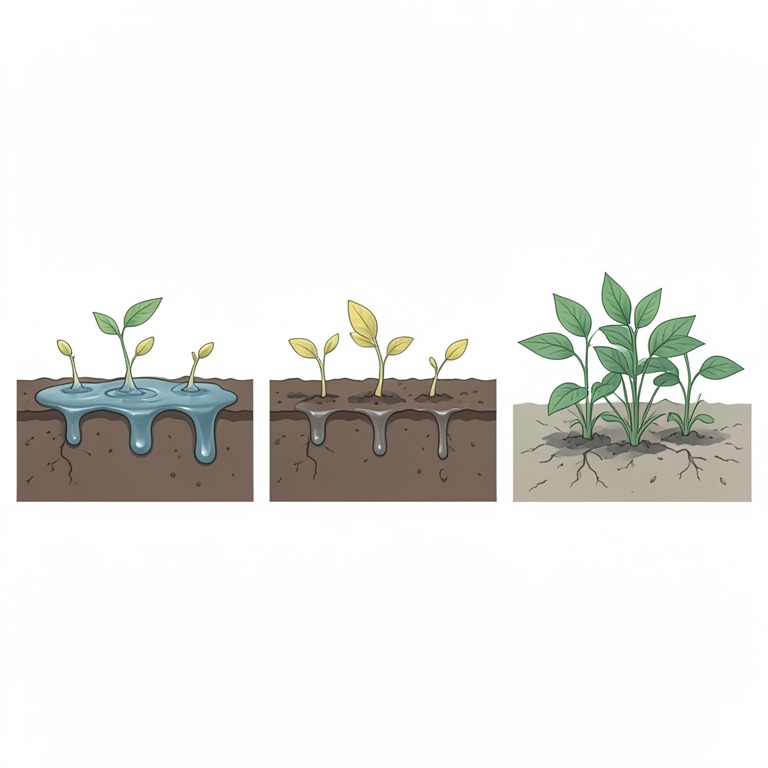
Experimental Setup
AI-generated conceptual illustration (soybean plants (Glycine max L.) in soil). It explains the idea and does not show study data.
View source evidence ↗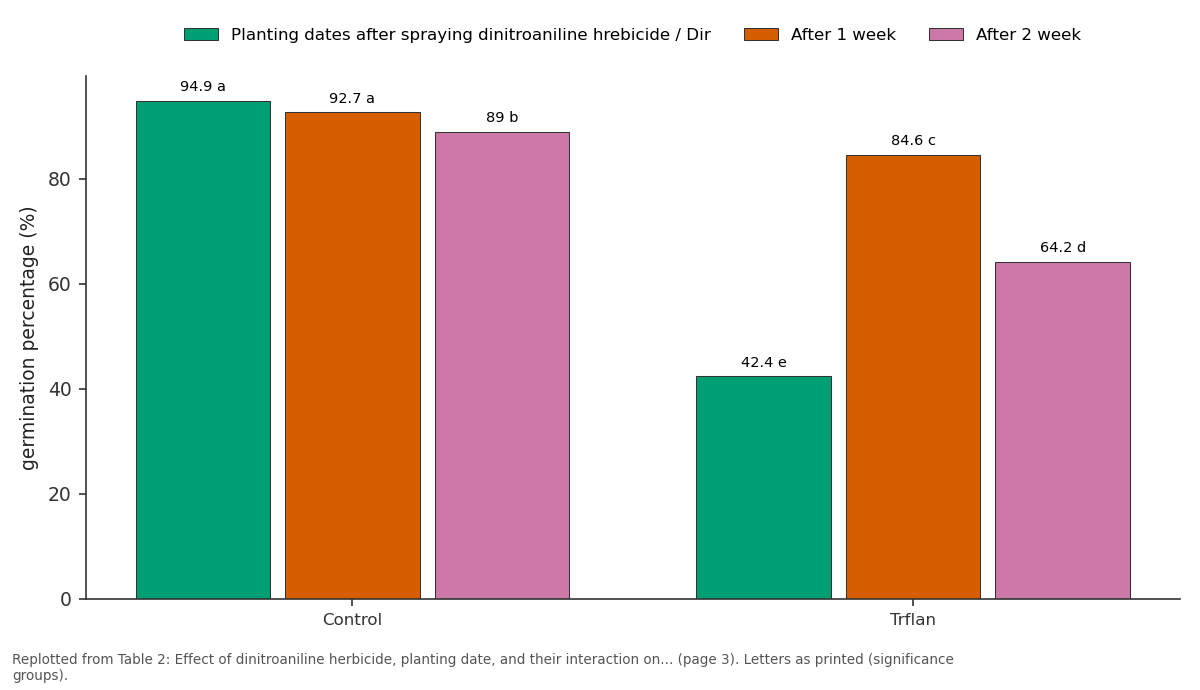
Planting dates after spraying dinitroaniline... and After 1 week and more: Control vs Trflan
Replotted from Table 2 (page 3) of the original paper. Every bar is the paper's own table value.
View source evidence ↗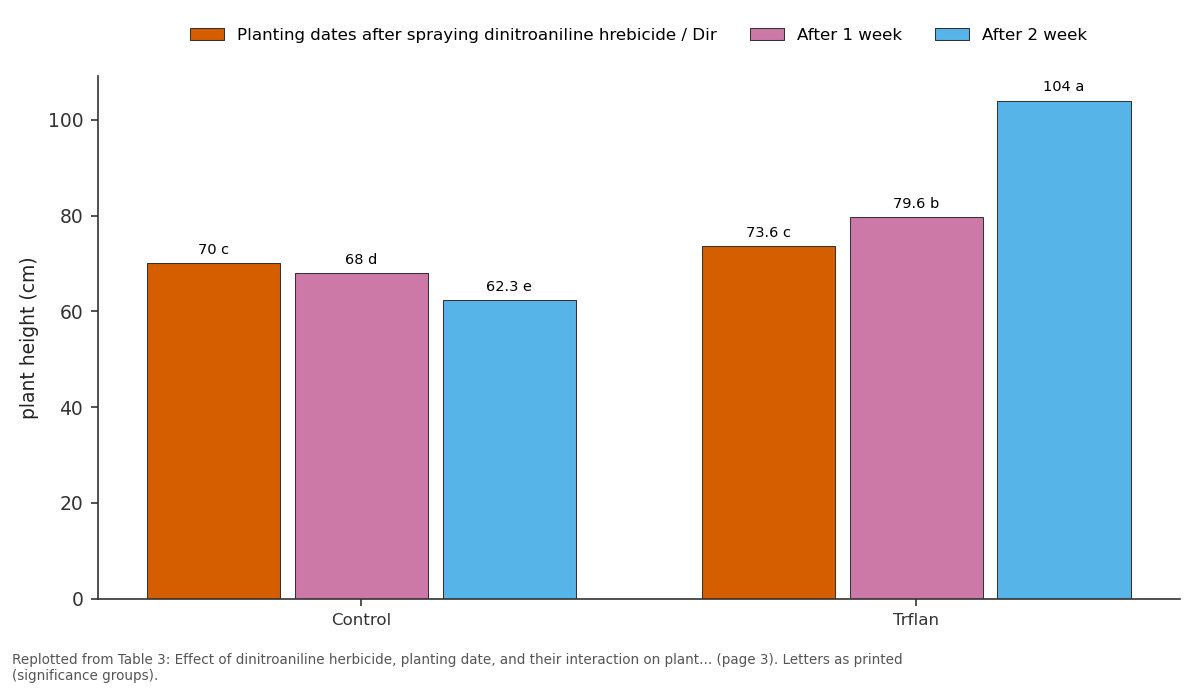
Planting dates after spraying dinitroaniline... and After 1 week and more: Control vs Trflan
Replotted from Table 3 (page 3) of the original paper. Every bar is the paper's own table value.
View source evidence ↗Figures & tables
From the original paper Table 1
 Table 2
 Table 3
 Table 4
 Table 5
Introduction
Glycine max L soybeans are considered one of the annual summer field crops (Legumes, oil crops), as their seeds contain mainly oil and protein, and what increases their importance is that they contain most of the amino acids necessary for body growth. The seeds and what they contain have a wide scope in manufacturing, including the extraction of edible oils, fats, and vegetable butter, in addition to using their oil in making mayonnaise and salads. Seed flour is used in some pastries and ingredients for bread, cakes, and biscuits. It is added to meat, in the manufacture of baby food and sweets, and in special nutrition for diabetes due to its low carbohydrate content. Soybean meal grits are used in feeding poultry and livestock as a concentrated protein Megha et al., (2023) [9] , and hay is used in animal feed. There are bacterial nodules on its roots to fix atmospheric nitrogen, which leads to increased soil fertility. Pedersen and Lauer's (2003) [13] study examines the influence of planting dates on the oil and protein content of two soybean varieties Hardin and Spansoy 250, in the United States of America the planting date significantly impacted the oil and protein content of the Spansoy 250 variety, with the protein percentage increasing from 35.4% to 36.0%. The study revealed that early planting resulted in a 0.15 increase in oil percentage than in late cultivation. Ruqayya et al., (2013) concluded that early planting was significantly superior to late planting in the percentage of oil in seeds, and a significant decrease in the percentage of protein occurred. Treflan herbicide this is one of the dinitroaniline herbicides widely used in combating some weeds grow alongside field crops due to their resistance to herbicides added after germination. (Llewellyn and Powles, 2001) [11] . Chauhan et al., (2006) [3] explained that the herbicide Treflan, which has a high vapor pressure (99.1 x 10 mm H at 29.5 C), is widely used to combat weeds in fields of field crops, and to ensure the effectiveness of the herbicide dinitroaniline, it must be thoroughly mixed in the soil. Both Cudney et al., (1993) [5] and Hayawi (2015) [8] stated that the effect of treflan is through the formation of swollen cells with spherical thickening of the cells in plants treated with the herbicide, and that its effect is rapid on the roots and shoots that it comes into contact with. The aim of the research is to know the best time to plant the soybean crop after spraying the dinitroaniline herbicide, so that it does not affect the germination rate or slow growth of the crop, since the dinitroaniline herbicide is one of the herbicides that is added to the soil.
Materials and methods
The study was conducted at Rashedia Research Station -Mosul during the 2023/2024 agricultural season. The study involved 2 factors.: First: dinitroaniline herbicide at two levels (comparison, recommended concentration), Second: Sowing dates after spraying the dinitroaniline herbicide at three levels: (The planting process involves spraying the herbicide directly after it has been applied., planting 1 week after spraying the herbicide, planting 2 weeks after spraying the herbicide. Research was carried out using a factorial experiment system and a completely Randomized Complete Block Design (RCBD). The process of spraying the dinitroaniline herbicide was carried out at the recommended concentration (1248 cm3.ha -1 ) in the early morning using a backpack sprayer with a capacity of ( 16) liters. The planting process continued from (4/15/2023 to 4/29/2023) with the seed rate of (36) kg. ha -1 for the Shaima variety, with the planting lines should be spaced at a distance of 50 cm. in the experimental unit, was (2.5 m x 5 m), and with a distance of one meter between replicates. One month after each planting date, samples of the weed were taken randomly, at rate of one square meter from each experimental unit, to study dry weight of the weed. At end of season, the plants were harvested and the characteristics studied included the percentage of germination (%), plant height (cm). The formula calculates the number of seeds in a pod, the weight of 100 grains, and the number of pods in plant -1 . The data was analyzed using the SAS software program, the Duncan multiple range test is used to compare means at a probability level of 0.05.
Chemical composition of dinitroaniline herbicide ά, ά, ά -Trifuoro -2, 6dinitro-N,N -dipropyl-p-toluidine
Results and Discussion
Dry weight of weed (g -2 )
The statistical analysis results are presented in Table (1) the study indicates that dinitroaniline herbicide treatment significantly reduced the dry weight of the weed compared to the control treatment. This could be attributed to the ability of dinitroaniline herbicide to limit growth of weed plants, in addition to the fact that the plants escaping from the action of the herbicide are poor growth, which is reflected in a decrease in the dry weight of weed. The study found that planting two weeks after herbicide spraying led to a significant decrease in weed dry weight, with three different weeds having a dry weight of 66.9, 65.6, and 60.8 g -2 respectively. The reason for this could be attributed to the effectiveness of the herbicide dinitroaniline. In reducing growth of weed plants before the crop seeds begin to germinate (Neelu, 2015) [12] . The study indicates that the interaction between dinitroaniline herbicide and agriculture is significant for two weeks. after spraying the herbicide achieved the lowest dry weight of the weed accompanying the soybean crop, as it reached (38.33) gm -2 , while The study investigates the interaction between the control treatment and agriculture after two weeks resulted in a higher recording. Dry weight, which reached (83.33) g -2 .
Table (2) presents the results indicate the dinitroaniline herbicide treatment caused The germination percentage decreased significantly compared to the control treatment, reaching 95.2% and 64.7% for the two treatments, respectively. The reason for this may be due to the seeds entering contact with the herbicide, which increased how these plants are affected is reflected in the germination rate (Hayawi, 2022) [10] , and this result is consistent with what he reached (Hayawi, 2015) [8] . The germination percentage was significantly higher when planting a week after spraying the herbicide than the other two dates, as the germination percentage reached (68.6, 88.6, and 76.6%) for the three treatments, respectively, and this result was similar to what was obtained (Hamad and Hayawi, 2019) [6] . The interaction between the control treatment and planting immediately after spraying the herbicide, as well as the control treatment and planting a week after spraying the herbicide, achieved the highest germination rate, the germination rate reached a significantly higher level than the other interactions. (94.9 And 92.7%) for the two interventions, respectively, while the lowest percentage was (42.4) % when there is an interaction between treatment with Trflan herbicide and agriculture immediately after spraying the herbicide.
Table (3) The study found that the dinitroaniline herbicide the treatment significantly improved plant height compared to the control treatment, possibly due to the absence of competition between the crop and the weed, which reflected positively on this trait (Amaregouda et al., 2013) [1] . The agricultural treatment two weeks after spraying the herbicide achieved the highest average plant height, reaching (83.1 cm). Perhaps the reason for this may be attributed to washing the pesticide into the soil and its presence far from the depth of the seed presence in the soil. The result obtained by Hayawi et al., (2021) [7] was identical to the one obtained. The dinitroaniline herbicide, the herbicide treatment resulted in the highest plant height of 104 cm after two weeks of cultivation, while the control treatment resulted in the lowest height and cultivation were combined two weeks after spraying the herbicide, as the height reached (62.33 cm).
Number of pods plant -1
Table (4) reveals that the dinitroaniline herbicide treatment significantly outperformed the control treatment in terms of the average number of pods plant -1 by an increase of (23.1%). This may be due to effectiveness of dinitroaniline herbicide in limiting growth of weed plants and reducing competition between the crop and the accompanying weed, which this was reflected positively on the growth characteristics and yield of crop plants (Reis and Vivian, 2020) [2] . The data show a gradual there has been a significant increase in the average the total number of plants pods with different planting dates after spraying the herbicide, as the number of plant pods reached (209.8, 220.1, 269.6) the three dates are listed in the given text.
Delaying planting two weeks after spraying the herbicide may be the reason for this caused killing or inhibiting the growth of the weed plants, which made the crop plants face competition from weed for essentials of life, so the number of plant pods increased accordingly (Chikezie et al., 2019) [4] . The study found that the interaction between dinitroaniline herbicide and planting time, two weeks after spraying the herbicide, significantly influences the results achieved the highest number of plant pods, reaching (348.6) pods plant -1 was thus significantly superior to all interactions, while lowest number of plant pods was (190.6) pods plant -1 , when the control treatment was combined with cultivation after two weeks, achieved the lowest number of pods per plant, which reached (190.6) pod plant -1 .
The results of Table (5) indicate that the dinitroaniline herbicide treatment caused the average weight of 100 grains showed a significant increase compared to the comparison treatment. as the weight reached (14.5 and 14.9) grams for two treatments, respectively. The reason for this may be due to efficacy of dinitroaniline herbicide in reducing from growth of weed plants provided a new opportunity for crop plants to grow well and thus this increase in the components of the crop (Hayawi, 2022) [10] . Two weeks after spraying herbicide, agriculture achieved a significant increase in average weight of 100 seeds, as weight of 100 seeds for the three treatments reached (14.5, 13.1, 16.6) grams, respectively. Reason for this may be attributed to the association of this trait with many growth and yield characteristics, in addition to the significant decrease in dry weight of the weed. Data indicates the interaction between treatments with dinitroaniline herbicide is significant and cultivation two weeks after spraying the herbicide caused a significant increase in the average weight of 100 seeds. As for lowest weight of 100 seeds, it was achieved when the interaction between the dinitroaniline herbicide and agriculture occurred a week after spraying the herbicide, as it reached weight of 100 seeds (11.6 g).
Figures and tables from the paper
| Treats | Planting dates after spraying dinitroaniline hrebicide | — | — | — |
|---|---|---|---|---|
| Directly | After 1 week | After 2 week | Effect of Herbicide | |
| Control | 66.6 c | 74.0 b | 83.3 a | 74.6 a |
| Trflan | 67.3 c | 57.3 d | 38.3 e | 54.3 b |
| Effect of planting date | 66.9 a | 65.6 ab | 60.8 b |
Table text extracted from the original PDF; superscript letters are shown inline. The original table image is below.
View original table image
| Treats | Planting dates after spraying dinitroaniline hrebicide | — | — | — |
|---|---|---|---|---|
| Directly | After 1 week | After 2 week | Effect of herbicide | |
| Control | 94.9 a | 92.7 a | 89.0 b | 95.2 a |
| Trflan | 42.4 e | 84.6 c | 64.2 d | 63.7 b |
| Effect of planting date | 68.6 c | 88.6 a | 76.6 b |
Table text extracted from the original PDF; superscript letters are shown inline. The original table image is below.
View original table image
| Treats | Planting dates after spraying dinitroaniline hrebicide | — | — | — |
|---|---|---|---|---|
| Directly | After 1 week | After 2 week | Effect of herbicide | |
| Control | 70.0 c | 68.0 d | 62.3 e | 66.7 b |
| Trflan | 73.6 c | 79.6 b | 104.0 a | 85.7 a |
| Effect of planting date | 71.8 b | 73.8 b | 83.1 a |
Table text extracted from the original PDF; superscript letters are shown inline. The original table image is below.
View original table image
| Treats | Planting dates after spraying dinitroaniline hrebicide | — | — | — |
|---|---|---|---|---|
| Directly | After 1 week | After 2 week | Effect of herbicide | |
| Control | 217.3 c | 200.3 c | 190.6 d | 202.7 b |
| Trflan | 202.3 c | 240.0 b | 348.6 a | 263.6 a |
| Effect of planting date | 209.8 c | 220.1 b | 269.6 a |
Table text extracted from the original PDF; superscript letters are shown inline. The original table image is below.
View original table image
| Treats | Planting dates after spraying dinitroaniline hrebicide | — | — | — |
|---|---|---|---|---|
| Directly | After 1 week | After 2 week | Effect of herbicide | |
| Control | 217.3 c | 200.3 c | 15.6 b | 14.5 b |
| Triflan | 202.3 c | 240.0 b | 17.9 a | 14.9 a |
| Effect of planting date | 209.8 c | 220.1 b | 16.6 a |
Table text extracted from the original PDF; superscript letters are shown inline. The original table image is below.
View original table image
References
10 in the original paper- Amaregouda AJ, Jadhav MB Chetti, Nawalagatti. Effect of weedicides on physiological parameters, growth, yield, and yield components of soybean (Glycine max L.) and weed growth. J Agri. Allied Sci. 2013;2(4):12-51.
- Chauhan BS, Gurjeet G, Christopher P. Tillage systems affect trifluralin bioavailability in soil. Weed Sci. 2006;54:941-947.
- Chikezie OE, Anyim A, Chukwudi Okechukwu UP, Ikeogu UN. Growth and yield response of selected improved soybean (Glycine max L. Merrill) varieties to varying weeding regimes under tropical conditions; 2019.
- Cudney DW, Orloff SB, Demason DA. Effect of thiazopyr and trifluralin on dodder (Cuscuta indecora L.) in alfalfa (Medicago sativa L.). Weed Technol. 1993;7(4):660-664.
- Hayawi JA, Taha MAW, Hamad AS. The use of trifluralin herbicide, cultivation distances, and cultivation methods to control the weeds accompanying the local barley crop (Hordeum vulgare L.). IOP Conf Ser: Earth Environ Sci. 2021;735.
- Megha PS, Ramnath V, Sapna PP, Vishnudas KV. The level of isoflavones (genistein and daidzein) in different chicken feed formulations. Int J Adv Biochem Res. 2023;7(2):43-46. DOI:10.33545/26174693.2023.v7.i2a.241.
- Hayawi JA. The effect of planting date and Trflan herbicide on the growth and yield of local barley, Hordeum vulgare L. Kirkuk Univ J Agric Sci., 2022, 13(4).
- Llewellyn RS, Powles SB. High levels of herbicide resistance in rigid ryegrass (Lolium rigidum L.) in the wheat belt of Western Australia. Weed Technol. 2001;15:242-248.
- Neelu S. Effect of herbicides on weed growth, yield, and yield components of soybean (Glycine max L.) Herbicides mode of action. Available from: www.ozonet.edu/library/crops12/c715.pdf. Accessed 2 Mar 2012.
- Pedeesen P, Lauer JG. Soybean agronomic response to management systems in the upper Midwest. Agron J. 2003;95:1146-1151.