
Research article · 2024 · Full text
International Journal of Veterinary Sciences and Animal HusbandryStudy of morphometric traits in farmbred geese population
Volume 9(4S) · Pages 30–31 · DOI: 10.22271/veterinary.2024.v9.i4sa.1539 ↗
Research areasGenetic and phenotypic traits in livestockAnimal Nutrition and PhysiologyAgriculture and Biological Studies
Abstract
Author-writtenThe present investigation was focused to document the morphological traits of farmbred geese population in Tamil Nadu. Body measurements on beak length, beak width, neck length, trunk length, body length, chest width, chest circumference, wing length, tibial length, tibial circumference, metatarsal length, metatarsal circumference and live body weight were recorded on a farmbred geese population maintained at Sheep Breeding Research Station, Sandynallah, The Nilgiris. The mean live body weight (pooled gender) of less than one month, 1-4 month and more than one year age were 0.56±0.27kg, 2.53±0.36kg and 3.08±0.30 kg, respectively. The consistent correlation of body length, neck length, chest width and chest circumference with live body weight in both grower and adult stage were observed. The geese variety in Tamil Nadu was studied for its morphometric traits for the first time to generate the basic data that can be used for further characterization of the population which was very much needed.
Summary
Source-checkedPlain-language reading of the full paper, prepared with AI and checked against the text. Each point links to the authors' own words.
Why it matters
- Domestic geese are valued for their high growth rates, disease resistance, and high-quality meat. View evidence ↗
- Because they forage on grass and weeds, geese are well-suited for wetland farming and can provide additional income. View evidence ↗
- Geese farming is limited in Tamil Nadu, India, potentially due to a lack of awareness regarding breeding, feeding, and marketing. View evidence ↗
The question
- The study aimed to document the morphological traits of a farm-bred geese population in Tamil Nadu. View evidence ↗
What they did
- Measurement points followed the Szabone Willin (1997) protocol, and data were analyzed using statistical methods based on Harvey (1990). View evidence ↗
What they found
- The mean live body weight for pooled genders increased with age: 0.56±0.27 kg for those under one month, 2.53±0.36 kg for 1-4 months, and 3.08±0.30 kg for those over one year. View evidence ↗
- In geese under one month old, beak length (0.884), chest circumference (0.747), and body length (0.693) showed significant correlations with live body weight. View evidence ↗
- For geese aged 1-4 months, chest width (0.985), neck length (0.974), wing length (0.971), and body length (0.959) were highly correlated with live body weight. View evidence ↗
- In adult birds, chest circumference (0.864), body length (0.771), and neck length (0.701) showed high correlations with live body weight. View evidence ↗
- Body length, neck length, chest width, and chest circumference showed a consistent relationship with live body weight across both grower and adult stages. View evidence ↗
What it means
- The authors conclude that documenting these twelve morphological parameters for the first time provides essential basic data for the future characterization of the geese population in Tamil Nadu. View evidence ↗
Figures & tables
From the original paper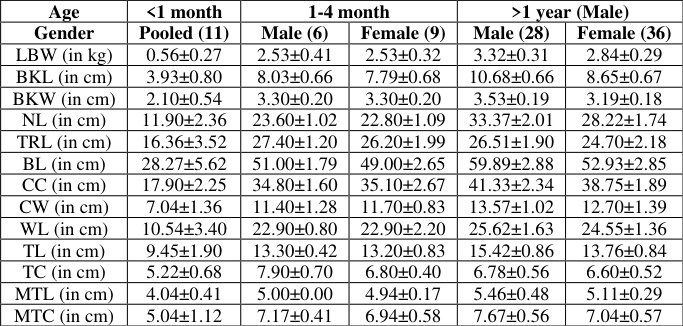 Table 1
Introduction
Domestic geese (Anser anser domesticus) are known for its high growth rate, free range grazing, disease resistance (NRC, 1991) [9] and high quality meat (Romanov, 1999) [10]. Since, geese are grass foragers and weeders it is suitable for farming in wetlands. Geese farming will give additional income besides its protein rich meat. The practice of geese farming in India, particularly in Tamil Nadu is very much limited even in available wetland areas.
The reasons may be due to lack of awareness about geese varieties, feeding, breeding and marketing. Hence, scientific literatures on geese husbandry, research and development in India and in Tamil Nadu are scanty. The available literatures are on the status, growth and production of domestic geese in Kashmir valley (Hamadini, H. et al., 2013, 2014a, 2014b, 2020) [2], [3], [4], [5]; characterization and performance evaluation of indigenous geese in Assam (Hoque, H. et al., 2023) [7]; growth and hatch performance of geese in hilly terrain of Nilgiris (Kumar, A. et al., 2015) [8]; In India, the only recognized and registered geese breed is Kashmir Anz (Verma, et al. 2017) [13]. Characterization of any new population and its recognition requires extensive data on various aspects viz. morphology and molecular levels.
The present investigation was focused to document the morphological traits of farmbred geese population in Tamil Nadu.
Materials And Methods
Body measurements on beak length (BKL), beak width (BKW), neck length (NL), trunk length (TRL), body length (BL), chest width (CW), chest circumference (CC), wing length (WL), tibial length (TL), tibial circumference (TC), metatarsal length (MTL), metatarsal circumference (MTC) and live body weight (LBW) were recorded on both sexes of 90 geese maintained at Sheep Breeding Research Station (SBRS), Sandynallah, The Nilgiris. The points of measurements were taken as per Szabone Willin (1997) [12]. Recorded data were subjected for appropriate statistical analysis (Harvey, W.R., 1990) [6].
Results And Discussion
Live body weight and morphomoetric traits The mean live body weight (pooled gender) of less than one month, 1-4 month and more than one year age were 0.56±0.27 kg, 2.53±0.36 kg and 3.08±0.30 kg, respectively. Kumar, A. et https://www.veterinarypaper.com comparable. All twelve morphological parameters were first time documented in the geese from Tamil Nadu (Table 1). It forms the basic morphometric data useful for further characterization of the geese population in Tamil Nadu. al., (2015) [8] reported the body weight of one month and four month age as 0.61±11.30 kg and 2.68±0.04 kg, respectively.
The differences observed were may be due to the year, season effect. Also, the differences in body weight of similar age groups between these two studies were not remarkable but Table 1: The mean value of different body measurements observed in different age groups. Geese (Anser Anser Domesticus) under Local Conditions of Kashmir, India. Indian Journal of Animal Science. 2014b;84(5):108-109. 5.
Hamadani H, Khan AA, Banday MT. Kashmir Anz geese breed. World's Poultry Science Journal; c2020. DOI: 10.1080/00439339.2020.1711293. 6.
Harvey WR. Mixed Model Least-squares and Maximum Likelihood Computer Programme. PC–2 version. Columbus: Ohio State University; c1990. 7.
Hoque H, Phookan A, Goswami RN, Kalita D, Das B, Das A, Khanikar D. Characterization and performance evaluation of indigenous geese of Assam. Indian Journal of Animal Sciences. 2023;93(2):62-66. 8. Kumar RA, Iyue M, Venkataramanan R.
Growth and hatch performance of geese in Hilly Terrain of Nilgiris. In: Proceedings of IV World Waterfowl Conference. Thrissur, India; c2009 Nov 11-13. p. 115-123. 9. National Research Council (NRC).
Micro-Livestock: Little Known Small Animals with Promising Economic Future. Washington: National Academy Press; c1991. 10. Romanov MN. Goose production efficiency as influenced by genotype, nutrition and production system.
World Poultry Science Journal. 1999;55:281-294. 11. Saatci M, Tilki M. Zoometrical body measurements and their relation with live weight in native Turkish geese. Turk J Vet Anim Sci. 2007;31(1):47-53. 12.
Szabone Willin E. Changing of body measurements and the correlation of these withy body weight from 0-16 weeks of age in geese. Allattenyesztes es Takarmanyozas. 1997;46:409-414. 13. Verma NK, Sharma R, Ahlawat S.
ICAR-NBAGR Newsletter (April-September, 2017). Karnal: ICAR- National Bureau of Animal Genetic Resources; c2017. Age <1 month 1-4 month >1 year (Male) Gender Pooled (11) Male (6) Female (9) Male (28) Female (36) LBW (in kg) 0.56±0.27 2.53±0.41 2.53±0.32 3.32±0.31 2.84±0.29 BKL (in cm) 3.93±0.80 8.03±0.66 7.79±0.68 10.68±0.66 8.65±0.67 BKW (in cm) 2.10±0.54 3.30±0.20 3.30±0.20 3.53±0.19 3.19±0.18 NL (in cm) 11.90±2.36 23.60±1.02 22.80±1.09 33.37±2.01 28.22±1.74 TRL (in cm) 16.36±3.52 27.40±1.20 26.20±1.99 26.51±1.90 24.70±2.18 BL (in cm) 28.27±5.62 51.00±1.79 49.00±2.65 59.89±2.88 52.93±2.85 CC (in cm) 17.90±2.25 34.80±1.60 35.10±2.67 41.33±2.34 38.75±1.89 CW (in cm) 7.04±1.36 11.40±1.28 11.70±0.83 13.57±1.02 12.70±1.39 WL (in cm) 10.54±3.40 22.90±0.80 22.90±2.20 25.62±1.63 24.55±1.36 TL (in cm) 9.45±1.90 13.30±0.42 13.20±0.83 15.42±0.86 13.76±0.84 TC (in cm) 5.22±0.68 7.90±0.70 6.80±0.40 6.78±0.56 6.60±0.52 MTL (in cm) 4.04±0.41 5.00±0.00 4.94±0.17 5.46±0.48 5.11±0.29 MTC (in cm) 5.04±1.12 7.17±0.41 6.94±0.58 7.67±0.56 7.04±0.57 Phenotypic correlations Live body weight of a goose is determined by size and density of organs at a given age (Brody, 1945 and Saatci, M., et al. 2007) [1], [11]. At the age of less than one month, BKL, CC and BL had significant correlation of 0.884, 0.747 and 0.693 with LBW respectively.
It may be due to juvenile stage of development of neck, wing, leg, chest and internal organs. Hence, LBW of gosling is primarily determined by hardy beak along with BL. As the bird grows all body parts including neck, wing, leg, chest, internal organs also increase both in size and density. This upward trend continues till bird reaches adult stage of around one year.
Present study supported this by revealing significant correlation between almost all body measurements and LBW. Indeed, CW, NL, WL and BL showed correlation of 0.985, 0.974, 0.971 and 0.959 with LBW respectively during 1-4 month of age. Expectedly, CC, BL and NL showed high correlation of 0.864, 0.771 and 0.701 with LBW in adult birds. The consistent relationship of BL, NL, CW and CC with LBW in both grower and adult stage is noteworthy.
Conclusion
The geese variety in Tamil Nadu was studied for its morphometric traits for the first time to generate the basic data that can be used for further characterization of the population which was very much needed. The body weights of the geese at different ages were showed high correlations with BL, NL, CW and CC.
Acknowledgement
The data collected from the Sheep Breeding Research Station, Sandynallah, The Nilgiris is highly acknowledged.
References
4 in the original paper- Brody S. Bioenergetics and Growth. New York: Reinhold Publication Corporation; c1945.
- Hamadani H, Khan AA, Mir MS, Ganai TAS, Banday MT, Hamadani A. Status of Domestic Geese (Anser Anser Domesticus) in Kashmir. SKUAST Journal of Research. 2013;15(1):1-6.
- Hamadani H, Khan AA, Mir MS, Banday MT, Ganai TAS, Hamadani A. Morphometric characterization of Local Geese in the Valley of Kashmir. Indian Journal of Animal Science. 2014a;84(9):978-981.
- Hamadani H, Khan AA, Ganai TAS, Banday MT, How to Cite This Article Jagadeesan K. Study of morphometric traits in farmbred geese population. International Journal of Veterinary Sciences and Animal Husbandry. 2024;SP-9(4):30-31. Creative Commons (CC) License This is an open access journal, and articles are distributed under the terms of the Creative Commons Attribution-NonCommercial- ShareAlike 4.0 International (CC BY-NC-SA 4.0) License, which allows others to remix, tweak, and build upon the work non- commercially, as long as appropriate credit is given and the new creations are licensed under the identical terms. Hamadani A. Growth and Production Traits of Domestic