
Research article · 2024 · Full text
International Journal of Veterinary Sciences and Animal HusbandryEvaluating the influence of varying milk fat levels on paneer production efficiency
Volume 9(4S) · Pages 61–63 · DOI: 10.22271/veterinary.2024.v9.i4sb.1541 ↗
Research areasLivestock Management and Performance ImprovementAgricultural Systems and PracticesAgricultural Economics and Practices
Abstract
Author-writtenThe present investigation entitled “Study on the effect of fat levels on the quality of paneer” was carried out in the department of Animal Husbandry & Dairying, R.B.S. College, Bichpuri, Agra. The variables involved in this study viz. Fat levels (%) of Milk 3.0, 4.5 and 6.0), thus in all 9 sample were compared in Compleat Randomised Design (C.R.D.) with 3 replications. There were the following conclusions drawn from the study Milk with 6.0% fat produced best sensory quality paneer which also satisfied all legal requirements regarding chemical composition. Simultaneously, the highest yield of paneer was also obtained at the same fat content of milk. Although milk with other fat levels also produced paneer of acceptable sensory quality but they failed to fulfill the legal standard regarding fat content in paneer. So, milk of 6.0% fat is being finally recommended for commercial production of paneer.
Summary
Source-checkedPlain-language reading of the full paper, prepared with AI and checked against the text. Each point links to the authors' own words.
Why it matters
- Paneer is an effective method for preserving milk solids in a highly concentrated form for a period of 2 to 3 days. View evidence ↗
- Paneer is highly nutritious, providing essential amino acids for vegetarians, fat-soluble vitamins A and D, and essential fatty acids. View evidence ↗
- Due to its composition, paneer is recommended for individuals with diabetes or lactose intolerance. View evidence ↗
The question
- The study aimed to investigate how different levels of fat in milk affect the overall quality of the produced paneer. View evidence ↗
What they did
- The researchers used a Complete Randomised Design (C.R.D.) with three replications to compare milk fat levels of 3.0%, 4.5%, and 6.0%. View evidence ↗
- The milk used for paneer production was a 50:50 mixture of cow and buffalo milk collected from a farmer in Laramda village. View evidence ↗
- The study measured paneer yield, the recovery of total solids, and sensory attributes including flavor, body, texture, color, appearance, and overall acceptability. View evidence ↗
What they found
- Paneer yield increased with milk fat content, with the 6.0% fat milk producing the highest average yield (22.86%) compared to the lowest from 3.0% fat milk (18.34%). View evidence ↗
- The recovery of total solids was highest (64.60%) in paneer made from 6.0% fat milk and lowest (59.91%) in paneer from 3.0% fat milk. View evidence ↗
- There was an inverse relationship between milk fat and moisture content; 3.0% fat milk produced the highest moisture (60.79%) and 6.0% fat milk the lowest (57.62%). View evidence ↗
- The fat content of the final paneer increased with the fat level of the milk, ranging from 16.43% for 3.0% fat milk to 22.60% for 6.0% fat milk. View evidence ↗
- Protein content in paneer decreased as milk fat increased, with 3.0% fat milk yielding the highest protein (15.72%) and 6.0% fat milk the lowest (13.97%). View evidence ↗
What it means
- The authors concluded that milk with 6.0% fat is optimal because it produces the highest yield and best sensory quality while meeting all legal chemical requirements. View evidence ↗
- The study recommends using milk with 6.0% fat for the commercial production of paneer. View evidence ↗
Visual summary
3 visualsIllustrations explain the paper; charts are replotted from the paper's own table values.
Positive Correlation of Milk Fat on Paneer Quality
AI-generated conceptual illustration (cow milk and paneer cheese blocks). It explains the idea and does not show study data.
View source evidence ↗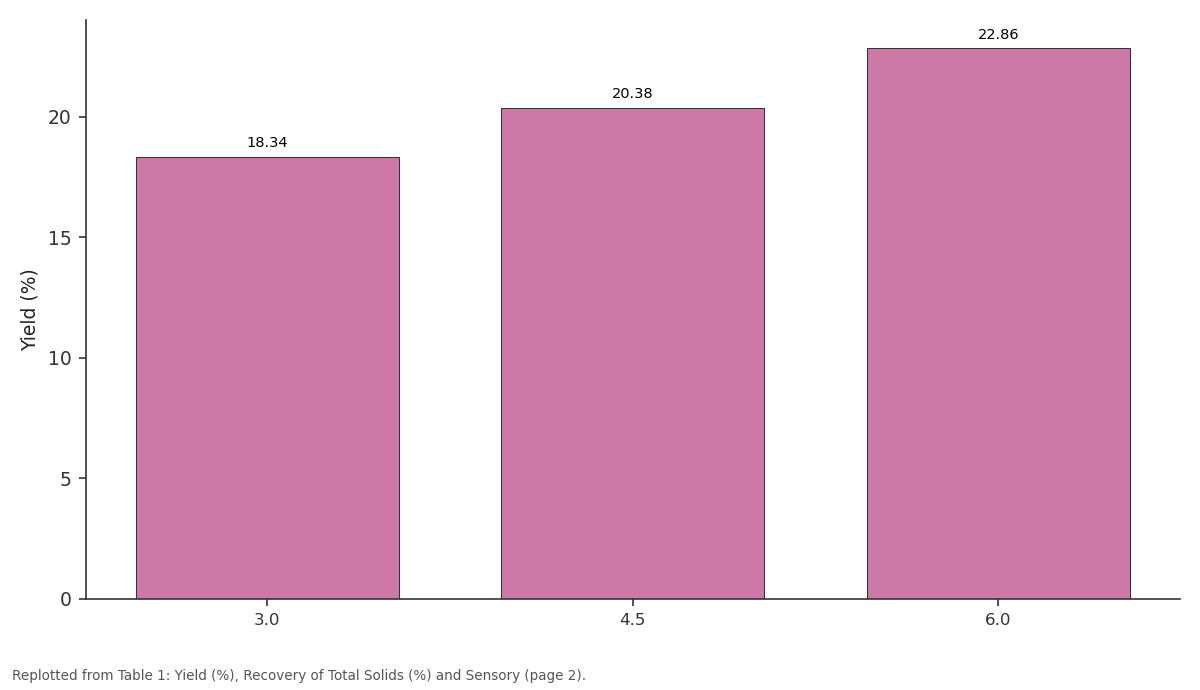
Average: 3.0 vs 4.5 vs 6.0
Replotted from Table 1 (page 2) of the original paper. Every bar is the paper's own table value.
View source evidence ↗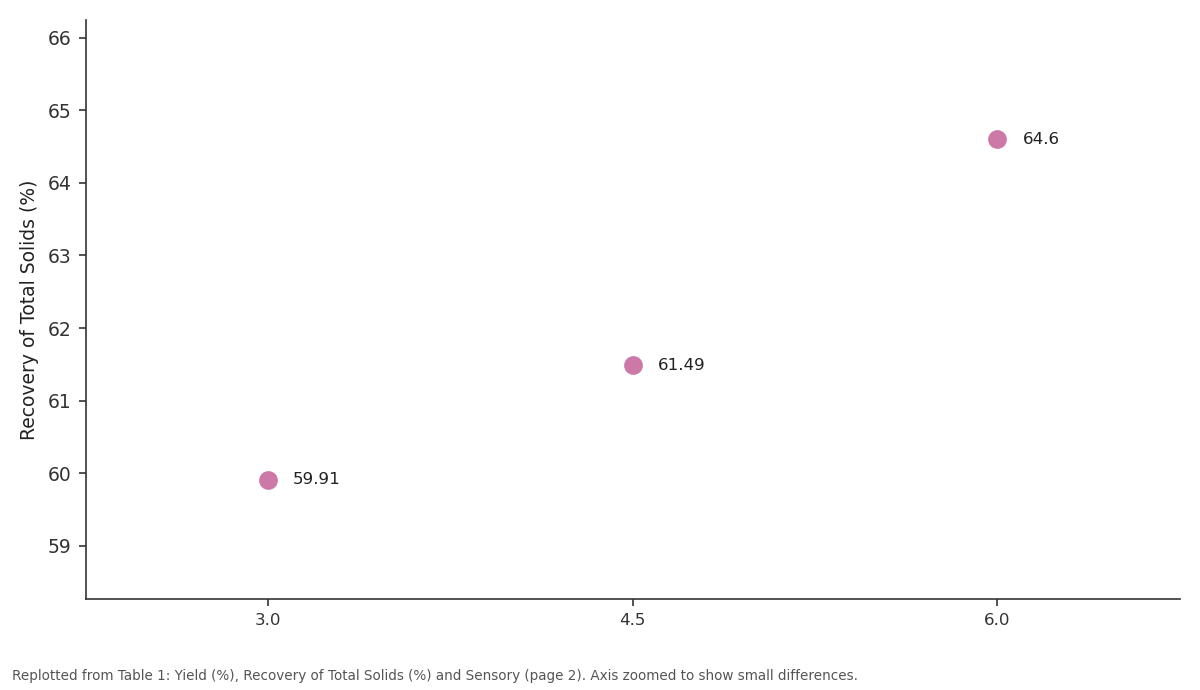
Average: 3.0 vs 4.5 vs 6.0
Replotted from Table 1 (page 2) of the original paper. Every bar is the paper's own table value.
View source evidence ↗Figures & tables
From the original paper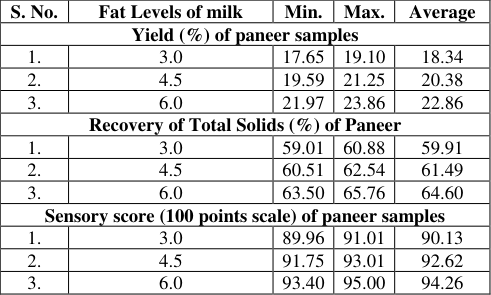 Table 1
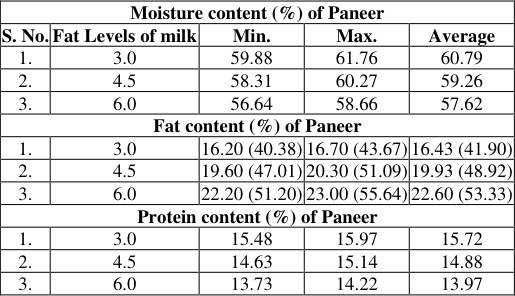 Table 2
Introduction
Paneer is a coagulate indigenous milk product obtained by heating acidulation followed by filtration and pressing. It is similar to unripened cheese because both products contain same milk solids. Good quality paneer is characterized by its acidic flavour with slight sweet taste form and compact body and smooth texture. According to F.O.A., India's milk production has increased from 17 million tones in 1950-51 to around 230.58 million tonnes in 2022-23 registered a growth of 22.81%. The per capita availability of milk has reached to 444 gm / day in year 2021-22. A large quantity of milk produced in country amounting around 50 percent is being converted into various milk products such as khoa, chhena, paneer, dahi, ghee, shrikhand etc. West Bangal produces maximum quantity of chhana and paneer followed by Uttar Pradesh and Maharastra. (Verma et al. 2022) [11] Among all the processes of preservation of milk solids possible under out climatic condition. Paneer provides one of the best method of conserving and preserving milk solids in highly concentrated form for about 2-3 days. Paneer contains entire milk casein, some part of denatured whey proteins, almost all fat and colloidal salts and lactose in proportion to the moisture retained in the product. About 90% per cent of fat and protein, 50% of ash and 10 per cent of lactose of milk are retained into paneer. The sugar content of paneer is low as most of it is drained with the whey. The general composition of paneer is as moisture 52-54 percent, fat 24-28 percent, protein 16-19 percent, lactose 2.0-2.2 percent and ash 2.0-2.3 percent. (Vishwesjwaraiah, et al. 1985) [12] Paneer is an ideal food for mothers, infants, growing children, young and adults. It is highly nutritious and whole some product. It is an excellent source of all the essential amino acids to the vegetarian. The presence of paneer in diet provides fat soluble Vitamins 'A' and 'D', essential fatty acids (linolnic and archidonic) and energy with its high protein and low lactose content. It gives about 400 calories/ 100 gm energy and is both palatable and highly digestible. It is highly recommended to diabetic patients. It also has particular value for those who possess the problem of lactose intolerance but not suitable for the persons who suffer from heart disease or hypertension or renal problem because it is rich in fat and protein. Paneer is mainly used for preparation of some very popular vegetable dished viz. paneer, Karahi Paneer, palak paneer, paneer pakora, Sahi paneer etc. (Chandan, et al. 1987) [3]
Materials and Methods
The present investigation entitled "Study on the effect of fat levels on the quality of paneer" was carried out in the department of Animal Husbandry & Dairying, R.B.S. College, Bichpuri, Agra. The variables involved in this study viz. Fat levels (%) of Milk 3.0, 4. Recovery of Total Solids: First, TS content present in used quantity of milk was calculated. Then TS content present in paneer made was mathematically computed. Second value was divided by previous one and multiplied by 100. Sensory Evaluation: The sensory quality of paneer samples was evaluated by a panel of judges drawn from the department of A.H. & Dairying to provide specific comments in both desirable and undesirable organoleptic properties quantitatively on 100 points arbitrary scale as described by Patil and Gupta (1986) [9] with certain modifications. The following attributes of quality were considered in sensory evaluation. Flavour (45 Texture and consistency (35), Colours and appearance (15) and Overall acceptability (100)
Collection of Milk
Fresh and good quality milk of cow and buffalo milk was collected from a particular farmer of Laramda village and mixed in the ratio of 50:50 for the purpose of paneer making.
Analysis and standardization of milk
First, the analysis of milk was done as per procedures applied for the analysis of paneer with modifications necessary for the purpose. Then, milk was standardized to 3.0, 4.5 and 6.0% milk fat with an SNF level of 9.0% by adding fresh potable water. The additional requirement of SNF content was made up through spray dried skim milk powder.
Results and Discussion
The paneer samples prepared in the laboratory of Department of A.H. & Dairying R.B.S. College, Bichpuri, Agra during the investigation entitled "Study on the effect of fat levels on the quality of paneer". were subjected for sensory evaluation and chemical analysis. Thereafter, data were converted into recovery of total solids in paneer. The yield (%) was also reported. The data thus obtained were statistically analysed using CRD and tested at 5% level of significance.
Preparation of Paneer
The manufacture of paneer was done according to the procedure adopted by Sachdeva (1985) [10] with some modifications. 2.5 Kg of milk was heated to 85 0 C for 5 minutes. The milk was slowly stirred by stainless steel to prevent the burning and skin formation during heating. The vessel with heated milk was then removed from the fire and the milk was cooled to required temperatures (80 0 C). The coagulant (2% lactic acid) was then added slowly to milk with constant stirring till complete coagulation was obtained and whey became yellowish green in colour. Then the coagulum was strained through a muslin cloth. During this period, the temperature of whey was not allowed to fall below 70 0 C.The coagulum thus collected was tied in the muslin cloth and then pressed for 30 minutes by applying a suitable pressure on the top.
The yield of paneer was calculated on milk basis and represented as percent. It is mainly depends upon the composition of milk, processing parameters, recovery of TS and amount of whey drained. The data presented in the table 1 indicated that the average yield percent was increased with the increase in fat content of milk used. The highest average yield (22.86%) was observed in case of paneer samples prepared from milk having 6.0% fat. The samples prepared from milk testing 3.0% fat obtained on an average 18.34% (lowest) yield. Similar trends in yield of paneer had also been reported by Chauhan et al. (2017) [4] .
| S. No. | Fat Levels of milk | Min. | Max. | Average |
|---|---|---|---|---|
| Yield (%) of paneer samples | ||||
| 1. | 3.0 | 17.65 | 19.10 | 18.34 |
| 2. | 4.5 | 19.59 | 21.25 | 20.38 |
| 3. | 6.0 | 21.97 | 23.86 | 22.86 |
| Recovery of Total Solids (%) of Paneer | ||||
| 1. | 3.0 | 59.01 | 60.88 | 59.91 |
| 2. | 4.5 | 60.51 | 62.54 | 61.49 |
| 3. | 6.0 | 63.50 | 65.76 | 64.60 |
| Sensory score (100 points scale) of paneer samples | ||||
| 1. | 3.0 | 89.96 | 91.01 | 90.13 |
| 2. | 4.5 | 91.75 | 93.01 | 92.62 |
| 3. | 6.0 | 93.40 | 95.00 | 94.26 |
Table text extracted from the original PDF; superscript letters are shown inline. The original table image is below.
View original table image
It was mathematically calculated using the data on the TS content of milk and finished product. The data presented in the table-1 indicated that average recovery of total solids in paneer was increased with the increase in fat content of milk used. The highest average recovery of total solid (64.60%) was observed in case of paneer samples prepared from milk having 6.0% fat. The samples prepared from milk testing 3.0% fat exhibited on an average 59.91% (lowest) recovery of total solid in paneer. Similar trends in recovery of solids in paneer had also been reported by Chawla et al. (1985) [5] . The hike in recovery of total solids with increasing fat levels in milk might be attributed to the increase in fat-protein complexes during heating of milk [7] and Chauhan et al. (2017) [4] also reported similar results in this regard.
The data presented in the table 4A indicated that average moisture content in paneer was decreased with the increase in fat content of milk used. The highest average moisture content (60.79%) was observed in case of paneer samples prepared from milk having 3.0% fat. The samples prepared from milk testing 6.0% fat exhibited on an average 57.62% (lowest) moisture in paneer. Similar trends in moisture content of paneer had also been reported by Chawla et al. (1987) [6] . Thus it is apparent from the results that there was a inverse relationship between moisture content of paneer and fat levels in milk. The reason could be hydrophobic nature of fat which reduces the moisture content of paneer made from milk with rather higher fat content. All paneer samples had conformed the legal specification in this regard. Values in the parenthesis are fat on dry matter basis (Chauhan, et al.2017) [4]
Figures and tables from the paper
| Moisture content (%) of Paneer | — | — | — | — |
|---|---|---|---|---|
| S. No. | Fat Levels of milk | Min. | Max. | Average |
| 1. | 3.0 | 59.88 | 61.76 | 60.79 |
| 2. | 4.5 | 58.31 | 60.27 | 59.26 |
| 3. | 6.0 | 56.64 | 58.66 | 57.62 |
| Fat content (%) of Paneer | ||||
| 1. | 3.0 | 16.20 (40.38) | 16.70 (43.67) | 16.43 (41.90) |
| 2. | 4.5 | 19.60 (47.01) | 20.30 (51.09) | 19.93 (48.92) |
| 3. | 6.0 | 22.20 (51.20) | 23.00 (55.64) | 22.60 (53.33) |
| Protein content (%) of Paneer | ||||
| 1. | 3.0 | 15.48 | 15.97 | 15.72 |
| 2. | 4.5 | 14.63 | 15.14 | 14.88 |
| 3. | 6.0 | 13.73 | 14.22 | 13.97 |
Table text extracted from the original PDF; superscript letters are shown inline. The original table image is below.
View original table image
References
11 in the original paper- Bhadekar SV, Deshmukh BR, Baswade SV, Mule RS, Gatchearle PL. Sensory evaluation and overall acceptability of paneer from buffalo milk added with sago powder. J Dairying Foods H S. 2008;27(2):99-103.
- Chandan RC, Marin H, Nakrani KR, Zehmer MD. Production and consumer acceptance of Latin American white cheese. J Dairy Sci. 1979;62:691-696.
- Chauhan SK, Kumar R, Singh VP, Singh KP. Effect of fat levels of milk on yield and quality of paneer. J Rural Agric Res. 2017;17(1):62-64.
- Chawla AK, Singh S, Kanawjia SK. Effect of fat levels, additives, and process modification on composition and quality of paneer and whey. Asian J Dairy Res. 1985;6(2):87-92.
- Chawla AK, Singh S, Kanawjia SK. Effect of fat levels, additives, and process modifications on composition and quality of paneer and whey. Asian Dairy Res. 1987;6(2):87.
- Kumar R. Effects of fat levels of milk on the yield, recovery of solids and sensory attributes of Bhadawari buffalo milk paneer. Shrinkhla Ek Shodhparak Vaicharik Patrika. 2021;9(1):17-19.
- Pal MA, Yadav PL, Sanyal MK. Physical-chemical and sensory characteristics of low fat paneer from high heated milk. Indian J Dairy Sci. 1991;44(7):437-441.
- Patil GR, Gupta SK. Some aspect of sensory evaluation of paneer. Indian Dairyman. 1986;38(3):135.
- Sachdeva S, Singh S, Kanawjia SK. Recent development in paneer technology. Indian Dairyman. 1985;37(11):501-505.
- Verma T, Aggarwal A, Tripathi AD, Rai DC, Jaspal S. Preservation approaches for milk and milk products: A review. Indian J Dairy Sci. 2022;75(5):395-401.
- Vishwesjwaraiah L, Anantakrishnan CP. Studies on technological aspects of preparing paneer from cow's milk. Asian J Dairy Res. 1985;4(3):171-176.