
Research article · 2024 · Full text
International Journal of Veterinary Sciences and Animal HusbandryStudies on managemental practices on cattle in Bharatpur district of Rajasthan
Volume 9(4) · Pages 265–268 · DOI: 10.22271/veterinary.2024.v9.i4e.1553 ↗
Research areasLivestock Management and Performance ImprovementAgricultural Economics and PracticesAgricultural Systems and Practices
Abstract
Author-writtenIndia, renowned for its extensive agricultural heritage, ranks second globally in terms of dairy cow population but fifth in cow milk production, indicating inefficiencies in dairy management practices. This study investigates in title
Summary
Source-checkedPlain-language reading of the full paper, prepared with AI and checked against the text. Each point links to the authors' own words.
Why it matters
- India has the world's second-largest dairy cow population but only the fifth-highest milk production, which suggests that dairy management practices are inefficient. View evidence ↗
- Improving milk production depends not only on the genetics of the cattle but also on the precise application of management programs. View evidence ↗
- In the Bharatpur district, dairy farming is mostly done by small and marginal farmers who often use agricultural by-products for feed due to limited access to commercial feed and high-quality fodder. View evidence ↗
The question
- The study aimed to examine the current housing and feeding practices used for cattle in rural Bharatpur district. View evidence ↗
- The research also sought to identify the specific constraints, whether economic, infrastructural, educational, or socio-cultural, that hinder effective cattle management. View evidence ↗
What they did
- The study was conducted across eight villages total, with four villages each in the Kumher and Deeg blocks of the Bharatpur district in Rajasthan. View evidence ↗
- Researchers used a mixed-methods approach, collecting data through direct observation, interviews with farmers, and field surveys. View evidence ↗
- The data collection for the study took place in July 2022. View evidence ↗
What they found
- Cattle numbers were similar across blocks: Kumher had 50 male calves, 103 female calves, and 37 bulls, while Deeg had 50 male calves, 96 female calves, and 38 bulls. View evidence ↗
- Both blocks showed a higher population of female calves than male calves or bulls, indicating a strategic focus on increasing milk production. View evidence ↗
- Housing varied by block: Kumher had 20 cattle in open, 6 in closed, and 30 under-tree housing; Deeg had 18 in open, 8 in closed, and 24 under-tree housing. View evidence ↗
- Open and under-tree housing are the most common because they are simple and low-cost, fitting the economic limitations of small-scale farmers. View evidence ↗
- Mud floors are most common in Kumher, whereas farmers in Deeg show a slight preference for more structured options like sloped floors with drainage or brick-mud combinations. View evidence ↗
What it means
- The authors conclude that the dairy sector in Bharatpur can be transformed by combining traditional knowledge with modern management practices, financial incentives, and better infrastructure. View evidence ↗
- To promote sustainable farming, the authors recommend improving veterinary services, providing subsidies, and implementing training and awareness programs. View evidence ↗
Visual summary
2 visualsIllustrations explain the paper; charts are replotted from the paper's own table values.
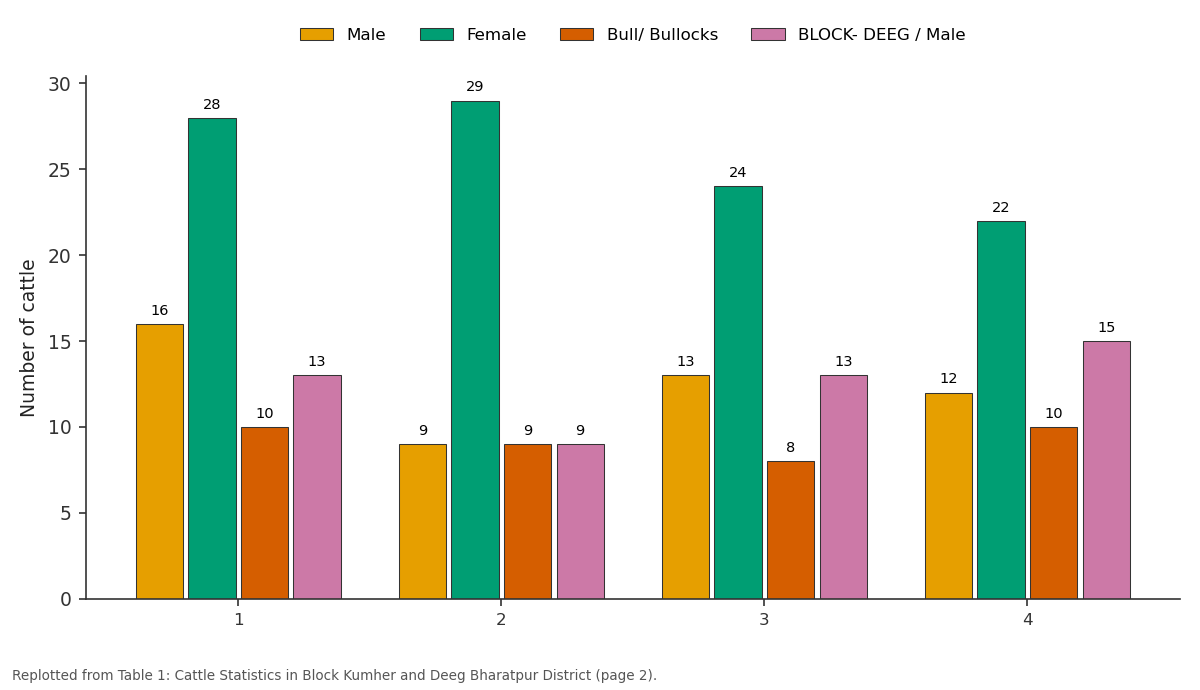
Male and Female and more: 1 vs 2 vs 3 vs 4
Replotted from Table 1 (page 2) of the original paper. Every bar is the paper's own table value.
View source evidence ↗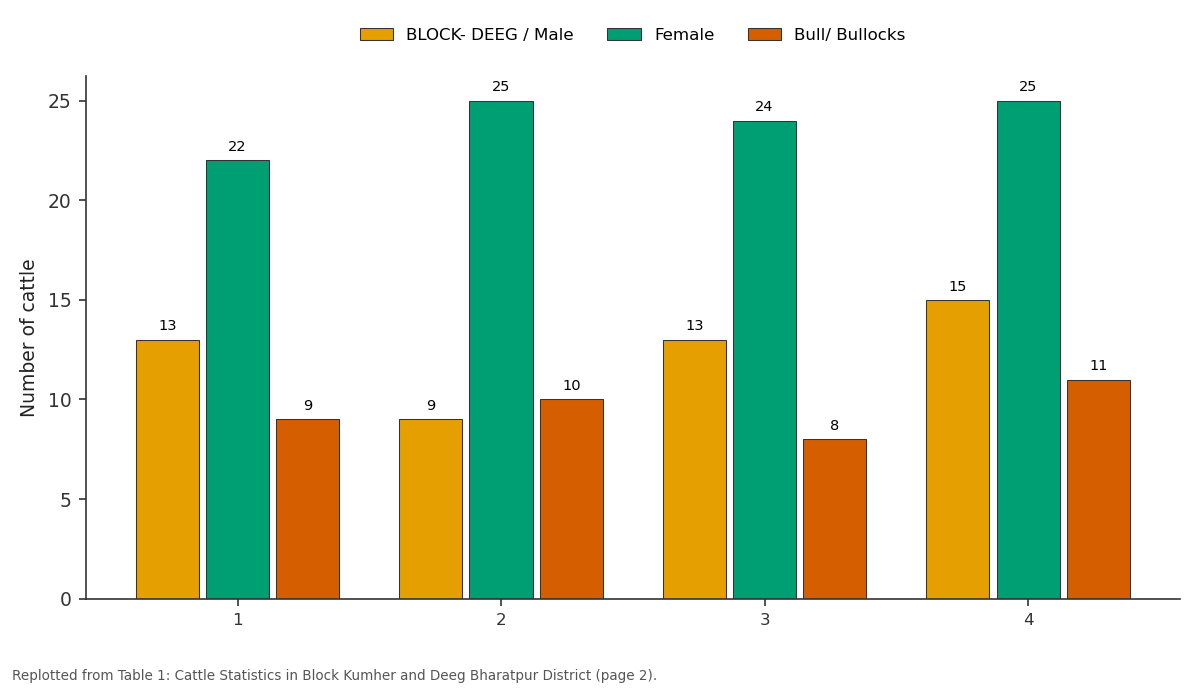
BLOCK- DEEG / Male and Female and more: 1 vs 2 vs 3 vs 4
Replotted from Table 1 (page 2) of the original paper. Every bar is the paper's own table value.
View source evidence ↗Figures & tables
From the original paper Table 1
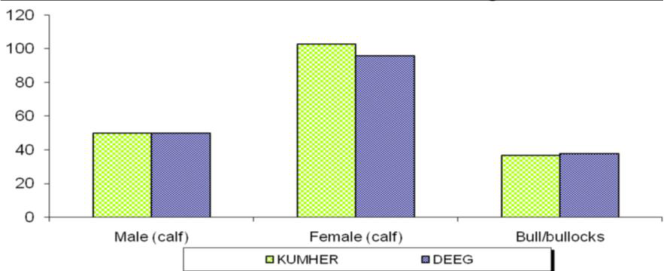 Figure 1
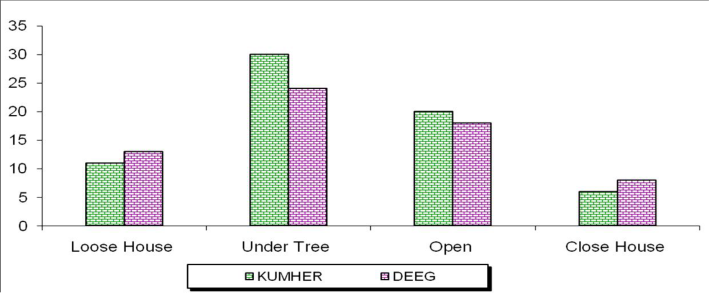 Figure 2
Introduction
India, with its rich agricultural heritage, holds the second position globally in terms of dairy cow population. Despite this impressive statistic, the nation ranks fifth in cow milk production, highlighting a disparity that points to underlying inefficiencies in dairy management practices. The essence of this investigation is to unravel the intricacies of these practices and their impacts, specifically in the Bharatpur district of Rajasthan. The cornerstone of enhanced milk production lies not just in the genetic potential of the cattle but in the meticulous application of management programs. These programs, when implemented with precision, have the potential to significantly boost milk production without necessitating substantial capital investment or advanced skills. Management, therefore, emerges as a pivotal factor in the dairy farming equation, where the timely and careful application of scientific practices can lead to remarkable improvements in herd performance. Indian indigenous cattle, though often criticized for their low milk yield, present a unique set of advantages. Animal husbandry plays a crucial role in driving economic and social change, especially for small and marginal farmers as well as landless agricultural laborers. For these communities, livestock is not just a source of income but also a vital component of their socio-economic fabric. Despite India being the largest milk producer globally, with an output of 82 million tonnes, the productivity per animal remains low. This low productivity is a direct consequence of the aforementioned challenges, underscoring the need for a concerted effort to address these issues through improved management practices. In Bharatpur district, as in many other parts of rural India, dairy farming is predominantly undertaken by small and marginal farmers. These farmers typically rely on agricultural by-products to feed their cattle, given their limited access to high-quality fodder and commercial feed. The adoption of scientific technologies and best practices remains limited, further exacerbating the productivity gap. Effective management practices are thus imperative to bridge this gap and enhance milk production.
Objectives of the Study
The primary objectives of this study are twofold. Firstly, it aims to examine the existing feeding and housing practices in the rural areas of Bharatpur district. This involves a comprehensive analysis of the types of feed used, the feeding schedules, the housing structures, and the overall care provided to the cattle. Secondly, the study seeks to identify the constraints that impede effective cattle management in the region. These constraints could be economic, infrastructural, educational, or socio-cultural in nature. This investigation is driven by two primary objectives: 1. To study the various feeding and housing practices of cattle in the rural areas of Bharatpur district, Rajasthan. 2. To identify the different constraints in the management practices of cattle in the Bharatpur district of Rajasthan.
Materials and Methods
The The methodology adopted for this study is a combination of qualitative and quantitative approaches. Field surveys, interviews with farmers, and direct observation form the crux of the data collection process. The surveys are designed to gather detailed information on feeding practices, housing conditions, and management challenges. Additionally, interviews with local veterinary experts, agricultural extension officers, and other stakeholders provide valuable insights into the broader context of dairy farming in Bharatpur. Quantitative data, such as milk yield, feed intake, and health indicators, are analyzed using statistical tools to identify patterns and correlations. This mixed-methods approach ensures a holistic understanding of the issues at hand, enabling the formulation of targeted recommendations for improvement.
Results and Discussion
The study highlights several key management practices in the Bharatpur district that influence cattle performance. The similarities in cattle statistics, fodder types, and concentrate mixture preparation across both blocks suggest a uniformity in management practices. However, slight variations in housing systems and types of floors used indicate localized preferences and conditions. The involvement of men, women, and children in various tasks reflects the gender roles and family dynamics in these rural areas. The results also emphasize the importance of balanced feeding practices and adequate water provision for maintaining cattle health and productivity.
Cattle Statistics
The data was collected regarding number of cattle their male calves, female calves and number of bull etc. from district Bharatpur of Rajasthan. Results drawn from this study have been presented in Table-1 and its graphical representation with Fig. -1. From the given data it can be seen that cattle maintained in the different villages of the two blocks Bharatpur district were nearly same. The study was conducted in the month of July 2022. The number of cattle producing male and female has not changed materially changed during the study period of August 2022. From Table-1 and Fig.
-l it can be seen observed that the numbers of male calves, females calves and bull /bullocks were nearly same in the villages of both the blocks of Kumher and Deeg. The number of male calves, female calves and bull /bullock number in two blocks were 50, 103 and 37 and 50, 96 and 38 respectively. This results is in close agreement with reported by Dass (1983) [3] . Chauhan, et al. (1985) [2] , Bacon, (1983) [1] and Gupta et al. (2008) [4] . The data collected from Bharatpur district reveals that the number of cattle, including male calves, female calves, and bulls, is nearly identical in the blocks of Kumher and Deeg. Specifically, Kumher recorded 50 male calves, 103 female calves, and 37 bulls, while Deeg had 50 male calves, 96 female calves, and 38 bulls. This parity in cattle numbers indicates a consistent distribution of livestock across these blocks, which can be attributed to similar agricultural practices, land availability, and economic conditions. This results is in close agreement with reported by Rao and Naidu (1982) [9] . Mayne, et al. (1986) [6] and Petersen and Dallum (1984) [8] .
Gender Distribution in Cattle
The gender distribution among the cattle in both blocks shows a higher number of female calves compared to male calves and bulls. This trend is essential for understanding the future productivity potential of the herds. Female calves are primarily raised for milk production, making them more valuable in the long term. The slightly higher number of female calves in Kumher suggests a focus on enhancing dairy production capabilities in this block. The higher number of female calves is indicative of a strategic approach to maximize milk production, which is the primary source of income for many dairy farmers in the region. Female calves are nurtured with the intention of expanding the dairy herd, thus ensuring sustained milk production over the years. This trend is aligned with the national focus on improving dairy productivity by increasing the population of high-yielding cows. This results is in close agreement with reported by Sharma and Singh (2019) [10] .
Housing Systems for Cattle
The housing systems for cattle in Bharatpur vary between the two blocks, reflecting local preferences and available resources. In Kumher, cattle are housed in three primary systems: open, closed, and under-tree. The numbers recorded were 20 cattle in open housing, 6 in closed housing, and 30 under trees. In Deeg, the figures were 18, 8, and 24, respectively. The prevalence of open and under-tree housing systems indicates a reliance on natural and cost-effective solutions for cattle shelter. These systems are preferred due to their simplicity and minimal construction costs, which align with the economic constraints of small and marginal farmers.
The preference for open and under-tree housing systems is rooted in the traditional practices of the region. These systems allow cattle to roam freely, which is believed to contribute to their overall well-being. However, such housing arrangements also expose the cattle to harsh weather conditions and potential predators, which can impact their health and productivity. There is a need to balance traditional practices with modern housing solutions to ensure the safety and health of the cattle. This results is in close agreement with reported by Yadav and Gupta (1983) [12] . Yadav and Gupta (1985) [13] .
Conclusion
This study provides a comprehensive analysis of cattle management practices in the Bharatpur district of Rajasthan, focusing on the blocks of Kumher and Deeg. The data reveals a consistent cattle population across both blocks, highlighting uniformity in breeding practices and overall cattle management. The slightly higher number of female calves suggests a strategic focus on increasing dairy production, which is vital for the economic stability of the region's farmers. The study underscores the importance of balanced feeding practices, adequate water provision, and regular health management in enhancing cattle productivity.
Variations in housing systems and floor types reflect local adaptations to economic constraints and available resources. Enhancing veterinary services, conducting awareness and training programs, providing financial support and subsidies, and improving infrastructure can address these challenges and promote sustainable dairy farming. The economic impact of adopting effective management practices is evident, with higher milk yields and better cattle health leading to increased income and improved livelihoods for farmers. Social and cultural factors also play a crucial role, with cattle management practices deeply ingrained in the community's traditions and values. In conclusion, integrating modern cattle management practices with traditional knowledge, supported by robust infrastructure and financial incentives, can transform the dairy sector in Bharatpur. This integration will ensure sustainable growth, improved productivity, and economic prosperity for the region's farmers, contributing to the broader goal of enhancing India's dairy industry.
Figures and tables from the paper
| — | BLOCK – KUMHER | — | — | — | BLOCK- DEEG | — | — |
|---|---|---|---|---|---|---|---|
| No. of Villages | No. of House Holds | Male | Female | Bull/ Bullocks | Male | Female | Bull/ Bullocks |
| 1 | 10 | 16 | 28 | 10 | 13 | 22 | 9 |
| 2 | 10 | 09 | 29 | 9 | 09 | 25 | 10 |
| 3 | 10 | 13 | 24 | 8 | 13 | 24 | 08 |
| 4 | 10 | 12 | 22 | 10 | 15 | 25 | 11 |
| Total | 40 | 50 | 103 | 37 | 50 | 96 | 38 |
Table text extracted from the original PDF; superscript letters are shown inline. The original table image is below.
View original table image
References
12 in the original paper- Bacon R. Effect of feeding different levels of green forages on feeding cost for milk production in buffaloes. Livest Advisor. 1983;7(4):11-16.
- Chauhan et al. Effect of different housing systems on the production of buffaloes during summer. Indian J Dairy Sci. 1985;38(4):245-249.
- Dass RS. Studies on growth of buffalo calves fed on milk and milk replacer. Indian Vet Med J. 1983;7(3):148-152.
- Gupta DC, Suresh A, Mann JS. Management practices and productivity status of cattle and buffaloes in Rajasthan. Indian J Anim Sci. 2008;78(7):769-774.
- Kovaces et al. Effect of feeding total mixed rations on the performance of buffalo calves. Indian J Anim Nutr. 2005;7:1-4.
- Meena ML, Soni R, Soni RK, Jat H, Singh V. Dietary crude protein (DCP) and dry matter management for ensuring growth and development of goats in Rajasthan. The Pharma Innovation J. 2023;SP-12(8):48648-8.
- Petersen PH, Dallum AS. Effect of housing and feeding systems on the production of Murrah buffaloes during the rainy season. Haryana Agric Univ J Res. 1984;13(4):497504.
- Rao RM, Naidu KN. Effect of feeding different levels of green forages on feeding cost for milk production in buffaloes. Livest Advisor. 1982;7(4):11-16.
- Sharma P, Singh K. Shelter slaking behaviour of dairy cattle in various types of housing systems. Indian J Anim Sci. 2019;72(1):91-95.
- Tripathi VN, Gupta LR. Effect of various roughage and concentrate rations on nutrient digestibility and milk production in buffaloes. Asian J Dairy Res. 1982;1(2):1340.
- Yadav BL, Gupta LR. Effect of housing and feeding systems on the production of Murrah buffaloes during the rainy season. Haryana Agric Univ J Res. 1983;13(4):497504.
- Yadav JL, Gupta LR. Effect of different housing systems on the production of buffaloes during summer. Indian J Dairy Sci. 1985;38(4):245-249.