
Research article · 2024 · Full text
International Journal of Agriculture Extension and Social DevelopmentRole of technology adoption on summer marigold (Variety-Seracole) production through front line demonstration in the Nagaon district of Assam
Volume 7(7S) · Pages 189–191 · DOI: 10.33545/26180723.2024.v7.i7sc.843 ↗
Research areasFlowering Plant Growth and Cultivation
Abstract
Author-writtenA field trial was conducted with African marigold variety Seracole during 2nd week of March, 2019–20 and 2020–21 as summer planting in Matikhola, Lokhonabondha and Bengennati villages of Nagaon district of Assam with the objective of popularizing summer marigold (variety - Seracole) among the farmers through a Front Line Demonstration (FLD). Front Line Demonstration is an appropriate tool to demonstrate recommended technologies among the farmers under the close supervision of scientist. October planted winter marigolds were grown as control. The data were collected on growth and yield parameters and economic indicators. The results showed that the winter marigold had an average flower weight of 6.73 gm, shelf life of 12.53 days and the yield was 234.20 q ha-1 which was closely followed by summer marigold with average flower weight of 5.82 gm, shelf life of 11.15 days and the yield was 199.92 q ha-1 respectively with good compact flowering. It is obvious from the study that variety Seracole have good economic potential so farmers may grow both as summer and winter varieties. However, summer marigold gave higher profit compared to winter marigold as it fetched best market price due to summertime scarcity and increased market demand. During the two years of study, summer marigold proved to be more advantageous than winter planting in terms of both B.C. ratio 4.34 and high net return Rs.538317.00 ha-1.
Summary
Source-checkedPlain-language reading of the full paper, prepared with AI and checked against the text. Each point links to the authors' own words.
Why it matters
- Marigolds are globally and nationally significant commercial flowers used in religious, celebratory, and culinary contexts, accounting for over half of India's loose flower production. View evidence ↗
- Despite year-round demand for flowers for festivals and weddings, marigolds are typically not produced during the summer or kharif seasons. View evidence ↗
- Cultivating marigolds outside the winter season offers a potentially higher income and employment source for farmers compared to traditional crops like rice and legumes. View evidence ↗
The question
- The study aimed to popularize and disseminate the production technology of the African marigold variety Seracole for summer planting among farmers in the Nagaon district of Assam. View evidence ↗
What they did
- Field trials were conducted in three villages of Nagaon, Assam, during 2019–20 and 2020–21, comparing summer plantings (March) with winter plantings (October) as a control. View evidence ↗
- Cuttings with 3–4 leaves were transplanted into 3x2 m² plots at 45x45 cm² spacing, receiving 5 kg m⁻² of FYM and N:P:K fertilizer at 10:10:10 gm⁻². View evidence ↗
- Seedlings were pinched 45 days after transplanting to promote growth, and flowers were harvested weekly to record growth and flowering parameters. View evidence ↗
- The study analyzed growth, yield, cultivation costs, net income, and cost-benefit ratios for both the summer demonstration and winter control plots. View evidence ↗
What they found
- Winter plantings (October) achieved a higher average plant height of 61.03 cm compared to 58.54 cm for summer plantings. View evidence ↗
- Summer plantings exhibited faster flower bud emergence, occurring at 45.02 days after transplanting (DAT) compared to 48.03 DAT for winter plantings. View evidence ↗
- Summer plantings achieved a higher benefit-cost (B:C) ratio of 4.34 compared to 3.22 for winter plantings, driven by higher market prices due to summer scarcity. View evidence ↗
What it means
- The authors conclude that while variety Seracole is viable for both seasons, summer cultivation can potentially double farmer income due to higher market demand. View evidence ↗
- The authors recommend encouraging farmers in the Central Brahmaputra Valley Zone to adopt these production technologies to sustainably increase their livelihoods. View evidence ↗
Visual summary
3 visualsIllustrations explain the paper; charts are replotted from the paper's own table values.
Yield vs. Profit Trade-off
AI-generated conceptual illustration (summer marigold flowers (Variety-Seracole)). It explains the idea and does not show study data.
View source evidence ↗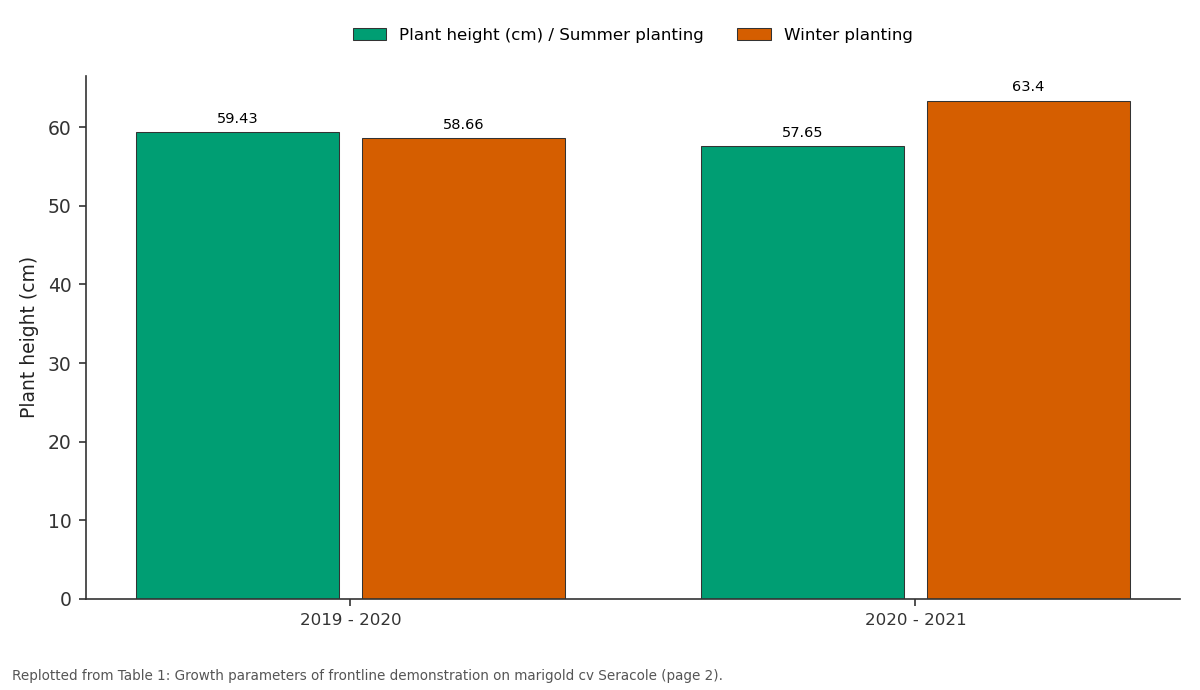
Plant height (cm) / Summer planting and Winter planting: 2019 - 2020 vs 2020 - 2021
Replotted from Table 1 (page 2) of the original paper. Every bar is the paper's own table value.
View source evidence ↗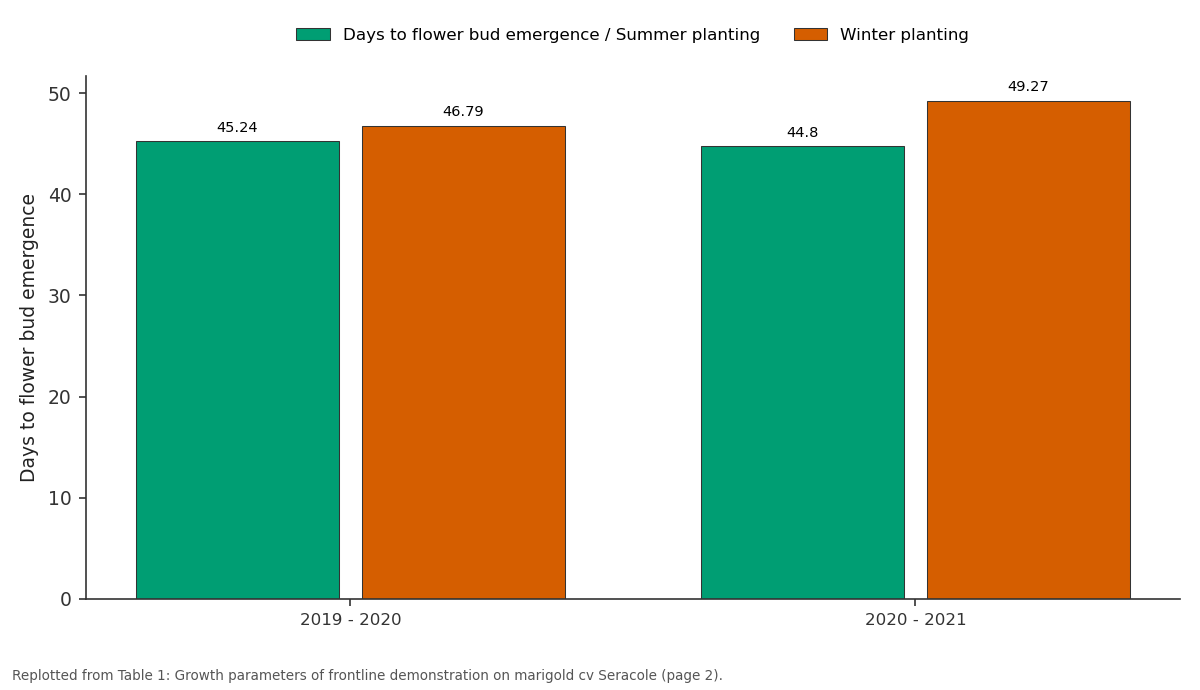
Days to flower bud emergence / Summer... and Winter planting: 2019 - 2020 vs 2020 - 2021
Replotted from Table 1 (page 2) of the original paper. Every bar is the paper's own table value.
View source evidence ↗Figures & tables
From the original paper Table 1
 Table 2
 Table 3
Introduction
Marigold scientifically known as Tagetes erecta L. is a vivid and versatile flower that is frequently appreciated for its endurance beauty and various symbolic meanings. Marigolds are utilized in religious rituals, celebratory decorations, and even culinary endeavors because of their characteristic golden-orange hues. These cheerful blooms come in different varieties and are one of the most important commercially grown flowering plants in the world and in India as well responsible for more than half of the national production of loose flower. This is a native of Central and South America, especially Mexico, from where it spread to different parts of the world during the early 16th century but marigold has been adapted so well to Indian conditions (Gawle et al., 2012) [5] . It comprises 33 species of strongly scented annual and perennial herbs. Mostly cultivated types of marigold include African marigold (Tagetes erecta L., 2n = 24) and French marigold (Tagetes patula L., 2n = 48). Marigold is in great demand as loose flower throughout the year. Easy cultivation, hardy nature and wider adaptability of the crop have increased its popularity (Gulia et al., 2017) [7] . It is one of the important commercial flower crop grown worldwide and is being utilized in traditional medicine as well as for ornamental purpose (Singh et al., 2014) [15] . The adoption of IPM technology in tomato using African marigold as a trap crop with ratio 1:16 rows of tomato is effective to reduce the menace of fruit borer (Gajanana et al., 2006) [4] . Marigold extract has been used commercially as an additive to poultry to increase the yellow colour of egg yolk (Balnave and Bird, 1996) [2] . Marigold is one of the richest sources of natural carotenoids. African Marigold (Tagetes erecta Linn.) and French Marigold (Tagetes patula Linn.) are mainly grown in the winter season. But this crop can be grown as either a perennial or as an annual outside of the winter season, which usually gives a good economic return. Marigold cv Seracole is a day neutral plant with the potential to produce compact, medium-sized, orange-red flowers having a long shelf life. The variety Seracole exhibited maximum for quantitative traits with respect to vegetative, floral, self life, loose flower life and yield characters under agroclimatic condition of Assam. The var. Seracole also exhibited highest carotenoid content 290.50 µg g -1 (Mahanta et al., 2020) [9] . The plant has the capacity to produce flowers all year round, but it does not produce any during the summer or the kharif season, despite the fact that there is an equivalent need for flowers throughout several festivals, including marriages (Maharana et al., 2016) [8] . Flowers are purchased from adjacent states throughout festival and wedding season in order to fulfil the constantly rising demand. In general, farmers in Nagaon District grow rice and legumes to earn a living. In order to motivate farmers to diversify and to offer floriculture as an www.extensionjournal.com additional source of income beyond already established agriculture, marigold cultivation can be an important area of diversification. Growing marigolds outside of the winter season can be a good source of income and employment for both large and small farmers as this crop fetches a higher unit price than rice and legumes. Therefore, this demonstration was undertaken in the farmer's field with an objective to disseminate Summer Marigold var Seracole and its production technology in the operational area of KVK Nagaon, Assam.
Materials and Methods
The study was conducted using observation data and field data on a farmer's field during the Summer 2 nd week of March, and winter season (October) in Matikhola (Hojai) and Lokhonabondha (Koliabor) villages in Nagaon District during the cropping year 2019-20 to 2020-21 in the operational area of the KVK Nagaon carried out to convince farmers of the potential of this Seracole marigold which can be planted in the summer season and whose yields can fetch more income in the off-season. Well rooted terminal cuttings with uniform growth and vigour having 3-4 leaf were transplanted into 3×2 m 2 plots spaced at 45x45 cm 2 apart in the second week of March 2019 to 2021. A light rinse was applied after the transplant. At the time of planting a uniform dose of FYM 5 kg m -2 and the recommended fertilizer rate N:P:K @ 10:10:10 gm -2 was applied. The transplanted seedlings were pinched 45 days after transplanting to encourage vegetative growth. Well matured and fully opened flowers were harvested at weekly intervals and various growth and flowering parameters were recorded by using standard methods. The mean yield data was recorded to assess the effect of FLD intervention marigold yield. Marigold cultivation during the winter season was considered as a control plot in the demonstration cluster. In addition field days and group meetings were organized to provide other farmers the opportunity to experience the benefits of the technologies being demonstrated. The data output were collected from both demonstration and control plots and cultivation costs, net income, and costeffectiveness ratios were also worked out (Samui et al., 2000) [13] reported by (Aklade et al., 2018) [1] .
Results and Discussion
The results obtained from the present study have been discussed under the following heads:
Vegetative parameters
The results revealed that there was a significant difference between the summer and winter planting of marigold cv Seracole in relation to plant height. The average of 2-year data showed that the maximum plant height (61.03 cm) was found in October planting followed by 58.54 cm in the summer planting. As for the branching of marigold cv. Seracole showed primary and secondary branch counts (5.5, 19.45) when planted in October closely followed by summer planting with primary and secondary branch counts of 3.75, 13.99 respectively with compact flowering in both the seasons. This may be due to the time of planting which significantly affects the height of the plants and the number of primary -secondary branches. These results are in conformity with the findings of Ghosh and Pal, 2008 [6] .
Reproductive parameters
Marigolds planted in summer showed early flower bud emergence at 45.02 DAT, followed by October planting at 48.03 DAT.
Flower diameter and Individual flower weight
Marigold plants planted in October recorded significantly more weight of flowers plot -1 (6.73 g) and number of flowers (130.34) and diameter of flowers (5.54 cm) while weight (5.82 g), number (125.12) and diameter of flowers (5.20 cm) plant -1 was recorded during planting in summer.
The same was reported by Mohanty et al., 2015 [11] and Sharma et al., 2023 [14] for African marigold when planted in November recorded more weight of flowers plot -1 and maximum number of flowers ha -1 compared to other planting dates. Meena et al. (2015) [10] also observed the maximum number of flowers plant -1 when planting in October compared to September and November planting which is due to the better environmental conditions and more number of branches plant -1 .
The differences in weight of flower might be due to the variation in size, diameter, length and number of petals of the flower. This might be due to the good plants vigour and optimum temperature prevailing during the growing season to advantageously produce bigger size flowers with more flower weights. The results are in close agreement with the findings of Narsude et al. (2010) [12] , Deepa et al. (2016) [3] in marigold. Days to flower bud emergence is earliest in summer planting compared to winter planting. This is in conformity with the findings of Singh et al. (2015) [16] .
Flower yield
Flower yield data recorded showed that the maximum yield (0.86 kg) plant -1 , 14.06 kg plot -1 and 234.20 q ha -1 was obtained during winter planting as observed in this study compared to summer planting of (0.730 kg plant -1 , 12.51 kg plot -1 and (199.92 q ha -1 ).
Economics and B.C ratio
The prices of inputs and products prevailed during demo year took into account for calculation of cultivation costs, net returns and cost-benefit ratio. Economic analysis of yield showed that summer marigold had higher net return of Rs. 538317/-ha -1 compared to winter marigold Rs. 323186/ha -1 . The higher B:C ratio of 4.34 was recorded in the summer planting compared to the October planting of 3.22 due to high market demand as marigold is rare in the market which fetch better price during the summer season.
Conclusion
From this it can be concluded that the marigold cv Seracole can be cultivated both in summer and winter season. But when grown in summer it fetches a higher price due to market demand which can double the farmer's income by adopting this technology. Farmers should be encouraged to adopt the recommended production technologies in order to get the maximum benefit of production from the considerable areas. This would sustainably increase the incomes and livelihoods of the farmers in the Central Brahmaputra Valley Zone.
Figures and tables from the paper
| Year | Plant height (cm) | — | Primary branches plant-1 | — | Secondary branches plant-1 | — | Days to flower bud emergence | — | No of flowers plant-1 | — |
|---|---|---|---|---|---|---|---|---|---|---|
| Summer planting | Winter planting | Summer planting | Winter planting | Summer planting | Winter planting | Summer planting | Winter planting | Summer planting | Winter planting | |
| 2019 - 2020 | 59.43 | 58.66 | 3.87 | 5.36 | 14.36 | 18.23 | 45.24 | 46.79 | 123.69 | 132.25 |
| 2020 - 2021 | 57.65 | 63.40 | 3.63 | 5.64 | 13.62 | 20.67 | 44.80 | 49.27 | 126.52 | 128.43 |
| Average | 58.54 | 61.03 | 3.75 | 5.5 | 13.99 | 19.45 | 45.02 | 48.03 | 125.12 | 130.34 |
Table text extracted from the original PDF; superscript letters are shown inline. The original table image is below.
View original table image
| Year | Flower diameter (cm) | — | Individual flower weight (g) | — | Shelf Life (days) | — | Yield plant-1 (kg) | — | Yield Plot-1 (kg) | — |
|---|---|---|---|---|---|---|---|---|---|---|
| Summer planting | Winter planting | Summer planting | Winter planting | Summer planting | Winter planting | Summer planting | Winter planting | Summer planting | Winter planting | |
| 2019 - 2020 | 4.89 | 5.62 | 5.74 | 6.64 | 11.45 | 12.72 | 0.72 | 0.88 | 12.56 | 14.35 |
| 2020 - 2021 | 5.48 | 5.47. | 5.90 | 6.82 | 10.86 | 12.35 | 0.74 | 0.83 | 11.74 | 13.76 |
| Average | 5.20 | 5.54 | 5.82 | 6.73 | 11.15 | 12.53 | 0.73 | 0.86 | 12.15 | 14.06 |
Table text extracted from the original PDF; superscript letters are shown inline. The original table image is below.
View original table image
| Year | Avg. yield (q ha-1) | — | % increase | Gross Return (Rs ha-1) | — | Net Return (Rs ha-1) | — | B:C Ratio | — |
|---|---|---|---|---|---|---|---|---|---|
| Summer planting | Winter planting | Summer planting | Winter planting | Summer planting | Winter planting | Summer planting | Winter planting | ||
| 2019 - 2020 | 204.25 | 239.07 | 14.56 | 714875 | 478140 | 554635 | 332612 | 4.46 | 3.28 |
| 2020 - 2021 | 195.58 | 229.24 | 14.68 | 684530 | 458480 | 521999 | 313760 | 4.21 | 3.16 |
| Average | 199.92 | 234.20 | 14.62 | 699702 | 468310 | 538317 | 323186 | 4.34 | 3.22 |
Table text extracted from the original PDF; superscript letters are shown inline. The original table image is below.
View original table image
References
16 in the original paper- Aklade SA, Dobariya JB, Thesiya NM. Impact of front line demonstration of INM in Okra during off season in the Dang District of Gujarat. Int J Econ Plants. 2018;5(3):123-126. DOI: https://doi.org/10.23910/ijep/2018.5.3.0257.
- Balnave D, Bird JN. Relative efficiencies of yellow carotenoids for egg yolk pigmentation. Asian Australas J Anim Sci. 1996;9(5):515-518. DOI: https://doi.org/10.5713/ajas.1996.515.
- Deepa VP, Patil VS, Venugopal CK, Biradar MS, Shridhar K. Study on the growth and yield attributes of marigold (Tagetes spp.) hybrids under Dharwad condition. Hort Flora Res Spectrum. 2016;5(1):43-47.
- Gajanana TM, Moorthy PNK, Anupama HL, Raghunatha R, Kumar GTP. Integrated pest and disease management in tomato: An economic analysis. Agric Econ Res Rev. 2006;19:269-280.
- Gawle SK, Chaturvedi MK, Yadaw KN. Adoption pattern of improved marigold production technologies by the farmers in Bilaspur district of Chhattisgarh. Agric Update. 2012;7(3/4):323-329.
- Ghosh P, Pal P. Performance of Tagetes erecta Linn. cv. Seracole as influenced by planting time and spacing under West Bengal conditions. Nat Prod Radiance. 2008;7(5):437-443.
- Gulia R, Beniwal BS, Sheoron S, Sandooja JK. Evaluation of marigold genotypes for growth, flowering, yield and essential oil content. Res Crops. 2017;18(2):299-304. DOI: https://doi.org/10.5958/2348-7542.2017.00051.1.
- Maharana J, Behera SK, Acharya P, Jakhar P. Adoption behavior of conservation based improved marigold cultivation in tribal villages of southern Odisha. J Soil Conserv. 2016;44(2):2.
- Mahanta S, Talukdar MC, Taukdar P. Evaluation of marigold varieties for growth, flowering, yield and carotenoid content under Assam condition. J Soils Crops. 2020;30(2):231-235.
- Meena Y, Sirohi HS, Tomar BS, Kumar S. Effect of planting time and pinching on growth and seed yield traits in African marigold (Tagetes erecta) cv. Pusa Narangi Gainda. Indian J Agric Sci. 2015;85(6):797801. DOI: https://doi.org/10.56093/ijas.v85i6.49231.
- Mohanty CR, Mohanty A, Parhi R. Effect of planting dates and pinching on growth and flowering in African marigold. Asian J Hortic. 2015;10(1):95-99. DOI: https://doi.org/10.15740/has/tajh/10.1/95-99.
- Narsude PB, Kadam AS, Patil VK. Studies on the growth and quality attributes of African marigold (Tagetes erecta L.) genotypes under Marathwada condition. Asian J Hortic. 2010;5(2):407-410.
- Samui SK, Maitra S, Roy DK, Mandal AK, Saha D. Evaluation of front line demonstration on groundnut. J Indian Soc Coastal Agric Res. 2000;18(2):180-183. Available from: https://www.researchgate.net/publication/335396062.
- Sharma P, Pal R, Abrol GS, Sharma G. Regulation of commercial flower production of marigold in Bundelkhand region by manipulating planting time. J Crop Weed. 2023;19(1):252-256.
- Singh KP, Raju DVS, Namata, Janakiram T. Determination of genetic variation for vegetative and floral traits in African marigold. Indian J Agric Sci. 2014;84(9):1057-1062.
- Singh AK, Kumar U, Kumar A. Effect of planting date and spacing on performance of Marigold (Tagetes erecta Linn) cv. Pusa Narangi under North Bihar agroecological conditions. Int J Forestry Crop Improve. 2015;6(1):16-20.