
Research article · 2024 · Full text
International Journal of Veterinary Sciences and Animal HusbandryA field survey of prevalence of Umblachery bullocks in Cauvery delta zone
Volume 9(4) · Pages 224–226 · DOI: 10.22271/veterinary.2024.v9.i4d.1548 ↗
Research areasFish Biology and Ecology StudiesFisheries and Aquaculture StudiesAgricultural Systems and Practices
Abstract
Author-writtenThe present study was targeted to survey the prevalence of Umblachery bullocks among the farmers in Cauvery delta zone of Tamil Nadu. The survey revealed that only 19.77% of surveyees maintained Umblachery bullocks, where as the rest of them had Umblachery cows (80.60%), crossbred cows (18.65%) and non-described cows (0.75%). It was observed that among 268 surveyees, 81.71% were involved in paddy cultivation and the rest were not involved in paddy cultivation but had either Umblachery cows or non-described cows. Among these paddy cultivators, mere 9.33% of the farmers utilized Umblachery bullocks for wet-ploughing and other agricultural works. On the contrary, 89.92% of the paddy crop cultivators employed tractors for land preparation and other agricultural tasks. The respondents also revealed their purposes for having the Umblachery cattle breed included cart-pulling and ploughing (33.57%), dairying (15.67%), sale of male animals for slaughter (13.06%) and cultural sports such as Jallikattu, Rekla race, etc. (13.06%). To conclude, there was a scope for increasing the Umblachery cattle especially male germplasm in its breeding tract.
Summary
Source-checkedPlain-language reading of the full paper, prepared with AI and checked against the text. Each point links to the authors' own words.
Why it matters
- The Umblachery cattle breed is recognized as the world's best breed for wet ploughing. View evidence ↗
- Due to the rise of mechanized agriculture, the Umblachery breed has lost its traditional role in wet ploughing within the Cauvery delta zone. View evidence ↗
- The population of Umblachery cattle has declined significantly, dropping from 283,000 in 1999 to 39,050 in 2013 and further to 31,195 in 2019. View evidence ↗
The question
- The study aimed to survey the prevalence of Umblachery bullocks among farmers in the Cauvery delta zone of Tamil Nadu. View evidence ↗
What they did
- The survey included 268 farmers rearing Umblachery cattle across 15 villages in the Thanjavur, Tiruvarur, and Nagapattinam districts. View evidence ↗
- Villages were selected using a stratified random method, and data was collected via direct surveys using preset questionnaires. View evidence ↗
- The questionnaires focused on the types of animals reared, their utility, paddy cultivation status, and irrigation methods. View evidence ↗
What they found
- Only 19.77% of the surveyed farmers maintained Umblachery bullocks, while 80.60% had Umblachery cows, 18.65% had crossbred cows, and 0.75% had non-described cows. View evidence ↗
- Out of the 268 respondents, 81.71% were involved in paddy cultivation. View evidence ↗
- Among paddy cultivators, only 9.33% used Umblachery bullocks for wet-ploughing, whereas 89.92% used tractors. View evidence ↗
- Regarding irrigation, 63.43% of respondents used bore-well systems and 36.56% used river-canal systems. View evidence ↗
- The traditional practice of using bullocks to draw water for irrigation (Etram iraiththal) was completely absent. View evidence ↗
What it means
- The authors conclude that there is an opportunity to increase the population of Umblachery cattle, particularly the male germplasm, within its breeding tract. View evidence ↗
- The authors suggest that targeted subsidies and skill training on the production supply chain could help increase the breed's population. View evidence ↗
Visual summary
3 visualsIllustrations explain the paper; charts are replotted from the paper's own table values.
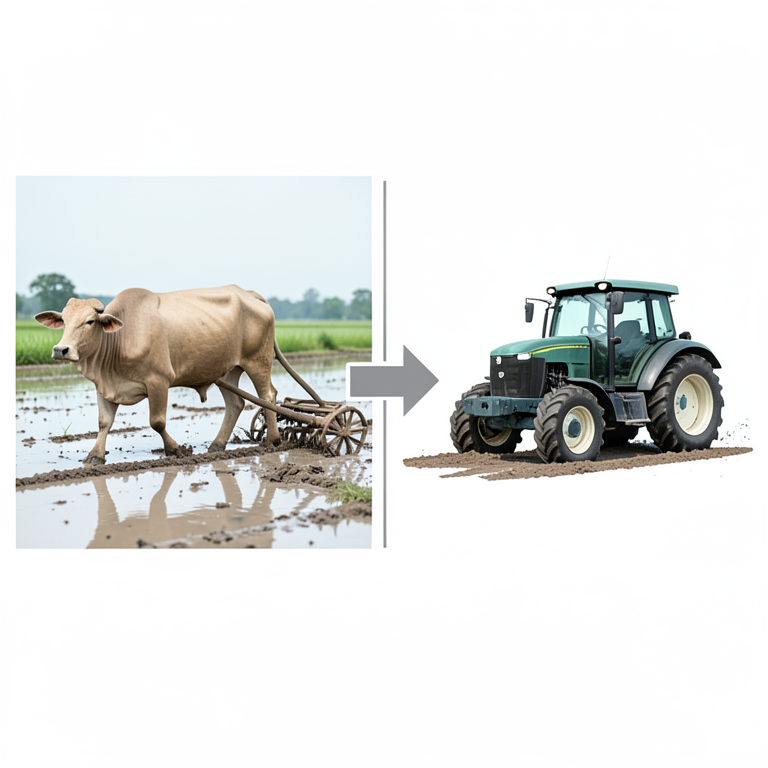
Mechanization vs. Tradition
AI-generated conceptual illustration (Umblachery bullocks and a modern agricultural tractor in a paddy field). It explains the idea and does not show study data.
View source evidence ↗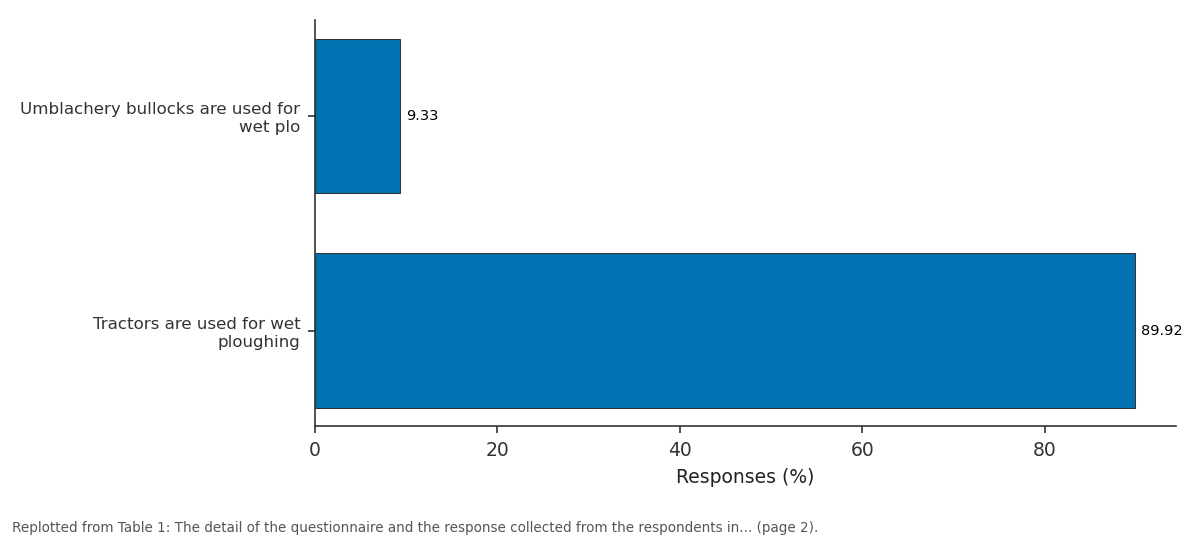
Responses: Umblachery bullocks are... vs Tractors are used for...
Replotted from Table 1 (page 2) of the original paper. Every bar is the paper's own table value.
View source evidence ↗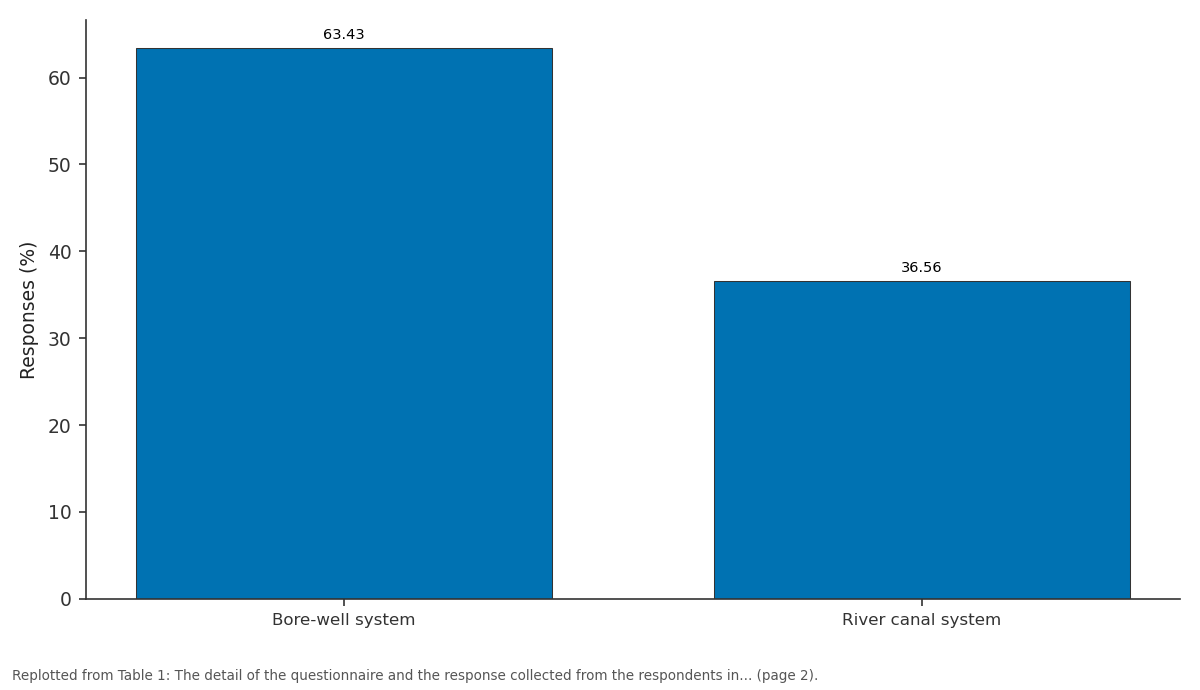
Responses: Bore-well system vs River canal system
Replotted from Table 1 (page 2) of the original paper. Every bar is the paper's own table value.
View source evidence ↗Figures & tables
From the original paper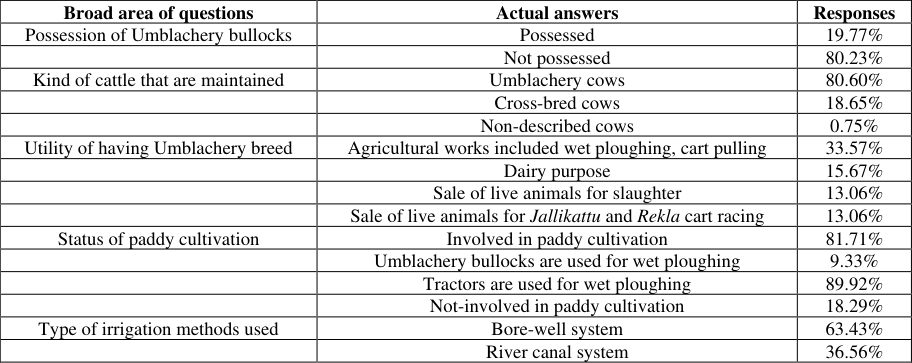 Table 1
Introduction
The Umblachery breed of cattle is the best wet ploughing breed in the world. Its breeding tract included the integrated districts of Thanjavur, Tiruvarur and Nagapattinam in Tamil Nadu. These three districts together popularly called as the "Rice bowel of Tamil Nadu. In today's mechanized agricultural system, Umblachery cattle breed a pride of Cauvery delta zone lost its traditional role of wet ploughing in paddy cultivation. Possessing the unemployed breed for the sake of mere cultural value alone has not been sustaining well in the highly pressurized commercial system (Rajendran et al., 2008) [5] . As a result, the population size of this breed started dwindling. This was evident in the breed wise population reports of 2013 and 2019 and the population sizes were 39,050 and 31,195 in numbers respectively (GoI Report, 2013 and 2019) [2,1] . The earliest report available on the population size of this breed was in 1999 and it was 2,83,000 in numbers (Report, 1999) [6] . It indicated the marked declining trend of Umblachery population in its native tract. The major constraints in maintaining its population were due to lack of grazing land, lack of ponds, deficit of feeds, mechanization in agriculture, use of fertilizers in place of manure, inefficient breed associations, lack of quality bulls, dominance of crossbreeding and unregulated livestock sandy (Kannadhasan, M.S. et al., 2018) [3] . The declining trend of Umblachery cattle breed needs to be checked and restored. The present study was targeted to survey the prevalence of Umblachery bullocks among the farmers in Cauvery delta zone of Tamil Nadu.
Materials and Methods
The field survey was conducted among 268 numbers of those farmers who were involved in rearing of Umblachery cattle spreaded in 15 villages in three districts viz. Thanjavur, Tiruvarur and Nagapattinam. The villages were selected based on stratified random method. The direct survey was done using the preset questionnaires. The questionnaire largely had the questions on kind of animals being reared, its utility, status of paddy cultivation, irrigation method being adapted and other relevant information. The resultant data were subjected to the appropriate statistical analysis.
Results and Discussion
Among 268 respondents, 33.21%, 42.54% and 24.53% were from Thanjavur, Tiruvarur and Nagapattinam districts, respectively. The higher percentage of respondents from Tiruvarur district may be attributed to the presence of higher number of Umblachery cattle rearers in that district which is the highest paddy producing state in Tamil Nadu. The tradition of agriculture and indigenous breed keeping practice in Tiruvarur district was rightly reflected in the result. [3,7] . The prevailing and growing demand in the market for dairy from indigenous breeds can wisely be utilized in the Cauvery delta zone. Targeted subsidy package along with concerted skill training on production supply chain may help the Umblachery breed population to rise. It was observed that among 268 surveyees, 81.71% were involved in paddy cultivation and the rest were not involved in paddy cultivation but had either Umblachery cows or nondescribed cows. This result demonstrated that the tradition of paddy cultivation had been the primary occupation for the majority of the people in Cauvery delta basin. Among these paddy cultivators, mere 9.33% of the farmers utilized Umblachery bullocks for wet-ploughing and other agricultural works. On the contrary, 89.92% of the paddy crop cultivators employed tractors for land preparation and other agricultural tasks. This contrasting feature openly displayed the dominance of mechanization in agricultural fields. The reasons for the popularity of mechanized agriculture may be due to time saving, minimal physical works, labour shortages, higher work efficiency, etc. The finance assistance from the banks for purchasing of tractors and other farm implements may be another reason why the tractors invaded every nook and corner of even the remote villages. Among all the respondents, nearly two-third (63.43%) had bore-well system and one-third (36.56%) had river-canal irrigation system of paddy cultivation. The practice of traditional bullocks-drawing water irrigation system (Etram iraiththal in Tamil) was nil. Hence, this utility of the bullocks of Umblachery breed was no more an option for having this breed among the farmers. This could be attributed to the second reason next to mechanization in agriculture for the loss of the breed (Kannadhasanm, M.S., et al., 2018; Sridhala, K., et al., 2024) [3,7] .
The respondents also revealed their purposes for having the Umblachery cattle breed included cart-pulling and ploughing (33.57%), dairying (15.67%), sale of male animals for slaughter (13.06%) and cultural sports such as Jallikattu, Rekla race, etc. (13.06%). This aspect of the response clearly indicated that the Umblachery breed more precisely the bullocks were still being preferred for its popular and traditional purpose of agricultural works only. Followed by male animals of this precious germplasm was preferred for slaughter sales and cultural sports. In the history of animal husbandry especially in developing countries like India, where the commercial interests are omnipresent in postglobalization era, the only factor that would save the otherwise non-commercial traditional draught breeds like Umblachery cattle is cultural sports. Thus, cultural factors that save any given breeds of livestock should be facilitated and promoted. The morphological traits of Umblachery jallikattu bulls along with Pulikulam and Kangayam breeds revealed the potential role of cultural sports in saving these indigenous draught breeds of Tamil Nadu (Priyadharsini, R., et al., 2019) [4] .
Conclusion
The present study found that the percentage of the farmers maintained Umblachery cattle actually had bullocks was alarming. The results also showed that those farmers who involved in paddy crop cultivation used Umblachery bullocks were meager. Further it was also understood that a considerable section of the farmers keeping male animals for slaughter sales and cultural sports. There was a scope for increasing the Umblachery cattle especially male germplasm in its breeding tract.
Acknowledgement
The financial assistance to conduct this study was granted by Tamil Nadu State Council for Science and Technology (TNSCST), Chennai, Tamil Nadu.
Figures and tables from the paper
| Broad area of questions | Actual answers | Responses |
|---|---|---|
| Possession of Umblachery bullocks | Possessed | 19.77% |
| Not possessed | 80.23% | |
| Kind of cattle that are maintained | Umblachery cows | 80.60% |
| Cross-bred cows | 18.65% | |
| Non-described cows | 0.75% | |
| Utility of having Umblachery breed | Agricultural works included wet ploughing, cart pulling | 33.57% |
| Dairy purpose | 15.67% | |
| Sale of live animals for slaughter | 13.06% | |
| Sale of live animals for Jallikattu and Rekla cart racing | 13.06% | |
| Status of paddy cultivation | Involved in paddy cultivation | 81.71% |
| Umblachery bullocks are used for wet ploughing | 9.33% | |
| Tractors are used for wet ploughing | 89.92% | |
| Not-involved in paddy cultivation | 18.29% | |
| Type of irrigation methods used | Bore-well system | 63.43% |
| River canal system | 36.56% |
Table text extracted from the original PDF; superscript letters are shown inline. The original table image is below.
View original table image
References
5 in the original paper- Government of India, Ministry of Agriculture & Farmers Welfare, Department of Animal Husbandry, Dairying & Fisheries (Animal Husbandry Statistics Division). Breed wise report of livestock and poultry based on 20 th livestock census 2019. Krishi Bhawan, New Delhi; c2019.
- Government of India, Ministry of Agriculture & Farmers Welfare, Department of Animal Husbandry, Dairying & Fisheries (Animal Husbandry Statistics Division). Estimated livestock population breed wise based on breed survey 2013. Krishi Bhawan, New Delhi; c2013.
- Kannadhasan MS, Kathirchelvan M, Rajendran R. Identification and prioritization of constraints in Umblachery breed cattle farming through participatory approach. Int J Curr Microbiol App Sci. 2018;7(11):1100-1110. DOI: 10.20546/ijcmas.2018.711.128.
- Priyadharsini R, Gopinathan A, Smk K, Jagatheesan PN. Study on morphological traits in indigenous Jallikattu bulls of Tamil Nadu. Indian Vet J. 2019;96:9-13.
- Sridhala K, Sasikala V, Saravanan KP, Boopathi V. Identification of constraints in Umblachery cattle rearing. Int J Vet Sci Anim Husb. 2024;9(3):553-555.