
Research article · 2024 · Full text
International Journal of Agriculture Extension and Social DevelopmentAdoption behavior of improved black gram cultivation practices: Study of west Singhbhum district in Jharkhand
Volume 7(7) · Pages 556–558 · DOI: 10.33545/26180723.2024.v7.i7h.857 ↗
Research areasAgricultural Economics and PracticesLivestock Management and Performance Improvement
Abstract
Author-writtenResearch study entitled “Study on Adoption Behavior of Improved Black Gram Cultivation Practices in West Singhbhum District in Jharkhand” was undertaken to study the personal profile characteristics of framers, knowledge and adoption of the respondents towards black gram cultivation technique and aims to analyze the constraints paced by them during the cultivation. This study was carried out in West Singhbhum District of Jharkhand in one selected block. 120 farmers were taken randomly as respondents as sample size. The respondents were interviewed personally by a well-structured interview schedule. The collected data were analyzed with the help of suitable statistical techniques to draw appropriate conclusions. The study reveals that the majority of the respondents were having medium.
Summary
Source-checkedPlain-language reading of the full paper, prepared with AI and checked against the text. Each point links to the authors' own words.
Why it matters
- Black gram (Vigna mungo), commonly known as Urad, is a significant pulse crop in India, which is its primary origin. View evidence ↗
- The seeds of black gram are highly nutritious, containing 25-26% protein and 60% carbohydrates. View evidence ↗
- Black gram serves as a green manure crop and improves soil quality by adding approximately 42 kg of Nitrogen per hectare. View evidence ↗
The question
- The study aimed to examine the personal profiles, knowledge, and adoption behavior of farmers regarding improved black gram cultivation practices in the West Singhbhum District of Jharkhand, as well as the constraints they face. View evidence ↗
What they did
- The research was conducted in the Noamundi block of the West Singhbhum district in Jharkhand, where 6 villages were selected from a total of 62. View evidence ↗
- A sample size of 120 farmers was selected based on the availability of black gram cultivators. View evidence ↗
What they found
- A majority of farmers (77.5%) adopted the use of suitable varieties such as Shekhar urd 3 or Azad urd 3. View evidence ↗
- About 73.33% of respondents adopted the recommended crop duration of 75-90 days. View evidence ↗
- Weekly irrigation intervals were adopted by 62.5% of the farmers. View evidence ↗
- Soil testing had a low adoption rate, with only 33.33% of farmers adopting it and 52.5% not adopting it. View evidence ↗
- The practice of spraying 2% urea during flowering and pod formation was the least adopted, with only 20.83% adoption. View evidence ↗
- The overall extent of adoption among black gram cultivators was primarily medium, accounting for 55% of the respondents. View evidence ↗
- The remaining farmers were split between low adoption (25%) and high adoption (20%). View evidence ↗
What it means
- The authors conclude that farmers in the studied region generally exhibit a medium level of adoption regarding improved black gram cultivation practices. View evidence ↗
Visual summary
3 visualsIllustrations explain the paper; charts are replotted from the paper's own table values.
Distribution of Adoption Levels
AI-generated conceptual illustration (black gram plants in a field). It explains the idea and does not show study data.
View source evidence ↗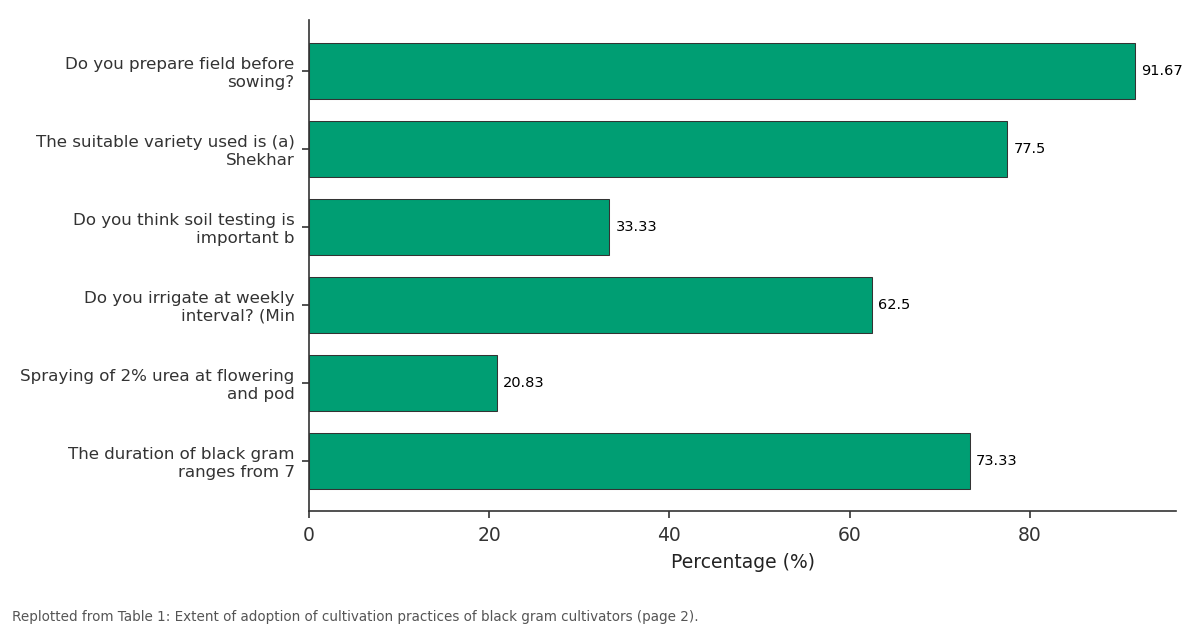
%: Do you prepare field... vs The suitable variety... vs Do you think soil... vs Do you irrigate at... vs Spraying of 2% urea at...
Replotted from Table 1 (page 2) of the original paper. Every bar is the paper's own table value.
View source evidence ↗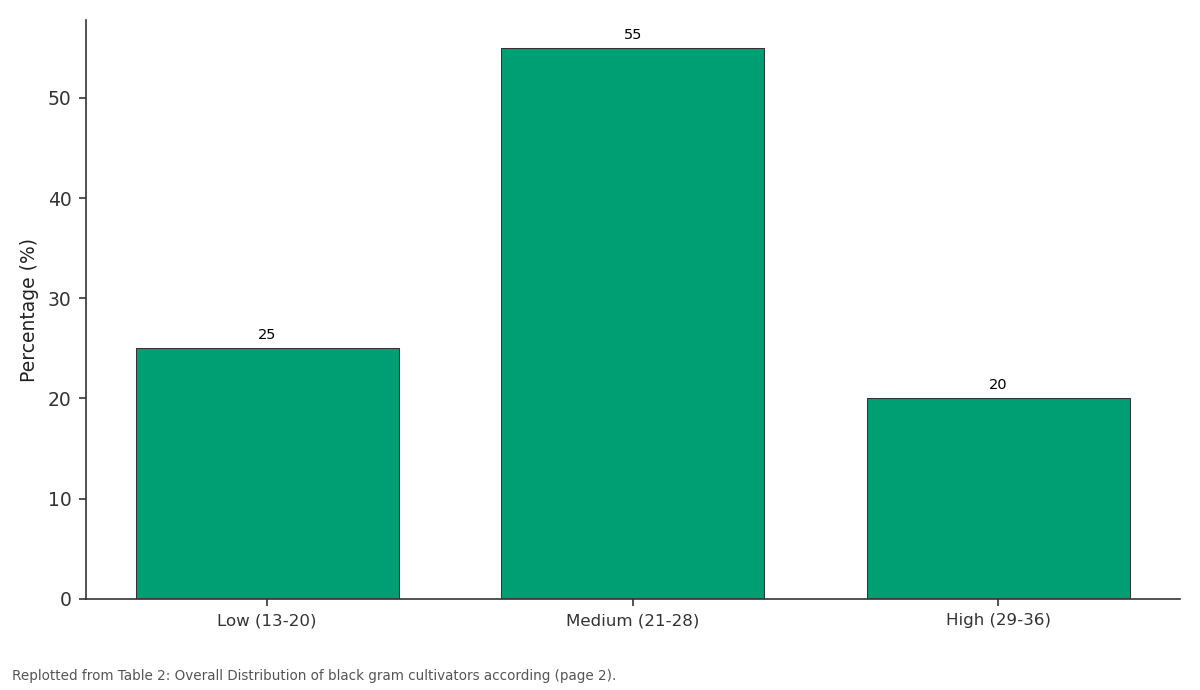
Percentage: Low (13-20) vs Medium (21-28) vs High (29-36)
Replotted from Table 2 (page 2) of the original paper. Every bar is the paper's own table value.
View source evidence ↗Figures & tables
From the original paper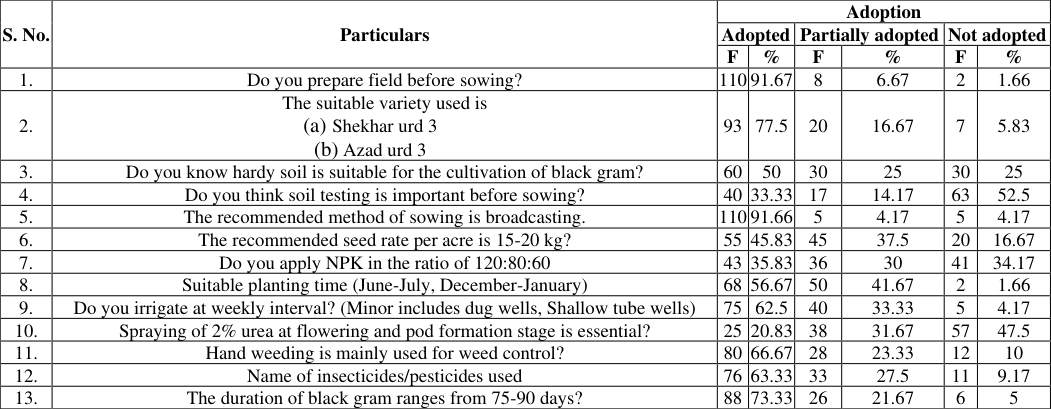 Table 1
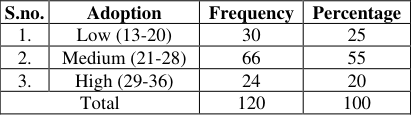 Table 2
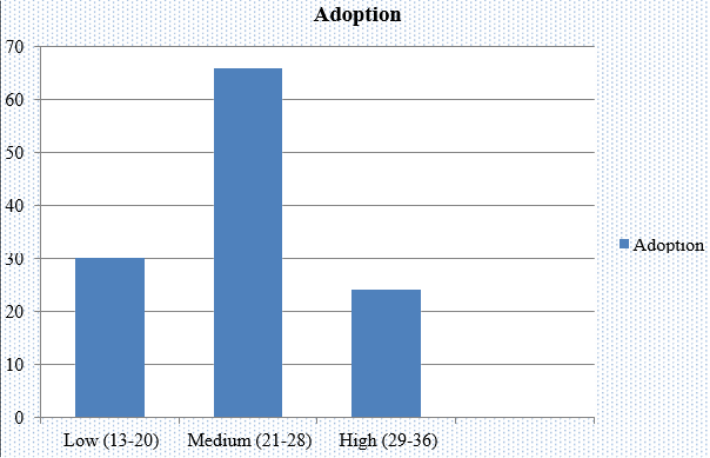 Figure 1
Introduction
Black gram is scientifically known as Vigna mungo and it is commonly known as Urad in India. India is its primary origin and is mainly cultivated in Asian countries including Pakistan, Myanmar and parts of Southern Asia. It is one of the important pulse crops grown throughout India. It is consumed in the form of 'dal' (whole or split, husked and un-husked) or perched. It is used as nutritive fodder especially for milch animals. It is also green manuringb crop. High values of lysine make urd bean an excellent complement to rice in terms of balanced human nutrition. Being a crop of tropical region, it requires hot and humid climate for best growth. It is basically a warm weather crop. In North parts of the country where the temperatures during winter are quite low, it is cultivated generally during rainy and summer season. In the eastern states, it is also grown during winter. In Central and Southern states, where there is not much variation in the climate, it is cultivated during winter and rainy seasons. Black gram can be grown on variety of soils ranging from sandy soils to heavy cotton soils. The most ideal soil is a well-drained loam with pH of 6.5 to 7.8. Black gram cannot be grown on alkaline and saline soils. Land is prepared like any other kharif season pulse crop. However during summer it requires a thorough preparation to give a pulverized free from stubbles and weeds completely. Black gram originated in India, where it has been in cultivation from ancient times and is one of the most highly prized pulses of India and Pakistan. Black gram has also been introduced to other tropical areas mainly by Indian immigrants.
Black gram, also known as urd bean, mash, black maple, etc. is an important short-duration pulse crop grown in many parts of India. This crop is grown in cropping systems as a mixed crop, catch crop, sequential crop besides as sole crop under residual moisture conditions after the harvest of rice also before and after the harvest of other summer crops under semi-irrigated and dry land conditions. Its seeds are highly nutritious with protein (25-26%), carbohydrates (60%), fat (1.5%), minerals, amino acids and vitamins. Seeds are used in the preparation of many popular Indian dishes such as dosa, idli, vada etc. besides, it adds about 42 kg Nitrogen per hectare in soil. It is also valued as a green manure crop. Its dry stalks along with pod husk forms a nutritive fodder especially for milch cattle. Black gram possesses deep root system, which binds soil particles and thus prevents soil erosion. This crop is itself a mini-fertilizer factory, as it has unique characteristics of maintaining and restoring soil fertility through fixing atmospheric nitrogen in symbiotic association with Rhizobium bacteria, present in the root nodules. Crop is suitable for inter cropping with different crops such as cotton, sorghum, pearl millet, green gram, maize, soybean, groundnut, for increasing production and maintaining soil fertility. Black gram is mostly grown as a rainfed crop during summers in Northern India and in winters in Peninsular and Southern India. With increase in irrigation potential, the area under black gram cultivation has registered an increase in recent years. Thus, there is need to increase production and productivity of pulses in general and black gram, in particular of our country by more interventions. www.extensionjournal.com
The crop is resistant to adverse climatic conditions and hence, can be cultivated in many situations where other crops fail. Black gram is cultivated as a catch crop under the residual moisture after the harvest of main crop. Being a crop which fixes atmospheric nitrogen, it improves the soil fertility also. (www.icrisat.org)
Materials and Methods
The study was conducted in purposively selected district of West Singhbhum of Jharkhand. One block namely Noamundi block was selected for the selection of respondents. Noamundi block consists of 62 villages, 6 villages were selected from the block. The respondents were selected on the basis of availability of maximum numbers black gram cultivators, making the total sample size of 120 farmers.
Data collection and analysis
Data was collected through personal interviews with the selected respondents. A structured interview schedule was prepared to insure consistency and relevance in data collection. The collected data was analysed using appropriate statistical tools. Descriptive statistics such as frequencies, percentages, mean and standard deviations was employed to summarize the demographic and socioeconomic characteristics of the respondents.
Extent of adoption of black gram cultivation practices
To measure the adoption of the respondents about the cultivation practices of black gram, 13 questions were asked from them and their responses were recorded on 3-point continuum scale as adopted, partially adopted and not adopted and given 3,2,1 score respectively. The following analysis will show that these are a good deal of variations also in the adoption of different practices while practices are adopted fully, partially and not adopted as per recommendation. It is evident from Table 1. That 91.67 per cent and 91.66 per cent of the respondents adopted the field preparation and method of sowing. Regarding 77.33 per cent and 73.5 per cent of the respondents had adopted crop duration range and suitable variety of black gram. 66.67 per cent and 63.33 per cent and 62.5 per cent of respondents adopted the weed control method and knowledge about insecticides and pesticides and weekly irrigation interval. In case of suitable sowing time 56.67 per cent of the respondents had adopted the cultivation practice. Half of the respondents have adopted the suitable soil for the cultivation of black gram i.e. 50.00 per cent. 45.83 per cent of respondents had adopted the recommended seed rate. In case of NPK ratio 35.83 per cent of respondents had adopted the recommended ratio. 33.33 per cent had adopted the soil testing method. 20.83 per cent of respondents adopted the method of spraying urea at flowering and pod formation stage. An overview of Table 2. makes it clear that black gram cultivators are coming under medium (55.00%) extent of adoption followed by those coming under low and high (25.00%) and (20.00%) respectively with regard to adoption of selected black gram cultivation practices. www.extensionjournal.com
| S.no. | Adoption | Frequency | Percentage |
|---|---|---|---|
| 1. | Low (13-20) | 30 | 25 |
| 2. | Medium (21-28) | 66 | 55 |
| 3. | High (29-36) | 24 | 20 |
| Total | 120 | 100 |
Table text extracted from the original PDF; superscript letters are shown inline. The original table image is below.
View original table image
| S. No. | Particulars | Adoption | — | — | — | — | — |
|---|---|---|---|---|---|---|---|
| Adopted | Partially adopted | Not adopted | |||||
| F | % | F | % | F | % | ||
| 1. | Do you prepare field before sowing? | 110 | 91.67 | 8 | 6.67 | 2 | 1.66 |
| 2. | The suitable variety used is (a) Shekhar urd 3 (b) Azad urd 3 | 93 | 77.5 | 20 | 16.67 | 7 | 5.83 |
| 3. | Do you know hardy soil is suitable for the cultivation of black gram? | 60 | 50 | 30 | 25 | 30 | 25 |
| 4. | Do you think soil testing is important before sowing? | 40 | 33.33 | 17 | 14.17 | 63 | 52.5 |
| 5. | The recommended method of sowing is broadcasting. | 110 | 91.66 | 5 | 4.17 | 5 | 4.17 |
| 6. | The recommended seed rate per acre is 15-20 kg? | 55 | 45.83 | 45 | 37.5 | 20 | 16.67 |
| 7. | Do you apply NPK in the ratio of 120:80:60 | 43 | 35.83 | 36 | 30 | 41 | 34.17 |
| 8. | Suitable planting time (June-July, December-January) | 68 | 56.67 | 50 | 41.67 | 2 | 1.66 |
| 9. | Do you irrigate at weekly interval? (Minor includes dug wells, Shallow tube wells) | 75 | 62.5 | 40 | 33.33 | 5 | 4.17 |
| 10. | Spraying of 2% urea at flowering and pod formation stage is essential? | 25 | 20.83 | 38 | 31.67 | 57 | 47.5 |
| 11. | Hand weeding is mainly used for weed control? | 80 | 66.67 | 28 | 23.33 | 12 | 10 |
| 12. | Name of insecticides/pesticides used | 76 | 63.33 | 33 | 27.5 | 11 | 9.17 |
| 13. | The duration of black gram ranges from 75-90 days? | 88 | 73.33 | 26 | 21.67 | 6 | 5 |
Table text extracted from the original PDF; superscript letters are shown inline. The original table image is below.
View original table image
Conclusion
The major findings indicate that farmers hold a medium adoption level towards the black gram cultivation. It was also evident that adoptions of farmers about black gram cultivation practices were found in medium level.
Acknowledgement
AcknowledgementI express my deepest gratitude to my Advisor, Prof. Dr. Syed H. Mazhar, for their valuable guidance and support. I also thank the faculty of Department of Agricultural Extension and Communication, NAI -SHUATS. Special thanks to the farmers who participated and for their insights, and to my family and friends for their unwavering support.
Figures and tables from the paper
References
6 in the original paper- Chandawat MS, Sharma PK, Parmar AB. Extent of adoption about improved cultivation practices of gram crop and constraints faced by the farmers of Kheda district. Hand. 2012;3:13.
- Goswami AJ, Deka CK, Das P. Study on the extent of adoption of recommended package of practices of green gram by the farmers in Nagaon district of Assam. Curr Adv Agric Sci. 2017;9(1):107-109.
- Khare A, Wakle PK, Shambharkar YB, Patil J. Correlation of adoption and constraints faced by gram farmers in adoption of improved cultivation practices. Indian J Res. 2013;2:8-10.
- Khuspe SB, Kadam RP. Adoption gap in recommended production practices of chickpea. Agric Update. 2012;7(3-4):301-303.
- Mane SS, Pulate SL, Sawandkar DN, Suradkar DD. Personal characteristics of green gram growers in Latur district of Maharashtra state. Int J Curr Microbiol App Sci. 2018;Special Issue-6:1613-1617.
- Patel CR, Singh SP, Paikra KK. Performance of cluster frontline demonstration on productivity and profitability of blackgram (Vigna mungo) in Raigarh District of Chhattisgarh, India. Int J Curr Microbiol App Sci. 2018;7(6):1325-1330.