
Research article · 2024 · Full text
International Journal of Agriculture Extension and Social DevelopmentAssessing the impact of the agricultural technology management agency (ATMA) on information access challenges for beneficiaries in Tirunelveli district, Tamil Nadu
Volume 7(7) · Pages 447–450 · DOI: 10.33545/26180723.2024.v7.i7f.836 ↗
Research areasAgricultural Innovations and PracticesInnovation and Socioeconomic DevelopmentMicrofinance and Financial Inclusion
Abstract
Author-writtenAgriculture in India plays a pivotal role in the economy, necessitating effective dissemination of agricultural knowledge and technologies to enhance sustainability and productivity. The Agricultural Technology Management Agency (ATMA) serves as a decentralized extension system aimed at empowering farmers with relevant information and skills. This study assesses ATMA's impact on information access challenges among beneficiaries in Tirunelveli District, Tamil Nadu, focusing on the effectiveness of its interventions amidst diverse agro-climatic conditions. Employing a mixed-methods approach, the study utilizes before-and-after surveys, structured interviews, and focus group discussions to evaluate changes in beneficiaries' knowledge and attitudes. Key challenges identified include issues of timeliness, relevance of information, and the interpersonal skills of extension workers, alongside socio-political and technical constraints. Despite positive perceptions on collaboration and technology dissemination, marketing constraints remain significant. Findings underscore the need for improved feedback mechanisms, enhanced training for extension workers, and targeted interventions to address socio-political and technical barriers. The study contributes actionable insights to enhance ATMA's efficacy in promoting sustainable agricultural practices and fostering rural development in the region.
Summary
Source-checkedPlain-language reading of the full paper, prepared with AI and checked against the text. Each point links to the authors' own words.
Why it matters
- Agriculture is a critical part of India's economy, making the efficient spread of knowledge and technology essential for improving productivity and sustainability. View evidence ↗
- The Agricultural Technology Management Agency (ATMA) is a decentralized system designed to empower farmers by providing them with necessary skills and information. View evidence ↗
- Tirunelveli District in Tamil Nadu is a key area of interest due to its diverse agro-climatic conditions, which create specific challenges for agricultural development. View evidence ↗
The question
- The study aims to evaluate how ATMA impacts the knowledge and attitudes of beneficiaries in Tirunelveli District, specifically focusing on information access challenges. View evidence ↗
What they did
- The researchers used a mixed-methods approach with a 'Before and After' design, employing quantitative surveys to measure changes in knowledge and attitudes. View evidence ↗
- A total of 120 respondents were selected (24 from each of five purposively selected villages in the Valliyoor block) using stratified purposive and random sampling. View evidence ↗
- Data was analyzed using SPSS 16 software, applying tools such as percentage analysis, arithmetic mean, standard deviation, and Pearson's correlation coefficient. View evidence ↗
What they found
- The highest-ranked positive aspect was the comprehensibility of information, with 62.50% of respondents fully agreeing that ATMA's information is easily understood. View evidence ↗
- ATMA was viewed positively for promoting collaboration between state-funded technical departments, with 58.33% of respondents fully agreeing. View evidence ↗
- While 58.33% of respondents fully agreed that ATMA provides relevant and timely information, the authors note there is still room for improvement in delivery consistency. View evidence ↗
- Marketing constraints are a significant issue, with 50.00% of respondents fully agreeing that they face difficulties in promoting agriculture and allied fields. View evidence ↗
- Technical constraints specifically limiting knowledge about animal rearing were identified as a challenge, with 41.67% of respondents fully agreeing. View evidence ↗
- Socio-political factors were found to affect the allocation of demonstrations, with 37.50% of respondents fully agreeing. View evidence ↗
- Delays in information delivery were reported, though this was the lowest-ranked constraint in terms of full agreement (33.33%). View evidence ↗
What it means
- The authors conclude that ATMA's effectiveness can be improved by enhancing information delivery systems, increasing training for extension workers, and strengthening stakeholder coordination. View evidence ↗
- The authors recommend ongoing training for extension workers to improve their interpersonal and communication skills to better deliver information. View evidence ↗
Visual summary
2 visualsIllustrations explain the paper; charts are replotted from the paper's own table values.
ATMA Information Flow Improvement
AI-generated conceptual illustration (Indian farmers and agricultural extension workers in rural Tamil Nadu). It explains the idea and does not show study data.
View source evidence ↗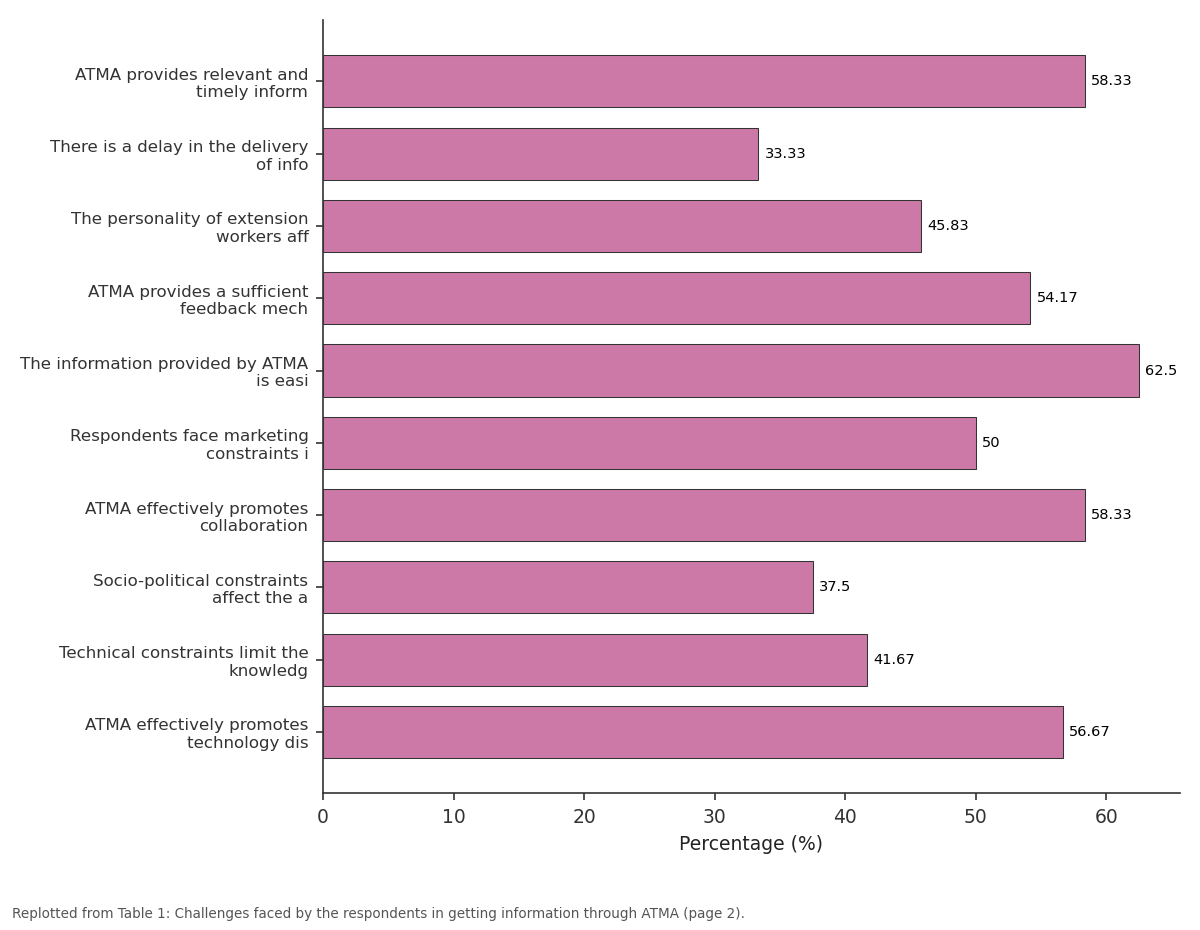
%: ATMA provides relevant... vs There is a delay in the... vs The personality of... vs ATMA provides a... vs The information...
Replotted from Table 1 (page 2) of the original paper. Every bar is the paper's own table value.
View source evidence ↗Figures & tables
From the original paper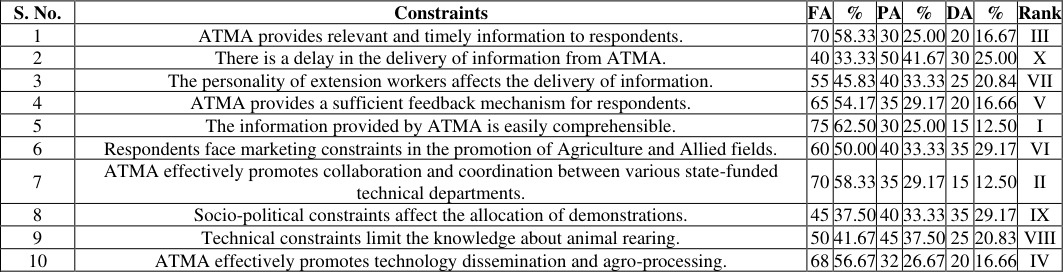 Table 1
Introduction
Agriculture remains a pivotal sector in India, significantly contributing to the nation's economy and sustenance. Ensuring the efficient dissemination of agricultural knowledge and technology to farmers is crucial for enhancing productivity and sustainability. The Agricultural Technology Management Agency (ATMA) is a key initiative designed to facilitate the transfer of agricultural technologies and innovations to farmers. By providing a decentralized and demand-driven extension system, ATMA aims to empower farmers with relevant information, improving their agricultural practices and livelihoods. In the context of Tirunelveli District, Tamil Nadu, the effectiveness of ATMA in addressing information access challenges for farmers is of particular interest. This region, characterized by diverse agro-climatic conditions, presents unique challenges and opportunities for agricultural development. Previous research has highlighted the critical role of information dissemination in enhancing agricultural productivity and the need for effective extension services to bridge the knowledge gap among farmers. However, despite the efforts of ATMA, farmers in Tirunelveli still face significant barriers in accessing timely and relevant agricultural information. These challenges can impede the adoption of innovative practices and technologies, ultimately affecting their productivity and income. Understanding the specific constraints faced by beneficiaries in this district and identifying potential solutions is essential for improving the efficacy of ATMA's interventions. This study aims to assess the impact of ATMA on the knowledge and attitudes of its beneficiaries in Tirunelveli District, with a particular focus on the challenges encountered in accessing information. By examining these constraints and gathering suggestions from the beneficiaries, this research seeks to provide actionable insights to enhance the effectiveness of ATMA's information dissemination efforts. This investigation is expected to contribute to the broader discourse on agricultural extension services and inform policy recommendations for improving the delivery of agricultural technologies to farmers.
Materials and Methods: Research Design
This study employs a mixed-methods approach to assess the impact of ATMA interventions on the knowledge and attitudes of beneficiaries in Tirunelveli District, Tamil Nadu. Using a Before and After design, quantitative surveys are conducted to measure changes in knowledge and attitudes before and after ATMA interventions. Additionally, qualitative methods such as in-depth www.extensionjournal.com interviews and focus group discussions provide deeper insights into beneficiaries' experiences and perceptions. Ethical considerations, including informed consent and confidentiality, are prioritized to ensure the integrity of the research process (Kumar, R. 2019) [9] .
Locale of Study
The research is situated in Tirunelveli District, Tamil Nadu, a region known for its diverse agricultural practices and reliance on both rain-fed and irrigated farming systems. The district's varied topography, including coastal plains, river valleys, and mountainous regions, supports the cultivation of a wide array of crops. The selection of Tirunelveli is based on its agricultural diversity and significant participation in ATMA training programs, providing an ideal setting for evaluating the effectiveness of these programs. The district's coordinates are approximately latitude: 8.7254° N and longitude: 77.6842° E.
Sampling and Sampling Procedures
A stratified purposive sampling method is employed to select a representative sample of ATMA program beneficiaries. From the Valliyoor block in Tirunelveli, which comprises 18 villages, five villages are selected through purposive sampling based on the availability of ATMA beneficiaries. The selected villages are Valliyoor, Chithambarapuram, Jacobpuram, Karungulam, and Panankudi. From each village, 24 respondents are randomly selected, totaling 120 respondents. Data collection involves structured interviews, questionnaires, and field observations, ensuring a comprehensive evaluation of ATMA's effectiveness.
Selection and Measurement of Variables
The study categorizes variables into independent and dependent types. Independent variables include age, educational level, caste, family type, type of house, annual income, land holding, occupation, extension contacts, mass media exposure, and source of information. Dependent variables are knowledge and attitude towards ATMA.
Measurement procedures for each variable follow established scales and schedules, such as Giridhara (2013) [7] for age and Kappa (2014) [8] for educational level. Constraints and suggestions from respondents are also measured to identify challenges and potential improvements in accessing ATMA benefits.
Methods of Data Collection and Statistical Analysis
Data collection is conducted using a pre-tested, wellstructured interview schedule, ensuring reliability and validity. Each respondent is interviewed personally, and their responses are recorded. The collected data is categorized, tabulated, and analyzed using SPSS 16 software. Statistical tools employed include arithmetic mean, standard deviation, percentage analysis, and Pearson's product-moment correlation coefficient. These tools facilitate a detailed analysis of the data, enabling the study to draw meaningful conclusions about the impact of ATMA programs on beneficiaries in Tirunelveli District. All data collection and analysis procedures adhere to ethical standards, ensuring the accuracy and credibility of the research findings.
Results and Discussion
The Agricultural Technology Management Agency (ATMA) plays a crucial role in disseminating agricultural information and promoting sustainable agricultural practices among farmers. This study aims to identify the challenges faced by respondents in obtaining information through ATMA and to provide insights into areas where ATMA can improve its services. By understanding these challenges, we can suggest measures to enhance the effectiveness of ATMA in supporting the agricultural community. Key challenges identified include issues related to the timeliness and relevance of information, the impact of extension workers' personalities, the sufficiency of feedback mechanisms, and marketing constraints. The study also examines the role of socio-political and technical constraints and evaluates ATMA's efforts in promoting collaboration and technology dissemination Delay in Information Delivery: Some respondents report delays in receiving information from ATMA. The variability in responses suggests that the consistency of information delivery needs to be addressed to ensure all respondents receive timely updates.
Impact of Extension Workers' Personality:
The personality and interpersonal skills of extension workers are seen as critical factors influencing the effectiveness of www.extensionjournal.com information delivery. This highlights the need for ongoing training and development for extension workers to enhance their communication and interpersonal skills.
Feedback Mechanism: While a majority of respondents believe ATMA has a sufficient feedback mechanism, a significant portion remains undecided. This suggests a need to improve the visibility and effectiveness of feedback channels to ensure respondents feel their input is valued and acted upon.
Comprehensibility of Information:
Most respondents find the information provided by ATMA to be easily understandable. However, there is a percentage of respondents who are unsure, indicating a potential gap in communication clarity that needs to be addressed. Marketing Constraints: Marketing constraints are a significant challenge for many respondents, with half of them facing difficulties in promoting agriculture and allied fields. This underscores the importance of providing more targeted marketing support and training.
Collaboration and Coordination: ATMA's efforts to promote collaboration between state-funded technical departments are viewed positively. However, there is a need for better communication about these collaborative efforts to ensure all respondents are aware and can benefit from them.
Socio-Political Constraints: Socio-political factors affecting the allocation of demonstrations are acknowledged as challenges by many respondents. This highlights the need to address external factors that impact ATMA's operations.
Technical Constraints in Animal Rearing: Technical constraints, particularly in the area of animal rearing, are identified as a challenge. This points to the need for more specialized technical support and training for respondents engaged in animal husbandry.
Promotion of Technology Dissemination and Agro-Processing:
A majority of respondents believe ATMA effectively promotes technology dissemination and agroprocessing. However, there is a need for more visible or impactful efforts to ensure all respondents can benefit from these initiatives.
Suggestions for
Suggestions for
Acknowledgement
AcknowledgementsI express my deepest gratitude to my Advisor, Prof. Dr. (Ms.) Jahanara, for their invaluable guidance and support. I also thank the faculty of Department of Agricultural Extension and Communication, NAI -SHUATS, and for their assistance. Special thanks to the participating farmers for their insights, and to my family and friends for their unwavering support.
Figures and tables from the paper
| S. No. | Constraints | FA | % | PA | % | DA | % | Rank |
|---|---|---|---|---|---|---|---|---|
| 1 | ATMA provides relevant and timely information to respondents. | 70 | 58.33 | 30 | 25.00 | 20 | 16.67 | III |
| 2 | There is a delay in the delivery of information from ATMA. | 40 | 33.33 | 50 | 41.67 | 30 | 25.00 | X |
| 3 | The personality of extension workers affects the delivery of information. | 55 | 45.83 | 40 | 33.33 | 25 | 20.84 | VII |
| 4 | ATMA provides a sufficient feedback mechanism for respondents. | 65 | 54.17 | 35 | 29.17 | 20 | 16.66 | V |
| 5 | The information provided by ATMA is easily comprehensible. | 75 | 62.50 | 30 | 25.00 | 15 | 12.50 | I |
| 6 | Respondents face marketing constraints in the promotion of Agriculture and Allied fields. | 60 | 50.00 | 40 | 33.33 | 35 | 29.17 | VI |
| 7 | ATMA effectively promotes collaboration and coordination between various state-funded technical departments. | 70 | 58.33 | 35 | 29.17 | 15 | 12.50 | II |
| 8 | Socio-political constraints affect the allocation of demonstrations. | 45 | 37.50 | 40 | 33.33 | 35 | 29.17 | IX |
| 9 | Technical constraints limit the knowledge about animal rearing. | 50 | 41.67 | 45 | 37.50 | 25 | 20.83 | VIII |
| 10 | ATMA effectively promotes technology dissemination and agro-processing. | 68 | 56.67 | 32 | 26.67 | 20 | 16.66 | IV |
Table text extracted from the original PDF; superscript letters are shown inline. The original table image is below.
View original table image
References
11 in the original paper- Chinnadurai C, Manickam S, Subramanian Y. Impact of agricultural extension services on farmers' knowledge and adoption of improved maize production technologies in Tamil Nadu, India. Agricultural Economics Research Review. 2017;30:269-276.
- Kumar S, Jat ML, Gupta RK, Sutaliya JM, Singh RG, Khatri-Chhetri A. Adoption of sustainable agricultural practices among smallholder farmers: Evidence from semi-arid regions of India. Land Use Policy. 2018;76:71-78.
- Narayanan S, Suresh A, Sudha M, Murugan S, Gowtham R. Effectiveness of Agricultural Technology Management Agency (ATMA) in enhancing sustainable agricultural practices: Evidence from Southern India. Agricultural Extension Review. www.extensionjournal.com 2019;41(2):125-136.
- Patel M, Prajapati B, Shah N, Patel K, Patel R. Role of extension services in enhancing agricultural productivity: A case study of ATMA in Gujarat, India. Journal of Agricultural Extension and Rural Development. 2020;12(5):123-135.
- Reddy NR, Rao N, Raju LSS. Impact of ATMA in technology dissemination and adoption among farmers: A case study from Andhra Pradesh. Journal of Extension Education. 2018;30(2):45-52.
- Singh SS, Singh M, Kumar V. Socio-economic impact of ATMA programme in Haryana: A case study. Indian Journal of Extension Education. 2019;55(3, 4):27-33.
- Giridhara. Educational status of farmers in Tamil Nadu. Journal of Rural Development. 2013;32(1):45-52.
- Kappa R. Understanding age demographics in agricultural practices. Indian Journal of Agricultural Sciences. 2014;84(6):789-794.
- Kumar R. Ethical considerations in agricultural research: Guidelines and practices. Agricultural Research Ethics. 2019;2(1):15-22.
- Mishra S, Kumar A. Technological constraints in animal husbandry practices: A review. Livestock Research for Rural Development. 2017;29(6):112-118.
- Ministry of Agriculture and Farmers Welfare. Annual Report 2020-2021. Government of India; 2021. Available from: https://agricoop.nic.in/sites/default/files/AR202021_0.pdf [Accessed 14 July 2024].