
Research article · 2024 · Full text
International Journal of Agriculture Extension and Social DevelopmentEconomic analysis and constraints faced by paddy-wheat rotation in Kaithal district of Haryana
Volume 7(7) · Pages 545–547 · DOI: 10.33545/26180723.2024.v7.i7h.854 ↗
Research areasAgricultural Economics and PracticesAgricultural risk and resilienceRice Cultivation and Yield Improvement
Abstract
Author-writtenThe present study was conducted in Kaithal district of Haryana. The data was collected for paddy and wheat crops from 20 farmers of Sakra village during 2023-24. The result of the study revealed that the total cost and variable cost of cultivation of paddy (PR-126), paddy (CSR-30) and wheat cultivation were Rs. 136597 & Rs. 58697, Rs. 150926 & Rs. 70004 and Rs. 108061 & Rs. 39719 per hectare, respectively. The gross returns received from paddy (PR-126), paddy (CSR-30) and wheat were Rs. 187552, 214972 and Rs. 127091 per hectare, respectively. The cost benefit ratio recorded for paddy (PR-126), paddy (CSR-30) and wheat was 1.37, 1.42 and 1.18, respectively which was more than one indicated that cultivation of these crops in the study area was profitable. Constraints faced by farmers due to paddy wheat rotation in the study area were the high rental value of land as revealed by 80.00 per cent of the growers followed by problem of soil fertility (75.00%), problem of crop residue management (70.00%) and non-availability of quality seed (60.00%). For mitigating these constraints there must be need of diversification to improve soil health and crop residue management.
Summary
Source-checkedPlain-language reading of the full paper, prepared with AI and checked against the text. Each point links to the authors' own words.
Why it matters
- Rice and wheat are critical crops for India's economy and food security. View evidence ↗
- In Haryana, the continuous rotation of rice and wheat has caused soil fertility degradation, over-exploitation of natural resources, and increased crop vulnerability to pests and diseases. View evidence ↗
- The profitability of the rice-wheat system has stagnated because of rising input costs and flat yields. View evidence ↗
The question
- The study aimed to perform an economic analysis and identify the constraints faced by farmers practicing paddy-wheat rotation in the Kaithal district of Haryana. View evidence ↗
What they did
- Data was collected from 20 farmers in Sakra village, Kaithal district, Haryana, during the 2023-24 period. View evidence ↗
- The researchers used pre-tested schedules for data collection and analyzed the results using percentages and means. View evidence ↗
What they found
- The total cost per hectare for paddy (PR-126) was Rs. 136,597 (variable cost Rs. 58,697) and for paddy (CSR-30) was Rs. 150,926 (variable cost Rs. 71,004). View evidence ↗
- Wheat cultivation in Kaithal had a total cost of Rs. 108,061 per hectare, with a variable cost of Rs. 39,719. View evidence ↗
- Gross returns per hectare were Rs. 187,552 for paddy (PR-126), Rs. 214,972 for paddy (CSR-30), and Rs. 127,091 for wheat. View evidence ↗
- The cost-benefit ratios were 1.37 for paddy (PR-126), 1.42 for paddy (CSR-30), and 1.18 for wheat, indicating that all three were profitable. View evidence ↗
- The most significant constraint reported by farmers was the high rental value of land, cited by 80.00% of growers. View evidence ↗
- Other major constraints included soil fertility issues (75.00%), crop residue management (70.00%), lack of quality seeds (60.00%), labor shortages (55.00%), and rainy season drainage problems (40.00%). View evidence ↗
What it means
- The authors conclude that crop diversification is necessary to mitigate existing constraints, improve soil health, and manage crop residues. View evidence ↗
Visual summary
3 visualsIllustrations explain the paper; charts are replotted from the paper's own table values.
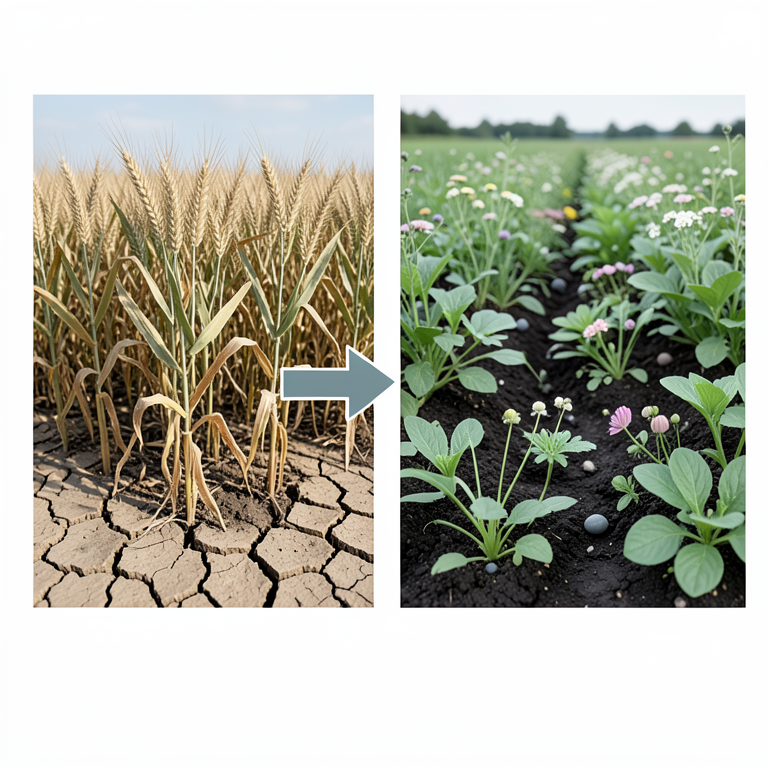
The Cycle of Degradation and Diversification
AI-generated conceptual illustration (Paddy and wheat crops transitioning to a diversified field of pulses, oilseeds, and vegetables in a rural farmland). It explains the idea and does not show study data.
View source evidence ↗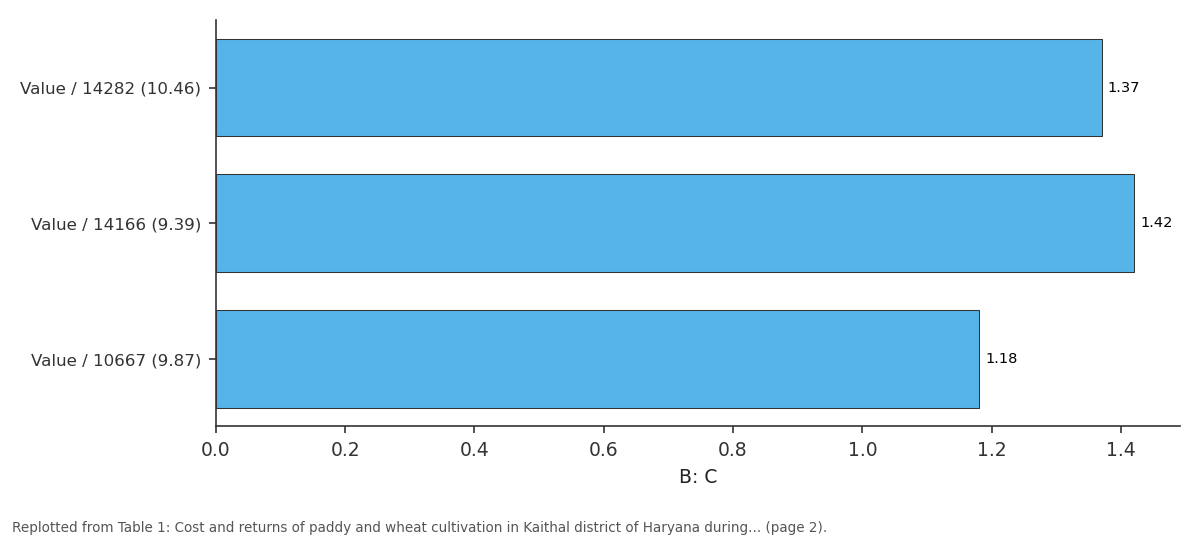
B: C: Value / 14282 (10.46) vs Value / 14166 (9.39) vs Value / 10667 (9.87)
Replotted from Table 1 (page 2) of the original paper. Every bar is the paper's own table value.
View source evidence ↗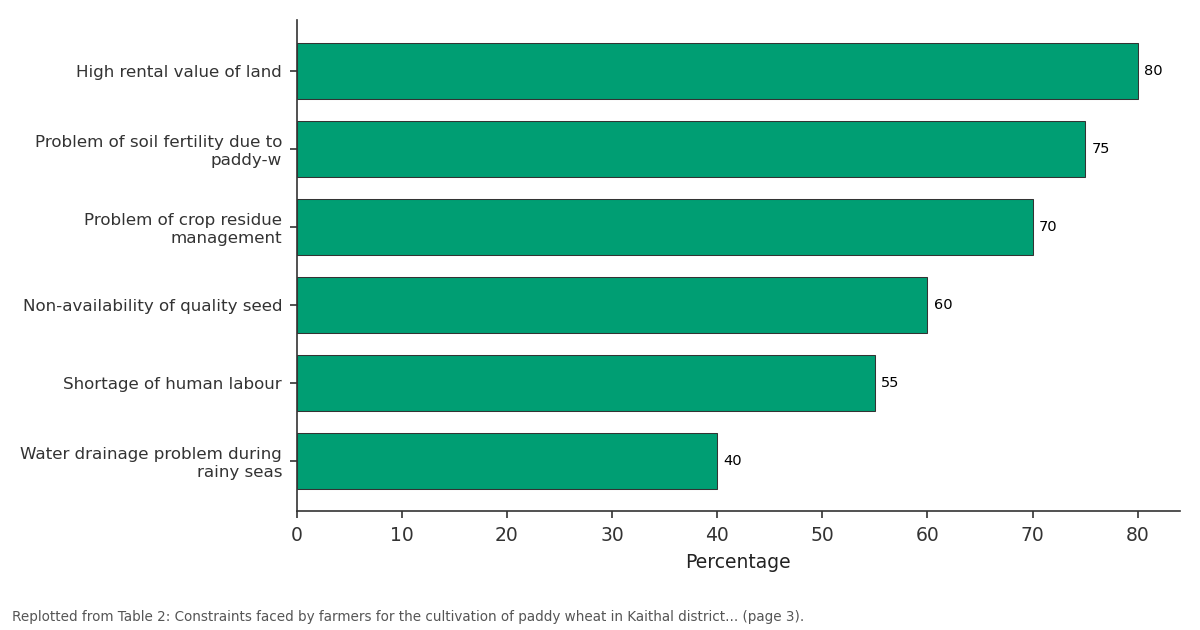
Percentage: High rental value of... vs Problem of soil... vs Problem of crop residue... vs Non-availability of... vs Shortage of human labour
Replotted from Table 2 (page 3) of the original paper. Every bar is the paper's own table value.
View source evidence ↗Figures & tables
From the original paper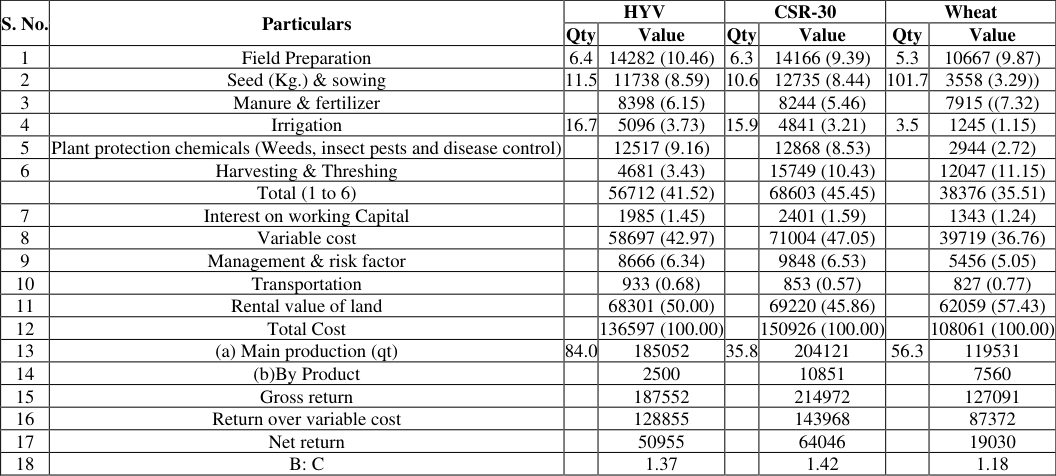 Table 1
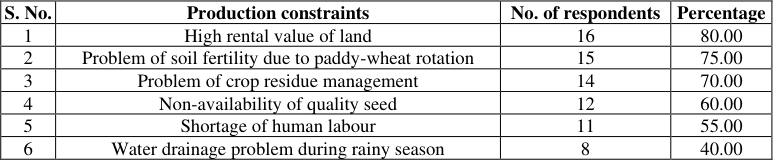 Table 2
Introduction
Rice and Wheat are two major crops in India, contributing significantly to the country's food security and economy. According to the data from the Indian Ministry of Agriculture and Farmers Welfare, the 5-year average production of rice in India from 2019-20 to 2023-24 was 128.49 lakh tons with an average area of 46.31 lakh hectares and average yield of 4.2 tons per hectare, while the production of wheat during the same period averaged 107.12 lakh tons with an average area of 30.73 lakh hectares and an average yield of 3.5 tons per hectare. These statistics highlight the significant contribution of rice to India's agricultural output (Foreign Agricultural Service, 2024) [3] . In Haryana during the year 2022-23, Rice was cultivated over an area of 1661.28 thousand ha and a yield of 3564.40 kg/ha was obtained and the state contributed in 5921.47 thousand tonnes of rice production. On the other hand, wheat was cultivated over an area of 2375.8 thousand ha with a yield of 4684 kg/ha and a total production of 11127.64 thousand tonnes of production was contributed by the state (Anonymous, 2024) [1] . The output of wheat and rice in the country has reached a saturation point. But, farmers in agriculturally advanced states like Punjab and Haryana still prefer to grow wheat and rice despite being aware of problems created by this crop rotation in terms of deteriorating soil health and depleting water table. The production, productivity and profitability which reached a plateau in leading green revolution states, started plummeting in early eighties. These developments made clear that the country would have a surplus of superior cereals and therefore, farmers should diversify towards other crops by increasing area under pulses, oilseeds, fruits, vegetables and commercial crops. With this realization, crop pattern in several states experienced significant change with diversification from traditional food crops to commercial crops, plantation crops and horticultural crops (Vyas, 1996; Nadkarni, 1996; Joshi et.al, 2004; Joshi 2014) [11,7,4,5] . Thus, the monoculture of rice wheat crop rotation in several districts of Haryana particularly in areas with assured irrigation has led to over exploitation of natural resources, degradation in soil fertility and higher susceptibility of crops to the attack of various insects, pests and diseases. Moreover, profitability from these crops has almost stagnated due to stagnating yields and rising input costs including human labour. In such circumstances, crop diversification towards coarse cereals, pulses, oilseeds, fruits, vegetables and commercial crops is being advocated as a future strategy in order to improve income of the farmers and to save natural resources from further degradation.
Materials and Methods
The present study was conducted in Kaithal district of Haryana. The data was collected for paddy and wheat crops from 20 farmers of Sakra village during 2023-24 under RAWE (Rural Agricultural Work Experience) Program. The data was collected from pre-tested schedules. Statistical tools like mean, percentage were used to analyse the data.
Results and Discussion
The item wise break-up of cost of cultivation of paddy (PR-126), Paddy (CSR-30) and wheat crops in Kaithal district www.extensionjournal.com are presented in table 1. Per hectare total cost of paddy (PR-126) and paddy (CSR-30) in Kaithal were Rs. 136597 and Rs. 150926, respectively. Total variable cost was Rs. 58697 and Rs. 71004 in Kaithal district, respectively. Expenditure on field preparation, seed & sowing, manure & fertilizers, plant protection chemicals, irrigation and harvesting & threshing were the important component of total variable cost. The highest expenditure incurred in the cultivation of paddy (PR-126) on field preparation was (10.46%) followed by plant protection chemicals (9.16%), seed & sowing (8.59%), manure & fertilizers (6.15%), irrigation (3.73%) and harvesting & threshing (3.43%) in Kaithal district, respectively. Similarly, rental value of land, management & risk factor and transportation cost were the major components of fixed cost in paddy (PR-126). The rental value of land was the highest which accounted for Rs. 68301 per hectare (50.00%) of the total cost followed by management & risk factor (6.34%) and transportation cost (0.68%), respectively. The gross return of paddy (PR-126) cultivation in Kaithal district was Rs. 187552 per hectare. The return over variable cost and net return were Rs. 128855 & Rs. 50955 per hectare, respectively. The cost benefit ratio in Kaithal district was 1.37. Similar findings were also observed by Saini et al., 2019 [8] . Similarly, per hectare total cost and variable cost of cultivation of paddy (CSR-30) in Kaithal were Rs. 150926 and 71004 per hectare, respectively. The highest expenditure incurred in the cultivation of paddy (CSR-30) on harvesting & threshing (10.43%) followed by field preparation was (9.39%) plant protection chemicals (8.53%), seed & sowing (8.44%), manure & fertilizers (5.46%) and irrigation (3.21%) in Kaithal district, respectively. Similarly, rental value of land, management & risk factor and transportation cost were the major components of fixed cost in paddy (CSR-30). The rental value of land was the highest which accounted for Rs. 69220 per hectare (45.86%) of the total cost followed by management & risk factor (6.53%) and transportation cost (0.57%), respectively. The gross return of paddy (CSR-30) cultivation in Kaithal district was Rs. 214972 per hectare. The return over variable cost and net return were Rs. 143968 and Rs. 64046 per hectare, respectively. The cost benefit ratio in Kaithal district was 1.42. Similar findings were also observed by Kamboj et al., 2021 [6] . The per hectare total cost and variable cost of cultivation of wheat in Kaithal were Rs. 108061 and 39719 per hectare, respectively. The highest expenditure incurred in the cultivation of wheat on harvesting & threshing (11.15%) followed by field preparation was (9.87%), manure & fertilizers (7.32%), seed & sowing (3.29%), plant protection chemicals (2.72%), and irrigation (1.15%) in Kaithal district, respectively. Similarly, rental value of land, management & risk factor and transportation cost were the major components of fixed cost of wheat cultivation. The rental value of land was the highest which accounted for Rs. 62059 per hectare (57.43%) of the total cost followed by management & risk factor (5.05%) and transportation cost (0.77%), respectively. The gross return of wheat cultivation in Kaithal district was Rs. 127091 per hectare. The return over variable cost and net return were Rs. 87371 and Rs. 19030 per hectare, respectively. The cost benefit ratio in Kaithal district was 1.18. Similar findings were also observed by Tripathi and Singh 2018 [10] .
| S. No. | Particulars | HYV | — | CSR-30 | — | Wheat | — |
|---|---|---|---|---|---|---|---|
| Qty | Value | Qty | Value | Qty | Value | ||
| 1 | Field Preparation | 6.4 | 14282 (10.46) | 6.3 | 14166 (9.39) | 5.3 | 10667 (9.87) |
| 2 | Seed (Kg.) & sowing | 11.5 | 11738 (8.59) | 10.6 | 12735 (8.44) | 101.7 | 3558 (3.29)) |
| 3 | Manure & fertilizer | 8398 (6.15) | 8244 (5.46) | 7915 ((7.32) | |||
| 4 | Irrigation | 16.7 | 5096 (3.73) | 15.9 | 4841 (3.21) | 3.5 | 1245 (1.15) |
| 5 | Plant protection chemicals (Weeds, insect pests and disease control) | 12517 (9.16) | 12868 (8.53) | 2944 (2.72) | |||
| 6 | Harvesting & Threshing | 4681 (3.43) | 15749 (10.43) | 12047 (11.15) | |||
| Total (1 to 6) | 56712 (41.52) | 68603 (45.45) | 38376 (35.51) | ||||
| 7 | Interest on working Capital | 1985 (1.45) | 2401 (1.59) | 1343 (1.24) | |||
| 8 | Variable cost | 58697 (42.97) | 71004 (47.05) | 39719 (36.76) | |||
| 9 | Management & risk factor | 8666 (6.34) | 9848 (6.53) | 5456 (5.05) | |||
| 10 | Transportation | 933 (0.68) | 853 (0.57) | 827 (0.77) | |||
| 11 | Rental value of land | 68301 (50.00) | 69220 (45.86) | 62059 (57.43) | |||
| 12 | Total Cost | 136597 (100.00) | 150926 (100.00) | 108061 (100.00) | |||
| 13 | (a) Main production (qt) | 84.0 | 185052 | 35.8 | 204121 | 56.3 | 119531 |
| 14 | (b)By Product | 2500 | 10851 | 7560 | |||
| 15 | Gross return | 187552 | 214972 | 127091 | |||
| 16 | Return over variable cost | 128855 | 143968 | 87372 | |||
| 17 | Net return | 50955 | 64046 | 19030 | |||
| 18 | B: C | 1.37 | 1.42 | 1.18 |
Table text extracted from the original PDF; superscript letters are shown inline. The original table image is below.
View original table image
Constraints faced by farmers in paddy-wheat cultivation
The constraints faced by growers in cultivation of paddywheat are presented in table 2. Major constraints were the high rental value of land as revealed by 80.00 per cent of the growers. It was due to compaction among the paddy growers and assured MSP and high market price in the market of paddy crop followed by problem of soil fertility due to paddy-wheat rotation (75.00%). The soil health deteriorates because of paddy-wheat rotation (Debangshi and Ghosh, 2022) [2] , problem of crop residue management (70.00%), non-availability of quality seed (60.00%), shortage of human labour (55.00%) and problem of water drainage during rainy season (40.00%) Similar observations were also reported by Singh (2011) [9] . and Rs. 127091 per hectare, respectively. The cost benefit ratio recorded for paddy (PR-126), paddy (CSR-30) and wheat was 1.37, 1.42 and 1.18, respectively which was more than one indicated that cultivation of these crops in the study area was profitable. Meanwhile there were constraints faced by farmers due to paddy wheat rotation in the study area were the high rental value of land as revealed by 80.00 per cent of the growers followed by problem of soil fertility (75.00%), problem of crop residue management (70.00%) and non-availability of quality seed (60.00%). For mitigating these constraints there must be need of diversification to improve soil health and crop residue management.
| S. No. | Production constraints | No. of respondents | Percentage |
|---|---|---|---|
| 1 | High rental value of land | 16 | 80.00 |
| 2 | Problem of soil fertility due to paddy-wheat rotation | 15 | 75.00 |
| 3 | Problem of crop residue management | 14 | 70.00 |
| 4 | Non-availability of quality seed | 12 | 60.00 |
| 5 | Shortage of human labour | 11 | 55.00 |
| 6 | Water drainage problem during rainy season | 8 | 40.00 |
Table text extracted from the original PDF; superscript letters are shown inline. The original table image is below.
View original table image
References
8 in the original paper- Debangshi U, Ghosh P. Rice wheat cropping systemsconstraints and strategies: A review. Plant Arch. 2022;22(1):19-28.
- Joshi PK, Gulati A, Birthal PS, Tewari L. Agriculture diversification in South Asia: Patterns, determinants and policy implications. Econ Polit Wkly. 2004;39(24):2457-2467.
- Kamboj P, Kumar S, Sanjay. Economic analysis of basmati cultivation in Haryana. The Pharma Innovation J. 2021;SP-10(11):2948-2953.
- Nadkarni MV, Vedini KH. Accelerating commercialization of agriculture: Dynamic agriculture and stagnating peasants. Econ Polit Wkly. 1996;3(26)
- Saini S, Nimbrayan PK, Amar Jeet. An economic analysis of wheat and paddy cultivation in Kurukshetra District of Haryana. Int Arch Appl Sci Technol. 2019;10(3):28-31.
- Singh M. Yield gap and production constraints in ricewheat system: Scenario from eastern Uttar Pradesh. Bangladesh J Agric Res. 2011;36(4):623-632.
- Tripathi AK, Singh JP. An economic analysis of production and marketing of wheat in Ghazipur District of Eastern U.P. J Pharmacogn Phytochem. 2018;SP1:1686-1688.
- Vyas VS. Diversification in agriculture: Concept, rationale and approaches. Indian J Agric Econ. 1996;5(4):636-646.