
Research article · 2024 · Full text
International Journal of Agriculture Extension and Social DevelopmentConstraints faced by the rural women in attending the training programme of KVK: Study of Varanasi district
Volume 7(7) · Pages 494–496 · DOI: 10.33545/26180723.2024.v7.i7g.847 ↗
Research areasLivestock Management and Performance ImprovementAgricultural Economics and PracticesSocial and Economic Development in India
Abstract
Author-writtenConstraints faced by the rural women in attending the training programme of KVK: Study of Varanasi district
Summary
Source-checkedPlain-language reading of the full paper, prepared with AI and checked against the text. Each point links to the authors' own words.
Why it matters
- Rural women in India often perform significant unpaid labor in domestic and farm settings, yet they remain economically and psychologically disempowered. View evidence ↗
- Vocational training provided by Krishi Vigyan Kendra (KVK) aims to increase income and improve socio-economic status by helping women utilize agricultural technologies. View evidence ↗
- The core mandate of KVK includes capacity development, technology assessment, and demonstrating the application of these technologies. View evidence ↗
The question
- The study aims to evaluate the challenges rural women face when participating in KVK training programs and establishing entrepreneurial ventures. View evidence ↗
What they did
- The researchers used purposive sampling to select the Varanasi region of Uttar Pradesh for the study. View evidence ↗
- The study sample consisted of 120 rural women, with 60 respondents randomly selected from each of two villages: Kallipur and Khajuri. View evidence ↗
- Data collection involved a mix of qualitative and quantitative methods, specifically pre-tested interviews and structured questionnaires. View evidence ↗
- To measure constraints, respondents answered 10 questions using a 3-point scale: Always, Sometimes, and Never. View evidence ↗
What they found
- The most severe constraint was a lack of time to spend away from home, reported by 96.67% of the women. View evidence ↗
- Major social barriers included family restrictions on training (74.17%), negative societal views on women's mobility (71.67%), and lack of family support (60.00%). View evidence ↗
- Economic and technical barriers included inability to compete with existing brands (45.00%), lack of startup funds (40.00%), infrequent extension visits (37.50%), and technical language barriers (24.17%). View evidence ↗
- The least reported constraints were difficulty reaching the center (17.50%) and inadequate facilities at the center (12.50%). View evidence ↗
- To improve participation, 75.83% of respondents suggested implementing flexible training schedules, such as weekends or evenings. View evidence ↗
- 60.83% of respondents suggested using awareness campaigns to engage families by showing success stories and ensuring safety. View evidence ↗
- Respondents recommended avoiding training during peak harvest seasons (52.50%) and conducting sessions in the local language (45.00%). View evidence ↗
What it means
- The authors conclude that KVK can improve access to vocational training by implementing respondent suggestions and addressing the identified multifaceted constraints. View evidence ↗
- Addressing these barriers is seen as a pathway to economic independence for rural women and inclusive socio-economic development in rural India. View evidence ↗
Visual summary
2 visualsIllustrations explain the paper; charts are replotted from the paper's own table values.
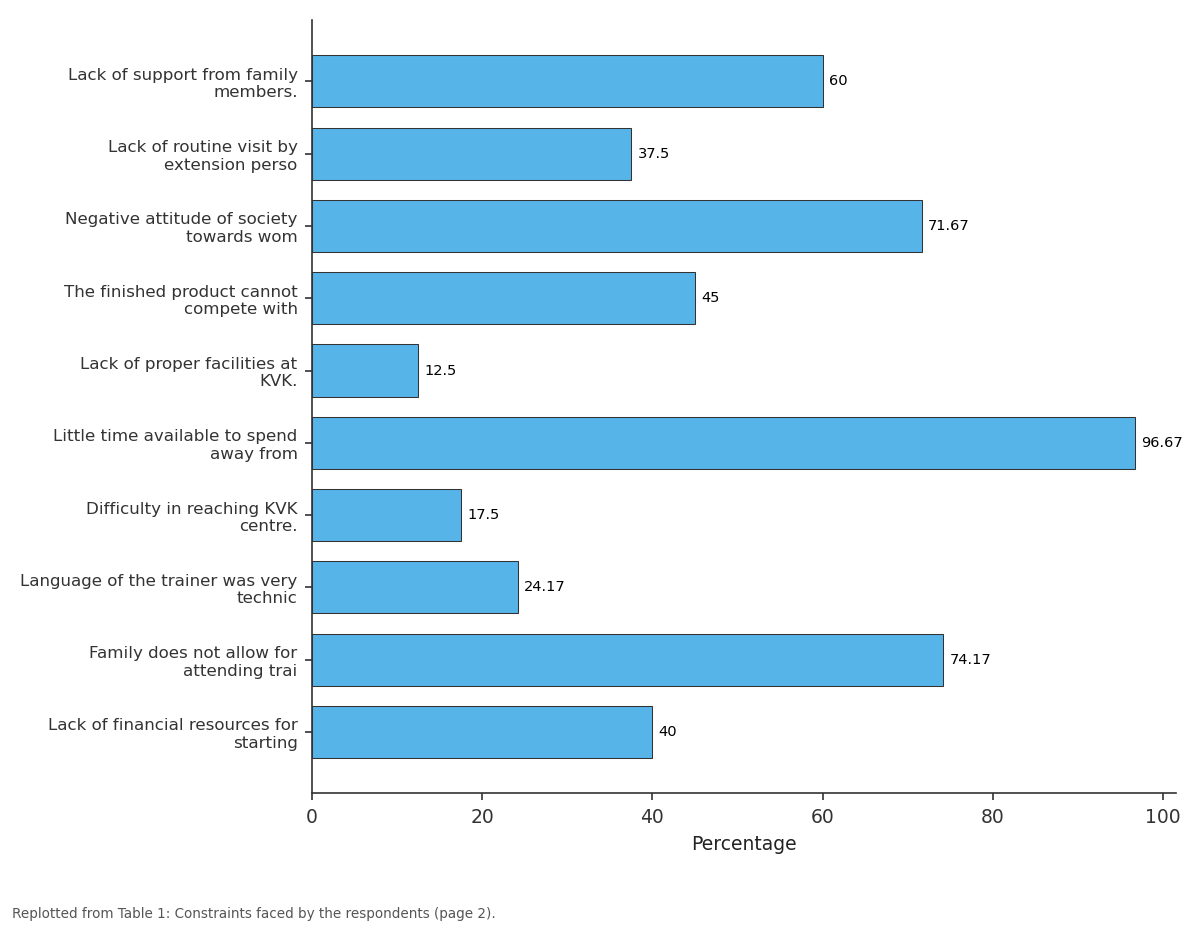
Percentage: Lack of support from... vs Lack of routine visit... vs Negative attitude of... vs The finished product... vs Lack of proper...
Replotted from Table 1 (page 2) of the original paper. Every bar is the paper's own table value.
View source evidence ↗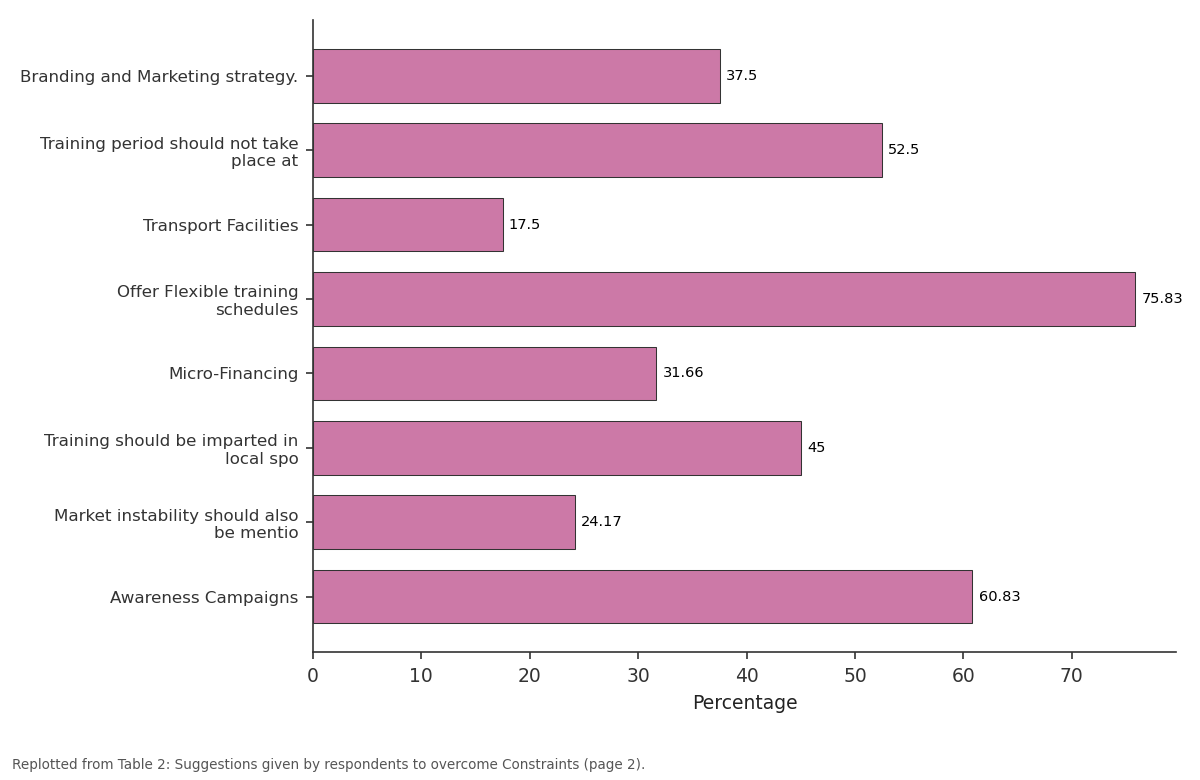
Percentage: Branding and Marketing... vs Training period should... vs Transport Facilities vs Offer Flexible training... vs Micro-Financing
Replotted from Table 2 (page 2) of the original paper. Every bar is the paper's own table value.
View source evidence ↗Figures & tables
From the original paper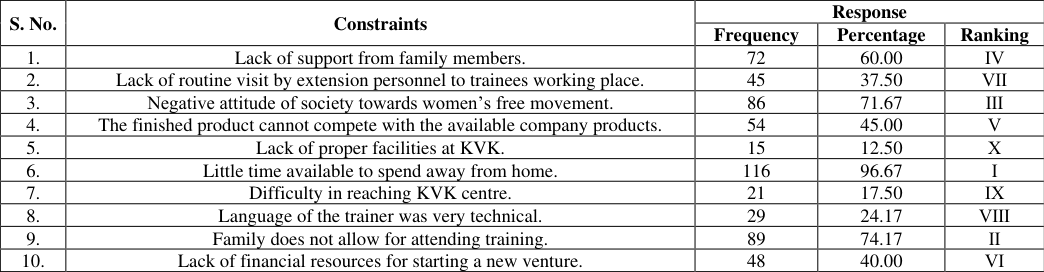 Table 1
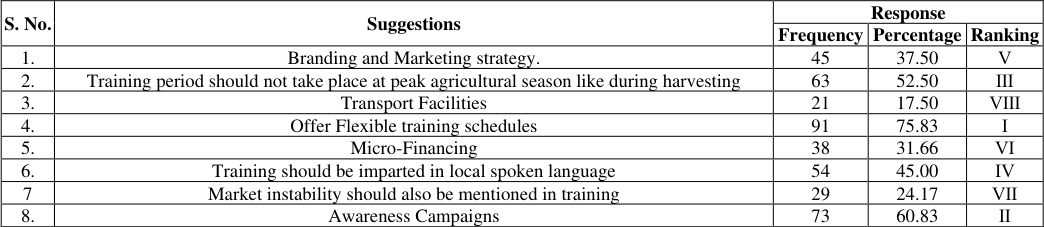 Table 2
Introduction
The Indian Council of Agriculture (ICAR) in1973, appointed a committee under the Chairmanship of Dr. Mohan Singh Mehta for formulating the institutional design of KVK for providing vocational training in agriculture and allied sectors for the rural people with emphasis on 'learning by doing' for generating self-employment. The mandate of KVK is Technology Assessment, Demonstration for its application and Capacity Development. Training is one of the important aspects of Human Resource Development. KVKs impart trainings and education with a view to raise the level of Knowledge, Attitudinal and Increase selfemployment opportunities. There are total 731 KVK in India. Rural women play a pivotal yet often overlooked role in agricultural and household economies across India. Despite their integral contributions, they encounter numerous constraints that hinder their participation in training programs aimed at enhancing their skills and livelihoods. KVK, recognizing the importance of empowering rural women, conducts various training programs focused on agricultural practices, entrepreneurship, and vocational skills. This introduction delves into the constraints faced by rural women in attending KVK's training programs. These constraints encompass logistical challenges such as access to transportation and childcare, socio-cultural barriers including gender norms and societal attitudes towards women's mobility, and economic limitations. This study aims to shed light on these constraints. By identifying, analysing and seeking solutions to these constraints, we can pave the way for inclusive growth and empowerment, ensuring that all individuals have equitable opportunities to thrive and contribute to their communities' development.
Materials and Methods
The study has been conducted in the state of Uttar Pradesh. Uttar Pradesh has 75 districts. Varanasi region is selected by purposive sampling because the researcher is well acquainted with the culture, social customs, and language. Varanasi district comprises 8 blocks, out of which Arajiline block is selected by purposive sampling. The purpose of choosing Arajiline block is due to its high engagement with training programs by KVK, which provides a significant number of rural women for the study. Arajiline block consists of 229 villages. From these, two villages are selected through purposive sampling based on the availability of the maximum number of trained women who have participated in KVK training Programs. The selected villages were Kallipur and Khajuri. From both of the Village, 60 respondents were selected through random sampling method. Thus, constitutes the 120 respondents from 2 villages forms the respondents of the study. Data was collected through personal interviews conducted with the selected respondents. The collected data will be analysed using appropriate statistical tools. Descriptive statistics such as frequencies, percentages, means, and standard deviations will be employed to summarize the demographic and socioeconomic characteristics of the respondents. To measure the constraints of the respondents in attending the training programme conducted by the KVK, 10 questions were asked from them and their responses were recorded on 3point continuum scale as Always, Sometimes and Never respectively.
Results and Discussion
The Table-1 provides a comprehensive overview of the constraints faced by respondents participating in a training program, as identified through a survey conducted among rural women. Each constraint is quantitively represented by its frequency, percentage of respondents affected, and ranking in terms of perceived severity. Similar findings were also reported by Malabasari and Hiremath (2016) [3] . 2015) [1] .
Conclusion
This study underscores the significant challenges faced by rural women in Varanasi district when participating in training programs and venturing into entrepreneurship facilitated by Krishi Vigyan Kendra (KVK). Through a thorough examination of constraints, it is clear that time constraints, family support, societal attitudes towards women's mobility, and financial barriers emerge as primary obstacles hindering their full engagement. The findings highlight the need for targeted interventions to address these multifaceted challenges effectively. Recommendations from respondents, such as improving accessibility through transport facilities, adapting training content to local needs, and conducting sessions in the local language, provide actionable insights for enhancing program effectiveness. By implementing these suggestions and addressing identified constraints, KVK can foster an environment where rural women can more readily access and benefit from vocational training opportunities. This, in turn, can empower them to achieve economic independence, contribute meaningfully to their communities, and advance towards inclusive socioeconomic development in rural India.
Acknowledgement
AcknowledgementI express my deepest gratitude to my Advisor, Prof. Dr. (Ms.) Jahanara, for their invaluable guidance and support. I also thank the faculty of Department of Agricultural Extension and Communication, NAI -SHUATS, and KVK Varanasi for their assistance. Special thanks to the participating women for their insights, and to my family and friends for their unwavering support.
Figures and tables from the paper
| S. No. | Constraints | Response | — | — |
|---|---|---|---|---|
| Frequency | Percentage | Ranking | ||
| 1. | Lack of support from family members. | 72 | 60.00 | Ⅳ |
| 2. | Lack of routine visit by extension personnel to trainees working place. | 45 | 37.50 | Ⅶ |
| 3. | Negative attitude of society towards women’s free movement. | 86 | 71.67 | Ⅲ |
| 4. | The finished product cannot compete with the available company products. | 54 | 45.00 | Ⅴ |
| 5. | Lack of proper facilities at KVK. | 15 | 12.50 | Ⅹ |
| 6. | Little time available to spend away from home. | 116 | 96.67 | Ⅰ |
| 7. | Difficulty in reaching KVK centre. | 21 | 17.50 | Ⅸ |
| 8. | Language of the trainer was very technical. | 29 | 24.17 | Ⅷ |
| 9. | Family does not allow for attending training. | 89 | 74.17 | Ⅱ |
| 10. | Lack of financial resources for starting a new venture. | 48 | 40.00 | Ⅵ |
Table text extracted from the original PDF; superscript letters are shown inline. The original table image is below.
View original table image
| S. No. | Suggestions | Response | — | — |
|---|---|---|---|---|
| Frequency | Percentage | Ranking | ||
| 1. | Branding and Marketing strategy. | 45 | 37.50 | Ⅴ |
| 2. | Training period should not take place at peak agricultural season like during harvesting | 63 | 52.50 | Ⅲ |
| 3. | Transport Facilities | 21 | 17.50 | Ⅷ |
| 4. | Offer Flexible training schedules | 91 | 75.83 | Ⅰ |
| 5. | Micro-Financing | 38 | 31.66 | Ⅵ |
| 6. | Training should be imparted in local spoken language | 54 | 45.00 | Ⅳ |
| 7 | Market instability should also be mentioned in training | 29 | 24.17 | Ⅶ |
| 8. | Awareness Campaigns | 73 | 60.83 | Ⅱ |
Table text extracted from the original PDF; superscript letters are shown inline. The original table image is below.
View original table image
References
2 in the original paper- Malabasari RT, Hiremath US. Impact of Krishi Vigyan Kendras trainings in adoption of home science technologies. Asian J Home Sci. 2016;11(2):367-372.
- Gupta S, Verma S. Impact of KVK on knowledge level of farm women. J Rural Agric Res. 2013;13(2):87-89.