
Research article · 2024 · Full text
International Journal of Agriculture Extension and Social DevelopmentAdoption of improved black rice (Chak Hao) production practices by farmers in the Imphal east, district of Manipur
Volume 7(7) · Pages 342–345 · DOI: 10.33545/26180723.2024.v7.i7e.823 ↗
Research areasAgricultural Economics and PracticesRice Cultivation and Yield ImprovementAgricultural Systems and Practices
Abstract
Author-writtenA study was conducted in Imphal East District of Manipur during the 2023-2024 period to assess the level of adoption among farmers regarding improved black rice production practices. A total of one twenty respondents were selected for the purpose of the study. The primary data was collected using pre-structured interview schedule and appropriate statistical analysis to obtain the results. It was revealed that majority (50.83%) of the respondents are of middle age group, 26.67 per cent of the respondents were educated up to high school,(53.33%) of the respondents are from joint family, majority (70.83%) of the respondents have hut as their housing pattern, (54.17%) of the respondents are engaged in agriculture 47.50 per cent of the respondents have Rs 50,001 to 1 lakh as their annual income, (55.83%) of the respondents have 1-2 acres of land, 41.67 per cent of the respondents have 10-20 years of farming experience. It was observed that 40.00 per cent of the respondents had low level of mass media exposure, 50.00 per cent of the respondents have medium level extensionist participation/contact, majority (60.00%) of the respondent’s category have medium level to social contact. The study shows that 40.00 per cent of the respondents have medium adoption level towards the improved Black Rice production practices. Age, education, occupation, housing pattern, annual income, land holding, farming experience, mass-media exposure, extension contact and social contact were found positively and significantly correlated with the adoption category of the respondents.
Summary
Source-checkedPlain-language reading of the full paper, prepared with AI and checked against the text. Each point links to the authors' own words.
Why it matters
- Black rice is valued for its dark-purple color and high anthocyanin content, which provides antioxidant properties and various health benefits, including anti-cancer and anti-diabetic effects. View evidence ↗
- In India, black rice (known locally as Chak hao) is traditionally cultivated on a small scale in the state of Manipur. View evidence ↗
- Despite high demand, production of black rice remains low, necessitating an investigation into the constraints affecting its cultivation. View evidence ↗
The question
- The study aimed to assess the level of adoption of improved black rice production practices among farmers in the Imphal East District of Manipur during 2023-2024. View evidence ↗
What they did
- Primary data was gathered using a pre-tested, structured interview schedule. View evidence ↗
- The study used correlation analysis to determine the relationship between socio-economic variables and the adoption of improved production practices. View evidence ↗
What they found
- Farmers showed high full adoption rates for deep ploughing (59.17%), suitable sowing time (55.83%), and recommended varieties (56.67%). View evidence ↗
- Adoption was notably low for chemical fertilizers (66.67% not adopted), pest control (71.67% not adopted), and disease control (68.46% not adopted). View evidence ↗
- A majority of respondents (59.17%) fully adopted the recommended number of days for harvesting. View evidence ↗
- Age, education, annual income, land holding, mass media exposure, and social contact were all positively and significantly correlated with adoption at the 0.01% probability level. View evidence ↗
- Occupation, housing pattern, farming experience, and extension participation also showed positive significant correlations with adoption, though at a lower probability level of 0.05%. View evidence ↗
What it means
- The authors concluded that various socio-economic factors, including education, income, and social contact, directly influence the adoption of improved black rice practices through their correlation with farmer knowledge. View evidence ↗
Figures & tables
From the original paper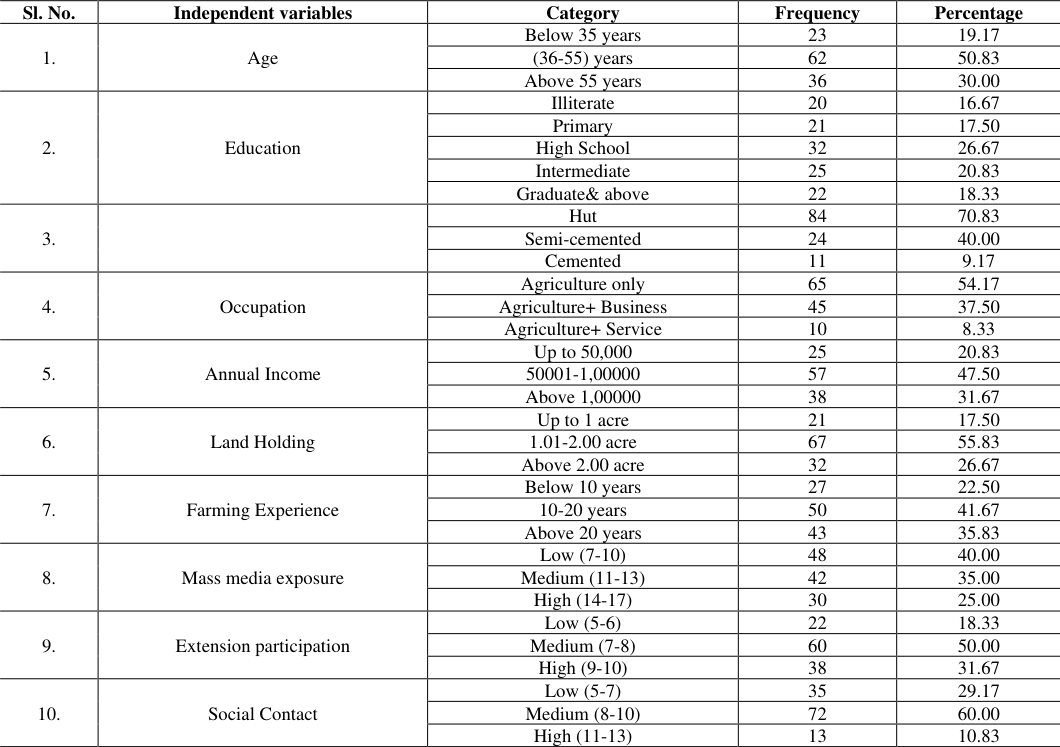 Table 1
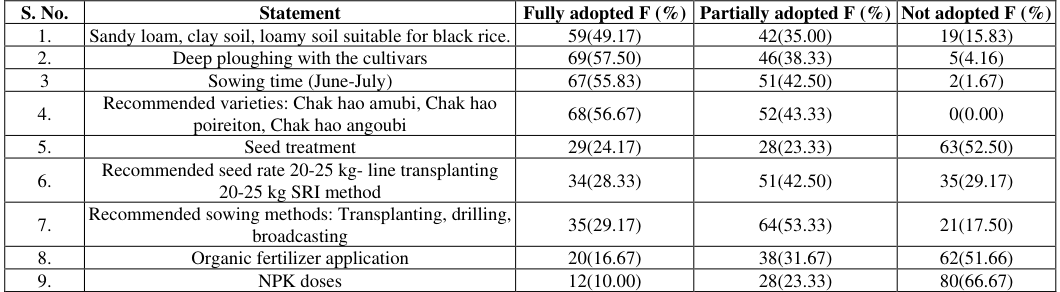 Table 2
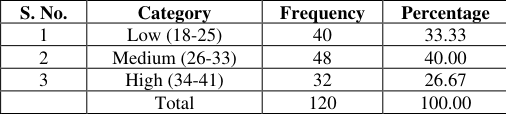 Table 3
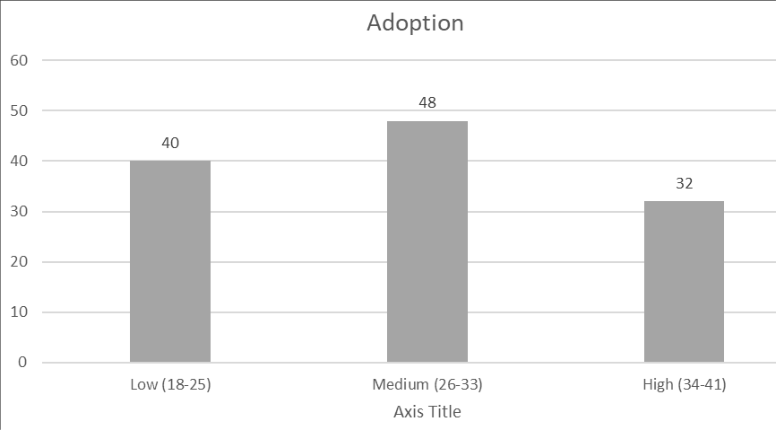 Figure 1
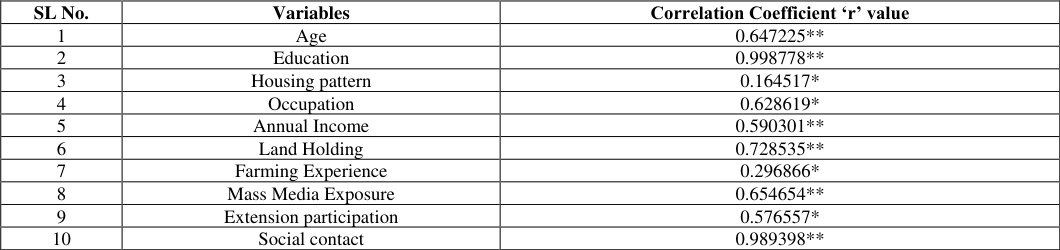 Table 4
Introduction
Black Rice is a type of rice which is grown in various parts of the countries including Manipur, a state of North East India, where it is known by the name "Chak hao", Chak means rice and "Hao" means delicious, together meaning delicious rice. Since ancient times, people in Asian nations including China, Korea, and Japan have enjoyed black rice. According to reports, black rice exhibits higher levels of antioxidant activity in comparison to white rice. It was thought that black rice, which was extremely rare and exceptional, would extend a king's life and promote good health. In India, black rice is grown in Manipur on small scale by traditional farmers. China is the richest country in the black rice resources (62%) followed by Srilanka (8.6%), Indonesia (7.2%), India (5.1%), Bangladesh (4.1%) and few in Malaysia. So far, they have developed 200 varieties including 52 high yielding varieties. Black Rice has a lot of varieties like Chak hao Poreiton, Chak-hao Amubi, Wairi Chak-hao, Khurkhul Chak-hao, Pong Chak-hao, and Chak-hao Sempak, Chak hao Angoubi, Chak hao Arangbi, among them Chak hao Amubi, Chak hao Angoubi and Chak hao Poireiton were mostly cultivated in the Imphal East District of Manipur. Chak hao is famous for its aroma and nutty flavour and is mostly used in traditional feasts and cultural events from the time immemorial.
Nowadays lots of Chak hao products are manufactured from various factories like 'Taret Foods', Leimalen Foods', in various ways like Chak hao kheer, Chak hao bhujia, Chak hao cake, Chak hao gula, Chak hao cereals, Chak kabok etc. Black Rice is dark-purpled in colour due to the presence of anthocyanin which is rich in antioxidants and poses a variety of health benefits like anti-cancer, anti-diabetic, antiobesity etc., Black rice is good for people suffering from diabetes and alzheimer's disease. It helps to protect arteries, controls blood lipid, prevent oxidative DNA damage, reduces cholesterol levels as well as cancer cell invasion and decreases cancer risk/prevent tumors in addition to being a good source of protein, fibre, and vitamin E. The findings of the present study are expecting to help the adoption of Black rice by the farmers in the Imphal East District of Manipur. It will enable us to investigate its appropriate approach to trace out the constrains which lead to the less production of the crop which are very much high in demand. www.extensionjournal.com Sawombung Block was chosen purposively because majority of Black Rice were grown on that area.
Materials and Methods
A pre-tested structured interview schedule directed towards the objectives of the study was developed for primary data collection. The secondary data was obtained from books, journals, research paper, etc. The collected data were classified, tabulated, and analysed according to the objectives. The data presented at Table 2. shows that 49.17 per cent of the respondents has fully adopted the recommended soil type of Black rice cultivation. It shows that majority (59.17%) of the respondents has fully done deep ploughing with the cultivars. It shows that majority (55.83%) of the respondents has fully adopted the suitable sowing time of Black rice cultivation. It shows that majority (56.67%) of the respondents has fully adopted the recommended variety of black rice. It shows that majority (52.50%) of the respondents has not adopted the seed treatment of Black rice cultivation. It shows that 42.50 per cent of the respondents has partially adopted the recommended seed rate of Black rice cultivation. It shows that majority (53.33%) of the respondents has partially adopted the sowing methods recommended for Black rice cultivation. It shows that majority (51.66%) of the respondents has not adopted, the recommended organic fertilizers of Black rice cultivation. It shows that majority (66.67%) of the respondents has not adopted the recommended chemical fertilizers of Black rice cultivation. It shows that majority (51.66%) of the respondents has not adopted the irrigation methods of Black rice cultivation. It shows that majority (60.00%) of the respondents has not adopted proper weed management practices of Black rice cultivation. It shows that majority (71.67%) of the respondents has not adopted the suitable pest control measures of Black rice cultivation. It shows that majority (68.46%) of the respondents has not adopted the disease control measures of Black rice cultivation. It shows that majority (59.17%) of the respondents has fully adopted the recommended days of harvesting of Black rice cultivation. It shows that 40.83 per cent of the respondents has partially adopted the recommended yield of Black rice cultivation. The data presented at Based on the analysis of Table 4 it was observed that several variables, are positively and significantly correlated with adoption of the farmers towards improved Black Rice cultivation. These variables include age, education, annual income, land holding, mass media exposure and social contact. The correlation was found to be statistically significant at a probability level 0.01%. Additionally, occupation, housing pattern, farming experience and extension participation were also positively and significantly correlated with the respondents' adoption, but at a slightly lower probability level of 0.05%.
| SL No. | Variables | Correlation Coefficient ‘r’ value |
|---|---|---|
| 1 | Age | 0.647225** |
| 2 | Education | 0.998778** |
| 3 | Housing pattern | 0.164517* |
| 4 | Occupation | 0.628619* |
| 5 | Annual Income | 0.590301** |
| 6 | Land Holding | 0.728535** |
| 7 | Farming Experience | 0.296866* |
| 8 | Mass Media Exposure | 0.654654** |
| 9 | Extension participation | 0.576557* |
| 10 | Social contact | 0.989398** |
Table text extracted from the original PDF; superscript letters are shown inline. The original table image is below.
View original table image
| S. No. | Statement | Fully adopted F (%) | Partially adopted F (%) | Not adopted F (%) |
|---|---|---|---|---|
| 1. | Sandy loam, clay soil, loamy soil suitable for black rice. | 59(49.17) | 42(35.00) | 19(15.83) |
| 2. | Deep ploughing with the cultivars | 69(57.50) | 46(38.33) | 5(4.16) |
| 3 | Sowing time (June-July) | 67(55.83) | 51(42.50) | 2(1.67) |
| 4. | Recommended varieties: Chak hao amubi, Chak hao poireiton, Chak hao angoubi | 68(56.67) | 52(43.33) | 0(0.00) |
| 5. | Seed treatment | 29(24.17) | 28(23.33) | 63(52.50) |
| 6. | Recommended seed rate 20-25 kg- line transplanting 20-25 kg SRI method | 34(28.33) | 51(42.50) | 35(29.17) |
| 7. | Recommended sowing methods: Transplanting, drilling, broadcasting | 35(29.17) | 64(53.33) | 21(17.50) |
| 8. | Organic fertilizer application | 20(16.67) | 38(31.67) | 62(51.66) |
| 9. | NPK doses | 12(10.00) | 28(23.33) | 80(66.67) |
Table text extracted from the original PDF; superscript letters are shown inline. The original table image is below.
View original table image
Results and Discussions
Results and Discussions
Conclusion
It was concluded that majority of the respondents are of middle age group and attained High School, are from joint family, have hut as their housing pattern, are engaged in agriculture, having Rs 50,001 to 1 lakh as their annual income, have 1-2 acres of land, have 10-20 years of farming experience, low level of mass media exposure, medium level extensionist contact, medium level to social contact, medium adoption level category towards the improved black rice production practices. The factors influencing the adoption of the farmers towards improved black rice production practices were age, education, occupation, housing pattern, annual income, land holding, farming experience, mass media exposure and extension participation and social contact, which were directly correlated with knowledge towards Black Rice production practices.
Figures and tables from the paper
| Sl. No. | Independent variables | Category | Frequency | Percentage |
|---|---|---|---|---|
| 1. | Age | Below 35 years | 23 | 19.17 |
| (36-55) years | 62 | 50.83 | ||
| Above 55 years | 36 | 30.00 | ||
| 2. | Education | Illiterate | 20 | 16.67 |
| Primary | 21 | 17.50 | ||
| High School | 32 | 26.67 | ||
| Intermediate | 25 | 20.83 | ||
| Graduate& above | 22 | 18.33 | ||
| 3. | Hut | 84 | 70.83 | |
| Semi-cemented | 24 | 40.00 | ||
| Cemented | 11 | 9.17 | ||
| 4. | Occupation | Agriculture only | 65 | 54.17 |
| Agriculture+ Business | 45 | 37.50 | ||
| Agriculture+ Service | 10 | 8.33 | ||
| 5. | Annual Income | Up to 50,000 | 25 | 20.83 |
| 50001-1,00000 | 57 | 47.50 | ||
| Above 1,00000 | 38 | 31.67 | ||
| 6. | Land Holding | Up to 1 acre | 21 | 17.50 |
| 1.01-2.00 acre | 67 | 55.83 | ||
| Above 2.00 acre | 32 | 26.67 | ||
| 7. | Farming Experience | Below 10 years | 27 | 22.50 |
| 10-20 years | 50 | 41.67 | ||
| Above 20 years | 43 | 35.83 | ||
| 8. | Mass media exposure | Low (7-10) | 48 | 40.00 |
| Medium (11-13) | 42 | 35.00 | ||
| High (14-17) | 30 | 25.00 | ||
| 9. | Extension participation | Low (5-6) | 22 | 18.33 |
| Medium (7-8) | 60 | 50.00 | ||
| High (9-10) | 38 | 31.67 | ||
| 10. | Social Contact | Low (5-7) | 35 | 29.17 |
| Medium (8-10) | 72 | 60.00 | ||
| High (11-13) | 13 | 10.83 |
Table text extracted from the original PDF; superscript letters are shown inline. The original table image is below.
View original table image
| S. No. | Category | Frequency | Percentage |
|---|---|---|---|
| 1 | Low (18-25) | 40 | 33.33 |
| 2 | Medium (26-33) | 48 | 40.00 |
| 3 | High (34-41) | 32 | 26.67 |
| Total | 120 | 100.00 |
Table text extracted from the original PDF; superscript letters are shown inline. The original table image is below.
View original table image
References
10 in the original paper- Singh DP, Yadav SK. Knowledge and adoption gap of tribal farmers of Bastar towards rice production technology. American International Journal of Research in Humanities, Arts and Social Sciences. 2014;5(1):5456.
- Dubey AK, Srivastava JP. Effect of training programme on knowledge and adoption behaviour of farmers on wheat production technologies. Indian Research Journal of Extension Education. 2016;7(3):41-43.
- Thakker BN, Patel KH, Singh SK. Knowledge and adoption of farmers about scientific cultivation of maize in Panchmahal district. Young. 2017;34:24-29.
- Shijagurumayum S, Devi GA, Singh CB. Grain quality evaluation of some aromatic rice varieties of Manipur, India. Research on Crops. 2021;19(2):169-181.
- Shijagurumayum S, Devi GA, Singh CB. Chakhao scented traditional rice of Manipur (India). Journal of Advanced Scientific Research. 2021;12(1):1-9.
- Sarma PK, Alam MJ, Begum IA. Farmers' knowledge, attitudes, and practices towards the adoption of hybrid rice production in Bangladesh: A PLS-SEM approach. GM Crops & Food. 2022;13(1):327-341.
- Devi B, Dubey MK, Jaiswal DK. Adoption of minor millets production technology among tribal farmers of Dindori district in Madhya Pradesh. The Pharma Innovation Journal. 2023;12(10):1225-1228.
- Khapudang D, Bose DK. Adoption of improved Hathei Chilli production practices by tribal farmers in Sirarakhong Village of Ukhrul District, Manipur, India. Research Highlights in Agricultural Sciences. 2023;7(1):106-116.
- Premavathi R, Vennila MA, Sasikala R, Karthickraja M. Extent of adoption and socio-economic impact of TNAU Millet varieties and technologies in Dharmapuri District. The Pharma Innovation Journal. 2023;12(9):2699-2702.
- Sharma S, Ningombam L, Loukham L. Socio-economic impact on livelihood of black rice growers in Manipur. Economic Affairs. 2023;68(2):1069-1074.