
Research article · 2024 · Full text
International Journal of Agriculture Extension and Social DevelopmentTesting relationship of bending rigidity with drape coefficient for silk viscose blended knitted fabrics
Volume 7(7) · Pages 398–399 · DOI: 10.33545/26180723.2024.v7.i7f.830 ↗
Research areasTextile materials and evaluationsSilk-based biomaterials and applications
Abstract
Author-writtenAesthetic behavior of any fabric is largely determined by its property to drape. It has an important bearing on how good a garment looks in use. Knitted fabrics known for their high elastic properties often have high drape characteristics. In the present investigation, the influence of bending rigidity of fabrics in prediction of drapability of weft knitted fabric, have been determined. Knitted fabrics blended in proportion of 50: 50 silk and viscose, have been developed in two yarn counts. And their bending rigidities and drape coefficients were obtained. Statistical analysis has been done for the findings indicating that draping has linear correlation with bending rigidities.
Summary
Source-checkedPlain-language reading of the full paper, prepared with AI and checked against the text. Each point links to the authors' own words.
Why it matters
- The drape of a fabric is a critical factor in determining its aesthetic behavior and how a garment appears when worn. View evidence ↗
- Fabric drape is not an independent property; it is influenced by other characteristics, including bending rigidity. View evidence ↗
- Bending rigidity is defined as the resistance of a fabric to being bent. View evidence ↗
The question
- The study aims to determine how bending rigidity can be used to predict the drapability of fabrics. View evidence ↗
What they did
- The researchers used fabrics made from a 50% silk and 50% viscose blend in two yarn counts: 15 Nm and 20 Nm. View evidence ↗
- Drape coefficients were measured using a drapemeter with a 10-inch diameter circular sample placed on a 5-inch diameter supporting disc. View evidence ↗
- Bending rigidity was measured using a cantilever stiffness tester with fabric strips measuring 6 inches by 1 inch. View evidence ↗
What they found
- The 15 Nm yarn fabric had a higher drape coefficient (38.040) compared to the 20 Nm yarn fabric (32.870). View evidence ↗
- For 15 Nm yarn, bending rigidity was 203.142 mg/cm in the wale direction and 152.393 mg/cm in the course direction. View evidence ↗
- For 20 Nm yarn, bending rigidity was 168.202 mg/cm in the wale direction and 96.699 mg/cm in the course direction. View evidence ↗
- A strong positive correlation (R = 0.983) was found between the drape coefficient and bending rigidity in the wale direction for 15 Nm yarn. View evidence ↗
- For 20 Nm yarn, strong positive correlations were observed in both the wale direction (R = 0.9607) and the course direction (R = 0.9229). View evidence ↗
What it means
- The authors conclude that bending rigidity has a positive impact on the drape coefficient, meaning an increase in one typically leads to an increase in the other. View evidence ↗
Visual summary
3 visualsIllustrations explain the paper; charts are replotted from the paper's own table values.
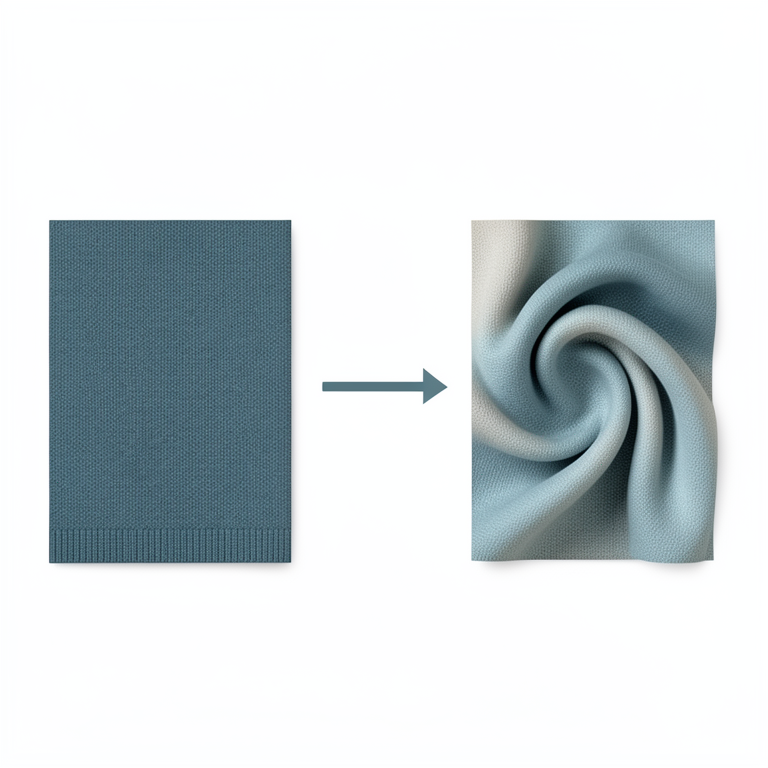
Relationship between Bending Rigidity and Drape
AI-generated conceptual illustration (silk viscose blended knitted fabrics). It explains the idea and does not show study data.
View source evidence ↗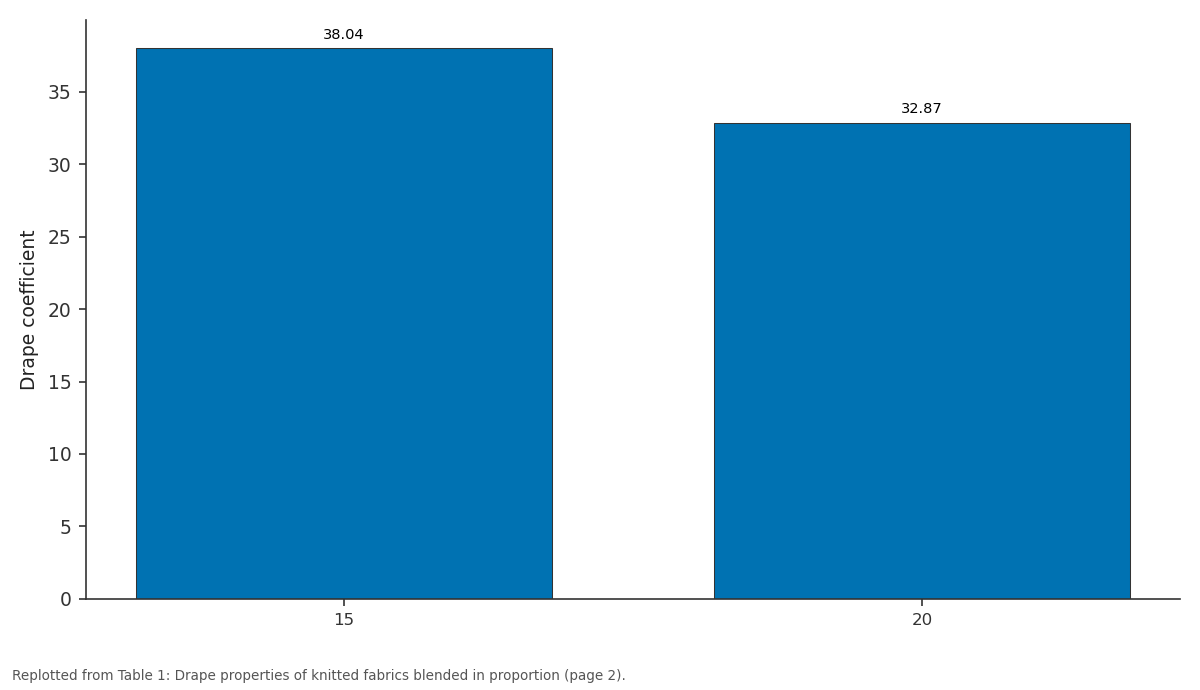
Drape coefficient: 15 vs 20
Replotted from Table 1 (page 2) of the original paper. Every bar is the paper's own table value.
View source evidence ↗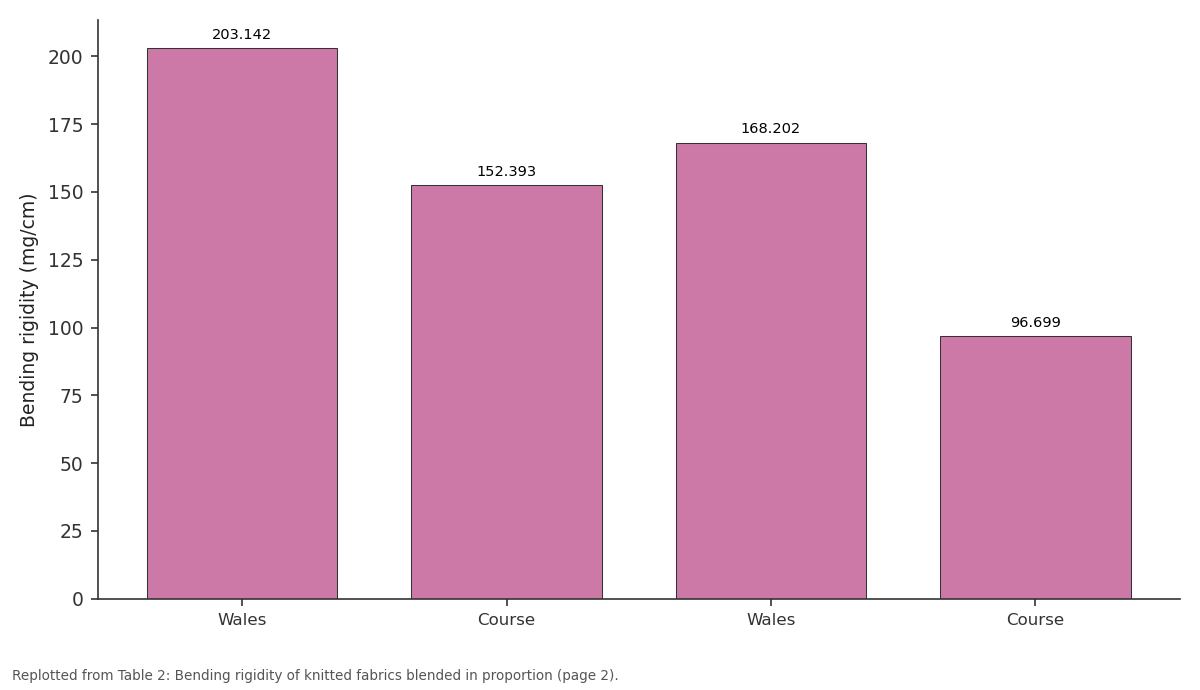
Bending rigidity (mg/cm): Wales vs Course vs Wales vs Course
Replotted from Table 2 (page 2) of the original paper. Every bar is the paper's own table value.
View source evidence ↗Figures & tables
From the original paper Table 1
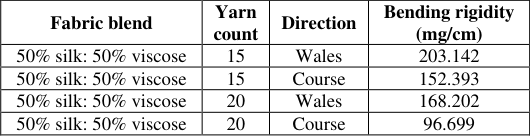 Table 2
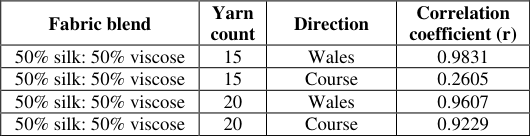 Table 3
Introduction
The trade of knitting has gone through brisk changes in relation to trends and customer interests. User requirements have been modified a lot in the recent years in terms of character and nature of fabric. High fashion fabrics with high perfection are demanded. In this context, the property of drape plays as significant role as deciding end use of the fabric. The term 'drape' can be defined as the ability of a fabric to assume graceful appearance in use. According to Glock and Kunz 1 , drapability relates to how fabric falls when it hangs, its ability to form graceful configurations. Although drape is a subjective quality as it pertains to appearance, attempts have been made to objectively define and measure drape in fabric form [2] . Subjective evaluation of drape is related to psychological factors like human perceptions, whereas, objective evaluation of fabric drape involves measurement of drapability in terms of drape coefficient. Fabric drape is not an independent property [3] . It is influenced by many other properties of fabric, one of which is bending rigidity. As opined by Adanur [4] , bending rigidity is resistance of fabric to bending. It is the resistance which is observed when the fabric is bent back and forth between the fingers. The higher the rigidity of structure, lesser it will bend under a given load [5] . Flexural rigidity is one of factors perceived through the human body sensory mechanisms [6] . In this paper, the impact of bending rigidity in prediction of drape ability of fabric has been determined.
Materials and methods
Blended yarns in proportion of 50 % silk: 50% viscose, in two different yarn counts viz. 15 Nm and 20 Nm were utilized for fabric construction. Knitting was carried out on sinker circular knitting machine and single jersey structures were obtained on 10 gauge. Physical parameters of blended knitted fabrics were analyzed. Drape is a unique physical property that allows a fabric to be bent in more than one direction with double curvature [7] . Drapabilty being a significant measure for end use of a fabric, was also analyzed for its dependence and influence of other related parameters. Drape coefficient was measured using drapemeter. A circular sample was cut with a diameter of 10 inches and was kept over a supporting metal disc of diameter 5 inches. During this, the unsupported sides of fabric fell under the influence of gravity and draped over the edges of supporting disc. Drape coefficient was calculated by using below formula:
Where, A D = The area of specimen A d = The area of supporting disc A s = The actual projected area of the specimen The drape coefficient F, is the ratio between the projected area of specimen and its undraped area, after deduction of the area of the supporting disc. Bending rigidity of knitted fabrics was computed by using cantilever stiffness tester. A fabric strip of 6 inch x 1 inch was mounted on a horizontal plateform in such a way that overhangs like a cantilever and bends downward. The scale of equipment was in cms of bending length which can also be used for cutting specimen to exact size. The fabric was moved a little to the right side and stopped when it bends and coincides with the slanting line in the mirror. The bent length was measured. Specimens were tested both www.extensionjournal.com Drape coefficient for 15 Nm yarn was calculated as 38.040, whereas, it was 32.870 for 20 Nm. According to Gnanavel and Ananthakrishnan [8] , a low drape coefficient indicates easy deformation of a fabric and a high drape coefficient indicates less deformation. This is because higher projected area means less drapability. Findings of bending rigidity elucidate that fabric knitted with 15 Nm yarn count has bending rigidity of 203.142 mg/cm in the direction of wales. In course wise direction, bending rigidity was calculated as 152.393 mg/cm. In case of fabrics blended in 20 Nm yarn count, bending rigidity values were 168.202 mg/cm and 96.699 mg/cm for wale wise and course wise direction. Under the present investigation, correlation coefficient was calculated for assessing the impact of bending rigidity over drape coefficient. The attempt was carried out all the four fabric blends. The findings have been furnished in table 3.
| Fabric blend | Yarn count | Direction | Correlation coefficient (r) |
|---|---|---|---|
| 50% silk: 50% viscose | 15 | Wales | 0.9831 |
| 50% silk: 50% viscose | 15 | Course | 0.2605 |
| 50% silk: 50% viscose | 20 | Wales | 0.9607 |
| 50% silk: 50% viscose | 20 | Course | 0.9229 |
Table text extracted from the original PDF; superscript letters are shown inline. The original table image is below.
View original table image
Results and Discussion
Data thus obtained reveals that in case of fabric knitted by using 15 yarn, there is a strong positive relationship between drape coefficient and bending rigidity, in the direction of wales. The value of R was 0.983. 1This means which means that high drapability values go with high bending rigidity figures and vice versa. In course wise direction, the value of R had been calculated as 0.2605. Although technically a positive correlation has been witnessed between two variables, the relationship between drape coefficient and bending rigidity was weak in this case.
As regards to fabrics knitted by using 20 Nm yarns, drape and bending rigidity figures carry a powerful positive relationship in the wales wise direction. Values of drape coefficient increase with rise in bending rigidity. Correlation coefficient calculated for this relationship was 0.9607. In case of course wise direction, the value of R was found to be 0.9229. A strong positive relationship was observed in this direction as well.
Conclusion
Findings of the experiment clearly say that there is a positive impact of bending rigidity over drape coefficient and a rise in one variable leads to an increase in other variable. When bending and shear hysteresis are large, drape coefficient percentage will be large and unstable [9] .
Figures and tables from the paper
| Fabric blend | Yarn count | Drape coefficient |
|---|---|---|
| 50% silk: 50% viscose | 15 | 38.040 |
| 50% silk: 50% viscose | 20 | 32.870 |
Table text extracted from the original PDF; superscript letters are shown inline. The original table image is below.
View original table image
| Fabric blend | Yarn count | Direction | Bending rigidity (mg/cm) |
|---|---|---|---|
| 50% silk: 50% viscose | 15 | Wales | 203.142 |
| 50% silk: 50% viscose | 15 | Course | 152.393 |
| 50% silk: 50% viscose | 20 | Wales | 168.202 |
| 50% silk: 50% viscose | 20 | Course | 96.699 |
Table text extracted from the original PDF; superscript letters are shown inline. The original table image is below.
View original table image
References
4 in the original paper- Glock RE, Kunz GI. Apparel Manufacturing: Sewn Product Analysis. Dorling Kindersley, India; 2005, 288.
- Pant S. Factors Affecting Draping Quality of Fabric and Its Measurement; c2018. Available from: http://www.fibre2fashion.com. Accessed 2018 Mar 31.
- Filgueiras A, Fangueiro R, Soutinho F. Drape behavior of functional knitted fabrics for sport clothing. Indian Journal of Fibre and Textile Research. 2008;34:64-68.
- Hu J, Chung S. Drape Behavior of Woven Fabrics with Seams. Textile Research Journal. 1998;68:913-19.
Cited by 1
From OpenAlex, OpenCitations and reference lists read by Scinovex
- From Conventional to Organic Wool: Bending and Drape Behavior of Milano Rib Knitted Fabrics ↗
Nadiia Petar Bukhonka, Koviljka A. Asanović, Mirjana Kostić · Textiles · 2026
This study investigates the influence of wool yarn variants and relaxation state on the bending and drape behavior of double-jersey Milano rib knitted fabrics. The fabrics were produced from commercially available wool yarns (100% conventional wool, 22 × 2 tex; 100% organic wool, 20 × 2 tex). The use of these yarns enabled a comparative evaluation of how commercially available…
❝ 0PDF