
Research article · 2024 · Full text
International Journal of Veterinary Sciences and Animal HusbandryStudies on socio-economic characteristics of goat and sheep owners in district Sawai Madhopur of Rajasthan
Volume 9(4) · Pages 178–180 · DOI: 10.22271/veterinary.2024.v9.i4c.1536 ↗
Research areasLivestock Management and Performance ImprovementAgricultural Economics and PracticesAgricultural Systems and Practices
Abstract
Author-writtenThis study investigates the socio-economic characteristics of goat and sheep owners in the Sawai Madhopur district of Rajasthan. A total of 49 households from five villages in the Tehsil-Bonli area were surveyed. The study revealed that 28.57% of households owned less than five goats, 57.14% had between five to ten goats, and 14.29% possessed more than ten goats. The average farm size was 1.52 acres, with 53.06% of respondents engaged in agriculture as their primary occupation. Additionally, 61.22% of the households had a monthly income of less than ₹10,000. The majority of the respondents were above 40 years of age and illiterate, highlighting significant challenges in accessing modern agricultural practices and government schemes. Despite these challenges, the study emphasizes the adaptability and resilience of these farmers, who primarily depend on livestock for their livelihood. The result revealed that call for targeted interventions to improve the productivity and profitability of goat and sheep farming, including enhanced fodder availability, training on improved feeding practices, better access to veterinary services, and promotion of community-based organizations for knowledge dissemination and resource mobilization. Further research is recommended to explore the impact of different feeding regimes, market linkages, and the integration of goat and sheep farming with other agricultural activities.
Summary
Source-checkedPlain-language reading of the full paper, prepared with AI and checked against the text. Each point links to the authors' own words.
Why it matters
- Goat and sheep farming are vital for the livelihoods of rural people in the Sawai Madhopur district of Rajasthan. View evidence ↗
- Livestock farming potential in the region is limited by poor feeding practices, low technology adoption, and restricted access to resources. View evidence ↗
The question
- The study aimed to examine the socio-economic traits of goat and sheep owners in Sawai Madhopur, specifically looking at feeding practices and decision-making factors. View evidence ↗
What they did
- Researchers surveyed 49 goat owners with different landholding sizes across five villages in the Bonli Tehsil of Sawai Madhopur. View evidence ↗
- Data collection was performed using a structured questionnaire, on-site observations, and personal interviews. View evidence ↗
- The survey measured demographics, livestock holdings, feeding practices, and socio-economic indicators such as income and government scheme awareness. View evidence ↗
What they found
- The average farm size was 1.52 acres, and 53.06% of the participants listed agriculture as their main occupation. View evidence ↗
- A majority of households (61.22%) earned a monthly income of less than ₹10,000. View evidence ↗
- The majority of the farmers were over 40 years old and were illiterate. View evidence ↗
- 60% of the respondents were small farmers with landholdings of less than 2 hectares. View evidence ↗
- Children provided the primary labor for grazing (87.76%), with women (8.16%) and men (4.08%) contributing less. View evidence ↗
- Although 85.71% of farmers used weighed concentrate, only 24.49% administered it before milking. View evidence ↗
What it means
- The authors recommend improving fodder availability, providing feeding training, increasing access to credit and veterinary services, and using community organizations for knowledge sharing. View evidence ↗
- The authors state that further research is needed to study market linkages, different feeding regimes, and the integration of livestock farming with other agricultural activities. View evidence ↗
Visual summary
2 visualsIllustrations explain the paper; charts are replotted from the paper's own table values.
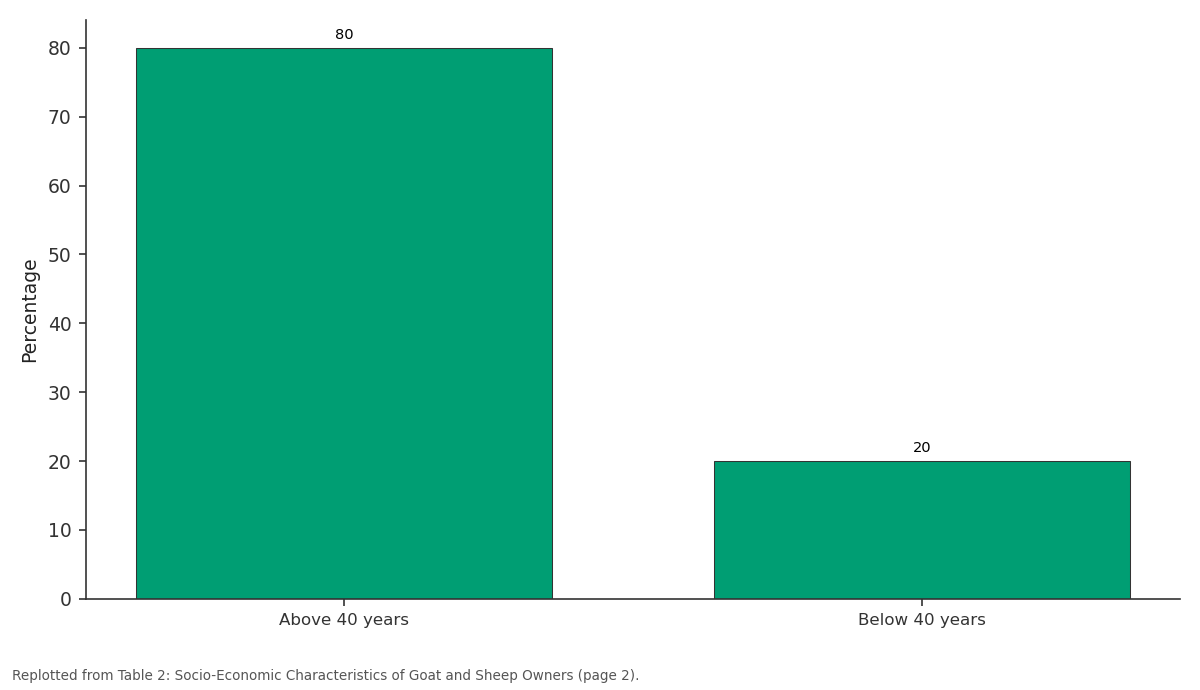
Percentage: Above 40 years vs Below 40 years
Replotted from Table 2 (page 2) of the original paper. Every bar is the paper's own table value.
View source evidence ↗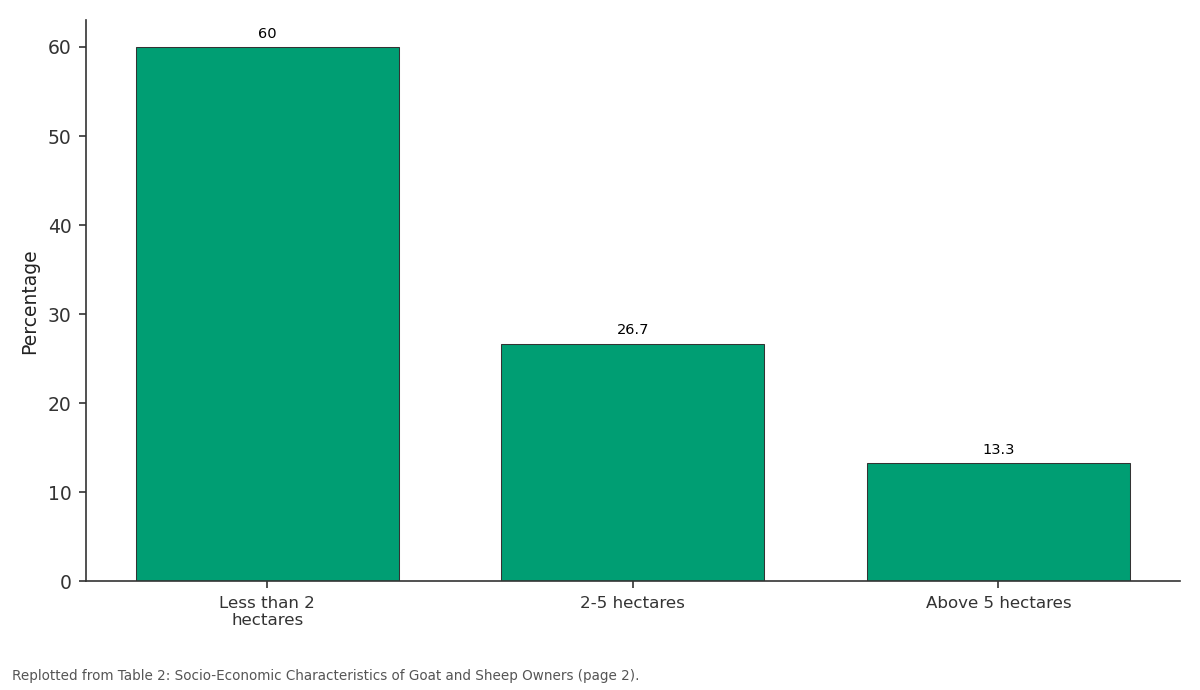
Percentage: Less than 2 hectares vs 2-5 hectares vs Above 5 hectares
Replotted from Table 2 (page 2) of the original paper. Every bar is the paper's own table value.
View source evidence ↗Figures & tables
From the original paper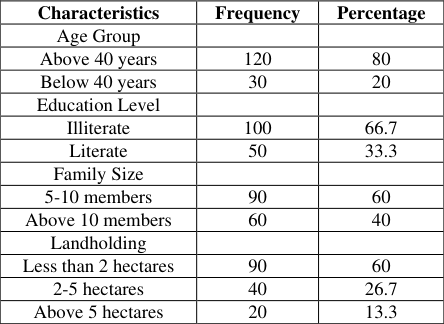 Table 2
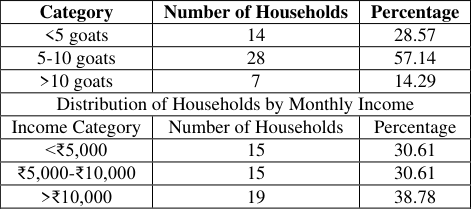 Table 1
Introduction
Goat and sheep farming play a crucial role in the livelihood of rural communities in Rajasthan, particularly in the district of Sawai Madhopur. However, the region faces challenges in maximizing the potential of livestock farming due to factors like inadequate feeding practices, low levels of adoption of improved technologies, and limited access to information and resources. This study aimed to investigate the socio-economic characteristics of goat and sheep owners in the district, focusing on their feeding practices and the factors influencing their decision-making. Considering the Agro-economic conditions of the country at this moment and projecting them for the next century (21st century), it can clouded that the keeping of the larger animals like cattle and buffaloes is becoming more and more tedious and it may become impossible in times to come. (Meena, et al. 2023) [11] . Goats are known as the "Poor man's cow" in India and are an important source of income for many rural households. India has the largest population of goats, with over 148 million goats, which is 16% of the world's total goat population. Goats contribute significantly to India's livestock production, providing milk, meat, skin, and fiber. There are 28 breeds of goats in India, with Jamunapari and Beetal being important milch breeds. Goats are often raised on grazing systems, but some are also stall-fed. They have a unique ability to browse and graze on a wide variety of feeds and vegetation. Johari and Talapatra (1971) [3] . The digestibility of nutrients in goats is higher than in cattle and buffaloes, but lower than in sheep. Goats have different dry matter intake requirements depending on their purpose, with meat goats requiring 3-4% of their live weight and dairy goats requiring 5-7%. The availability of feeds, palatability, and moisture content also affect dry matter consumption.
The importance of animal protein in human diets cannot be overstated, and goats are an important source of protein for many people. The Indian government has recognized the importance of goat farming and has initiated research projects to develop the industry. The goal of this study is to survey goat farming practices in villages in Rajasthan and understand the feeding patterns of goats in relation to the socioeconomic status of their owners. (Devendra, 1967, Tanwar and Khem 2011) [2,16,17] .
Methodology
A survey was conducted in five villages of the Bonli Tehsil in Sawai Madhopur, covering 49 goat owners with varied landholdings. Data was collected through personal interviews and on-site observations using a structured questionnaire. The questionnaire covered details like: Demographic Information: Name, age, education, household size, occupation. Livestock Holdings: Number of goats and sheep, type of breed, lactation status, milk yield. Feeding Practices: Types of feed used, frequency and method of feeding, availability of fodder, use of concentrates, use of minerals and supplements. Socio-Economic Indicators: Landholding size, income sources, access to market, awareness of government schemes.
Results and Discussion
The study revealed a wide range of socio-economic factors influencing goat and sheep farming practices in the region. While most farmers relied on grazing as their primary feeding method, the availability of suitable grazing land and the lack of awareness about improved feeding practices contributed to limitations in productivity. The study highlights the need for: The results revealed that 28.57% of households had less than five goats, 57.14% possessed between 5-10 goats, and 14.29% had more than 10 goats per household. The majority of the respondents (63.27%) were literate, and 53.06% of them were engaged in agriculture as their primary occupation. The study also found that 61.22% of the respondents had a monthly income of less than ₹10,000. The present findings are encouraging the finding of (Tripathi, et al. 1986, Chauhan and Sharma 1989 and Tanwar, 2011) [18,1,16,17] .
Socio-Economic Characteristics of Goat and Sheep Owners
The results of the study revealed that majority of the sheep and goat farmers belonged to the age group of above 40 years and are illiterate. The family size of the respondents varied from 5 to 10 members. The majority of the respondents (60%) were found to be small farmers having landholding of less than 2 hectares. The average herd size was 7.16 animals per household, with 2.0 lactating goats and 5.17 dry goats. Most farmers (57.14%) owned between 5-10 goats, while 14.29% had more than 10 goats. 87.76% of farmers used grazing, while 8.16% used stall feeding. Child labor was the primary workforce for grazing (87.76%), followed by women (8.16%) and men (4.08%). Women primarily handled chaffing of fodder (42.86%), followed by men (30.61%) and children (11.21%). While 85.71% of farmers used weighed concentrate, only 24.49% provided it before milking. The average farm size was 1.52 acres per household. Most farmers relied on agriculture as their primary income source. The present findings are encouraging the finding of (Sherman, 1941, Raskar et al. 2009 and Prajapati, 1992) [15,14,13] . Access to Resources: Facilitating access to credit, veterinary services, and information on government schemes. The present findings are encouraging the finding of (Maity et al., 1999 and Muscio, 1992) [10,12] Recommendations Government Intervention: Implementing programs for promoting fodder production, providing training and extension services, and facilitating access to microfinance for goat and sheep farmers.
Community-based Organizations: Empowering local organizations to play a role in knowledge dissemination, resource mobilization, and marketing support for livestock farmers. Research and Development: Conducting further research on specific challenges related to goat and sheep farming in the region, focusing on breed improvement, disease management, and optimal feeding practices. The results are in close proximity with the results obtained by Longnecher, 1963, Lahoti and Chole, 2010 and Lush, 1930) [8,7,9] .
Further Research
Further studies can be conducted to: Analyze the impact of different feeding regimes on milk yield, weight gain, and animal health. Assess the role of market linkages and value chains in improving the profitability of goat and sheep farming. Investigate the potential of integrating goat and sheep farming with other agricultural activities for diversification of income sources. The present findings are encouraging the finding of (Knight, 1965, Kumar, 1992 and Johnson, et al. 2010) [5,6,4]
Conclusion
In conclusion, the study provides valuable insights into the socio-economic characteristics of goat and sheep owners in the Sawai Madhopur district of Rajasthan. The majority of farmers rely on traditional methods of goat and sheep farming, with limited access to modern agricultural practices and government schemes. Most farmers belong to the age group of above 40 years, are illiterate, and own small landholdings of less than 2 hectares. Despite these challenges, the study highlights the resilience and adaptability of these farmers, who primarily depend on agriculture and livestock for their livelihood. The result reveled that underscore the need for targeted interventions to improve the productivity and profitability of goat and sheep farming in the region. Key recommendations include enhancing fodder availability, providing training on improved feeding practices, facilitating access to veterinary services and credit, and promoting community-based organizations for knowledge dissemination and resource mobilization. Further research is suggested to explore the impact of different feeding regimes, market linkages, and the integration of goat and sheep farming with other agricultural activities.
Figures and tables from the paper
| Characteristics | Frequency | Percentage |
|---|---|---|
| Age Group | ||
| Above 40 years | 120 | 80 |
| Below 40 years | 30 | 20 |
| Education Level | ||
| Illiterate | 100 | 66.7 |
| Literate | 50 | 33.3 |
| Family Size | ||
| 5-10 members | 90 | 60 |
| Above 10 members | 60 | 40 |
| Landholding | ||
| Less than 2 hectares | 90 | 60 |
| 2-5 hectares | 40 | 26.7 |
| Above 5 hectares | 20 | 13.3 |
Table text extracted from the original PDF; superscript letters are shown inline. The original table image is below.
View original table image
| Category | Number of Households | Percentage |
|---|---|---|
| <5 goats | 14 | 28.57 |
| 5-10 goats | 28 | 57.14 |
| >10 goats | 7 | 14.29 |
| Distribution of Households by Monthly Income | ||
| Income Category | Number of Households | Percentage |
| <₹5,000 | 15 | 30.61 |
| ₹5,000-₹10,000 | 15 | 30.61 |
| >₹10,000 | 19 | 38.78 |
Table text extracted from the original PDF; superscript letters are shown inline. The original table image is below.
View original table image
References
17 in the original paper- Chauhan A, Sharma AK. Socio-economic profile of milk producers: A study. Kurukshetra. 1989;37:11-16.
- Devendra C. Food conversion efficiency, economic efficiency and feeding standard for goats. Nutrition Abst. 1967;38:1022.
- Johari CB, Talapatra SK. (1) Growth studied with Jamunapari goats, (2) Jamunapari kids under browsing and stall feeding condition. Nutrition Abst. and Review. 1971;42:1227.
- Johnson CR, Doyle SP, Long RS. Effect of feeding system on meat goat growth performance and carcass traits. Sheep and Goat Research Journal. 2010;25:78-82.
- Knight J. Some observations on the feeding habits of goats in the South Baringo district of Kenya. Nutrition Abst. and Review. 1965;36.
- Kumar H. Some observations on Barbari goats under field conditions of Tarai area in U.P. In: Recent advances in goat production, Vth International Conference on Goats; March 1992; New Delhi. 1992:358-360.
- Lahoti SR, Chole RR. Adoption of feeding practices by goat keepers. Indian J Anim Res. 2010;44(1):52-54.
- Lush JL. A study of the accuracy of measurement of dairy cattle. J Agril Res. 1930;41:41.
- Maity SB, Mishra AK, Upadhyay VS. Effect of wheat bran supplementation on the utilization of mixed straws in goats. Indian J Animal Nutrition. 1999;16(1):86-88.
- Meena ML, Soni R, Soni RK, Jat H, Singh V. Dietary crude protein (DCP) and dry matter management for ensuring growth and development of goats in Rajasthan. The Pharma Innovation Journal. 2023;SP-12(8):486-488.
- Muscio A. Live-weight, prolificacy and milk yield of grazed and confined Garganica goats. In: Recent advances in goat production, Vth International Conference on Goats; March 1992; New Delhi. 1992:386-387.
- Prajapati MC. Growth pattern of goat in relation with wetness and available forages in Yamuna ravines. In: Recent advances in goat production, Vth International Conference on Goats; March 1992; New Delhi. 1992:407-412.
- Raskar BR, Chauhan DS, Khillare SS, Jadhav VS. Status of housing under home tract of Osmanabadi goat. Abstract published in: National Seminar on Goat Biodiversity Conservation; Challenges and Opportunities; March 20-21, 2009; M.P.K.V., Rahuri, MS. Pp: 193.
- Sherman HE. Chemistry of food nutrition. Macmillan & Co. Ltd.; 1941. New York.
- Tanwar PS, Chand Khem. Existing grazing and supplementary feeding practices of goats in semi-arid Rajasthan, India. J Small Ruminants. 2011;17(2):240242.
- Tanwar PS. Constraints perceived by goat keepers in adoption of goat husbandry practices in semi-arid Rajasthan. J Comm Mob and Sus Dary. 2011;6(1):108111.
- Tripathi RS, Garg JS, Singh GN. An economic analysis of dairy enterprise in Bundelkhand region of Uttar Pradesh. Indian J Dairy Sci. 1986;39:17-23.