
Research article · 2023 · Full text
International Journal of Geography Geology and EnvironmentAssessing the potential of green finance in supporting environmental sustainability
Volume 5(1) · Pages 266–269 · DOI: 10.22271/27067483.2023.v5.i1c.271 ↗
Research areasSustainable Finance and Green BondsEnergy, Environment, Economic Growth
Abstract
Author-writtenGreen finance has emerged as a critical mechanism for supporting environmental sustainability by directing financial resources towards environmentally friendly and sustainable projects. This review article explores the various aspects of green finance, including its definitions, instruments, and the role it plays in promoting sustainable development. By synthesizing findings from previous studies, the paper aims to provide a comprehensive understanding of the potential of green finance in fostering environmental sustainability and addressing the challenges and opportunities associated with its implementation.
Summary
Source-checkedPlain-language reading of the full paper, prepared with AI and checked against the text. Each point links to the authors' own words.
Why it matters
- Global concerns regarding environmental sustainability are rising due to the negative effects of resource depletion, environmental degradation, and climate change. View evidence ↗
- Green finance has emerged as a tool to support sustainable development by directing public and private capital toward initiatives like renewable energy and environmental protection. View evidence ↗
- Green finance utilizes various strategies and instruments to achieve environmental goals, specifically green loans, green bonds, sustainable banking, and impact investing. View evidence ↗
The question
- The study aims to evaluate how green finance can support environmental sustainability by analyzing its effectiveness, operational mechanisms, and associated opportunities and challenges. View evidence ↗
What they did
- The authors conducted a review by synthesizing findings from existing research to understand the potential of green finance. View evidence ↗
What they found
- The global issuance of green bonds reached $269.5 billion in 2020, indicating an increase in investor interest in sustainable projects. View evidence ↗
- Evidence suggests that green loans can encourage companies to adopt more sustainable practices and improve their overall environmental performance. View evidence ↗
- The impact investing market saw significant growth, with assets under management totaling $715 billion in 2020. View evidence ↗
- Sustainable banking practices can help banks reduce financial risks related to social and environmental issues while improving their reputation and attracting specific customer bases. View evidence ↗
- Companies that utilize green loans or issue green bonds generally show improvements in their environmental, social, and governance (ESG) performance. View evidence ↗
- Green finance is important for driving technological innovation in fields such as sustainable agriculture, energy efficiency, and renewable energy. View evidence ↗
- Green finance supports international climate commitments by attracting substantial investment for projects focused on climate adaptation and mitigation. View evidence ↗
- A lack of standardized criteria for green investments can lead to 'greenwashing,' where projects are falsely labeled as environmentally beneficial. View evidence ↗
- Despite the growth of the green bond market, there remains a shortage of projects that meet the necessary criteria to be considered investable green opportunities. View evidence ↗
- Financial technology (fintech) can support the expansion of green finance by improving impact measurement, reporting, and risk assessment. View evidence ↗
What it means
- The authors conclude that green finance can significantly aid environmental sustainability by promoting innovation, reducing risks, and mobilizing capital. View evidence ↗
- To maximize the impact of green finance, the authors recommend international collaboration, policy development, and addressing issues of greenwashing, project availability, and standardization. View evidence ↗
Visual summary
1 visualsIllustrations explain the paper; they do not show study data.
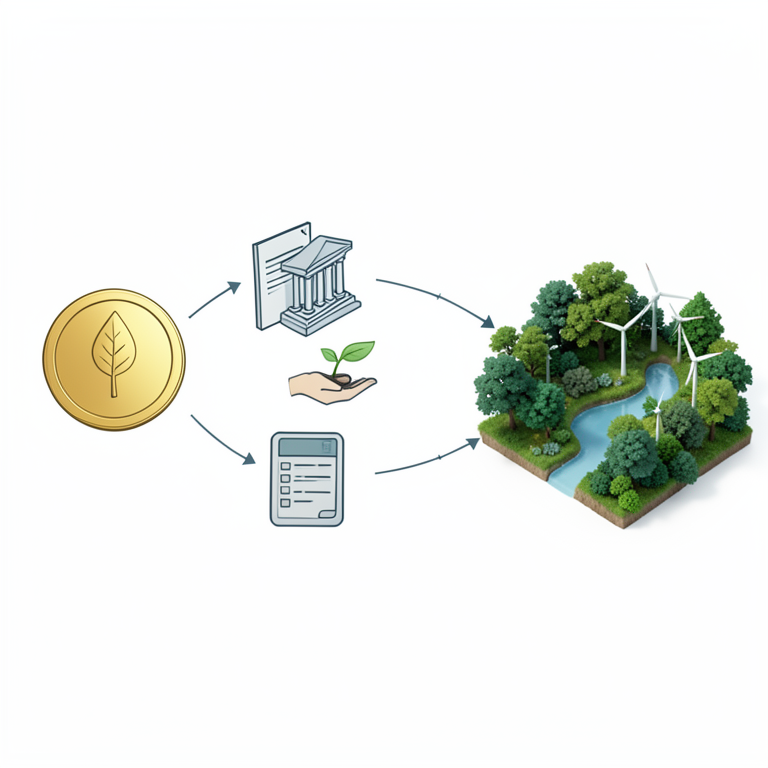
Green Finance Ecosystem
AI-generated conceptual illustration (A conceptual ecosystem of sustainable financial instruments and nature). It explains the idea and does not show study data.
View source evidence ↗Introduction
Environmental sustainability has become a paramount concern globally, with increasing awareness of the detrimental impacts of climate change, resource depletion, and environmental degradation. In response, green finance has gained prominence as a means to support sustainable development by mobilizing private and public capital for projects that promote environmental protection, energy efficiency, renewable energy, and other green initiatives. Green finance encompasses a wide range of financial instruments and investment strategies designed to achieve environmental benefits. These include green bonds, green loans, impact investing, and sustainable banking practices. The objective of this review is to assess the potential of green finance in supporting environmental sustainability, examining the mechanisms through which it operates, its effectiveness, and the challenges and opportunities it presents.
Objective of paper
The objective of this paper is to assess the potential of green finance in supporting environmental sustainability by examining its mechanisms, effectiveness, and associated challenges and opportunities.
Definitions and instruments of green finance
Green bonds: Green bonds are fixed-income securities issued to raise capital for projects with positive environmental impacts. These projects can include renewable energy installations, energy efficiency improvements, sustainable waste management, and conservation efforts. Green bonds offer investors a way to support sustainable projects while earning returns, thus aligning financial and environmental goals. The green bond market has grown rapidly in recent years. According to the Climate Bonds Initiative, global green bond issuance reached $269.5 billion in 2020, reflecting a growing appetite for sustainable investment. Studies, such as those by Ehlers and Packer (2017) [1] , have shown that green bonds can attract a diverse range of investors, including institutional investors and retail investors, thereby broadening the investor base for green projects.
Green loans
Green loans function similarly to green bonds but are typically provided by banks and other financial institutions directly to borrowers. These loans finance projects that deliver environmental benefits, such as renewable energy infrastructure, energy-efficient buildings, and sustainable agriculture practices. Green loans often come with favorable terms, including lower interest rates and longer repayment periods, to incentivize sustainable investment. Research by Flammer (2021) [2] indicates that companies receiving green loans tend to improve their environmental performance, suggesting that green loans can drive corporate sustainability initiatives. The study highlights the potential for green loans to encourage businesses to adopt more sustainable practices and reduce their environmental footprint.
Impact investing
Impact investing involves making investments with the intention of generating positive social and environmental impacts alongside financial returns. This approach can encompass a wide range of asset classes, including equities, fixed income, and private equity. Impact investors seek to support companies and projects that contribute to environmental sustainability, social equity, and economic development.
The Global Impact Investing Network (GIIN) reports that the impact investing market has grown significantly, with assets under management reaching $715 billion in 2020. Studies by Bugg-Levine and Emerson (2011) [3] suggest that impact investing can mobilize substantial capital for sustainable development and help address pressing environmental and social challenges.
Sustainable banking practices
Sustainable banking involves integrating environmental, social, and governance (ESG) criteria into banking operations and investment decisions. Banks adopting sustainable practices may offer green financial products, implement responsible lending policies, and support environmental initiatives. Sustainable banking aims to reduce the negative environmental impacts of financial activities and promote positive social outcomes. A study by Weber and Feltmate (2016) [4] found that banks engaging in sustainable banking practices can enhance their reputation, attract socially conscious customers, and mitigate financial risks associated with environmental and social issues. The research emphasizes the importance of ESG integration in banking for promoting long-term sustainability.
The role of green finance in promoting sustainability
Green finance plays a pivotal role in promoting sustainability by mobilizing capital towards projects that offer environmental benefits, encouraging corporate sustainability practices, reducing environmental risks, and fostering innovation in green technologies. By directing financial resources towards sustainable development, green finance supports global efforts to combat climate change and environmental degradation. This section discusses the various ways in which green finance contributes to sustainability and highlights relevant studies that underscore its importance. One of the primary roles of green finance is to mobilize capital for projects that contribute to environmental sustainability. This includes funding for renewable energy projects, energy efficiency improvements, sustainable agriculture, and other initiatives that reduce greenhouse gas emissions and enhance environmental resilience. The issuance of green bonds is a prominent mechanism for achieving this. Green bonds are fixed-income securities that raise capital specifically for projects with positive environmental impacts. According to the Climate Bonds Initiative, global green bond issuance reached $269.5 billion in 2020, reflecting a growing investor appetite for sustainable investment. Ehlers and Packer (2017) [1] demonstrated that green bonds attract a diverse range of investors, including institutional and retail investors, thereby broadening the investor base for green projects and increasing the flow of capital into sustainable initiatives. In addition to mobilizing capital, green finance incentivizes companies to adopt sustainable practices. By offering financial rewards for environmental performance, such as through lower interest rates on green loans or favorable terms for green bonds, green finance encourages businesses to invest in sustainable technologies and processes. Hachenberg and Schiereck (2018) [6] found that companies issuing green bonds or receiving green loans tend to improve their environmental, social, and governance (ESG) performance. This indicates that green finance can drive corporate sustainability initiatives by making it financially advantageous for companies to pursue environmentally friendly practices. Green finance also plays a crucial role in reducing environmental risks associated with financial activities. By incorporating ESG criteria into investment decisions, green finance ensures that environmental and social impacts are considered, mitigating risks related to environmental degradation, regulatory changes, and reputational damage. Sustainable banking practices, for example, involve integrating ESG factors into lending and investment portfolios. Weber and Feltmate (2016) [4] found that banks engaging in sustainable banking practices can enhance their reputation, attract socially conscious customers, and mitigate financial risks associated with environmental and social issues. This approach promotes long-term financial stability and sustainability by aligning financial activities with environmental goals. Moreover, green finance supports innovation and the development of green technologies. By providing funding for research and development, green finance fosters the creation of new technologies that can address environmental challenges. Polzin et al. (2019) [7] highlighted the importance of green finance in promoting innovation in renewable energy, energy efficiency, and sustainable agriculture. These technological advancements are essential for achieving environmental sustainability and transitioning to a low-carbon economy. The availability of green finance can accelerate the development and deployment of cuttingedge technologies, driving progress towards sustainable development goals. Green finance also contributes to the achievement of international environmental goals, such as the Paris Agreement and the United Nations Sustainable Development Goals (SDGs). By directing financial resources towards projects that support these goals, green finance plays a key role in global efforts to combat climate change and promote sustainable development. For instance, Karpf and Mandel (2018) [5] demonstrated that green finance can attract significant investment for climate mitigation and adaptation projects, thereby supporting international commitments to reduce greenhouse gas emissions and enhance climate resilience. Despite its potential, green finance faces several challenges that need to be addressed to maximize its impact. One of the main challenges is the lack of standardized definitions and criteria for what constitutes a green investment. This lack of standardization can lead to greenwashing, where projects are labelled as green without delivering genuine environmental benefits. Bachelet et al. (2019) [8] emphasized the need for clear guidelines and standards to ensure the credibility of green finance. Another challenge is the limited availability of green investment opportunities. While the green bond market has grown, there is still a shortage of investable projects that meet the criteria for green finance. Shishlov et al. (2016) [9] suggested that expanding the pipeline of green projects and improving project readiness can enhance the effectiveness of green finance. Despite these challenges, green finance presents significant opportunities for promoting environmental sustainability. One opportunity is the growing demand for sustainable investment among institutional and retail investors. As awareness of environmental issues increases, more investors seek to align their investments with their values. This growing demand can drive the expansion of green finance and increase the availability of capital for sustainable projects. Another opportunity is the potential for green finance to support the achievement of international environmental goals. By directing financial resources towards projects that contribute to these goals, green finance can play a pivotal role in global efforts to combat climate change and promote sustainable development. Technological advancements also present opportunities for green finance. Innovations in financial technology (fintech) can enhance the efficiency and transparency of green finance, making it easier for investors to identify and invest in green projects. Gimpel et al. (2018) [10] suggested that fintech can facilitate the growth of green finance by providing tools for better risk assessment, reporting, and impact measurement. In conclusion, green finance has the potential to significantly support environmental sustainability by mobilizing capital for green projects, encouraging corporate sustainability, reducing environmental risks, and promoting innovation. However, to fully realize this potential, it is essential to address the challenges related to standardization, project availability, and greenwashing. Continued research, policy development, and international collaboration are crucial for advancing green finance and enhancing its effectiveness in promoting sustainable development. By leveraging the opportunities presented by growing investor demand and technological advancements, green finance can play a key role in achieving global environmental and sustainability goals.
Challenges and opportunities in green finance
Despite its potential, green finance faces several challenges that need to be addressed to maximize its impact. One of the main challenges is the lack of standardized definitions and criteria for what constitutes a green investment. This lack of standardization can lead to greenwashing, where projects are labelled as green without delivering genuine environmental benefits. Studies by Bachelet et al. (2019) [8] emphasize the need for clear guidelines and standards to ensure the credibility of green finance. Another challenge is the limited availability of green investment opportunities. While the green bond market has grown, there is still a shortage of investable projects that meet the criteria for green finance. This shortage can limit the flow of capital into sustainable projects. Research by Shishlov et al. (2016) [9] suggests that expanding the pipeline of green projects and improving project readiness can enhance the effectiveness of green finance. Despite these challenges, green finance presents significant opportunities for promoting environmental sustainability. One opportunity is the growing demand for sustainable investment among institutional and retail investors. As awareness of environmental issues increases, more investors are seeking to align their investments with their values. This growing demand can drive the expansion of green finance and increase the availability of capital for sustainable projects. Another opportunity is the potential for green finance to support the achievement of international environmental goals, such as the Paris Agreement and the United Nations Sustainable Development Goals (SDGs). By directing financial resources towards projects that contribute to these goals, green finance can play a pivotal role in global efforts to combat climate change and promote sustainable development. Technological advancements also present opportunities for green finance. Innovations in financial technology (fintech) can enhance the efficiency and transparency of green finance, making it easier for investors to identify and invest in green projects. Studies by Gimpel et al. (2018) [10] suggest that fintech can facilitate the growth of green finance by providing tools for better risk assessment, reporting, and impact measurement.
Conclusion
Green finance has the potential to significantly support environmental sustainability by mobilizing capital for green projects, encouraging corporate sustainability, reducing environmental risks, and promoting innovation. However, to fully realize this potential, it is essential to address the challenges related to standardization, project availability, and greenwashing. Continued research, policy development, and international collaboration are crucial for advancing green finance and enhancing its effectiveness in promoting sustainable development. By leveraging the opportunities presented by growing investor demand and technological advancements, green finance can play a key role in achieving global environmental and sustainability goals.
References
7 in the original paper- Flammer C. Green bonds: Effectiveness and implications for public policy. Environ Energy Policy Econ. 2021;2(1):95-128.
- Bugg-Levine A, Emerson J. Impact investing: Transforming how we make money while making a difference. Innov. Technol. Gov Glob. 2011;6(3):9-18.
- Karpf A, Mandel A. The changing value of the 'green' label on the US municipal bond market. Nat Clim Chang. 2018;8(2):161-165.
- Hachenberg B, Schiereck D. Are green bonds priced differently from conventional bonds? J Asset Manag. 2018;19(6):371-383.
- Polzin F, Migendt M, Täube FA, von Flotow P. Public policy influence on renewable energy investments -A panel data study across OECD countries. Energy Policy. 2019;119:67-82.
- Bachelet MJ, Becchetti L, Manfredonia S. The green bonds premium puzzle: The role of issuer characteristics and third-party verification. Sustainability. 2019;11(4):1098.
- Gimpel C, Bergmann C, Bockenhauer D, Breysem L, Cadnapaphornchai MA, Cetiner M, et al. International consensus statement on the diagnosis and management of autosomal dominant polycystic kidney disease in children and young people. Nature Reviews Nephrology. 2019 Nov;15(11):713-726.
Cited by 1
From OpenAlex, OpenCitations and reference lists read by Scinovex
- Future Directions in Sustainable Investing ↗
Menaka Biswal, Jyoti Tyagi, Mukesh Sehrawat, Vishal Kumar Jain · IGI Global eBooks · 2025
The imperatives of climate change coupled with a global momentum towards sustainable development are changing the face of personal finance and investment. This chapter, explores the way financial markets, institutions, and instruments are growing to enable individual investors to fund environmental sustainability and social responsibility efforts. It starts by discussing how green finance - focused on financing projects that help…
❝ 0