
Research article · 2023 · Full text
International Journal of Geography Geology and EnvironmentGeotechnical evaluation of Injana formation clays used in the manufacture of kilns: Kirkuk/northern Iraq
Volume 5(1) · Pages 105–110 · DOI: 10.22271/27067483.2023.v5.i1b.148 ↗
Research areasGeotechnical and construction materials studiesTunneling and Rock MechanicsGrouting, Rheology, and Soil Mechanics
Abstract
Author-writtenThe present study aimed to evaluate the geotechnical properties of Injana Formation clays in the Laylan-Kirkuk area for kiln (oven) manufacturing. Five samples were collected from the study area to conduct various geotechnical tests, represented by petrophysical and chemical analyses. The studied samples revealed the clay and silt (fines) ranged between (89% - 95%), while the sand was around (5%) from the total volume of samples, therefore it's classified as (CL; Inorganic clays or low to medium plasticity, sandy clays, silty clays, lean clays), according to the Unified Soil Classification System (USCS). On the other side the Atterberg limits test revealed that the plasticity index ranged between (10.6 to 16.82) is low- medium according to Casagrande plasticity chart. This range of plasticity index is due to the high amount of clay and silt contents. The mentioned condition is preferable for molding the mixture to get the required shape in the kilns manufacturing. The chemical analysis for the studied samples (gypsum, organic matter contents, calcium carbonate percentage, and pH) appeared an exceptionally low gypsum and organic matter contents, and thus does not affect the engineering properties, therefore it is considered to have a very high calcium carbonate content, and it is alkaline neutral. These clays are used by the local population in the manufacture of kilns, and due to the lack of international standards and because it is a local industry, we suggest that these tests be considered as international standards.
Summary
Source-checkedPlain-language reading of the full paper, prepared with AI and checked against the text. Each point links to the authors' own words.
Why it matters
- Clay is widely used in construction across Iraq due to its availability, low cost, thermal insulation, and resistance to weather and fire. View evidence ↗
- Clay serves as the primary raw material for manufacturing traditional kilns used for cooking and baking. View evidence ↗
The question
- The study aims to evaluate the geotechnical properties of clays from the Injana Formation to determine their suitability for kiln manufacturing. View evidence ↗
What they did
- Researchers collected 40 kg samples from five different stations within the Injana Formation after removing weathered surface layers. View evidence ↗
- Grain size distribution was analyzed using mechanical screening and hydrometric wet screening methods following ASTM D422-63 standards. View evidence ↗
- Atterberg limits, including liquid and plastic limits, were measured using a Casagrande device according to ASTM D 4318-14. View evidence ↗
- Chemical analyses for pH, gypsum, calcium carbonate, and organic matter were performed at the Kirkuk construction laboratory following BS 1377-3-1990. View evidence ↗
What they found
- Grain size analysis showed that the samples consisted of 22%-42% clay, 48%-73% silt, and 5%-11% sand. View evidence ↗
- The liquid limits of the samples ranged from 31.61% to 34.86%, and the plastic limits ranged from 18.04% to 23.32%. View evidence ↗
- The plasticity index (PI) ranged from 10.70% to 16.82%, classifying the soil as having low-to-medium plasticity. View evidence ↗
- Based on the Unified Soil Classification System (USCS), the samples were classified as CL (inorganic clays of low to medium plasticity). View evidence ↗
- Chemical tests revealed gypsum content between 0.744% and 1.80% and a pH range of 7.7 to 7.9, indicating the samples are neutral alkaline. View evidence ↗
- The samples contained high calcium carbonate (24.19%-24.25%) and low organic matter (0.97%-1.4%). View evidence ↗
What it means
- The authors conclude that the low sand content enhances the durability, compressive strength, and water resistance of the resulting kilns. View evidence ↗
- Because the local kiln industry lacks international standards, the authors suggest that the tests conducted in this study be adopted as standards. View evidence ↗
Visual summary
3 visualsIllustrations explain the paper; charts are replotted from the paper's own table values.
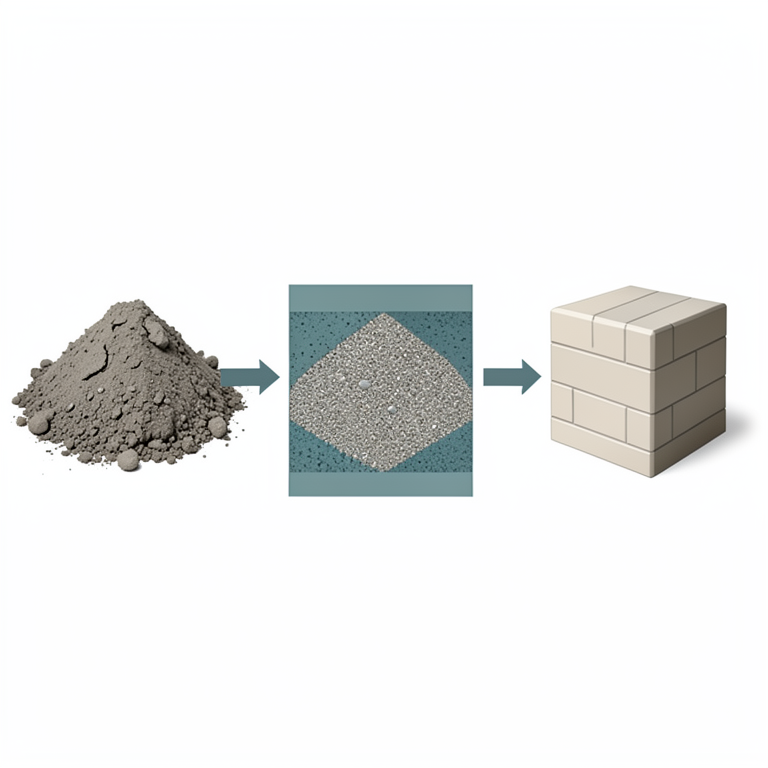
Clay Suitability for Kilns
AI-generated conceptual illustration (Injana formation clay and a traditional brick kiln). It explains the idea and does not show study data.
View source evidence ↗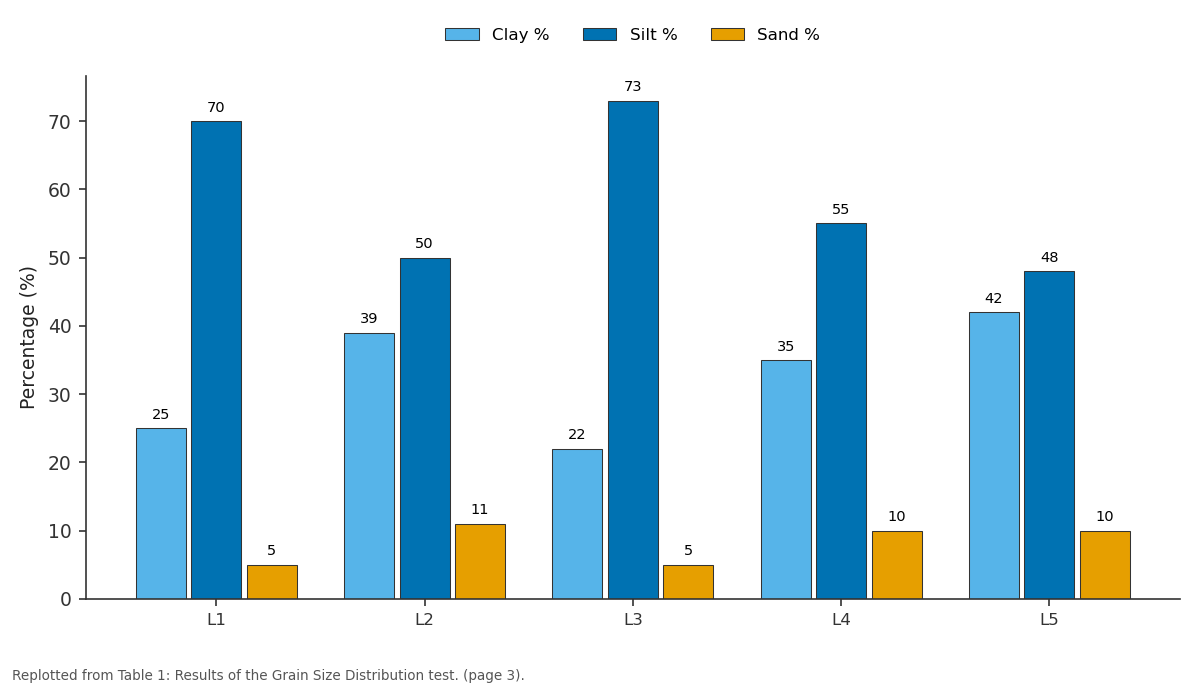
Clay % and Silt % and more: L1 vs L2 vs L3 vs L4 vs L5
Replotted from Table 1 (page 3) of the original paper. Every bar is the paper's own table value.
View source evidence ↗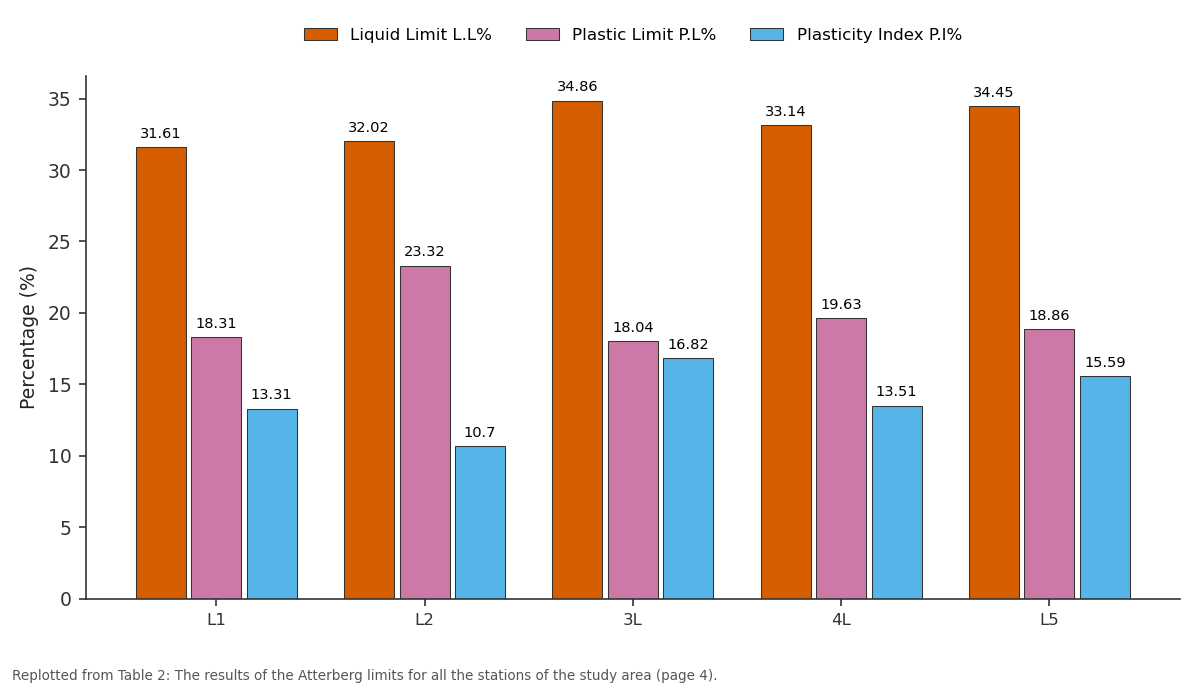
Liquid Limit L.L% and Plastic Limit P.L% and more: L1 vs L2 vs 3L vs 4L vs L5
Replotted from Table 2 (page 4) of the original paper. Every bar is the paper's own table value.
View source evidence ↗Figures & tables
From the original paper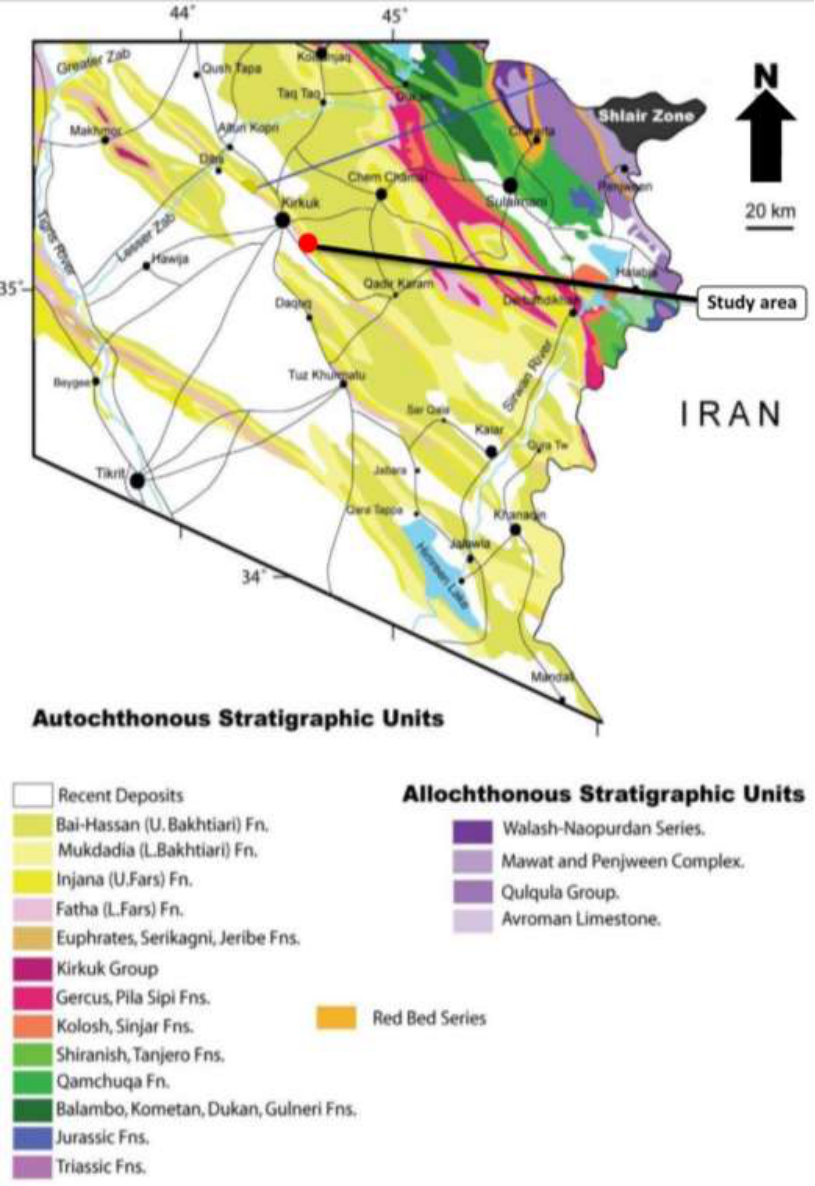 Figure 1
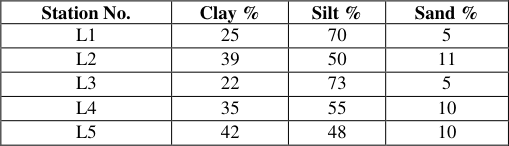 Table 1
 Table 2
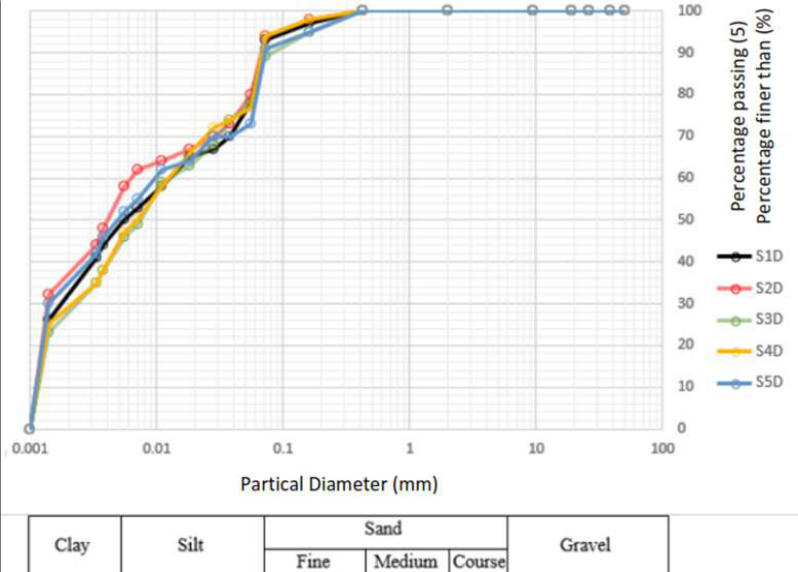 Figure 2
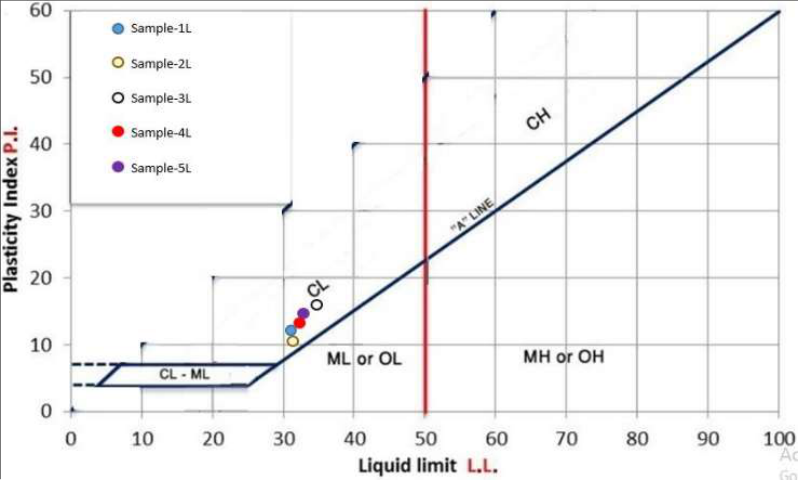 Figure 3
 Table 3
Introduction
In light of their economic growth all governorates of Iraq are witnessing a wide reconstruction, in addition to the initiation of many projects, such as shopping malls, hotels, and other engineering projects that require the provision of building stones, it is not hidden from anyone the importance of rocks of all kinds in various applied fields. For example, limestone has been used in construction for many centuries, such as in the historic city of urban buildings in which limestone has been used for some 2200 years ago. Small pieces of limestone have also been used to build walls and ceilings, and large ones have been used in the stone pillars. The use of clay for various construction projects has grown throughout the world as a result of its widespread use, as well as the urbanization and development that has taken place. The low cost, resistance to fire and weather conditions, and thermal insulation of clay, also because of availability of raw material, made it widely used in all regions of the country. Clay is considered the main raw material in the manufacture of kilns as it is the most traditional methods used in the past in baking breads, pastries and cooking to the present day in spite of the technological progress that the world witnessed during the last period and the development in diversity in the manufacture of ovens that operate on electricity and gas, because the kiln is characterized by the bread type baked with a distinct taste and their low production cost [1] . There are several previous studies related to the subject of the research, including (Maaleh et al., 2007) [2] evaluation of the physical, chemical and mineral properties of clay deposits to form a brick for five different locations within the foothills, the study concluded that the clay deposits can be used as a raw material in the manufacture of building bricks, (Obeidat, 2010) [3] the bricks in the northern region of Jordan, an ethnoarchaeological archaeological study, this study mentioned how bricks were made and the materials used in their manufacture (local clay mixed with straw and other materials) and dried, the study explained the history of the kilns and clay bricks that were present in the region. finally (Maaleh et al., 2001) [4] conducted a quantitative and qualitative evaluation of the clay soils applied in Injana Formation for manufacturing brick purposes, after conducting physical tests on the samples, the study determined the type of brick manufactured according to the Iraqi standard specifications no. (25) for the year (1993) for the manufacture of bricks.
Aim of the research
The research aims to evaluate the geotechnical properties of Injana Formation clays used in the manufacture of kilns, based on the geotechnical tests represented by petrophysical and chemical tests.
Location of the study area
The study area is located in the northeast of Kirkuk governorate (Kazan Balakh area, 12 km from the center of Kirkuk) and southwest Chamchamal District (with coordinate latitudes 35° 12ʹ 23ʹʹ and longitudes 44° 29ʹ 5.95ʹʹ), which tectonically lies within the low folded zone.
Geology of the study area
The lithological of the study area stscscoc of the following formations from the oldest to the newest, and they are as follows (Fat'ha, Injana, Muqdadiya, and Bai Hassan Formations) as well as Quaternary sediments represented by deposits (valley fill sediments, floodplain sediments, and soils).
Fat'ha Formation (Middle Miocene)
This formation is present in the study area as gypsum, marl and limestone rocks, which are ranging in thickness; gypsum (2-6 m), marl (5-7 m) and limestone up to 3 m.
Injana Formation (Upper Miocene)
The age of this formation is Upper Miocene and the hickness of Injana formation exceeds (620 m). The thickness of the sandstone and mudstone layers in the study area varies from station to another, where the thickness of the sandstone ranges from (2-5 m) while the thickness of the mud layers ranges from (3-6 m). The lower contact between the underlying Fat'ha Formation and the Injana formation (previously known as the Lower Fars Formation) is conformable, placed in the field at the top of the uppermost limestone horizon of the Fat'ha Formation which is overlain by a thick red and subordinate grey mudstone beds. The upper contact of formation with the Muqdadiya Formation (previously known as the Lower Bakhtiari Formation) [5] .
Muqdadiya Formation (Upper Pliocene)
The age of this formation is Upper Pliocene, and the thickness of Muqdadiya Formation exceeds (2000 m), this formation is represented by pebble sand rocks, sand rocks and red clay rocks.
Bai Hassan Formation (Pliocene-Pleistocene)
The age of this formation is Upper Miocene -Pliocene. Bai Hassan formation consists of sequence of breccia and sandstone with siltstone and shale stone, this formation is often covered with recent sediments, the thickness of Bai Hassan Formation is more than (2000 m). and the main component of this formation is breccia, the gravel is derived from diverse types and sources of rocks and clay minerals.
Methodology Fieldwork stage
During the fieldwork stage, several site investigations were carried out in the study area to identify the geological background and the distribution of the clays in the area. The collected samples from the stations of Injana Formation after removing the weathering layers using the geological hammer and then (40 kg) was taken for each sample from five stations.
Laboratory work stage
The following tests were conducted to show the Suitability of clays from Injana Formation in Laylan region in the manufacture of kilns. These laboratory tests included the following:
Petrophysical tests Grain size distribution
The grain size distribution of granules is considered one of the most important geotechnical properties, as it is one of the most important characteristics of the soil, has great indications on the rest of the standard specifications of the soil, as well as its important factor on the rest of the physical specifications of the soil such as texture and others, this test is used worldwide to classify the soil and determine its suitability for engineering works in general [6] . Where it is noted that the soil of Kirkuk is heterogeneous in its properties due to the discrepancy in the percentages of grain sizes of (silt, clay and sand), as there is a predominance of fine sizes relative to the coarse sizes [7] . Two different and separate methods were used depending on the grain proportions passed through the sieves, namely the mechanical screening method (sieves) and the wet screening method (hydrometric). Calculated according to (ASTM D422-63, 2004) [8] .
Atterberg limits
The Atterberg Limits test of soil is considered one of the indicative tests and of foremost importance in the local industries, which shows its role in preparing the appropriate soil consistency, and it was divided into (liquid limit, plastic limit, and plasticity index). Both the plastic limit and liquid limit were assessed by the Casagrande device in the laboratory based on the American standard (ASTM D 4318-14, 2014) [9].
Chemical Analysis
Chemical analysis was conducted at Kirkuk construction laboratory for tests of gypsum percentage, acidity index, calcium carbonate percentage, and organic matter content according to British standards (BS 1377-3-1990) [10] .
Results and Discussion
Results and Discussion
Petrophysical tests Grain size distribution
The results of the grain size distribution test of the clays in Laylan region revealed fine grain size type (silt and clay), and this in turn gives the mixture used in the manufacture of kilns an appropriate plasticity and elasticity, since the percentage of clay ranged between (22%-42%) and the percentage of silt ranged between (48%-73%). while the percentage of sand ranged between (5%-11%), table no. (1) shows the results of the grain size gradient, and Figure (2) shows the grain size curves of the samples representing the study area.
Atterberg limits
The liquid limit and the plastic limit were assessed according to American standards [9] , where the liquid limit for the samples taken from the study area ranged between (31.61%-34.86%), while the values of the plastic limit ranged between (18.04%-23.32%) and According to soil classification based on the Plasticity index the soil is of lowmedium Plasticity as PI ranges between (10.70%-16.82%). The studied samples were classified according to the plasticity chart based on the Unified soil Classification system (USCS), and the results were as shown in table (2) and figure (3). [12]
Chemical Analysis
The results of chemical analysis indicated (gypsum percentage, ph, calcium carbonate percentage, and organic matter content) the percentage of gypsum in the studied samples ranged between (0.744%-1.80%), while the acidity index (ph) was between (7.7-7.9), meaning that the samples were neutral alkaline according to (Ryan et al., 2003) [13] , and the percentage of calcium carbonate was between (24.19%-24.25%), while the results of the analysis revealed the organic materials percentage for the samples ranged between (0.97%-1.4%), as shown in table (3).
Discussion
The results indicated that deposits of the studied area are fine grains (clay, silt), the high percentage of clay and silt contents helps in increasing the plasticity index and thus, gives the dough acceptable plasticity to manufacture kilns, this has a positive effect on the required clay properties for the kilns manufacturing and also helps in facilitating the formation of the dough according to the required size and shape. The percentage of clay in the samples ranged between (42%-22%), and the percentage of silt in the study samples ranged between (48%-73%), while the sand percentage ranged between (5%-11%). The low percentage of sand gives the kilns durability, increases its compressive strength and reduces the water absorption rate, thus most of the soils of this region are (silty clay or clay silt).
Conclusion
The researcher reached the following conclusions. (a) The results of the petrophysical examinations, which included: 1. Through the application of the unified soil classification system (USCS), the study found that the samples of the study area have more than 50% of the fine grain (silt and clay), that more than 50% of the particles passed through sieve #200 (0.075mm), which is of the clayey silt type.
(b) The results of the Atterberg limit tests indicated that all of the samples are (CL: inorganic clays or low to medium plasticity, sandy clays, silty clays, lean clays) according to the unified soil classification system (USCS) with having low plasticity according to the plasticity scheme. 2. Through the results of the chemical tests, which included (gypsum content, organic matter content, calcium carbonate percentage, and acidity index), it was found that the studied samples have little gypsum content, with a low percentage of organic matter and thus do not affect the engineering properties and are considered to be of good quality. Also, it was found that the calcium carbonate is remarkably high and alkaline neutral.
Recommendations
After conducting various tests related to evaluating the clays in Laylan region used in kilns manufacturing, the following recommendations were reached: 1. In addition to the geotechnical properties studied in this research, it is recommended to study other geotechnical and engineering properties to obtain an accurate perception of all the properties of the clays of the study area. 2. Conduct a field study to calculate the amount of mud within the study area and find out its economic feasibility. 3. Evaluation of the validity of using the clays of the study area in other local industries such as bricks, ceramics and pottery making.
Figures and tables from the paper
| Station No. | Clay % | Silt % | Sand % |
|---|---|---|---|
| L1 | 25 | 70 | 5 |
| L2 | 39 | 50 | 11 |
| L3 | 22 | 73 | 5 |
| L4 | 35 | 55 | 10 |
| L5 | 42 | 48 | 10 |
Table text extracted from the original PDF; superscript letters are shown inline. The original table image is below.
View original table image
| Station No. | Liquid Limit L.L% | Plastic Limit P.L% | Plasticity Index P.I% | According to (U.S.C) (Terzaghi, 1996)[11] |
|---|---|---|---|---|
| L1 | 31.61 | 18.31 | 13.31 | CL |
| L2 | 32.02 | 23.32 | 10.70 | CL |
| 3L | 34.86 | 18.04 | 16.82 | CL |
| 4L | 33.14 | 19.63 | 13.51 | CL |
| L5 | 34.45 | 18.86 | 15.59 | CL |
Table text extracted from the original PDF; superscript letters are shown inline. The original table image is below.
View original table image
| Station No. | (CaSO4.2H2O) % | CaCO3 % | O.M.C % | (pH) | SO3 % | SO4 % |
|---|---|---|---|---|---|---|
| L1 | 0.991 | 24.19 | .970 | 7.8 | 0.835 | 0.99 |
| L2 | 0.788 | 24.21 | 1.13 | 7.7 | 0.771 | 0.93 |
| L3 | 0.744 | 24.23 | 1.4 | 7.8 | 0.821 | 0.98 |
| L4 | 1.423 | 24.20 | 0.97 | 7.9 | 0.793 | 0.94 |
| L5 | 1.801 | 24.25 | 1.2 | 7.7 | 0.842 | 1.00 |
Table text extracted from the original PDF; superscript letters are shown inline. The original table image is below.
View original table image
References
6 in the original paper- Daoudi Lahcen A, Elboudour Elidrissi Hicham A, Saadi Latifa B, Albizane Abderrahmane C, Bennazha Jamal C, et al. Characteristics and ceramic properties of clayey materials from the region of Amezmiz (Western High Atlas, Morocco). Applied Clay Science. 2014;102:139-147.
- Abbas MK, Basem QD. Laboratory Evaluation of the Use of Neogene Sediments in the Manufacturing of Building Bricks. Journal of Iraqi Geology and Mining. 2007;3(2):73-81.
- Muhammad OD. Al-Tawabin in the northern region of Jordan, an ethnoarchaeological archaeological study. The Jordanian Journal of History and Archaeology, an international quarterly specialized and peer-reviewed scientific Journal issued by the Ministry of Higher Education and Scientific Research and the University of Jordan, The fourth issue of the fourth. 2010;4(4):171198.
- Abbas MK, Jassem SQ, Badr KD, Al-Saadi NA, Lafta AA. Quantitative and qualitative evaluation of clay soils for the purpose of building bricks. Iraqi Journal of Science. 2001;42(2):107-115.
- Al-Ameri SA, Kadhim LS. Heavy Mineral Distribution and Clay Mineralogy of Injana Formation at Zawita and Daigala Northern Iraq, Tikrit Journal of Pure Science. 2023;28(1):40-46.
- Khaled AA, Omar AW. Geotechnical Assessment for Yaychee town-Kirkuk/north Iraq, Tikrit Journal of Pure Science, University Tikrit. 2016;21(7):143-51.