
Research article · 2023 · Full text
International Journal of Geography Geology and EnvironmentThe impact of bioenergy crops on land use and food security
Volume 5(1) · Pages 251–254 · DOI: 10.22271/27067483.2023.v5.i1c.267 ↗
Research areasEnergy and Environment Impacts
Abstract
Author-writtenThe increasing demand for renewable energy sources has driven the expansion of bioenergy crops. While bioenergy offers a sustainable alternative to fossil fuels, its cultivation has significant implications for land use and food security. This review paper examines the current state of knowledge on the impact of bioenergy crops on land use and food security, drawing from a comprehensive analysis of previous studies. It highlights the trade-offs between bioenergy production and food production, explores the environmental consequences of land-use changes, and discusses policy frameworks aimed at balancing energy and food needs.
Summary
Source-checkedPlain-language reading of the full paper, prepared with AI and checked against the text. Each point links to the authors' own words.
Why it matters
- The growth of bioenergy crops is being driven by a rising global demand for renewable energy sources. View evidence ↗
- Although bioenergy is a sustainable alternative to fossil fuels, its production significantly impacts how land is used and affects food security. View evidence ↗
- Biomass-derived bioenergy is considered a critical part of transitioning toward a sustainable energy future. View evidence ↗
The question
- The primary goal of this review is to examine how the cultivation of bioenergy crops impacts land use and food security. View evidence ↗
What they did
- The authors conducted a comprehensive analysis of previous studies to review the current state of knowledge regarding bioenergy crops. View evidence ↗
What they found
- First-generation bioenergy crops, including soybeans, sugarcane, and maize, are food crops utilized for biodiesel and bioethanol production. View evidence ↗
- First-generation crops compete directly with food production; for example, using maize for ethanol in the U.S. has been linked to increased food prices. View evidence ↗
- In Southeast Asia, the cultivation of oil palm for biodiesel has caused significant habitat loss and widespread deforestation. View evidence ↗
- Second-generation bioenergy crops, such as miscanthus and switchgrass, are non-food crops used to create cellulosic ethanol. View evidence ↗
- Second-generation crops can be grown on marginal lands unsuitable for food, which helps reduce competition for high-quality agricultural land. View evidence ↗
- Third-generation crops like algae can be grown in saline environments or deserts, offering higher yields per unit area than land crops and avoiding arable land use. View evidence ↗
- Bioenergy crops like sugarcane and maize require significant water, which can strain resources in arid regions and lower food yields by competing with food crop irrigation. View evidence ↗
- Large agribusinesses in the bioenergy sector can concentrate land ownership, displacing smallholder farmers and reducing their access to food and land. View evidence ↗
What it means
- The authors conclude that balancing bioenergy and food security requires a comprehensive approach involving effective policy, sustainable farming, and continued research. View evidence ↗
- The authors note that large-scale algae production is currently limited by economic and technological feasibility barriers. View evidence ↗
Visual summary
1 visualsIllustrations explain the paper; they do not show study data.
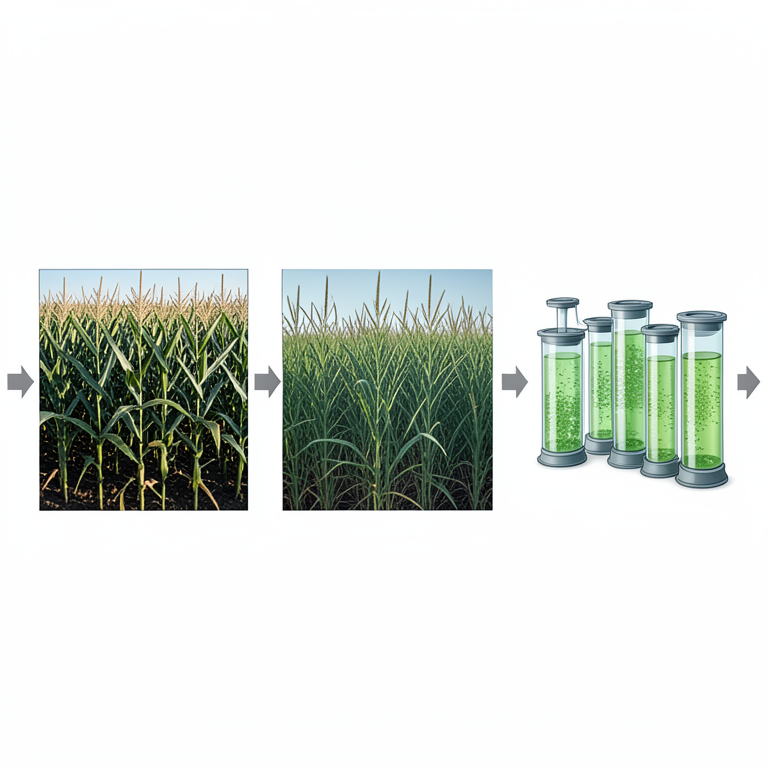
Generations of Bioenergy Crops
AI-generated conceptual illustration (maize, switchgrass, and microalgae). It explains the idea and does not show study data.
View source evidence ↗Introduction
Bioenergy, derived from biomass, is seen as a critical component of the transition to a sustainable energy future. Bioenergy crops, such as corn, sugarcane, and oil palm, are cultivated specifically for energy production. However, the expansion of these crops can lead to competition for arable land, affecting food production and potentially exacerbating food insecurity. This review aims to synthesize existing research on the impact of bioenergy crops on land use and food security and to identify key areas for future research.
Main objective of the paper
The primary objective of this review paper is to examine the impact of bioenergy crop cultivation on land use and food security.
Bioenergy crops and land use
Bioenergy crops, cultivated specifically for energy production, have gained significant attention as an alternative to fossil fuels due to their potential to reduce greenhouse gas emissions and enhance energy security. However, their cultivation requires extensive land resources, leading to notable changes in land use patterns. This section explores the types of bioenergy crops, their geographic distribution, and their land-use requirements, drawing on relevant studies to compare and contrast their impacts. Bioenergy crops are typically categorized into three generations based on their source materials and technological processes. First-generation bioenergy crops, such as maize, sugarcane, and soybeans, are food crops used to produce bioethanol and biodiesel. Second-generation bioenergy crops include non-food crops like switchgrass and miscanthus, which are processed into cellulosic ethanol. Third-generation bioenergy crops, such as algae, are high-yielding biomass sources that are still largely experimental but hold promise for the future due to their high productivity and minimal land requirements. The geographic distribution of bioenergy crop cultivation is influenced by climatic conditions, soil fertility, and agricultural practices. For example, sugarcane is predominantly grown in Brazil due to its favorable tropical climate, while maize is widely cultivated in the United States, benefiting from its extensive arable land and established agricultural infrastructure. Studies have shown that the expansion of bioenergy crops often occurs in regions with optimal growing conditions, which can lead to competition with food crops for high-quality arable land. The land-use requirements for bioenergy crops vary significantly depending on the type of crop and the local environmental conditions. First-generation bioenergy crops, being food crops, often compete directly with food production, leading to concerns about food security. For instance, the expansion of maize for ethanol production in the United States has been associated with higher food prices and increased pressure on agricultural land. Similarly, the cultivation of oil palm for biodiesel in Southeast Asia has led to widespread deforestation and habitat loss, raising significant environmental concerns. Second-generation bioenergy crops, while not competing directly with food crops, still require substantial land resources. These crops are often grown on marginal lands that are not suitable for food production, which can help mitigate some of the competition for prime agricultural land. However, the largescale cultivation of second-generation bioenergy crops can still lead to indirect land-use changes, such as the displacement of food crops to less suitable areas, resulting in reduced yields and increased environmental degradation. Third-generation bioenergy crops, particularly algae, offer a promising solution to the land-use challenges associated with bioenergy production. Algae can be cultivated in nonarable areas, such as deserts or saline environments, and have a higher yield per unit area compared to terrestrial crops. However, the technological and economic feasibility of large-scale algae production remains a significant barrier, and further research is needed to realize its potential. Relevant studies have highlighted the complex interplay between bioenergy crop cultivation and land use. For instance, a study by Fargione et al. (2008) [1] demonstrated that the conversion of natural ecosystems to bioenergy crop production can result in significant carbon emissions, offsetting the benefits of bioenergy. Another study by Searchinger et al. (2008) [2] found that the indirect land-use changes associated with bioenergy crop expansion could lead to higher overall greenhouse gas emissions compared to fossil fuels.
Geographic distribution and land use
The geographic distribution of bioenergy crops is largely influenced by regional climatic conditions, soil fertility, agricultural practices, and economic factors. Different types of bioenergy crops are cultivated in various parts of the world, each with unique land-use implications.
Maize: Maize, a first-generation bioenergy crop, is extensively cultivated in the United States, primarily in the Midwest region, known as the "Corn Belt." The region's favorable climate, rich soils, and advanced agricultural infrastructure support high maize yields. Maize is used predominantly for ethanol production, which has led to a significant increase in its cultivation area over the past few decades. However, this expansion has raised concerns about land competition with food crops and the environmental impacts of monoculture farming practices.
Sugarcane: Sugarcane, another first-generation bioenergy crop, is primarily grown in tropical and subtropical regions, with Brazil being the leading producer. The country's favorable climate, combined with large expanses of arable land, makes it ideal for sugarcane cultivation. Sugarcane is processed into bioethanol, contributing significantly to Brazil's energy matrix. The expansion of sugarcane plantations has led to deforestation and land-use changes, particularly in the Amazon and Cerrado biomes, raising concerns about biodiversity loss and carbon emissions.
Soybeans: Soybeans are widely grown in South America, particularly in Brazil and Argentina, where they are used for biodiesel production. The expansion of soybean cultivation has been linked to deforestation in the Amazon rainforest and the Gran Chaco region. These land-use changes have significant environmental implications, including habitat destruction, biodiversity loss, and increased greenhouse gas emissions.
Switchgrass and miscanthus:
These second-generation bioenergy crops are primarily cultivated in the United States and Europe. They are grown on marginal lands that are less suitable for food production, which helps to mitigate direct competition with food crops. Switchgrass and miscanthus have high biomass yields and are used for cellulosic ethanol production. However, the large-scale cultivation of these crops still requires significant land resources and can lead to indirect land-use changes.
Oil palm: Oil palm is predominantly grown in Southeast Asia, with Indonesia and Malaysia being the largest producers. Palm oil is used for biodiesel production, but its cultivation has led to widespread deforestation, particularly in tropical rainforests. The conversion of forests to oil palm plantations results in significant carbon emissions and loss of biodiversity. The expansion of oil palm has also been linked to social issues, including land conflicts and displacement of indigenous communities.
Algae: Algae, a third-generation bioenergy crop, offers a promising solution to land-use challenges. Algae can be cultivated in non-arable areas, such as deserts or saline environments, and have a high yield per unit area. Research and pilot projects are being conducted in various parts of the world, including the United States, Europe, and Australia, to explore the feasibility of large-scale algae production. Algae cultivation does not compete with food crops for arable land, making it an attractive option for sustainable bioenergy production. However, the technology and economic viability of algae bioenergy are still in the developmental stages.
Impacts on food security
The relationship between bioenergy crop production and food security is multifaceted, involving direct and indirect impacts on food availability, access, and utilization. The expansion of bioenergy crops has both positive and negative consequences for food security, depending on various factors such as the type of bioenergy crop, regional agricultural practices, and socioeconomic conditions. Bioenergy crops, particularly first-generation crops like maize, sugarcane, and soybeans, compete directly with food crops for arable land. This competition can lead to a reduction in the land available for food production, potentially causing higher food prices and reduced food availability. For example, the diversion of maize to ethanol production in the United States has been associated with significant increases in maize prices, which can negatively affect food security, especially for low-income populations who spend a larger proportion of their income on food. Studies, such as those by Searchinger et al. (2008) [2] , highlight how the use of food crops for bioenergy can exacerbate food insecurity by increasing the volatility of food prices and reducing the supply of staple foods. In regions where bioenergy crops replace diverse food crops, there is a risk of reduced dietary diversity, which is crucial for nutritional security. Monoculture practices, often associated with large-scale bioenergy crop production, can also deplete soil nutrients, reducing the long-term fertility of the land and affecting future food production. This phenomenon has been observed in regions where sugarcane and soybeans are grown extensively for bioenergy, leading to concerns about soil degradation and the sustainability of local food systems. Indirect land-use changes (ILUC) further complicate the relationship between bioenergy crops and food security. When bioenergy crops displace food crops, food production may shift to previously uncultivated or marginal lands. This shift can result in deforestation, loss of biodiversity, and increased greenhouse gas emissions, as highlighted in studies by Fargione et al. (2008) [1] . The environmental degradation associated with ILUC can undermine the ecological basis of food production, further threatening food security. Bioenergy crop production can also impact water resources, which are vital for both food and energy crops. Many bioenergy crops, such as maize and sugarcane, require substantial water inputs. In regions with limited water availability, the competition for water between bioenergy and food crops can strain water resources, affecting irrigation for food crops and potentially leading to lower food yields. This water is particularly problematic in arid and semi-arid regions, where water scarcity is already a significant challenge. On the other hand, the development of second-generation bioenergy crops, which utilize non-food biomass such as agricultural residues and dedicated energy crops like switchgrass and miscanthus, offers a potential solution to some of these issues. These crops can be grown on marginal lands that are not suitable for food production, thus reducing the direct competition with food crops. However, large-scale cultivation of these crops still requires significant land and water resources, and their impact on food security depends on the specific context and management practices. Economic access to food can also be affected by the expansion of bioenergy crops. Higher food prices, driven by increased demand for bioenergy crops, can limit the ability of low-income households to afford adequate food. Additionally, the concentration of land ownership and control by large agribusinesses involved in bioenergy production can displace smallholder farmers and reduce their access to land and food resources. This displacement can have profound social and economic impacts, particularly in developing countries where smallholder farming is a key source of livelihood and food security. Policy frameworks play a crucial role in mediating the impacts of bioenergy crops on food security. Policies promoting sustainable bioenergy production, such as those incorporating sustainability criteria for biofuel certification, can help mitigate negative impacts. For instance, the European Union's Renewable Energy Directive includes criteria to prevent biofuel production from causing deforestation and biodiversity loss. However, the effectiveness of such policies depends on their implementation and enforcement at both national and local levels. Comparative studies, such as those conducted by Tilman et al. (2009) [3] , provide valuable insights into the trade-offs between bioenergy production and food security. These studies emphasize the need for a balanced approach that considers the environmental, economic, and social dimensions of bioenergy crop production. They suggest that integrating bioenergy crops into diverse agricultural systems, promoting agroforestry, and utilizing marginal lands can enhance the sustainability of bioenergy production while minimizing its impact on food security. In conclusion, the expansion of bioenergy crops presents complex challenges for food security, involving direct competition for land and resources, environmental degradation, and socioeconomic impacts. Addressing these challenges requires a comprehensive approach that includes sustainable agricultural practices, effective policy frameworks, and ongoing research to optimize the balance between bioenergy production and food security.
Conclusion
The cultivation of bioenergy crops offers significant potential for renewable energy production and reducing reliance on fossil fuels. However, it also presents complex challenges for land use and food security. First-generation bioenergy crops, such as maize, sugarcane, and soybeans, directly compete with food crops for arable land, leading to potential increases in food prices and reduced food availability. Additionally, the environmental impacts of land-use changes, such as deforestation, soil degradation, and water resource competition, further complicate the sustainability of bioenergy crop production. Secondgeneration bioenergy crops, which utilize non-food biomass and can be grown on marginal lands, provide some relief from direct competition with food crops. However, these crops still require significant land and water resources, and their large-scale cultivation can lead to indirect land-use changes with negative environmental consequences. Thirdgeneration bioenergy crops, like algae, hold promise due to their high yield per unit area and ability to be cultivated in non-arable areas, though their technological and economic feasibility remains under development. The relationship between bioenergy crop production and food security is influenced by a variety of factors, including regional agricultural practices, socioeconomic conditions, and policy frameworks. Effective land-use planning, sustainable agricultural practices, and robust policies that promote sustainable bioenergy production while protecting food security and environmental health are essential. Future research should focus on optimizing bioenergy crop technologies, integrating bioenergy crops into diverse agricultural systems, and developing strategies to balance the competing demands of energy and food production.
References
16 in the original paper- Fargione J, Hill J, Tilman D, Polasky S, Hawthorne P. Land clearing and the biofuel carbon debt. Science. 2008;319(5867):1235-1238.
- Searchinger T, Heimlich R, Houghton RA, Dong F, Elobeid A, Fabiosa J et al. Use of U.S. croplands for biofuels increases greenhouse gases through emissions from land-use change. Science. 2008;319(5867):12381240.
- Tilman D, Socolow R, Foley JA, Hill J, Larson E, Lynd L et al. Beneficial biofuels -The food, energy, and environment trilemma. Science. 2009;325(5938):270271.
- Beringer T, Lucht W, Schaphoff S. Bioenergy production potential of global biomass plantations under environmental and agricultural constraints. GCB Bioenergy. 2011;3(4):299-312.
- Pimentel D, Marklein A, Toth MA, Karpoff MN, Paul GS, McCormack R et al. Biofuel impacts on world food supply: Use of fossil fuel, land and water resources. Energies. 2009;2(3):441-469.
- Field CB, Campbell JE, Lobell DB. Biomass energy: The scale of the potential resource. Trends Ecol Evol. 2008;23(2):65-72.
- Hoogwijk M, Faaij A, van den Broek R, Berndes G, Gielen D, Turkenburg W et al. Exploration of the ranges of the global potential of biomass for energy. Biomass Bioenergy. 2003;25(2):119-133.
- Slade R, Bauen A, Gross R. Global bioenergy resources. Nat Clim Chang. 2014;4(2):99-105.
- Haberl H, Erb KH, Krausmann F, Bondeau A, Lauk C, Muller C et al. Global bioenergy potentials from agricultural land in 2050: Sensitivity to climate change, diets and yields. Biomass Bioenergy. 2011;35(12):4753-4769.
- Gasparatos A, Stromberg P, Takeuchi K. Biofuels, ecosystem services and human wellbeing: Putting biofuels in the ecosystem services narrative. Agric Ecosyst Environ. 2011;142(3-4):111-128.
- Wicke B, Sikkema R, Dornburg V, Faaij A. Exploring land use changes and the role of palm oil production in Indonesia and Malaysia. Land Use Policy. 2011;28(1):193-206.
- Koh LP, Ghazoul J. Biofuels, biodiversity, and people: Understanding the conflicts and finding opportunities. Biol Conserv. 2008;141(10):2450-2460.
- Dale VH, Kline KL, Wiens J, Fargione J. Biofuels: Implications for land use and biodiversity. Biofuels and Sustainability Reports. 2010;60(6):331-342.
- Netshiukhwi ZG. The significance of disadvantaged crop species to improve food systems and security in the changing climate: Learning from Motheo District, South Africa. International Journal of Agriculture and Nutrition. 2022;4(1):44-52.
- Robertson GP, Dale VH, Doering OC, Hamburg SP, Melillo JM, Wander MM et al. Sustainable biofuels redux. Science. 2008;322(5898):49-50.
- Gelfand I, Snapp SS, Robertson GP. Energy efficiency of conventional, organic, and alternative cropping systems. Proc Natl Acad Sci USA. 2010;107(27):12052-12057