
Research article · 2019 · Full text
International Journal of Geography Geology and EnvironmentGender bias in modern Indian society: A study on geographical perspective
Volume 1(2) · Pages 43–48 · DOI: 10.22271/27067483.2019.v1.i2a.278 ↗
Research areasDemographic Trends and Gender PreferencesGlobal Maternal and Child Health
Abstract
Author-writtenGender bias remains a significant socio-cultural issue in contemporary India, profoundly affecting societal dynamics and demographic trends. It examines the root causes, manifestations, and consequences of gender bias, particularly in relation to skewed sex ratios, female foeticide, and socio-economic disparities across different regions. By analyzing these factors, the study aims to provide insights into the complexities of gender inequality and propose strategies for fostering gender equity in diverse geographical contexts.Decline sex ratio is an emerging issue mainly in developing countries. Female foeticide or infanticide is one of the major causes behind it. By use of modern technology one can easily identify foetus sex in the womb of mother and if it is girl fetus aborted silently. Though it is prohibited by law but some dishonest doctors and clinics do it for money. Days are not so far away, when there may be the manifestation of the situation where brides will not be accessible for the marriage of the sons to maintain the lineage and continue the human race of even those people who believe in the long-standing tradition of son preference, that “only sons can offer Pray Pindadana, Mukhagni and not the daughters”. Therefore, it is felt that the mindsets of the people should be changed right from now towards the importance of the girl child in the family.
Summary
Source-checkedPlain-language reading of the full paper, prepared with AI and checked against the text. Each point links to the authors' own words.
Why it matters
- Gender bias is a major socio-cultural problem in modern India that significantly impacts demographic trends and how society functions. View evidence ↗
- Even with economic modernization, patriarchal norms and traditional beliefs continue to limit women's access to healthcare, education, and general opportunities. View evidence ↗
- Gender biases are not uniform across India; they are amplified by geographical variations and diverse regional socio-cultural landscapes. View evidence ↗
The question
- The study aims to analyze the complexities of gender inequality across different geographical contexts to propose strategies for achieving gender equity. View evidence ↗
What they did
- The research was conducted using secondary data, employing a process of literature review, data collection, analysis, and the formulation of recommendations. View evidence ↗
What they found
- In West Bengal, mountainous regions like Darjeeling city showed a higher sex ratio (1,007 per 1,000 males) than plain regions like Tamluk Municipality (963 per 1,000 males). View evidence ↗
- Pew Research Center data suggests that at least 9 million female foeticides occurred in India between 2000 and 2019. View evidence ↗
- Northern states, specifically Punjab and Haryana, have severely skewed sex ratios caused by son preference, dowry traditions, and the practice of female foeticide and infanticide. View evidence ↗
- Government schemes like West Bengal's Kanyashree Prakalpa provide financial aid, including 1,000 rupees annually for girls aged 13-18 and a one-time grant of 25,000 rupees at age 18. View evidence ↗
What it means
- The authors conclude that achieving sustainable gender equity in India requires a combination of challenging discrimination, empowering women, and fostering inclusive norms tailored to different regions. View evidence ↗
- The authors state that recognizing and embracing the value of the girl child is essential for eliminating gender bias and creating a just society. View evidence ↗
Figures & tables
From the original paper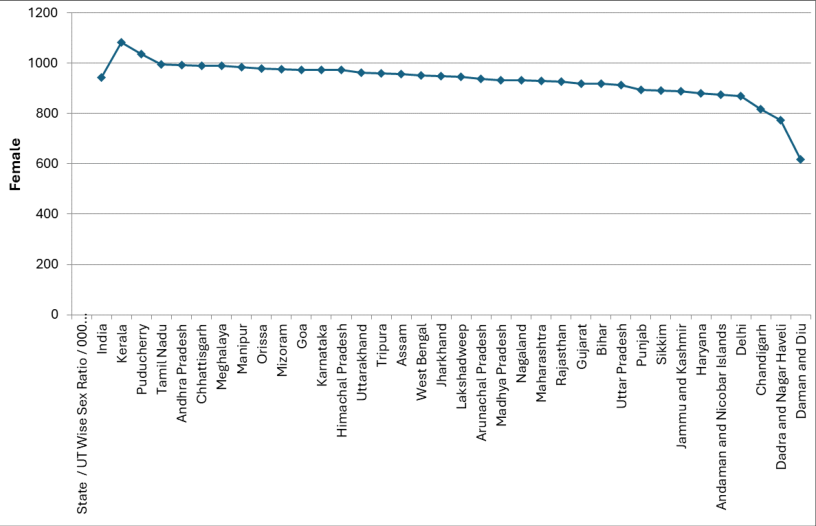 Figure 1
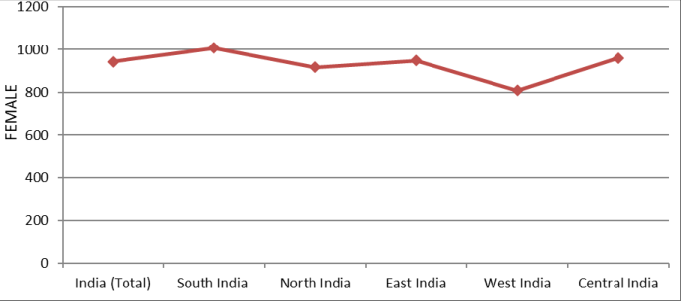 Figure 2
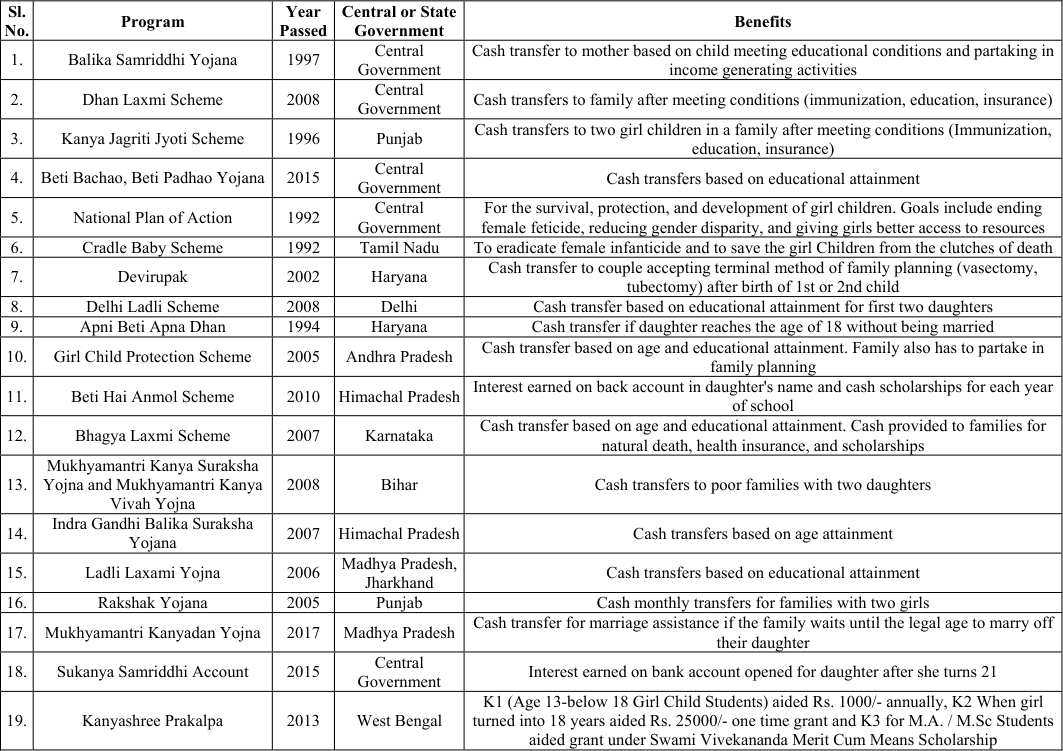 Table 1
Introduction
Gender bias, manifested through discriminatory practices and attitudes towards women and girls, continues to pervade various facets of Indian society. Despite significant strides in economic development and modernization, traditional beliefs and patriarchal norms persist, influencing gender roles, access to education, healthcare, and opportunities for women. Geographical variations amplify these biases, reflecting diverse socio-cultural landscapes across India's states and regions. This study delves into these geographical dimensions to understand how gender bias is shaped by local traditions, economic conditions, and regional policies. In this regard, the term 'Abortion' was historically a taboo subject, deeply stigmatized across the globe. However, over recent decades, legislative changes and shifting societal norms have gradually liberalized attitudes towards abortion in many countries, including India. While legal reforms have expanded access to safe abortions, ethical debates persist, particularly around issues like female foeticide and infanticide. These practices, deeply entrenched in cultural beliefs, highlight persistent gender biases that skew sex ratios and perpetuate societal inequalities. Hence, there are no formalized women's movements in India. The issue of declining sex ratios, particularly in developing countries, has become a critical concern. Female foeticide and infanticide are among the primary causes contributing to this imbalance. Despite legal prohibitions, the practice continues covertly, facilitated by modern technology that allows for prenatal sex determination and subsequent abortion of female foetuses. This practice is rooted in deep-seated cultural beliefs, including the preference for sons due to traditional roles in rituals like Pyre Pindadana and Mukhagni. Urgent societal change is necessary to recognize the value of the girl child and address these ethical challenges.
Objectives
This article attempts to synthesize the provided content into a coherent narrative on gender bias in modern Indian society, focusing on geographical perspectives on the following grounds; 1. To find out the contribution of Geography in mind set and cultural practices 2. To analysis the regional variations 3. To study the ethical issues regarding abortion as well as gender bias 4. To know the Govt. scheme to alleviate female foeticide as well as gender bias.
Methodology
The entire research work has been done based on the secondary data which includes the following points; i). Literature Review ii). Secondary Data Collection iii). Analysis and iv). Recommendations.
Results and Discussion
The ancient Romans did accept the execution of unwanted infants. Further-more, such customs are not unique to antiquity. Thousands of newborns are still slain or allowed to perish every year all across the world. Southern states generally fare better in terms of sex ratios but may face challenges related to gender disparities in education and employment opportunities. Understanding these regional variations is crucial for formulating targeted interventions and policies to address gender inequality effectively.
Regional Variations
Geographically, female foeticide exhibits significant regional disparities within India. Certain states and regions have higher incidences of female foeticide from the mind setting of gender bias as sons demand because of economic purposes as to increase the source of family income along with social and traditional Hindu culture where only the son has right for Pray Pindadana, Mukhagni etc. and not the daughters according to the culture of traditional patriarchal society. ii) Rural Urban Variations: The sex ratio in India is characterized by the differences in its rural-urban components. The rural sex ratio of India according to 2011 census is 946 / 000 males and the urban sex-ratio is 900 / 000 males. The urban-rural difference in the sex-ratio of India is the product of sex selective migration from rural areas to urban areas. More males move from rural areas to urban areas in India. iii) Regional Disparities
A. Ethical Issues
It makes sense to discuss the matter as long as people are open-minded, especially since public opinion on the subject of abortion is polarized at least for now. A mind that is open to such an approach is necessary for mental health. Seeking understanding perspective and enlightenment wherever they may be found is a necessary part of human fulfillment. This suggest that one could have a change of heart upon looking into the arguments more thoroughly, many philosophers belief like Michel Tooley, for instance continue to support abortion and infanticide, although his justifications of these claims have evolved in his important paper "Abortion and Infanticide". Similarly, Mary Anne Warren changed the way that she justified her support for abortion from what amounted to an un-questioning stance to one that look into account several factors. Although Tristram Engelhardt formerly supported abortion likes, he now feels that abortion is ethically wrong for reasons that are primarily theological rather than secular. If abortion is ethically unacceptable then a person like who has undergone an abortion or assisted someone else in getting one appears to have committed a grave transgression. The pro-lifers believe that by doing so, they have slain an innocent person. If aborting a child or criticizing abortion turns a person into a morally reprehensible person, then it would appear that both groups are morally reprehensible.
From the above discussion it can be said that it is very controversial matter along with there have normally practiced the determination of sex in the fetus stage although there have some availability of law for the expectation of sex determination needs strict execution in our country. There will be a scarcity of brides in the marriage market mainly because of the adverse sex ratio, combined with an overall deterioration in fertility. So, we must have to change our mindset and not to differ girl child from a boy, otherwise the human mankind will not be found in the society.
B. Govt. Scheme
The Governments both the Central and States have initiated different schemes to alleviating the female feticide from the mind set of gender bias and to promote the gender equality which can be understand from the following government scheme.
Challenges and Consequences
Gender bias poses multifaceted challenges, including adverse demographic trends, such as declining sex ratios and imbalanced population pyramids. Social consequences include limited opportunities for women in education and employment, contributing to perpetuating cycles of poverty and exclusion. Addressing these challenges requires comprehensive strategies that encompass legal reforms, socio-cultural interventions and economic empowerment initiatives tailored to regional contexts. By implementing these recommendations systematically and collaboratively, India can make significant strides towards mitigating gender bias and creating a more inclusive and equitable society across its diverse geographical landscapes.
Strategies for Mitigating Gender Bias
Strategies for Mitigating Gender Bias
Conclusion
Gender bias in modern Indian society is a complex issue shaped by geographical, socio-cultural, and economic factors. By examining these dimensions, this study underscores the importance of region-specific approaches to address gender inequality effectively. Sustainable progress towards gender equity requires concerted efforts to challenge discriminatory practices, empower women, and foster inclusive societal norms across diverse geographical contexts in India.
In conclusion, while legal frameworks and technological advancements like artificial wombs offer potential solutions, lasting change hinges on societal attitudes towards gender and human rights. Embracing the value of the girl child is not only essential for addressing gender bias but also for fostering a more just and equitable society in India and beyond.
Figures and tables from the paper
References
10 in the original paper- Garg S, Nath A. Female feticide in India: Issues and concern. Journal of Postgraduate Medicine. 2008, 54(4). Available from: www.jpgmonline.com
- Kapoor V. Inheritance Rights of Daughters in India. The Banaras Law Journal. 2011;40(1-2):174-191.
- Khatun S, Islam A. Death before birth-A study on female in India. MS Academic. 2011;1(3):94-99. Available from: www.researchgate.net
- Koradia K, Sharma M, Narang D, Yadav V. Female foeticide. International Journal of Social Science & Interdisciplinary Research. 2013, 2(5). Available from: www.indianresearchjournals.com
- Nawal S, Hiral V, Dhwanee T, et al. Female foeticide perceptions and practices among women in Surat city. National Journal of Community Medicine. 2011, 2(1).
- Saravanan S. Female infanticide in India: A review of literature. Social Change. 2002, 32(1-2). Available from: https://doi.org/10.1177/004908570203200205
- Sarmah U. Women and their role in labour market: a case study conducted on North Eastern coal fields, Margherita, Assam. IOSR Journal of Humanities and Social Sciences. 2012;3(5):47-51.
- Saryal S. Women's Rights in India: Problems and Prospects. International Research Journal of Social Sciences. 2014;3(7):49-53.
- Srivastava R. Female feticide: A social evil in India. IOSR Journal of Humanities and Social Science. 2014;19(1):71-74. Available from: www.iosrjournals.org
- Varma MP, Prasad KS, Mummadi MK, et al. Assessment of knowledge and awareness of female feticide among college students of State. Indian Journal Medical Research and Pharmaceutical Sciences. 2015, 2(5).