
Research article · 2024 · Full text
International Journal of Horticulture and Food ScienceEffect of boron and spacing on seed yield of radish (Raphanus sativus L.) varieties Punjab Pasand and Arka Nishant
Volume 6(1) · Pages 145–149 · DOI: 10.33545/26631067.2024.v6.i1b.219 ↗
Research areasPlant Micronutrient Interactions and EffectsAgricultural Science and FertilizationCrop Yield and Soil Fertility
Abstract
Author-writtenThis research investigates the effect of boron (B) and spacing on seed production of two commercially important radish (Raphanus sativus L.) varieties cultivated in Punjab, India: Arka Nishant and Punjab Pasand. Building upon research conducted at Guru Kashi University in the academic year 2023-2024, to find out the response of boron treatment (0%, 0.05 mg/l, 0.1 mg/l), spacing (50 cm, 60 cm, 70 cm) and their intraction on seed yield of radish cv. Arka Nishant and Punjab Pasand. The experiment was conduct in split plot design with three replications. Observations were recorded on highest leaf length (Arka Nishant), Maximum Root length (Arka Nishant), Root Girth, Maximum Number of Siliqua per plant (Punjab Pasand), Maximum siliqua weight (Punjab Pasand), siliqua length, Maximum (Arka Nishant) Average Seed Yield Per hectare, respectively.
Summary
Source-checkedPlain-language reading of the full paper, prepared with AI and checked against the text. Each point links to the authors' own words.
Why it matters
- Radish is a cruciferous salad root vegetable grown extensively in India, covering approximately 209 thousand hectares. View evidence ↗
- Boron is a critical micronutrient that supports essential plant functions such as carbohydrate metabolism, pollen germination, and cell wall synthesis. View evidence ↗
- Boron deficiency in radish can lead to reduced seed viability, smaller seed size and weight, and a decrease in the number of seeds produced. View evidence ↗
The question
- The study aimed to investigate how boron affects seed production parameters for the Arka Nishant and Punjab Pasand radish varieties in Punjab. View evidence ↗
What they did
- The research was carried out during the winter of 2023-2024 at the Guru Kahi University research farm in Talwandi-Sabo, Bathinda. View evidence ↗
- The experiment utilized a split plot design with three replications for each radish variety. View evidence ↗
- The study tested three boron treatments (0%, 0.05 mg/l, and 0.1 mg/l) and three spacing intervals (50 cm, 60 cm, and 70 cm). View evidence ↗
What they found
- In the Punjab Pasand variety, the number of leaves was highest at 70 cm spacing (34.7) and lowest at 50 cm spacing (30.8). View evidence ↗
- For Punjab Pasand, the maximum number of siliques per plant (296.8) occurred with 0.05 mg/l boron, while the minimum (281.4) occurred with 0.1 mg/l boron. View evidence ↗
- In the Arka Nishant variety, the highest number of siliques per plant (393.3) was found at 0.1 mg/l boron, and the lowest (322.6) at 0.05 mg/l boron. View evidence ↗
- The interaction of 0.05 mg/l boron and 70 cm spacing produced the maximum seed yield for Punjab Pasand (160.4 kg/ha), while 0.05 mg/l boron and 50 cm spacing produced the minimum (154.3 kg/ha). View evidence ↗
What it means
- While Punjab Pasand is better for leaf size and siliqua numbers, Arka Nishant is recommended for cultivation due to its superior seed yield and root characteristics. View evidence ↗
Visual summary
3 visualsIllustrations explain the paper; charts are replotted from the paper's own table values.
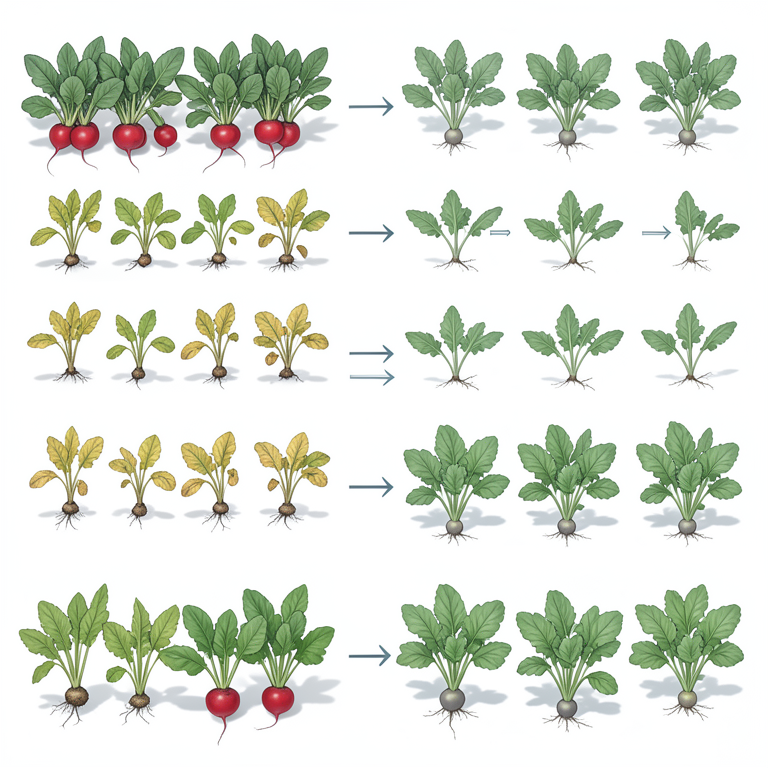
Experimental Variable Matrix
AI-generated conceptual illustration (radish plants (Raphanus sativus L.)). It explains the idea and does not show study data.
View source evidence ↗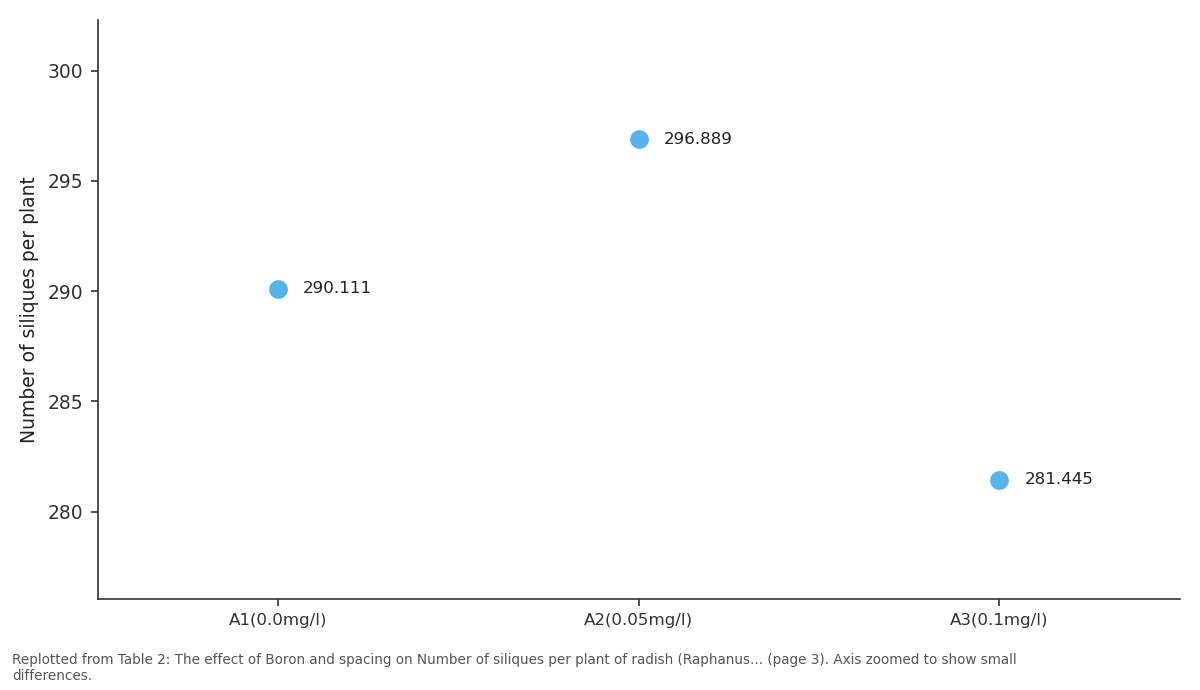
Mean A: A1(0.0mg/l) vs A2(0.05mg/l) vs A3(0.1mg/l)
Replotted from Table 2 (page 3) of the original paper. Every bar is the paper's own table value.
View source evidence ↗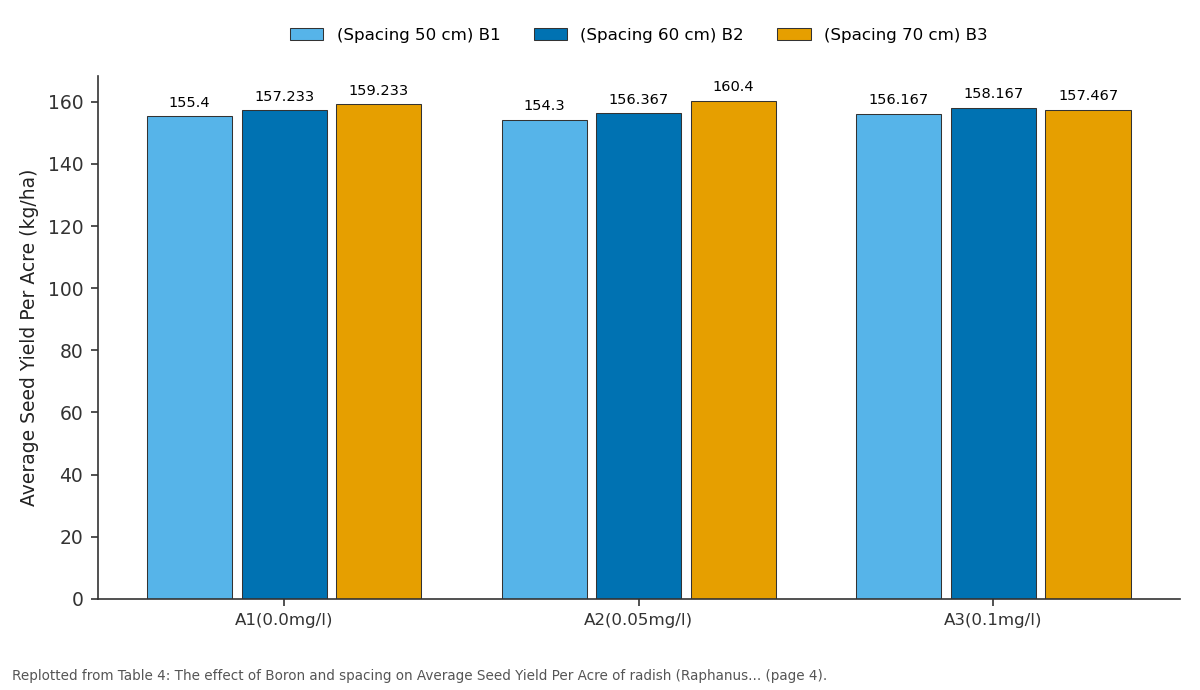
(Spacing 50 cm) B1 and (Spacing 60 cm) B2 and more: A1(0.0mg/l) vs A2(0.05mg/l) vs A3(0.1mg/l)
Replotted from Table 4 (page 4) of the original paper. Every bar is the paper's own table value.
View source evidence ↗Figures & tables
From the original paper Table 1
 Table 2
 Table 2
 Table 2
 Table 3
 Table 3
 Table 3
 Table 4
 Table 4
 Table 4
Introduction
Radish (Raphanus sativus L.) is an open pollinated salad root vegetable belongs to family cruciferous with chromosome number 2n = 2x 18. There is self-incompatibility in radish. It is an ancient crop native to the eastern Mediterranean and Middle East. In India, it is grown over an area of 209 thousand ha with annual production of radish.
Radish are annual or biennial crops mainly grown for its young tender roots which can be globular, tapering or cylindrical, which are eaten raw as a salad or cooked as vegetable. Some radishes grown for their seeds and oilseed radishes grown for oil production. They germinate quickly and grow rapidly, smaller varieties being ready for consumption within a month while large daikon varieties taking several months. Radish is a good source of vitamin C (ascorbic acid) containing (15-40 mg/100 g) of edible portion and supplies variety of minerals.
Roots are also rich in carbohydrate and protein. In addition, it contains various water-soluble vitamins (B1, B2, B3, B5, B6, B9, and C) and minerals (calcium, iron, magnesium, manganese zinc, potassium, and phosphorous). Its consumption prevent constipation, increase appetite and useful for jaundice, liver disorders and also useful in urinary complaints and piles. In homeopathy, it is used for chronic diarrhea, headache and sleeplessness.
It can be useful as companion plants for many other crops because their pungent Odor deters such insect pests as aphids, cucumber beetles, tomato hornworms and ants. The commonly grown radish varieties are classified broadly into two groups European or temperate type and Asian or tropical type. Micronutrients, elements required by plants in small quantities, play a critical role in various physiological processes, including seed production [Gupta, A.K. 2004] [6]. Boron (B) is an essential micronutrient for plant growth and development.
It is involved in cell wall synthesis, pollen germination, carbohydrate metabolism, and other vital functions [Haworth, J. 1977] [7]. Deficiency in boron can significantly impact seed yield and quality in various crops [Hedge, D.M. & Mengel, K. 1976] [8]. In radish, boron deficiency has been shown to negatively affect seed production. Studies have reported a decrease in the number of seeds produced (Siliques per plant and seeds per silique), reduced seed size and weight, and impaired seed viability when boron is deficient [Huang, L. 2002] [9] Rajat Kumar Sharma Department of Horticulture, College of Agriculture, Guri Kashi University, Talwandi- Sabo, Bathinda, Punjab, India https://www.hortijournal.com Optimizing boron application can potentially address these limitations and enhance seed production in radish varieties like Arka Nishant and Punjab Pasand.
The primary objective of this research is to investigate the effect of micronutrient boron on seed production parameters of radish varieties Arka Nishant and Punjab Pasand grown under Punjab conditions. The specific objectives are To standardize the variety for south-western region of Punjab To standardize the Boron and spacing in south-western region of Punjab To standardize the requirement of Boron doses and spacing effect for obtaining vegetative growth and seed yield of radish varieties (Punjab Pasand and Arka Nishant).
Materials And Methods
The present research was conducted at the experimental sites of Guru Kahi University research farm, Talwandi- Sabo (Bathinda) During winter 2023-2024 According to the google map, the farm is located at 29057’N latitude and 7507’E longitude and altitude if 213 meters above sea levels. The material used in the research work of radish (Raphanus sativus L.) in Arka Nishant and Punjab Pasand. The experiment was laid out in split plot technique with three replications of each varieties. The seedlings were transplanted on 11oct.2023.
The response of boron treatment (0%, 0.05 mg/l, 0.1 mg/l), spacing (50 cm, 60 cm, 70 cm) and their intraction on seed yield of radish cv. Arka Nishant. Maximum Root length (Arka Nishant), Root Girth, Maximum Number of Siliqua per plant (Punjab Pasand), Maximum siliqua weight (Punjab Pasand), siliqua length, Maximum (Arka Nishant) Average Seed Yield Per hectare, respectively. The statistical analysis of data recorded during the course of investigation for the all characters was done by the analysis of variance methods for split plot technique design described by fisher (1925).
Results And Discussion
Analysis of variance (ANOVA) revealed significant differences among spacing and boron of all characters. Number of leaves per Plant A significant variation in spacing was observed on number of leaves per plant (Table 1) among the varieties Punjab Pasand and Arka Nishant of radish. Maximum number of leaves (34.7) at spacing 70 cm in Punjab Pasand and Minimum number of leaves (30.8) at spacing 50 cm. Number of leaves varied from 30.8 to 34.7.
| Punjab Pasand (V1) | — | — | — | — | Arka Nishant(V2) | — | — | — |
|---|---|---|---|---|---|---|---|---|
| (Spacing 50cm)B1 | (Spacing 60cm)B2 | (Spacing 70cm)B 3 | Mean A | (Spacin g 50cm)B 1 | (Spacin g 60cm)B 2 | (Spacin g 70cm)B 3 | MeanA | |
| A1(0.0mg/l) | 31.000 | 33.333 | 34.667 | 33.000 | 29.333 | 31.667 | 33.000 | 31.333 |
| A2(0.05mg/l) | 32.333 | 33.333 | 35.667 | 33.778 | 30.667 | 32.333 | 34.000 | 32.333 |
| A3(0.1mg/l) | 29.333 | 32.000 | 34.000 | 31.778 | 29.667 | 31.000 | 32.667 | 31.111 |
| Mean B | 30.889 | 32.889 | 34.778 | 29.889 | 31.667 | 33.222 |
Table text extracted from the original PDF; superscript letters are shown inline. The original table image is below.
View original table image
In Arka Nishant variety Maximum number of leaves (33.2) at spacing 70cm and Minimum number of leaves (29.8) at spacing 50cm. Number of leaves varied from 33.2 to 29.8. The Finding are confirmed by the findings of. A significant variation in boron was observed on number of leaves per plant (Table 1) among the varieties Punjab Pasand and Arka Nishant of radish.
Maximum number of leaves 33.7 at boron treatment 0.5 mg/l in Punjab Pasand and Minimum number of leaves (31.7) at boron treatment 0.1 mg/l. Number of leaves varied from 31.7 to 33.7. In Arka Nishant variety Maximum number of leaves (32.3) at boron treatment 0.05mg/l boron and Minimum number of leaves (31.1) at boron treatment 0.1mg/l. Number of leaves varied from 31.1 to 32.3.
Significant effect of interaction of Boron and Spacing was observed for number of leaves (Table 1). In Punjab Pasand Maximum number of leaves (35.0) at boron and spacing 0.05 mg/l, 70 cm and Minimum number of leaves (31) at boron and spacing 0.0 mg/l, 50 cm. In Arka Nishant Maximum number of leaves (34) at boron and spacing 0.05 mg/l, 70 cm and Minimum number of leaves (29.3) at boron and spacing 0.0 mg/l, 50 cm. Number of leaves varied from 29.3 to 34.
Similar Finding are confirmed by the findings of. Number of siliques per plant A significant variation in boron was observed on Number of siliques per plant (Table 2) among the varieties Punjab Pasand and Arka Nishant of radish. Maximum Number of siliques per plant (296.8) at boron treatment 0.05 mg/l in Punjab Pasand and Minimum Number of siliques per plant (281.4) at boron treatment 0.1gm/l. Number of siliques ranged from 281.4 to 296.8.
| Punjab Pasand (V1) | — | — | — | — | Arka Nishant(V2) | — | — | — |
|---|---|---|---|---|---|---|---|---|
| (Spacing 50 cm) B1 | (Spacing 60 cm) B2 | (Spacing 70 cm) B3 | Mean A | (Spacing 50 cm) B1 | (Spacing 60 cm) B2 | (Spacing 70 cm) B3 | Mean A | |
| A1(0.0mg/l) | 271.000 | 292.000 | 307.333 | 290.111 | 332.000 | 341.333 | 351.667 | 341.667 |
| A2(0.05mg/l) | 282.333 | 302.667 | 305.667 | 296.889 | 317.000 | 323.333 | 327.667 | 322.667 |
| A3(0.1mg/l) | 266.333 | 282.000 | 296.000 | 281.445 | 282.333 | 291.667 | 306.000 | 293.333 |
| Mean B | 273.222 | 292.222 | 303.000 | 310.445 | 318.778 | 328.445 |
Table text extracted from the original PDF; superscript letters are shown inline. The original table image is below.
View original table image
| Factors | C.D. | SE(d) | SE(m) |
|---|---|---|---|
| Factor(A) | N/A | 0.380 | 0.268 |
| Factor(B) | 0.469 | 0.213 | 0.150 |
| Factor(B)at same level of A | N/A | 0.369 | 0.465 |
| Factor(A)at same level of B | N/A | 0.484 | 0.34 |
Table text extracted from the original PDF; superscript letters are shown inline. The original table image is below.
View original table image
| Factors | C.D. | SE(d) | SE(m) |
|---|---|---|---|
| Factor(A) | 0.409 | 0.143 | 0.101 |
| Factor(B) | 0.565 | 0.257 | 0.181 |
| Factor(B)at same level of A | N/A | 0.444 | 0.176 |
| Factor(A)at same level of B | N/A | 0.390 | 0.276 |
Table text extracted from the original PDF; superscript letters are shown inline. The original table image is below.
View original table image
In Arka Nishant variety Maximum Number of siliques per plant (393.3) at boron treatment 0.1mg/l and Minimum Number of siliques per plant (322.6) at boron treatment 0.05mg/l. Number of siliques ranged from 322.6 to 393.3. Dursun, A., & Esiyok, D. (2009) [4]. Find the physiological parameters of chickpea (Cicer arietinum L.).
A significant variation in spacing was observed on Number of siliques per plant (Table 2) among the varieties Punjab Pasand and Arka Nishant of radish. Maximum Number of siliques per plant (303.0) at spacing 70cm in Punjab Pasand and Minimum Number of siliques per plant (273.2) at spacing 50cm. Number of siliques ranged form 273.2 to 303.0. In Arka Nishant variety Maximum Number of siliques per plant (328.4) at spacing 70cm and Minimum Number of siliques per plant (310.4) at spacing 50cm.
Number of siliques ranged from 310.4 to 328.4. Significant effect of interaction of Boron and Spacing was observed for Number of siliques (Table2). In Punjab Pasand Maximum Number of siliques (307.3) at boron and spacing 0.0 mg/l, 70 cm and Minimum Number of siliques (271.0) at boron and spacing 0.0mg/l, 50cm. Number of siliques ranged from 271.0 to 307.3.
In Arka Nishant Maximum Number of siliques (351.6) at boron and spacing 0.0mg/l, 70cm and Minimum Number of siliques (282.3) at boron and spacing 0.1 mg/l, 50cm. Number of siliques ranged from 282.3 to 351.6. Number of seeds per silique A significant variation in Boron was observed on Number of seeds per silique (Table 3) among the varieties Punjab Pasand and Arka Nishant of radish. Maximum Number of seeds per silique (2.43) at boron treatment 0.05 mg/l in Punjab Pasand and Minimum Number of Number of seeds per silique (2.42) at boron treatment 0.0mg/l.
| Factors | C.D. | SE(d) | SE(m) |
|---|---|---|---|
| Factor(A) | 1.306 | 0.458 | 0.324 |
| Factor(B) | 0.734 | 0.333 | 0.236 |
| Factor(B)at same level of A | 1.454 | 0.577 | 0.561 |
| Factor(A)at same level of B | 1.655 | 0.657 | 0.465 |
Table text extracted from the original PDF; superscript letters are shown inline. The original table image is below.
View original table image
| Factors | C.D. | SE(d) | SE(m) |
|---|---|---|---|
| Factor(A) | 0.517 | 0.181 | 0.128 |
| Factor(B) | 0.916 | 0.416 | 0.294 |
| Factor(B)at same level of A | 1.627 | 0.720 | 0.222 |
| Factor(A)at same level of B | 1.390 | 0.615 | 0.435 |
Table text extracted from the original PDF; superscript letters are shown inline. The original table image is below.
View original table image
Number of seeds ranged from 2.42 to 2.43. In Arka Nishant variety Maximum Number of seeds per silique (4.87) at boron treatment 0.05 mg/l and Minimum Number of seeds per silique (4.70) at boron treatment 0.1 mg/l. Number of seeds ranged from 4.70 to 4.87. Similar findings were found Fernandez- Escobar, R.., Barranco, 2013.
A significant variation in Spacing was observed on Number of seeds per silique (Table 3) among the varieties Punjab Pasand and Arka Nishant of radish. Maximum Number of seeds per silique (2.46) at spacing 70cm in Punjab Pasand https://www.hortijournal.com kg/ha) at boron treatment 0.0 mg/l. Average seed yield ranged from 159.7 kg/ha to 161.12 kg/ha. Similar findings were Chen, Y.
H., Li, X. P., Wang (2007) [14] and F. M., Moreno-Diez, S (2013) [5]. A significant variation in spacing was observed on Average Seed Yield Per hectare (kg/ha) (Table 4) among the varieties Punjab Pasand and Arka Nishant of radish.
| Factors | C.D. | SE(d) | SE(m) |
|---|---|---|---|
| Factor(A) | 0.082 | 0.029 | 0.020 |
| Factor(B) | 0.059 | 0.027 | 0.019 |
| Factor(B)at same level of A | 0.113 | 0.047 | 0.035 |
| Factor(A)at same level of B | 0.116 | 0.048 | 0.034 |
Table text extracted from the original PDF; superscript letters are shown inline. The original table image is below.
View original table image
| Factors | C.D. | SE(d) | SE(m) |
|---|---|---|---|
| Factor (A) | 0.001 | 0.000 | 0.000 |
| Factor (B) | 0.002 | 0.001 | 0.001 |
| Factor (B) at same level of A | 0.004 | 0.002 | 0.001 |
| Factor (A )at same level of B | 0.003 | 0.001 | 0.001 |
Table text extracted from the original PDF; superscript letters are shown inline. The original table image is below.
View original table image
Maximum Average Seed Yield Per hectare (159.03 kg/ha) at spacing 70cm in Punjab Pasand and Average Seed Yield Per hectare (155.28kg/ha) at spacing 50cm. Average seed yield ranged from 155.28 kg/ha to 159.03 kg/ha. In Arka Nishant variety Maximum Average Seed Yield Per hectare of Radish (163.11kg/ha) at spacing 70cm and Minimum Average Seed Yield Per hectare (158.44 kg/ha) at spacing 50 cm. Average seed yield ranged from 158.44 kg/ha to 163.11 kg/ha.
Significant effect of interaction of Boron and Spacing was observed for Average Seed Yield Per hectare (kg/ha) (Table 4). In Punjab Pasand Maximum Average Seed Yield Per hectare (160.4 kg/ha) at boron and spacing 0.05 mg/l, 70 cm and Minimum Average Seed Yield Per hectare (154.3 kg/ha) at boron and spacing 0.05 mg/l, 50 cm. Average seed yield ranged from 154.3 kg/ha to 160.4 kg/ha. In Arka Nishant Maximum Average Seed Yield Per hectare (163.6 kg/ha) at boron and spacing 0.0 mg/l, 70cm and Minimum days to Average Seed Yield Per hectare (156.6 kg/ha) at boron and spacing 0.0 mg/l, 50 cm.
Average seed yield ranged from 156.6 kg/ha to 163.6 kg/ha. and Minimum Number of Number of seeds per silique (2.37) at spacing 50cm. Number of seeds ranged from 2.37 to 2.46. In Arka Nishant variety Maximum Number of seeds per silique (5.02) at spacing 70 cm and Minimum Number of seeds per silique (4.63) at spacing 50 cm. Significant effect of interaction of Boron and Spacing was observed for Number of seeds per silique (Table3).
In Punjab Pasand Maximum Number of seeds per silique (2.47) at boron and spacing 0.1 mg/l, 70cm and Minimum Number of seeds per silique (2.36) at boron and spacing 0.0 mg/l, 50 cm. Number of seeds ranged from 2.36 to 2.47. In Arka Nishant Maximum Number of seeds per silique (5.14) at boron and spacing 0.0 mg/l, 70cm and Minimum Number of seeds per silique (4.62) at boron and spacing 0.0mg/l, 50 cm. Number of seeds ranged from 4.62 to 5.14.
Average Seed Yield Per hectare A significant variation in boron was observed on Average Seed Yield Per hectare (kg/ha) (Table 4) among the varieties Punjab. Punjab Pasand and Arka Nishant of radish. Maximum Average Seed Yield Per hectare (157.2 kg/ha) at boron treatment 0.0mg/l in Punjab Pasand and Average Seed Yield Per hectare (157 kg/ha) at boron treatment 0.05 mg/l. Average seed yield ranged from 157 kg/ha to 157.2 kg/ha.
In Arka Nishant variety Maximum Average Seed Yield Per hectare of Radish (161.12 kg/ha) at boron treatment 0.1 mg/l and Minimum Average Seed Yield Per hectare (159.7 Table 1: The effect of Boron and spacing on number of leaves of radish (Raphanus sativus L.) varieties Punjab Pasand and Arka Nishant Punjab Pasand (V1) Arka Nishant(V2) (Spacing 50cm)B1 (Spacing 60cm)B2 (Spacing 70cm)B 3 Mean A (Spacin g 50cm)B 1 (Spacin g 60cm)B 2 (Spacin g 70cm)B 3 MeanA A1(0.0mg/l) 31.000 33.333 34.667 33.000 29.333 31.667 33.000 31.333 A2(0.05mg/l) 32.333 33.333 35.667 33.778 30.667 32.333 34.000 32.333 A3(0.1mg/l) 29.333 32.000 34.000 31.778 29.667 31.000 32.667 31.111 Mean B 30.889 32.889 34.778 29.889 31.667 33.222 Table of SEM, SED and C.D. Factors C.D. SE(d) SE(m) Factor(A) 0.409 0.143 0.101 Factor(B) 0.565 0.257 0.181 Factor(B)at same level of A N/A 0.444 0.176 Factor(A)at same level of B N/A 0.390 0.276 Factors C.D. SE(d) SE(m) Factor(A) N/A 0.380 0.268 Factor(B) 0.469 0.213 0.150 Factor(B)at same level of A N/A 0.369 0.465 Factor(A)at same level of B N/A 0.484 0.34 Table 2: The effect of Boron and spacing on Number of siliques per plant of radish (Raphanus sativus L.) varieties Punjab Pasand and Arka Nishant Punjab Pasand (V1) Arka Nishant(V2) (Spacing 60 cm) (Spacing 70 cm) Mean (Spacing 50 cm) (Spacing 60 cm) (Spacing 70 cm) Mean (Spacing 50 cm) B1 B2 B3 A B1 B2 B3 A A1(0.0mg/l) 271.000 292.000 307.333 290.111 332.000 341.333 351.667 341.667 A2(0.05mg/l) 282.333 302.667 305.667 296.889 317.000 323.333 327.667 322.667 A3(0.1mg/l) 266.333 282.000 296.000 281.445 282.333 291.667 306.000 293.333 Mean B 273.222 292.222 303.000 310.445 318.778 328.445 https://www.hortijournal.com TABLE of SEM,SED and C.D.
Factors C.D. SE(d) SE(m) Factor(A) 0.517 0.181 0.128 Factor(B) 0.916 0.416 0.294 Factor(B)at same level of A 1.627 0.720 0.222 Factor(A)at same level of B 1.390 0.615 0.435 Factors C.D. SE(d) SE(m) Factor(A) 1.306 0.458 0.324 Factor(B) 0.734 0.333 0.236 Factor(B)at same level of A 1.454 0.577 0.561 Factor(A)at same level of B 1.655 0.657 0.465 Table 3: The effect of Boron and spacing on Number of seeds per silique of radish (Raphanus sativus L.) varieties Punjab Pasand and Arka Nishant Punjab Pasand (V1) Arka Nishant(V2) (Spacing 60 cm) (Spacing 70 cm) Mean (Spacing 50 cm) (Spacing 60 cm) (Spacing 70 cm) Mean (Spacing 50 cm) B1 B2 B3 A B1 B2 B3 A A1(0.0 mg/l) 2.361 2.439 2.463 2.421 4.623 4.657 5.143 4.808 A2(0.05 mg/l) 2.378 2.417 2.476 2.424 4.640 4.857 5.130 4.876 A3(0.1 mg/l) 2.395 2.441 2.456 2.430 4.643 4.680 4.797 4.707 Mean B 2.378 2.432 2.465 4.636 4.731 5.023 Table of SEM, SED and C.D. Factors C.D.
SE(d) SE(m) Factor (A) 0.001 0.000 0.000 Factor (B) 0.002 0.001 0.001 Factor (B) at same level of A 0.004 0.002 0.001 Factor (A )at same level of B 0.003 0.001 0.001 Factors C.D. SE(d) SE(m) Factor(A) 0.082 0.029 0.020 Factor(B) 0.059 0.027 0.019 Factor(B)at same level of A 0.113 0.047 0.035 Factor(A)at same level of B 0.116 0.048 0.034 Table 4: The effect of Boron and spacing on Average Seed Yield Per Acre of radish (Raphanus sativus L.) varieties Punjab Pasand and Arka Nishant Punjab Pasand (V1) Arka Nishant(V2) (Spacing 60 (Spacing 70 cm) (Spacing 60 (Spacing 70 (Spacing 50 cm) B1 cm) B2 B3 Mean A (Spacing 50 cm) B1 cm) B2 cm) B3 Mean A A1(0.0mg/l) 155.400 157.233 159.233 157.289 156.667 159.000 163.667 159.778 A2(0.05mg/l) 154.300 156.367 160.400 157.022 158.667 161.000 163.000 160.889 A3(0.1mg/l) 156.167 158.167 157.467 157.267 160.000 161.000 162.667 161.222 Mean B 155.289 157.256 159.033 158.444 160.333 163.111 Table of SEM, SED and C.D. Factors C.D. SE(d) SE(m) Factor(A) N/A 0.074 0.053 Factor(B) 0.122 0.056 0.039 Factor(B)at same level of A 0.242 0.096 0.091 Factor(A)at same level of B 0.272 0.108 0.077 Factors C.D.
SE(d) SE(m) Factor(A) N/A 0.979 0.692 Factor(B) 1.009 0.458 0.324 Factor(B)at same level of A 2.106 0.793 1.199 Factor(A)at same level of B 3.116 1.174 0.830
Conclusion
The comparative analysis of Punjab Pasand and Arka Nishant varieties across various parameters reveals significant differences in their agronomic traits. In terms of leaf characteristics, Punjab Pasand generally exhibits larger sizes compared to Arka Nishant. However, Arka Nishant demonstrates superior root length and girth, particularly in category 0.1mg/l boron. Siliqua traits vary between the two varieties, with Punjab Pasand often showing higher numbers and weights per plant.
Conversely, Arka Nishant tends to produce longer siliquas. Flowering times are relatively similar, though Arka Nishant tends to flower slightly later. When considering seed yield, Arka Nishant consistently outperforms Punjab Pasand, especially in category 70cm https://www.hortijournal.com Rapeseed (Brassica napus L.). Pedosphere. 2007;17(2):226-232.
DOI:10.1007/s11437-007-0026-2 15. Eşiyok D, Gönülal E. Effects of Boron Fertilization on Yield and Quality Parameters of Cabbage (Brassica oleracea var. capitata). Communications in Soil Science and Plant Analysis. 2006;37(17-18):2523-2530.
DOI:10.1080/00103620600841972 spacing. Overall, while Punjab Pasand excels in certain traits like leaf size and siliqua numbers, Arka Nishant demonstrates better performance in root characteristics and seed yield, making it a favorable choice for cultivation in various conditions.
References
14 in the original paper- Bhargava SK, Clark RB. Function of Boron in Irrigation and Salinity Management. Journal of Plant Nutrition. 2001;24(8):183-218. DOI:10.1081/PLN- 100107199
- Cakmak I. Boron deficiency in higher plants: A review. Plant and Soil. 2008;302(1-2):17-32. doi:10.1007/s11104-007-9400-5
- Chen W, Zhang Z, Wang F, Li Y, Christie P. Functions of Boron in Plants: Recent Progress and Challenges. Frontiers in Plant Science. 2018;9:1750. doi:10.3389/fpls.2018.01750
- Eşiyok D, Gönülal E. Effects of Boron Fertilization on Yield and Quality Parameters of Pepper. Communications in Soil Science and Plant Analysis. 2006;37(17-18):2531-2539. doi:10.1080/00103620600841984
- Fernández-Escobar R, Barranco V, Cánovas FM, Gallardo A, Moreno-Diez S. Boron Effects on Yield and Quality of Broccoli (Brassica oleracea var. italica) Grown in a Greenhouse with Climate Control. Journal of Agricultural Science. 2013;5(12):1249-1258. DOI:10.5539/jas.2013.v5n12p1249
- Gupta AK. Sources and management of boron in agriculture. Advances in Agronomy. 2004;83:9-74. DOI:10.1016/S0065-2113(03)00002-2
- Haworth J. Boron. In: Marschner DP, editor. Mineral nutrition of higher plants. 2nd ed. Academic Press; c1997. p. 254-283.
- Hegde DM, Mengel K. Effect of boron deficiency on the sugar translocation and sugar level in various parts of the tomato plant. Plant and Soil. 1976;44(2):241-249. doi:10.1007/BF00003562
- Huang L, Duncan HJ. Boron uptake and distribution in relation to flower and seed development in oilseed rape (Brassica napus L.). Annals of Botany. 2002;90(7):811-818. DOI:10.1093/aob/mcf242
- Jeschke WD. The Role of Boron in Higher Plants. Journal of Plant Nutrition. 1984;7(1-2):481-500. doi:10.1080/01632788408540371
- Liu S, Wang Y, Li Y, Li J, Jia Z, Jin C. Effects of Boron Stress on the Germination, Seedling Growth and Physiological Metabolism of Radish (Raphanus sativus L.). Journal of Plant Growth Regulation. 2020;39(3):1089-1100. DOI:10.1007/s00344-020- 09982-9
- Agnia HF, El-Gizawy AM, El-Sawy AA. Response of broccoli plants (Brassica oleracea var. italica) to foliar application of boron and nitrogen fertilizer. Archives of Agronomy and Soil Science. 2016;62(14):1902-1914. DOI:10.1080/00032768.2016.1191774
- Cakmak I, Torun B, Erenoglu B, Kaya C. Effect of boron deficiency on seed yield and quality of peanut (Arachis hypogaea L.). Journal of Plant Nutrition. 1999;22(12):1801-1816. doi:10.1080/01632789909385284
- Chen YH, Li XP, Wang SQ, Zou CL. Effects of Boron Nutrition on Seed Yield and Quality of Winter