
Research article · 2024 · Full text
International Journal of Agriculture Extension and Social DevelopmentAdoption behaviour of farmers towards improved Tamenglong orange cultivation practices in Tamenglong District of Manipur
Volume 7(7S) · Pages 161–164 · DOI: 10.33545/26180723.2024.v7.i7sc.815 ↗
Research areasAgricultural Economics and Practices
Abstract
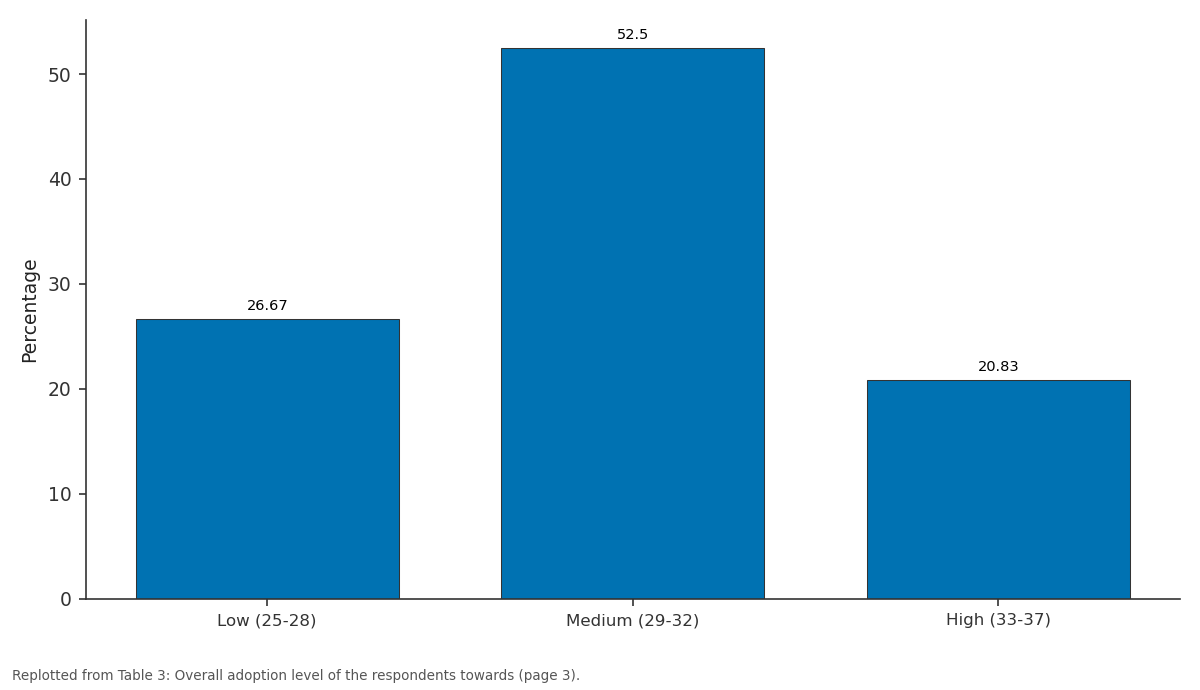
Author-writtenThe present study was conducted to ascertain the adoption behaviour of farmers towards improved tamenglong orange cultivation practices in Tamenglong district of Manipur. The Tamenglong Block of Tamenglong District was selected purposively for the present study, descriptive research designed was applied. The primary data was collected from 120 respondents by personal interview which were selected randomly by using pre-structure interview schedule. Adoption of the farmers was measured by asking 15 questions in respect of Tamenglong orange cultivation. Finding showed that 52.50 per cent of the respondents have medium level of adoption of Tamenglong orange cultivation, followed by low level adoption i.e., 26.67 per cent and high-level adoption 20.83 per cent respectively. The relation between profile of the respondents and their adoption about improved Tamenglong orange cultivation practices the co-efficient correlation was revealed that independent variable like age, education, occupation, land holding, farming experience, annual income, mass media exposure, innovativeness, scientific orientation, risk bearing capacity and progressiveness are positively and significantly associated with adoption.
Summary
Source-checkedPlain-language reading of the full paper, prepared with AI and checked against the text. Each point links to the authors' own words.
Why it matters
- The Tamenglong orange is a unique fruit found exclusively in the Tamenglong district of Manipur and is considered among the highest quality oranges globally. View evidence ↗
- Tamenglong is the primary orange production hub in Manipur, accounting for more than 50% of the state's annual output, which totals approximately 10,000 to 11,000 metric tonnes. View evidence ↗
- The region's elevation of 1,260 meters provides a favorable climate and soil for orange cultivation, with nearly 40% of the land mass dedicated to this crop. View evidence ↗
The question
- The study aimed to determine the level at which farmers have adopted improved cultivation practices for Tamenglong oranges. View evidence ↗
- The researchers sought to identify the relationship between specific independent variables and the adoption of these improved practices. View evidence ↗
What they did
- Data was gathered from 120 randomly selected respondents through personal interviews using a pre-structured schedule. View evidence ↗
- Farmer adoption was quantified using a set of 15 specific questions regarding Tamenglong orange cultivation. View evidence ↗
- The research was conducted in three randomly selected villages within the purposively chosen Tamenglong block of the Tamenglong District in Manipur. View evidence ↗
What they found
- The majority of farmers (52.50%) showed a medium level of adoption, while 26.67% had low adoption and 20.83% had high adoption. View evidence ↗
- The most widely adopted practice was the correct harvesting time, which was fully adopted by 84.17% of the respondents. View evidence ↗
- Biological control was the least adopted practice, with 90.83% of respondents not adopting it and 0.00% fully adopting it. View evidence ↗
- Over half of the respondents (50.83%) did not adopt proper irrigation practices. View evidence ↗
- All eleven studied independent variables, including age, education, income, and mass media exposure, were found to be positively and significantly correlated with the adoption of improved practices. View evidence ↗
What it means
- The authors recommend providing farmers with proper training for pest and disease identification, alongside government support through loans and subsidies to improve cultivation practices. View evidence ↗
Visual summary
2 visualsIllustrations explain the paper; charts are replotted from the paper's own table values.
Percentage: Low (25-28) vs Medium (29-32) vs High (33-37)
Replotted from Table 3 (page 3) of the original paper. Every bar is the paper's own table value.
View source evidence ↗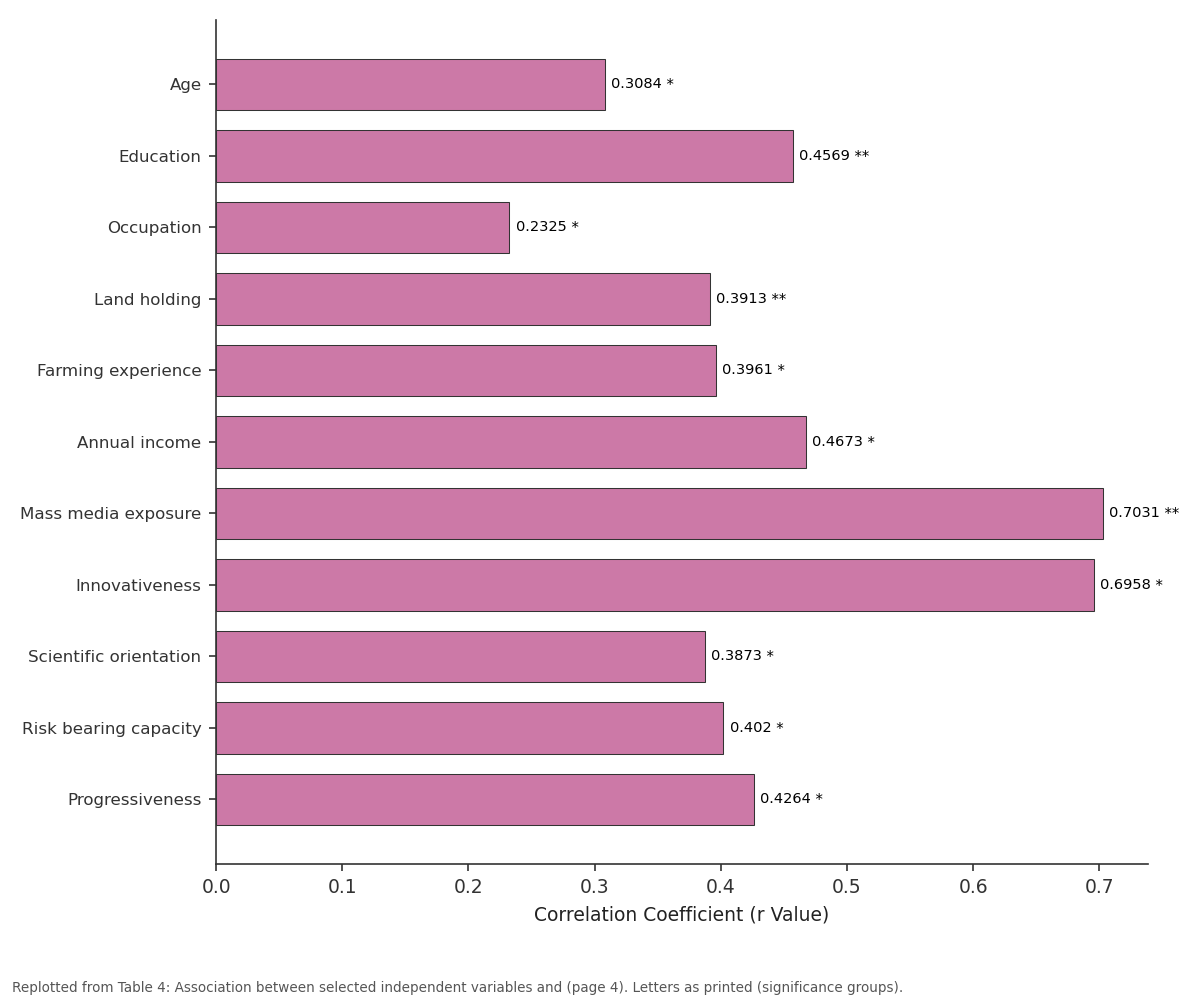
Correlation Coefficient (‘r’ Value): Age vs Education vs Occupation vs Land holding vs Farming experience
Replotted from Table 4 (page 4) of the original paper. Every bar is the paper's own table value.
View source evidence ↗Figures & tables
From the original paper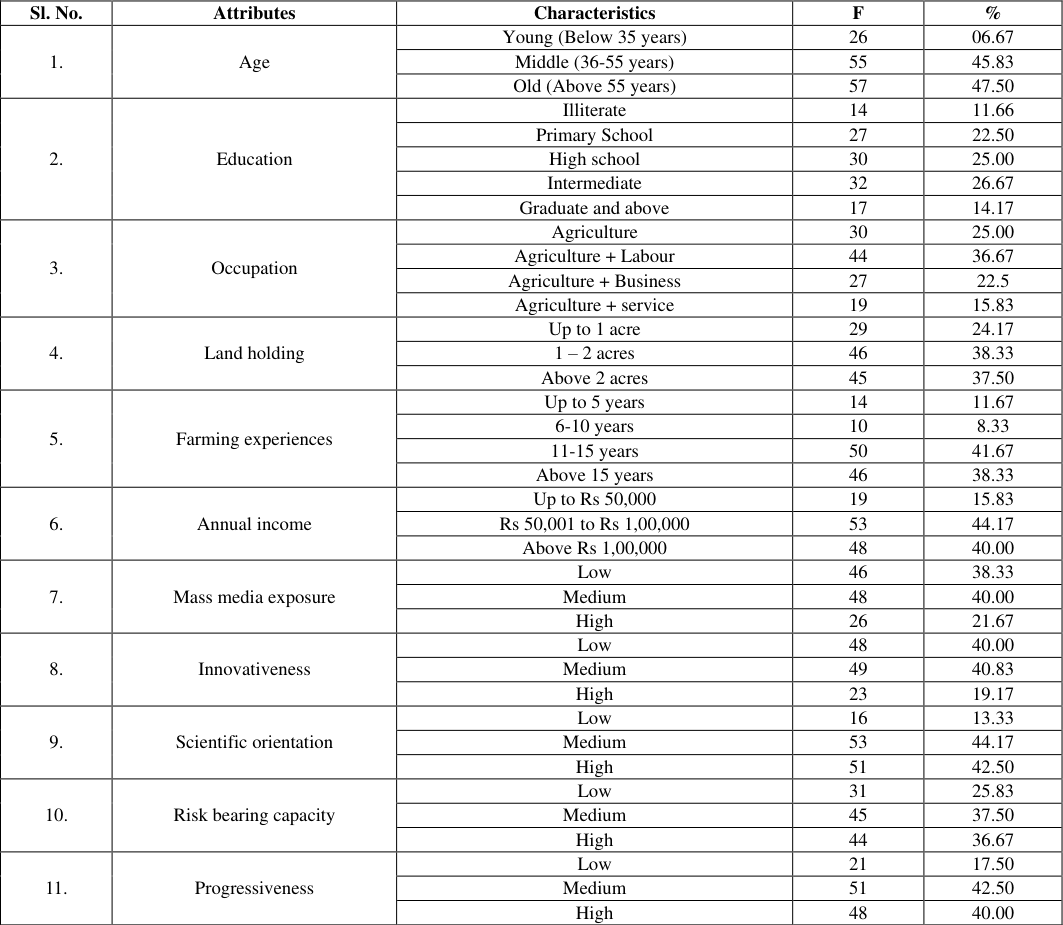 Table 1
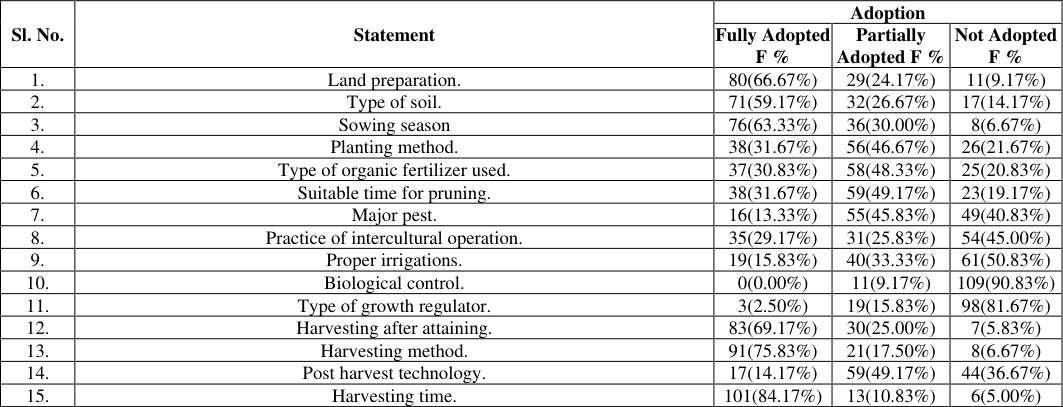 Table 2
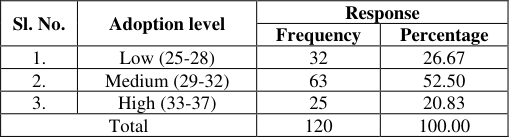 Table 3
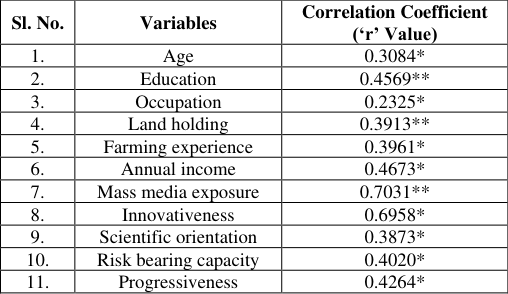 Table 4
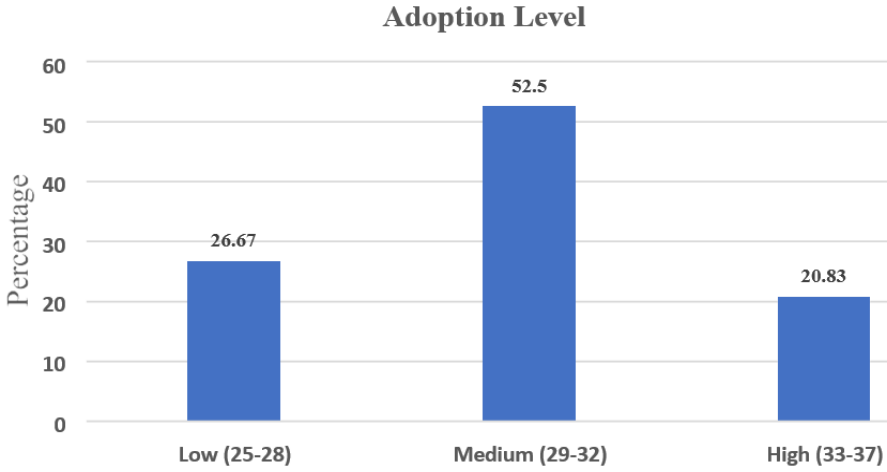 Figure 1
Introduction
The Tamenglong orange is also believed to be one of the best qualities of oranges found in the world. This uniques fruits is found only in the Tamenglong district of the state of Manipur. Recently, Tamenglong orange received GI tag (Intellectual property of India, 2020). Tamenglong Orange (Citrus reticulata), a species of mandarin group is unique fruit crop found only in the Tamenglong district of the state of Manipur. It is famous especially for its well-blended sweetness and acidity taste. Usually, each fruit contains 10-14 segments. The segments of the fruit are easily separable and the core is open at maturity. The fruits are loose skinned, smooth surface and orange in colour. The rind is thin and seeds are pointed with light green cotyledons. Tamenglong is not only the largest producer of oranges in Manipur, contributing over 50 percent of the state's annual production of nearly 10,000 to 11,000 metric tonnes, but is also believed that oranges found in Tamenglong are one of the best qualities in the world. Orange is one of the important horticultural crops of Manipur. Manipur is considered to be one of the potential states for citrus genetic diversity since it is adjoining to Myanmar where maximum citrus diversity has been reported. In Manipur, mandarin, different strains of rough lemon and semi-wild Heiribob (Citrus macroptera) are grown. Mandarin orange is grown in different parts of Manipur, but the main centre of orange production is Tamenglong district of Manipur which produces more than 80% of the total orange production of the state. The soil and the climate of Tamenglong hill district which is situated at an elevation of 1,260 m above sea level is favourable for orange growing and almost 40% of the total land mass is under orange cultivation.
Research Methodology
Descriptive research design was followed for this study as it describes the characteristics or phenomenon that is being studied. The study was conducted at Tamenglong block of Tamenglong District, of under Manipur state. Which were selected purposively. Three villages were selected randomly from this block and a total number of 120 respondents were selected through proportionately random sampling method.
Objectives
▪ To find the adoption level of improved Tamenglong orange cultivation practices by the respondents. ▪ To establish the relationship between the selected independent variables with adoption. The above table 2 reveals that majority (66.17%) of the respondents fully adopted recommended land preparation, 24.17% of the respondents does partially adopted and 9.17% of the respondents does not adopted the recommended land preparation. It was observed that majority (59.17%) of the respondents fully adopted suitable soil for Tamenglong orange cultivation, 26.67% of the respondents partially adopted and 14.17% of the respondents does not adopted suitable soil for Tamenglong orange cultivation. It shows that majority (63.33%) of the respondents fully adopted sowing season of Tamenglong orange, 30.00% of the respondents partially adopted and 6.67% of the respondents does not adopted the sowing season time. It reveals that (46.67%) of the respondents partially adopted the propagation of Tamenglong orange, 31.67% of the respondents fully adopted and 21.67% of the respondents does not adopted the planting method. It reveals that (48.33%) of the respondents partially adopted the used of organic fertilizer, 30.83% of the respondents fully adopted and 20.83 per cent of the respondents does not adopted the used of organic fertilizer. It was observed that (49.17%) of the respondents partially adopted the suitable time for pruning, 31.67% of the respondent fully adopted and 19.17% of the respondents does not adopted the time for pruning. It was observed that (45.83%) of the respondents partially adopted the major pest of Tamenglong orange, 40.83% does not adopted and 13.33 per cent of the respondents fully adopted the major pest of Tamenglong orange. It revealed that (40.83%) of the respondent does not adopted the practice of intercultural operation, 25.83% partially adopted and 29.17% of the respondents fully adopted the practice of intercultural operation. It was revealed that majority (50.83%) of the respondents does not adopted the used of irrigation, 33.33% of the respondent partially adopted and 15.83% fully adopted the used of irrigation. It was found that majority (90.83%) of the respondent does not adopted the used of biological control, 9.17% of the respondents partially adopted the used of biological control. It was revealed that majority (81.67%) of the respondents not adopted the used of growth regulator, 15.83 per cent partially adopted, 2.50 fully adopted the used of growth regulator. It shows that majority (69.17%) of the respondents fully adopted the harvested of orange fruits after attaining, 25.00 per cent and partially adopted and 5.83 per cent does not adopted the harvested of orange fruits after attaining. It was revealed that majority (75.83%) of the respondents fully adopted types of harvesting method, 17.50 per cent of the respondent partially adopted and 6.17 per cent of the respondents does not adopted harvesting method. It was observed that (49.17%) of the respondents partially adopted the used of post-harvest technologies, 36.67 per cent does not adopted and 14.17% fully adopted the used of post-harvest technologies. It was found that majority (84.17%) of the respondents fully adopted the harvesting time of Tamenglong orange, 10.83 per cent partially adopted and 5.00 per cent does not adopted the harvesting time of Tamenglong orange. The data presented in [4] . www.extensionjournal.com Progressiveness 0.4264* * = Significant at p = 0.05%, **= Significant at p = 0.01%, NS= Non-Significant
| Sl. No. | Statement | Adoption | — | — |
|---|---|---|---|---|
| Fully Adopted F % | Partially Adopted F % | Not Adopted F % | ||
| 1. | Land preparation. | 80(66.67%) | 29(24.17%) | 11(9.17%) |
| 2. | Type of soil. | 71(59.17%) | 32(26.67%) | 17(14.17%) |
| 3. | Sowing season | 76(63.33%) | 36(30.00%) | 8(6.67%) |
| 4. | Planting method. | 38(31.67%) | 56(46.67%) | 26(21.67%) |
| 5. | Type of organic fertilizer used. | 37(30.83%) | 58(48.33%) | 25(20.83%) |
| 6. | Suitable time for pruning. | 38(31.67%) | 59(49.17%) | 23(19.17%) |
| 7. | Major pest. | 16(13.33%) | 55(45.83%) | 49(40.83%) |
| 8. | Practice of intercultural operation. | 35(29.17%) | 31(25.83%) | 54(45.00%) |
| 9. | Proper irrigations. | 19(15.83%) | 40(33.33%) | 61(50.83%) |
| 10. | Biological control. | 0(0.00%) | 11(9.17%) | 109(90.83%) |
| 11. | Type of growth regulator. | 3(2.50%) | 19(15.83%) | 98(81.67%) |
| 12. | Harvesting after attaining. | 83(69.17%) | 30(25.00%) | 7(5.83%) |
| 13. | Harvesting method. | 91(75.83%) | 21(17.50%) | 8(6.67%) |
| 14. | Post harvest technology. | 17(14.17%) | 59(49.17%) | 44(36.67%) |
| 15. | Harvesting time. | 101(84.17%) | 13(10.83%) | 6(5.00%) |
Table text extracted from the original PDF; superscript letters are shown inline. The original table image is below.
View original table image
Result and Discussion
The data presented in Table 4 revealed that out of eleven independent variables, i.e. age, education, occupation, land holding, farming experience, annual income, mass media exposure, innovativeness, scientific orientation, risk bearing capacity, and progressiveness are positively and significantly correlated with adoption of farmers towards improved Tamenglong orange cultivation practices.
| Sl. No. | Variables | Correlation Coefficient (‘r’ Value) |
|---|---|---|
| 1. | Age | 0.3084* |
| 2. | Education | 0.4569** |
| 3. | Occupation | 0.2325* |
| 4. | Land holding | 0.3913** |
| 5. | Farming experience | 0.3961* |
| 6. | Annual income | 0.4673* |
| 7. | Mass media exposure | 0.7031** |
| 8. | Innovativeness | 0.6958* |
| 9. | Scientific orientation | 0.3873* |
| 10. | Risk bearing capacity | 0.4020* |
| 11. | Progressiveness | 0.4264* |
Table text extracted from the original PDF; superscript letters are shown inline. The original table image is below.
View original table image
Conclusion
It is concluded that majority of the respondents had medium level of adoption followed by high and low in respective to the recommended practices. Subsequently all of the selected independent variables were positively significant with the adoption of the farmers towards improved tamenglong orange cultivation practices and Proper training should be given to the farmers for identification of pest and disease and better government support such as subsidies and loan to be provided for a better Cultivation Practices.
Figures and tables from the paper
| Sl. No. | Attributes | Characteristics | F | % |
|---|---|---|---|---|
| 1. | Age | Young (Below 35 years) | 26 | 06.67 |
| Middle (36-55 years) | 55 | 45.83 | ||
| Old (Above 55 years) | 57 | 47.50 | ||
| 2. | Education | Illiterate | 14 | 11.66 |
| Primary School | 27 | 22.50 | ||
| High school | 30 | 25.00 | ||
| Intermediate | 32 | 26.67 | ||
| Graduate and above | 17 | 14.17 | ||
| 3. | Occupation | Agriculture | 30 | 25.00 |
| Agriculture + Labour | 44 | 36.67 | ||
| Agriculture + Business | 27 | 22.5 | ||
| Agriculture + service | 19 | 15.83 | ||
| 4. | Land holding | Up to 1 acre | 29 | 24.17 |
| 1 – 2 acres | 46 | 38.33 | ||
| Above 2 acres | 45 | 37.50 | ||
| 5. | Farming experiences | Up to 5 years | 14 | 11.67 |
| 6-10 years | 10 | 8.33 | ||
| 11-15 years | 50 | 41.67 | ||
| Above 15 years | 46 | 38.33 | ||
| 6. | Annual income | Up to Rs 50,000 | 19 | 15.83 |
| Rs 50,001 to Rs 1,00,000 | 53 | 44.17 | ||
| Above Rs 1,00,000 | 48 | 40.00 | ||
| 7. | Mass media exposure | Low | 46 | 38.33 |
| Medium | 48 | 40.00 | ||
| High | 26 | 21.67 | ||
| 8. | Innovativeness | Low | 48 | 40.00 |
| Medium | 49 | 40.83 | ||
| High | 23 | 19.17 | ||
| 9. | Scientific orientation | Low | 16 | 13.33 |
| Medium | 53 | 44.17 | ||
| High | 51 | 42.50 | ||
| 10. | Risk bearing capacity | Low | 31 | 25.83 |
| Medium | 45 | 37.50 | ||
| High | 44 | 36.67 | ||
| 11. | Progressiveness | Low | 21 | 17.50 |
| Medium | 51 | 42.50 | ||
| High | 48 | 40.00 |
Table text extracted from the original PDF; superscript letters are shown inline. The original table image is below.
View original table image
| Sl. No. | Adoption level | Response | — |
|---|---|---|---|
| Frequency | Percentage | ||
| 1. | Low (25-28) | 32 | 26.67 |
| 2. | Medium (29-32) | 63 | 52.50 |
| 3. | High (33-37) | 25 | 20.83 |
| Total | 120 | 100.00 |
Table text extracted from the original PDF; superscript letters are shown inline. The original table image is below.
View original table image
References
6 in the original paper- Attar JR, Aski SG. Analysis of adoption of recommended cultivation practices by lime growers of north Karnataka. Int. Res J Agric Econ Stat. 2018;9(1):120-124.
- Gedam PC, Padaria RN. Study of gaps in adoption of improved orange production technologies in Maharashtra, India. Asian J Agric Ext Econ Sociol. 2023;41(9):586-593.
- Hiwarale AS, Manvar VS, Gohade GR, Hadolikar SB, Vaidya NG. Constraints faced by sweet orange growers in adoption of recommended cultivation practices of sweet orange. Pharma Innovation. 2023;12(1):14481449.
- Jakkawad SR, Sawant RC, Pawar SB. Knowledge and adoption level of the pomegranate growers in Aurangabad District of Marathwada Region of Maharashtra. Trends Biosci. 2017;10(24):5066-5069.
- Jain N, Choudhary S, Wankhede A, Barche S, Jain SK. Adoption behaviour of orange producer under National Horticulture Mission (NHM) at Shajapur district of M.P. Int J Agric Environ Sci. 2019;6(5):57-59.
- Kale NM, Ingole VS, Tingare AS, Khade AH, Jangwad NP, Kokate SD. Adoption of recommended cultivation practices by the mandarin growers. Int J Curr Microbiol Appl Sci. 2023;12(05):51-57.