
Research article · 2024 · Full text
International Journal of Agriculture Extension and Social DevelopmentA study on consumption pattern of millets among NTR district of Andhra Pradesh
Volume 7(7S) · Pages 113–117 · DOI: 10.33545/26180723.2024.v7.i7sb.810 ↗
Research areasAgricultural Economics and PracticesGenetics and Plant BreedingRice Cultivation and Yield Improvement
Abstract
Author-writtenMillets are small seeded grains and belongs to the family grass. Majorly this crop cultivation is suitable to dry lands and also can cultivate in rain fed areas. Millets, an ancient food grain for the human consumption. It was spreaded in 131 nations and majorly 9 types of millets are known to all. Millets are a staple diet for 59 crores of people in Asia and Africa. Millets are the only crop that will be able to overcome challenges in the future related to food, feed, fuel, malnutrition, health, and climate change. These are the millets are good source for nutrients which are helped in giving good health to human beings. A recent study found that millets diet is the best for suffering with diabetic, cardiovascular disease, constipation, over weight and malnutrion.
Summary
Source-checkedPlain-language reading of the full paper, prepared with AI and checked against the text. Each point links to the authors' own words.
Why it matters
- Millets are considered critical crops for addressing future global challenges including food security, malnutrition, and climate change. View evidence ↗
- Diets incorporating millets are reported to be beneficial for individuals with cardiovascular disease, diabetes, obesity, and malnutrition. View evidence ↗
- The recent increase in millet popularity is driven by their health benefits, resistance to climate change, and low environmental impact. View evidence ↗
The question
- The study aimed to assess the perception, consumption patterns, and frequency of millet consumption within the NTR district of Andhra Pradesh. View evidence ↗
What they did
- The researchers used a random sample of 60 willing respondents for the study. View evidence ↗
- Data analysis was performed using frequencies and percentages. View evidence ↗
- An observational study design was employed to collect background information and assess millet consumption patterns in the NTR district. View evidence ↗
What they found
- The majority of the study participants were from rural areas (75%), compared to urban (16.66%) and semi-urban (5%) areas. View evidence ↗
- The influence of neighbors and friends was a high-priority factor for 61.66% of consumers regarding millet consumption. View evidence ↗
- The availability of Ready-to-Eat and Ready-to-Cook foods was ranked as a low priority by 78.33% of the respondents. View evidence ↗
What it means
- The authors conclude that while awareness of millets is high, actual consumption interest is low, necessitating broader popularization to change consumer attitudes. View evidence ↗
Visual summary
2 visualsIllustrations explain the paper; charts are replotted from the paper's own table values.
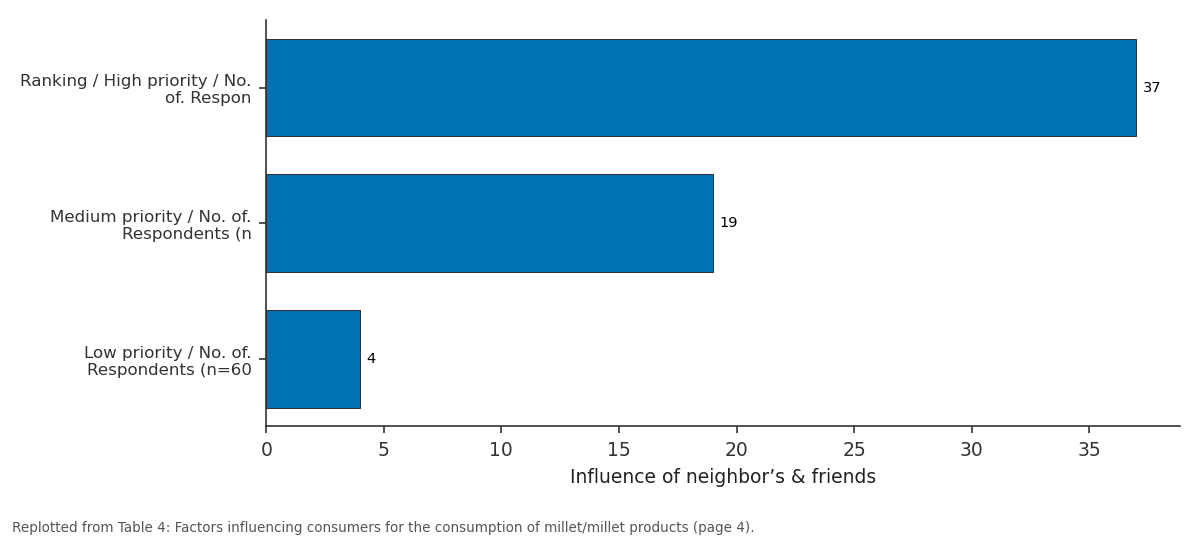
Influence of neighbor’s & friends: Ranking / High priority... vs Medium priority / No.... vs Low priority / No. of....
Replotted from Table 4 (page 4) of the original paper. Every bar is the paper's own table value.
View source evidence ↗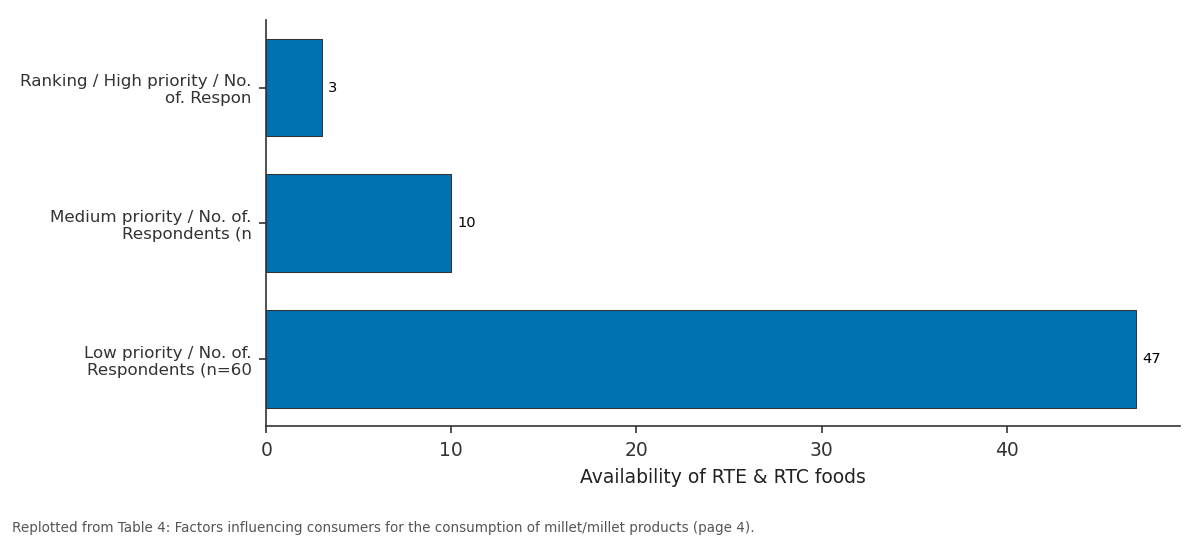
Availability of RTE & RTC foods: Ranking / High priority... vs Medium priority / No.... vs Low priority / No. of....
Replotted from Table 4 (page 4) of the original paper. Every bar is the paper's own table value.
View source evidence ↗Figures & tables
From the original paper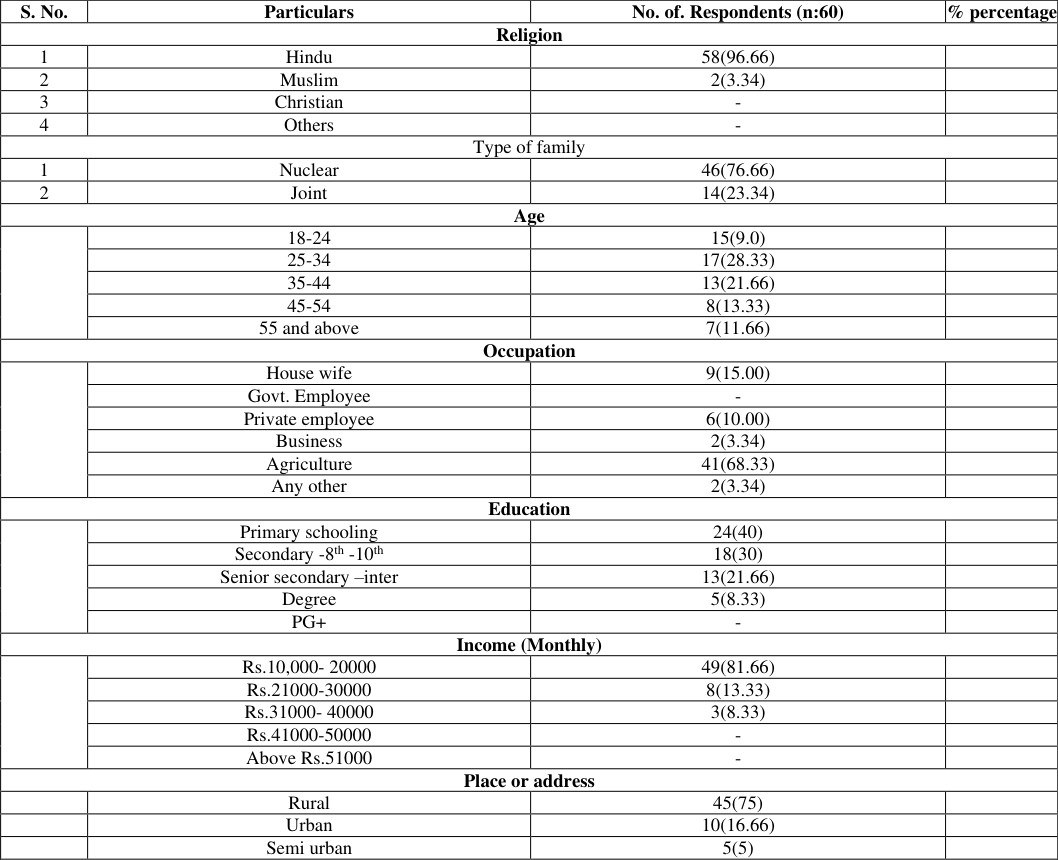 Table 1
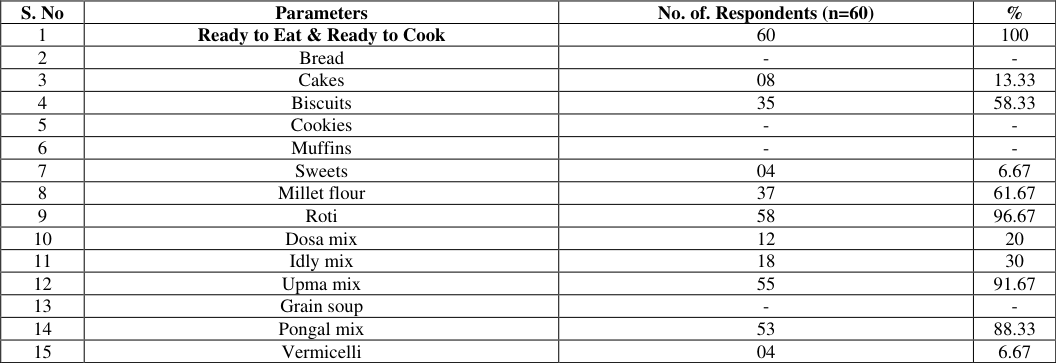 Table 2
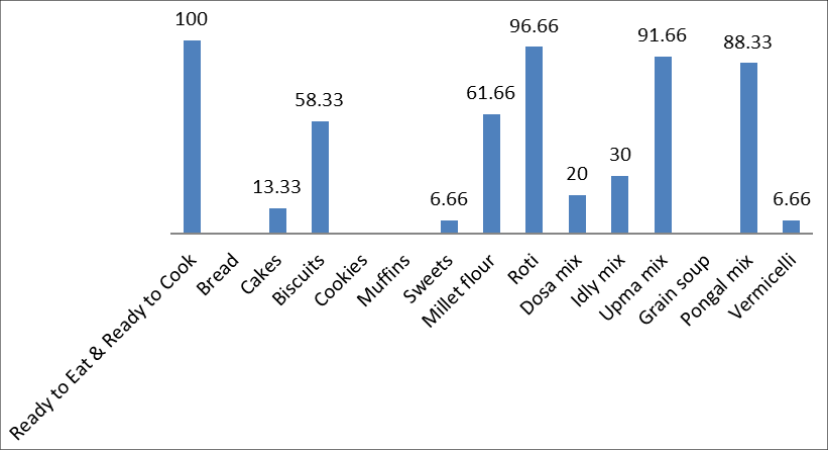 Figure 1
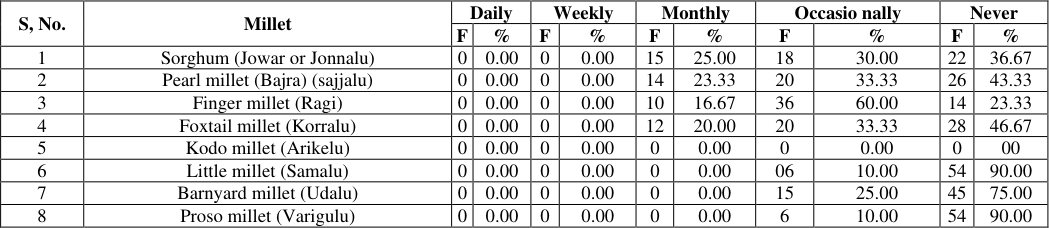 Table 3
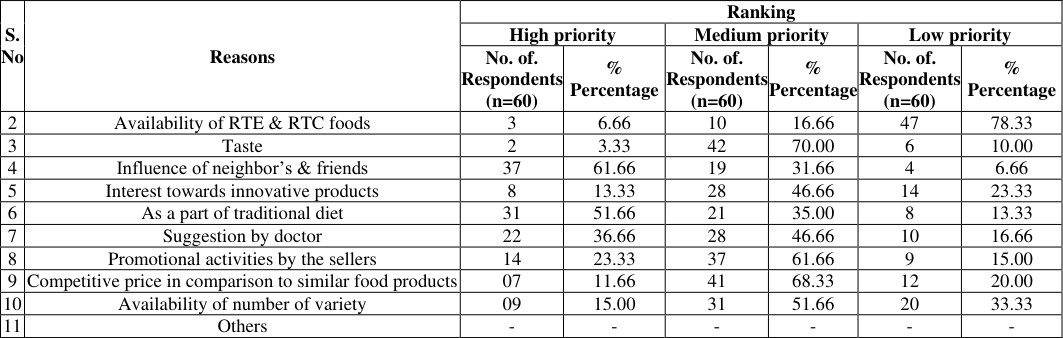 Table 4
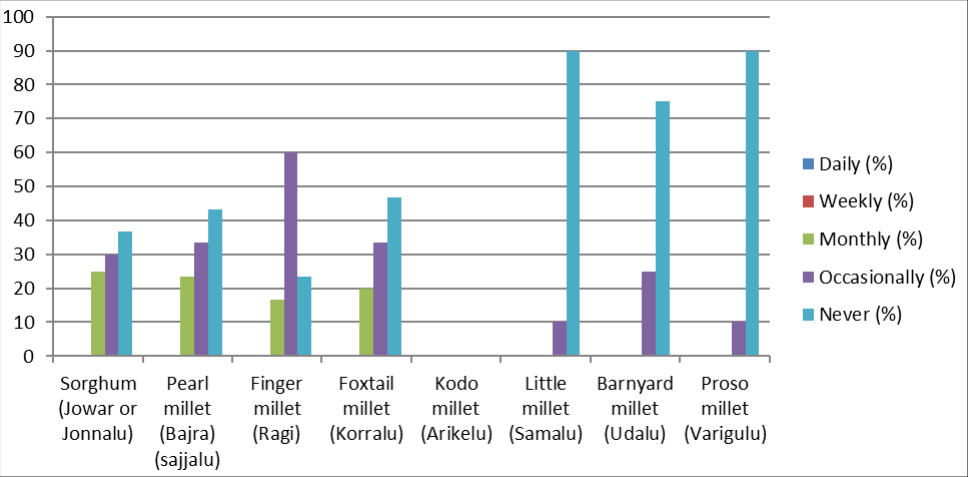 Figure 2
Introduction
Millets are nutritionally stuffed a small-seeded annual grasses that are grown in degraded soils, and least necessities of water, pesticides, and fertilizers (Saleh et al., 2013) [7] . It has been consuming by majority of the people around the world from ancient time. They are a hub of nutrients. Further millets are good source of iron, calcium, fiber, Niacin, folacin, riboflavin, and thiamine and phosphorus and this is also a right diet who wants reduces their overweight and control diabetic. Millets have regained popularity recently due to their miraculous health benefits, low environmental effect and climate change resistance. Millets come in two varieties: Major and Minor, based on the size of the grain and the regions in which they are grown. Major millets include pearl millet, sorghum, finger millet, foxtail millet, little millet, and kodo millet. Pearl millet is the most macronutrient-rich and notably rich in resistant starch, soluble and insoluble dietary fibres of all the millets and moreover among the all millets finger millet has thirty times more calcium than rice. In their Iron content, foxtail and little millet are so rich that rice is nowhere in the race (Kalaiselvi A et al., 2016) [3][4] . Sorghum is abundant in minerals and B vitamins and is a significant tropical cereal crop for food, feed, and fodder in semiarid climates. Finger millet is the best source of amino acids high in sulphur and calcium and has strong antioxidant properties. Minor millets include foxtail millet, little millet, and kodo millet. Kodo millet is the coarsest grain of all grains and has high lecithin content. The consumption of millets in India has significantly increased over the past ten years due to growing knowledge of their health advantages and the availability of millet-based products on the market. According to Kumar et al. (2021), millets have rich content of fiber and calcium than rice and wheat. India is the world's largest producer of millets and growing of awareness in consumption of millets due to it is a good source of complex carbohydrates, dietary fiber, vitamins, and minerals, as well as a reserve of phytochemicals that are good for health. Millet is becoming increasingly popular due to rising interest in foods with good nutritious content. As part of research on "Assessment of the State of Millet Farming in India," millets have strong root systems that enable them to withstand extreme temperatures, droughts, and floods. Behera (2017) [2] found that millets were consumed less frequently than other cereals, with wheat and rice being the favoured cereals. Bhagavatula et al. (2020) found that eating millets was linked to a lower body mass index (BMI) and a more varied diet. Further these millets contain vitamins, minerals, vital fatty acids, phytochemicals, and antioxidants that can helps in reduction of nutritional problems. All the millets are amazingly greater with phytochemicals and are therefore, the solution for the malnutrition and obesity that affects a vast majority of the Indian inhabitants (Mounika et al., 2022) [5] among people.
Methodology
The study was undertaken to access the Perception, Consumption pattern and consumption frequency of millets among NTR district. The collection of primary data was carried out by perceiving the views of the respondents regarding millets. The Sample size of 60 respondents was taken randomly for the proposed study, those who were willing to participate in the study. The data was further statistically analyzed by presenting the information through frequency, and percentages. An observational study was used in the assessment of general background information and assessed the consumption pattern of millets among NTR, district in Andhrapradesh. www.extensionjournal.com
Results
Results a brief background on the respondents was collected based on their religion, type of family, age, occupation, education, income and place or address of the family Majority number of respondents of religion was Hindu when compared with other religions of muslim noted only 2 (3.34%) and in Christian and others category of religion no one were noticed among all the samples (Table ). Then more 46(76.66%) number of respondents had nuclear family than joint families' number 14(23.34%). Kalaiselvi et al., (2016) [3][4] reported that 64.9% belongs to the family type was nuclear (64.9%). The age of the respondents was categorized into five groups ranging from 18-24, 25-34, 35-44, 50-60, 45-54 and 55 and above years. The highest percentage of respondents were in the age group of 25-34 years, followed by 18-24 and 45-54 years. From the elder generation of 55 and above and 45-54 yr, only 7% and 8% of the respondents were recorded (Table1). Highest per cent of respondents were practicing agriculture, only less percentage of samples were housewives and few percentage was identified for private employees, business and any other category. However, government employees were not notified. Further, forty percent of respondents education of primary schooling, 30% recorded for secondary schooling, senior secondary-inter was 21.66%, only 8.33 percentage of samples were studied degree and no PG holders were not recorded in this study. From the data it was an evident that majority of respondents (81.66 per cent) have low income of Rs.10,000-20,000. Kalaiselvi et al., (2016) [3][4] reported that 46.4% respondent's monthly income was Rs.10,001-20,000 and their type of family is nuclear (64.9%). As per the results of the study most (75percent) of the respondents were selected from the rural area than urban (16.66 percent) and semiurban (5percent) areas of the NTR district (Table 1). known among the subjects in the study area (Table 2 & Fig. 1).
| S. No | Parameters | No. of. Respondents (n=60) | % |
|---|---|---|---|
| 1 | Ready to Eat & Ready to Cook | 60 | 100 |
| 2 | Bread | - | - |
| 3 | Cakes | 08 | 13.33 |
| 4 | Biscuits | 35 | 58.33 |
| 5 | Cookies | - | - |
| 6 | Muffins | - | - |
| 7 | Sweets | 04 | 6.67 |
| 8 | Millet flour | 37 | 61.67 |
| 9 | Roti | 58 | 96.67 |
| 10 | Dosa mix | 12 | 20 |
| 11 | Idly mix | 18 | 30 |
| 12 | Upma mix | 55 | 91.67 |
| 13 | Grain soup | - | - |
| 14 | Pongal mix | 53 | 88.33 |
| 15 | Vermicelli | 04 | 6.67 |
Table text extracted from the original PDF; superscript letters are shown inline. The original table image is below.
View original table image
| S. No. | Particulars | No. of. Respondents (n:60) | % percentage |
|---|---|---|---|
| Religion | |||
| 1 | Hindu | 58(96.66) | |
| 2 | Muslim | 2(3.34) | |
| 3 | Christian | - | |
| 4 | Others | - | |
| Type of family | |||
| 1 | Nuclear | 46(76.66) | |
| 2 | Joint | 14(23.34) | |
| Age | |||
| 18-24 | 15(9.0) | ||
| 25-34 | 17(28.33) | ||
| 35-44 | 13(21.66) | ||
| 45-54 | 8(13.33) | ||
| 55 and above | 7(11.66) | ||
| Occupation | |||
| House wife | 9(15.00) | ||
| Govt. Employee | - | ||
| Private employee | 6(10.00) | ||
| Business | 2(3.34) | ||
| Agriculture | 41(68.33) | ||
| Any other | 2(3.34) | ||
| Education | |||
| Primary schooling | 24(40) | ||
| Secondary -8th -10th | 18(30) | ||
| Senior secondary –inter | 13(21.66) | ||
| Degree | 5(8.33) | ||
| PG+ | - | ||
| Income (Monthly) | |||
| Rs.10,000- 20000 | 49(81.66) | ||
| Rs.21000-30000 | 8(13.33) | ||
| Rs.31000- 40000 | 3(8.33) | ||
| Rs.41000-50000 | - | ||
| Above Rs.51000 | - | ||
| Place or address | |||
| Rural | 45(75) | ||
| Urban | 10(16.66) | ||
| Semi urban | 5(5) |
Table text extracted from the original PDF; superscript letters are shown inline. The original table image is below.
View original table image
Frequency of millet consumption pattern
In the Present study (Table 3 & Fig. 2) subject's majority, they are consuming occasionally except finger millet. Finger millet consumed daily (9.5%), weekly once (26.8%) and twice (13%) while sorghum milled consumed was weekly once (16.2%) and monthly once (12%). Senthamarai selvi et al., 2019 reported that majority of millets were consumed monthly once while kodo millet, finger millet and barnyard millet were consumed monthly twice. Sorghum was consumed weekly once by 28% subject's. The figure 2 showed that more than half of respondents consume finger millet which is 60.00%. The study (Sangeetha, et al, 2022) [8] stated that majority of the subjects consuming ragi (78.7%) while compared to other millets. Then 33.33% consume pearl and foxtail millet, 10.00% little millet and proso millet, 30.00% sorghum and 25.00% barn yard millet Here, 28 subjects given the rank medium priority followed by 14 subjects marked the rank low priory and a small number indicated the rank high for the particular reason of Interest towards innovative products with millets.
| S, No. | Millet | Daily | — | Weekly | — | Monthly | — | Occasio nally | — | Never | — |
|---|---|---|---|---|---|---|---|---|---|---|---|
| F | % | F | % | F | % | F | % | F | % | ||
| 1 | Sorghum (Jowar or Jonnalu) | 0 | 0.00 | 0 | 0.00 | 15 | 25.00 | 18 | 30.00 | 22 | 36.67 |
| 2 | Pearl millet (Bajra) (sajjalu) | 0 | 0.00 | 0 | 0.00 | 14 | 23.33 | 20 | 33.33 | 26 | 43.33 |
| 3 | Finger millet (Ragi) | 0 | 0.00 | 0 | 0.00 | 10 | 16.67 | 36 | 60.00 | 14 | 23.33 |
| 4 | Foxtail millet (Korralu) | 0 | 0.00 | 0 | 0.00 | 12 | 20.00 | 20 | 33.33 | 28 | 46.67 |
| 5 | Kodo millet (Arikelu) | 0 | 0.00 | 0 | 0.00 | 0 | 0.00 | 0 | 0.00 | 0 | 00 |
| 6 | Little millet (Samalu) | 0 | 0.00 | 0 | 0.00 | 0 | 0.00 | 06 | 10.00 | 54 | 90.00 |
| 7 | Barnyard millet (Udalu) | 0 | 0.00 | 0 | 0.00 | 0 | 0.00 | 15 | 25.00 | 45 | 75.00 |
| 8 | Proso millet (Varigulu) | 0 | 0.00 | 0 | 0.00 | 0 | 0.00 | 6 | 10.00 | 54 | 90.00 |
Table text extracted from the original PDF; superscript letters are shown inline. The original table image is below.
View original table image
Figures and tables from the paper
| S. No | Reasons | Ranking | — | — | — | — | — |
|---|---|---|---|---|---|---|---|
| High priority | Medium priority | Low priority | |||||
| No. of. Respondents (n=60) | % Percentage | No. of. Respondents (n=60) | % Percentage | No. of. Respondents (n=60) | % Percentage | ||
| 2 | Availability of RTE & RTC foods | 3 | 6.66 | 10 | 16.66 | 47 | 78.33 |
| 3 | Taste | 2 | 3.33 | 42 | 70.00 | 6 | 10.00 |
| 4 | Influence of neighbor’s & friends | 37 | 61.66 | 19 | 31.66 | 4 | 6.66 |
| 5 | Interest towards innovative products | 8 | 13.33 | 28 | 46.66 | 14 | 23.33 |
| 6 | As a part of traditional diet | 31 | 51.66 | 21 | 35.00 | 8 | 13.33 |
| 7 | Suggestion by doctor | 22 | 36.66 | 28 | 46.66 | 10 | 16.66 |
| 8 | Promotional activities by the sellers | 14 | 23.33 | 37 | 61.66 | 9 | 15.00 |
| 9 | Competitive price in comparison to similar food products | 07 | 11.66 | 41 | 68.33 | 12 | 20.00 |
| 10 | Availability of number of variety | 09 | 15.00 | 31 | 51.66 | 20 | 33.33 |
| 11 | Others | - | - | - | - | - | - |
Table text extracted from the original PDF; superscript letters are shown inline. The original table image is below.
View original table image
References
8 in the original paper- Basavaraj G, Rao P, Bhagavatula S, Ahmed W. Availability and utilization of pearl millet in India. SAT eJournal. 2010;8.
- Behera MK. Assessment of the State of Millets Farming in India. MOJ Ecology & Environmental Science. 2017;2(1). doi:10.15406/mojes.2017.02.00013
- Kalaiselvi A, Fathima LR, Parameswari M. Awareness and Consumption of Millets by Women -A Study on Coimbatore city. Indian Journal of Applied Research. 2016;6(2). Retrieved from https://www.worldwidejournals.com/indian-journal-ofapplied-research-- (IJAR)/recent_issues_pdf/2016/February/February_201 6_1454142343__27.pdf
- Kalaiselvi A, Fathima LR. Awareness and Consumption of Millets by Women -A Study on Coimbatore city. Indian Journal of Applied Research. 2016;6(2).
- Mounika D, Sangeetha U, Sireesha G. Estimation of phytochemicals in Millets and selected Millet products. Indian Journal of Applied & Pure Biology. 2022;37(3):810-820.
- Prasanthi K, Sireesha G. Individuals' Knowledge, Attitude and Practices on Millets. International Journal of Food and Nutritional Sciences. 2022;11:21-22.
- Saleh SMA, Zhang Q, Chen J, Shen Q. Millet grains: nutritional quality, processing, and potential health benefits. Comprehensive Reviews in Food Science and Food Safety. 2013;12:281-295. doi: 10.1111/15414337.12012
- Sangeetha U, Mounika D, Sireesha G. Assessment of millets consumption among young females (18-23 years) in Tirupati. Journal of Pharmaceutical Negative Results. 2022;13(7):2545-2557.