
Research article · 2024 · Full text
International Journal of Geography Geology and EnvironmentAssessment of polynuclear aromatic hydrocarbons in water samples from Lagos Lagoon
Volume 6(1) · Pages 10–12 · DOI: 10.22271/27067483.2024.v6.i1a.194 ↗
Research areasToxic Organic Pollutants Impact
Abstract
Author-writtenThis study focuses on the analysis and quantification of polynuclear aromatic hydrocarbons (PAHs) in the Lagos Lagoon. Given the ecological significance of this water body and the potential health risks posed by PAHs, we employed advanced chromatographic techniques to assess their concentrations and distribution patterns. This research aims to contribute to environmental monitoring efforts and inform public health policies in the region.
Summary
Source-checkedPlain-language reading of the full paper, prepared with AI and checked against the text. Each point links to the authors' own words.
Why it matters
- The Lagos Lagoon is an environmentally and economically vital water body that is facing increasing pressure from human activities. View evidence ↗
- Due to its role as a hub for urban, industrial, and agricultural activity, the lagoon is susceptible to pollution from runoff and industrial effluents. View evidence ↗
- Human-induced activities can cause polynuclear aromatic hydrocarbons (PAHs) to accumulate in the water, which may threaten human health and aquatic ecosystems. View evidence ↗
What they did
- Water samples were systematically collected from five distinct locations: Lagoon Industrial Park, Victoria Island Shore, Eko Nature Reserve, Mainland Runoff Point, and the Atlantic Interface. View evidence ↗
- The researchers used Gas Chromatography-Mass Spectrometry (GC-MS) to accurately quantify the concentrations of PAH compounds. View evidence ↗
- Sample preparation involved filtering to remove particulates and storing samples at specific temperatures to prevent PAH degradation. View evidence ↗
- To ensure data reliability, instruments were calibrated with known standards, and procedural blanks and spiked samples were used. View evidence ↗
What they found
- The highest total PAH concentration was recorded at the Lagoon Industrial Park (Site A) at 13.1 μg/L. View evidence ↗
- The lowest total PAH concentration was found at the Eko Nature Reserve (Site C), measuring 2.1 μg/L. View evidence ↗
- Moderate PAH levels were observed at the Mainland Runoff Point (9.1 μg/L) and Victoria Island Shore (4.4 μg/L). View evidence ↗
- The Atlantic Interface (Site E) exhibited intermediate PAH levels of 5.1 μg/L. View evidence ↗
- The general presence of low molecular weight PAHs, including Fluorene and Naphthalene, suggests pollution from fossil fuel use and incomplete combustion. View evidence ↗
- High molecular weight PAHs, such as Benzo[a]pyrene, were found at urban runoff and industrial sites, which is concerning because of their potential to cause cancer. View evidence ↗
What it means
- The authors conclude that significant variations in PAH levels across the lagoon necessitate targeted pollution control and environmental management to protect public health and the ecosystem. View evidence ↗
- The authors recommend strict monitoring and pollution control in industrial areas (Site A) and regular monitoring in urban areas (Site B and Site D) to prevent pollution from increasing. View evidence ↗
Visual summary
2 visualsIllustrations explain the paper; charts are replotted from the paper's own table values.
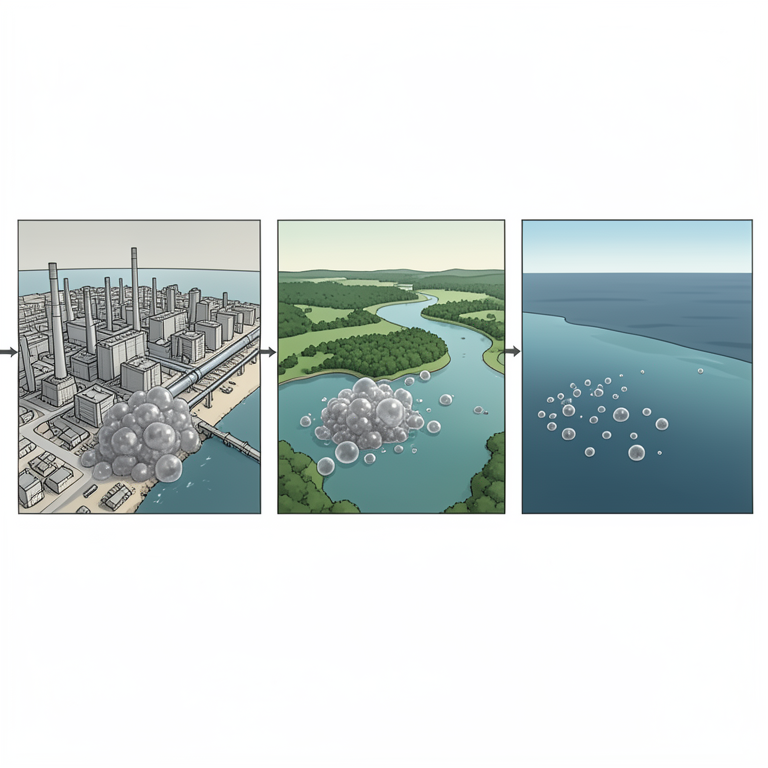
PAH Concentration Gradient
AI-generated conceptual illustration (Lagos Lagoon water environment). It explains the idea and does not show study data.
View source evidence ↗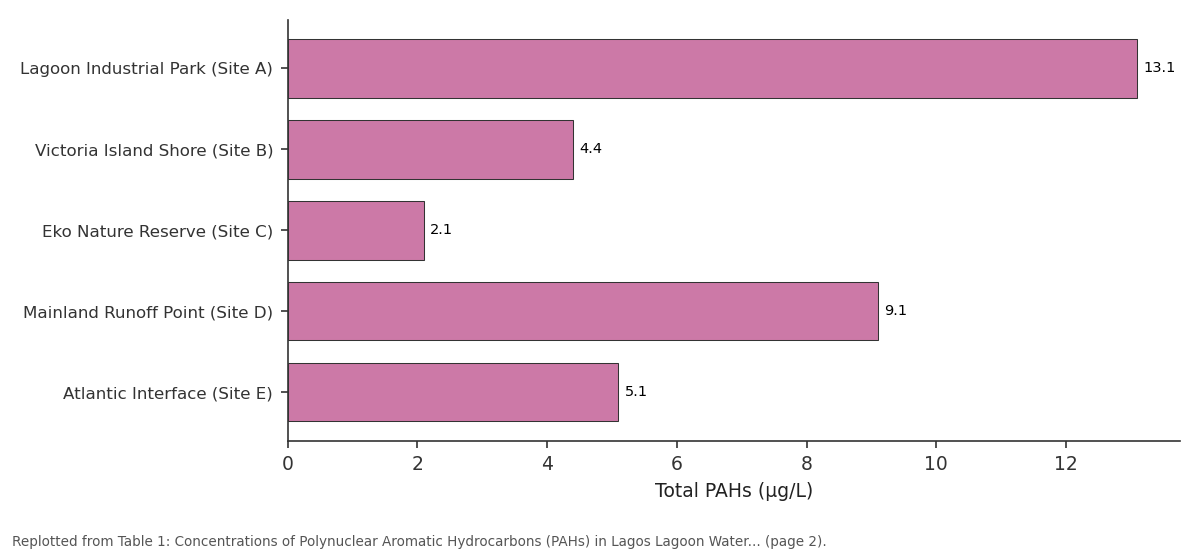
Total PAHs: Lagoon Industrial Park... vs Victoria Island Shore... vs Eko Nature Reserve... vs Mainland Runoff Point... vs Atlantic Interface...
Replotted from Table 1 (page 2) of the original paper. Every bar is the paper's own table value.
View source evidence ↗Figures & tables
From the original paper Table 1
Introduction
The Lagos Lagoon, a critical component of the region's environmental and economic fabric, is increasingly subjected to various anthropogenic pressures. As a bustling hub of industrial, agricultural, and urban activities, the lagoon is vulnerable to contamination from various sources, including industrial effluents, urban runoff, and other human-induced activities. These activities can lead to the accumulation of PAHs in the water, posing risks to aquatic life and, potentially, human health. The objective of this study is Multifood: Firstly, to quantify the levels of various PAH compounds in water samples collected from different locations within the Lagos Lagoon. This involves the use of sophisticated analytical methods, such as Gas Chromatography-Mass Spectrometry (GC-MS), to accurately measure the concentrations of these compounds. Secondly, the study aims to identify potential sources of PAHs in the lagoon by examining the distribution patterns and comparing them with known sources of these pollutants. Finally, the research seeks to evaluate the potential ecological and health risks associated with PAH levels in the lagoon, thereby providing crucial information for policymakers and stakeholders in environmental management and public health. This study is particularly timely and significant, given the growing concerns over environmental pollution in major water bodies in Nigeria and the broader global context of increasing industrialization and urbanization. By providing a comprehensive analysis of PAH contamination in the Lagos Lagoon, the research contributes valuable insights into the environmental health of the region, serving as a basis for future studies and actions aimed at preserving the ecological integrity and ensuring the safety and well-being of communities dependent on these vital water resources.
Objective of the study
The primary objective of this study, titled "Assessment of Polynuclear Aromatic Hydrocarbons in Water Samples from Lagos Lagoon," is to comprehensively analyse and understand the concentration and distribution of Polynuclear Aromatic Hydrocarbons (PAHs) in the Lagos Lagoon.
Methodology Sample Collection
Location Selection: Lagoon Industrial Park (Site A), Victoria Island Shore (Site B), Eko Nature Reserve (Site C), Mainland Runoff Point (Site D), Atlantic Interface (Site E). Water samples are collected systematically from these sites.
Sample Preparation: Samples are filtered to remove particulate matter. Samples are stored at appropriate temperature to prevent degradation of PAHs until analysis.
Quality Control
Instruments are calibrated with known PAH standards. Running procedural blanks and spiked samples alongside the actual samples to ensure the reliability and accuracy of the data.
Data Analysis
PAH concentrations in the samples are calculated based on calibration curves from the standards. Data are subjected to statistical analysis to interpret the results accurately.
Results
Results
Discussion and Analysis
Analyzing the data from Table 1, which presents concentrations of various polynuclear aromatic hydrocarbons (PAHs) in water samples from around Lagos Lagoon, we observe distinct patterns of contamination across different locations. Lagoon Industrial Park (Site A) shows the highest total PAH concentration at 13.1 μg/L. This elevated level, particularly of compounds like Fluoranthene, Pyrene, and Phenanthrene, is indicative of significant industrial pollution, a common characteristic in areas with intensive industrial activities involving combustion processes and chemical discharges. At Victoria Island Shore (Site B) and Mainland Runoff Point (Site D), we find moderate levels of PAHs, 4.4 μg/L and 9.1 μg/L respectively. These figures suggest urban runoff and residential waste as potential sources. The higher levels at Site D compared to Site B could be attributed to variances in urban activity and waste management practices. The lowest total PAH concentration is found at Eko Nature Reserve (Site C), registering at 2.1 μg/L. This minimal level is likely due to reduced human activity and the preservation of natural conditions in this area. The Atlantic Interface (Site E) shows intermediate levels of PAHs at 5.1 μg/L. This could be influenced by a combination of terrestrial runoff and aquatic environmental factors. From an individual compound perspective, the presence of high molecular weight PAHs like Benzo[a]pyrene, particularly at industrial and urban runoff sites, is concerning due to their carcinogenic potential. The widespread presence of low molecular weight PAHs such as Naphthalene and Fluorene indicates a general pollution issue likely linked to incomplete combustion and fossil fuel usage. The ecological impact of high PAH levels, especially in industrial and urban areas, raises significant concerns for aquatic life and could lead to bioaccumulation in the food chain, affecting a wide range of organisms. For humans, the proximity of carcinogenic PAHs to residential areas is alarming, as long-term exposure to these compounds is linked to increased cancer risk. The pattern of PAH distribution suggests industrial discharge and urban runoff as primary pollution sources.
| 9 | Naphthalene | Acenaphthene | Fluorene | Phenanthrene | Anthracene | Fluoranthene | Pyrene | Benzo [a] pyrene | Chrysene | Total PAHs |
|---|---|---|---|---|---|---|---|---|---|---|
| Lagoon Industrial Park (Site A) | 1.8 | 0.6 | 0.9 | 2.2 | 1.2 | 3.1 | 2.5 | 1.0 | 0.8 | 13.1 |
| Victoria Island Shore (Site B) | 0.5 | 0.2 | 0.3 | 0.7 | 0.4 | 1.0 | 0.8 | 0.3 | 0.2 | 4.4 |
| Eko Nature Reserve (Site C) | 0.2 | 0.1 | 0.1 | 0.3 | 0.2 | 0.6 | 0.4 | 0.1 | 0.1 | 2.1 |
| Mainland Runoff Point (Site D) | 1.2 | 0.4 | 0.6 | 1.6 | 0.9 | 2.3 | 1.9 | 0.7 | 0.5 | 9.1 |
| Atlantic Interface (Site E) | 0.7 | 0.3 | 0.4 | 1.0 | 0.5 | 1.4 | 1.1 | 0.4 | 0.3 | 5.1 |
Table text extracted from the original PDF; superscript letters are shown inline. The original table image is below.
View original table image
Strict monitoring and pollution control measures are particularly crucial in industrial areas like Site A. Regular monitoring is also recommended for urban areas like Victoria Island Shore and Mainland Runoff Point to prevent potential escalation in pollution levels. The lower levels at Eko Nature Reserve highlight the effectiveness of conservation efforts, which should be maintained and possibly extended to other areas. In conclusion, the data reveals significant variations in PAH concentrations across different sites in Lagos Lagoon, emphasizing the need for focused environmental management and pollution control strategies to mitigate the impact of PAHs on both the ecosystem and public health
Conclusion
In conclusion, the assessment of Polynuclear Aromatic Hydrocarbons (PAHs) in the Lagos Lagoon water samples reveals significant variations in contamination levels across different locations. The study underscores the impact of industrial activities and urban runoff on the PAH concentration in the lagoon. These findings highlight the necessity for enhanced environmental management and pollution control strategies to protect the aquatic ecosystem and public health in the region. This study not only contributes to our understanding of pollution dynamics in Lagos Lagoon but also emphasizes the importance of continuous monitoring for the sustainable management of water resources.
References
7 in the original paper- Igwe JC, Odo EO, Okereke SE, Asuqou EE, Nnorom IC, Okpareke OC. Levels of polycyclic aromatic hydrocarbons (PAHs) in some fish samples from Mushin Area of Lagos, Nigeria: Effects of smoking. Terrestrial and Aquatic Environmental Toxicology. 2012;6(1):30-35.
- Sogbanmu TO, Nagy E, Phillips DH, Arlt VM, Otitoloju AA, Bury NR. Lagos lagoon sediment organic extracts and polycyclic aromatic hydrocarbons induce embryotoxic, teratogenic and genotoxic effects in Danio rerio (Zebrafish) embryos. Environmental Science and Pollution Research. 2016;23:14489-14501.
- Edori OS, Odoemelam SA. Concentration, source apportionment and ring size analysis of polycyclic Aromatic Hydrocarbons (PAHs) in water from Kolo Creek, Niger Delta, Nigeria. International Journal of Advanced Chemistry Research. 2022;4(1):36-41. DOI: 10.33545/26646781.2022.v4.i1a.45
- Chibuike PM, Wemedo SA, Williams JO, Ugboma CJ, Ogbonna DN. Effect of crude oil pollution on the microbiology of coastal wetlands in Rivers State. J Adv Microbiol Res. 2023;4(2):92-105.
- Tongo I, Ezemonye L, Akpeh K. Levels, distribution and characterization of polycyclic aromatic hydrocarbons (PAHs) in Ovia river, Southern Nigeria. Journal of Environmental Chemical Engineering. 2017;5(1):504-512.
- Asagbra MC, Adebayo AS, Anumudu CI, Ugwumba OA, Ugwumba AA. Polycyclic aromatic hydrocarbons in water, sediment and fish from the Warri River at Ubeji, Niger Delta, Nigeria. African Journal of Aquatic Science. 2015;40(2):193-199.
- Adewuyi GO, Adeleye A. Evaluation of polybrominated diphenyl ethers in sediment of Lagos Lagoon, Nigeria. African Journal of Environmental Science and Technology. 2013;7(7):686-693.