
Research article · 2024 · Full text
International Journal of Agriculture Extension and Social DevelopmentHacking the decision-making behaviour of farmers
Volume 7(7) · Pages 217–220 · DOI: 10.33545/26180723.2024.v7.i7c.799 ↗
Research areasAgricultural Innovations and Practices
Abstract
Author-writtenThis paper explores the complex process of decision-making among farmers, particularly about technology adoption and their economic choices. It examines various factors influencing farmers’ decisions, including financial considerations, risk perception, access to information, and social influences. The study emphasizes the importance of understanding farmers’ decision-making processes for effective policy formulation and implementation of agricultural schemes. It highlights the role of credit facilities, insurance, and comprehensive information in encouraging technology adoption. The paper also discusses the impact of behavioral factors such as patience, loss aversion, and perceived control on farmers’ choices. Finally, it underscores the significance of incorporating behavioral insights into agricultural policy design to ensure better outcomes and increased farmer participation in modernization efforts.
Summary
Source-checkedPlain-language reading of the full paper, prepared with AI and checked against the text. Each point links to the authors' own words.
Why it matters
- Understanding how farmers make decisions is critical for government bodies to formulate effective policies and design schemes centered on farmers' needs. View evidence ↗
- Agricultural modernization depends on understanding farmer psychology to ensure that new technologies are trusted and actually adopted. View evidence ↗
- Analyzing the complex process of decision-making is essential for the successful implementation of agricultural schemes. View evidence ↗
The question
- The paper aims to explore the complex processes farmers use to make economic choices and decide whether to adopt new technologies. View evidence ↗
What they did
- The authors examine a range of influencing factors, specifically financial considerations, social influences, information access, and risk perception. View evidence ↗
- The analysis utilizes a framework of three heuristic elements: the context of decision-making, the suitability of the decision to the farmer, and the availability of resources. View evidence ↗
What they found
- Farmers with a stronger aversion to loss tend to achieve higher gains when selling their stored produce. View evidence ↗
- Access to significant credit facilities increases the likelihood that farmers will adopt new technologies because it allows them to take calculated risks. View evidence ↗
- Farmers who perceive their control as external are less likely to commit to risky technologies, including basic improvements like chemical fertilizers. View evidence ↗
- Incomplete information increases perceived risk and reduces the sense of control, leading farmers to avoid new technology commitments. View evidence ↗
- Intrinsic factors, such as personal identity and self-efficacy, determine whether a farmer feels capable of handling the challenges of innovative technologies. View evidence ↗
- Large farmers often serve as role models; their adoption of innovation can encourage small and marginal farmers to follow suit. View evidence ↗
- Gender is a factor that creates differences in how individual farmers approach the decision-making process. View evidence ↗
What it means
- The authors conclude that policymakers should integrate behavioral insights into program design, specifically by providing demonstrations, comprehensive information, and credit to drive adoption. View evidence ↗
- The authors recommend targeting influential farmers as early adopters to effectively spread innovation throughout the community. View evidence ↗
Visual summary
1 visualsIllustrations explain the paper; they do not show study data.
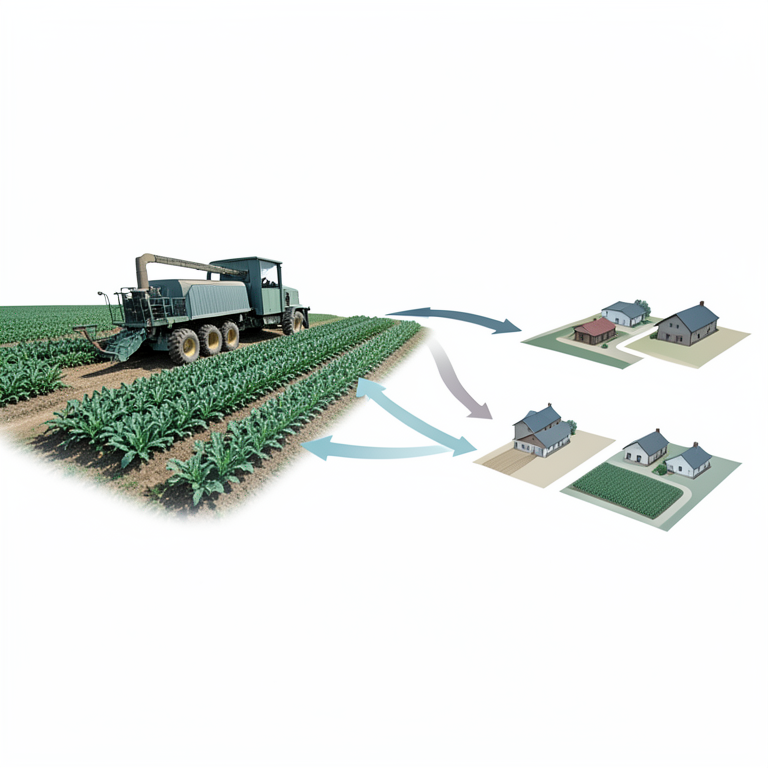
Social Influence Network
AI-generated conceptual illustration (small-scale agricultural farmers in a rural village setting). It explains the idea and does not show study data.
View source evidence ↗Introduction
Decision-making in farmers has been a topic of great interest for researchers associated with agriculture and allied fields. One of the main reasons for the same is from the institutional side of things. Where government bodies have to understand the way, farmers reach a choice or decision, hence acting as a mirror for policy formulation and the introduction of various farmer-centric schemes. Beyond institutions, the modernization of agriculture also requires the study of how farmers think and decide. At the time of introducing any new technology and realizing the actual adoption of those technologies by farmers, it is necessary to address all factors that are significant for them to ensure trust and acceptance. The process of decision-making in farmers undergoes some steps, hence called a process. And this decision-making can't be looked at by segregating that process into individual steps. The flow of actions while making a decision is important and hence requires combined attention (Wittstock et al., 2022) [18] . The way farmers formulate decisions while adopting agri-environmental schemes (AES) follows three major steps, also called heuristic elements of a decisionmaking process. The first element, known as the context of decision-making, involves factors important to consider to understand the context in which any decision will be made. This involves understanding why such a topic has come to light and if deciding in that respect has any relevance at all, like trying to understand a new scheme introduced by the government. The second element consists of the matter of suitability of a decision to a particular farmer. This involves the question of where and how the decision will be suitable for that farmer given his present situation (land etc.) and if he/she is a suitable candidate to undergo such a decision. The third and final element considers the availability of resources important to apply that decision, be it economic, political, or even resource-based, focusing on the final consequences taking place as a result of that decision (Wittstock et al., 2022) [22] . (Weersink & Fulton, 2020) [17] argued that decisions related to technology adoption take shape in many stages, instead of being a binary choice between "adopt" or "not-adopt". This in turn makes it all the more important to study other relevant factors affecting these decisions, both farmercentric as well as farm-centric. The final adoption decision takes place only after all the previous stages have been completed. Furthermore, while making decisions, farmers are impacted by the frequency with which they are supposed to make those decisions. The priority basis of decisions also has a significant impact on the kind of behavior farmers depict, alongside the variations observed between any small decision as opposed to the big ones.
Economic Decision-making Behavior of Farmers
Patience in farmers plays a vital role while making www.extensionjournal.com important decisions like those related to investment. The lessons from past decisions are also taken into consideration by farmers to not repeat previous mistakes and fall into similar patterns. (Ihli et al., 2013) [8] stated that the sociodemographic factors play an important role in predicting farmers' investment decisions, alongside farm-specific factors creating significant profile differences among different farmers. Other than investment decisions, farmers also have an important decisional aspect to address when it comes to selling their stored stocks of produce in time, involving their response to risks, and their overall viewpoint towards loss as opposed to similar volumes of gains. (Vollmer et al., 2018) [16] stated in their work how farmers who bear a stronger loss aversion, are more likely to earn higher gains against the sales of their stored good stocks. As far as financial support is concerned, farmers who are offered significant credit facilities are more likely to bend towards technology adoption. The main reason underlying this interaction can be that the flow of money makes it possible for the farmers to take a calculated risk, where they might decide to undergo the application of said technologies partially for a portion of their crops requiring a set amount of investment. Alongside that, they are not dependent on their end-of-season sales to access funds, which might vary from one cycle to another and also are the main source of their survival, hence not a very wise option to make risky investments (Rayhan et al., 2023) [13] . To support the above observation even further, it can be highlighted that credit is shown to have a negative association with agricultural technology adoption in previous research work terminating any doubts emerging in this line of thought (Magruder, 2018) [12] (Lemecha, 2023) [9] . Beyond credit, insurance facilities are also observed to have an association with technology adoption, although not as clear and giving mixed interpretations (Magruder, 2018) [12] . The more obvious reason for the same can be that insurance, although functioning as a form of security, is still not the same as credit where the farmer has the autonomy to use it according to his enlisted priorities. Alongside that, he/she also is compelled to use that technology considering they have availed insurance for the same, without having any direct funding to spare on the application of the said technology (Magruder, 2018) [12] .
Technology Adoption based Decision-making
Studies focus on the importance of maximizing profit gains in farmer decision-making regarding technology adoption. But other factors like the perceptive inclinations of farmers alongside their social and economic makeups play a vibrant role in the response of farmers towards technology. This association can be understood as profit maximization being the starting point for farmers giving them a slight nudge towards new technologies, but the ultimate decision to adopt or reject only comes due to other aspects aligning positively with their choice of going forward with the said advancement (Weersink & Fulton, 2020) [17] . Financial gains are not the only factor causing farmers to adopt challenging and innovative technologies like those designed around conservation and sustainability. But they still play the part of an important attribute to motivate them towards developing a positive attitude towards such technologies. This ensures a sense of security among the farmers and gives them a safe space to experiment and practice innovative behavior. Besides financial factors, the sense of control over their choices, and the belief that they can change their decisions as and when they need to in the future also acts as a driving force for farmers to adopt new technologies. This allows them to be autonomous and individualistic in their decisions without having to feel stuck under the pressures of any longterm commitments that involve a probable risk of not working out (Lynne et al., 1995) [10] . Furthermore, farmers who believe their locus of control to be external, as in coming from external forces, are less likely to make such risky commitments with technology, even those as basic as newly improved chemical fertilizers. The reason is that they can't see the future as clearly having no control, and hence are not able to calculate the risks involved in any such technology adoption process (Abay et al., 2017) [2] . The whole idea of planning tends to fall frail under the rule of external locus of control. Informational access, too, has come across as a transforming factor when it comes to technology adoption involving a certain amount of risk. Based on that, farmers who are given incomplete information are more likely to avoid any such new commitments because it multifold the risk and takes away any control they may have. As is seen in some cases, farmers either do not understand what and how the said technology works, or are not given proper assistance at the time they require it, causing a feeling of distrust and insecurity and making them question such choices.
Although not seen as a direct association, this is an important reason why farmers back out of adoption at the time any new technology is released (Magruder, 2018) [12] . Additionally, wholistic information wherein the technology is properly demonstrated, combined with its impact on the final yield as a result of its application helps farmers gain more trust in the said technology. Demonstrating to the farmers what long-term adoption can do for them, and how small-term gains are not to be targeted helps them to visualize its sustenance in their businesses. Besides, such complete information is more influential than what peersourced information can do, allowing the farmers to take risks beyond the scope of their social circles (Ambler et al., 2023) [4] . Moreover, when studying the volume of technology adoption among farmers, one factor stands out calling out the attention of researchers. The factor is 'how farmers view the attributes localized to the said technology'. Among several behavioural studies being done, this attribute has been lost in a mound of many unimportant characters, although being of decent importance to understanding the adoption cycle of farmers. Once the viewpoint of farmers is revealed regarding the technology or innovation in question, especially when segregated into different parts and angles, a scope is offered to the developers to make changes as and when necessary to increase adoption within the same session of technology introduction, while at the same time giving direction to future research & development (Adesina & Zinnah, 1993) [3] . Beyond a generalized lens, when we take a peek at farmers who are highly influenced by the presence of society around www.extensionjournal.com them, mainly consisting of fellow farmers forming their social circle, seem to give great heed to the opinions and experiences of those members of society. This is mainly common among farmers practicing agriculture for sustenance, wherein the bargaining process plays an important role in giving the farmers a sense of control, and gain deeper understanding of the said technology. The lack of financial security is fulfilled by the support gained from society and family members, hence it's important to include them while measuring the volume of technology adoption (Sambodo & Nuthall, 2010) [14] . Consequently, taking simple approaches, and not going deep into behavioural nuances to understand the whole process of technology introduction to final adoption, only leads to inconsistent research works. In line with that, factors like self-efficacy and personal identity impact the choice of farmers considering these are intrinsic factors and define the perception of farmers about their capability to deal with innovative technologies they are not used to in day-to-day agricultural practices. A farmer high in these factors may see himself more fit to fight with the challenges and risks involved thereafter, and also access help when needed (Burton, 2004) [5] .
The association between farmer decision-making and policy formulation
Studying behavioral factors guiding farmers' decisions to adopt different agricultural practices can be an influential trajectory in formulating policies centered on agriculture and farmers' welfare. Such analysis can work as a blueprint for designing new strategies, allowing the authorities to ensure maximum benefit for the said beneficiaries, vis-à-vis farmers (Dessart et al., 2019) [6] . This protects the policymakers against generalized assumptions fitting in a large group of farmers ignoring the small but significant characteristics that differentiate one farmer from the other. Such ignorance leads to significant disinterest in most farmers whenever a new policy is introduced (How Can Behavioural Insights Be Used to Improve EU Policy? 2018) [1] . Furthermore, policies being designed conventionally, still following the native idea of removing poverty and strengthening farmer reach won't work until the clause of 'perception of control' is brought under them. Like most individuals, farmers as a group, also require control over decisions concerning their business to ensure safe survival in the face of failure. The whole window of seeing farmers as poor fellows liable to accept whatever it is they are offered has to change, and such understanding can only come through behavioral studies focused on the whole decision-making process of farmers (Abay et al., 2017) [2] . Moreover, provisions of rural credit, especially those coming from NGOs and other such lenient institutions instead of private banks, act as a good propellant for farmers to invest in risky innovations. This way they are not putting the major chunk of income that they earn out of selling agricultural produce at stake, and instead have a separate source of money as a loan which they can pay back in a comfortable length of time. Such policy designs, where farmers are given either an incentive or credit facility to adapt to new technologies and see the results through their own eyes motivating a positive response are encouraged. Such policies can build trust and a sense of self-security in farmers, pulling them out of the pit of conventionalism and giving a gentle push toward modernization (Rayhan et al., 2023) [13] . Even in the face of climate change and environmental unpredictability, farmers are still driven by the sense of ownership of available resources as well as their reach to those resources. These factors interact with their ability to control their situation, hence being able to bear the uncertainty of any particular decision. Besides these factors, farmers also work towards realizing how much power they retain to adapt to situations that might emerge as a result of making new decisions, helping them identify if they are qualified enough to go forward with the said process. To keep these limitations in check, policies have to be structured in such a way that they do not challenge the farmers way beyond their abilities, while also pushing them in the direction of change (Singh et al., 2016) [15] . Further into this, gender has also been observed as a determinant of differences arising in the decision-making process of individual farmers While designing the extension programs to bring farmers into the effect of technology adoption, importance should be given to factors like how societal and cultural influences propel or push back farmers from technology adoption. This should be combined with the demographic factors of those farmers like gender, observed as a determinant of differences arising in the decision-making process of individual farmers (Dijk et al., 2022) [7] . Additionally, heed should be also given to the kind of role models they take suggestions from. Many times, large farmers act as influential characters to demonstrate how things should be done to get preferred results, and small and marginal farmers walk on their footprints. Hence, how these dominant farmers behave, what are their driving factors, and even better, convincing and demonstrating the innovations to these farmers, who can in turn encourage other smaller farmers of society to take the same route can be a rather impactful and collected way to increase farmer participation in agricultural technology adoption (Sambodo & Nuthall, 2010) [14] .
Conclusion
Studying farmers' decision-making processes is essential for effective agricultural policy development and technology adoption. Factors such as economic security, perceived control, access to information, and social influences strongly influence farmers' choices. Policymakers need to consider these behavioral concepts when designing agricultural programs and extension programs. Providing credit facilities, comprehensive information and demonstrations can encourage farmers to adopt new technologies. Furthermore, targeting influential farmers as early adopters can help spread innovation within the farming community. By understanding and addressing the complex determinants of farmers' decision-making, policymakers can develop more effective strategies to support agricultural modernization and improve farmers' welfare.
References
13 in the original paper- How Can Behavioural Insights Be Used to Improve EU Policy? Intereconomics, 2018;53:8-12. https://doi.org/10.1007/s10272-018-0711-1. www.extensionjournal.com
- Abay K, Blalock G, Berhane G. Locus of control and technology adoption in developing country agriculture: Evidence from Ethiopia. Journal of Economic Behavior and Organization. 2017;143:98-115. https://doi.org/10.1016/J.JEBO.2017.09.012.
- Adesina A, Zinnah M. Technology characteristics, farmers' perceptions, and adoption decisions: A Tobit model application in Sierra Leone. Agricultural Economics. 1993;9:297-311. https://doi.org/10.1016/0169-5150(93)90019-9.
- Burton R. Reconceptualising the 'behavioural approach' in agricultural studies: a socio-psychological perspective. Journal of Rural Studies. 2004;20:359-371. https://doi.org/10.1016/J.JRURSTUD.2003.12.001.
- Dijk R, Zambrano J, Diehl J, Ertsen M. Q-methodology and farmers' decision-making, 2022, 6. https://doi.org/10.3389/fsufs.2022.954934.
- Ihli HJ, Maart-Noelck SC, Musshoff O. Does timing matter? A real options experiment to farmers' investment and disinvestment behaviours. The Australian Journal of Agricultural & Resource Economics. 2013;58(3):430-452. Retrieved from https://onlinelibrary.wiley.com/doi/full/10.1111/14678489.12028.
- Lemecha M. Credit constraint and agricultural technology adoptions: Evidence from Ethiopia. Agricultural Finance Review; c2023. https://doi.org/10.1108/afr-06-2022-0075.
- Lynne G, Casey C, Hodges A, Rahmani M. Conservation technology adoption decisions and the theory of planned behavior. Journal of Economic Psychology. 1995;16:581-598. https://doi.org/10.1016/0167-4870(95)00031-6.
- Maart-Noelck SC, Musshoff O. Investing Today or Tomorrow? An Experimental Approach to Farmers' Decision Behaviour. Journal of Agricultural Economics. 2012;64(2):295-318. Retrieved from https://onlinelibrary.wiley.com/doi/abs/10.1111/j.14779552.2012.00371.x.
- Sambodo L, Nuthall P. A Behavioural Approach to Understanding Semi-subsistence Farmers' Technology Adoption Decisions: The Case of Improved PaddyPrawn System in Indonesia. The Journal of Agricultural Education and Extension. 2010;16:111-129. https://doi.org/10.1080/13892241003651373.
- Singh C, Dorward P, Osbahr H. Developing a holistic approach to the analysis of farmer decision-making: implications for adaptation policy and practice in developing countries. Land Use Policy. 2016;59:329343. https://doi.org/10.1016/J.LANDUSEPOL.2016.06.041.
- Vollmer E, Hermann D, Musshoff O. The disposition effect in farmers' selling behavior: an experimental investigation. The Journal of International Association of Agricultural Economics. 2019;50(2):177-189. Retrieved from https://onlinelibrary.wiley.com/doi/abs/10.1111/agec.12 475.
- Weersink A, Fulton M. Limits to Profit Maximization as a Guide to Behavior Change. Applied Economics Perspectives & Policy. 2020;42(1):67-79. Retrieved from https://onlinelibrary.wiley.com/doi/10.1002/aepp.1300.