
Research article · 2024 · Full text
International Journal of Agriculture Extension and Social DevelopmentAcademic anxiety among selected rural and urban adolescents of Telangana state
Volume 7(7) · Pages 272–277 · DOI: 10.33545/26180723.2024.v7.i7d.805 ↗
Research areasEmotional Intelligence and PerformanceResilience and Mental HealthHealth and Well-being Studies
Abstract
Author-writtenAcademic anxiety is a mental sensitivity of uneasiness or distress in response to school or college circumstances that is perceived negatively. Academic Anxiety is a state of distress induced by a student’s appraisal of excessive academic demands. The current study was undertaken to study the levels of academic anxiety among rural and urban adolescents of Telangana state. The sample consisted of 240 adolescents where 120 were from rural area and 120 were from urban area. Academic anxiety scale developed by Siddiqui and Rehman (2019) was used to study the levels of academic anxiety. The results inferred that adolescents experienced average to higher levels of anxiety irrespective of gender and residence. A significant difference was found between mean scores of urban and rural adolescents at 0.01 level. Urban adolescents experienced more academic anxiety than rural adolescents. The study concludes that both internal and external factors influence the degree to which the adolescents experience the academic anxiety and need for counselling and psychological support systems at institution level.
Summary
Source-checkedPlain-language reading of the full paper, prepared with AI and checked against the text. Each point links to the authors' own words.
Why it matters
- Academic anxiety is defined as a state of distress or uneasiness that occurs when students perceive school or college circumstances negatively. View evidence ↗
- Academic anxiety is significant because it can lead to poor self-esteem, low educational motivation, and overall lower life satisfaction in adolescents. View evidence ↗
- The severity of academic stress in India is highlighted by reports that 623 students commit suicide daily due to academic stress and exam failure. View evidence ↗
The question
- The study aimed to investigate the levels of academic anxiety among selected rural and urban adolescents in the state of Telangana. View evidence ↗
What they did
- The researchers used a total sample of 240 adolescents, split equally between rural (120) and urban (120) areas. View evidence ↗
- The participants selected for the study were adolescents between the ages of 13 and 18 years. View evidence ↗
- Academic anxiety levels were measured using a scale developed by Siddiqui and Rehman in 2019. View evidence ↗
- Data analysis was performed using frequencies, percentages, and t-tests. View evidence ↗
What they found
- Regarding academic anxiety symptoms, 55% of urban adolescents experienced high levels, compared to only 20% of rural adolescents. View evidence ↗
- For anxiety stemming from poor study habits, 52% of urban adolescents reported high levels, while only 13% of rural adolescents did. View evidence ↗
- High levels of anxiety related to specific subjects were reported by 46% of urban adolescents and 34% of rural adolescents. View evidence ↗
- Anxiety from the school environment was high for 34% of urban adolescents and 23% of rural adolescents. View evidence ↗
- High levels of anxiety caused by teachers were reported by 49% of urban adolescents and 34% of rural adolescents. View evidence ↗
- Examination-related anxiety was high for 72% of urban adolescents, significantly higher than the 33% reported by rural adolescents. View evidence ↗
- Urban students scored higher in all academic anxiety dimensions than rural students, with the sole exception of anxiety from the school environment. View evidence ↗
What it means
- The authors conclude that academic anxiety is influenced by both internal and external factors, highlighting a need for institutional counseling and psychological support. View evidence ↗
- The authors attribute the higher anxiety in urban adolescents to repeated examinations, lack of interest in chosen courses, and high expectations from schools and parents. View evidence ↗
Visual summary
3 visualsIllustrations explain the paper; charts are replotted from the paper's own table values.

Comparison of Anxiety Dimensions
AI-generated conceptual illustration (adolescents from rural and urban settings in Telangana). It explains the idea and does not show study data.
View source evidence ↗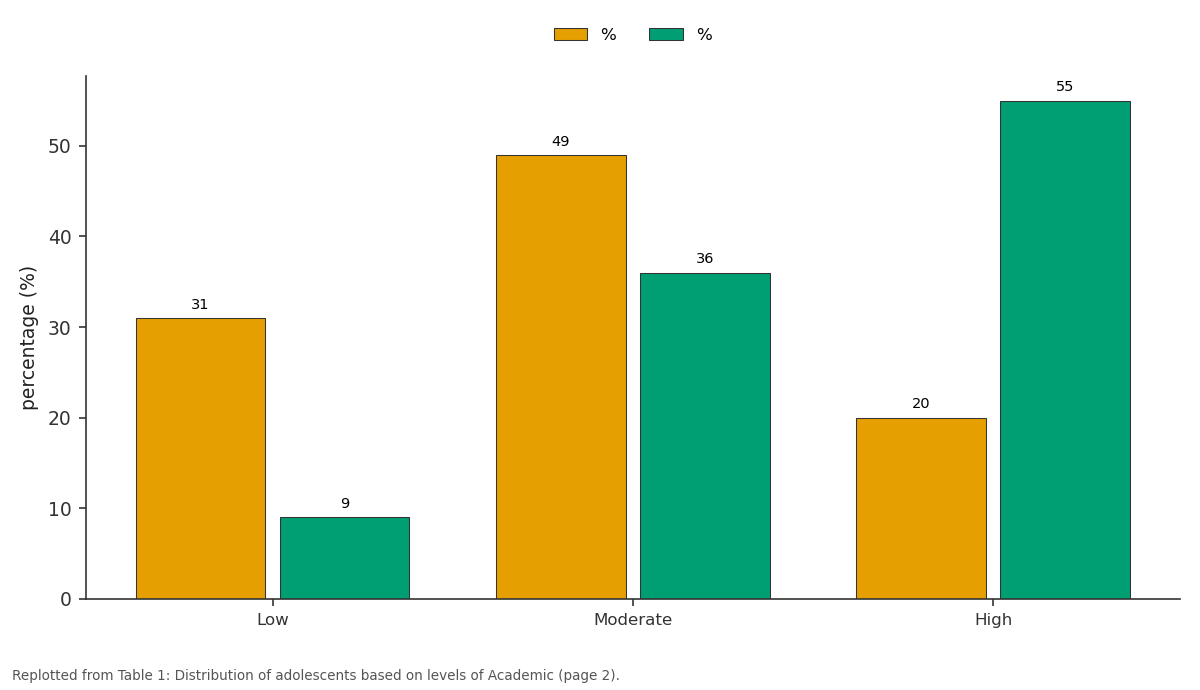
% and %: Low vs Moderate vs High
Replotted from Table 1 (page 2) of the original paper. Every bar is the paper's own table value.
View source evidence ↗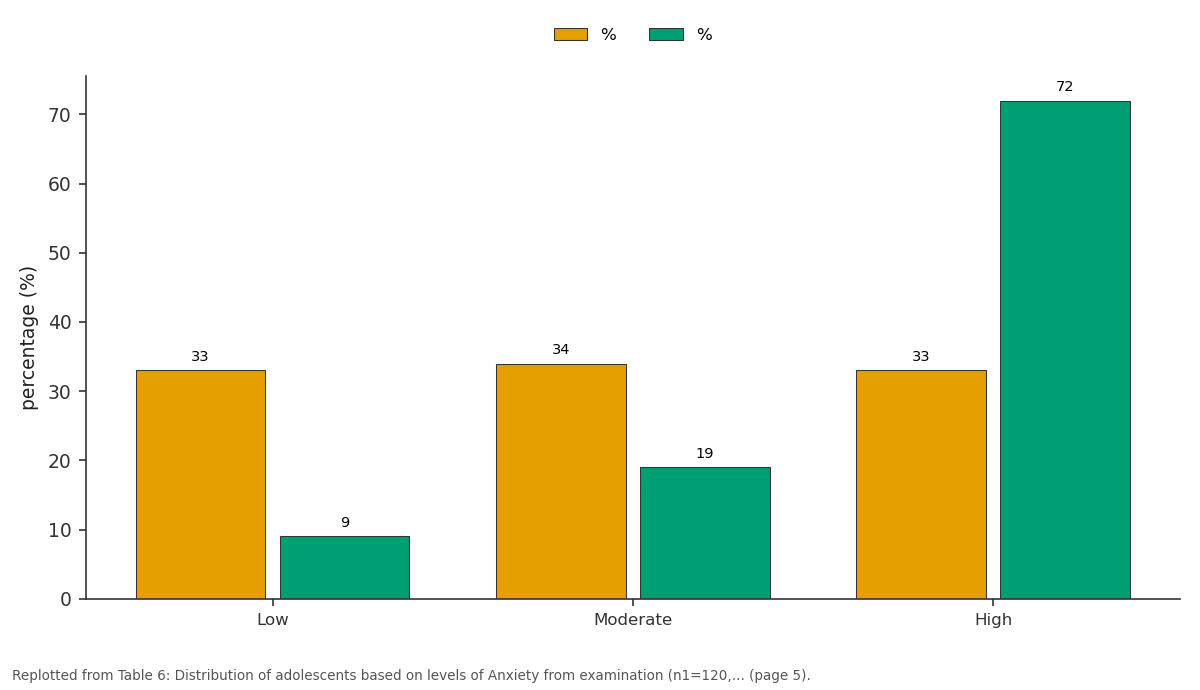
% and %: Low vs Moderate vs High
Replotted from Table 6 (page 5) of the original paper. Every bar is the paper's own table value.
View source evidence ↗Figures & tables
From the original paper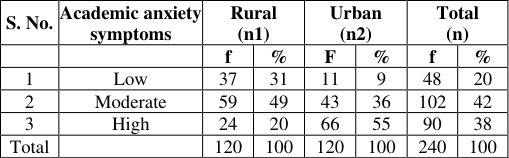 Table 1
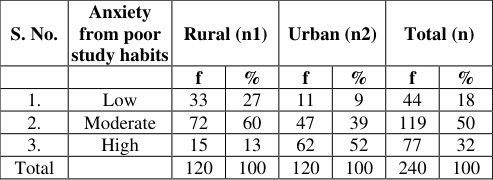 Table 2
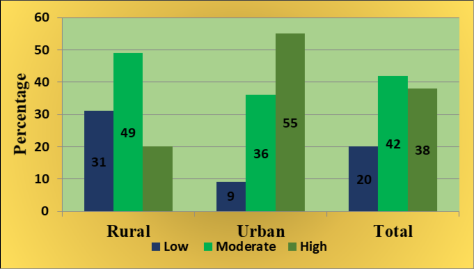 Figure 1
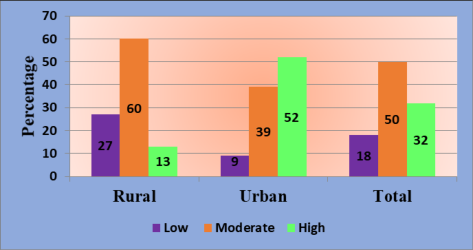 Figure 2
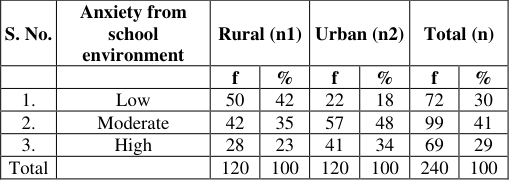 Table 4
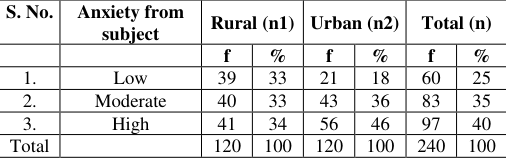 Table 3
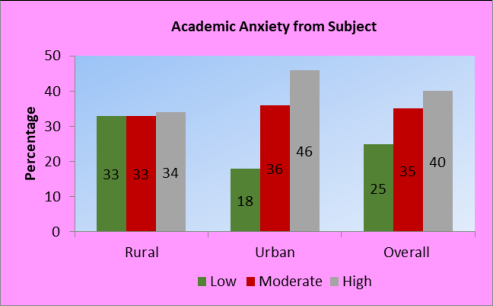 Figure 3
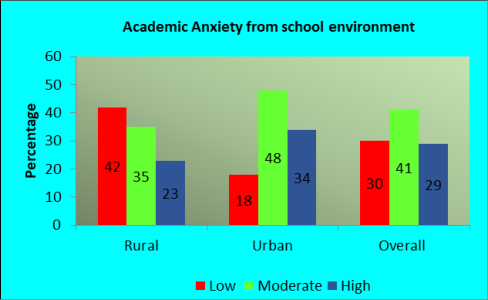 Figure 4
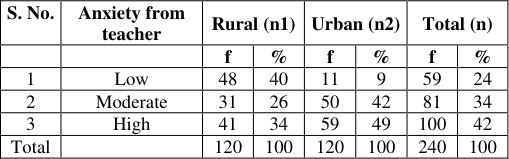 Table 5
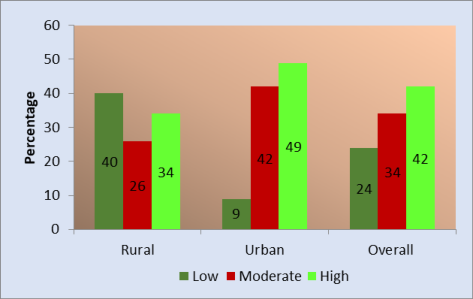 Figure 5
 Table 6
 Table 7
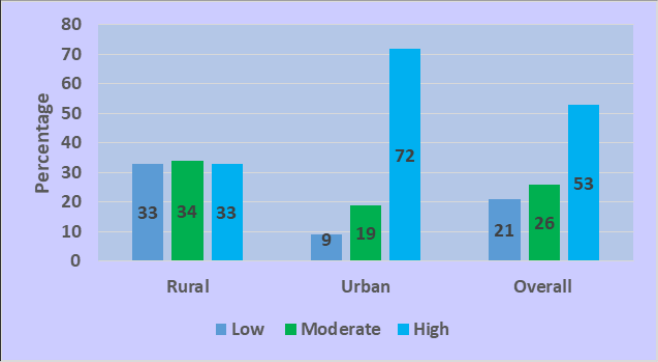 Figure 6
Introduction
Adolescence is one of the most critical periods of life. Adolescents deal with a variety of difficulties in their daily lives and experiencing several anxieties. Anxiety is the state of uneasiness and distress accompanied by nervous behavior, often caused by academic pressure, social expectations and future uncertainty. Anxiety disorders are common and prevalent during adolescence when compared to other age groups. The prevalence of anxiety disorders among Indian adolescents ranged from 8.2% to 20.8%. Globally, it is estimated that 1 in 7 of 10-19 year-olds (14%) had mental health problems (WHO, 2021), yet these remain largely unrecognized and untreated. Adolescent girls reported depressive symptoms two times more than boys. Academic anxiety is a type of fear, a nervousness or apprehension about any form of academic activity which is one of the contributing factors for anxiety disorders. Research studies revealed that adolescents with academic anxiety tend to have poor self-esteem, low motivation to pursue education, disinterest towards future career prospects and develop a negative attitude towards learning and ended up with low level of satisfaction with their life. Academic anxiety is also closely linked to mental health issues such as depression, anxiety disorders and even suicidal ideation. Every day 623 Indian students commit suicide due to academic stress and failure in examination (Deb et al. 2015) [6] . Nearly two-thirds (63.5%) of the students reported stress and anxieties due to academic pressure with no significant differences across gender, age, grade and several other personal factors. The urban adolescents had a higher prevalence of academic anxieties compared to their rural counterparts and female adolescents experienced more academic anxieties when compared to male adolescents. Studies also revealed that self-efficacy beliefs play a crucial role in academic achievements and anxieties. Not many studies were taken up on this important construct especially in Telangana state. Unless the levels of academic anxieties among rural and urban adolescents along with their associative factors are explored, suitable intervention programmes cannot be made to enhance mental health status and psychological wellbeing among adolescents. Hence to fill up the existing research gap the present study was taken up with the objective of studying the levels of academic anxiety among selected rural and urban adolescents of Telangana state.
Materials and Methods
An exploratory and comparative study designs were adopted. The sample consisted of 120 rural and 120 urban adolescents thus, a total sample of 240 adolescents was taken for the investigation. The rural sample were selected from Alampur and Manopadu mandals of Jogulamba Gadwal district and urban sample was selected from various zones of Hyderabad city (GHMC). Random sampling technique was used to select the sample. Adolescents in the age group of 13-18 years were selected. Interview schedule was developed to collect information on general profile of adolescents and Academic anxiety scale developed by Siddiqui and Rehman (2019) [18] was used to study the levels of academic anxiety. The data was analyzed by using frequency and percentage and t-test.
Results and Discussion
Academic anxiety is a mental sensitivity of uneasiness or distress in response to school or college circumstances that is perceived negatively. Academic Anxiety is a state of distress induced by a student's appraisal of excessive academic demands. The dimensions of Academic anxiety were -Anxiety symptoms, Anxiety from poor study habits, Anxiety from subjects, Anxiety from school environment, Anxiety from teachers, Anxiety from examination. The details of the results related to components of Academic anxiety are presented under the following tables.
Levels of academic anxiety symptoms among rural and urban adoloscents
Academic anxiety symptoms are the abnormal behaviour of a student shown at the beginning of any new academic task like procrastination in academic activities, worrying most of the time, perform poorly in school work, fail classes and withdraw from socializing with peers or pursuing activities that interest him/her. The data on levels of Academic anxiety symptoms among adolescents obtained is discussed below. The above table reveals that nearly half (42%) of the respondents had moderate levels of academic anxiety symptoms followed by high levels (38%) and low levels (20%).
According to the table 1 nearly more than half of the urban respondents had high level of Academic anxiety symptoms followed by moderate levels and low levels were as above half of the rural adolescents were having moderate levels of Academic anxiety symptoms.
| S. No. | Academic anxiety symptoms | Rural (n1) | — | Urban (n2) | — | Total (n) | — |
|---|---|---|---|---|---|---|---|
| f | % | F | % | f | % | ||
| 1 | Low | 37 | 31 | 11 | 9 | 48 | 20 |
| 2 | Moderate | 59 | 49 | 43 | 36 | 102 | 42 |
| 3 | High | 24 | 20 | 66 | 55 | 90 | 38 |
| Total | 120 | 100 | 120 | 100 | 240 | 100 |
Table text extracted from the original PDF; superscript letters are shown inline. The original table image is below.
View original table image
The above findings indicate that more than half of the respondents were getting easily irritated when asked about studies, they were having more subject related stress, they felt school as most boring place, they were finding difficulty in focusing the task, they were facing Intense fear in group activities or presentations, they were Lacking in effective planning and organization, Inadequate or poor-quality sleep. This might be due to the prevalence of High expectations from parents and teachers, Competitive academic environments, disorganized study habits and poor time management, Using ineffective study methods, Previous academic failures or poor performance, Lack of support system and cognitive distortions.
The results were further supported by Mbanuzuru et al.
(2022) [19] found that urban participants reported higher levels of academic anxiety symptoms It clearly depicts that the majority of rural adolescents were able to handle academic challenges, concentrate on studies, they have the ability to plan and stick to a study schedule, and a healthy level of motivation to succeed academically without excessive pressure.
Levels of poor study habits among rural and urban adoloscents
Anxiety from poor study habits is the Anxiety caused by learning strategies applied by students in their daily academic tasks.The Anxiety from poor study habits was studied in terms of Difficulty in remembering, getting tired easily, not interested in studies, difficulty in conceptual relation understanding, negative self-talk, and fear of failure, increased heartbeat, sweaty palms, difficulty concentrating due to anxiety, Worrying about not meeting academic expectations, Poor time management skills, Inadequate preparation, lack of confidence and increased anxiety about performance.
The data obtained on existing levels of Anxiety from poor study habits among rural and urban adolescents is discussed below. [13] reported that study habits had a predictive effect on academic performance. Better study habits lead to higher academic performance. Completion of homework and assignments at proper time, proper time allocation, reading and note-taking and teacher consultation significantly influenced academic performance of university students. In contrast with the present findings (2016) Girls were found better than boys on study habits as well as academic achievement. Urban students had higher score on study habits as well as academic achievement than rural students.
Levels of anxiety from subject among rural and urban adoloscents
Anxiety from subject is the ability toward Possessing negative attitude towards a particular subject or different subjects due to one or the other reasons. Anxiety caused by it is called anxiety from subjects of study. Anxiety from the subject was studied in terms of worrying about difficult subject, perceiving study as most difficult task, not interested in subjects he is studding, finding certain subjects harder than others, lack of interest or motivation in a particular subject, Becoming easily frustrated or irritated when dealing with the subject, hard to focus on studying the subject, Previous failures or struggles in the subject.
The data obtained on existing levels of anxiety from subject among rural and urban adolescents is discussed below. It was observed that nearly half (40%) of the respondents had moderate to high levels of anxiety from subject and one fourth (25%) had a low level of anxiety from subject. It clearly depicts that the majority of rural and urban were having moderate to high levels of anxiety from subject. This might be due to the reason, in both rural and urban areas, students may lack access to adequate academic support, fear of failure, causing significant subject anxiety, particular subject anxiety The current findings are in line with Sanal et al. (2017) [20] explored the Maths anxiety in primary and secondary school students. Results revealed that girls exhibited higher anxiety than boys at both educational levels. Ambion (2023) [2] inferred that girls obtained a higher GPA than boys although their level of anxiety was higher too. The results of table 4 showed that about half of the respondents (41%) had moderate level of Anxiety from school environment. And about only one-third (30%) of them had low levels and less than one -fourth of the respondents (29%) had low levels of anxiety from school environment. It was also found that both rural and urban adolescents were almost similar in their levels of Anxiety from school environment. The above findings indicate that the majority of rural and urban adolescents are facing problems like High expectations for grades and performance, Constant comparisons with classmates, The pressure to succeed and fear of making mistakes, Strict, controlling, and punitive administrative styles, they may feel powerless and stressed due to rigid rules, Unrealistic demands and lack of adequate support. This might be due to the reason that majority of adolescents were suffering from Academic Pressure, Performance Anxiety, heavy workload, Negative interactions with teachers and lack of support. The findings are on par with the study by Kumar (2018) [10] who found a significant relationship between academic achievement and school environment of senior secondary school.
| S. No. | Anxiety from school environment | Rural (n1) | — | Urban (n2) | — | Total (n) | — |
|---|---|---|---|---|---|---|---|
| f | % | f | % | f | % | ||
| 1. | Low | 50 | 42 | 22 | 18 | 72 | 30 |
| 2. | Moderate | 42 | 35 | 57 | 48 | 99 | 41 |
| 3. | High | 28 | 23 | 41 | 34 | 69 | 29 |
| Total | 120 | 100 | 120 | 100 | 240 | 100 |
Table text extracted from the original PDF; superscript letters are shown inline. The original table image is below.
View original table image
Levels of anxiety from school environment among rural and urban adoloscents
Levels of anxiety from school environment among rural and urban adoloscents
Levels of anxiety from teachers among rural and urban adoloscents
Anxiety from teachers is the ability of teaching incompetency and partial attitude of teachers inside the classroom also provoke academic anxiety among students. Anxiety occurring due to this phenomenon is called anxiety caused by teachers. Child gets worried when teacher enters the class, avoid sitting in first bench, do not like clarifying doubts, problems with teacher, lack of motivation from teacher. Feeling anxious, high expectations in terms of grades, participation, behavior, or overall academic achievement. feel overwhelmed or stressed, fear of negative feedback or criticism from teachers, feeling unsupported, misunderstood, or intimidated by their teachers, experiencing harsh criticism, strict, inflexible teaching style, constant negative feedback, harsh criticism, unfair treatment, unwilling to provide extra help. The data obtained on existing levels of Anxiety from teachers among rural and urban adolescents is discussed below. The results from table 5 show that more than half of respondents (42%) had high levels of Anxiety from teacher and about only one-third (34%) of them had moderate levels and very few (24%) had low levels of Anxiety from teacher. This clearly shows that the, majority of urban adolescents It was also observed that high levels of anxiety from teachers were slightly more among rural adolescents when compared to urban adolescents. The above findings indicate that more than half of the respondents believed that, teachers were providing inconsistent or unclear feedback on assignments and performance, placing high academic pressure on students to achieve high grades or meet high standards without considering individual capabilities, creating an environment where mistakes are not tolerated and are met with severe consequences.
| S. No. | Anxiety from teacher | Rural (n1) | — | Urban (n2) | — | Total (n) | — |
|---|---|---|---|---|---|---|---|
| f | % | f | % | f | % | ||
| 1 | Low | 48 | 40 | 11 | 9 | 59 | 24 |
| 2 | Moderate | 31 | 26 | 50 | 42 | 81 | 34 |
| 3 | High | 41 | 34 | 59 | 49 | 100 | 42 |
| Total | 120 | 100 | 120 | 100 | 240 | 100 |
Table text extracted from the original PDF; superscript letters are shown inline. The original table image is below.
View original table image
The results were further supported by A study conducted by Purwanti et al. (2020) [14] in Nigeria who found that anxiety levels were influenced by location, with urban students experiencing higher levels of anxiety. This was linked to more intense academic pressure and higher expectations from teachers in urban areas. The results show that about half of the respondents had (42%) high levels of anxiety from examination and about only (34%) had moderate levels and a very few (24%) were having low levels of anxiety from examination. Urban adolescents were having more anxiety from teachers when compared to rural. Similar findings are supported by Mendez et al. (2023) [12] . The mean difference between urban and rural adolescents shows a significant difference in all the dimensions of the academic anxiety. Comparatively urban students expressed higher mean scores in all the dimensions of academic anxiety than rural adolescents except for the anxiety from school environment. The higher levels of academic anxiety among urban adolescents may be attributed to the high parental and school expectations, lack of interest in the subjects and course chosen and repeated examinations.
Levels of anxiety from examination among rural and urban adoloscents
Levels of anxiety from examination among rural and urban adoloscents
Conclusion
Academic anxiety is a kind of anxiety which is closely related with stressed state of students due to one of the many factors or collective effect of many factors like type of school, environment of the institution, subjects taken, examination patterns etc. The study concludes that adolescence are experiencing average to high levels of academic anxiety irrespective of gender and residence. However, urban adolescents had more academic anxiety compared to rural adolescents. Academic anxiety can be caused by various factors. These include internal factors such as excessive worry and unpreparedness to face academic challenges, as well as external factors like parental demands, environmental conditions, and unsupportive facilities.
Figures and tables from the paper
| S. No. | Anxiety from poor study habits | Rural (n1) | — | Urban (n2) | — | Total (n) | — |
|---|---|---|---|---|---|---|---|
| f | % | f | % | f | % | ||
| 1. | Low | 33 | 27 | 11 | 9 | 44 | 18 |
| 2. | Moderate | 72 | 60 | 47 | 39 | 119 | 50 |
| 3. | High | 15 | 13 | 62 | 52 | 77 | 32 |
| Total | 120 | 100 | 120 | 100 | 240 | 100 |
Table text extracted from the original PDF; superscript letters are shown inline. The original table image is below.
View original table image
| S. No. | Anxiety from subject | Rural (n1) | — | Urban (n2) | — | Total (n) | — |
|---|---|---|---|---|---|---|---|
| f | % | f | % | f | % | ||
| 1. | Low | 39 | 33 | 21 | 18 | 60 | 25 |
| 2. | Moderate | 40 | 33 | 43 | 36 | 83 | 35 |
| 3. | High | 41 | 34 | 56 | 46 | 97 | 40 |
| Total | 120 | 100 | 120 | 100 | 240 | 100 |
Table text extracted from the original PDF; superscript letters are shown inline. The original table image is below.
View original table image
| S. No. | Anxiety from examination | Rural (n1) | — | Urban (n2) | — | Total (n) | — |
|---|---|---|---|---|---|---|---|
| f | % | f | % | f | % | ||
| 1. | Low | 39 | 33 | 11 | 9 | 50 | 21 |
| 2. | Moderate | 41 | 34 | 22 | 19 | 63 | 26 |
| 3. | High | 40 | 33 | 87 | 72 | 127 | 53 |
| Total | 120 | 100 | 120 | 100 | 240 | 100 |
Table text extracted from the original PDF; superscript letters are shown inline. The original table image is below.
View original table image
| S. No. | Academic anxiety levels | Rural (n1) | — | Urban (n2) | — | t value | P |
|---|---|---|---|---|---|---|---|
| 1. | Academic anxiety symptoms | 15.46 | 2.25 | 17.25 | 2.86 | 2.64** | 0.00 |
| 2. | Anxiety from poor study habits | 13.52 | 3.15 | 16.45 | 2.82 | 3.46** | 0.00 |
| 3. | Anxiety from subjects | 11.78 | 2.32 | 12.88 | 2.62 | 2.87** | 0.00 |
| 4. | Anxiety from school environment | 13.56 | 2.53 | 10.22 | 3.24 | 2.97** | 0.00 |
| 5. | Anxiety from teachers | 18.44 | 3.12 | 19.57 | 2.58 | 2.14** | 0.00 |
| 6. | Anxiety from examination | 15.64 | 2.41 | 17.45 | 3.11 | 3.22** | 0.00 |
| 7. | Overall Academic anxiety levels | 62.46 | 8.14 | 78.92 | 7.45 | 7.86** | 0.00 |
Table text extracted from the original PDF; superscript letters are shown inline. The original table image is below.
View original table image
References
18 in the original paper- Ambion SAA. Parenting styles and academic anxiety towards academic performance of grade 11 students. SDCA Asia-Pacific Multidiscip Res J. 2023;5(1):64.
- Attri AK. Academic anxiety and achievement of secondary school students-A study on gender differences. Int J Behav Social Mov Sci. 2017;2(1):2733.
- Banga CL. Academic anxiety among high school students in relation to gender and type of family. Shodh www.extensionjournal.com Sanchayan. 2017;5(1):1-7.
- Bihari S. Academic anxiety among secondary school students with reference to gender, habitat and types of school. Int J Educ Psychol Res. 2017;3(4):30-32.
- Deb S, McGirr K, Bhattacharya B, Ji, Sun O. Role of Home Environment, Parental Care, Parents Personality and Their Relationship to Adolescent Mental Health. J Psychol Psychother. 2015;5:1-8.
- Hill F, Mammarella IC, Devine A, Caviola S, Passolunghi MC, Szűcs D. Maths anxiety in primary and secondary school students: Gender differences, developmental changes and anxiety specificity. Learn Individ Differ. 2017;48:45-53.
- Kaur H, Chawla A. A Study of Academic Anxiety and School Adjustment among Adolescents. Indian J Psychiatric Social Work. 2018.
- Khesht Masjedi MF, Shokrgozar S, Abdollahi E, Habibi B, Asghari T, Ofoghi RS, et al. The relationship between gender, age, anxiety, depression, and academic achievement among teenagers. J Family Med Prim Care. 2019;8(3):799-804.
- Kumar A. Relationship of Academic Anxiety among Adolescents in Relation to their Home Environment. 2017.
- Mahato B, Jangir S. A study on academic anxiety among adolescents of Minicoy Island. Int J Sci Res. 2017;1(3):12-14.
- Mendez MJ, Nacional A, Quilos DJ, Salva LH. Home Environmental Factors and Academic Anxiety affecting Academic Performance of adolescents. SEAQIS J Sci Educ. 2023.
- Nwosu KC, Nwanguma VC, Onyebuchi GC. Parenting styles, test anxiety, and self-efficacy of secondary school students in Nigeria: Lessons from Nigerian sociocultural context. Educ Res J. 2016;6(2):32-41.
- Purwanti IY, Wangid MN, Aminah S. Self-Efficacy and Academic Anxiety of College Students. In: Wangid MN, Aminah S, eds. 2nd International Seminar on Guidance and Counseling 2019 (ISGC 2019). Atlantis Press; 2020. p. 276-279.
- Rohiwal DS. Home -Environment and Academic performance among Male and Female College Students. 2018.
- Sandal RK, Goel NK, Sharma MK, Bakshi RK, Singh N, Kumar D. Prevalence of depression, anxiety and stress among school going adolescent in Chandigarh. J Family Med Prim Care. 2017;6(2):405-410.
- Siddiqui SH, Rasheed R, Nawaz S, Abbas M. Knowledge sharing and innovation capabilities: The moderating role of organizational learning. Pakistan Journal of Commerce and Social Sciences (PJCSS). 2019;13(2):455-486.
- Mbanuzuru AV, Anyaoku CS, Ojimba AO, Mbanuzuru MC, Ezenyeaku AC, Obi DC, et al. Prevalence of Anxiety Disorders Among in-school Adolescents in Urban and Rural Areas of Anambra State-a Comparative Study; c 2022.
- Sheikh D, Mateti UV, Kabekkodu S, Sanal T. Assessment of medication errors and adherence to WHO prescription writing guidelines in a tertiary care hospital. Future Journal of Pharmaceutical Sciences. 2017 Jun 1;3(1):60-64.