
Research article · 2023 · Full text
International Journal of Advanced Chemistry ResearchAdvances in extraction techniques for rare earth elements from mineral ores
Volume 5(2) · Pages 117–119 · DOI: 10.33545/26646781.2023.v5.i2b.210 ↗
Research areasExtraction and Separation Processes
Abstract
Author-writtenRare Earth Elements (REEs) are critical components in various high-tech industries due to their unique chemical and physical properties. The extraction of REEs from mineral ores presents significant technical challenges due to their low concentrations and the complexity of the ores. This review explores recent advances in extraction techniques for REEs, focusing on innovations in hydrometallurgical and pyrometallurgical processes, environmentally friendly extraction methods, and emerging technologies. The paper synthesizes current research findings, highlights the advantages and limitations of different techniques, and discusses future directions for improving the efficiency and sustainability of REE extraction.
Summary
Source-checkedPlain-language reading of the full paper, prepared with AI and checked against the text. Each point links to the authors' own words.
Why it matters
- Rare Earth Elements (REEs) are essential for high-tech industries because of their distinct physical and chemical properties. View evidence ↗
- Extracting REEs from ores is technically difficult because the elements occur in low concentrations and the ores themselves are complex. View evidence ↗
- There is a need for more sustainable extraction methods because traditional processes often cause environmental damage. View evidence ↗
The question
- The study aims to review recent advancements in REE extraction techniques to identify ways to improve sustainability and efficiency. View evidence ↗
What they did
- The review analyzes innovations across four main areas: hydrometallurgical processes, pyrometallurgical processes, environmentally friendly methods, and emerging technologies. View evidence ↗
What they found
- A two-stage leaching process using hydrochloric acid (HCl) and sulfuric acid (H2SO4) increases REE recovery from bastnäsite ore. View evidence ↗
- Alkaline leaching is an effective method for extracting REEs from monazite, offering high selectivity and lower acid use. View evidence ↗
- Ionic liquids serve as effective, selective alternatives to traditional organic solvents for extracting REEs from leachates. View evidence ↗
- Functionalized ion-exchange resins can achieve high REE recovery rates when processing complex leach solutions. View evidence ↗
- Combining pyrometallurgical smelting with hydrometallurgical acid leaching significantly improves REE recovery from refractory ores. View evidence ↗
- High-purity REE products can be achieved by combining chlorination with solvent extraction. View evidence ↗
- Using advanced carbon materials like graphene in carbothermic reduction enhances the efficiency of producing REE metals. View evidence ↗
- Bioleaching using specific bacteria and fungi strains provides a sustainable way to selectively extract REEs from low-grade ores. View evidence ↗
- Phytomining using hyperaccumulator plants can effectively concentrate REEs from soil. View evidence ↗
- Supercritical CO₂ is a highly selective and efficient medium for extracting REEs while reducing hazardous solvent use. View evidence ↗
What it means
- The authors conclude that recent innovations in chemical, thermal, and biological extraction have improved efficiency and lowered the environmental footprint of REE production. View evidence ↗
- The authors recommend continued research to further improve the cost-effectiveness and sustainability of REE extraction to ensure a stable industrial supply. View evidence ↗
Visual summary
1 visualsIllustrations explain the paper; they do not show study data.
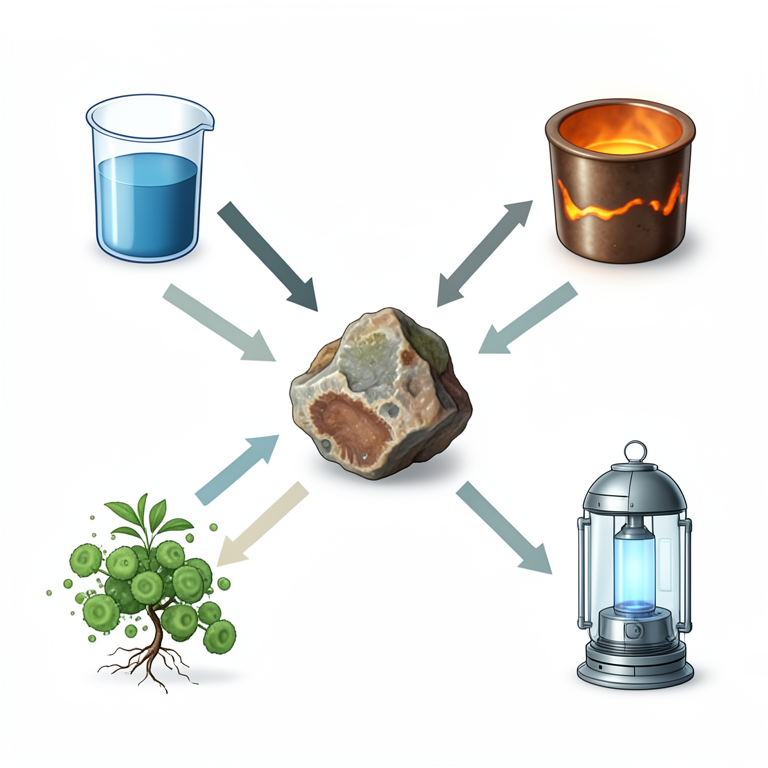
REE Extraction Pathways
AI-generated conceptual illustration (mineral ore containing rare earth elements). It explains the idea and does not show study data.
View source evidence ↗Introduction
Rare Earth Elements (REEs) are a group of 17 elements, including the 15 lanthanides plus scandium and yttrium, which are essential for numerous high-tech applications such as electronics, renewable energy technologies, and defense systems. Despite their name, REEs are relatively abundant in the Earth's crust, but their extraction is challenging due to their dispersed occurrence and the complexity of the ores. Traditional extraction methods often involve environmentally damaging processes, highlighting the need for more efficient and sustainable techniques. This review provides a comprehensive overview of the recent advances in extraction techniques for REEs from mineral ores, examining both established and emerging technologies.
Objective of the study
The objective of this study is to review recent advances in extraction techniques for rare earth elements from mineral ores, focusing on improving efficiency and sustainability.
Hydrometallurgical processes
Hydrometallurgical processes involve the use of aqueous chemistry to extract metals from ores, concentrates, or recycled materials. These processes are widely used for REE extraction due to their ability to selectively separate and recover individual elements. Acid leaching is one of the most common methods for extracting REEs from ores. This process involves dissolving the REE-containing minerals in strong acids such as hydrochloric acid (HCl) or sulfuric acid (H 2 SO 4 ). Recent advancements have focused on optimizing acid concentration, temperature, and leaching time to improve extraction efficiency. For instance, research by Zhang et al. (2015) [1] demonstrated that a two-stage leaching process with HCl and H 2 SO 4 can achieve higher REE recovery rates from bastnäsite ore. Alkaline leaching, using agents such as sodium hydroxide (NaOH), is another method used for REE extraction, particularly from phosphate ores. This technique has gained attention due to its lower environmental impact compared to acid leaching. Studies by Xie et al. (2014) [2] showed that alkaline leaching can effectively extract REEs from monazite with high selectivity and reduced acid consumption. Solvent extraction involves the separation of REEs from leach solutions using organic solvents. This method is highly selective and can achieve high purity levels of individual REEs. Recent developments have focused on identifying more efficient and environmentally friendly solvents. For example, ionic liquids have emerged as promising alternatives to traditional organic solvents, offering advantages such as low volatility and recyclability. Research by Abreu and Morais (2014) [3] highlighted the effectiveness of ionic liquids in selectively extracting REEs from leachates. Ion exchange is a process where REEs are separated from solutions using ion-exchange resins. This method is particularly useful for recovering REEs from lowconcentration solutions. Advances in ion exchange have focused on developing resins with higher selectivity and capacity for REEs. A study by Chen et al. (2016) [4] demonstrated the use of functionalized resins to achieve high recovery rates of REEs from complex leach solutions.
Pyrometallurgical processes
Pyrometallurgical processes involve high-temperature treatments to extract metals from ores. These processes are typically used for extracting REEs from refractory minerals that are difficult to process using hydrometallurgical methods. Smelting involves heating the ore to high temperatures in the presence of a reducing agent to produce a metal or metal oxide. For REEs, smelting is often combined with other techniques to improve recovery rates.
Recent research has focused on optimizing smelting conditions and integrating smelting with hydrometallurgical processes to enhance overall efficiency. Studies by Guo et al. (2018) [5] have shown that combining smelting with acid leaching can significantly increase REE recovery from refractory ores. Chlorination is a pyrometallurgical process that uses chlorine gas to convert REEs in ores to their chloride forms, which can then be extracted using hydrometallurgical methods. This technique is particularly effective for processing high-grade ores. Advances in chlorination have focused on improving reaction kinetics and reducing chlorine consumption. Research by Reddy et al. (2017) [6] demonstrated that using a combination of chlorination and solvent extraction can achieve high-purity REE products. Carbothermic reduction involves reducing REE oxides with carbon at high temperatures to produce REE metals. This process is typically used for producing REE alloys. Recent developments have aimed at optimizing reduction conditions to improve yield and purity. Studies by Liu et al. (2019) [7] have explored the use of advanced carbon materials, such as graphene, to enhance the reduction process and achieve higher efficiencies.
Environmentally friendly extraction methods
The environmental impact of traditional REE extraction methods has led to the development of more sustainable and environmentally friendly techniques. These methods aim to reduce the use of hazardous chemicals, minimize waste, and lower energy consumption. Bioleaching involves using microorganisms to leach REEs from ores. This method is environmentally friendly and can be conducted at ambient temperatures. Recent research has focused on identifying and optimizing microorganisms capable of effectively leaching REEs. A study by Brierley (2010) [8] demonstrated that certain strains of bacteria and fungi can selectively leach REEs from low-grade ores, offering a sustainable alternative to conventional methods. Phytomining uses plants to extract REEs from soil or mine tailings. The plants accumulate REEs in their biomass, which can then be harvested and processed to recover the metals. This technique has gained attention due to its low environmental impact and potential for rehabilitating contaminated sites.
Research by Chaney et al. (2007) [9] showed that certain [10] highlighted the potential of supercritical CO₂ for extracting REEs with high selectivity and efficiency.
Conclusion
The extraction of Rare Earth Elements from mineral ores is a complex and challenging process, requiring advanced techniques to achieve high efficiency and sustainability.
References
13 in the original paper- Zhang L, Xu C, Li X. Two-stage leaching process for bastnäsite ore. Hydrometallurgy. 2015;157:17-23.
- Xie F, Zhang T, Dreisinger D, Doyle F. A critical review on solvent extraction of rare earths from aqueous solutions. Minerals Engineering. 2014;56:1028.
- Abreu CM, Morais C. Ionic liquids as novel solvent systems for rare earth extraction. Journal of Rare Earths. 2014;32(2):90-96.
- Chen Z, Zhu G, Zhang W, et al. Functionalized ionexchange resins for selective recovery of rare earth elements. Journal of Hazardous Materials. 2016;318:0108.
- Guo Z, Sun W, Wang J, Li H. Combined smelting and acid leaching for rare earth recovery from refractory ores. Metallurgical and Materials Transactions B. 2018;49(5):2389-2396.
- Reddy BR, Kumar JI, Babu TS. Chlorination of rare earth oxides: A review. Journal of Rare Earths. 2017;35(1):1-10.
- Liu Y, Jiang Y, Yang B, et al. Enhanced carbothermic reduction of rare earth oxides using graphene as a reducing agent. Journal of Alloys and Compounds. 2019;781:117-125.
- Brierley CL. How will biomining be applied in future? Transactions of Nonferrous Metals Society of China. 2010;20(3):473-481.
- Chaney RL, Angle JS, McIntosh MS. Using hyperaccumulator plants to phytoextract soil metals. Current Opinion in Biotechnology. 2007;8(3):279-284.
- Reverchon E, De Marco I. Supercritical fluid extraction and fractionation of natural matter. Journal of Supercritical Fluids. 2006;38(2):146-166.
- Zhang W, He J, Chen G, et al. Nanoporous membranes for rare earth element separation. Journal of Membrane Science. 2018;564:119-128.
- Tian J, Chen Y, Ma L, et al. Microwave-assisted leaching of rare earth elements from bastnäsite ore. Minerals Engineering. 2017;109:101-109.
- Li M, Zhao Z, Fan X, et al. Electrochemical extraction of rare earth elements from ores. Electrochimica Acta. 2015;176:162-170.