
Research article · 2024 · Full text
International Journal of Research in AgronomyProductivity and balance sheet of potassium in soil as affected by nutrient management under pearlmillet-mustard cropping system
Volume 7(7S) · Pages 259–262 · DOI: 10.33545/2618060x.2024.v7.i7sd.1043 ↗
Research areasAgricultural Science and Fertilization
Abstract
Author-writtenThe present investigation aimed to see the effect of different nutrient combination with or without farmyard manure on productivity, potassium uptake and its balance sheet in alluvial soil under pearl millet-mustard cropping system. The investigations revealed that the maximum economic yield of both crops obtained in 100% NPK + 10 t FYM ha-1 Yr-1 treatment (2174.3 and 2236.8 kg ha-1 in pearl millet and mustard, respectively) which was statistically at par with 150% NPK and 100% NPK + 25 kg ZnSO4 ha-1 Yr-1 treatments. Application of either 150% NPK or 100% NPK+ 10 t FYM ha-1 Yr-1 showed statistically at par K-uptake by grain and stover of both crops under study which was significantly higher as compared to 100% NPK treatments. A declining trend (-3.8 to 27.0 kg ha-1) was observed either without K (Control, 100% N & 100% NP) or less amount-K (50 & 75% NPK) applied treatment as compared to initial level of available K status which indicates considerable mining of available K in these treatments under pearlmillet-mustard cropping system.
Summary
Source-checkedPlain-language reading of the full paper, prepared with AI and checked against the text. Each point links to the authors' own words.
Why it matters
- Potassium is a critical plant nutrient that is consumed in large amounts during intensive farming, often at levels similar to nitrogen. View evidence ↗
- Both pearl millet and mustard are crops with high potassium requirements to complete their growth cycles. View evidence ↗
- When potassium supplementation is insufficient, the amount removed by crops exceeds the input, leading to a negative balance and depletion of soil reserves. View evidence ↗
The question
- The study aimed to evaluate how different nutrient combinations, with or without farmyard manure, affect the productivity, potassium uptake, and soil potassium balance in a pearl millet-mustard cropping system. View evidence ↗
What they did
- The research was conducted in Gwalior, Madhya Pradesh, spanning the Kharif seasons of 2020 and 2021 and the Rabi seasons of 2020-21 and 2021-22. View evidence ↗
- The recommended nutrient dosage for both pearl millet and mustard was 80 kg N, 40 kg P2O5, and 20 kg K2O per hectare. View evidence ↗
- Farmyard manure (FYM) was applied at a rate of 10 t ha-1 yr-1 specifically before the sowing of the pearl millet crop in the Kharif season. View evidence ↗
- The soil potassium balance was calculated by comparing potassium inputs from various sources against the amount removed by the crops. View evidence ↗
What they found
- The highest economic yields for pearl millet (2174.3 kg ha-1) and mustard (2236.8 kg ha-1) were achieved using the 100% NPK + 10 t FYM ha-1 Yr-1 treatment. View evidence ↗
- The maximum total potassium uptake for the cropping system was 140.00 kg ha-1 under 150% NPK, followed closely by 138.95 kg ha-1 under 100% NPK + FYM. View evidence ↗
- Treatments with no potassium or low potassium (50% and 75% NPK) showed a decline in available soil potassium ranging from -3.8 to -27.0 kg ha-1 compared to initial levels. View evidence ↗
- The most significant depletion of soil potassium occurred in the 100% NP treatment (-27.0 kg ha-1), followed by the 100% N treatment (-21.2 kg ha-1). View evidence ↗
- The highest level of available soil potassium (256.0 kg ha-1) was recorded in the 100% NPK + 10 t FYM ha-1 Yr-1 treatment. View evidence ↗
What it means
- The authors concluded that combining farmyard manure with NPK fertilizers improves both crop productivity and potassium uptake compared to using NPK alone. View evidence ↗
- Because low or no potassium application led to significant mining of soil reserves, the authors suggest that existing nutrient recommendations for the pearl millet-mustard system should be re-evaluated. View evidence ↗
Visual summary
3 visualsIllustrations explain the paper; charts are replotted from the paper's own table values.
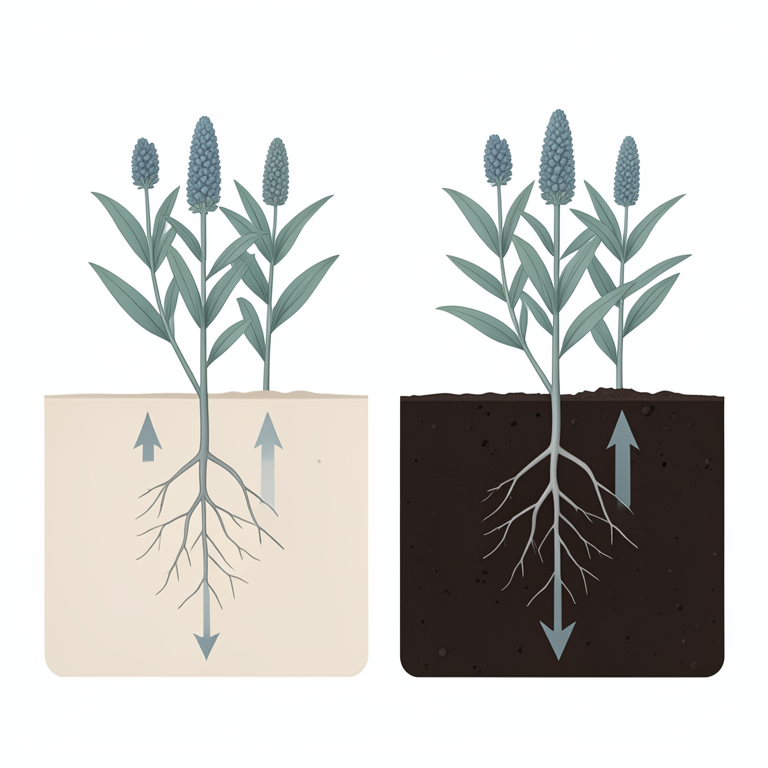
Soil Potassium Balance Comparison
AI-generated conceptual illustration (pearlmillet and mustard plants in soil profiles). It explains the idea and does not show study data.
View source evidence ↗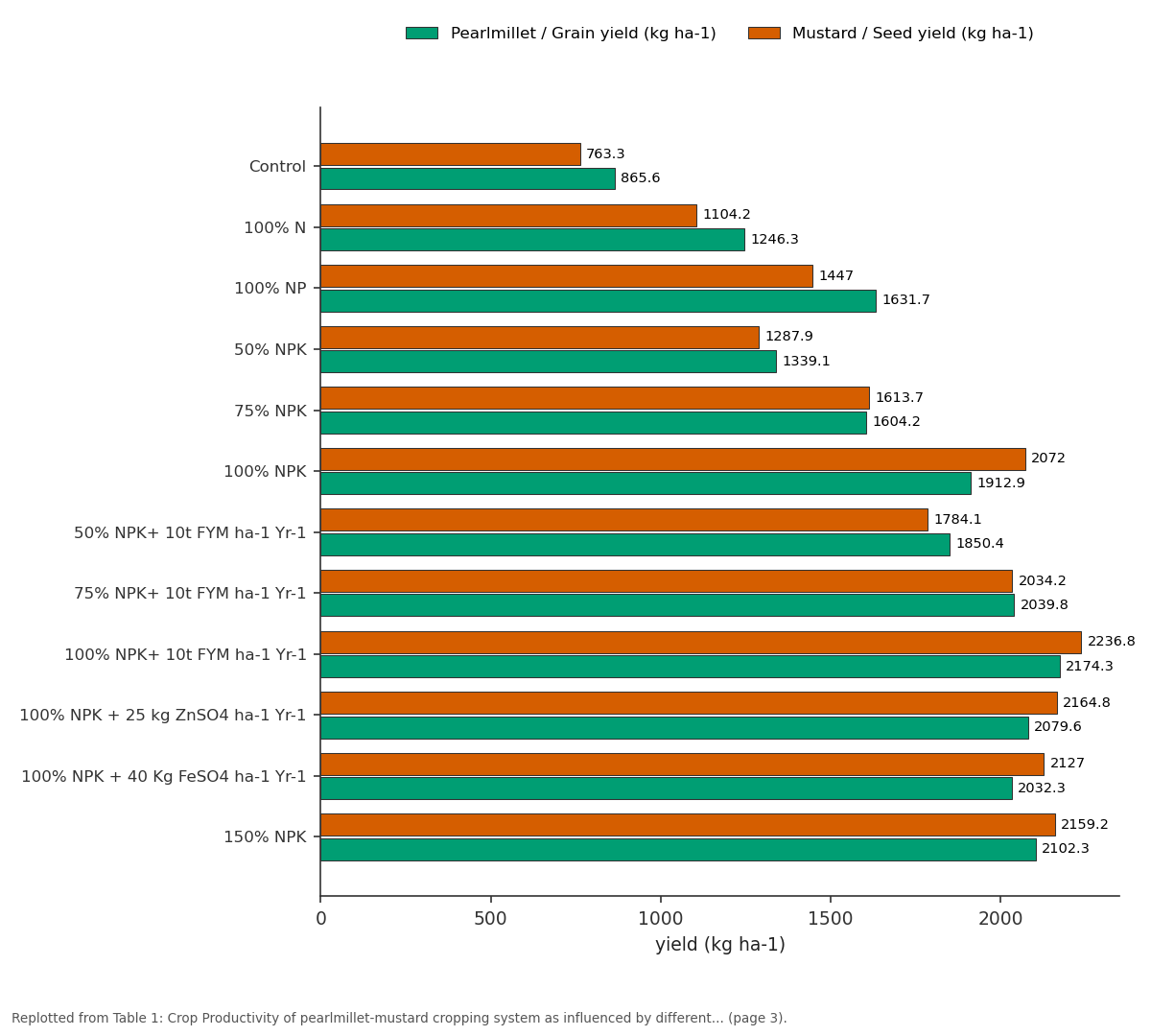
Pearlmillet / Grain yield (kg ha-1) and Mustard / Seed yield (kg ha-1): Control vs 100% N vs 100% NP vs 50% NPK vs 75% NPK
Replotted from Table 1 (page 3) of the original paper. Every bar is the paper's own table value.
View source evidence ↗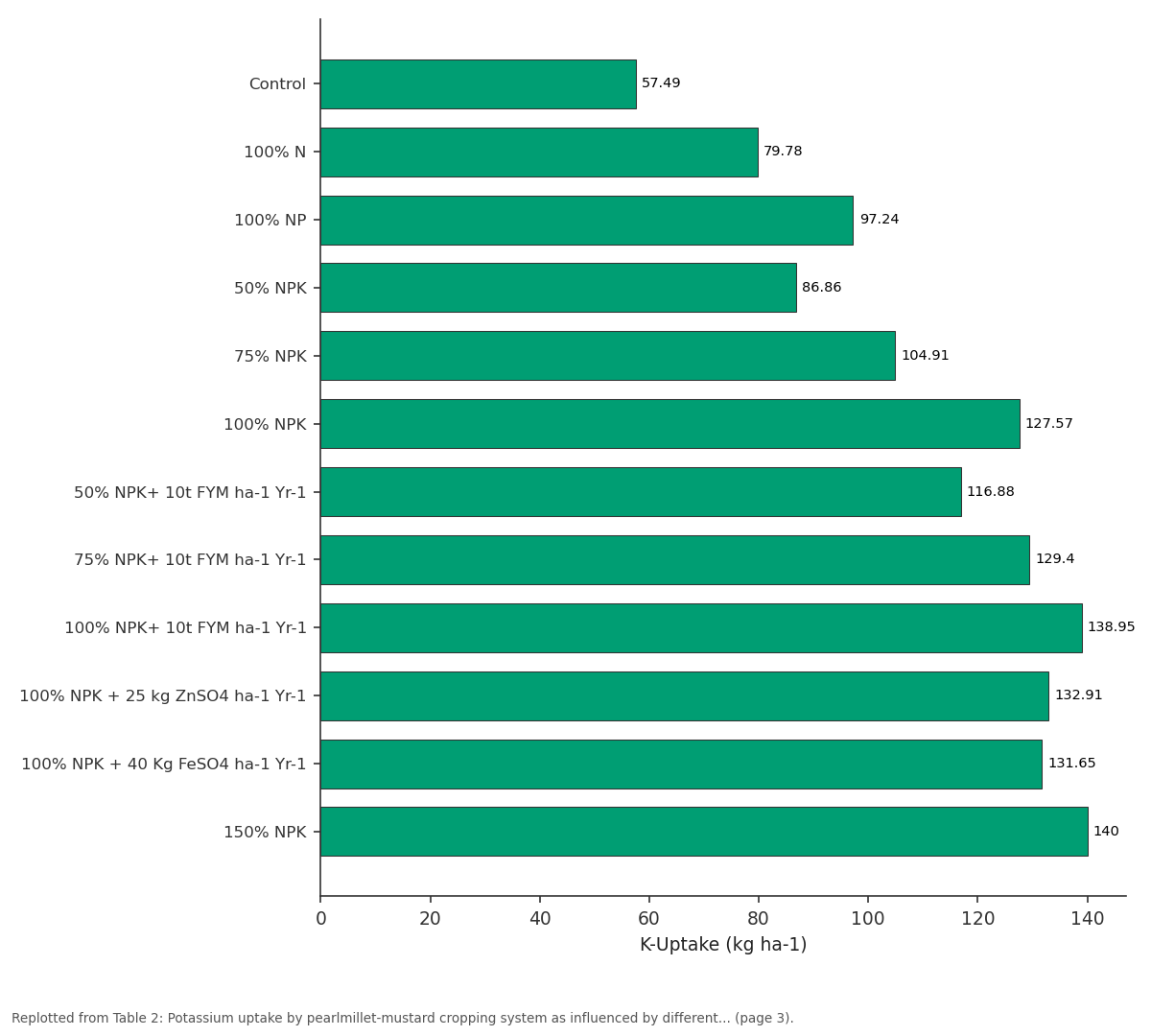
Pearlmillet-mustard / G. Total: Control vs 100% N vs 100% NP vs 50% NPK vs 75% NPK
Replotted from Table 2 (page 3) of the original paper. Every bar is the paper's own table value.
View source evidence ↗Figures & tables
From the original paper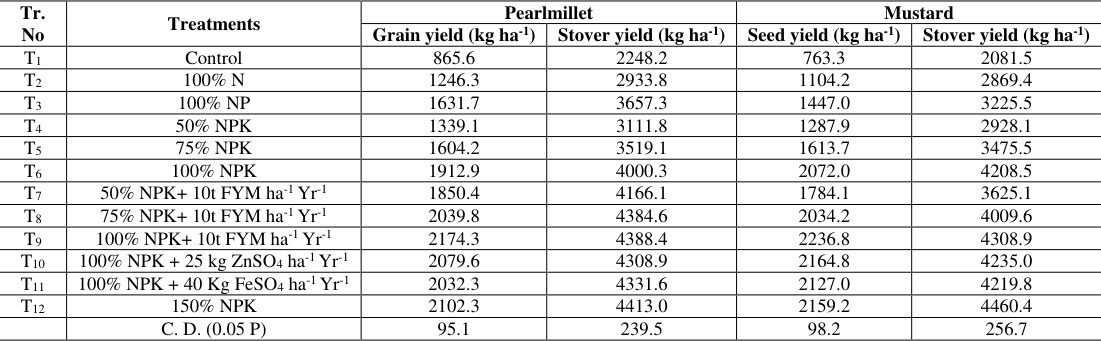 Table 1
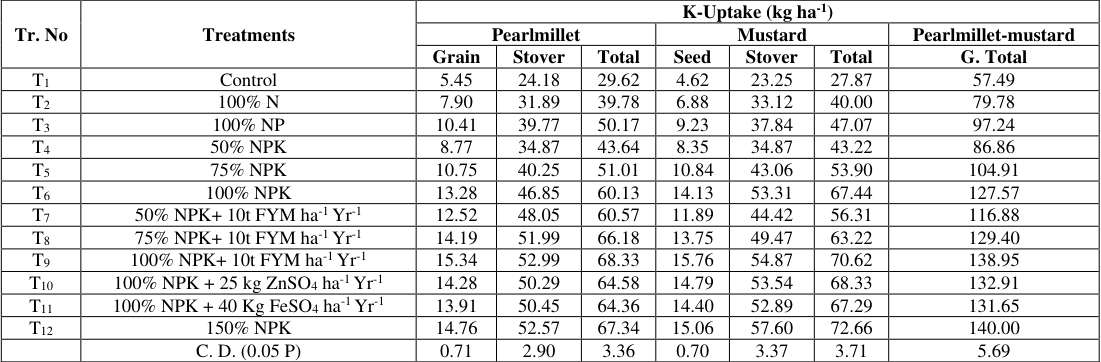 Table 2
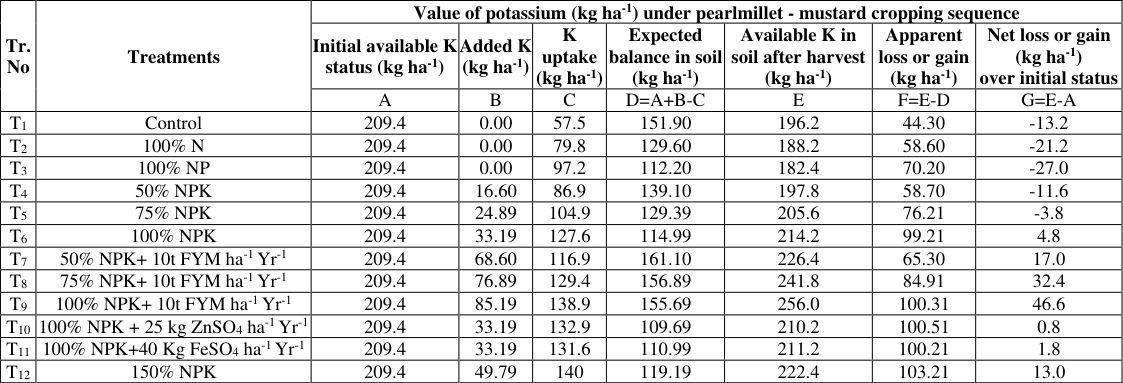 Table 3
Introduction
Potassium (K) is an essential, major plant nutrient with numerous functions and is often taken up in large quantities by crops under intensive cropping and its uptake is in many crops almost equal to nitrogen. Thus, severe depletion of K in soils under long term continuous cropping without supplemental K, leads to minimal exchangeable K. In this scenario, the K requirement of crop(s) is met from the reserve K fraction (Srinivasarao et al. 2007) [9] . Pearl milletmustard cropping system got popularized during last several years under limited and assured irrigated condition, in alluvial soil region (Typic Hapluslepts/Ustocrepts) of Northern Madhya Pradesh. Pearl millet and mustard both are high K demanding crops and requires a large amount of K to complete its life cycle. In the absence of external K application, soil K weathering is the major source for meeting the K requirement. Therefore, optimum K release from the soil to meet crop K needs is particularly important at critical plant growth stage of crop. As most farmers apply N and P regularly, yield under high rainfall depletes soil K reserves more than those with poor rainfall. As a general practice some of the farmers apply variable amounts of farm yard manure (FYM) along with imbalanced fertilizers omitting K and other nutrients. Depletion of soil K reserves is a strong constraint in enhancing and sustaining productivity of a K -demanding crops. In-sufficient K supplementation, K removal exceeds the K input, and hence the resulting negative K balance leads to severe depletion of the K reserves (Subba Rao et al. 2010) [10] . With these considerations, the present study was carried out for investigate trends in yields, uptake and K balance in pearl milletmustard cropping system under different nutrient management practices.
Materials and Methods
Present study was carried out at Rajmata Vijayraje Sciendia Krishi Vishwa Vidyalaya, Gwalior, Madhya Pradesh during Kharif 2020 & 2021 and Rabi 2020-21 & 2021-22. The experimental soil was alluvial, sandy clay loam in nature and belonging to Inceptisol, hyperthermic family of Typic Ustochrept. The mean initial soil available N, P and K were 206.4, 12.2 and 209.4 kg ha -1 , respectively. Mean value of initial soil pH of 7.87, EC 0.36 dSm -1 and Organic carbon 4.26 g kg -1 . The recommended N, P and K dose, was 80 kg N, 40 kg P 2 O 5 and 20 kg K 2 O ha -1 for pearl millet as well as mustard. The sources of N, P and K used were urea, single superphosphate and muriate of potash. Under farm yard manure treatments it was applied @ 10 t ha -1 yr -1 only before sowing of pearl millet crop during Kharif season. The Hybrid (F1) Pearl millet and NRCHB-101 variety of mustard was used in present experiments. After harvest, the ground grain and stover samples were digested with nitric-perchloric (9:4) di-acid mixture for the analysis of potassium was estimated with flame photometer (Jackson, 1973) [5] . The uptake of potassium was calculated with their content and yields of respective parts of the crops. The surface soil samples were collected after the harvest of mustard during 2021-22 with the help of a tube auger (stainless steel) from each plot. Exchangeable-K was extracted by neutral ammonium acetate (1N) extraction in 1:5 ratio as described by Black (1965) [3] . Soil K balance was computed by assessing K inputs into soil through different sources and outputs through crop K removal, assuming negligible loss by erosion or leaching.
Results and Discussion
Results and Discussion
Crop productivity
The pooled data on grain yield of pearlmillet and mustard are presented in table 1. The lowest grain yields of pearl millet and mustard 865.6 and 763.3 kg ha -1 , respectively were recorded in control. Application of 100% NPK recorded significantly higher grain yield of pearlmillet and mustard over potassium free i.e. 100% N and 100% NP treatments. This might be attributed to the adequate and balanced supply nutrition to plants which might have created a favorable influence on the plant growth and development, which ultimately depicted in higher yield. Yield improvement in yield due to potassium was also reported by Khare and Dixit (2011) [6] . Maximum grain yield obtained in 100% NPK + FYM treatment (2174.3 and 2236.8 kg ha -1 in pearl millet and mustard, respectively) was significantly higher than other treatments except 150% NPK and 100% NPK + 25 kg ZnSO 4 ha -1 Yr -1 treatments. The application of organic manure (10 t FYM ha -1 yr -1 ) along with NPK dose (50, 75 and 100% NPK) was observed to be beneficial in enhancing the crop productivity of pearl millet and mustard over their respective NPK alone (Table 1). The beneficial effect of FYM clubbing may be due to additionnal nutrient supply from its decomposition, enhanced mobilization of nutrients from the soil, activation of beneficial soil biological activities through which nutrient availability was increased as well as improved physical condition of soil which provided the plant a good food hold to grow and develop. The similar beneficial effects of FYM along with NPK have been reported by Tiwari et al. (2002) [11] .
| Tr. No | Treatments | Pearlmillet | — | Mustard | — |
|---|---|---|---|---|---|
| Grain yield (kg ha-1) | Stover yield (kg ha-1) | Seed yield (kg ha-1) | Stover yield (kg ha-1) | ||
| T1 | Control | 865.6 | 2248.2 | 763.3 | 2081.5 |
| T2 | 100% N | 1246.3 | 2933.8 | 1104.2 | 2869.4 |
| T3 | 100% NP | 1631.7 | 3657.3 | 1447.0 | 3225.5 |
| T4 | 50% NPK | 1339.1 | 3111.8 | 1287.9 | 2928.1 |
| T5 | 75% NPK | 1604.2 | 3519.1 | 1613.7 | 3475.5 |
| T6 | 100% NPK | 1912.9 | 4000.3 | 2072.0 | 4208.5 |
| T7 | 50% NPK+ 10t FYM ha-1 Yr-1 | 1850.4 | 4166.1 | 1784.1 | 3625.1 |
| T8 | 75% NPK+ 10t FYM ha-1 Yr-1 | 2039.8 | 4384.6 | 2034.2 | 4009.6 |
| T9 | 100% NPK+ 10t FYM ha-1 Yr-1 | 2174.3 | 4388.4 | 2236.8 | 4308.9 |
| T10 | 100% NPK + 25 kg ZnSO4 ha-1 Yr-1 | 2079.6 | 4308.9 | 2164.8 | 4235.0 |
| T11 | 100% NPK + 40 Kg FeSO4 ha-1 Yr-1 | 2032.3 | 4331.6 | 2127.0 | 4219.8 |
| T12 | 150% NPK | 2102.3 | 4413.0 | 2159.2 | 4460.4 |
| C. D. (0.05 P) | 95.1 | 239.5 | 98.2 | 256.7 |
Table text extracted from the original PDF; superscript letters are shown inline. The original table image is below.
View original table image
Potassium uptake
Total K uptake varied from 29.62 to 68.33 kg ha -1 in pearl millet and 27.87 to 72.66 kg ha -1 in mustard, respectively. In case of pearlmillet -mustard cropping system total K-uptake ranged from 57.49 to 140.00 kg ha -1 and The highest grand total K uptake (140.00 kg ha -1 ) was found in 150% NPK closely followed by 100% NPK + FYM (138.95 kg ha -1 ) treatment and both treatments were statistically at par among them and the lowest uptake was observed in control plots in both the crops. It is clear from table-2 that application of 100% NPK showed significantly higher K -uptake by grain and stover of both crops as compared to 100% N, 100% NP, 50% NPK and 75% NPK treatments. Application of either 150% NPK or 100% NPK+ 10 t FYM ha -1 Yr -1 showed statistically at par K-uptake by grain and stover of both crops under study which was significantly higher as compared to 100% NPK treatments. This might be due to more availability of potassium through balanced levels of applied nutrients. Total uptake of K increased with their application to the crop because of increased availability of potassium through their respective sources and higher biomass yield. Integration of FYM with NPK was beneficial in enhancing the uptake of potassium over sole use of NPK treatment. This may be because of the fact that use of nutrients at different levels with FYM increased the K content which could be due to additional supply of these nutrients through organic matter and improvement in the soil physical, biological and chemical condition for better nutrient availability and plant growth. Findings are corroborated with those reported by Bhadauria, et al. (2016) [1] .
Potassium input and output balance
Balance sheet of potassium (kg ha -1 ) was calculated on the basis of mean values of potassium in soil (before and after harvest) as well as K uptake by pearlmillet -mustard cropping sequences. The perusal of data (Table -3) revealed a declining trend (-3.8 to 27.0 kg ha -1 ) was observed either without K (Control, 100% N & 100% NP) or less amount-K (50 & 75% NPK) applied treatment as compared to its initial level (209.4 kg ha -1 ) of available K status which indicates considerable mining of available K under pearlmillet-mustard cropping system. Maximum decline (-27.0 kg ha -1 ) was observed in 100% NP followed by (-21.2 kg ha -1 ) in 100% N treatment. The magnitude of decline decreased with increasing levels of NPK application. Among the inorganic fertilizers, continuous application of N, NP adversely affected the available K content of the soil, which may be attributed to non application of potassic fertilizer, which also resulted in nutrient imbalance in the soil. Continuous omission of K in pearl millet-mustard caused mining of its native pools also resulted reduction in yield (Dwivedi et al.; 2007) [4] . Highest available K status (256.0 kg ha -1 ) of soil was found in the treatment 100% NPK+ 10t FYM ha -1 Yr -1 followed by75% NPK+ 10t FYM ha -1 Yr -1 (241.8 kg ha -1 ). Bhattacharyya et al. (2008) [2] opined that organic matter might have caused reduction in K fixation and consequentially increased available K content due to interaction of organic matter with clay, besides the direct addition to the available K pools of soil. The similar observations of FYM along with NPK have been reported by Singh and Wanjari, (2012) [8] .
Conclusion
From the results obtained under present study indicate that the integration of FYM with different levels of NPK increased the productivity and K-uptake in pearl millet and mustard over NPK alone treatments. Application of nutrients either without K (Control, 100% N & 100% NP) or less amount-K (50 & 75% NPK) resulted considerable mining of available -K from reserves pools towards a relook at the existing recommendation for under pearlmillet-mustard cropping system.
Figures and tables from the paper
| Tr. No | Treatments | K-Uptake (kg ha-1) | — | — | — | — | — | — |
|---|---|---|---|---|---|---|---|---|
| Pearlmillet | Mustard | Pearlmillet-mustard | ||||||
| Grain | Stover | Total | Seed | Stover | Total | G. Total | ||
| T1 | Control | 5.45 | 24.18 | 29.62 | 4.62 | 23.25 | 27.87 | 57.49 |
| T2 | 100% N | 7.90 | 31.89 | 39.78 | 6.88 | 33.12 | 40.00 | 79.78 |
| T3 | 100% NP | 10.41 | 39.77 | 50.17 | 9.23 | 37.84 | 47.07 | 97.24 |
| T4 | 50% NPK | 8.77 | 34.87 | 43.64 | 8.35 | 34.87 | 43.22 | 86.86 |
| T5 | 75% NPK | 10.75 | 40.25 | 51.01 | 10.84 | 43.06 | 53.90 | 104.91 |
| T6 | 100% NPK | 13.28 | 46.85 | 60.13 | 14.13 | 53.31 | 67.44 | 127.57 |
| T7 | 50% NPK+ 10t FYM ha-1 Yr-1 | 12.52 | 48.05 | 60.57 | 11.89 | 44.42 | 56.31 | 116.88 |
| T8 | 75% NPK+ 10t FYM ha-1 Yr-1 | 14.19 | 51.99 | 66.18 | 13.75 | 49.47 | 63.22 | 129.40 |
| T9 | 100% NPK+ 10t FYM ha-1 Yr-1 | 15.34 | 52.99 | 68.33 | 15.76 | 54.87 | 70.62 | 138.95 |
| T10 | 100% NPK + 25 kg ZnSO4 ha-1 Yr-1 | 14.28 | 50.29 | 64.58 | 14.79 | 53.54 | 68.33 | 132.91 |
| T11 | 100% NPK + 40 Kg FeSO4 ha-1 Yr-1 | 13.91 | 50.45 | 64.36 | 14.40 | 52.89 | 67.29 | 131.65 |
| T12 | 150% NPK | 14.76 | 52.57 | 67.34 | 15.06 | 57.60 | 72.66 | 140.00 |
| C. D. (0.05 P) | 0.71 | 2.90 | 3.36 | 0.70 | 3.37 | 3.71 | 5.69 |
Table text extracted from the original PDF; superscript letters are shown inline. The original table image is below.
View original table image
| Tr. No | Treatments | Value of potassium (kg ha-1) under pearlmillet - mustard cropping sequence | — | — | — | — | — | — |
|---|---|---|---|---|---|---|---|---|
| Initial available K status (kg ha-1) | Added K (kg ha-1) | K uptake (kg ha-1) | Expected balance in soil (kg ha-1) | Available K in soil after harvest (kg ha-1) | Apparent loss or gain (kg ha-1) | Net loss or gain (kg ha-1) over initial status | ||
| A | B | C | D=A+B-C | E | F=E-D | G=E-A | ||
| T1 | Control | 209.4 | 0.00 | 57.5 | 151.90 | 196.2 | 44.30 | -13.2 |
| T2 | 100% N | 209.4 | 0.00 | 79.8 | 129.60 | 188.2 | 58.60 | -21.2 |
| T3 | 100% NP | 209.4 | 0.00 | 97.2 | 112.20 | 182.4 | 70.20 | -27.0 |
| T4 | 50% NPK | 209.4 | 16.60 | 86.9 | 139.10 | 197.8 | 58.70 | -11.6 |
| T5 | 75% NPK | 209.4 | 24.89 | 104.9 | 129.39 | 205.6 | 76.21 | -3.8 |
| T6 | 100% NPK | 209.4 | 33.19 | 127.6 | 114.99 | 214.2 | 99.21 | 4.8 |
| T7 | 50% NPK+ 10t FYM ha-1 Yr-1 | 209.4 | 68.60 | 116.9 | 161.10 | 226.4 | 65.30 | 17.0 |
| T8 | 75% NPK+ 10t FYM ha-1 Yr-1 | 209.4 | 76.89 | 129.4 | 156.89 | 241.8 | 84.91 | 32.4 |
| T9 | 100% NPK+ 10t FYM ha-1 Yr-1 | 209.4 | 85.19 | 138.9 | 155.69 | 256.0 | 100.31 | 46.6 |
| T10 | 100% NPK + 25 kg ZnSO4 ha-1 Yr-1 | 209.4 | 33.19 | 132.9 | 109.69 | 210.2 | 100.51 | 0.8 |
| T11 | 100% NPK+40 Kg FeSO4 ha-1 Yr-1 | 209.4 | 33.19 | 131.6 | 110.99 | 211.2 | 100.21 | 1.8 |
| T12 | 150% NPK | 209.4 | 49.79 | 140 | 119.19 | 222.4 | 103.21 | 13.0 |
Table text extracted from the original PDF; superscript letters are shown inline. The original table image is below.
View original table image
References
8 in the original paper- Bhadauria J, Singh T, Verma S, Parajapati B, Singh A, Khan S. Effect of integrated nutrient management on yield and nutrient uptake by wheat in alluvial soils of Madhya Pradesh. Int J Agric Sci. 2016;8(51):2206-2209.
- Bhattacharyya R, Prakesh V, Kundu S, Ghosh BN, Gupta HS. Potassium availability as influenced by farmyard manure application under continuous soybean-wheat cropping system in a Typic Haplaquept. J Indian Soc Soil Sci. 2008;56:182-185.
- Khare D, Dixit HC. Effect of potassium and zinc on yield, quality and uptake of nutrients in wheat. Ann Plant Soil Res. 2011;13(2):158-160.
- Netam UP, Anurag CR. Residual effect of organic and inorganic fertilizer nutrients on sulphur content and uptake in wheat crop under rice-wheat cropping system. J Soils Crops. 2011;21(10):82-85.
- Singh M, Wanjari RH. Potassium response and requirement in crops grown in Vertisols: Experiences from long-term fertilizers experiment. Indian J Fertilizers. 2012;8:26-32.
- Srinivasarao C, Vittal KPR, Tiwari KN, Gajbhiye PN, Kundu S. Categorization of soils based on potassium reserves and production systems: Implications in K management. Aust J Soil Res. 2007;45:438-447.
- Subba Rao S, Srinivasarao C, Srivastava S. Potassium status and crop response to potassium on the soils of agroecological regions of India. IPI Res Topics. 2010;20:185.
- Tiwari A, Dwivedi AK, Dikshit PR. Long term influence of organic and inorganic fertilization on soil fertility and productivity of soybean-wheat system in a Vertisol. J Indian Soc Soil Sci. 2002;50:472-475.