
Research article · 2024 · Full text
International Journal of Research in AgronomyWeed seed bank and residual effect on succeeding crop (Sunflower) as influenced by weed control methods in maize
Volume 7(7) · Pages 395–398 · DOI: 10.33545/2618060x.2024.v7.i7sf.1056 ↗
Research areasAgriculture and Biological StudiesWeed Control and Herbicide ApplicationsVaried Academic Research Topics
Abstract
Author-writtenTo study the effect of weed control methods on weed seed bank and the residual effect of different herbicides applied in maize on succeeding sunflower crop, a field experiment was conducted at Tamilnadu Agricultural University, Coimbatore during kharif seasons of 2018-19 and 2019-20. Treatments included two pre-emergence herbicides viz., atrazine 0.5 kg ha-1 and pendimethalin 1 kg ha-1 at 1 DAS along with two early post-emergence herbicides topramezone 25.2 g ha-1 and tembotrione 122 g ha-1 at 20 DAS were used. Hand weeding twice at 20 and 45 DAS and control were also included. After the maize harvest, a reduction in weed seed bank was observed with hand weeding twice at 20 and 45 DAS which was on par with pre emergence atrazine fb either early post emergence topramezone or tembotrione at 20 DAS. Residue of herbicides was noticed in early post emergence topramezone alone or tembotrione at 20 DAS alone and sequential application of pre emergence atrazine fb either topramezone or tembotrione as early post emergence were noticed above detectable level in the soil at harvest stage of maize. However, none of the herbicide treatments used in the kharif maize season showed any residual carryover effects on the subsequent sunflower crop.
Summary
Source-checkedPlain-language reading of the full paper, prepared with AI and checked against the text. Each point links to the authors' own words.
Why it matters
- Maize crops grown during the rainy season are highly susceptible to weed infestation because of wide row spacing and favorable weather. View evidence ↗
- Weed competition in maize can be severe enough to reduce crop yields by 40% to 60%. View evidence ↗
- Chemical weed control is often preferred over other methods because it is fast, effective, and reduces labor and time requirements. View evidence ↗
The question
- The study aimed to evaluate how different weed control methods in maize affect the soil weed seed bank and whether herbicide residues impact a subsequent sunflower crop. View evidence ↗
What they did
- The field experiment took place at Tamilnadu Agricultural University in Coimbatore during the 2018-19 and 2019-20 kharif seasons. View evidence ↗
- To analyze the weed seed bank, soil samples were collected from two depths: 0-15 cm and 16-30 cm. View evidence ↗
- Herbicide residues were analyzed using High-Performance Liquid Chromatography (HPLC) and Gas Chromatography (GC) methods. View evidence ↗
What they found
- Across all weed control treatments, the number of seeds in the weed seed bank was significantly lower at the 16-30 cm depth than at the 0-15 cm depth. View evidence ↗
- The highest emergence of grasses, sedges, and broad-leaved weeds occurred in the unweeded control plots compared to all other treatments. View evidence ↗
- Plots treated with atrazine alone showed higher grass emergence than those treated with pendimethalin or HPPD inhibitors (topramezone and tembotrione). View evidence ↗
- Pendimethalin treatments resulted in more broad-leaved weeds compared to the sequential application of atrazine followed by HPPD inhibitors. View evidence ↗
- At the maize harvest stage, herbicide residues were only detectable in plots treated with early post-emergence topramezone or tembotrione, either alone or following pre-emergence atrazine. View evidence ↗
- No herbicide residues were detectable in the soil during the subsequent sunflower crop phase. View evidence ↗
What it means
- The authors conclude that applying pre-emergence atrazine followed by either topramezone or tembotrione as early post-emergence provides extended weed control with minimal residual effects and a reduced weed seed bank. View evidence ↗
- The authors state that chemical weed management is the practical choice for farmers because the cost of maintaining weed-free fields through manual weeding is too high. View evidence ↗
Visual summary
1 visualsIllustrations explain the paper; they do not show study data.
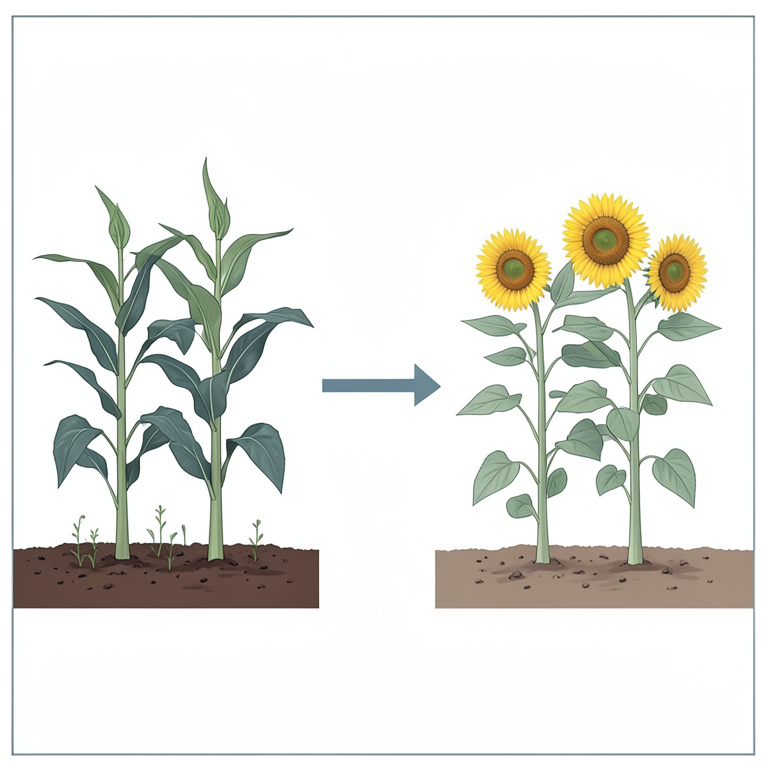
Crop Rotation Residue Flow
AI-generated conceptual illustration (Maize and sunflower plants in agricultural soil). It explains the idea and does not show study data.
View source evidence ↗Figures & tables
From the original paper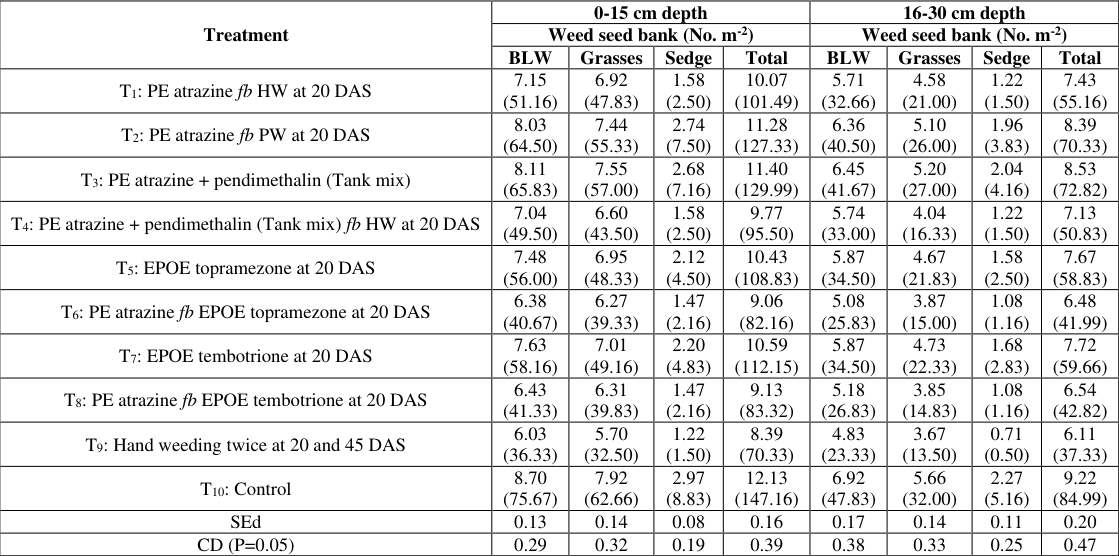 Table 1
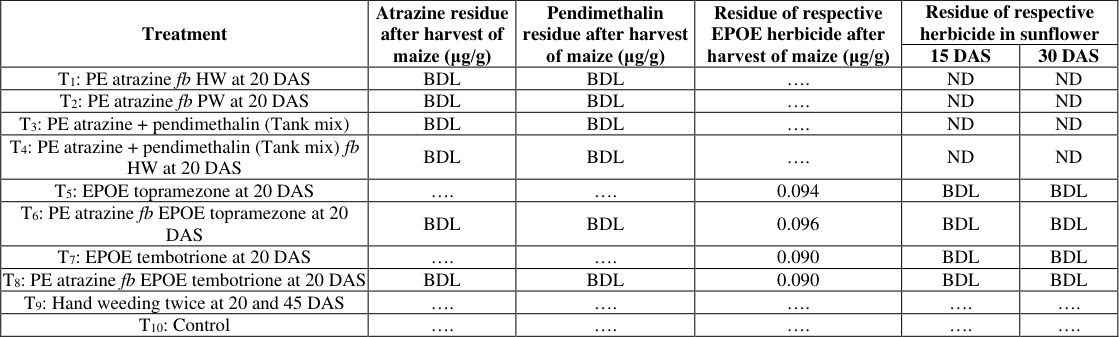 Table 2
Introduction
Maize (Zea mays), grown during the rainy season, suffers significantly from severe weed infestation due to favorable weather conditions and wider row spacing. Severe competition from weeds can lead to yield reductions of 40-60%, depending on the intensity and type of weed flora, as noted by (Pandey et al., 2001) [6] . The species composition and density of weeds are influenced by various factors including cropping history, agronomic practices particularly weed control measures, tillage methods, soil and climatic conditions of the region. These factors can cause variations from field to field and within different areas of the same field (Bhuler, 1995) [3] these variations are directly related to the weed seed bank in the soil. While seed banks and the resultant weed population consist of numerous species, typically few dominant species make up 70 to 90% of the total weed flora, as noted by (Wilson, 1988) [8] . To mitigate weed losses, various methods are mechanical, cultural, biological and chemical control methods. As cultural methods become less effective, farmers are increasingly turning to alternative weed control strategies (Varga et al., 2007) [7] . In this regard, chemical weed control may be regarded as the optimal choice. The chemical control method is rapid, highly effective and saves time and labor compared to alternative methods (Ahmad et al., 2008) [2] . (Wilson, 2014) [10] resulted that pendimethalin can be effectively used as a pre-emergence treatment to achieve satisfactory weed control while maintaining crop selectivity. (Fazal et al., 2009) [4] reported that the application of pendimethalin during pre-emergence reduced weed populations and boosted grain yield compared to uncontrolled weedy conditions. In general, the assessment of herbicides used in maize should consider not only their efficacy in weed control but also their impact on plant growth, maize grain yield and their residual effects on subsequent sunflower. Keeping this in view, the present investigation was carried out to find the effect weed control methods on weed seed distribution in soil.
Also, study the residual effects of the four herbicides and their impact on succeeding sunflower crop.
Materials and Methods
The field experiment was conducted during 2018 and 2019 seasons, at Tamilnadu Agricultural University, Coimbatore. Field experiment included the following treatments: pre emergence atrazine at 0.5 kg a.i. ha -1 fb hand weeding at 20 DAS, pre emergence atrazine at 0.5 kg a.i. ha -1 fb power weeder at 20 DAS, pre emergence atrazine at 0.5 kg a.i. ha -1 + pendimethalin at 1 kg a.i. ha -1 (tank mix), pre emergence atrazine at 0.5 kg a.i. ha -1 + pendimethalin at 1 kg a.i. ha -1 (tank mix) fb hand weeding at 20 DAS, early post emergence topramezone at 25.2 g a.i. ha -1 at 20 DAS, pre emergence atrazine at 0.5 kg a.i. ha -1 fb early post emergence topramezone at 25.2 g a.i. ha -1 at 20 DAS, early post emergence tembotrione at 122 g a.i. ha -1 at 20 DAS, pre emergence atrazine at 0.5 kg a.i. ha -1 fb early post emergence tembotrione at 122 g a.i. ha -1 at 20 DAS, hand weeding twice at 20 and 45 DAS and unweeded control. The randomized complete block design with three replications was used. Plot area was 21.60 m 2 (4.8 m length and 4.5 m width). The commercial maize cultivar COH (M) 6 was used in both the years at the rate of 20 kg ha -1 . Maize seeds were dibbled with the spacing of 60 cm × 25 cm. seeds were sown on first fortnight of june in both the years. Pre emergence herbicides treatments were sprayed at 1 DAS, whereas early post emergence herbicides were sprayed at 20 DAS. The normal cultural practices for growing maize were applied as recommended for the region (i.e., irrigation, pest and diseases control) as per the university guideline. Fertilizer recommended (250:75:75 N:P 2 O 5 :K 2 O kg ha -1 ) for maize was applied in the form of urea, SSP and MOP. Nitrogen was applied in three splits. 25% nitrogen and full dose of phosphorus and potassium were given as basal dose along with ZnSO 4 @ 37.5 kg ha -1 . Remaining 50% of nitrogen and 25% of nitrogen was top dressed at 25 and 45 DAS respectively. For weed seed bank studies, composite soil samples were collected from the respective main plots at depths of 0-15 cm and 16-30 cm. Samples were taken from a designated area measuring 25 cm x 25 cm and were placed individually in 5 cm deep plastic trays for each depth sampled. The trays were placed in an open area and watered daily and the emerged seedlings were counted by species over a three-month period. The total number of weeds obtained was then expressed per square meter and subjected to transformation using the formula √(X+0.5). The emerging weed flora was counted at intervals of up to 90 days and categorized into broad-leaved weeds, grasses and sedges. After 45 days, gibberellic acid was applied to the soil to stimulate the germination of dormant weed seeds and subsequent seed germination was recorded for each kg of soil (Adams and Steigerwalt, 2008) [1] . The residual effect of maize herbicides on the succeeding sunflower: The experiment was extended to find out the effect of any leftover residues of herbicides used in maize on sunflower. Cultivar (CO 3) was raised without disturbing the layout of the experimental field and recommended package of practices were followed according to crop production guide. Soil samples were collected for analysing the herbicide residue content from both pre and post emergence herbicides (atrazine, pendimethalin, topramezone and tembotrione) treated plots at periodical intervals of at harvest of maize and 15 and 30 DAS of sunflower crop in all treated plots using HPLC and GC method.
Herbicide residues present in the soil was calculated by using the following formula.
Data of all the observations in both years were pooled before statistical analysis. Data on weed density was square root transformed before analysis. Where the F test was significant (at 5% level of significance), the critical difference (CD) was used to compare mean (P=0.05).
Results and Discussions
Weed flora of the experimental field belongs to nine taxonomic families of which four species were grasses (Cynodon dactylon, Dactyloctenium aegyptium, Dinebra retroflexa and Echinochloa colona), nine species of broadleaved weeds (BLW) (Amaranthus viridis, Boerhavia diffusa, Corchorus olitorius, Digera arvensis, Euphorbia hirta, Parthenium hysterophorus, Phyllanthus nirurui, Trianthema portulacastrum and Sida acuta) and only one species of sedge (Cyperus rotundus). The predominant weed species noticed in the experimental field were Cynodon dactylon, Dactyloctenium aegyptium and Echinochloa colona among grasses. Amaranthus viridis, Digera arvensis and Trianthema portulacastrum among BLW.
Effect on weed seed bank
Weed seed bank studies for different soil depths (Table 1) revealed that various weed control treatments in terms of herbicidal effect on seed bank resulted in significantly lowest number of seeds at 16-30 cm depth compared to 0-15 cm depth. The reduction in weed seed bank is the result of reduction in seeding capacity of weeds due to herbicide application. The emergence of grasses, broad-leaved weeds and sedge was higher in weedy situation as compared to other treatments. Emergence of grasses was more in herbicide atrazine alone treated plots compared to HPPD inhibitor herbicides (topramezone and tembotrione) and pendimethalin. This was due to the fact that grassy weeds were not effectively controlled by atrazine alone treated plots as compared to broad-leaved weeds and the grasses had multiplied through seeds as well as vegetative portion. Broad-leaved weeds were more in pendimethalin treated plots as compared to atrazine fb HPPD inhibitor herbicides (Topramezone and tembotrione). This is in conformity with the results of (Jain et al., 2006) [5] and (Walia et al., 2006) [9] reported that a decline in weed density and weed seed bank as affected by herbicides used in rice and wheat.
| Treatment | 0-15 cm depth | — | — | — | 16-30 cm depth | — | — | — |
|---|---|---|---|---|---|---|---|---|
| Weed seed bank (No. m-2) | Weed seed bank (No. m-2) | |||||||
| BLW | Grasses | Sedge | Total | BLW | Grasses | Sedge | Total | |
| T1: PE atrazine fb HW at 20 DAS | 7.15 (51.16) | 6.92 (47.83) | 1.58 (2.50) | 10.07 (101.49) | 5.71 (32.66) | 4.58 (21.00) | 1.22 (1.50) | 7.43 (55.16) |
| T2: PE atrazine fb PW at 20 DAS | 8.03 (64.50) | 7.44 (55.33) | 2.74 (7.50) | 11.28 (127.33) | 6.36 (40.50) | 5.10 (26.00) | 1.96 (3.83) | 8.39 (70.33) |
| T3: PE atrazine + pendimethalin (Tank mix) | 8.11 (65.83) | 7.55 (57.00) | 2.68 (7.16) | 11.40 (129.99) | 6.45 (41.67) | 5.20 (27.00) | 2.04 (4.16) | 8.53 (72.82) |
| T4: PE atrazine + pendimethalin (Tank mix) fb HW at 20 DAS | 7.04 (49.50) | 6.60 (43.50) | 1.58 (2.50) | 9.77 (95.50) | 5.74 (33.00) | 4.04 (16.33) | 1.22 (1.50) | 7.13 (50.83) |
| T5: EPOE topramezone at 20 DAS | 7.48 (56.00) | 6.95 (48.33) | 2.12 (4.50) | 10.43 (108.83) | 5.87 (34.50) | 4.67 (21.83) | 1.58 (2.50) | 7.67 (58.83) |
| T6: PE atrazine fb EPOE topramezone at 20 DAS | 6.38 (40.67) | 6.27 (39.33) | 1.47 (2.16) | 9.06 (82.16) | 5.08 (25.83) | 3.87 (15.00) | 1.08 (1.16) | 6.48 (41.99) |
| T7: EPOE tembotrione at 20 DAS | 7.63 (58.16) | 7.01 (49.16) | 2.20 (4.83) | 10.59 (112.15) | 5.87 (34.50) | 4.73 (22.33) | 1.68 (2.83) | 7.72 (59.66) |
| T8: PE atrazine fb EPOE tembotrione at 20 DAS | 6.43 (41.33) | 6.31 (39.83) | 1.47 (2.16) | 9.13 (83.32) | 5.18 (26.83) | 3.85 (14.83) | 1.08 (1.16) | 6.54 (42.82) |
| T9: Hand weeding twice at 20 and 45 DAS | 6.03 (36.33) | 5.70 (32.50) | 1.22 (1.50) | 8.39 (70.33) | 4.83 (23.33) | 3.67 (13.50) | 0.71 (0.50) | 6.11 (37.33) |
| T10: Control | 8.70 (75.67) | 7.92 (62.66) | 2.97 (8.83) | 12.13 (147.16) | 6.92 (47.83) | 5.66 (32.00) | 2.27 (5.16) | 9.22 (84.99) |
| SEd | 0.13 | 0.14 | 0.08 | 0.16 | 0.17 | 0.14 | 0.11 | 0.20 |
| CD (P=0.05) | 0.29 | 0.32 | 0.19 | 0.39 | 0.38 | 0.33 | 0.25 | 0.47 |
Table text extracted from the original PDF; superscript letters are shown inline. The original table image is below.
View original table image
Residual effect of maize herbicides on the sunflower crop
Residues of different herbicides viz., atrazine, pendimethalin as pre emergence and topramezone and tembotrione as early post emergence were studied at harvest of maize and succeeding sunflower at 15 and 30 DAS (Table 2). Among the different treatments imposed in maize only early post emergence topramezone at 20 DAS, pre emergence atrazine fb early post emergence topramezone at 20 DAS, early post emergence tembotrione at 20 DAS and pre emergence atrazine fb early post emergence tembotrione at 20 DAS were noticed above detectable level at harvest stage of maize. Also, the residues of all herbicides in the study of succeeding crop of sunflower were noticed to be below detectable level.
| Treatment | Atrazine residue after harvest of maize (μg/g) | Pendimethalin residue after harvest of maize (μg/g) | Residue of respective EPOE herbicide after harvest of maize (μg/g) | Residue of respective herbicide in sunflower | — |
|---|---|---|---|---|---|
| 15 DAS | 30 DAS | ||||
| T1: PE atrazine fb HW at 20 DAS | BDL | BDL | …. | ND | ND |
| T2: PE atrazine fb PW at 20 DAS | BDL | BDL | …. | ND | ND |
| T3: PE atrazine + pendimethalin (Tank mix) | BDL | BDL | …. | ND | ND |
| T4: PE atrazine + pendimethalin (Tank mix) fb HW at 20 DAS | BDL | BDL | …. | ND | ND |
| T5: EPOE topramezone at 20 DAS | …. | …. | 0.094 | BDL | BDL |
| T6: PE atrazine fb EPOE topramezone at 20 DAS | BDL | BDL | 0.096 | BDL | BDL |
| T7: EPOE tembotrione at 20 DAS | …. | …. | 0.090 | BDL | BDL |
| T8: PE atrazine fb EPOE tembotrione at 20 DAS | BDL | BDL | 0.090 | BDL | BDL |
| T9: Hand weeding twice at 20 and 45 DAS | …. | …. | …. | …. | …. |
| T10: Control | …. | …. | …. | …. | …. |
Table text extracted from the original PDF; superscript letters are shown inline. The original table image is below.
View original table image
Conclusion
Findings from our study showed that seed bank from the study area is characterized by an abundance of viable broadleaved weeds compared to grasses and sedges that are resident within 0-15 cm soil depth compared to the 16-30 cm soil depth. This study has also shown that the seed density of weed soil seed bank is more susceptible to herbicide. Application of preceding herbicides on maize did not influence the residual effect on succeeding sunflower. In maize-sunflower cropping system application of atrazine as PE fb either topramezone or tembotrione as EPOE in maize registered the lesser residual effect, weed seed bank and recorded the extended weed control compared to control. Weed free practices was not feasible among farmers due to high cost incurred in weeding. Hence farmers used the chemical weed management practices.
References
8 in the original paper- Ahmed SE, Shams HM, El-Metwall IM, Shehata MN, ElWakeel MA. Efficiency of some weed control treatments on growth, yield and its attributes of maize (Zea mays L.) plants and associated weeds. J Agric. Sci. Mansoura Univ. 2008;33(7):4777-4789.
- Buhler DD. Influence of tillage systems on weed population dynamics and management in corn and soybean in the central USA. Crop Sci. 1995;35:1247-1258.
- Fazal M, Ali K, Khan I, Khan HU, Anwar M. Efficacy of various herbicides against weeds and their impact on yield of maize. Pak. J Weed Sci. Res. 2009;15(2-3):191-198.
- Jain N, Mishra JS, Kewat ML, Jain V. Effect of tillage and herbicides on weed seed bank dynamics in wheat (Triticum aestivum) under transplanted rice-wheat system. Indian J Weed Sci. 2006;38(1&2):161-164.
- Pandey AK, Prakash V, Singh P, Prakash K, Singh RD, MANI VP. Integrated weed management in maize. Indian. J Agron. 2001;46(2):260-265.
- Varga P, Bcrcs I, Rcisinger P, Busak P. The influence of soil herbicides on weeds in maize. Proc. German Conf. Weed Biology and Weed Control, Germany. 2011;17:641646.
- Walia US, Brar LS. Effect of tillage and weed management on seed bank of Phalaris minor in wheat under rice-wheat sequence. Indian J Weed Sci. 2006;38(1&2):104-107.
- Wilson RG, Sbatella GM. Integrating irrigation, tillage and herbicides for weed control in dry bean. Weed Tech. 2014;28(3):479-485.