
Research article · 2024 · Full text
International Journal of Research in AgronomyAssessment of growth, yield, and quality of hybrid ridge gourd (Luffa acutangula L.) in the agro-climatic conditions of Prayagraj
Volume 7(7) · Pages 286–289 · DOI: 10.33545/2618060x.2024.v7.i7d.1037 ↗
Research areasAdvances in Cucurbitaceae ResearchAgricultural Economics and PracticesAgricultural Science and Fertilization
Abstract
Author-writtenThis research evaluated the performance of ten hybrid ridge gourd (Luffa acutangula L.) varieties under Prayagraj's agro-climatic conditions, aiming to identify the best-performing hybrids. The study utilized a randomized block design, testing varieties such as USM-Sunita, F1-Kumbh, and F1 Hybrid Sonia, each with three replicates. Parameters assessed included germination time, vine length, time to first flower appearance, sex ratio, time to first harvest, fruit yield, and vitamin C content. Key findings highlighted F1 Hybrid Sigma's longest germination time (5.33 days), F1-Kumbh's longest vine length at 60 days (388.59 cm), and F1 Hybrid Sonia's highest fruit yield per plant (4.43 kg) and per hectare (394.07 q/ha). Additionally, significant differences were observed in vitamin C content, with F1 Hybrid Sonia and F1 Hybrid Ridge Gourd Green-333 having the highest content (0.67), and F1 Hybrid Alok and F1 Hybrid Sigma the lowest (0.40). An economic analysis revealed that F1 Hybrid Sonia had the highest benefit-cost ratio (0.94), making it the most profitable hybrid. In conclusion, F1 Hybrid Sonia, due to its superior growth, yield, quality, and profitability, is recommended for cultivation in Prayagraj. This study provides valuable insights for future ridge gourd cultivation and hybrid selection in this region.
Summary
Source-checkedPlain-language reading of the full paper, prepared with AI and checked against the text. Each point links to the authors' own words.
Why it matters
- Ridge gourd is a valuable vegetable in tropical and subtropical regions, known for its medicinal and nutritional properties, such as antimicrobial and antioxidant effects. View evidence ↗
- Agricultural productivity of ridge gourd can be challenging for farmers because of variations in agro-climatic conditions. View evidence ↗
The question
- The study aimed to evaluate ten hybrid ridge gourd varieties in Prayagraj, India, to determine which varieties are best suited for the local environment. View evidence ↗
What they did
- The research was conducted at the Vegetable Research Farm in Prayagraj, located at 25° North latitude and 81° East longitude. View evidence ↗
- The study used a Randomized Block Design (RBD) with three replicates for each of the ten hybrid varieties. View evidence ↗
- Researchers measured growth parameters (germination and vine length), flowering time, fruit characteristics, and economic viability. View evidence ↗
What they found
- Germination speed varied, with F1 Hybrid Sigma being the slowest at 5.33 days, while varieties like F1 Hybrid Sonia and USM-Sunita were the fastest at 3.00 days. View evidence ↗
- The timing of the first female flower appearance ranged from 36.33 days (USM-Sunita and F1 Saheli) to 40.00 days (F1 Hybrid Sigma). View evidence ↗
- At final harvest, vine lengths varied between 4.27 m for F1 Ridge Gourd–KSP 1501 ANU and 4.67 m for F1 Hybrid Alok. View evidence ↗
- The number of fruits per plant was highest in USM-Sunita and F1 Hybrid Alok (13.67) and lowest in F1 Zen 200 (9.67). View evidence ↗
- F1 Hybrid Sonia produced the highest yield per hectare at 394.07 q/ha, compared to the lowest yield of 281.48 q/ha from F1 Ridge Gourd–KSP 1501 ANU. View evidence ↗
- DS-10 F1 Hybrid exhibited the highest total soluble solids content at 3.50%. View evidence ↗
- Vitamin C content was highest in F1 Hybrid Sonia and F1 Hybrid Ridge Gourd Green-333 (0.67) and lowest in F1 Hybrid Alok and F1 Hybrid Sigma (0.40). View evidence ↗
- F1 Hybrid Sonia was the most profitable variety, with the highest benefit-cost ratio of 0.94. View evidence ↗
What it means
- The authors conclude that F1 Hybrid Sonia is the superior variety among those tested due to its growth, yield, and quality. View evidence ↗
- F1 Hybrid Sonia is recommended for cultivation in the Prayagraj region because of its high profitability and yield. View evidence ↗
Visual summary
3 visualsIllustrations explain the paper; charts are replotted from the paper's own table values.
Hybrid Performance Comparison
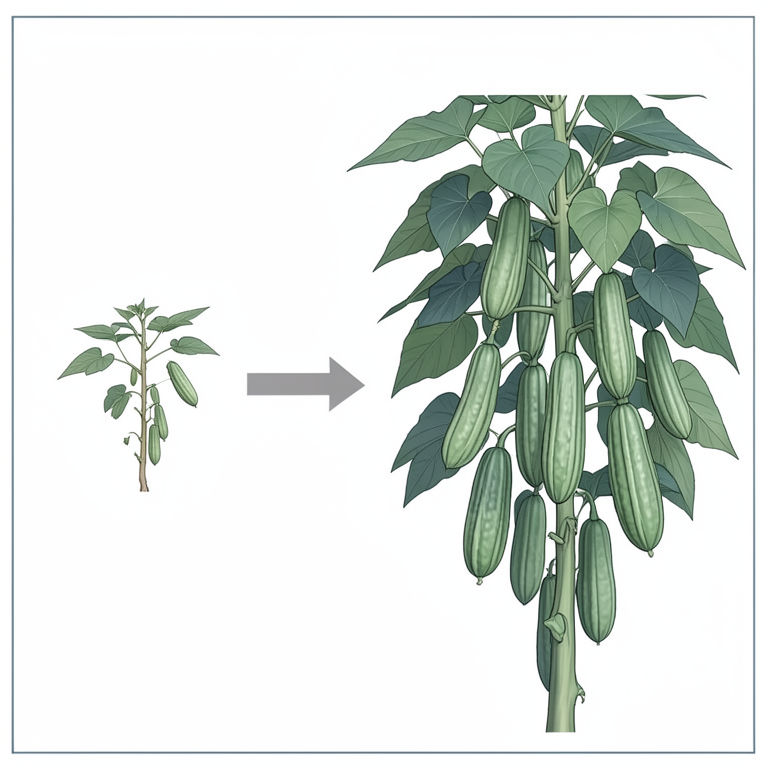
AI-generated conceptual illustration (hybrid ridge gourd plants (Luffa acutangula L.)). It explains the idea and does not show study data.
View source evidence ↗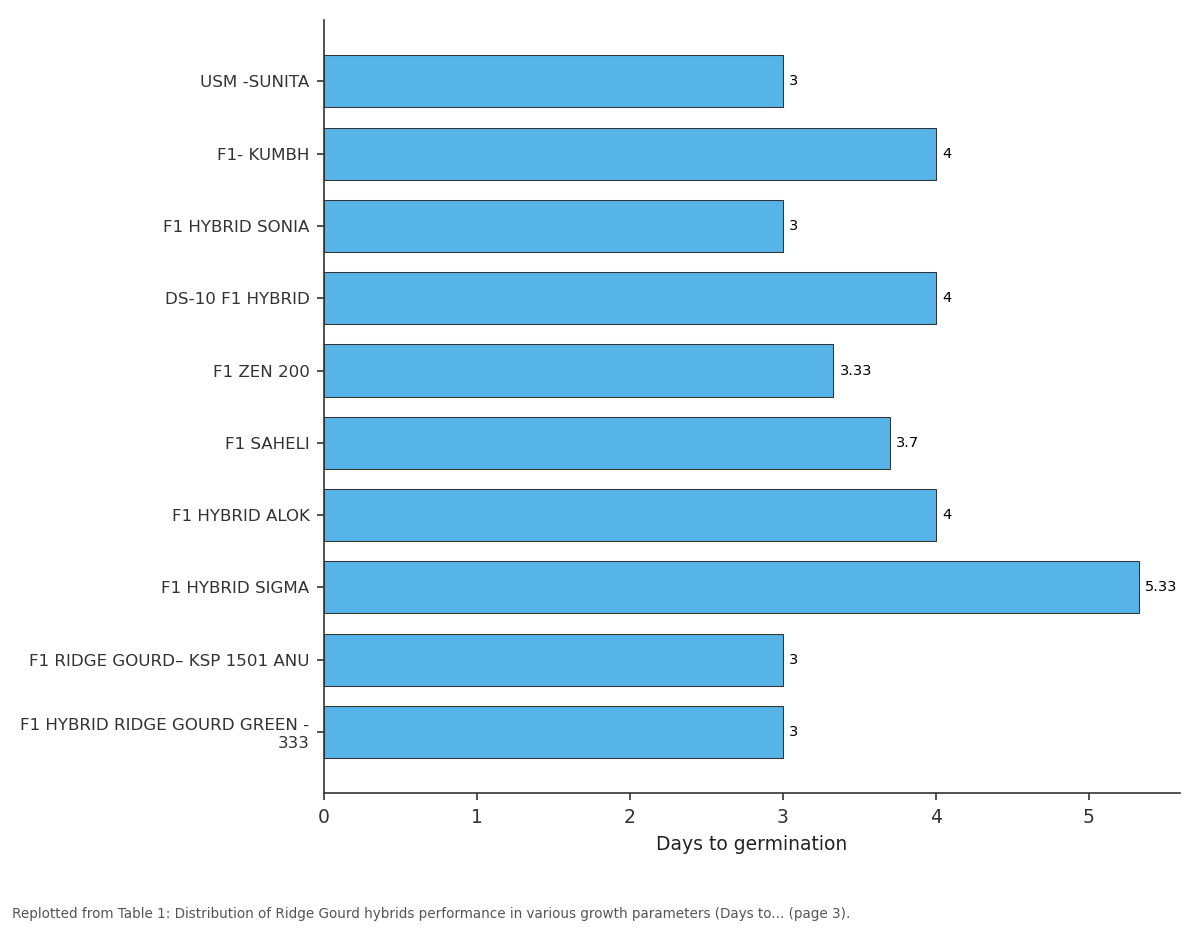
Days to germination: USM -SUNITA vs F1- KUMBH vs F1 HYBRID SONIA vs DS-10 F1 HYBRID vs F1 ZEN 200
Replotted from Table 1 (page 3) of the original paper. Every bar is the paper's own table value.
View source evidence ↗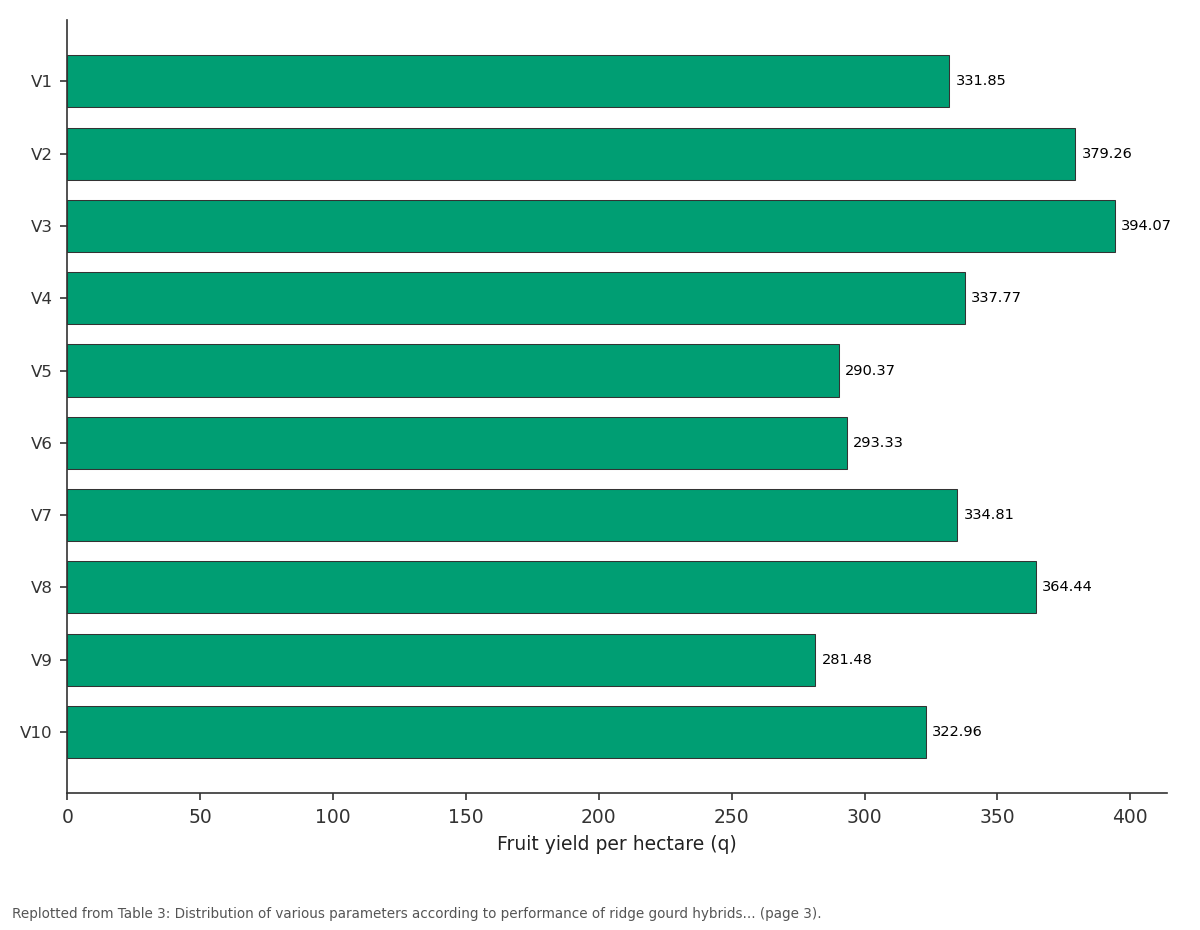
Fruit yield per hectare (q): V1 vs V2 vs V3 vs V4 vs V5
Replotted from Table 3 (page 3) of the original paper. Every bar is the paper's own table value.
View source evidence ↗Figures & tables
From the original paper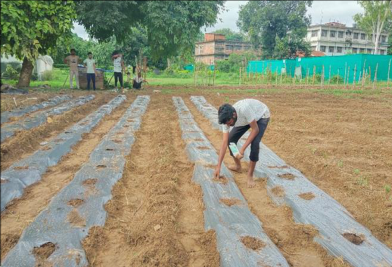 Figure 1
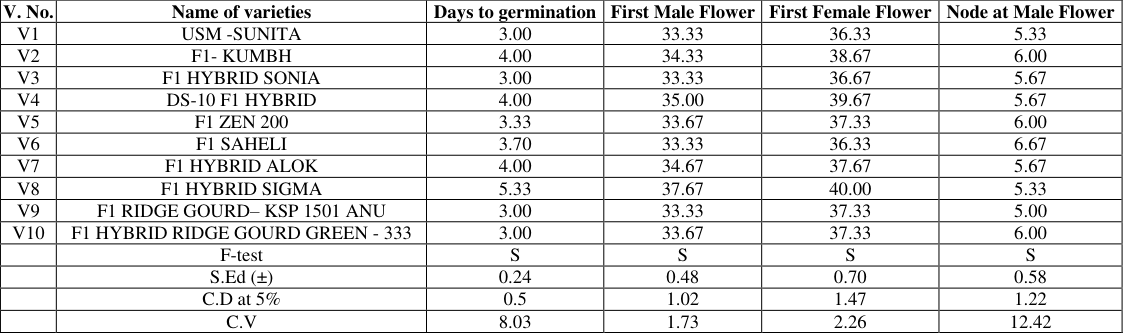 Table 1
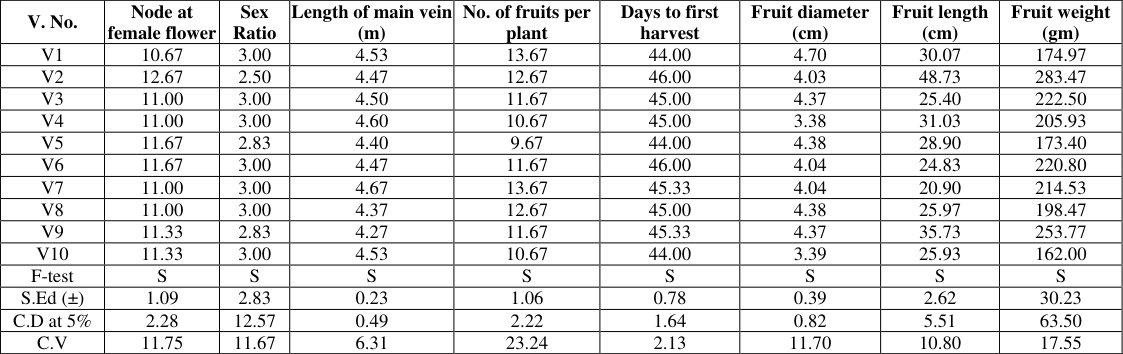 Table 2
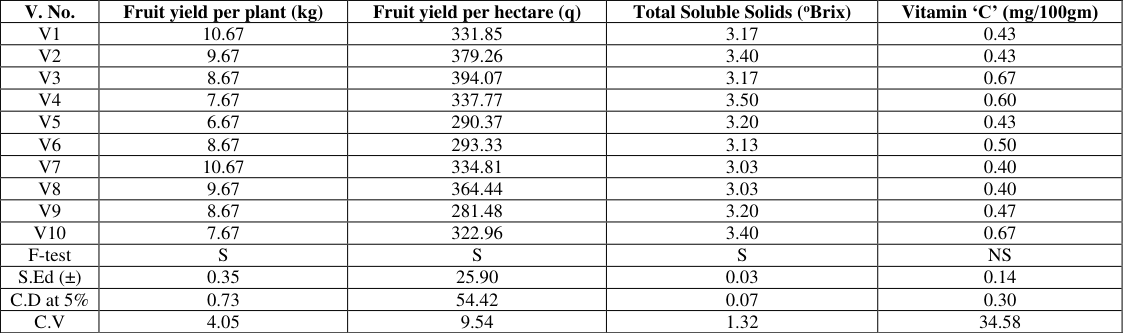 Table 3
 Figure 2
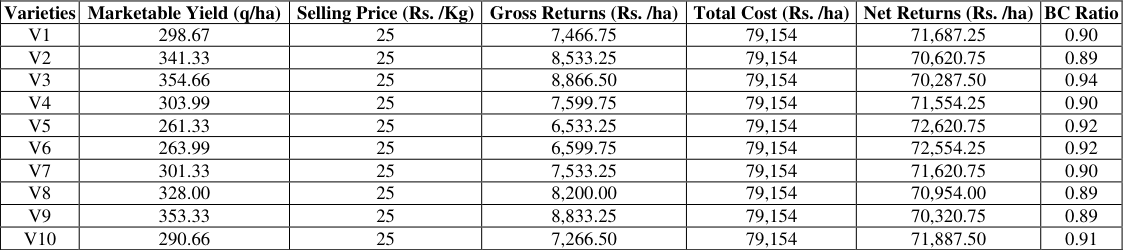 Table 4
Introduction
Ridge gourd (Luffa acutangula L.), a valuable vegetable in tropical and subtropical regions, is renowned for its nutritional and medicinal benefits, including antioxidant, anti-inflammatory, and antimicrobial properties. Enhancing its cultivation is crucial for improving human health and agricultural economies. However, farmers often encounter challenges due to varying agroclimatic conditions. This study aims to evaluate ten hybrid varieties of ridge gourd in Prayagraj, northern India, to understand their response to local conditions and assist farmers in selecting the best varieties for cultivation. Using a randomized block design with three replicates per hybrid, the study assessed key parameters such as germination, vine length, flowering time, fruit characteristics, yield, and economic viability. The hybrids tested included USM-Sunita, F1-Kumbh, F1 Hybrid Sonia, DS-10 F1 Hybrid, F1 Zen 200, F1 Saheli, F1 Hybrid Alok, F1 Hybrid Sigma, F1 Ridge Gourd-KSP 1501 ANU, and F1 Hybrid Ridge Gourd Green-333. By providing comprehensive data on adaptability and productivity, this research offers actionable recommendations for farmers, contributing to sustainable agriculture and enhancing food security and economic stability in similar agro-climatic regions.
Materials and Methods
This investigation, titled "Assessment of Growth, Yield, and Quality of Hybrid Ridge Gourd (Luffa acutangula L.) in the Agro-Climatic Conditions of Prayagraj," was conducted during the rainy season of 2023 at the Vegetable Research Farm of the Department of Horticulture, Allahabad School of Agriculture, Sam Higginbottom University of Agriculture, Technology and Sciences, Uttar Pradesh. This section details the materials used, procedures followed, and criteria adopted for evaluating the treatments throughout the study.
Experimental Site and Geographical Location
The experiment was conducted at the Vegetable Research Farm, Department of Horticulture, located 8 km from Prayagraj city, positioned at a latitude of 25° North and a longitude of 81° East, with an elevation of 98 meters above mean sea level (MSL).
Design of Experiment
Prayagraj, in the eastern region of Uttar Pradesh within the northern Gangetic alluvial plains, experiences a subtropical climate with an average annual rainfall of approximately 1100 mm, primarily during the rainy season from mid-June to mid-October. This study was conducted from August to November 2023, during which meteorological observations, including maximum and minimum temperatures, rainfall, and relative humidity, were recorded. The experimental site featured sandy loam soil with low clay content and a high percentage of sand. Soil samples were analyzed for pH, electrical conductivity (EC), organic carbon, and available nutrients. The experimental materials comprised ten hybrid varieties of ridge gourd sourced from the local seed market. The plot was prepared through ploughing, harrowing, and leveling. The experiment employed a Randomized Block Design (RBD) with three replications per variety, focusing on plant growth, yield, and quality parameters. Key parameters included days to germination, vine length, flowering time, fruit characteristics, and economic analysis. Growth and floral parameters such as days to the first appearance of male and female flowers, node numbers at which flowers appeared, sex ratio, and vine length were meticulously recorded. Yield parameters measured included the number of fruits per plant, fruit weight, diameter, length, and yield per plant and hectare. Quality parameters assessed were total soluble solids and vitamin C content. Economic analysis considered input costs, gross income, net income, and benefit-cost ratio. Data were analyzed using ANOVA, with significant differences tested at the 5% probability level. The study aimed to provide comprehensive data on the adaptability, productivity, and economic viability of the hybrids, offering actionable recommendations for farmers to enhance ridge gourd cultivation and contribute to sustainable agriculture in similar agro-climatic regions.
Results and Discussion
The investigation titled "Assessment of Growth, Yield, and Quality of Hybrid Ridge Gourd (Luffa acutangula L.) in the Agro-Climatic Conditions of Prayagraj" was conducted at the experimental station of the Department of Horticulture, Sam Higginbottom University of Agriculture, Technology, and Sciences, Allahabad, Uttar Pradesh. The study involved twelve distinct genotypes of ridge gourd, assessing their growth, yield, and quality attributes under local conditions. The data collected throughout the experiment are detailed in this section, with tables and illustrations provided to enhance the clarity and understanding of the results.
Growth Parameters
The study on ridge gourd hybrids revealed various growth parameters. Germination times ranged from the fastest at 3.00 days for USM-SUNITA, F1 HYBRID SONIA, F1 RIDGE GOURD-KSP 1501 ANU, and F1 HYBRID RIDGE GOURD GREEN-333, to the slowest at 5.33 days for F1 HYBRID SIGMA. Early germination is beneficial for market pricing, while late germination extends the harvesting period, aligning with Kumar et al. (2007) [7] . The first female flowers appeared earliest in USM-SUNITA and F1 SAHELI at 36.33 days and latest in F1 HYBRID SIGMA at 40.00 days, affecting crop earliness and yield timing similar to Panwar et al. (1977) [24] and Arora et al. (1983) [1] . The node appearance for the first male flower ranged from 5.33 in USM-SUNITA and F1 HYBRID SIGMA to 6.67 in F1 SAHELI, influencing male flower numbers as supported by Chaudhary and Kumar (2011) [7] . The first female flower appearance varied from node 10.67 in USM-SUNITA to node 12.67 in F1-KUMBH, affecting the total number of female flowers produced, corroborated by Kumar (2011) [7] .
Yield Parameters
The sex ratio (male: female) varied among varieties, with the highest ratio at 3.00 in several hybrids and the lowest at 2.50 in F1-KUMBH. This ratio impacts reproductive potential and yield, with variations supported by Shah and Kale (2002) [25] . Vine length at final harvesting ranged from 4.27 m in F1 RIDGE GOURD-KSP 1501 ANU to 4.67 m in F1 HYBRID ALOK, influenced by genetic characteristics and growth vigor, consistent with Khanikar et al. (1995) [26] . Fruit production varied, with the highest number of fruits per plant (13.67) in USM-SUNITA and F1 HYBRID ALOK, and the lowest (9.67) in F1 ZEN 200, influenced by sex ratio and fruit set percentage. Days to first harvest ranged from 44.00 days in USM-SUNITA and F1 ZEN 200 to 46.00 days in F1-KUMBH and F1 SAHELI, highlighting the importance of harvest timing as noted by Choudhary and Kumar (2011) [7] . Yield per plant ranged from 10.67 kg in USM-SUNITA and F1 HYBRID ALOK to 6.67 kg in F1 ZEN 200 and F1 HYBRID RIDGE GOURD GREEN-333. Yield per hectare also showed significant differences, with F1 HYBRID SONIA achieving the highest yield (394.07 q/ha) and F1 RIDGE GOURD-KSP 1501 ANU the lowest (281.48 q/ha). Total soluble solids content varied, with DS-10 F1 HYBRID having the highest (3.50%). Vitamin C content showed no significant differences, though trends indicated variations among varieties, warranting further investigation.
Economic Analysis
The economic analysis revealed stable selling prices at Rs. 25/kg despite yield variations, impacting gross returns and profitability in ridge gourd cultivation. The findings indicate that hybrid ridge gourd varieties demonstrate considerable differences in growth, yield, and quality under the agro-climatic conditions of Prayagraj, providing valuable insights for farmers to enhance ridge gourd cultivation and contribute to sustainable agriculture in similar regions.
Conclusion
Based on the current investigation, it can be concluded that among the ten ridge gourd hybrids studied, F1 HYBRID SONIA exhibited superior performance in terms of growth, yield, and quality. This hybrid achieved a remarkable fruit yield of 394.07 q/ha. Additionally, the economic analysis revealed that F1 HYBRID SONIA also had the highest benefit-cost ratio of 0.94. This hybrid not only attained the highest yield per hectare but also demonstrated exceptional profitability, making it the most favourable option for ridge gourd cultivation among the hybrids evaluated in this study.
Figures and tables from the paper
| V. No. | Name of varieties | Days to germination | First Male Flower | First Female Flower | Node at Male Flower |
|---|---|---|---|---|---|
| V1 | USM -SUNITA | 3.00 | 33.33 | 36.33 | 5.33 |
| V2 | F1- KUMBH | 4.00 | 34.33 | 38.67 | 6.00 |
| V3 | F1 HYBRID SONIA | 3.00 | 33.33 | 36.67 | 5.67 |
| V4 | DS-10 F1 HYBRID | 4.00 | 35.00 | 39.67 | 5.67 |
| V5 | F1 ZEN 200 | 3.33 | 33.67 | 37.33 | 6.00 |
| V6 | F1 SAHELI | 3.70 | 33.33 | 36.33 | 6.67 |
| V7 | F1 HYBRID ALOK | 4.00 | 34.67 | 37.67 | 5.67 |
| V8 | F1 HYBRID SIGMA | 5.33 | 37.67 | 40.00 | 5.33 |
| V9 | F1 RIDGE GOURD– KSP 1501 ANU | 3.00 | 33.33 | 37.33 | 5.00 |
| V10 | F1 HYBRID RIDGE GOURD GREEN - 333 | 3.00 | 33.67 | 37.33 | 6.00 |
| F-test | S | S | S | S | |
| S.Ed (±) | 0.24 | 0.48 | 0.70 | 0.58 | |
| C.D at 5% | 0.5 | 1.02 | 1.47 | 1.22 | |
| C.V | 8.03 | 1.73 | 2.26 | 12.42 |
Table text extracted from the original PDF; superscript letters are shown inline. The original table image is below.
View original table image
| V. No. | Node at female flower | Sex Ratio | Length of main vein (m) | No. of fruits per plant | Days to first harvest | Fruit diameter (cm) | Fruit length (cm) | Fruit weight (gm) |
|---|---|---|---|---|---|---|---|---|
| V1 | 10.67 | 3.00 | 4.53 | 13.67 | 44.00 | 4.70 | 30.07 | 174.97 |
| V2 | 12.67 | 2.50 | 4.47 | 12.67 | 46.00 | 4.03 | 48.73 | 283.47 |
| V3 | 11.00 | 3.00 | 4.50 | 11.67 | 45.00 | 4.37 | 25.40 | 222.50 |
| V4 | 11.00 | 3.00 | 4.60 | 10.67 | 45.00 | 3.38 | 31.03 | 205.93 |
| V5 | 11.67 | 2.83 | 4.40 | 9.67 | 44.00 | 4.38 | 28.90 | 173.40 |
| V6 | 11.67 | 3.00 | 4.47 | 11.67 | 46.00 | 4.04 | 24.83 | 220.80 |
| V7 | 11.00 | 3.00 | 4.67 | 13.67 | 45.33 | 4.04 | 20.90 | 214.53 |
| V8 | 11.00 | 3.00 | 4.37 | 12.67 | 45.00 | 4.38 | 25.97 | 198.47 |
| V9 | 11.33 | 2.83 | 4.27 | 11.67 | 45.33 | 4.37 | 35.73 | 253.77 |
| V10 | 11.33 | 3.00 | 4.53 | 10.67 | 44.00 | 3.39 | 25.93 | 162.00 |
| F-test | S | S | S | S | S | S | S | S |
| S.Ed (±) | 1.09 | 2.83 | 0.23 | 1.06 | 0.78 | 0.39 | 2.62 | 30.23 |
| C.D at 5% | 2.28 | 12.57 | 0.49 | 2.22 | 1.64 | 0.82 | 5.51 | 63.50 |
| C.V | 11.75 | 11.67 | 6.31 | 23.24 | 2.13 | 11.70 | 10.80 | 17.55 |
Table text extracted from the original PDF; superscript letters are shown inline. The original table image is below.
View original table image
| V. No. | Fruit yield per plant (kg) | Fruit yield per hectare (q) | Total Soluble Solids (oBrix) | Vitamin ‘C’ (mg/100gm) |
|---|---|---|---|---|
| V1 | 10.67 | 331.85 | 3.17 | 0.43 |
| V2 | 9.67 | 379.26 | 3.40 | 0.43 |
| V3 | 8.67 | 394.07 | 3.17 | 0.67 |
| V4 | 7.67 | 337.77 | 3.50 | 0.60 |
| V5 | 6.67 | 290.37 | 3.20 | 0.43 |
| V6 | 8.67 | 293.33 | 3.13 | 0.50 |
| V7 | 10.67 | 334.81 | 3.03 | 0.40 |
| V8 | 9.67 | 364.44 | 3.03 | 0.40 |
| V9 | 8.67 | 281.48 | 3.20 | 0.47 |
| V10 | 7.67 | 322.96 | 3.40 | 0.67 |
| F-test | S | S | S | NS |
| S.Ed (±) | 0.35 | 25.90 | 0.03 | 0.14 |
| C.D at 5% | 0.73 | 54.42 | 0.07 | 0.30 |
| C.V | 4.05 | 9.54 | 1.32 | 34.58 |
Table text extracted from the original PDF; superscript letters are shown inline. The original table image is below.
View original table image
| Varieties | Marketable Yield (q/ha) | Selling Price (Rs. /Kg) | Gross Returns (Rs. /ha) | Total Cost (Rs. /ha) | Net Returns (Rs. /ha) | BC Ratio |
|---|---|---|---|---|---|---|
| V1 | 298.67 | 25 | 7,466.75 | 79,154 | 71,687.25 | 0.90 |
| V2 | 341.33 | 25 | 8,533.25 | 79,154 | 70,620.75 | 0.89 |
| V3 | 354.66 | 25 | 8,866.50 | 79,154 | 70,287.50 | 0.94 |
| V4 | 303.99 | 25 | 7,599.75 | 79,154 | 71,554.25 | 0.90 |
| V5 | 261.33 | 25 | 6,533.25 | 79,154 | 72,620.75 | 0.92 |
| V6 | 263.99 | 25 | 6,599.75 | 79,154 | 72,554.25 | 0.92 |
| V7 | 301.33 | 25 | 7,533.25 | 79,154 | 71,620.75 | 0.90 |
| V8 | 328.00 | 25 | 8,200.00 | 79,154 | 70,954.00 | 0.89 |
| V9 | 353.33 | 25 | 8,833.25 | 79,154 | 70,320.75 | 0.89 |
| V10 | 290.66 | 25 | 7,266.50 | 79,154 | 71,887.50 | 0.91 |
Table text extracted from the original PDF; superscript letters are shown inline. The original table image is below.
View original table image
References
22 in the original paper- Aruin MTL, Rasco ET Jr. Enhancing yield in Luffa cylindrical (L.) roem through pruning and high-density planting. Philipp J Crop Sci. 1988;13(2):87-90.
- Badade DS, Warade SD, Gaikawad SK. Genetic divergence in bottle gourd of Maharashtra. Agric Univ J. 2001;26:137139.
- Bhave SG, Bendale VW, Pethe VB, Berde SA, Mehta JL. Correlation and path analysis in segregating generations of bitter gourd. J Soil Crops. 2003;13(1):33-40.
- Bouyoucous DG. Hydrometer Method for soil particle size analysis. Agron J. 1952;54:464-465.
- Choudhary D, Sharma KC. Variability, heritability, genetic advance, and correlation studies in ridge gourd. Hortic J. 2002;15:53-58.
- Choudhary R, Kumar S. Genetic analysis in ridge gourd [Luffa acutangula (Roxb.) L.] under hot arid conditions. Indian J Arid Hortic. 2011;6(1-2):55-58.
- Demove JP, Dhonukes BL, Thawere BL, Benadale VW, Jadhav BB, Thprat TN. Genetic variability and heritability studies in bitter gourd. J Maharashtra Agric Univ. 2010;35(1):163-165.
- Dey SS, Munshi AD, Behera TK. Genetic divergence in bitter gourd (Momordica charantia L.). J Maharashtra Agric Univ. 2007;30:368-372.
- Fageria MS, Choudhary BR, Dhaka RS. Vegetable crop production technology. Kalyani Publ. Int J Curr Microbiol Appl Sci. 2017;6(2):317-338.
- Hawlader MSH, Haque MM, Islam MS. Variability, correlation, and path analysis in bottle gourd. Bangladesh J Sci Ind Res. 1999;34(1):50-54.
- Jackson ML. Soil Chemical Analysis. New Delhi: Prentice Hall of India Private Ltd.; 1958.
- Kadam PY, Kale PN. Genetic variability in ridge gourd. J Maharashtra Agric Univ. 1987;12(2):242-243.
- Kalloo, Bergh. Genetic improvement of vegetable crops. Environ Exp Bot. 1993;34(3):343.
- Karuppaiah P, Kavita R, Kumar PS. Correlation and analysis in ridge gourd (Luffa acutangula L.). Crop Res Hisar. 2005;29:490-494.
- Khanikar S, Chakrabarty BK, Barua PK. Patterns of genetic variability in ridge gourd. Proceedings of the Seminar on Problems and Prospects of Agricultural Research and Development in North-East India, Assam Agricultural University, Jorhat, India; 1995 Nov 27-28. p. 74-77.
- Krishna Prasad VSR, Singh DP. A note on genetic variability and heritability studies in sponge gourd (Luffa cylindrica Mill.). Haryana J Hortic Sci. 1990;19(1-2):222224.
- Krishna Prasad VSR, Singh DP. Studies on heritability, genetic advance, and correlation in ridge gourd. Indian J Hortic. 1989;46(3):390-394.
- Kutty MS, Dharamatti PR. Genetic variability studies in bitter gourd (Momordica charantia L.). Karnataka J Hortic. 2004;1:11-15.
- Olsen SR, Cole CV, Watannhe FS, Dean LA. Estimation of available phosphorus in soil by interaction with sodium bicarbonate. U.S. Department of Agriculture Circular. 1954;939.
- Omini ME, Hossain MG. Modification of sex expression in sponge gourd (Luffa cylindrica L.) roem by mineral nutrient treatment. Genetica. 1987;74(3):203-209. doi: 10.1007/BF00056115.
- Panwar JS, Singh HN, Prasad R, Srivastava JP. Genetic variability and heritability studies in sponge gourd (Luffa cylindrica Rome). Haryana J Hortic Sci. 1977;6(3-4):170174.
- Shah P, Tiwari G, Gontia AS, Patil VD, Kale VV. Correlation studies in Indian mustard: Brassica juncea (L.) Czern and Coss. Agricultural Science Digest. 2002;22(2):79-82.