
Research article · 2024 · Full text
International Journal of Research in AgronomyEnhancing leaf area index and dry matter production in rice through enriched bio-digested bone sludge compost
Volume 7(7S) · Pages 363–366 · DOI: 10.33545/2618060x.2024.v7.i7se.1054 ↗
Research areasRice Cultivation and Yield ImprovementCrop Yield and Soil Fertility
Abstract
Author-writtenRice cultivation, pivotal for global food security, faces multifaceted challenges including declining soil health, nutrient depletion, and environmental pollution. Addressing these challenges requires innovative strategies to ensure sustainable agricultural practices. This study investigates the impact of enriched bio-digested bone sludge compost on leaf area index (LAI) and dry matter production (DMP) in rice cultivation. Conducted at Annamalai University, Tamil Nadu, India in 2022, the research aims to address these pressing issues by evaluating the efficacy of incorporating bio-digested bone sludge compost alongside other organic and inorganic fertilizers. Employing a randomized block design with three replications across eight treatments, the experiment seeks to fill existing gaps in knowledge regarding the potential of organic soil amendments in enhancing rice yield and preserving soil health. Results reveal that the application of enriched bio-digested bone sludge compost significantly enhances both LAI and DMP compared to other treatments, fostering robust vegetative growth and biomass accumulation. Notably, the combination of bone sludge compost @ 5 t/ha + Pressmud compost @ 5 t/ha, along with balanced N and K through fertilizers, exhibits superior performance in LAI and DMP. This study underscores the potential of enriched bio-digested bone sludge compost as a sustainable approach to maximize rice yield, offering valuable insights into environmentally friendly farming practices. In conclusion, the findings highlight the importance of incorporating organic soil amendments, particularly bio-digested bone sludge compost, in rice cultivation to optimize leaf area index and dry matter production. This research contributes to the advancement of sustainable agricultural practices, emphasizing the significance of integrating organic fertilizers into farming systems to enhance crop productivity while preserving soil health and environmental integrity.
Summary
Source-checkedPlain-language reading of the full paper, prepared with AI and checked against the text. Each point links to the authors' own words.
Why it matters
- Rice is essential for global food security, but its production is threatened by nutrient depletion, environmental pollution, and declining soil health. View evidence ↗
- The organic matter in bone sludge compost can improve soil aggregation and moisture retention, which supports better root development and nutrient uptake. View evidence ↗
The question
- The study aims to evaluate how enriched bio-digested bone sludge compost affects the leaf area index (LAI) and dry matter production (DMP) of rice. View evidence ↗
What they did
- The field experiment was carried out at the Department of Agronomy, Annamalai University, in Tamil Nadu, India. View evidence ↗
- The researchers used a randomized block design with three replications and eight different treatments on rice variety ADT43. View evidence ↗
- LAI was measured at active tillering, flowering, and harvest stages using leaf length and breadth; DMP was determined by oven-drying randomly sampled plants at 80 ± 5 °C. View evidence ↗
What they found
- The combination of 5 t/ha bone sludge and 5 t/ha pressmud compost (T4) achieved the highest LAI at harvest (5.56 cm) compared to the control (3.82 cm). View evidence ↗
- Among the 5 t/ha bone sludge treatments, the combination with pressmud compost (T4) outperformed combinations with poultry manure (T5) and goat manure (T6) in LAI at all stages. View evidence ↗
- Increasing the application rate of bone sludge and pressmud compost from 2.5 t/ha (T2) to 5 t/ha (T4) increased the LAI at harvest from 4.83 cm to 5.56 cm. View evidence ↗
What it means
- The authors conclude that applying 5 t/ha of both bone sludge and pressmud compost with balanced N and K fertilizers is an efficient and sustainable way to increase LAI and dry matter in rice. View evidence ↗
- The authors state that future research should investigate microbial communities, nutrient cycling processes, and the long-term impacts of organic compost on soil health. View evidence ↗
Visual summary
3 visualsIllustrations explain the paper; charts are replotted from the paper's own table values.
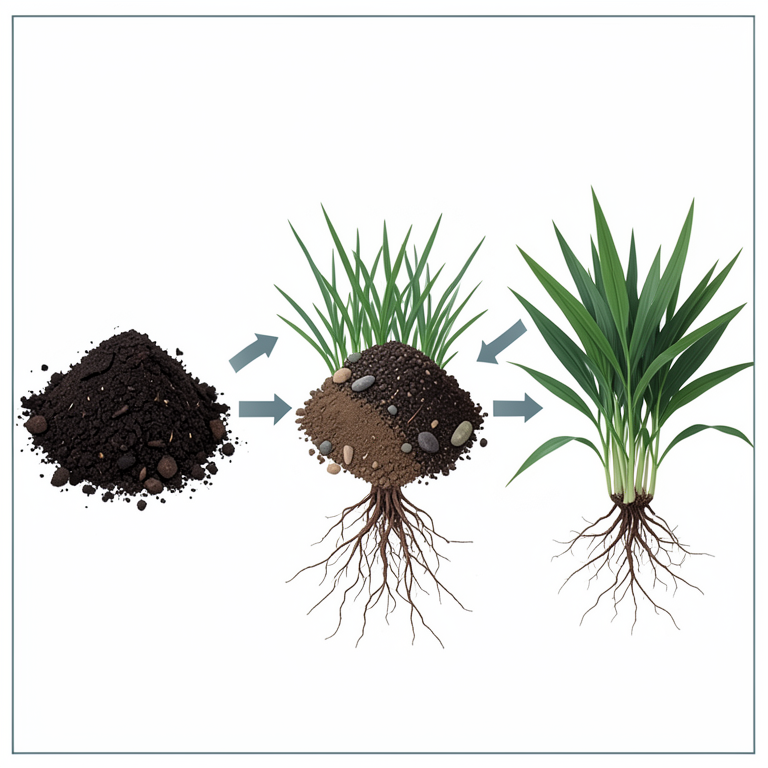
Experimental Treatment Framework
AI-generated conceptual illustration (rice plants (Oryza sativa)). It explains the idea and does not show study data.
View source evidence ↗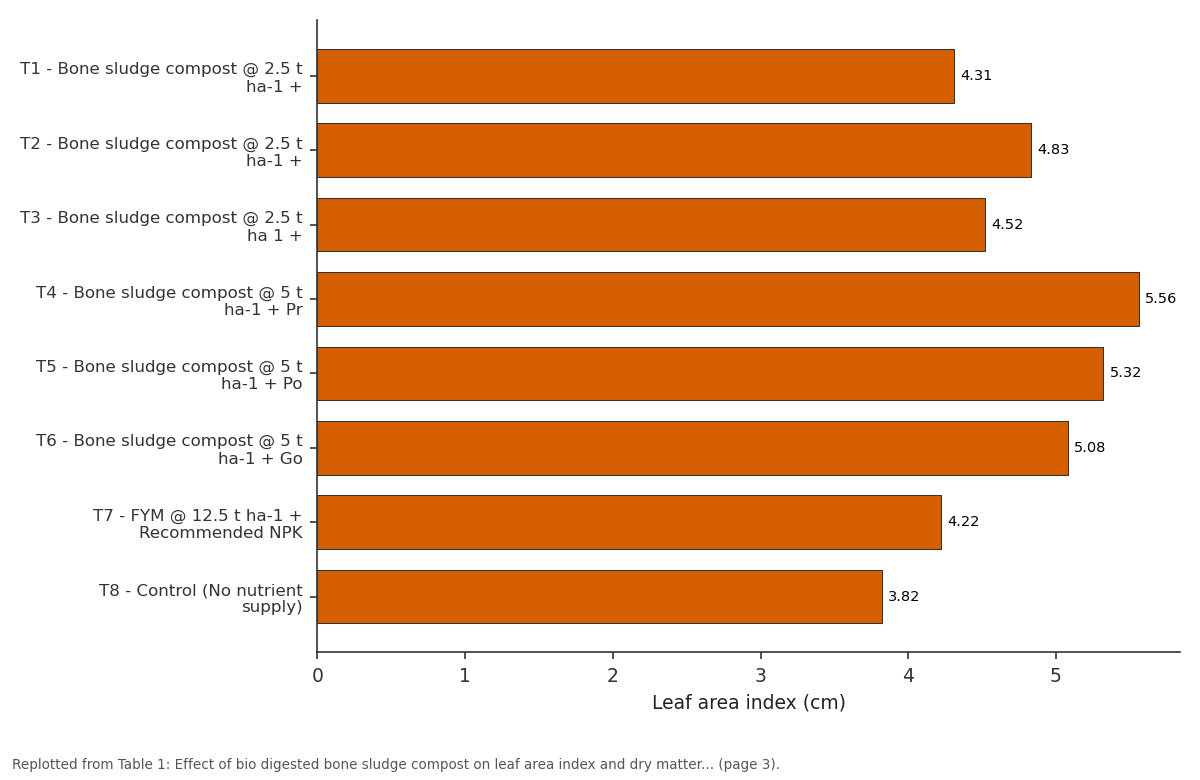
Harvest: T1 - Bone sludge... vs T2 - Bone sludge... vs T3 - Bone sludge... vs T4 - Bone sludge... vs T5 - Bone sludge...
Replotted from Table 1 (page 3) of the original paper. Every bar is the paper's own table value.
View source evidence ↗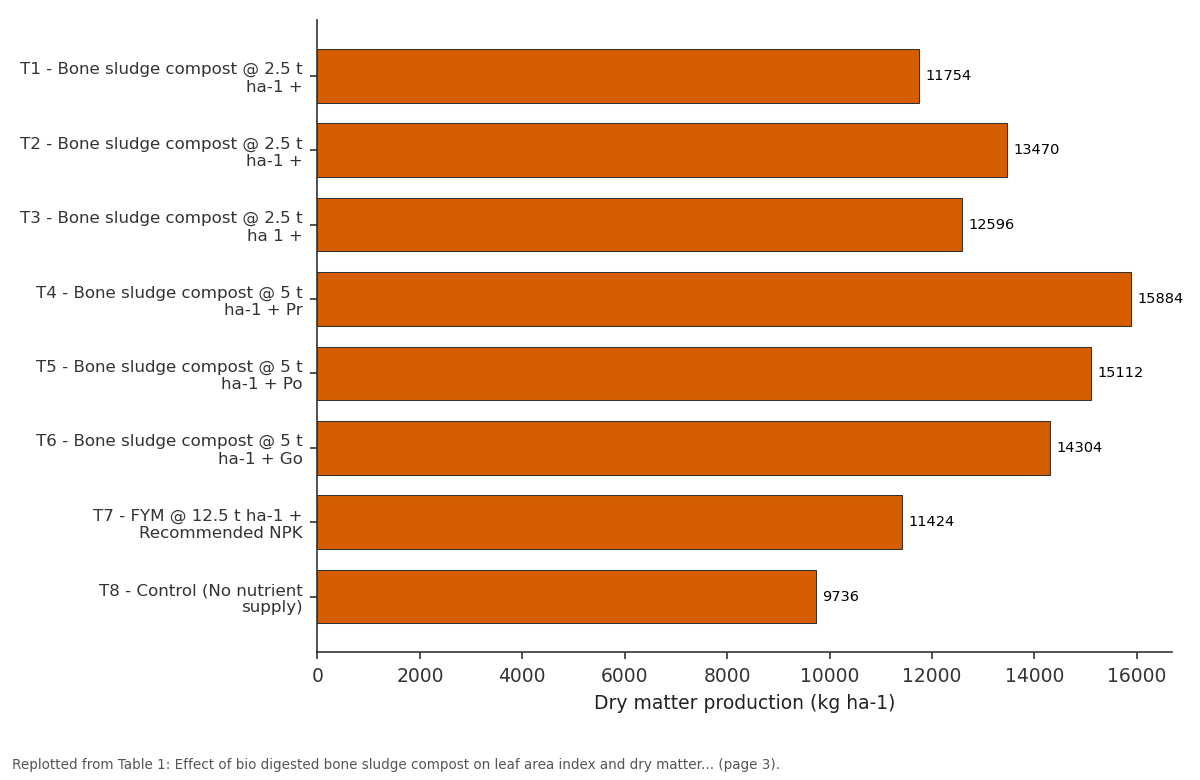
Harvesting: T1 - Bone sludge... vs T2 - Bone sludge... vs T3 - Bone sludge... vs T4 - Bone sludge... vs T5 - Bone sludge...
Replotted from Table 1 (page 3) of the original paper. Every bar is the paper's own table value.
View source evidence ↗Figures & tables
From the original paper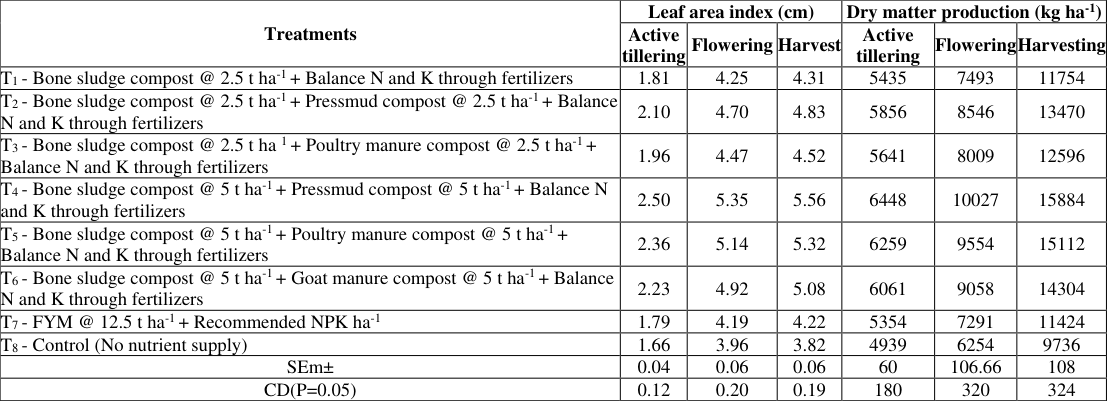 Table 1
Introduction
Rice, one of the most vital staple crops globally, plays a pivotal role in ensuring food security for billions of people. However, the sustainability of rice cultivation is threatened by various challenges such as declining soil health, nutrient depletion, and environmental pollution. Addressing these challenges necessitates innovative approaches to enhance crop productivity while minimizing adverse environmental impacts FAO (2022) [3] . Globally, rice is cultivated over 162 million hectares, yielding 700 million tonnes annually at an average productivity of 4.3 tonnes per hectare. In India, rice covers 48.53 million hectares, producing 112.18 million tonnes with an average productivity of 2.31 tonnes per hectare. In Tamil Nadu, rice cultivation spans 2.2 million hectares, producing 8.65 million tonnes with a productivity rate of 3.93 tonnes per hectare (Directorate of Economics and Statistics, 2021) [1] . In this context, maximizing rice yield while minimizing environmental impacts has become a critical objective for agricultural researchers and practitioners. One promising avenue in sustainable rice cultivation is the utilization of organic soil amendments, particularly bio-digested bone sludge compost. This organic amendment, derived from industrial waste, has garnered attention for its potential to improve soil fertility, enhance nutrient availability, and boost crop yields. Bone sludge compost, a by-product of the ossein industry, has garnered attention as a potential organic soil amendment in rice cultivation. This compost, derived from the processing of animal bones, offers a rich source of organic matter and
essential nutrients beneficial for plant growth and soil fertility enhancement. Its application in rice fields presents an opportunity to improve soil structure, nutrient availability, and overall crop performance. Studies have shown the positive effects of bone sludge compost on various aspects of rice cultivation, including increased yield, improved soil health, and enhanced nutrient uptake by plants. The organic matter content in bone sludge compost aids in soil aggregation, moisture retention, and microbial activity, thereby promoting a favorable environment for root development and nutrient uptake. Additionally, the slow-release nature of nutrients from bone sludge compost ensures a steady and sustained supply of essential elements throughout the crop growth cycle. Furthermore, the use of bone sludge compost aligns with sustainable agricultural practices by recycling organic waste materials and reducing reliance on chemical fertilizers. Its incorporation into rice farming systems holds promise for improving crop productivity while minimizing environmental impacts.
Recent research has shed light on the beneficial effects of biodigested bone sludge compost on rice cultivation. For instance, Sharma et al. (2023) [11] demonstrated the positive impact of biodigested bone sludge compost on rice yield and soil fertility. Similarly, Patel et al. (2022) [7] reported significant improvements in rice productivity following the application of bio-digested bone sludge compost. Furthermore, studies by Khan et al. (2021) [4] and Li et al. (2020) [5] highlighted the role of bio-digested bone sludge compost in enhancing soil microbial activity and nutrient cycling in rice fields. Additionally, Wu et al. (2023) [13] explored the effects of bio-digested bone sludge compost on soil water retention in rice cultivation systems, revealing its potential for improving wateruse efficiency. Despite these advancements, there remains a need to further investigate the specific impact of enriched bio-digested bone sludge compost on leaf area index (LAI) and dry matter production (DMP) in rice crops. Understanding how this organic soil amendment influences these key growth parameters is crucial for optimizing rice production and promoting sustainable agricultural practices. In this context, the present study aims to evaluate the impact of enriched bio-digested bone sludge compost on LAI and DMP in rice cultivation. By conducting field experiments and analyzing the data rigorously, we seek to provide valuable insights into the potential of bio-digested bone sludge compost as a sustainable solution for enhancing crop productivity and preserving soil health in rice cultivation systems.
Materials and Methods
The field experiment was conducted in Q block of experimental farm, Department of Agronomy, Faculty of Agriculture, Annamalai University, Tamil Nadu, India. The geographical location of Annamalai Nagar is 11º24' N latitude and 79º44' E longitude at an altitude of +5.79 m above mean sea level. The soil of the experimental field is classified as Udise Chromusterts (clay) according to FAO (1974) [2] . The initial analysis of the experimental soil revealed that heavy clay was neutral in reaction (pH = 7.6), with low soluble salts (EC = 0.33 dS/m), medium in available N (210 kg/ ha), low in available P 2 O 5 (21 kg/ha) and high in available K 2 O (265 kg/ha). The experiment was laid out in a randomized block design with three replications. The experiment comprised eight treatments viz., T 1 -Bone sludge compost @ 2.5 t/ha + Balance N and K through fertilizers, T 2 -Bone sludge compost @ 2.5 t/ha + Pressmud compost @ 2.5 t/ha + Balance N and K through fertilizers, T 3 -Bone sludge compost @ 2.5 t ha 1 + Poultry manure compost @ 2.5 t/ha + Balance N and K through fertilizers, T 4 -Bone sludge compost @ 5 t/ha + Pressmud compost @ 5 t/ha + Balance N and K through fertilizers, T 5 -Bone sludge compost @ 5 t/ha + Poultry manure compost @ 5 t/ha+ Balance N and K through fertilizers, T 6 -Bone sludge compost @ 5 t/ha + Goat Manure compost @ 5 t/ha +Balance N and K through fertilizers, T 7 -FYM @ 12.5 t/ha + Recommended NPK/ha and T 8 -Control (No nutrient supply). Rice variety ADT43 was chosen for the investigation. Bone sludge compost came from Pioneer Jellice India Pvt. Ltd., Cuddalore, while pressmud compost, poultry manure compost, and FYM were sourced from the farm unit of the Department of Agronomy, Faculty of Agriculture, Annamalai University, Annamalai Nagar. The nutrient content of organic manure composts viz., Bone sludge N-2.10%, P-9.96%, K-0.38%, pressmud compost N-2.63%, P-2.54%, K 2.36%, goat manure compost N-1.50%, P-0.40%, K-0.37%, poultry manure compost N-2.20%, P-1.40%, K-1.20% and FYM N-0.58%, P-0.27%, K-0.60%, respectively. The recommended package of practices was followed, and the crop was harvested. For Leaf Area Index, the maximum Length and breadth of the 3 leaf from the top of the tagged plants were measured at active tillering, Flowering and harvest stages and the mean value was multiplied by total number of leaves hill -¹. The LAl was worked out by using the formula as proposed by Palanisamy and Gomez (1973) [6] .
LAI =
Where, L = Maximum length of 3 rd leaf blade from the top (cm) B = Maximum breadth of the same leaf (cm) K = Correction factor (0.75) For DMP, five plants were removed randomly at active tillering, flowering and harvest stages. These samples were first air-dried in shade and then oven-dried at 80 + 5 °C till a constant weight was obtained and the weight was recorded. The mean dry weight was expressed in kg ha -¹. All data recorded for LAI and DMP were subjected to statistical analysis using analysis of variance (ANOVA) with critical differences calculated at a significance level of 0.05 using Agres software.
Results and Discussion
Leaf Area Index (LAI) Leaf Area Index (LAI) serves as a crucial indicator of canopy development and light interception, directly influencing photosynthetic efficiency and overall crop productivity. In our study, the application of bone sludge compost @ 5 t/ha + Pressmud compost @ 5 t/ha + Balance N and K through fertilizers (T 4 ), significantly influenced LAI in rice cultivation Table 1. The substantial increase in LAI observed in treatments receiving organic composts can be attributed due to several factors. Firstly, the organic matter content in bone sludge and pressmud composts contributes to soil structure improvement, promoting root development and thereby facilitating greater nutrient uptake. Enhanced nutrient availability, particularly nitrogen, phosphorus, and potassium, plays a pivotal role in stimulating leaf growth and expansion. Moreover, the organic amendments foster favourable soil conditions, enhancing microbial activity and nutrient cycling, which further supports robust vegetative growth. Our findings corroborate previous studies highlighting the beneficial effects of organic composts on LAI in rice cultivation. Sultana et al. (2021) [12] reported similar increases in LAI with organic compost application, underscoring the importance of organic soil amendments in promoting vegetative growth and canopy development. Furthermore, the observed synergism between mineral fertilizers and organic composts aligns with findings by Senthilvalavan and Ravichandran (2019) [10] , emphasizing the role of integrated nutrient management in optimizing LAI and canopy architecture.
| Treatments | Leaf area index (cm) | — | — | Dry matter production (kg ha-1) | — | — |
|---|---|---|---|---|---|---|
| Active tillering | Flowering | Harvest | Active tillering | Flowering | Harvesting | |
| T1 - Bone sludge compost @ 2.5 t ha-1 + Balance N and K through fertilizers | 1.81 | 4.25 | 4.31 | 5435 | 7493 | 11754 |
| T2 - Bone sludge compost @ 2.5 t ha-1 + Pressmud compost @ 2.5 t ha-1 + Balance N and K through fertilizers | 2.10 | 4.70 | 4.83 | 5856 | 8546 | 13470 |
| T3 - Bone sludge compost @ 2.5 t ha 1 + Poultry manure compost @ 2.5 t ha-1 + Balance N and K through fertilizers | 1.96 | 4.47 | 4.52 | 5641 | 8009 | 12596 |
| T4 - Bone sludge compost @ 5 t ha-1 + Pressmud compost @ 5 t ha-1 + Balance N and K through fertilizers | 2.50 | 5.35 | 5.56 | 6448 | 10027 | 15884 |
| T5 - Bone sludge compost @ 5 t ha-1 + Poultry manure compost @ 5 t ha-1 + Balance N and K through fertilizers | 2.36 | 5.14 | 5.32 | 6259 | 9554 | 15112 |
| T6 - Bone sludge compost @ 5 t ha-1 + Goat manure compost @ 5 t ha-1 + Balance N and K through fertilizers | 2.23 | 4.92 | 5.08 | 6061 | 9058 | 14304 |
| T7 - FYM @ 12.5 t ha-1 + Recommended NPK ha-1 | 1.79 | 4.19 | 4.22 | 5354 | 7291 | 11424 |
| T8 - Control (No nutrient supply) | 1.66 | 3.96 | 3.82 | 4939 | 6254 | 9736 |
| SEm± | 0.04 | 0.06 | 0.06 | 60 | 106.66 | 108 |
| CD(P=0.05) | 0.12 | 0.20 | 0.19 | 180 | 320 | 324 |
Table text extracted from the original PDF; superscript letters are shown inline. The original table image is below.
View original table image
Dry Matter Production (DMP)
Dry Matter Production (DMP) is a critical parameter reflecting biomass accumulation and plant growth dynamics, directly influencing crop yield and productivity. In our study, the application of bone sludge compost @ 5 t/ha + Pressmud compost @ 5 t/ha + Balance N and K through fertilizers (T 4 ), significantly influenced DMP in rice cultivation Table 1.
The observed elevation in DMP can be attributed due to the synergistic effect of organic and inorganic nutrients on rice physiology. The balanced supply of essential nutrients, including nitrogen, phosphorus, and potassium, promotes optimal plant metabolism, leading to increased photosynthetic activity and carbon assimilation. This results in greater biomass accumulation, particularly in above-ground plant parts such as leaves and stems. Additionally, the improved root system architecture facilitated by organic composts enhances nutrient and water uptake efficiency, further augmenting DMP. Our findings align with previous research emphasizing the positive impact of organic composts on DMP in rice cultivation. Rao et al. (2020) [9] reported similar increases in biomass accumulation with organic compost application, highlighting the importance of integrated nutrient management in optimizing crop growth and productivity. Furthermore, the observed enhancement in DMP underscores the potential of organic soil amendments in promoting sustainable agricultural practices and enhancing crop yield.
Conclusion
In conclusion, our study demonstrates the significant impact of organic composts, specifically bone sludge and pressmud composts, on leaf area index (LAI) and dry matter production in rice cultivation. The application of these composts, in combination with balanced nitrogen (N) and potassium (K) fertilizers, resulted in notable enhancements in LAI and biomass accumulation. These improvements can be attributed to the organic matter content of the composts, which improved soil structure, facilitated nutrient uptake, and promoted microbial activity, ultimately fostering robust vegetative growth. The application of bone sludge compost @ 5 t/ha + pressmud compost @ 5 t/ha with balanced N and K through fertilizers (T 4 ) shows promise in enhancing leaf area index and dry matter accumulation, offering an agronomically efficient, ecologically desirable, and economically viable approach without compromising soil health. Furthermore, the synergistic effects of organic and inorganic nutrients on rice physiology contributed to increased photosynthetic activity, carbon assimilation, and biomass accumulation. The observed benefits underscore the potential of organic soil amendments in enhancing crop performance and sustainability in agriculture. Further research is essential to uncover the underlying mechanisms driving the effects of organic composts on LAI and dry matter production in rice cultivation. Investigating microbial communities and nutrient cycling processes would optimize nutrient management strategies. Exploring the long-term impacts of organic compost application on soil health, nutrient cycling, and crop productivity is crucial for sustainable agriculture. Integrated approaches combining organic soil amendments with precision nutrient management techniques offer potential for maximizing yields while minimizing environmental impacts. Continued research efforts are vital for advancing our understanding of organic composts' role in sustainable agriculture and informing evidence-based strategies to enhance crop productivity and resilience against environmental challenges.
References
10 in the original paper- Khan S, Ananya, Rakesh, Jiahui, Yifan, Singh. Influence of bio-digested bone sludge compost on soil microbial community structure in rice fields. Soil Biol Biochem. 2021;155:107049.
- Li J, Sharma A, Patel R, Khan S, Wu Y, Singh. Effects of bio-digested bone sludge compost on nutrient cycling in rice fields. Agric Ecosyst Environ. 2020;305:107098.
- Palanisamy KM, Gomez KA. Length width method for estimating leaf area for rice. Agron J. 1973;66:430-433.
- Patel R, Singh N, Sharma B, Gupta A, Khan S, Kumar S. Enhancing rice productivity through the application of biodigested bone sludge compost. Environ Agric. 2022;45(2):102-115.
- Polagani N, Singh RS, Mohan Babu YN. Influence of fertilizer levels and weed management practices on growth and yield of hybrid rice. J Pharmacog Phytochem. 2020;9(6):865-868.
- Rao A, Singh NB, Pandey D, Singh MP. Effect of integrated nutrient management on productivity and profitability of rice under SRI. J Pharmacog Phytochem. 2020;9(5):665-667.
- Senthilvalavan P, Ravichandran M. Growth and physiological characters of rice (Oryza sativa) as influenced by integrated nutrient management under SRI in Cauvery Deltaic zone of Tamil Nadu. Ann Plant Soil Res. 2019;21(3):210-216.
- Sharma A, Patel R, Khan S, Li J, Wu Y, Naveen. Impact of bio-digested bone sludge compost on rice yield and soil fertility. J Agric Sci. 2023;78(3):215-227.
- Sultana M, Jahiruddin M, Islam MR, Rahman MM, Abedin MA, Solaiman ZM. Nutrient enriched municipal solid waste compost increases yield, nutrient content and balance in rice. Sustainability. 2021;13.
- Wu Y, Sharma A, Patel R, Khan S, Li J, Singh. Enhanced soil water retention in rice fields with bio-digested bone sludge compost. Soil Sci Soc Am J. 2023;87(1):210-221.