
Research article · 2023 · Full text
International Journal of Advanced Chemistry ResearchSoil carbon dynamics and CO₂ emissions in corn-soybean rotation systems
Volume 5(2) · Pages 114–116 · DOI: 10.33545/26646781.2023.v5.i2b.209 ↗
Research areasSoil Carbon and Nitrogen Dynamics
Abstract
Author-writtenThis review explores soil carbon dynamics and carbon dioxide (CO₂) emissions in corn-soybean rotation systems, a common agricultural practice. The paper examines the factors influencing soil carbon storage and CO₂ emissions, including tillage practices, crop residue management, soil properties, and environmental conditions. Emphasizing the significance of sustainable practices, this review synthesizes current research findings and offers insights into managing soil carbon for improved agricultural productivity and climate change mitigation.
Summary
Source-checkedPlain-language reading of the full paper, prepared with AI and checked against the text. Each point links to the authors' own words.
Why it matters
- Soil carbon dynamics and carbon dioxide emissions are vital to the global carbon cycle, affecting both the sustainability of agriculture and global climate change. View evidence ↗
- Corn-soybean rotation systems are widely used in agriculture and significantly influence soil carbon and emission dynamics. View evidence ↗
- Studying the impact of these rotations on carbon storage and emissions is necessary to create sustainable farming practices that maintain productivity while mitigating climate change. View evidence ↗
The question
- The paper aims to examine soil carbon dynamics and CO₂ emissions in corn-soybean rotation systems and identify sustainable practices to increase carbon sequestration and lower emissions. View evidence ↗
What they did
- This is a review paper that synthesizes research on factors affecting soil carbon and CO₂ emissions, specifically focusing on tillage, residue management, soil properties, and environment. View evidence ↗
What they found
- No-till farming in corn-soybean rotations significantly increases soil organic carbon (SOC) levels when compared to conventional tillage. View evidence ↗
- No-till systems support higher microbial biomass and activity because of more stable soil conditions and increased organic matter. View evidence ↗
- Conventional tillage increases CO₂ emissions by accelerating the decomposition of organic matter and increasing microbial respiration. View evidence ↗
- No-till systems in corn-soybean rotations result in lower CO₂ emissions than conventional tillage systems. View evidence ↗
- Retaining crop residues in corn-soybean rotations significantly decreases CO₂ emissions compared to removing the residues. View evidence ↗
- Soil moisture affects emissions: higher moisture generally increases microbial activity and CO₂ emissions, but extreme waterlogging can inhibit respiration and reduce emissions. View evidence ↗
- Warmer temperatures typically increase CO₂ emissions by increasing the rate of microbial respiration and organic matter decomposition. View evidence ↗
- Cover cropping in corn-soybean rotations increases soil organic carbon (SOC) levels and reduces CO₂ emissions. View evidence ↗
- Using a balance of organic and inorganic fertilizers (integrated nutrient management) can reduce emissions and promote carbon sequestration by improving plant growth and nutrient efficiency. View evidence ↗
What it means
- The authors conclude that the key strategies for reducing CO₂ emissions and optimizing soil carbon storage are cover cropping, no-till farming, and effective residue management. View evidence ↗
- The authors state that ongoing innovation and research in sustainable agriculture are essential to ensure environmental sustainability and long-term productivity in corn-soybean rotations. View evidence ↗
Visual summary
1 visualsIllustrations explain the paper; they do not show study data.
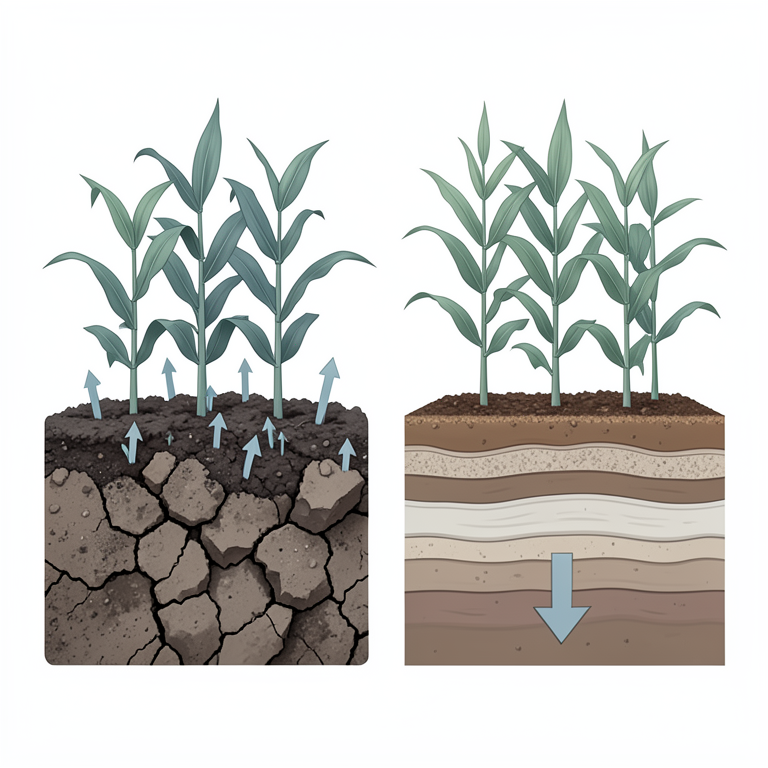
Tillage Comparison
AI-generated conceptual illustration (corn and soybean plants in soil profiles). It explains the idea and does not show study data.
View source evidence ↗Introduction
Soil carbon dynamics and CO₂ emissions are critical components of the carbon cycle, significantly influencing global climate change and agricultural sustainability. Corn-soybean rotation systems, prevalent in many agricultural regions, play a vital role in shaping these dynamics. Understanding how these rotations impact soil carbon storage and CO₂ emissions is essential for developing sustainable agricultural practices that mitigate climate change while maintaining productivity. This review aims to provide a comprehensive overview of the factors affecting soil carbon dynamics and CO₂ emissions in corn-soybean rotation systems, highlighting the implications for sustainable agriculture and climate change mitigation.
Main objective
The objective of this paper is to examine the soil carbon dynamics and CO₂ emissions in corn-soybean rotation systems and to highlight sustainable practices for enhancing soil carbon sequestration and reducing emissions.
Soil carbon dynamics in corn-soybean rotation systems
Soil carbon dynamics refer to the processes that govern the storage, transformation, and release of carbon within the soil. In corn-soybean rotation systems, these dynamics are influenced by various factors, including plant inputs, microbial activity, and environmental conditions. The primary sources of soil carbon are plant residues and root exudates, which contribute to soil organic carbon (SOC) through decomposition and humification processes. The incorporation of crop residues, particularly in no-till systems, enhances soil carbon sequestration by increasing organic matter inputs and reducing soil disturbance. Studies by Blanco-Canqui and Lal (2008) [1] have shown that no-till farming in corn-soybean rotations can significantly increase SOC levels compared to conventional tillage. This increase in SOC not only improves soil structure and fertility but also enhances the soil's capacity to retain moisture and nutrients. Microbial activity plays a crucial role in soil carbon dynamics by decomposing organic matter and releasing CO₂ through respiration. The balance between carbon inputs (e.g., crop CO₂ emissions in corn-soybean rotation systems CO₂ emissions from soil result from microbial respiration, root respiration, and the decomposition of organic matter. In corn-soybean rotations, these emissions are influenced by several factors, including tillage practices, crop residue management, soil moisture, temperature, and soil properties. Tillage practices have a significant impact on CO₂ emissions. Conventional tillage, which involves intensive soil disturbance, can lead to higher CO₂ emissions due to the accelerated decomposition of organic matter and increased microbial respiration. In contrast, no-till practices reduce soil disturbance, leading to lower CO₂ emissions and increased carbon sequestration. Al-Kaisi and Yin (2005) [5] found that no-till systems in corn-soybean rotations resulted in lower CO₂ emissions compared to conventional tillage, highlighting the potential of no-till practices for climate change mitigation. Crop residue management also plays a crucial role in determining CO₂ emissions. Retaining crop residues on the soil surface, as practiced in no-till systems, can reduce CO₂ emissions by protecting the soil from erosion and maintaining higher soil moisture levels. Additionally, the decomposition of crop residues adds organic matter to the soil, enhancing SOC levels and reducing net CO₂ emissions. [8] showed that residue retention in corn-soybean rotations significantly decreased CO₂ emissions compared to residue removal.
Research by VandenBygaart et al. (2003)
Environmental conditions, such as soil moisture and temperature, further influence CO₂ emissions. Higher soil moisture levels generally promote microbial activity and CO₂ emissions, while extreme moisture conditions (e.g., waterlogging) can inhibit microbial respiration and reduce emissions. Temperature affects the rate of organic matter decomposition and microbial respiration, with warmer temperatures typically increasing CO₂ emissions. Studies by Franzluebbers (2010) [5] indicated that managing soil moisture and temperature through appropriate agricultural practices is essential for minimizing CO₂ emissions in cornsoybean rotations.
Sustainable practices for managing soil carbon and CO₂ emissions
Implementing sustainable agricultural practices is crucial for optimizing soil carbon dynamics and reducing CO₂ emissions in corn-soybean rotation systems. Several strategies can be employed to achieve these goals, including no-till farming, cover cropping, crop residue management, and integrated nutrient management. No-till farming is a key practice for enhancing soil carbon sequestration and reducing CO₂ emissions. By minimizing soil disturbance, no-till practices maintain soil structure, increase organic matter inputs, and support microbial activity, all of which contribute to higher SOC levels and lower CO₂ emissions. Cover cropping, the practice of growing non-cash crops during fallow periods, can further enhance soil carbon storage by adding organic matter, improving soil structure, and reducing erosion. Research by Govaerts et al. (2006) [7] highlighted the benefits of cover cropping in corn-soybean rotations, showing increased SOC levels and reduced CO₂ emissions. Crop residue management, particularly residue retention, is another effective strategy for optimizing soil carbon dynamics. Retaining residues on the soil surface protects the soil, enhances organic matter inputs, and reduces CO₂ emissions. Integrated nutrient management, which involves the balanced use of organic and inorganic fertilizers, can also promote soil carbon sequestration and reduce emissions by improving nutrient use efficiency and supporting healthy plant growth.
Conclusion
Soil carbon dynamics and CO₂ emissions in corn-soybean rotation systems are influenced by various factors, including tillage practices, crop residue management, soil properties, and environmental conditions. Understanding these dynamics is essential for developing sustainable agricultural practices that enhance soil carbon sequestration and mitigate climate change. No-till farming, cover cropping, and effective crop residue management are key strategies for optimizing soil carbon storage and reducing CO₂ emissions. Continued research and innovation in sustainable agriculture will be crucial for maximizing the benefits of corn-soybean rotations and ensuring long-term agricultural productivity and environmental sustainability.
References
10 in the original paper- Blanco-Canqui H, Lal R. No-tillage and soil-profile carbon sequestration: An on-farm assessment. Soil Science Society of America Journal. 2008;72(3):693701.
- Six J, Ogle SM, Breidt FJ, Conant RT, Mosier AR, Paustian K, et al. The potential to mitigate global warming with no-tillage management is only realized when practised in the long term. Global Change Biology. 2004;10(2):155-160.
- West TO, Post WM. Soil organic carbon sequestration rates by tillage and crop rotation. Soil Science Society of America Journal. 2002;66(6):1930-1946.
- Lal R. Soil carbon sequestration impacts on global climate change and food security. Science. 2004;304(5677):1623-1627.
- Al-Kaisi MM, Yin X. Tillage and crop residue effects on soil carbon and carbon dioxide emission in cornsoybean rotations. Journal of Environmental Quality. 2005;34(2):437-445.
- Franzluebbers AJ. Soil organic carbon sequestration and agricultural greenhouse gas emissions in the southeastern USA. Soil and Tillage Research. 2010;104(2):82-92.
- Govaerts B, Sayre KD, Deckers J. A minimum data set for soil quality assessment of wheat and maize cropping in the highlands of Mexico. Soil and Tillage Research. 2006;87(2):163-174.
- VandenBygaart AJ, Gregorich EG, Angers DA. Influence of agricultural management on soil organic carbon: A compendium and assessment of Canadian studies. Canadian Journal of Soil Science. 2003;83(4):363-380.
- Follett RF. Soil management concepts and carbon sequestration in cropland soils. Soil and Tillage Research. 2001;61(1-2):77-92.
- Hobbs PR, Sayre K, Gupta R. The role of conservation agriculture in sustainable agriculture. Philosophical Transactions of the Royal Society B: Biological Sciences. 2008;363(1491):543-555.