
Research article · 2023 · Full text
International Journal of Advanced Chemistry ResearchLong-term effects of no-till farming on soil structure and carbon sequestration
Volume 5(2) · Pages 112–113 · DOI: 10.33545/26646781.2023.v5.i2b.208 ↗
Research areasSoil Carbon and Nitrogen DynamicsBioenergy crop production and managementRangeland Management and Livestock Ecology
Abstract
Author-writtenNo-till farming is an agricultural practice that involves growing crops without disturbing the soil through tillage. This review examines the long-term effects of no-till farming on soil structure and carbon sequestration. Emphasizing research findings from various regions and soil types, the review discusses how no-till farming improves soil structure, enhances soil organic carbon levels, and contributes to sustainable agriculture and climate change mitigation. The paper also addresses challenges and considerations for adopting no-till farming practices.
Summary
Source-checkedPlain-language reading of the full paper, prepared with AI and checked against the text. Each point links to the authors' own words.
Why it matters
- No-till farming is a method of agriculture where crops are grown without disturbing the soil through traditional tillage. View evidence ↗
- This practice is of interest because it may improve soil health, sequester carbon, and support sustainable agriculture. View evidence ↗
- Carbon sequestration in soil helps mitigate climate change by capturing and storing atmospheric carbon dioxide. View evidence ↗
The question
- The paper aims to explore how no-till farming affects soil structure and carbon sequestration over the long term to highlight benefits for the environment and agriculture. View evidence ↗
What they did
- The author conducted a review of research findings across various soil types and regions to analyze the effects of no-till farming. View evidence ↗
What they found
- Compared to conventional tillage, no-till farming significantly increases the stability of soil aggregates. View evidence ↗
- No-till farming improves water infiltration and retention by reducing soil bulk density and enhancing porosity. View evidence ↗
- No-till practices increased soil organic carbon (SOC) sequestration rates by an average of 0.57 megagrams of carbon per hectare per year. View evidence ↗
- Higher carbon sequestration in no-till systems is caused by lower decomposition rates (due to higher moisture and lower temperatures), increased organic matter input, and reduced erosion. View evidence ↗
- Increasing soil organic carbon via no-till farming can lead to improved soil health, higher agricultural productivity, and better food security. View evidence ↗
- Transitioning to no-till farming is challenging as it often requires new equipment, different management practices, and a change in farmer mindset. View evidence ↗
- No-till systems may experience increased weed pressure, which might lead to a higher need for herbicides. View evidence ↗
- No-till farming is not universally suitable; for instance, it can cause waterlogging in poorly drained soils. View evidence ↗
What it means
- The author concludes that no-till farming provides significant long-term benefits for carbon sequestration and soil structure, aiding climate mitigation and sustainable farming. View evidence ↗
- The author recommends continued research and innovation to maximize the benefits of no-till farming and encourage its adoption across different agricultural systems. View evidence ↗
- A limitation of no-till farming is that significant improvements in carbon sequestration and soil structure may take several years to become apparent. View evidence ↗
Visual summary
1 visualsIllustrations explain the paper; they do not show study data.
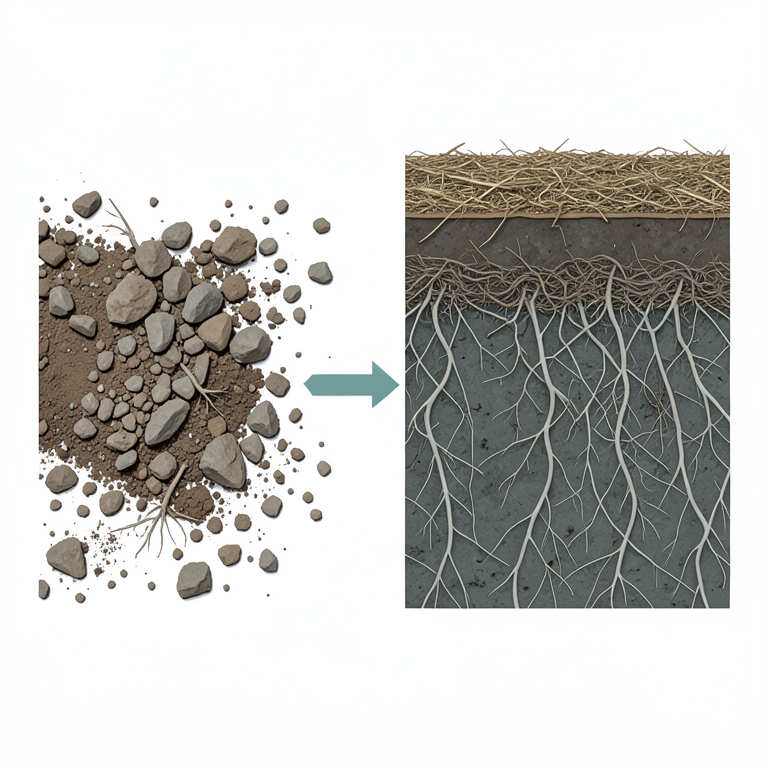
Soil Structure Comparison
AI-generated conceptual illustration (agricultural soil profiles). It explains the idea and does not show study data.
View source evidence ↗Introduction
No-till farming is an innovative agricultural practice that minimizes soil disturbance by avoiding traditional plowing and tilling. Instead, seeds are directly planted into undisturbed soil, often with the previous crop residues left on the field. This method has gained significant attention due to its potential benefits for soil health, carbon sequestration, and sustainable agriculture. This review aims to provide a comprehensive overview of the longterm effects of no-till farming on soil structure and carbon sequestration, highlighting the mechanisms involved and the implications for agricultural productivity and environmental sustainability.
Objective of paper
The objective of this paper is to explore the long-term effects of no-till farming on soil structure and carbon sequestration, highlighting its benefits for sustainable agriculture and climate change mitigation.
Soil structure in no-till farming
Soil structure refers to the arrangement of soil particles into aggregates, which affects water infiltration, root penetration, and overall soil health. No-till farming has been shown to improve soil structure over time by preserving soil aggregates and enhancing organic matter content. The presence of crop residues on the soil surface protects the soil from erosion and compaction, promoting the formation of stable aggregates. Studies by Blanco-Canqui and Lal (2008) [1] indicate that no-till farming significantly increases soil aggregate stability compared to conventional tillage practices. The improvement in soil structure under no-till farming is primarily due to increased organic matter inputs from crop residues and root biomass. These organic inputs serve as a binding agent for soil particles, enhancing aggregate formation and stability. Additionally, the lack of soil disturbance preserves existing soil structure, allowing natural processes such as root growth and microbial activity to further improve soil aggregation. Research by Six et al. (2004) [2] demonstrated that no-till farming enhances soil porosity and reduces bulk density, resulting in better water infiltration and retention, which are crucial for crop growth and resilience to drought.
No-till farming has been identified as a promising strategy for enhancing soil organic carbon (SOC) levels and sequestering carbon. The retention of crop residues on the soil surface and minimal soil disturbance promote the accumulation of organic matter, which is a key component of SOC. Several long-term studies have shown that no-till farming significantly increases SOC levels compared to conventional tillage. For instance, a study by West and Post (2002) [3] found that no-till practices increased SOC sequestration rates by an average of 0.57 megagrams of carbon per hectare per year. The increased carbon sequestration under no-till farming is attributed to reduced soil erosion, enhanced organic matter input, and decreased decomposition rates due to lower soil temperatures and higher moisture content. The benefits of carbon sequestration in no-till farming extend beyond climate change mitigation. Higher SOC levels improve soil fertility and structure, enhancing nutrient availability and water retention. This creates a more favorable environment for plant growth, leading to increased crop yields and sustainable agricultural practices. Lal (2004) [4] highlighted that increasing SOC through no-till farming can improve soil health, increase agricultural productivity, and contribute to food security.
Challenges and considerations
While no-till farming offers numerous benefits for soil structure and carbon sequestration, there are challenges and considerations that must be addressed for its successful adoption. One major challenge is the initial transition from conventional tillage to no-till farming, which may require changes in equipment, management practices, and farmer mindset. Additionally, the benefits of no-till farming may not be immediately apparent, as it can take several years for significant improvements in soil structure and carbon sequestration to occur. Another consideration is the potential for increased weed pressure under no-till systems, which may necessitate the use of herbicides. Integrated weed management strategies, including crop rotation and cover cropping, can help mitigate this issue. Furthermore, no-till farming may not be suitable for all soil types and climatic conditions. For example, poorly drained soils may experience challenges with waterlogging under no-till practices. Therefore, sitespecific assessments and adaptive management are crucial for the successful implementation of no-till farming.
Conclusion
No-till farming has demonstrated significant long-term benefits for soil structure and carbon sequestration, contributing to sustainable agriculture and climate change mitigation. By preserving soil aggregates, enhancing organic matter content, and increasing soil organic carbon levels, no-till farming improves soil health and resilience. However, successful adoption of no-till practices requires addressing challenges related to weed management, equipment, and site-specific conditions. Continued research and innovation in no-till farming techniques will be essential for maximizing its potential benefits and ensuring its widespread adoption in diverse agricultural systems.
References
11 in the original paper- Blanco-Canqui H, Lal R. No-tillage and soil-profile carbon sequestration: an on-farm assessment. Soil Science Society of America Journal. 2008;72(3):693701.
- Six J, Ogle SM, Breidt FJ, Conant RT, Mosier AR, Paustian K, et al. The potential to mitigate global warming with no-tillage management is only realized when practised in the long term. Global Change Biology. 2004;10(2):155-160.
- West TO, Post WM. Soil organic carbon sequestration rates by tillage and crop rotation. Soil Science Society of America Journal. 2002;66(6):1930-1946.
- Lal R. Soil carbon sequestration impacts on global climate change and food security. Science. 2004;304(5677):1623-1627.
- Hobbs PR, Sayre K, Gupta R. The role of conservation agriculture in sustainable agriculture. Philosophical Transactions of the Royal Society B: Biological Sciences. 2008;363(1491):543-555.
- Derpsch R, Friedrich T. Global overview of conservation agriculture adoption. In: Proceedings of the IV World Congress on Conservation Agriculture, 2009.
- Franzluebbers AJ. Soil organic carbon sequestration and agricultural greenhouse gas emissions in the southeastern USA. Soil and Tillage Research. 2010;104(2):82-92.
- Govaerts B, Sayre KD, Deckers J. A minimum data set for soil quality assessment of wheat and maize cropping in the highlands of Mexico. Soil and Tillage Research. 2006;87(2):163-174.
- VandenBygaart AJ, Gregorich EG, Angers DA. Influence of agricultural management on soil organic carbon: A compendium and assessment of Canadian studies. Canadian Journal of Soil Science. 2003;83(4):363-380.
- Follett RF. Soil management concepts and carbon sequestration in cropland soils. Soil and Tillage Research. 2001;61(1-2):77-92.
- Al-Kaisi MM, Yin X. Tillage and crop residue effects on soil carbon and carbon dioxide emission in cornsoybean rotations. Journal of Environmental Quality. 2005;34(2):437-445.
Cited by 3
From OpenAlex, OpenCitations and reference lists read by Scinovex
- Sediment and runoff losses from rainfall simulation: Effects of elevated atmospheric CO2 and tillage practice ↗
Stephen A. Prior, Dexter Brown Watts, G. Brett Runion, Francisco J. Arriaga, Henry Allen Torbert · Soil and Tillage Research · 2025
There is a lack of information regarding how rising atmospheric CO 2 concentration will affect runoff aspects in cropping systems. Following a 10-year study, a rainfall simulation examined the impacts of atmospheric CO 2 level (ambient and twice ambient) and tillage system (conventional tillage and no-till) on a Decatur silt loam (clayey, kaolinitic, thermic Rhodic Paleudults). Conventional tillage was a…
❝ 2PDF - Effects of Shallow Tillage versus Fallow on Soil Physical Fertility in the Semi-Arid Context of Burkina Faso ↗
Daouda Guébré, Harouna Ouédraogo, Aminata Ganeme, Adama Ilboudo, Zédara Isaïs Boussim, Koulibi Fidèle Zongo et al. · Agricultural Sciences · 2026
In sub-Saharan Africa, soil fertility is declining due to inappropriate agricultural practices, which means that greater efforts are needed to increase crop production. Conservation strategies like fallowing are crucial for this, but population pressure and decreasing land are reducing fallow periods, hurting soil regeneration. This study examines the benefits of two agroecological management systems on soil physical fertility in a…
❝ 0PDF - Tillage Legacy Modulates Soil Mechanical Sensitivity, Root System, and Wheat Grain Yield Under Short‐Term Compaction ↗
Ameet Kumar, Wenxu Dong, Xiuwei Liu, Chunsheng Hu · European Journal of Soil Science · 2026
ABSTRACT Long‐term conservation tillage improves soil condition, but episodic wheel traffic may impose mechanical constraints that alter root function and reduce yield. How tillage legacy regulates compaction sensitivity and root compensation remains unclear. From 2023 to 2025, on a 22‐year tillage platform, we compared moldboard ploughing with residue incorporation (MC) and no‐tillage with residue retention (NC), each subjected to short‐term…
❝ 0