
Research article · 2023 · Full text
International Journal of Advanced Chemistry ResearchSoil-water retention and its role in crop yield optimization
Volume 5(1) · Pages 117–120 · DOI: 10.33545/26646781.2023.v5.i1b.212 ↗
Research areasRice Cultivation and Yield Improvement
Abstract
Author-writtenSoil-water retention is a crucial factor influencing agricultural productivity and sustainability. This review explores the mechanisms of soil-water retention, factors affecting it, and its significant role in optimizing crop yield. Emphasizing the importance of soil texture, organic matter, and management practices, the review synthesizes current research findings and proposes strategies for enhancing soil-water retention to improve crop productivity.
Summary
Source-checkedPlain-language reading of the full paper, prepared with AI and checked against the text. Each point links to the authors' own words.
Why it matters
- Soil-water retention is a basic soil property that is essential for agricultural sustainability and productivity. View evidence ↗
- Effective water management is increasingly critical because climate change is causing more frequent and severe droughts. View evidence ↗
- Soils that can retain more water act as a buffer, ensuring crops have a stable water supply during dry periods. View evidence ↗
The question
- The paper aims to synthesize research on the factors that influence soil-water retention and how these factors can be used to optimize crop yields. View evidence ↗
What they did
- The author conducted a review of the mechanisms and factors affecting soil-water retention and its impact on crop yield. View evidence ↗
- The synthesis focuses specifically on the roles of soil texture, organic matter, and various management practices. View evidence ↗
What they found
- Clay soils retain more water than sandy soils due to their larger surface area and smaller particle size. View evidence ↗
- Organic matter increases soil-water retention by improving the soil's porosity and structure. View evidence ↗
- Management practices like no-till farming and conservation tillage improve water retention by increasing porosity and reducing soil compaction. View evidence ↗
- Soils with a higher capacity to retain water result in higher and more consistent crop yields than those with lower capacity. View evidence ↗
- Higher organic matter content improves both water retention and the availability and uptake of nutrients by plants. View evidence ↗
- Better moisture retention supports higher microbial activity, which improves overall soil health and crop yields. View evidence ↗
- No-till farming leads to higher soil-water retention than conventional tillage by preserving soil structure and organic matter. View evidence ↗
- Biochar significantly improves soil-water retention because of its high surface area and porosity. View evidence ↗
- Precision agriculture technologies improve crop yields and water use efficiency by allowing for optimized soil moisture management. View evidence ↗
What it means
- The author concludes that combining traditional soil management with modern technology is a promising way to optimize water retention and productivity. View evidence ↗
- The author recommends using appropriate management practices and technology to enhance water retention to ensure sustainability against water scarcity and climate change. View evidence ↗
Visual summary
1 visualsIllustrations explain the paper; they do not show study data.
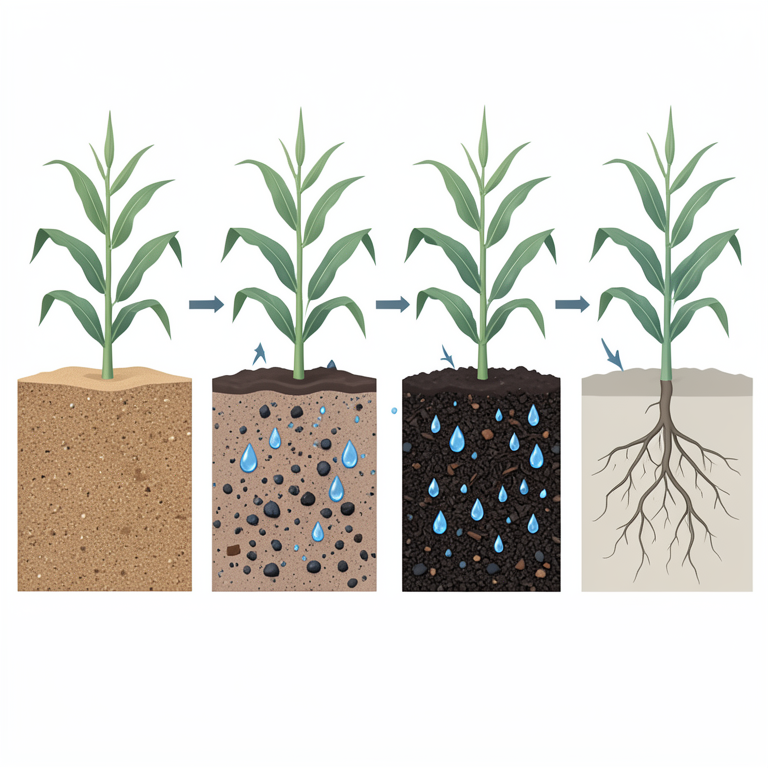
Factors Influencing Soil-Water Retention
AI-generated conceptual illustration (Agricultural soil profiles with maize plants). It explains the idea and does not show study data.
View source evidence ↗Introduction
Soil-water retention is a fundamental property of soil that significantly impacts agricultural productivity and sustainability. It refers to the soil's ability to retain water, making it available for plant uptake. This capacity of soil to hold water is crucial for supporting plant growth, particularly in regions prone to irregular rainfall or drought conditions. Efficient soilwater retention helps to mitigate the adverse effects of water scarcity, improves water use efficiency, and supports sustainable farming practices by maintaining soil moisture levels necessary for optimal crop development. The importance of soil-water retention cannot be overstated in the context of global agriculture. As climate change continues to alter weather patterns, leading to increased frequency and severity of droughts, the need for effective water management strategies becomes more critical. Soil with high water retention capacity can act as a buffer against these climatic extremes, providing a stable supply of water to crops during dry periods. This stability not only helps in maintaining consistent crop yields but also contributes to the resilience of agricultural systems against climate variability. Several factors influence soil-water retention, including soil texture, structure, organic matter content, and soil management practices. Soil texture, determined by the relative proportions of sand, silt, and clay particles, plays a significant role in water retention. Clay soils, with their fine particles and large surface area, have a higher capacity to retain water compared to sandy soils. Soil structure, which refers to the arrangement of soil particles into aggregates, also affects water retention. Well-aggregated soils create a network of pores that facilitate both water infiltration and retention, enhancing the soil's ability to supply water to plants. Organic matter is another crucial factor in soil-water retention. It improves soil structure, increases porosity, and enhances the soil's capacity to hold water. The decomposition of organic matter releases nutrients, which further supports plant growth and development. Soil management practices, such as conservation tillage, cover cropping, and the application of organic amendments, can significantly influence soil-water retention. These practices help maintain or improve soil structure, increase organic matter content, and enhance the soil's water-holding capacity. The role of soil-water retention in crop yield optimization is multifaceted. Adequate soil moisture supports essential physiological processes in plants, such as photosynthesis, nutrient uptake, and growth. It also promotes deeper root development, allowing plants to access water and nutrients from deeper soil layers. Improved water retention can lead to better crop yields, higher water use efficiency, and more resilient agricultural systems. In regions with limited water resources, optimizing soil-water retention is a key strategy for sustaining agricultural productivity and ensuring food security.
In addition to traditional soil management practices, technological advancements in precision agriculture have provided new tools for monitoring and managing soil moisture levels. Remote sensing technologies, soil moisture sensors, and data analytics allow for precise irrigation management, ensuring that crops receive adequate water while minimizing waste. These technologies help farmers make informed decisions about water use, enhancing soilwater retention and improving crop yields.
Objective of the paper
The objective of this paper is to explore the factors influencing soil-water retention and its role in optimizing crop yields, synthesizing current research findings, and proposing strategies to enhance soil-water retention for improved agricultural productivity.
Soil-water retention
Soil-water retention is a critical aspect of soil science that significantly influences agricultural productivity and sustainability.
Previous studies have extensively documented the mechanisms and factors influencing soilwater retention, providing a comprehensive understanding of its role in crop yield optimization. The ability of soil to retain water is primarily governed by its texture and structure. Soil texture, determined by the relative proportions of sand, silt, and clay, is a crucial factor. Clay soils, with their small particle size and large surface area, have a higher water retention capacity compared to sandy soils, which have larger particles and less surface area for water adhesion. This characteristic of clay soils allows them to hold more water, making them more resilient during periods of drought. For instance, research by Rawls et al. (2003) [1] demonstrated that the water retention capacity of clay soils is significantly higher than that of sandy soils, highlighting the importance of soil texture in water retention. Soil structure, referring to the arrangement of soil particles into aggregates, also plays a vital role in water retention. Well-aggregated soils with stable structures create a network of pores that facilitate both water infiltration and retention. The formation of aggregates is influenced by various factors, including organic matter content and soil management practices. A study by Bronick and Lal (2005) [2] showed that organic matter significantly enhances soilwater retention by improving soil structure and increasing porosity. Organic matter promotes the formation of soil aggregates, which, in turn, create a more favorable pore structure for water retention. This is particularly evident in soils where organic amendments such as compost and manure are applied, leading to improved water-holding capacity. The role of soil porosity and bulk density in water retention has been extensively studied. Soils with high porosity have a greater volume of pore spaces, which can retain more water. The balance between macropores (large pores) and micropores (small pores) is crucial. While macropores facilitate water infiltration, micropores are responsible for retaining water that plants can use. Lower bulk density typically indicates higher porosity, which enhances water retention. Studies such as those by Hillel (2004) [3] have demonstrated that soil management practices that reduce compaction and increase porosity, such as conservation tillage and no-till farming, improve soil-water retention. Organic matter's influence on soil-water retention cannot be overstated. Organic amendments increase the soil's capacity to hold water by improving its structure and increasing the number of micropores. This enhancement in water retention is vital for maintaining soil moisture during dry spells, thereby supporting crop growth. Additionally, organic matter contributes to the formation of a stable soil structure, which is essential for long-term water retention. Research by Hudson (1994) [4] has shown that soils with higher organic matter content have better water retention and supply water more efficiently to plants. Soil management practices also play a critical role in enhancing soil-water retention. Conservation tillage, which minimizes soil disturbance, helps maintain soil structure and organic matter content, thereby improving water retention. Cover cropping, another beneficial practice, protects the soil surface, adds organic matter, and enhances water retention. Studies such as those by Lal et al. (1998) [5] have shown that cover crops improve soil structure, increase organic matter content, and create a more favorable environment for water retention. Technological advancements have provided new tools for monitoring and managing soil-water retention. Remote sensing and precision agriculture technologies enable realtime monitoring of soil moisture levels, allowing farmers to optimize irrigation practices. Soil moisture sensors, for instance, provide accurate data on soil water content, helping to ensure that crops receive the right amount of water at the right time. These technologies not only enhance water use efficiency but also contribute to better soil-water retention by preventing over-irrigation and reducing soil compaction. Studies by Jones et al. (2005) [6] have highlighted the effectiveness of precision agriculture technologies in improving soil-water management and crop productivity. In conclusion, soil-water retention is a complex process influenced by soil texture, structure, organic matter content, porosity, and soil management practices. Studies have consistently shown that enhancing soil-water retention through appropriate soil management practices and organic amendments can significantly improve crop yield and sustainability. As agricultural challenges such as climate change and water scarcity become more pressing, understanding and improving soil-water retention will be critical for ensuring food security and sustainable agricultural practices. The integration of traditional soil management techniques with modern technological advancements offers a promising approach to optimizing soil-water retention and enhancing crop productivity.
Factors affecting soil-water retention
Soil-water retention is influenced by a complex interplay of physical, chemical, and biological factors that determine how water is stored and made available to plants. Understanding these factors is crucial for optimizing agricultural productivity and managing water resources effectively. One of the primary factors affecting soil-water retention is soil texture. Soil texture, which is determined by the relative proportions of sand, silt, and clay particles, has a significant impact on water retention capabilities. Clay soils, for instance, have a high surface area due to their small particle size, which allows them to retain more water compared to sandy soils, which have larger particles and less surface area. This characteristic of clay soils means they can hold water more effectively, making them more resilient during dry periods. A study by Rawls et al. (2003) [1] demonstrated that clayey soils have a higher water retention capacity compared to sandy soils, emphasizing the critical role of particle size distribution in soil-water dynamics. Soil structure, defined by the arrangement of soil particles into aggregates, also plays a critical role in water retention. Well-aggregated soils with stable structures create a network of pores that facilitate both water infiltration and retention. The formation and stability of these aggregates are influenced by organic matter content and soil management practices. Bronick and Lal (2005) [2] found that soils rich in organic matter have improved aggregation, which enhances water retention. This is because organic matter helps bind soil particles together, creating a structure that can hold water more effectively. Additionally, organic amendments such as compost and manure can further enhance soil structure and water-holding capacity. Porosity and bulk density are other crucial factors affecting soilwater retention. Soils with high porosity have more spaces between particles, which can store water. The balance between macropores (large pores) and micropores (small pores) is essential; while macropores allow for rapid water infiltration, micropores are responsible for retaining water that plants can use. Lower bulk density typically indicates higher porosity, which can improve water retention. Hillel (2004) [3] highlighted that soil management practices that reduce soil compaction and increase porosity, such as conservation tillage and no-till farming, can significantly enhance soil-water retention. The presence and content of organic matter in the soil are paramount for water retention. Organic matter increases the soil's capacity to hold water by improving its structure and increasing the number of micropores. Hudson (1994) [4] showed that soils with higher organic matter content have better water retention and supply water more efficiently to plants. Organic matter also contributes to the formation of stable soil aggregates, which are essential for maintaining long-term water retention. Moreover, the decomposition of organic matter releases nutrients that can improve plant growth and enhance the soil's ability to retain water. Soil management practices, including tillage, cover cropping, and the application of organic amendments, play a significant role in influencing soil-water retention. Conservation tillage practices, which minimize soil disturbance, help maintain soil structure and organic matter content, thereby improving water retention. Cover crops, which protect the soil surface and add organic matter, also enhance water retention. Lal et al. (1998) [5] demonstrated that cover crops improve soil structure, increase organic matter content, and create a more favorable environment for water retention. Comparative studies between different soil management practices have shown varying effects on soil-water retention. For instance, Jones et al. (2005) [6] found that no-till farming practices lead to higher soil-water retention compared to conventional tillage. This is because no-till practices reduce soil disturbance, preserve soil structure, and maintain higher levels of organic matter. Similarly, the application of biochar, a carbon-rich organic amendment, has been shown to improve soil-water retention significantly due to its high porosity and surface area, as highlighted by research from Lehmann and Joseph (2015) [7] . In conclusion, soil-water retention is influenced by a myriad of factors including soil texture, structure, porosity, bulk density, organic matter content, and soil management practices. Studies have consistently shown that enhancing soil-water retention through appropriate management practices and organic amendments can significantly improve crop yield and sustainability. As agricultural challenges such as climate change and water scarcity become more pressing, understanding and improving soil-water retention will be critical for ensuring food security and sustainable agricultural practices.
Role of soil-water retention in crop yield optimization
Soil-water retention is a fundamental aspect of soil science that directly impacts agricultural productivity and sustainability. The ability of soil to retain water significantly influences crop yield by affecting water availability, nutrient uptake, and overall plant health. Various studies have highlighted the critical role of soil-water retention in optimizing crop yields, particularly in the context of changing climate conditions and increasing water scarcity. Water availability is a primary factor determining crop growth and productivity. Soil-water retention ensures that water is available to plants during critical growth periods, especially in regions prone to drought or irregular rainfall. Retained soil moisture acts as a reservoir that supplies water to plants during dry spells, thereby stabilizing crop yields. Research by Rawls et al. (2003) [1] showed that soils with higher water retention capacity support more consistent and higher crop yields compared to soils with lower retention capacity. This is because retained soil moisture provides a buffer against short-term water deficits, allowing crops to maintain growth and development even in adverse weather conditions. Nutrient uptake is closely linked to soil-water retention. Water retained in the soil helps dissolve nutrients, making them available for plant uptake. Studies have demonstrated that soils with better water retention facilitate more efficient nutrient absorption by plant roots, leading to improved crop growth and higher yields. For instance, Hudson (1994) [4] found that soils with higher organic matter content, which enhances water retention, also show increased nutrient availability and uptake by plants. This synergistic effect of water and nutrient availability underscores the importance of soil-water retention in crop yield optimization. Soil-water retention also affects root development and plant health. Adequate soil moisture promotes deeper root growth, allowing plants to access water and nutrients from deeper soil layers. This deeper rooting system enhances the plant's ability to withstand drought and other environmental stresses, contributing to better overall plant health and higher yields. Studies by Bronick and Lal (2005) [2] have shown that improved soil structure and water retention support robust root development, leading to healthier plants and increased crop productivity. Furthermore, soil-water retention plays a crucial role in maintaining soil microbial activity, which is essential for nutrient cycling and soil fertility. Microorganisms in the soil require moisture to thrive and perform functions such as decomposing organic matter and fixing nitrogen. Soils with higher water retention provide a favorable environment for microbial activity, enhancing soil fertility and supporting crop growth. Research by Hillel (2004) [3] indicated that soils with better moisture retention have higher microbial activity, leading to improved soil health and crop yields. The role of soil-water retention in mitigating the effects of climate change on agriculture is also significant. Climate change is expected to increase the frequency and severity of droughts and extreme weather events, posing a challenge to crop production. Enhancing soil-water retention can help mitigate these impacts by providing a more stable water supply to crops, reducing yield variability, and increasing resilience to climate extremes. Studies by Lal et al. (1998) [5] emphasize the importance of soil management practices that improve water retention as a strategy for adapting to climate change and ensuring sustainable crop production. Technological advancements in precision agriculture have further highlighted the importance of soil-water retention in crop yield optimization. Tools such as soil moisture sensors and remote sensing technologies allow for precise monitoring and management of soil moisture levels. These technologies enable farmers to optimize irrigation practices, ensuring that crops receive adequate water without overirrigation, which can lead to soil compaction and reduced water retention. Research by Jones et al. (2005) [6] demonstrated that precision agriculture technologies significantly improve water use efficiency and crop yields by optimizing soil moisture management. In conclusion, soil-water retention is a critical factor in crop yield optimization. It influences water availability, nutrient uptake, root development, and overall plant health. By enhancing soil-water retention through appropriate soil management practices and leveraging technological advancements, farmers can improve crop yields and ensure agricultural sustainability in the face of climate change and water scarcity. The integration of traditional soil management techniques with modern technologies offers a promising approach to optimizing soil-water retention and enhancing crop productivity.
Conclusion
In summary, soil-water retention plays an indispensable role in optimizing crop yield and ensuring agricultural sustainability. By influencing water availability, nutrient uptake, root development, and overall plant health, soilwater retention provides a buffer against adverse weather conditions and enhances the resilience of crops. Various factors such as soil texture, structure, porosity, bulk density, organic matter content, and soil management practices significantly impact soil-water retention. Studies consistently demonstrate that enhancing soil-water retention through appropriate management practices, such as conservation tillage, cover cropping, and organic amendments, can lead to improved crop yields. Additionally, the integration of technological advancements in precision agriculture further supports efficient water management, contributing to higher productivity and sustainable farming. As climate change and water scarcity continue to challenge global agriculture, understanding and improving soil-water retention will be critical for securing food production and promoting sustainable agricultural practices.
References
11 in the original paper- Rawls WJ, Pachepsky YA, Ritchie JC, Sobecki TM, Bloodworth H et al. Effect of soil organic carbon on soil water retention. Geoderma. 2003;116(1-2):61-76.
- Bronick CJ, Lal R. Soil structure and management: a review. Geoderma. 2005;124(1-2):3-22.
- Hudson BD. Soil organic matter and available water capacity. Journal of Soil and Water Conservation. 1994;49(2):189-194.
- Lal R, Griffin M, Apt J, Lave L, Morgan MG. Managing soil carbon. Science. 1998;304(5677):393.
- Jones JW, Hoogenboom G, Porter CH et al. The DSSAT cropping system model. European Journal of Agronomy. 2005;18(3-4):235-265.
- Tejada M, Gonzalez JL, Martinez GAM, Parrado J. Effects of different green manures on soil biological properties and maize yield. Bioresource Technology. 2008;99(6):1758-1767.
- Canqui BH, Lal R. No-tillage and soil-profile carbon sequestration: An on-farm assessment. Soil Science Society of America Journal. 2008;72(3):693-701.
- Six J, Conant RT, Paul EA, Paustian K. Stabilization mechanisms of soil organic matter: Implications for Csaturation of soils. Plant and Soil. 2002;241(2):155-176.
- Ding G, Liu X, Herbert S, Novak J, Amarasiriwardena D, Xing B, et al. Effect of cover crop management on soil organic matter. Geoderma. 2006;130(3-4):229-239.
- Vance ED, Brookes PC, Jenkinson DS. An extraction method for measuring soil microbial biomass C. Soil Biology and Biochemistry. 1987;19(6):703-707.
- Post WM, Kwon KC. Soil carbon sequestration and land-use change: Processes and Potential. Global Change Biology. 2000;6(3):317-327.
Cited by 10
From OpenAlex, OpenCitations and reference lists read by Scinovex
- Investigating the vulnerability and resilience capacity of different land cover types to flash drought: A case study in the Mississippi River Basin ↗
Sophia Bakar, Hyunglok Kim, Jeffrey B. Basara, V. Lakshmi · Journal of Environmental Management · 2025
Flash droughts are rapidly intensifying drought events that can have severe impacts on both natural and human systems. This study assesses the vulnerability and resilience of different land use and land cover (LULC) types to flash droughts in the Mississippi River Basin (MRB) from 2000 to 2022. Using the Standardized Antecedent Precipitation Evapotranspiration Index (SAPEI) to identify flash drought events…
❝ 9PDF - Spatial Distribution of Grain Yield in the Songnen Plain Agro-Pastoral Zone in Heilongjiang Province: A Study Using Geostatistics and Geographically Weighted Regression ↗
Bing Sun, Yushuang Wang, Meiying Du, Hongyu Niu · Land · 2025
This study examines the spatial distribution of grain yield in the Songnen Plain Agro-Pastoral Zone in Heilongjiang Province from 2015, 2017, 2019 and 2021, using Kriging interpolation as the primary method. Ordinary Kriging (exponential kernel/semivariogram, step = 13) achieved optimal accuracy (RMSE = 0.856), outperforming Co-Kriging. Incorporating all covariates lowered precision due to weak spatial autocorrelation in slope and aspect,…
❝ 1PDF - How can the Addition of Sewage Sludge and Biochar to Green Roofs Influence the Substrate Physicochemical Properties and Affect Plant Growth? ↗
Michal Novotný, Milan Šipka, Vítězslav Vlček, Marco Carnevale Miino, Jakub Raček, Petr Hlavínek et al. · SSRN Electronic Journal · 2026
❝ 0PDF - Experiment and Modelling Characterisation of Clay Effect on Soil Water Retention Capacity ↗
Yu Wang, Amjad H. Khalil Albayati, Xingtao Fu, Mhd Naaman Al Brawy, Vincent C. Uzomah, Miklas Scholz · Water · 2026
This paper reports a research work on assessing clay content effect on the water retention capacity of clayey sandy soils. At first, experimental tests were conducted to measure the soil water retention curves (SWRCs) of clayey sandy soils. A total of four different soil samples, which have clay content of 0, 15, 30 and 50%, respectively, by total soil sample…
❝ 0PDF - Arahan Zonasi Penggunaan Lahan Berbasis Evaluasi Kemampuan Lahan dan Analisis LCLP di Kelurahan Tafamutu, Kecamatan Moti, Kota Ternate ↗
Gunawan Hartono, Tri Mulya Hartati, Sarif Robo, Kurnia Sari Kasman · MAKILA · 2025
This study evaluates land capability in Tafamutu Village, Moti District, Ternate City, as a basis for sustainable land-use planning. Employing the Land Capability Classification (LCC) framework and the Land Classification and Land Use Planning (LCLP) software, the analysis identifies five land capability classes (V–VIII) across sixteen land mapping units. Subclass V‑P1, occupying 7.6 ha (1.1%), is constrained by slow permeability…
❝ 0PDF - Grass Clippings Mulching Improves Infiltrability of Low-Permeability Dryland Soils ↗
Xia Li, Manuel López‐Vicente, Manuel Esteban Lucas‐Borja, Bradford P. Wilcox, Gao‐Lin Wu · Air Soil and Water Research · 2025
In arid and semiarid regions, the high compactness and poor water permeability of the soils severely limit agricultural production. This study aims to shed light on techniques to enhance the permeability of these soils—specifically, by improving soil properties through mulching with organic grass clippings. We evaluated the effects of mulching with clippings of two organic grasses: alfalfa ( Medicago sativa…
❝ 0PDF - Assessment of biochar as soil conditioner for maximizing yield in rainfed greengram
S Krishnakumar, Chelvi Ramessh, B Venudevan, T Balaji, J Selvi, A Vijayakumar · International Journal of Agriculture Extension and Social Development · 2025
Agriculture is the livelihood of people living therein. The agriculture of this region is unique in the sense that crops are mostly grown under rainfed conditions. This region receives usually rain largely from the onset of north-east monsoon with erratic behavior which affects level and spread of rainfall distribution. On an average, the seasonal rainfall was received to the extent of 656.4 mm and it has a downpour in short span of 40 days. Given the prevalence of drought vulnerability, farmers continue to face the consequences of rainfall Application of biochar @ 5t/ha along with soil test-b
- RL-FertNet: An intelligent agent for sustainable fertilization via sensor-driven and climate-aware optimization ↗
Yuvaraj Kavala · International Journal of Communication and Information Technology · 2024
Precision agriculture demands adaptive and intelligent fertilization strategies to optimize crop yield while minimizing environmental impact. This paper presents a Reinforcement Learning (RL)-based framework for generating dynamic fertilization schedules by integrating real-time soil sensor data and weather forecasts. A Deep Q-Network (DQN) agent is trained to recommend optimal fertilizer dosages at appropriate times, with state representation derived from multi-modal inputs
- Influence of integrated nutrient inputs on biochemical composition and marketable yield of brinjal ↗
Olufemi Adebayo, C. M. Nwankwo, Emeka Emmanuel Okoro · International Journal of Bioscience and Biochemistry · 2024
High temperature imposes adverse effects on plant’s metabolic processes which influence its productivity and crop yield. Curcuma longa L is an economically important perennial medicinal crop plant cultivated globally. In general, C. longa L. grown in sub-tropical and tropical regions which encompasses temperatures around 40 °C. Any crop plants when subjected to high temperature will definitely prone to stress conditions
- Impact of continuous conservation agriculture on soil chemistry and crop productivity in Burkina Faso ↗
Kofi Asare, Abigail A. Mensah, Edward Osei, Nana Yaw Boateng · International Journal of Chemical Research and Development · 2024
This study investigates the impact of continuous conservation agriculture (CCA) on soil chemistry and maize (Zea mays L.) productivity in the semi-arid regions of Burkina Faso. The primary objective was to evaluate the long-term effects of CCA on soil fertility, crop yields, and the socio-economic outcomes for smallholder farmers. The study was conducted over multiple growing seasons in fields practicing