
Research article · 2024 · Full text
International Journal of Research in AgronomyEffect of different treatment combination of urea and nano-urea on growth and flowering of calendula (Calendula officinalis)
Volume 7(7S) · Pages 352–355 · DOI: 10.33545/2618060x.2024.v7.i7se.1051 ↗
Research areasPlant Growth Enhancement Techniques
Abstract
Author-writtenAn Experiment was carried out during rabi 2023-2024 at Horticulture Research Farm, Department of Horticulture, Naini Agricultural Institute, Sam Higginbottom University of Agriculture, Technology and Sciences, Prayagraj (U.P) India. To study the effect of different treatment combination of urea and nano-urea on growth and flowering of calendula, CV calypso. The experiment was laid out in Randomized Block Design, replicated 3 times with 12 treatments with different combinations. The characters of growth, flowering and yield are noted. Based on above characters it is concluded that treatment combination T7 (50% N through Urea + Nano-urea @ 4 ml/L (2 sprays)) showed best results of Plant height ( 10.60 (20 days),14.41 (40 days),18.08 (60 days), Plant spread (6.26) 20 days (17.38) 40 days (30.52) 60 days ), Number of branches per plant (3.4 (20 days),8.06 (40 days),20.26 (60 days), Number of leaves per plant (10.93 (20 days),26.36 (40 days),60.35 (60 days), Days to 1st flowering (37.6), Flower weight (5.20g), Flower diameter (6.08 cm), Number of flowers per plant (41.33), Yield per plant (202.24g), Yield per plot (202.24 kg), Flower Yield t/ha (22.60), Importance of conducting this experiment is defined that nano-urea can lead to increased productivity of calendula flowers, thus enhancing the medicinal value and also have considerable interest for potential health benefits.
Summary
Source-checkedPlain-language reading of the full paper, prepared with AI and checked against the text. Each point links to the authors' own words.
Why it matters
- Calendula officinalis is an annual aromatic medicinal herb from the Asteraceae family containing various bioactive compounds like flavonoids and glycosides. View evidence ↗
- Nitrogen and phosphorus are essential nutrients for plant growth, with nitrogen serving as a key structural component of cell cytoplasm and proteins. View evidence ↗
- Using nano-urea may increase the productivity of calendula flowers, which could enhance their medicinal value and health benefits. View evidence ↗
The question
- The study aimed to evaluate how different combinations of urea and nano-urea affect the growth and flowering of the calendula cultivar 'Calypso'. View evidence ↗
What they did
- The field experiment was conducted at the SHUATS Horticulture Research Farm in Prayagraj, India, from November 2023 to January 2024. View evidence ↗
- The researchers used a Randomized Block Design with three replications to test 12 different treatment combinations on calendula cv. Calypso. View evidence ↗
- Treatments, including various combinations of urea and nano-urea (at 2 ml/L or 4 ml/L with 2 or 3 sprays), were applied 30 and 45 days after transplanting. View evidence ↗
What they found
- Treatment T7 (50% N Urea + 4 ml/L Nano-urea, 2 sprays) produced the maximum plant height at 20, 40, and 60 days (10.60, 14.41, and 18.08 cm), while the control had the minimum (9.23, 11.48, and 14.65 cm). View evidence ↗
- The maximum plant spread at 20, 40, and 60 days was observed in T7 (6.26, 17.38, and 30.52 cm), compared to the minimum in the control (4.6, 14.42, and 24.98 cm). View evidence ↗
- T7 resulted in the highest number of branches per plant at 20, 40, and 60 days (3.4, 8.06, and 20.26), while the control had the lowest (1.53, 6, and 15.93). View evidence ↗
- T7 led to the earliest first flower bud emergence at 37.06 days, whereas the control took the longest time at 40.53 days. View evidence ↗
- T7 produced the largest flower diameter (6.08 cm), compared to the smallest in the control (5.20 cm). View evidence ↗
- The highest number of flowers per plant was found in T7 (39.87), while the control had the lowest (27.66). View evidence ↗
- T7 achieved the maximum flower yield per plant (202.24 g), significantly higher than the control (122.64 g). View evidence ↗
- The maximum flower yield per hectare was recorded for T7 (22.49 tonnes), while the control yielded the minimum (14.17 tonnes). View evidence ↗
- T7 provided the best economic returns, with a maximum gross return of 678,000.00, net returns of 414,446.995.00, and a cost-benefit ratio of 1:2.57. View evidence ↗
What it means
- The authors conclude that the combination of 50% N through Urea and Nano-urea at 4 ml/L (2 sprays) is the superior treatment for improving growth and yield in calendula. View evidence ↗
Visual summary
3 visualsIllustrations explain the paper; charts are replotted from the paper's own table values.
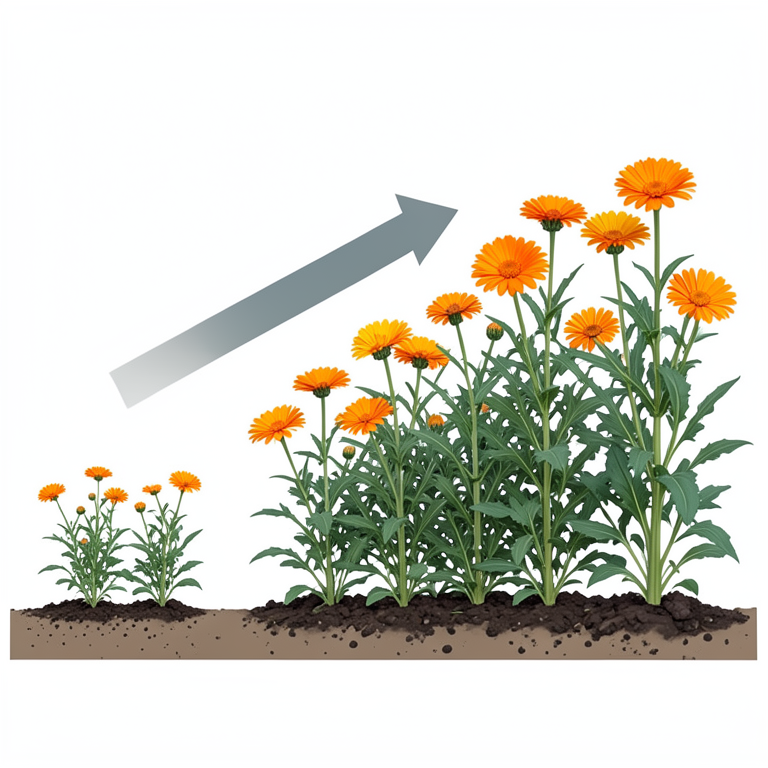
Experimental Treatment Layout
AI-generated conceptual illustration (Calendula officinalis plants). It explains the idea and does not show study data.
View source evidence ↗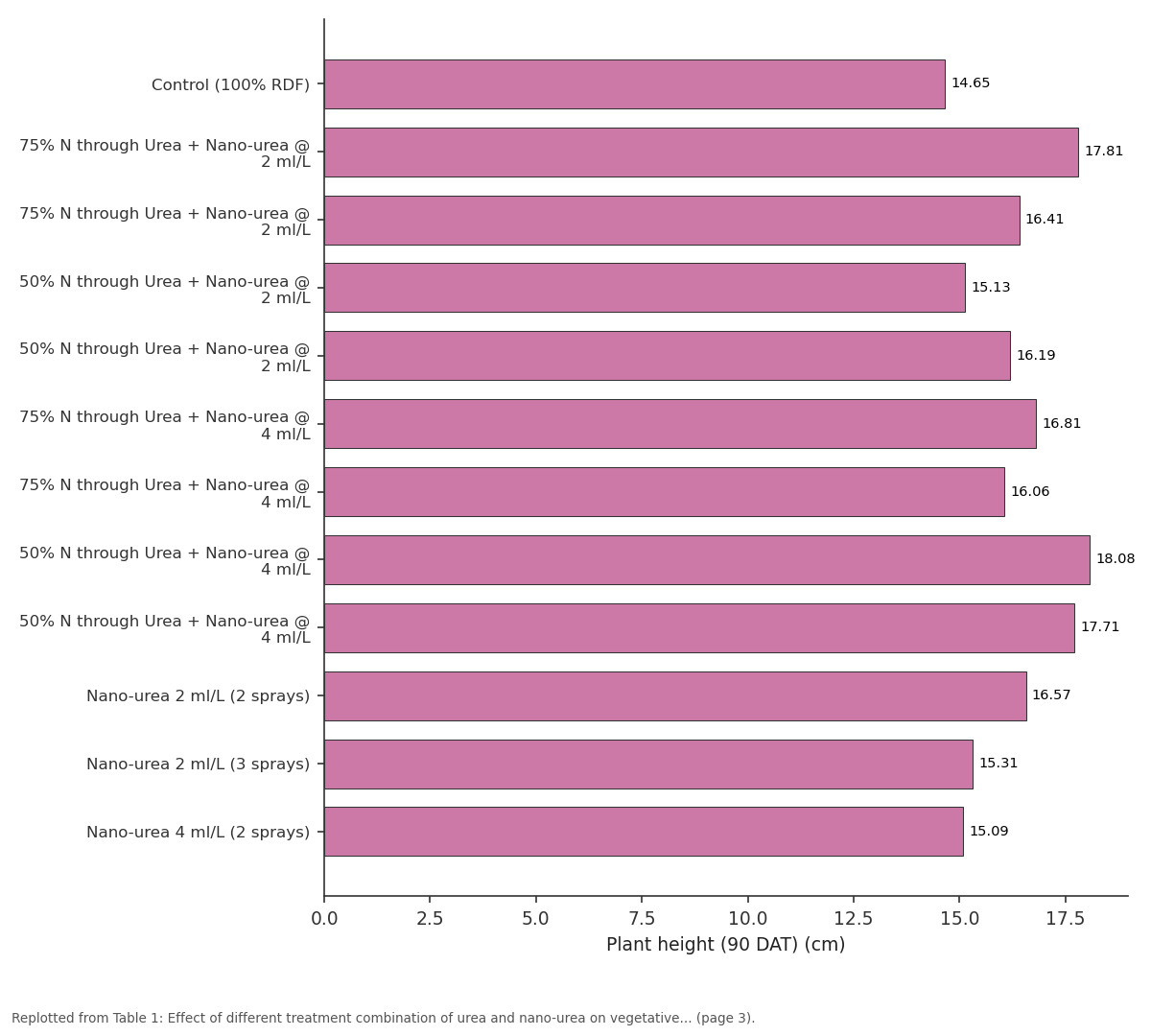
Plant height (90 DAT): Control (100% RDF) vs 75% N through Urea +... vs 75% N through Urea +... vs 50% N through Urea +... vs 50% N through Urea +...
Replotted from Table 1 (page 3) of the original paper. Every bar is the paper's own table value.
View source evidence ↗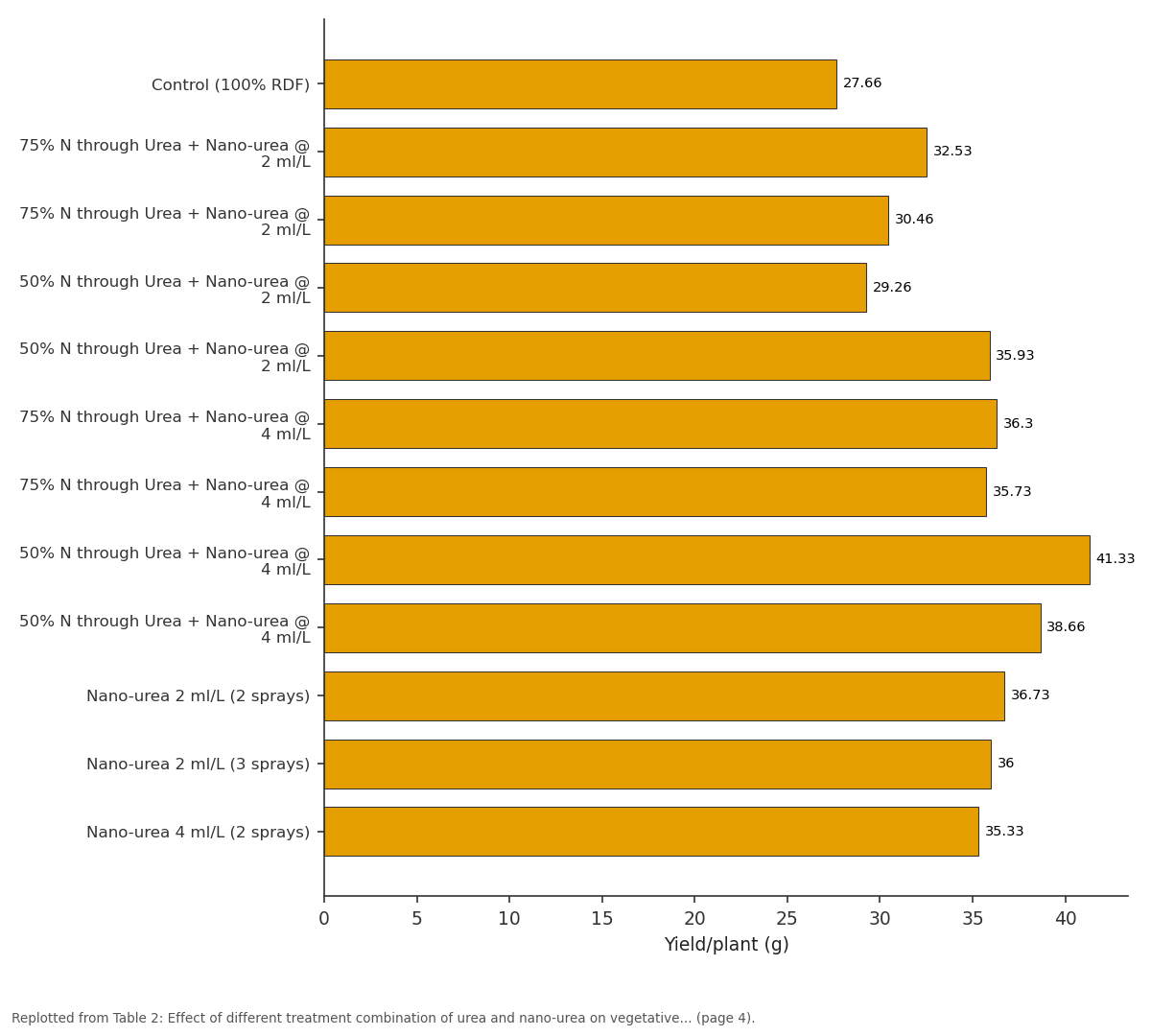
Number of flowers/plants: Control (100% RDF) vs 75% N through Urea +... vs 75% N through Urea +... vs 50% N through Urea +... vs 50% N through Urea +...
Replotted from Table 2 (page 4) of the original paper. Every bar is the paper's own table value.
View source evidence ↗Figures & tables
From the original paper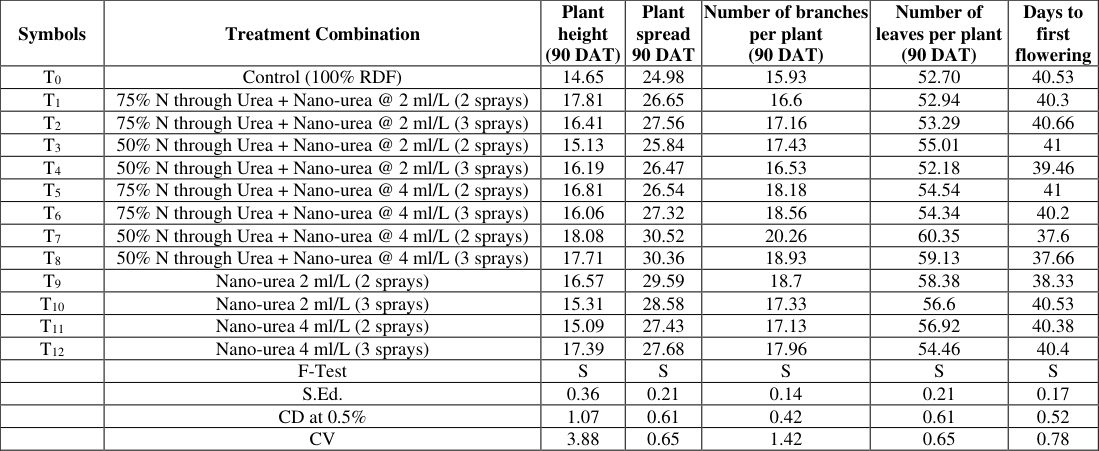 Table 1
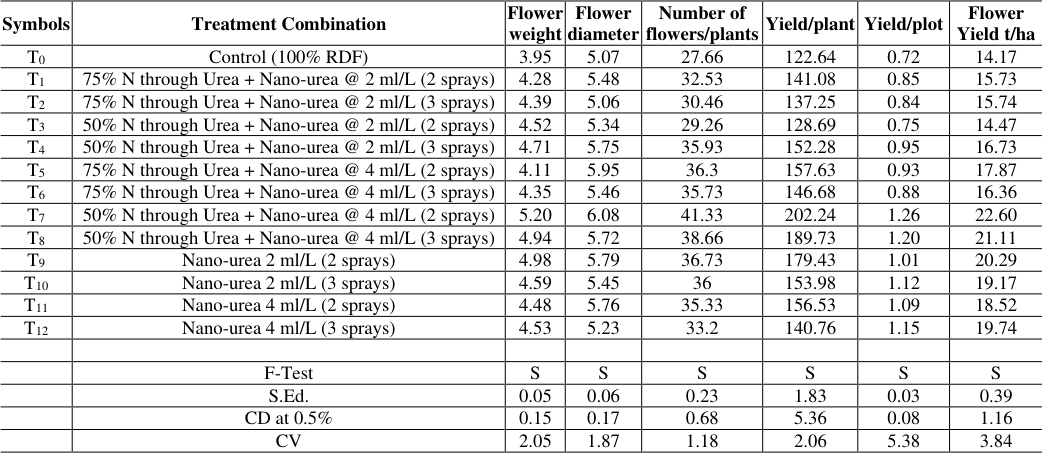 Table 2
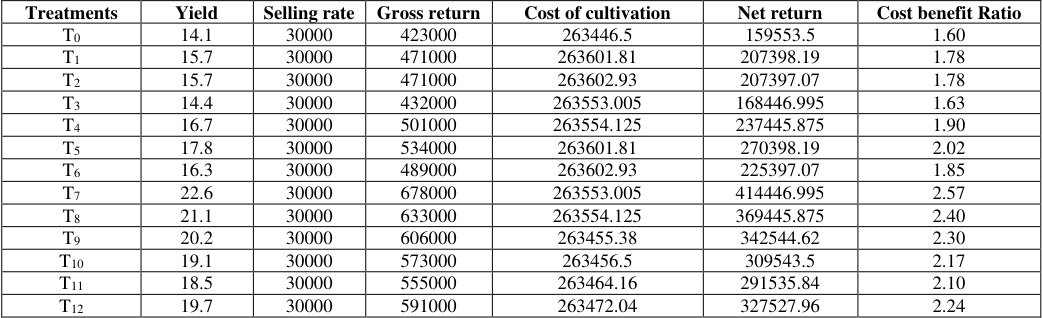 Table 3
Introduction
Calendula officinalis L is an annual aromatic herb belongs to the Asteraceae family. While the biennial form grows wild in the Southern, Eastern and Central Europe Van et al., (2004) [13] , the annual form is more widely cultivated Gilman et al., 1999 [7] . This medicinal plant contains sesquiterpenes, glycosides, saponins, xanthophylls, triol triterpenes, flavonoids and volatiles Della Loggia et al., (1994) [4] . Limited water supply is major environmental constraint in productivity of crop and medicinal plants. Although, micronutrient elements are needed in relatively very small quantities for adequate plant growth and production, their deficiency may cause great disturbance in the physiological and metabolic processes involved in the plant. Thus, the application of micronutrients fertilizer in the cultivation zone may not be meeting the crop requirement for root growth and nutrient use. The alternative approach is to apply these micronutrients as foliar sprays. The importance of pot marigold as a multipurpose plant (flower, seed, essential oil as economic production and end season water deficit condition on Calendula officinalis shows the importance of this effect that is the main objective of present study. Nitrogen is a major structural part of the cell cytoplasm, important constituent of amino-acids, proteins, purines and pyrimidines and acts as a biological catalyst phosphorus is an essential constituent of majority of enzymes, which are of great importance in carbohydrate and fat metabolism. It stimulates root growth, flowering and helps in fruiting. Nitrogen and phosphorus are essential nutrients for any plant growth. These nutrients are sometime deficient in soil which fulfilled by application of fertilizers based on soil analysis and crop requirement. Appropriate manure and fertilizers are very important for well growth of calendula. Nitrogen, Phosphorus and Potassium are required maximum quantities by the plant. These nutrients are often deficient. The deficient is corrected by application of fertilizers based on soil analysis and crop requirement. So, keeping these things in mind proper manuring and fertilization are very important for calendula. Deficiencies of different nutrient result in poor growth and flowering. Each of essential nutrients has a definite and very specific function to perform in the growth and development of plant. Calendula has no serious insect or disease problems. This plant has few pests, but may have problems with aphids, powdery mildew and occasionally cucumber mosaic virus. Plants may languish in prolonged hot summer weather but typically recover when cooler weather returns. Slugs and snails may feed on the plants, especially when they are young. Keep the ground clear of debris to minimize slug and snail damage. Aphids and whiteflies can sometimes be a problem. To control them, spray them with water or treat them with insecticidal soap. With foliar Mn applications, for optimum response, two or three applications are often required. Although foliar Mn application can supply sufficient Mn to overcome Mn deficiency, this strategy is expensive and often impractical for farmers on marginal lands. Moreover, foliar Mn sprays are only effective for a limited time period since Mn is very little mobile in the plant and does not remobilize from older leaves to Mn deficient young leaves.
Materials and Methods
A Field experiment was carried out at the Horticulture Research Farm, Department of Horticulture, SHUATS, Prayagraj, U.P. in the months of November 2023 to January, 2024. The experiment was conducted on calendula cv. Calypso in Randomized Block Design with three replications using 12 treatment combinations.
Treatments are applied at 30 Days after Transplanting, 45 Days After Transplanting. Treatment combinations are: T 0 Control T 1 75% N through Urea + Nano-urea @ 2 ml/L (2 sprays) , T 2 75% N through Urea + Nano-urea @ 2 ml/L (3 sprays), T 3 50% N through Urea + Nano-urea @ 2 ml/L (2 sprays), T 4 50% N through Urea + Nano-urea @ 2 ml/L (3 sprays), T 5 75% N through Urea + Nano-urea @ 4 ml/L (2 sprays), T 6 75% N through Urea + Nano-urea @ 4 ml/L (3 sprays), T 7 50% N through Urea + Nano-urea @ 4 ml/L (2 sprays), T 8 50% N through Urea + Nano-urea @ 4 ml/L (3 sprays), T 9 Nano-urea 2 ml/L (2 sprays), T 10 Nano-urea 2 ml/L (3 sprays), T 11 Nano-urea 4 ml/L (2 sprays), T 12 Nano-urea 4 ml/L (3 sprays).
Results and Discussion
The Maximum plant height was recorded in treatment T 7 (50% N through Urea + Nano-urea @ 4 ml/L (2 sprays) (10.60, 14.41, 18.08 cm) Plant height, at 20, 40 and 60 Days respectively in twelve treatments followed by T 8 (50% N through Urea + Nanourea @ 4 ml/L (3 sprays) with (9.59,14.15 and 17.71 cm), whereas minimum plant height (9.23, 11.48 and 14.65 cm) was recorded in Control. The plant height significantly influenced with application of Treatment combination; Nano urea is a Treatment combination essential to plant growth. In plants, it involves in the structure of photosynthetic proteins and enzymes. Excessive accumulation of Nano urea in plant tissues can change various processes, such as enzyme activity, translocation and utilization of other mineral elements Ducic and Polle, (2007) [5] , Similar results were finding Mn (0.30%) by Abou-Sreea et al., (2016) [2] in Calendula plants. The maximum Plant spread (cm 2 ) was observed T 7 (50% N through Urea + Nano-urea @ 4 ml/L (2 sprays) recorded maximum (10.93, 26.36 and 60.35). Number of leaves/Plant, at 20, 40 and 60 Days respectively in twelve treatments followed by T 8 (50% N through Urea + Nano-urea @ 4 ml/L (3 sprays) with (10.53, 25.44 and 59.13 leaves/plant) at 20, 40 and 60 days respectively, whereas minimum Number of leaves/plant (8.33, 24.09 and 52.70) was recorded in treatment Control. Nano urea plays a key role in photosynthesis, as the photosystem II-water oxidizing system has an absolute Nano requirement. Urea Enhance the photosynthetic efficiency and dry matter production, provide resistance to biotic stress by increasing plant resistance to various diseases and reducing the need for fungicides, contribute to abiotic stress tolerance, particularly drought and heat, resulting in increased photosynthesis and translocation of food material which might be enhanced the Number of leaves, leaves length and higher crop yield. The above result was confirmed by Alloway BJ. ( 2008) [1] . The maximum Number of branches per plant (cm) was observed with treatment T 7 (50% N through Urea + Nano-urea @ 4 ml/L (2 sprays) recorded maximum (6.26, 17.38 and 30.52 cm) Plant spread, at 20, 40 and 60 Days respectively in twelve treatments ,followed by T 8 (50% N through Urea + Nano-urea @ 4 ml/L (3 sprays) with (5.64, 17.32 and 30.36 cm), whereas minimum plant spread (4.6, 14.42 and 24.98 cm) was recorded in treatment T 0 (Control). The plant sprayed significantly influenced with application of Treatment combination, Nano urea is an essential plant mineral nutrient, playing a key role in several physiological processes, it encourages, cell multiplication, cell division and cell differentiation resulting in increased photosynthesis and translocation of food material which enhanced the plant spread and is also improved root system of plants resulting in absorption of more water and nutrients and its utilization (Alloway 2008) [1] . Urea is reported to activate over 35 enzymes, several of which catalyse different steps of the lignin and phytoalexins biosynthesis. Similar results were finding by Abou-Sreea et al., (2016) [2] in Calendula plants. The maximum Number of leaves was observed with T 7 (50% N through Urea + Nano-urea @ 4 ml/L (2 sprays) recorded maximum (3.4, 8.06 and 20.26) Number of Branches/Plant, at 20, 40 and 60 Days respectively in twelve treatments , followed by T 8 (50% N through Urea + Nano-urea @ 4 ml/L (3 sprays) with (2.8, 7.66 and 18.93 branches/plant) at 20, 40 and 60 days respectively, whereas minimum Number of branches/plant (1.53, 6 and 15.93) was recorded in treatment T 0 (Control). Increased the number of Branches be due to Treatment combinations like Nano urea activates some of enzyme systems and has an important role in cell division and cell lengthening resulting in increased photosynthesis and translocation of food material which enhanced the Number of Primary Branches. Teixeira et al., (2020) also reported that the foliar application of Urea increased the stem height in common bean. The minimum Days to 1 st flowering was observed with T 7 (50% N through Urea + Nano-urea @ 4 ml/L (2 sprays) recorded minimum (37.06 days) for first flower bud emergence, after transplanting in twelve treatments, followed by T 8 (50% N through Urea + Nano-urea @ 4 ml/L (3 sprays) with (37.66 days), whereas maximum days taken for first flower bud emergence (40.53 days) was recorded in treatment T 0 (Control). Treatment combination like Urea is used in plants as a major contributor to various biological systems including photosynthesis, respiration, and nitrogen assimilation. Urea is also involved in pollen germination, pollen tube growth, root cell elongation and resistance to root pathogens, which may be enhanced to flower earlier Jadhav (2004) [9] in Gerbera. The maximum Flower weight (g) was observed with T 7 (50% N through Urea + Nano-urea @ 4 ml/L (2 sprays) recorded maximum (5.20 g) fresh weight of flower, after transplanting in twelve treatments, followed by T 8 (50% N through Urea + Nano-urea @ 4 ml/L (3 sprays) with (4.94 g), whereas minimum fresh weight of flower (3.95 g) was recorded in treatment T 0 (Control).Urea is used in plants as a major contributor to various biological systems including photosynthesis, respiration, and nitrogen assimilation. Urea is also involved in pollen germination, pollen tube growth, root cell elongation and resistance to root pathogens, which may be promotes the flower size and weight of the flower Hardeep Kumar et al., (2003) in tuberose. The maximum Flower diameter was observed with T 7 (50% N through Urea + Nano-urea @ 4 ml/L (2 sprays) recorded maximum (6.08 cm) flower diameter, after transplanting in twelve treatments, followed by T 8 (50% N through Urea + Nano-urea @ 4 ml/L (3 sprays) with 5.72 cm), whereas minimum flower diameter (5.20 cm) was recorded in treatment T 0 (Control). Treatment plays an important role in the representation of critical auxins that increase cell division and increase the content chlorophyll in the leaf, Urea is used in plant as photosynthesis this might be due to more production of food material which subsequently increased in the quality parameters like flower stalk length, flower diameter. The above results also reported by Dehnavy (2009) The maximum Number of flowers per plant was observed T 7 (50% N through Urea + Nano-urea @ 4 ml/L (2 sprays) recorded maximum (39.87) number of flowers/plant, after transplanting in twelve treatments, followed by T 8 (50% N through Urea + Nano-urea @ 4 ml/L (3 sprays) with (38.66 flowers/plant), whereas minimum number of flowers/plant (27.66) was recorded in treatment T 0 (Control). Application of Urea relieved the plants from chlorosis and produced healthy green leaves which resulted in higher assimilate synthesis and partitioning of the flower growth which may in turn increase the flower production and ultimately flower yield. Pal et al., (2016) [11] in Gerbera. The maximum Yield per plant was observed with treatment T 7 (50% N through Urea + Nano-urea @ 4 ml/L (2 sprays) recorded maximum (202.24 g) flower yield/plant, after transplanting in twelve treatments, followed by T 8 (50% N through Urea + Nano-urea @ 4 ml/L (3 sprays)) with (189.73 g), whereas minimum flower yield/plant (122.64 g) was recorded in treatment T 0 (Control). Application of urea is used in plants as a major contributor to various biological systems relieved the plants from chlorosis and produced healthy green leaves which resulted in higher assimilate synthesis and partitioning of the flower growth which may in turn increase the flower production and ultimately flower yield. Zahedi (2016) [14] , Pal et al., (2016) [11] in Gerbera. The maximum Yield per plot was observed with T 7 (50% N through Urea + Nano-urea @ 4 ml/L (2 sprays) recorded maximum (1.26 kg) flower yield/plot, after transplanting in twelve treatments, followed by T 8 (50% N through Urea + Nano-urea @ 4 ml/L (3 sprays) with (1.20 kg), whereas minimum flower yield/plot (0.72 Kg) was recorded in treatment T 0 (Control + RDF). Application of Urea is used in plants as a major contributor to various biological systems relieved the plants from chlorosis and produced healthy green leaves which resulted in higher assimilate synthesis and partitioning of the flower growth which may in turn increase the flower production and ultimately flower yield. Zahedi (2016) [14] and Pal et al., (2016) [11] in Gerbera The maximum Flower Yield T/ha was observed with treatment T 7 (50% N through Urea + Nano-urea @ 4 ml/L (2 sprays) recorded maximum (22.49 tonnes) flower yield/ha, after transplanting in twelve treatments, followed by T 8 (50% N through Urea + Nano-urea @ 4 ml/L (3 sprays) with (21.37 tonnes), whereas minimum flower yield/ha (14.17 tonnes) was recorded in treatment T 0 (Control). Application of Urea is used in plants as a major contributor to various biological systems relieved the plants from chlorosis and produced healthy green leaves which resulted in higher assimilate synthesis and partitioning of the flower growth which may in turn increase the flower production and ultimately flower yield. Zahedi (2016) [14] and Pal et al., (2016) [11] in Gerbera. In terms of Economics, Maximum Gross return (678000.00), net returns (414446.995.00) and cost benefit ratio (1:2.57) respectively was found in treatment T 7 (50% N through Urea + Nano-urea @ 4 ml/L (2 sprays) followed by T 8 (50% N through Urea + Nano-urea @ 4 ml/L (2 sprays) with (633000.00) Gross return, (263554.12) Net return and (1:2.40) Cost benefit ratio, whereas minimum Gross return (423000.00), Net return (159553.5) and Cost benefit ratio (1:1.60) was recorded in treatment T 0 (Control).
Figures and tables from the paper
| Symbols | Treatment Combination | Plant height (90 DAT) | Plant spread 90 DAT | Number of branches per plant (90 DAT) | Number of leaves per plant (90 DAT) | Days to first flowering |
|---|---|---|---|---|---|---|
| T0 | Control (100% RDF) | 14.65 | 24.98 | 15.93 | 52.70 | 40.53 |
| T1 | 75% N through Urea + Nano-urea @ 2 ml/L (2 sprays) | 17.81 | 26.65 | 16.6 | 52.94 | 40.3 |
| T2 | 75% N through Urea + Nano-urea @ 2 ml/L (3 sprays) | 16.41 | 27.56 | 17.16 | 53.29 | 40.66 |
| T3 | 50% N through Urea + Nano-urea @ 2 ml/L (2 sprays) | 15.13 | 25.84 | 17.43 | 55.01 | 41 |
| T4 | 50% N through Urea + Nano-urea @ 2 ml/L (3 sprays) | 16.19 | 26.47 | 16.53 | 52.18 | 39.46 |
| T5 | 75% N through Urea + Nano-urea @ 4 ml/L (2 sprays) | 16.81 | 26.54 | 18.18 | 54.54 | 41 |
| T6 | 75% N through Urea + Nano-urea @ 4 ml/L (3 sprays) | 16.06 | 27.32 | 18.56 | 54.34 | 40.2 |
| T7 | 50% N through Urea + Nano-urea @ 4 ml/L (2 sprays) | 18.08 | 30.52 | 20.26 | 60.35 | 37.6 |
| T8 | 50% N through Urea + Nano-urea @ 4 ml/L (3 sprays) | 17.71 | 30.36 | 18.93 | 59.13 | 37.66 |
| T9 | Nano-urea 2 ml/L (2 sprays) | 16.57 | 29.59 | 18.7 | 58.38 | 38.33 |
| T10 | Nano-urea 2 ml/L (3 sprays) | 15.31 | 28.58 | 17.33 | 56.6 | 40.53 |
| T11 | Nano-urea 4 ml/L (2 sprays) | 15.09 | 27.43 | 17.13 | 56.92 | 40.38 |
| T12 | Nano-urea 4 ml/L (3 sprays) | 17.39 | 27.68 | 17.96 | 54.46 | 40.4 |
| F-Test | S | S | S | S | S | |
| S.Ed. | 0.36 | 0.21 | 0.14 | 0.21 | 0.17 | |
| CD at 0.5% | 1.07 | 0.61 | 0.42 | 0.61 | 0.52 | |
| CV | 3.88 | 0.65 | 1.42 | 0.65 | 0.78 |
Table text extracted from the original PDF; superscript letters are shown inline. The original table image is below.
View original table image
| Symbols | Treatment Combination | Flower weight | Flower diameter | Number of flowers/plants | Yield/plant | Yield/plot | Flower Yield t/ha |
|---|---|---|---|---|---|---|---|
| T0 | Control (100% RDF) | 3.95 | 5.07 | 27.66 | 122.64 | 0.72 | 14.17 |
| T1 | 75% N through Urea + Nano-urea @ 2 ml/L (2 sprays) | 4.28 | 5.48 | 32.53 | 141.08 | 0.85 | 15.73 |
| T2 | 75% N through Urea + Nano-urea @ 2 ml/L (3 sprays) | 4.39 | 5.06 | 30.46 | 137.25 | 0.84 | 15.74 |
| T3 | 50% N through Urea + Nano-urea @ 2 ml/L (2 sprays) | 4.52 | 5.34 | 29.26 | 128.69 | 0.75 | 14.47 |
| T4 | 50% N through Urea + Nano-urea @ 2 ml/L (3 sprays) | 4.71 | 5.75 | 35.93 | 152.28 | 0.95 | 16.73 |
| T5 | 75% N through Urea + Nano-urea @ 4 ml/L (2 sprays) | 4.11 | 5.95 | 36.3 | 157.63 | 0.93 | 17.87 |
| T6 | 75% N through Urea + Nano-urea @ 4 ml/L (3 sprays) | 4.35 | 5.46 | 35.73 | 146.68 | 0.88 | 16.36 |
| T7 | 50% N through Urea + Nano-urea @ 4 ml/L (2 sprays) | 5.20 | 6.08 | 41.33 | 202.24 | 1.26 | 22.60 |
| T8 | 50% N through Urea + Nano-urea @ 4 ml/L (3 sprays) | 4.94 | 5.72 | 38.66 | 189.73 | 1.20 | 21.11 |
| T9 | Nano-urea 2 ml/L (2 sprays) | 4.98 | 5.79 | 36.73 | 179.43 | 1.01 | 20.29 |
| T10 | Nano-urea 2 ml/L (3 sprays) | 4.59 | 5.45 | 36 | 153.98 | 1.12 | 19.17 |
| T11 | Nano-urea 4 ml/L (2 sprays) | 4.48 | 5.76 | 35.33 | 156.53 | 1.09 | 18.52 |
| T12 | Nano-urea 4 ml/L (3 sprays) | 4.53 | 5.23 | 33.2 | 140.76 | 1.15 | 19.74 |
| F-Test | S | S | S | S | S | S | |
| S.Ed. | 0.05 | 0.06 | 0.23 | 1.83 | 0.03 | 0.39 | |
| CD at 0.5% | 0.15 | 0.17 | 0.68 | 5.36 | 0.08 | 1.16 | |
| CV | 2.05 | 1.87 | 1.18 | 2.06 | 5.38 | 3.84 |
Table text extracted from the original PDF; superscript letters are shown inline. The original table image is below.
View original table image
| Treatments | Yield | Selling rate | Gross return | Cost of cultivation | Net return | Cost benefit Ratio |
|---|---|---|---|---|---|---|
| T0 | 14.1 | 30000 | 423000 | 263446.5 | 159553.5 | 1.60 |
| T1 | 15.7 | 30000 | 471000 | 263601.81 | 207398.19 | 1.78 |
| T2 | 15.7 | 30000 | 471000 | 263602.93 | 207397.07 | 1.78 |
| T3 | 14.4 | 30000 | 432000 | 263553.005 | 168446.995 | 1.63 |
| T4 | 16.7 | 30000 | 501000 | 263554.125 | 237445.875 | 1.90 |
| T5 | 17.8 | 30000 | 534000 | 263601.81 | 270398.19 | 2.02 |
| T6 | 16.3 | 30000 | 489000 | 263602.93 | 225397.07 | 1.85 |
| T7 | 22.6 | 30000 | 678000 | 263553.005 | 414446.995 | 2.57 |
| T8 | 21.1 | 30000 | 633000 | 263554.125 | 369445.875 | 2.40 |
| T9 | 20.2 | 30000 | 606000 | 263455.38 | 342544.62 | 2.30 |
| T10 | 19.1 | 30000 | 573000 | 263456.5 | 309543.5 | 2.17 |
| T11 | 18.5 | 30000 | 555000 | 263464.16 | 291535.84 | 2.10 |
| T12 | 19.7 | 30000 | 591000 | 263472.04 | 327527.96 | 2.24 |
Table text extracted from the original PDF; superscript letters are shown inline. The original table image is below.
View original table image
References
11 in the original paper- Alloway BJ, Pyliotis NA. Studies with manganese deficient chloroplasts. Biochemistry and Biophysics Acta. 2008;189:280-293.
- Abou-Sreea AIB. Supplying Calendula Plants with Some Micronutrients as Foliar Spray under Egyptian Soils Features. Int J Pharm Tech Res. 2016;9(12):97-108.
- Dehnavy RM, Verma P. Effect of growth retardants and micronutrients on growth and yield of African marigold (Targetes erecta L.) ev. Pusa Basanti. Sci Hortic. 2009;9:213-218.
- Della Loggia R, Tubaro A, Sosa S, Becker H, Saar ST, Isaac D. The role of triterpenoids in the topical antiinflammatory activity of Calendula officinalis flowers. Planta Med. 1994;60:516-520.
- Bloodrick KS. Influence of iron nutrition on growth, flowering and corm yield in gladiolus. J Ornamental Hortic. 2022;8(4):293-295.
- Hardeep K, Khanif YM, Saleem M. Role of zinc in plant nutrition. Am J Exp Agric. 2003;3(2):374-379.
- Jadhav AH, Dalal SR, Shinde RD, Deshmukh RP. Effect of micronutrients on growth and flower production of Gerbera under poly house conditions. Adv Plant Sci. 2004;18(2):755-758.
- Mousavi SR, Shahsavari M, Rezaei M. A General Overview on Manganese (Mn) Importance for Crops Production. Aust J Basic Appl Sci. 2011;5(9):1799-1803.
- Pal S, Barad AV, Singh AK, Khadda BS, Kumar D. Effect of foliar application of Fe and Zn on growth, flowering and yield of gerbera (Gerbera jamesonii) under protected condition. Indian J Agric Sci. 2016;86(3):394-398.
- Teixera SD, Renuka KA. Effect of Foliar Application of Manganese, Zinc and Copper on Growth and Yield of Chilli (Capsicum annum. L). Resour Environ. 2020;10(3):41-45.
- Zahedi HE, EL-Din AA. Growth, yield and essential oil response of Chrysanthemum coronarium L. to plant spacing and foliar microelements. Egypt J Hortic. 2016;29(2):229247.