
Research article · 2024 · Full text
International Journal of Research in AgronomyGrowth and flowering of gerbera (Gerbera jamesonii) as affected by different concentrations of micronutrients and humic acid under naturally ventilated polyhouse conditions of Prayagraj
Volume 7(7) · Pages 295–298 · DOI: 10.33545/2618060x.2024.v7.i7d.1039 ↗
Research areasPlant Growth Enhancement TechniquesAgricultural Science and FertilizationCrop Yield and Soil Fertility
Abstract
Author-writtenThe present investigation entitled Growth and flowering of Gerbera (Gerbera jamesonii) as affected by different concentrations of micronutrients and humic acid under naturally ventilated polyhouse conditions of Prayagraj was carried out during November 2023 to March 2024 in Naturally Ventilated Polyhouse, Department of Horticulture, Naini Agricultural Institute, SHUATS, Prayagraj. The experiment was conducted in Completely Randomized Design (CRD) with eleven treatment combinations, with the application of micronutrients; FeSO4, MgSO4, Boron and their combinations and humic acid at different levels, which was replicated thrice. It was concluded that the application of micronutrients treatments rendered their significant effect on almost all the growth, flowering and yield characters of gerbera. The treatment T10 i.e., MgSO4 + Boron + FeSO4 @ 0.6% was found superior in terms of plant height (23.87cm), number of leaves (15.08 cm), Leaf area (142.39 cm), plant spread (37.68 cm), days taken for first flower bud initiation (78.41 days), minimum days taken to first harvest (116.91 days), flower diameter (10.21 cm), stalk length (53.75 cm), stalk diameter (4.37 mm), number of flowers per plant (9.26) Flower yield per m2 (33.74) and Flower yield per 250 m2 (28221.8). Among the different treatments the highest gross return (282,218 Rs/250 m2), Net return (2,13,701 Rs/250 m2), benefit cost ratio (2.46) was obtained under the use of MgSO4 + Boron + FeSO4 @ 0.6%.
Summary
Source-checkedPlain-language reading of the full paper, prepared with AI and checked against the text. Each point links to the authors' own words.
Why it matters
- Gerbera jamesonii, also known as the Transvaal or Barberton daisy, is a popular ornamental plant widely grown for its decorative blooms and long vase life. View evidence ↗
- Micronutrients are essential for crop growth and flowering, playing critical roles in photosynthesis, hormone synthesis, and enzyme activity. View evidence ↗
- Specific nutrients like Boron, FeSO4 (iron), and MgSO4 (magnesium) are vital for cell wall formation, chlorophyll synthesis, and protein production. View evidence ↗
The question
- The study aimed to investigate how different concentrations of micronutrients and humic acid affect the growth and flowering of Gerbera jamesonii in a naturally ventilated polyhouse in Prayagraj. View evidence ↗
What they did
- The field experiment was conducted from November 2023 to March 2024 at the SHUATS Department of Horticulture in Prayagraj, U.P. View evidence ↗
- The researchers used a Completely Randomized Design (CRD) with 11 treatment combinations and three replications. View evidence ↗
- Treatments included a control (T0), individual applications of MgSO4, Boron, and FeSO4 at 0.4% and 0.6%, humic acid at 100 and 500 mg/l, and combined MgSO4 + Boron + FeSO4 at 0.4% and 0.6%. View evidence ↗
What they found
- The highest plant height at 90 days was 23.87 cm in the T10 treatment (combined micronutrients @ 0.6%), compared to 17.69 cm in the control group. View evidence ↗
- The T10 treatment resulted in the maximum plant spread of 37.68 cm at 90 days, while the control group had the minimum spread of 23.61 cm. View evidence ↗
- At 90 days, the T10 treatment produced the most leaves per plant (15.08), significantly more than the control group (7.00). View evidence ↗
- The T10 treatment accelerated flowering, with the first bud initiation occurring at 78.41 days, compared to 105.58 days for the control. View evidence ↗
- The first harvest occurred earliest in the T10 treatment at 116.91 days, whereas the control group took 137.16 days. View evidence ↗
- Flower diameter was largest in the T10 treatment (10.21 cm) and smallest in the control group (6.33 cm). View evidence ↗
- The T10 treatment produced the highest number of flowers per plant (9.26), while the control produced the fewest (5.25). View evidence ↗
- The highest flower yield per 250 m2 was achieved by the T10 treatment (33.74), compared to the lowest yield in the control (13.57). View evidence ↗
- Economically, the T10 treatment provided the highest net return (2,13,701 Rs) and the best benefit-cost ratio (4.11), while the control had the lowest net return (97,265 Rs) and ratio (2.46). View evidence ↗
What it means
- The authors conclude that the combination of MgSO4, Borax, and FeSO4 at 0.6% (T10) is superior for improving almost all growth, flowering, and yield parameters in Gerbera. View evidence ↗
Visual summary
3 visualsIllustrations explain the paper; charts are replotted from the paper's own table values.
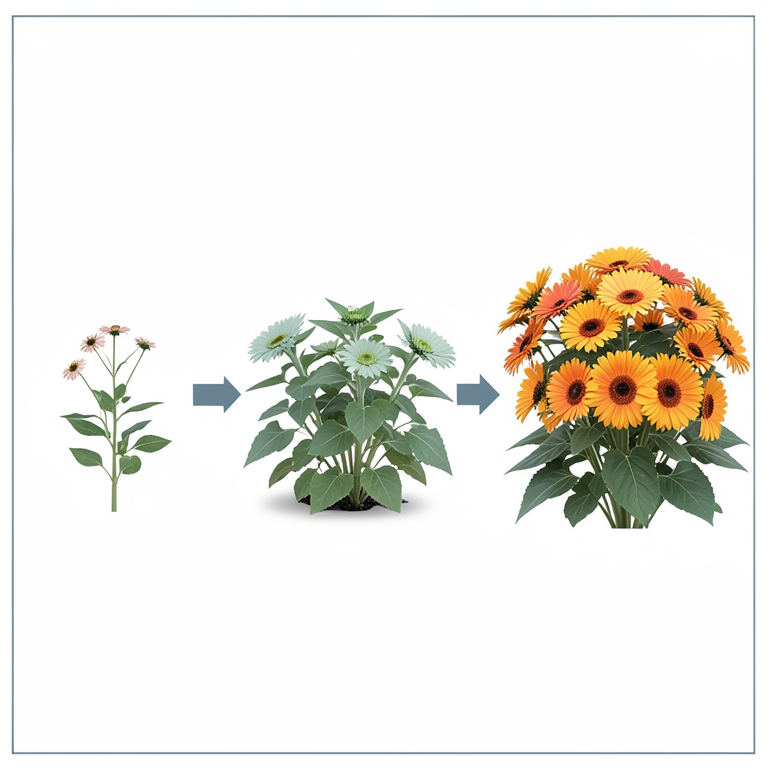
Experimental Treatment Layout
AI-generated conceptual illustration (Gerbera jamesonii plants in a naturally ventilated polyhouse). It explains the idea and does not show study data.
View source evidence ↗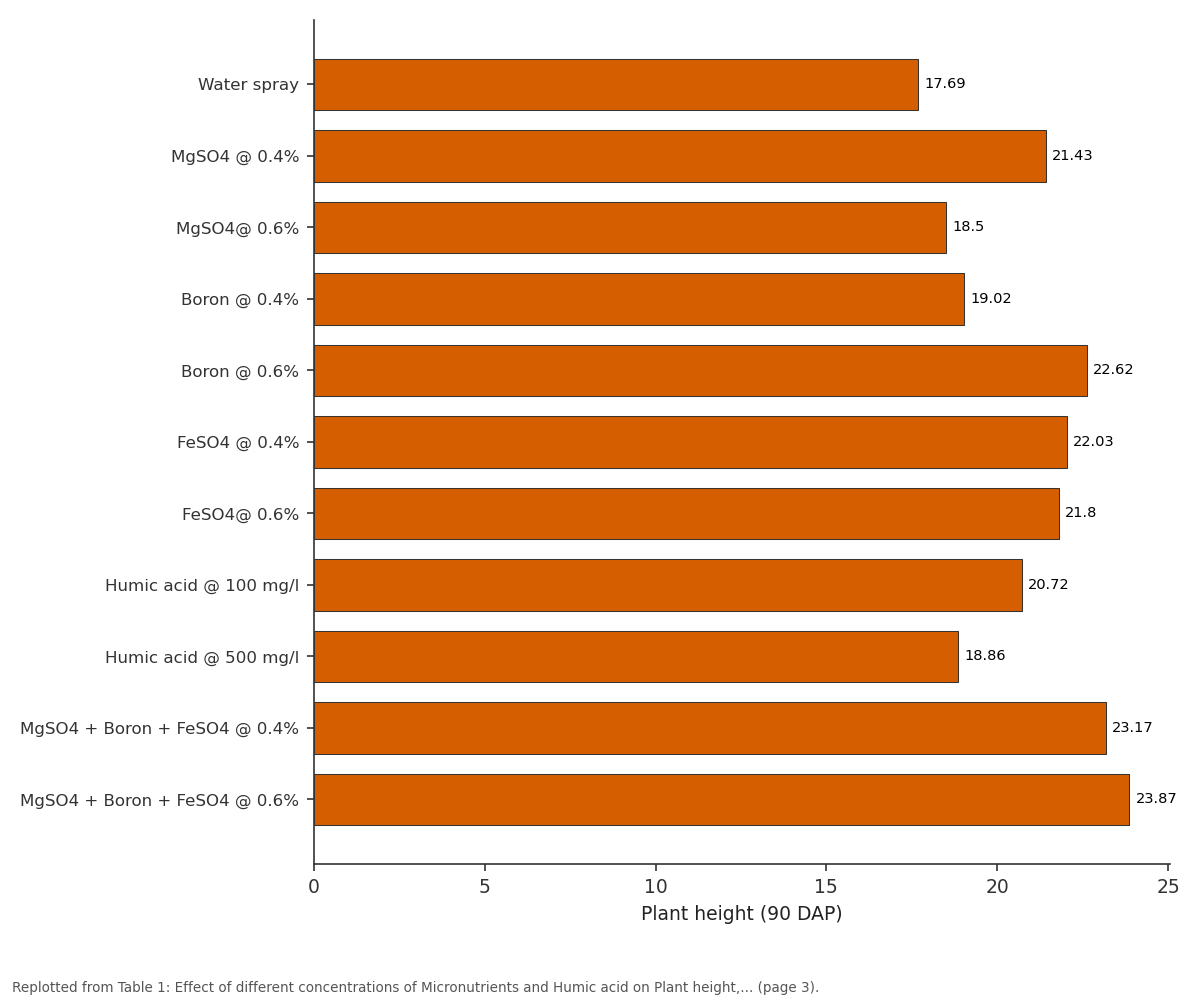
Plant height (90 DAP): Water spray vs MgSO4 @ 0.4% vs MgSO4@ 0.6% vs Boron @ 0.4% vs Boron @ 0.6%
Replotted from Table 1 (page 3) of the original paper. Every bar is the paper's own table value.
View source evidence ↗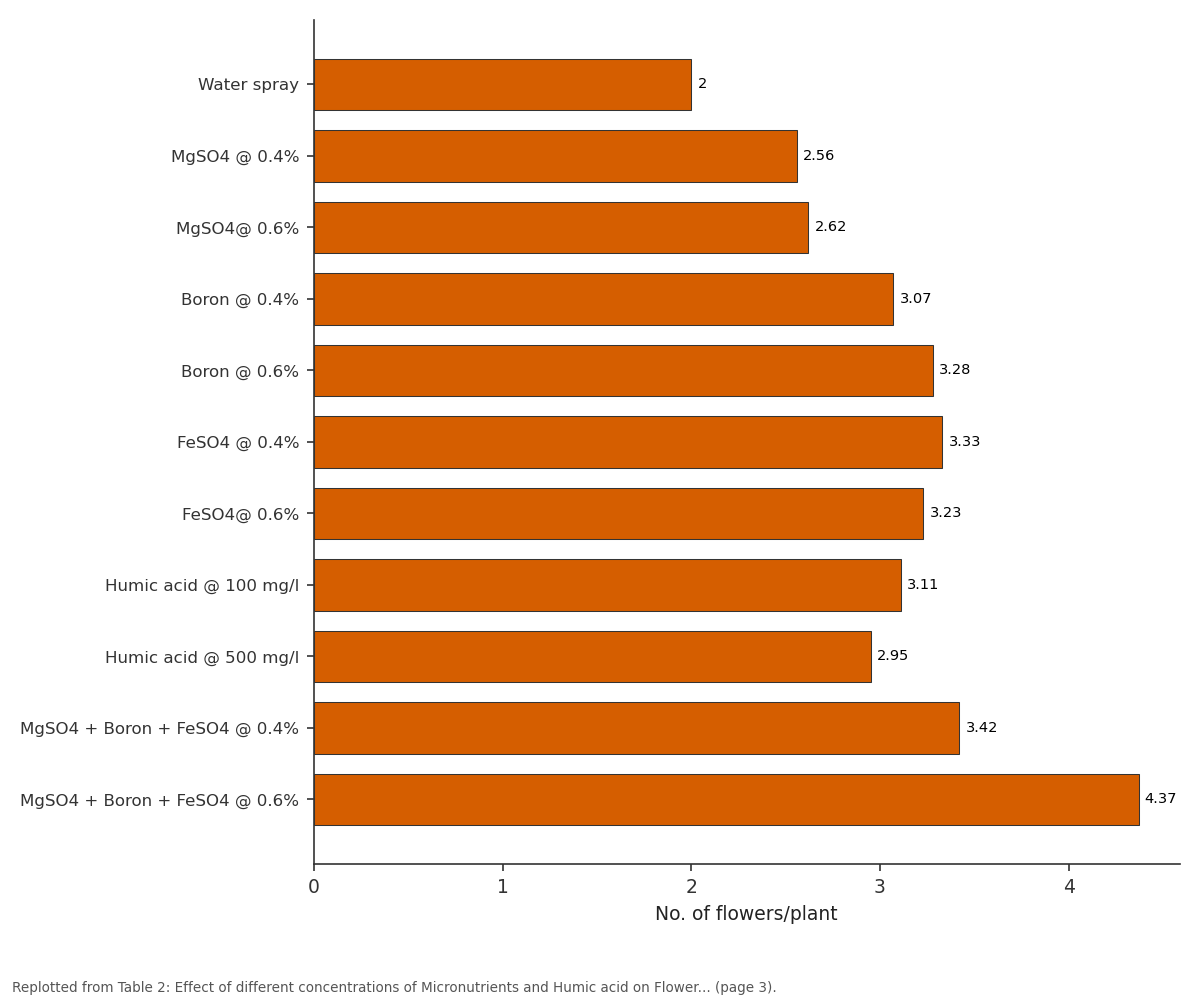
Stalk diameter: Water spray vs MgSO4 @ 0.4% vs MgSO4@ 0.6% vs Boron @ 0.4% vs Boron @ 0.6%
Replotted from Table 2 (page 3) of the original paper. Every bar is the paper's own table value.
View source evidence ↗Figures & tables
From the original paper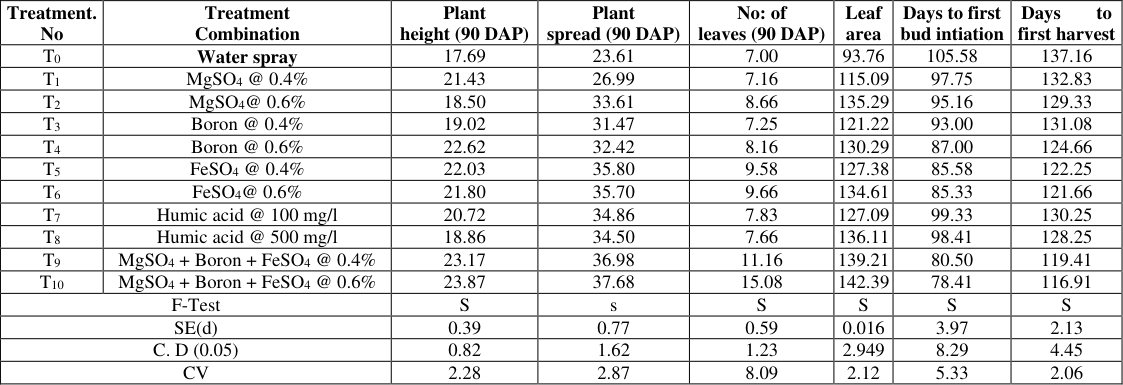 Table 1
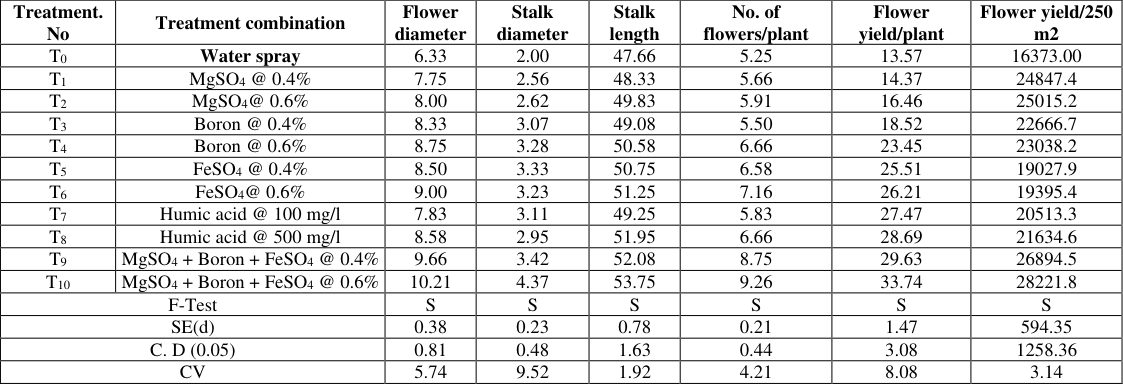 Table 2
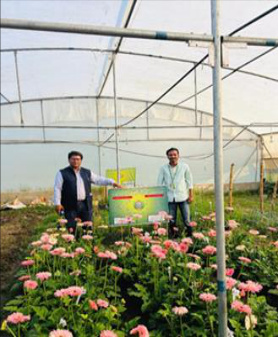 Figure 1
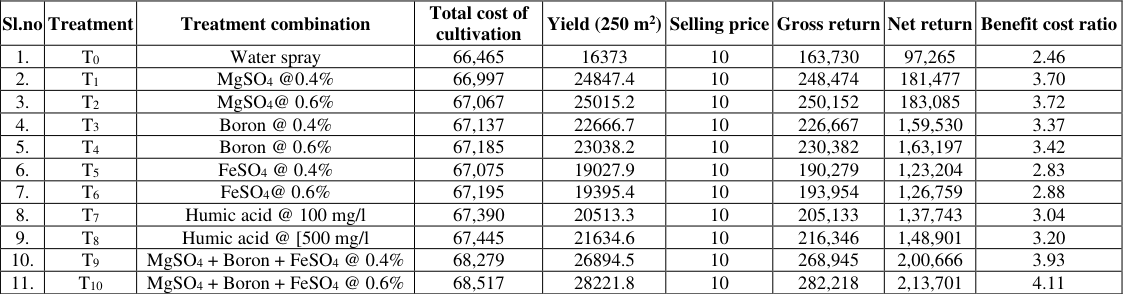 Table 3
Introduction
Gerbera jamesonii, commonly Boron, FeSO 4 , and MgSO 4 are known as the Transvaal daisy or Barberton daisy, is a popular ornamental plant in the Asteraceae family. Native to South Africa, this vibrant flower is cherished for its large, daisy-like blooms that come in a variety of colors including red, yellow, orange, pink, and white. Gerbera jamesonii is extensively cultivated for cut flowers and as a decorative garden plant due to its striking appearance and long vase life. This species thrives in well-drained soil with ample sunlight and is favored for its adaptability to different climates and resistance to common pests Chittaranjan et al. (2015) [4] . Micronutrients, though needed in small quantities, are essential for the optimal growth and flowering of crops. Elements like zinc, boron, iron, manganese, copper, and molybdenum are critical for processes such as enzyme activity, photosynthesis, and hormone synthesis. For instance, zinc plays a role in the production of auxin, a hormone crucial for flower development, while boron is vital for pollen tube formation and fruit set. Deficiencies in these micronutrients can lead to issues like chlorosis, stunted growth, and poor flowering. Therefore, ensuring a balanced supply of micronutrients is key to enhancing flower quality, vibrancy, and overall crop yield Khandekar et al. (2017) [6] critical micronutrients that play distinct roles in plant health and development. Boron is essential for cell wall formation, membrane integrity, and reproductive growth, particularly in pollen germination and seed development. Its deficiency can cause flower deformities and poor fruit set. FeSO 4 , a source of iron, is vital for chlorophyll synthesis and various enzymatic processes. Iron deficiency often leads to chlorosis, especially in young leaves, reducing photosynthetic efficiency Khurana et al. (2001) [7] .
MgSO 4 provides magnesium, a core component of the chlorophyll molecule, and sulfur, necessary for protein synthesis and enzyme function. A lack of magnesium can cause interveinal chlorosis and poor plant vigor. Together, these nutrients contribute to the overall health and productivity of flowering crops Rao et al. (2001) [8] . Humic acid significantly enhances the growth and flowering of Gerbera jamesonii by improving soil fertility and plant nutrient uptake. As an organic compound, it stimulates root development, increasing the plant's ability to absorb essential nutrients and water. This results in more robust growth and larger, more vibrant blooms. Additionally, it aids in the chelation of micronutrients, making them more readily available to the plants and boosting their overall health and resistance to stress Selvi et al (2018) [10] .
Materials and Methods
A Field experiment was carried out at Naturally Ventilated Polyhouse, Department of Horticulture, SHUATS, Prayagraj, U.P. in the months of November 2023 to March, 2024. The experiment was conducted on Gerbera jamesonii in Completely Randomized Design (CRD) with three replications using 11 treatment combinations. Treatment combinations are: T 0 Control T 1 MgSO 4 @ 0.4% + , T 2 MgSO 4 @ 0.6%, T 3 Boron @ 0.4%, T 4 Boron @ 0.6%, T 5 FeSO 4 @ 0.4%, T 6 FeSO 4 @ 0.6%, T 7 Humic acid @ 100 mg/l, T 8 Humic acid @ 500 mg/l, T 9 MgSO 4 + Boron + FeSO 4 @ 0.4%, T 10 MgSO 4 + Boron + FeSO 4 @0.6%.
Results and Discussion
The Maximum plant height(cm) was recorded in treatment T 10 -MgSO 4 + Boron + FeSO 4 @ 0.6% (15.94, 19.97, 23.87cm) Plant height, at 30, 60 and 90 Days respectively in Eleven treatments followed by T 11 -MgSO 4 + Boron + FeSO 4 @ 0.4% with (15.08, 19.17, 23.17 cm), whereas minimum plant height (9.68,14.66, 17.69 cm) was recorded in T 0 Control. This growth pattern highlights the critical role of micronutrient combinations in promoting plant growth, as also noted in the study by Bhardwaj and Yadav (2012) [3] , who emphasized that balanced micronutrient application can significantly influence vegetative and reproductive growth in floricultural crops. Similarly, Reddy and Pandey (2017) [9] reported that foliar sprays of micronutrients, including MgSO 4 , Boron, and FeSO 4 , can enhance plant height and overall growth by improving nutrient uptake and utilization. The Maximum plant spread (cm) was recorded in treatment T 10 -MgSO 4 + Boron + FeSO 4 @ 0.6% (29.83,32.9, 37.68 cm) Plant height, at 30, 60 and 90 Days respectively in Eleven treatments followed by T 11 -MgSO 4 + Boron + FeSO 4 @ 0.4% with (28.33, 32.06, 36.98 cm), whereas minimum plant height (15.78, 18.95, 23.61cm) was recorded in T 0 Control. The application of Boron, Ferrous Sulphate, and Magnesium Sulphate has profound effects on the lateral spread or canopy development of plants. This increased spread is a result of enhanced branching, foliage density, and overall vegetative growth, driven by the essential roles these micronutrients play in plant physiology founded in Alam et al. (2014) [2] . The Maximum Number of leaves per plant was recorded in treatment T 10 -MgSO 4 + Boron + FeSO 4 @ 0.6% (6.25, 9.75, 15.08) Plant height, at 30, 60 and 90 Days respectively in Eleven treatments followed by T 11 -MgSO 4 + Boron + FeSO 4 @ 0.4% with (5.50, 8.08, 11.16), whereas minimum plant height (2.33, 4.83, 7.00) was recorded in T 0 Control. The positive impact of micronutrient supplementation on leaf growth aligns with findings by Ahmad et al. (2016) [1] , who reported that the application of essential micronutrients significantly improves vegetative growth parameters, including leaf count, in floricultural crops. Similarly, Reddy and Pandey (2017) [9] observed that foliar application of micronutrients such as MgSO 4 , Boron, and FeSO 4 can enhance leaf development by promoting better nutrient absorption and physiological functions in plants. The Maximum Leaf area (cm2) was recorded in the treatment T 10 -MgSO 4 + Boron + FeSO 4 @ 0.6 (142.39), followed by T 9 -MgSO 4 + Boron + FeSO 4 @ 0.4% (139.21) and the minimum plant height was recorded in the treatment T 0water spray (93.76). The application of magnesium sulfate (MgSO₄), boron, and ferrous sulfate (FeSO₄) has been shown to significantly increase the leaf area of Gerbera flowering crops. These micronutrients are vital for chlorophyll production, enzyme activity, and cell division, leading to enhanced leaf expansion and overall plant growth. Jagtap et al (2015) [5] . The Minimum Days to First Bud initiation was recorded in the treatment T 10 -MgSO 4 + Boron + FeSO 4 @ 0.6 (78.41), followed by T 9 -MgSO 4 + Boron + FeSO 4 @ 0.4% (80.50) and the maximum plant height was recorded in the treatment T 0water spray (105.58). The findings align with research by Jagtap and Suryawanshi (2015) [5] , who observed that the foliar application of these micronutrients expedited the initiation of buds in Gerbera plants by enhancing enzyme activities and chlorophyll production, which are crucial for early flowering. The Minimum Day to first harvest was recorded in the treatment T 10 -MgSO 4 + Boron + FeSO 4 @ 0.6 (116.91), followed by T 9 -MgSO 4 + Boron + FeSO 4 @ 0.4% (119.41) and the minimum plant height was recorded in the treatment T 0water spray (137. 16). The combined application of these micronutrients creates a synergistic effect that optimizes the physiological conditions necessary for early bud initiation. Alam et al. (2014) [2] . The Maximum Flower diameter(cm) was recorded in the treatment T 10 -MgSO 4 + Boron + FeSO 4 @ 0.6 (10.21), followed by T 9 -MgSO 4 + Boron + FeSO 4 @ 0.4% (9.66) and the minimum plant height was recorded in the treatment T 0water spray (6.33). Applying a combination of MgSO 4 , Boron, and FeSO 4 has been observed to significantly increase the flower diameter in gerbera flower crops. This combination likely enhances nutrient uptake and promotes healthier growth, leading to larger blooms. Singh et al (2017) [12] . The Maximum Stalk diameter(mm) was recorded in the treatment T 10 -MgSO 4 + Boron + FeSO 4 @ 0.6 (4.37), followed by T 9 -MgSO 4 + Boron + FeSO 4 @ 0.4% (3.42) and the minimum plant height was recorded in the treatment T 0water spray (2.00) Magnesium, a crucial component of chlorophyll, enhances photosynthesis and cell growth, while sulfate aids protein synthesis and enzyme function. Boron is essential for cell wall formation and nutrient transport, strengthening vascular tissues. Iron, a key element in enzymes and chlorophyll synthesis, boosts energy transfer and photosynthesis. Together, these nutrients enhance plant vigor, resulting in thicker, sturdier stalks in Gerbera flowers. The Maximum Stalk length (cm) was recorded in the treatment T 10 -MgSO 4 + Boron + FeSO 4 @ 0.6 (53.75), followed by T 9 -MgSO 4 + Boron + FeSO 4 @ 0.4% (52.08) and the minimum plant height was recorded in the treatment T 0water spray (47.66). Magnesium enhances photosynthesis, Boron supports cell wall formation and hormone regulation, and Iron aids chlorophyll synthesis and respiration. Together, these nutrients promote vigorous stem elongation, resulting in taller Gerbera flowers Jagtap, V. R., & Suryawanshi, M. R. ( 2015) [5] . The Maximum No: of Flower per plant was recorded in the treatment T 10 -MgSO 4 + Boron + FeSO 4 @ 0.6 (9.26), followed by T 9 -MgSO 4 + Boron + FeSO 4 @ 0.4% (8.75) and the minimum plant height was recorded in the treatment T 0water spray (5.25) Magnesium boosts photosynthesis, providing energy for flower production (Cakmak, 2016) [15] , while Boron aids reproductive growth (Brown & Hu, 2011) [16] , and Iron supports overall plant health and chlorophyll synthesis. The Maximum Flower yield per plant was recorded in the treatment T 10 -MgSO 4 + Boron + FeSO 4 @ 0.6 (33.74), followed by T 9 -MgSO 4 + Boron + FeSO 4 @ 0.4% (29.63) and the minimum plant height was recorded in the treatment T 0water spray (13.57) Application of Micronutrients is used in plants as a major contributor to various biological systems relieved the plants from chlorosis and produced healthy green leaves which resulted in higher assimilate synthesis and partitioning of the flower growth which may in turn increase the flower production and ultimately flower yield Reddy & Pandey (2017) [9] . The Maximum Flower yield per 250 m2 was recorded in the treatment T 10 -MgSO 4 + Boron + FeSO 4 @ 0.6 (33.74), which was found to be at par with treatment T 9 -MgSO 4 + Boron + FeSO 4 @ 0.4% (29.63) and the minimum plant height was recorded in the treatment T 0water spray (13.57). In terms of Economics, Maximum Gross return (282,218), Net Returns (2,13,701) and Benefit cost ratio (4.11) respectively was found in treatment T 10 (MgSO 4 + Boron + FeSO 4 @ 0.6% followed by T 9 MgSO 4 + Boron + FeSO 4 @ 0.4% with (268,945) Gross return, (2,00,666) Net return and (3.93) Benefit cost ratio, whereas minimum Gross return (163,730), Net return (97,265) and Benefit cost ratio (2.46) was recorded in treatment T 0 (Control).
Figures and tables from the paper
| Treatment. No | Treatment Combination | Plant height (90 DAP) | Plant spread (90 DAP) | No: of leaves (90 DAP) | Leaf area | Days to first bud intiation | Days to first harvest |
|---|---|---|---|---|---|---|---|
| T0 | Water spray | 17.69 | 23.61 | 7.00 | 93.76 | 105.58 | 137.16 |
| T1 | MgSO4 @ 0.4% | 21.43 | 26.99 | 7.16 | 115.09 | 97.75 | 132.83 |
| T2 | MgSO4@ 0.6% | 18.50 | 33.61 | 8.66 | 135.29 | 95.16 | 129.33 |
| T3 | Boron @ 0.4% | 19.02 | 31.47 | 7.25 | 121.22 | 93.00 | 131.08 |
| T4 | Boron @ 0.6% | 22.62 | 32.42 | 8.16 | 130.29 | 87.00 | 124.66 |
| T5 | FeSO4 @ 0.4% | 22.03 | 35.80 | 9.58 | 127.38 | 85.58 | 122.25 |
| T6 | FeSO4@ 0.6% | 21.80 | 35.70 | 9.66 | 134.61 | 85.33 | 121.66 |
| T7 | Humic acid @ 100 mg/l | 20.72 | 34.86 | 7.83 | 127.09 | 99.33 | 130.25 |
| T8 | Humic acid @ 500 mg/l | 18.86 | 34.50 | 7.66 | 136.11 | 98.41 | 128.25 |
| T9 | MgSO4 + Boron + FeSO4 @ 0.4% | 23.17 | 36.98 | 11.16 | 139.21 | 80.50 | 119.41 |
| T10 | MgSO4 + Boron + FeSO4 @ 0.6% | 23.87 | 37.68 | 15.08 | 142.39 | 78.41 | 116.91 |
| F-Test | S | s | S | S | S | S | |
| SE(d) | 0.39 | 0.77 | 0.59 | 0.016 | 3.97 | 2.13 | |
| C. D (0.05) | 0.82 | 1.62 | 1.23 | 2.949 | 8.29 | 4.45 | |
| CV | 2.28 | 2.87 | 8.09 | 2.12 | 5.33 | 2.06 |
Table text extracted from the original PDF; superscript letters are shown inline. The original table image is below.
View original table image
| Treatment. No | Treatment combination | Flower diameter | Stalk diameter | Stalk length | No. of flowers/plant | Flower yield/plant | Flower yield/250 m2 |
|---|---|---|---|---|---|---|---|
| T0 | Water spray | 6.33 | 2.00 | 47.66 | 5.25 | 13.57 | 16373.00 |
| T1 | MgSO4 @ 0.4% | 7.75 | 2.56 | 48.33 | 5.66 | 14.37 | 24847.4 |
| T2 | MgSO4@ 0.6% | 8.00 | 2.62 | 49.83 | 5.91 | 16.46 | 25015.2 |
| T3 | Boron @ 0.4% | 8.33 | 3.07 | 49.08 | 5.50 | 18.52 | 22666.7 |
| T4 | Boron @ 0.6% | 8.75 | 3.28 | 50.58 | 6.66 | 23.45 | 23038.2 |
| T5 | FeSO4 @ 0.4% | 8.50 | 3.33 | 50.75 | 6.58 | 25.51 | 19027.9 |
| T6 | FeSO4@ 0.6% | 9.00 | 3.23 | 51.25 | 7.16 | 26.21 | 19395.4 |
| T7 | Humic acid @ 100 mg/l | 7.83 | 3.11 | 49.25 | 5.83 | 27.47 | 20513.3 |
| T8 | Humic acid @ 500 mg/l | 8.58 | 2.95 | 51.95 | 6.66 | 28.69 | 21634.6 |
| T9 | MgSO4 + Boron + FeSO4 @ 0.4% | 9.66 | 3.42 | 52.08 | 8.75 | 29.63 | 26894.5 |
| T10 | MgSO4 + Boron + FeSO4 @ 0.6% | 10.21 | 4.37 | 53.75 | 9.26 | 33.74 | 28221.8 |
| F-Test | S | S | S | S | S | S | |
| SE(d) | 0.38 | 0.23 | 0.78 | 0.21 | 1.47 | 594.35 | |
| C. D (0.05) | 0.81 | 0.48 | 1.63 | 0.44 | 3.08 | 1258.36 | |
| CV | 5.74 | 9.52 | 1.92 | 4.21 | 8.08 | 3.14 |
Table text extracted from the original PDF; superscript letters are shown inline. The original table image is below.
View original table image
| Sl.no | Treatment | Treatment combination | Total cost of cultivation | Yield (250 m2) | Selling price | Gross return | Net return | Benefit cost ratio |
|---|---|---|---|---|---|---|---|---|
| 1. | T0 | Water spray | 66,465 | 16373 | 10 | 163,730 | 97,265 | 2.46 |
| 2. | T1 | MgSO4 @0.4% | 66,997 | 24847.4 | 10 | 248,474 | 181,477 | 3.70 |
| 3. | T2 | MgSO4@ 0.6% | 67,067 | 25015.2 | 10 | 250,152 | 183,085 | 3.72 |
| 4. | T3 | Boron @ 0.4% | 67,137 | 22666.7 | 10 | 226,667 | 1,59,530 | 3.37 |
| 5. | T4 | Boron @ 0.6% | 67,185 | 23038.2 | 10 | 230,382 | 1,63,197 | 3.42 |
| 6. | T5 | FeSO4 @ 0.4% | 67,075 | 19027.9 | 10 | 190,279 | 1,23,204 | 2.83 |
| 7. | T6 | FeSO4@ 0.6% | 67,195 | 19395.4 | 10 | 193,954 | 1,26,759 | 2.88 |
| 8. | T7 | Humic acid @ 100 mg/l | 67,390 | 20513.3 | 10 | 205,133 | 1,37,743 | 3.04 |
| 9. | T8 | Humic acid @ [500 mg/l | 67,445 | 21634.6 | 10 | 216,346 | 1,48,901 | 3.20 |
| 10. | T9 | MgSO4 + Boron + FeSO4 @ 0.4% | 68,279 | 26894.5 | 10 | 268,945 | 2,00,666 | 3.93 |
| 11. | T10 | MgSO4 + Boron + FeSO4 @ 0.6% | 68,517 | 28221.8 | 10 | 282,218 | 2,13,701 | 4.11 |
Table text extracted from the original PDF; superscript letters are shown inline. The original table image is below.
View original table image
References
16 in the original paper- Ahmad I, Dole JM, Fonteno WC. Optimization of Nutrition in Gerbera jamesonii Cultivation. J Hortic Sci Biotechnol. 2016;91(5):545-551.
- Alam MS, Ali MY, Hossain MM. Effects of Different Micronutrients on Growth and Flowering of Gerbera (Gerbera jamesonii L.) Under Controlled Environment. Bangladesh J Bot. 2014;43(1):19-25.
- Bhardwaj RL, Yadav S. Micronutrient Management in Floriculture. Int J Plant Sci. 2012;7(1):1-9.
- Chittaranjan P, Manivel P. Gerbera Cultivation: Practices and Prospects. Curr Sci. 2015;109(2):259-264.
- Jagtap VR, Suryawanshi MR. Effect of Foliar Application of Micronutrients on Growth and Flowering of Gerbera (Gerbera jamesonii) Under Polyhouse Condition. Int J Hortic. 2015;7(1):58-62.
- Khandekar N, Kadam US. Role of Micronutrients in Plant Growth and Flower Production. Indian J Hortic. 2017;74(3):344-350.
- Khurana N, Chatterjee C. Iron Nutrition, Metabolism, and Plants: The Beneficial Use of Ferrous Sulfate. J Plant Nutr. 2001;24(10):1623-1642.
- Rao IM, Azuaje JM. Magnesium Sulfate and Plant Nutrition: Its Impact on Growth and Development. J Crop Improv. 2001;7(1):159-177.
- Reddy BS, Pandey AK. Impact of Micronutrient Foliar Sprays on Floricultural Crops. Floric Ornamental Biotechnol. 2017;11:47-52.
- Selvi S, Rajkumar R. Effect of Humic Acid on Growth, Yield and Quality of Gerbera (Gerbera jamesonii Bolus ex Hooker F.). Int J Chem Stud. 2018;6(5):3011-3015.
- Sharma R, Verma S. Impact of Micronutrient Supplementation on Growth Parameters of Gerbera. J Plant Nutr. 2022;45(4):585-592.
- Singh AK, Singh PK. Importance of Micronutrients in Floriculture Crops. Int J Curr Microbiol Appl Sci. 2019;8(2):1381-1390.
- Sujatha K, Gowda JVN, Khan MM. Effects of different fertigation levels on gerbera under low cost greenhouse. J Ornamental Hortic. New Series. 2002;5(1):54-59.
- Van den Berg H, Van Zanten T. Gerbera Cultivation in the Tropics. Florac Int. 2010;20(4):45-7.
- Çakmak U, Gökçe A, Çakmak ÖA. The key determinants of the import and policy recommendations for Turkish economy. Journal of Economics and Sustainable Development. 2016;7(6):96-103.
- Venkatesh V, Thong JY, Chan FK, Hu PJ, Brown SA. Extending the two-stage information systems continuance model: Incorporating UTAUT predictors and the role of context. Information systems journal. 2011 Nov;21(6):527555.