
Research article · 2024 · Full text
International Journal of Agriculture Extension and Social DevelopmentA study on profile characteristics, communication behaviour and constraints faced by the beneficiaries of Beti Bachao Beti Padhao scheme
Volume 7(7) · Pages 165–169 · DOI: 10.33545/26180723.2024.v7.i7c.786 ↗
Research areasDemographic Trends and Gender PreferencesGlobal Maternal and Child HealthPoverty, Education, and Child Welfare
Abstract
Author-writtenThe scheme Beti Bachao Beti Padhao was launched by Prime Minister Sri Narendra Modi, on 22nd January 2015 which means “save the daughter, educate the girl”. The scheme was launched in Haryana because of its lowest female to male sex ratio in the country (775:1000). The scheme aims to improve girl child enrollment in schools, sex ratio, and their rights. An ex-post facto research design was used. The state Andhra Pradesh, district Prakasham, and four blocks from the districtwere selected purposively because of their low Child Sex Ratio. Two villages from each block and 10 respondents from each village were selected randomly constituting a sample of 80 respondents. The data was collected through personal interview with the help of a structured interview schedule. Findings revealed that the majority were middle aged (52.50%) belonging to OBC (40.00%) with education up to secondary level (25.00%) and parent education was primary level (40.00%). Most had occupation as daily labor/ agriculture and allied activities (27.50%) and an annual income of 50,000 to 1,00,000 rupees (36.25%). A large portion of the respondents had up to 2 children (57.50%) with 1 girl child (40.00%). The majority had a medium level (71.25%), followed by high level (15.00%) of communication behaviour. Major constraints faced by them were lack of seriousness among the policy implementers as well as machinery workforces, lack of proper implementation of awareness programmes and poor fund rotation chain in case of socio-cultural, technical, and economic constraints, respectively.
Summary
Source-checkedPlain-language reading of the full paper, prepared with AI and checked against the text. Each point links to the authors' own words.
Why it matters
- Lack of education for women is considered a barrier to a country's economic development, and in India, women generally receive less education than men. View evidence ↗
- The Beti Bachao Beti Padhao scheme was designed to increase school enrollment for girls, balance the sex ratio, and highlight child rights. View evidence ↗
- The overall goal of the scheme is to eliminate gender inequality, promote female independence, and stop practices such as child marriage and female feticide. View evidence ↗
The question
- The study aimed to evaluate the success of the Beti Bachao Beti Padhao scheme by examining the profile characteristics, communication behaviors, and constraints of its beneficiaries. View evidence ↗
What they did
- The research was conducted in the Prakasham district of Andhra Pradesh, selected because of a low female literacy rate of 59.50%. View evidence ↗
- Four specific blocks (Marripudi, Racherla, Tangutur, and Chandra Sekhara Puran) were chosen based on their low child sex ratios. View evidence ↗
- Data was gathered through personal interviews using a structured interview schedule. View evidence ↗
What they found
- The majority of beneficiaries were middle-aged (52.50%, aged 25-50), followed by those in the young age group (30.00%, below 25). View evidence ↗
- Regarding education, 25.00% of beneficiaries had completed secondary education, while 21.25% had primary education. View evidence ↗
- The most common occupation among beneficiaries was daily labor or agriculture and allied activities, accounting for 27.50%. View evidence ↗
- Most beneficiaries exhibited a medium level of communication behavior (71.25%), with 15.00% showing a high level. View evidence ↗
- The primary socio-cultural constraint identified was a lack of seriousness among policy implementers and machinery workforces (76.25%). View evidence ↗
- The main technical constraint was the delay in birth registration by the Civil Registration System (66.25%). View evidence ↗
- The most significant economic constraint reported was a poor fund rotation chain (72.50%). View evidence ↗
What it means
- The authors recommend regular monitoring of government workers and officials to prevent negligence, particularly in rural areas with limited communication. View evidence ↗
- The authors conclude that there is a need to review current strategies and re-examine agency efforts to address the constraints faced by beneficiaries. View evidence ↗
Visual summary
2 visualsIllustrations explain the paper; charts are replotted from the paper's own table values.
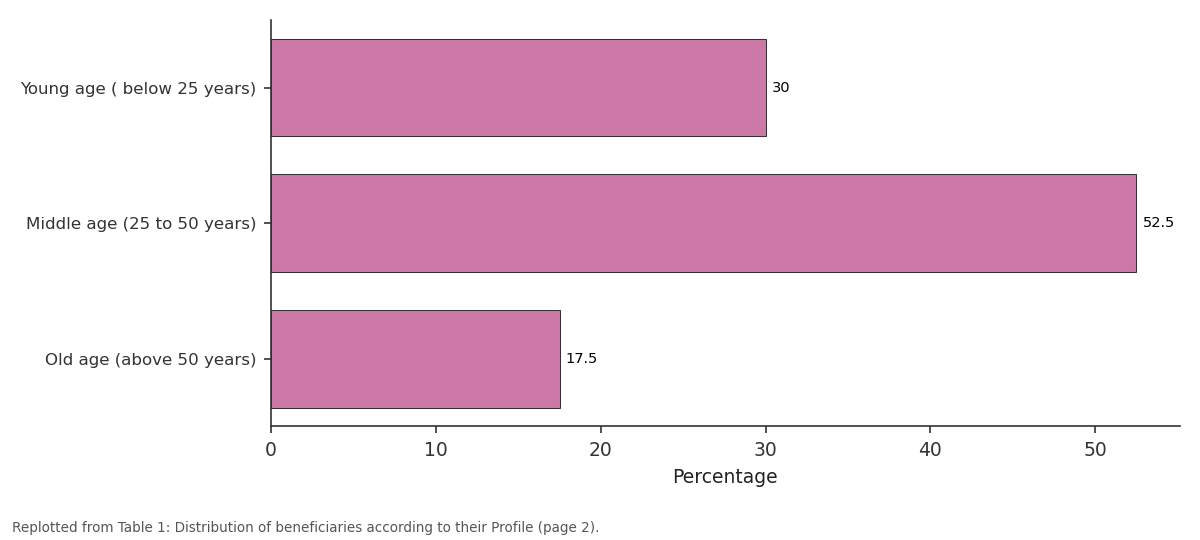
Percentage: Young age ( below 25... vs Middle age (25 to 50... vs Old age (above 50 years)
Replotted from Table 1 (page 2) of the original paper. Every bar is the paper's own table value.
View source evidence ↗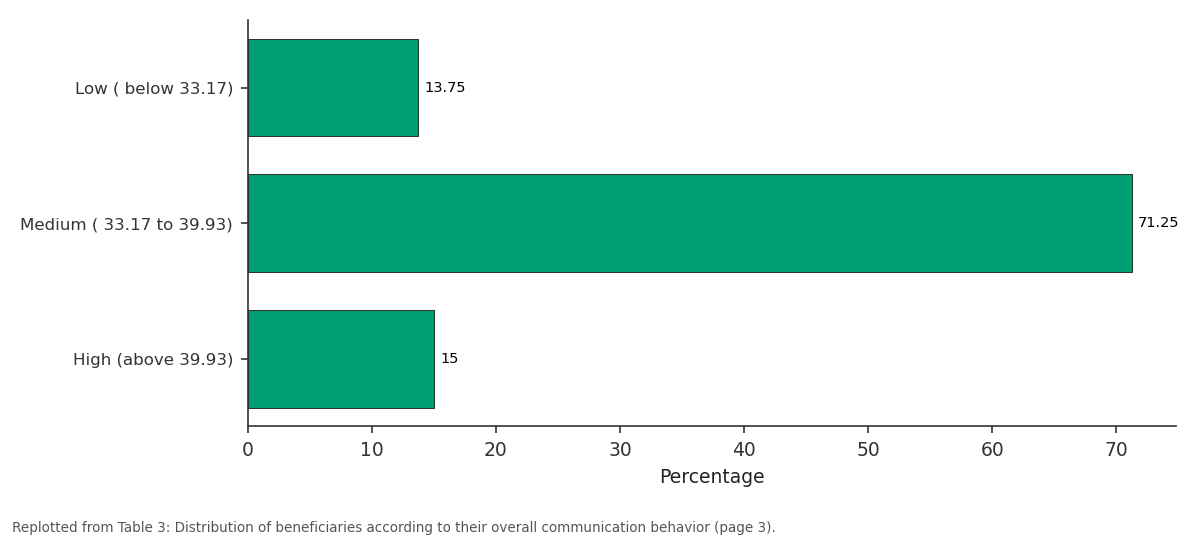
Percentage: Low ( below 33.17) vs Medium ( 33.17 to 39.93) vs High (above 39.93)
Replotted from Table 3 (page 3) of the original paper. Every bar is the paper's own table value.
View source evidence ↗Figures & tables
From the original paper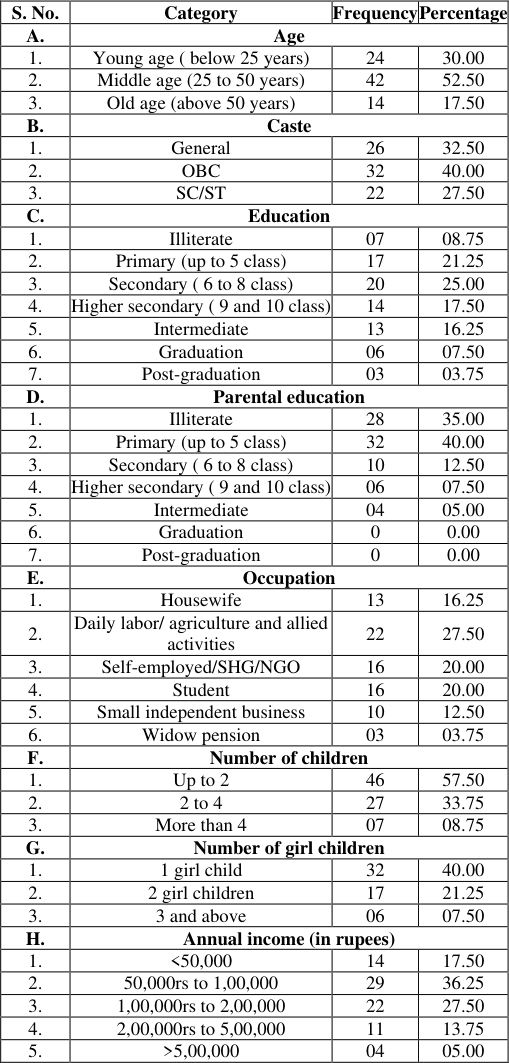 Table 1
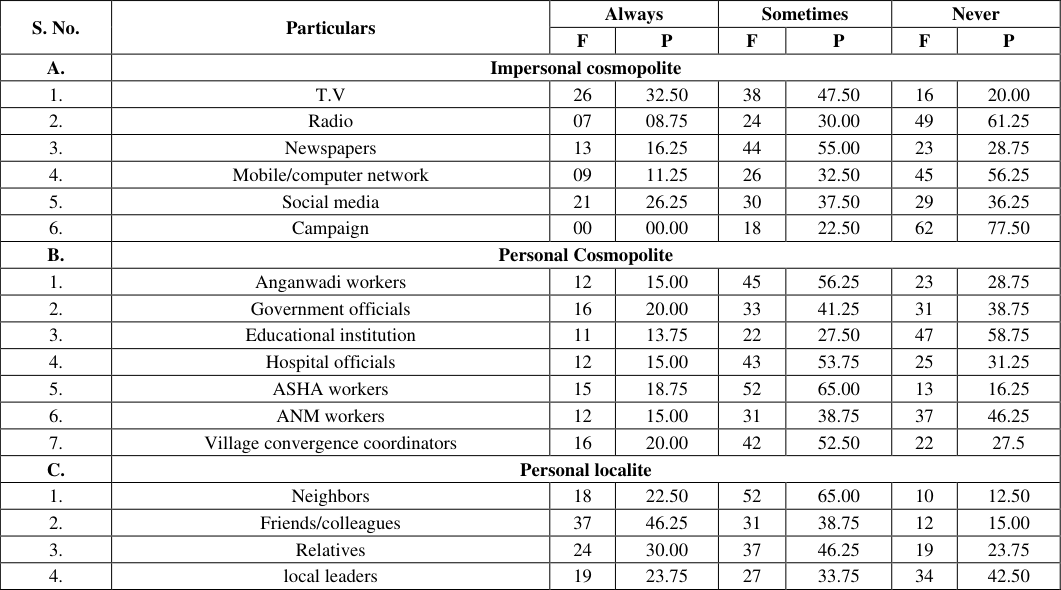 Table 2
 Table 3
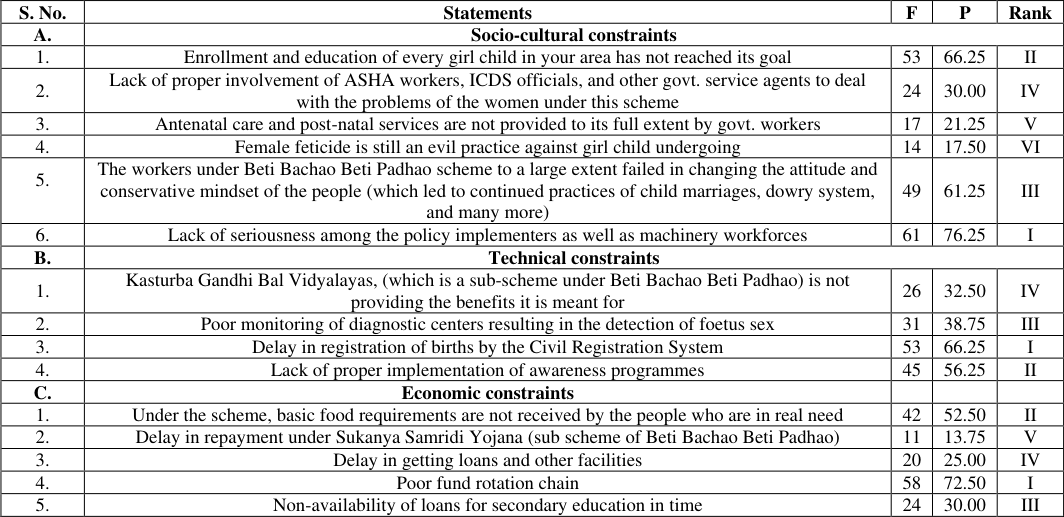 Table 4
Introduction
It is argued that lack of women education can be an obstruction to countries economic development. In India, women receive less education compared to men. At the National level, the literacy rate of an individual about 15 years or more is 74.04 percent. But among males it is 82.14 percent but in females, it is only 65.46 percent, and the gap in this literacy rate is far more observed in rural areas. The educational level, health, and nutritional status of mothers are central to the quality of life and a key ingredient for the welfare of her children in terms of health, nutritional status, behavioral, physical, and motor skills mainly in developing countries (Kaur et al., 2015a and Kaur et al., 2015b) [5,6] . Dr. Sanjay Salivkar (2012) [9] in his work stated that female foeticide had driven the health of society in danger. Due to this evil practice against women, their self-power, selfconfidence, independence, etc, are castigated leading to many problems. Studies revealed that there has been considerable improvement in enrollment of girls during the postindependence period, yet it continues to be below 50.00 percent both at primary and upper primary levels of school education. Keeping this in mind, Prime Minister Sri Narendra Modi, launched the Beti Bachao Beti Padhao scheme on 22 nd January, 2015 which means "save the daughter, educate the daughter". The scheme was launched in Haryana because of its lowest female to male sex ratio in the country (775:1000). The scheme aims to have three major effects i.e., enrolling more girls in schools, balancing the sex ratio, and emphasizing the importance of child rights. To summarize, the scheme aims to eradicate gender inequality and promote financial and social independence for females. It also fights to prevent inhumane practices like child marriages, female infanticide, and feticide, thereby contributing to women's empowerment. The scheme is implemented with the help of Anganwadi workers. Their nutritional knowledge and skills do have a direct impact on the implementation of the programme and the health of the people due to their close and continuous contact with the people of the community, especially the children and women (Sharma and Jain, 2015) [10] . Analysis by Ambay Singh et al., (2020) [13] revealed that there has been an improvement in the sex ratio at birth (SRB) from 918 in 2014-15 to 926 in 2016-17 as per Health www.extensionjournal.com Management Information System (HMIS) data after the implementation of Beti Bachao Beti Padhao scheme. The study conducted by Rakesh Gupta et al. (2018) [4] revealed that there has been a steady increase in the sex ratio at birth in the Haryana state after this implementation of the scheme. Keeping these points in view, the purpose of this study is to conduct an in-depth examination of whether the scheme has been successful in achieving its goals and to know its extent of success in terms of profile characteristics, communication behavior, and constraints faced by the beneficiaries.
Methodology
The ex-post facto research design was used as the events occurred already. The state Andhra Pradesh and district Prakasham were purposively chosen for the study because the literacy rate of the women was quite low (59.50 %) and this condition is worse for rural women residing in AP, where people don't value women's education. From the district, four blocks namely, Marripudi, Racherla, Tangutur, and Chandra Sekhara Puran were purposefully selected for the study based on their low child sex ratio. For the study, two villages from each block and ten beneficiaries from each village were taken randomly into consideration thus making up a total sample size of 80 beneficiaries from 8 villages. The response was collected with the help of a structured interview schedule by interviewing the beneficiaries personally and the list of beneficiaries was obtained from the Anganwadi center of the respective village. The profile characteristics were studied and the data was presented in terms of percentage and frequency. Communication behavior was studied under three components i.e., Impersonal Cosmopolite, Personal Cosmopolite, and Personal Localite. The responses were taken on a three-point continuum viz., Always, Sometimes, and Never with a score of 3, 2, and 1. Based on the mean and standard deviation, the respondents were divided into low, medium, and high categories. Socio-cultural, technical, and economic was the constraints studied. Using the rank order method, the constraints were ranked based on the frequency of responses.
Results
Results
Profile characteristics of the beneficiaries
The findings related to different aspects of the socioeconomic characteristics of the beneficiaries are given below:
The results from the Table 1 show that, 52.50 percent of them were from middle age group of 25 to 50 years followed by the young age group of below 25 years (30.00%). In the case of caste, 40.00 percent of them were from OBC followed by general (32.50%). 25.00 percent of them had completed their secondary level of education followed by primary education (21.25%). In the case of parental education, 40.00 percent had a primary level of education followed by illiterate (35.00%). The majority of the beneficiaries (27.50 %) were working as daily labor/ agriculture and allied activities followed by self employed/SHG/NGO (20.00%) and students (20.00%). In terms of a number of children, 57.50 percent had upto two children followed by 2 to 4 children (37.50%), and 40.00 percent with at least one girl child and 36.25 percent of them were earning around Rs.50,000 to Rs.1,00,000 annually.
| S. No. | Category | Frequency | Percentage |
|---|---|---|---|
| A. | Age | ||
| 1. | Young age ( below 25 years) | 24 | 30.00 |
| 2. | Middle age (25 to 50 years) | 42 | 52.50 |
| 3. | Old age (above 50 years) | 14 | 17.50 |
| B. | Caste | ||
| 1. | General | 26 | 32.50 |
| 2. | OBC | 32 | 40.00 |
| 3. | SC/ST | 22 | 27.50 |
| C. | Education | ||
| 1. | Illiterate | 07 | 08.75 |
| 2. | Primary (up to 5 class) | 17 | 21.25 |
| 3. | Secondary ( 6 to 8 class) | 20 | 25.00 |
| 4. | Higher secondary ( 9 and 10 class) | 14 | 17.50 |
| 5. | Intermediate | 13 | 16.25 |
| 6. | Graduation | 06 | 07.50 |
| 7. | Post-graduation | 03 | 03.75 |
| D. | Parental education | ||
| 1. | Illiterate | 28 | 35.00 |
| 2. | Primary (up to 5 class) | 32 | 40.00 |
| 3. | Secondary ( 6 to 8 class) | 10 | 12.50 |
| 4. | Higher secondary ( 9 and 10 class) | 06 | 07.50 |
| 5. | Intermediate | 04 | 05.00 |
| 6. | Graduation | 0 | 0.00 |
| 7. | Post-graduation | 0 | 0.00 |
| E. | Occupation | ||
| 1. | Housewife | 13 | 16.25 |
| 2. | Daily labor/ agriculture and allied activities | 22 | 27.50 |
| 3. | Self-employed/SHG/NGO | 16 | 20.00 |
| 4. | Student | 16 | 20.00 |
| 5. | Small independent business | 10 | 12.50 |
| 6. | Widow pension | 03 | 03.75 |
| F. | Number of children | ||
| 1. | Up to 2 | 46 | 57.50 |
| 2. | 2 to 4 | 27 | 33.75 |
| 3. | More than 4 | 07 | 08.75 |
| G. | Number of girl children | ||
| 1. | 1 girl child | 32 | 40.00 |
| 2. | 2 girl children | 17 | 21.25 |
| 3. | 3 and above | 06 | 07.50 |
| H. | Annual income (in rupees) | ||
| 1. | <50,000 | 14 | 17.50 |
| 2. | 50,000rs to 1,00,000 | 29 | 36.25 |
| 3. | 1,00,000rs to 2,00,000 | 22 | 27.50 |
| 4. | 2,00,000rs to 5,00,000 | 11 | 13.75 |
| 5. | >5,00,000 | 04 | 05.00 |
Table text extracted from the original PDF; superscript letters are shown inline. The original table image is below.
View original table image
Personal localite
Personal localite
Overall communication behavior of the beneficiaries
Overall communication behavior of the beneficiaries
Constraints faced by the Beneficiaries Socio-cultural constraints
The results from the Table 4 revealed that lack of seriousness among the policy implementers as well as the machinery workforces (76.25%) was the major constraint followed by enrollment and education of every girl child in their area has not reached its goal (66.25%) and the workers under Beti Bachao Beti Padhao scheme to a large extent failed in changing the attitude and conservative mindset of the people (61.25%).
Technical constraints
The result from Table 4 revealed the technical constraints faced by the beneficiaries. Delay in registration of births by the Civil Registration System (66.25%) was the main constraint, followed by lack of proper implementation of awareness programmes (56.25%) and poor monitoring of diagnostic centers resulting in the detection of foetus sex (38.75 %).
Economic constraints
Table 4 shows the economic constraints faced by the beneficiaries. Poor fund rotation chain (72.50%) was the major constraint followed by Under the scheme, basic food requirements are not received by the people who are in real need (52.50%) and Non-availability of loans for secondary education in time ( 30.00 %). www.extensionjournal.com Non-availability of loans for secondary education in time 24 30.00 III
Discussion
The result from the above table shows that, most of the beneficiaries are from middle age, with secondary education and undertaking some other holdings along with agriculture for external income. As reviewed by Naaz Bano et al., (2021) [2] education is the most significant component in raising the social and economic status of women in society and making them well aware of the surrounding threats and opportunities. Fifty percent of the households had at least one girl child in their family and most of them earned an annual income of about a lakh. Similar results were represented from the study conducted by Aritra Gosh, (2020) [3] . Among the various media of communication, television is the unbeatable mass media source that is trusted and used by almost all people among the impersonal cosmopolite sources followed by newspapers. The findings of Aisharwaya (2010) [1] revealed that mass media exposure and socio-economic status had a positive and significant association with the awareness of rural and urban respondents about female foeticide. So, the information distributed through these sources should be quite reliable and accurate to have a qualitatively better communication experience towards the beneficiaries. People generally have good dependence and belief towards personal cosmopolite sources, but among them, they mostly preferred ASHA workers, hospital officials, and Anganwadi workers as they have reasonably direct contact with the beneficiaries compared to others, and in case of village areas, they go with village convergence coordinator whom they meet frequently. A descriptive survey on social learning, and public awareness of the Beti Bachao-Beti Padhao scheme conducted by Shiva Parmar et al., (2020) [8] concluded that there was a powerful impact on the child sex ratio and a raise in the survival and protection of girl children. Through the scheme, there has been a measurable increase in girl education and was influencing the social mindset of people.
From the above results, it can be noticed that, almost all the means of communication through personal localite are well used by the beneficiaries to receive the information pertaining about the scheme. As concluded by Alhaji Liman et al., (2022) [15] for the effective realization and actualization of successful girl child education programmes, parents, community leaders, society, govt., and NGOs as well as the media must take responsibility. Care should be taken in identifying those target areas that lack proper communication networks and take necessary steps so that, no citizen is left out or forbidden from the right to receive information. As it is evident that most of the beneficiaries fall under the medium to high category of communication behaviour, it implies that the beneficiaries are well-versed with the usage of all means of communication channels in seeking information and making the best use of it, to elevate their living conditions. From the above table, it can be said that, the proper involvement of govt. officials working under this scheme still need to be improved for the effective implementation of the scheme and proper use of the benefits provided by it. A study conducted by Kumari (2015) [7] proves that by simply increasing female literacy and autonomy without bringing about a change in mindset of people will not be completely successful in combating the problem of female foeticide. Another constraint was lack of proper recorded evidence about the results of the tasks that come under this scheme, thereby giving a scope for negligence of duties and manipulation of the results leading to decreased efficiency of the scheme. Trilok Singh, (2018) [12] through his study, concluded that there is a dire need to review the ongoing strategies and re-examine efforts that are formulated by several agencies to tackle the declining rate of CSR in India. Whenever there is lag in the implementation of duties, the people in real need are not getting the deserved benefits they seek for. If that is a case of emergency, then their economic development gets seriously impaired. Sheila C. Vir et al.,
(2015) [11] highlighted the dimension of the malnutrition problem of women in India presented concerning its implications on birth outcome and under nutrition in children. Results revealed that the causative factor of under nutrition in women is not only food unavailability but is influenced by factors like early marriage and conception, education, empowerment, decision making power, and domestic violence. A number of policies in India address these issues but their implementation remains weak, so it must be accorded as a high programme priority.
Conclusion
The beneficiaries expressed satisfaction with the change in their socio-economic profile and improvements in their lifestyle as a result of enrolling in the scheme. They were middle aged with secondary education and parental education of primary level. Their major occupation was daily labours with an annual income of 50,000 to 1,00,000 rupees. The majority followed family planning techniques with up to 2 children and one girl child. The medium level of communication behaviour towards all means i.e., impersonal cosmopolite, personal cosmopolite, and personal localite indicates that still there is more to be taken care of to give the beneficiaries the maximum level of knowledge and information that can be used to their advantage. Some of them include proper fund rotation to meet the regular needs of the beneficiaries thereby enhancing their wellbeing and social and economic status, timely delivery of required information to the beneficiaries when in need, using two or three communication channels at a time which makes the information reach the beneficiaries faster, eye catching and motivate them to act upon the information that they received. The government workers and other officials under the scheme should be monitored regularly so that they never show negligence in their duties, especially in target specific rural areas where means of communication are comparatively low. Also, there is a need to review the ongoing strategies and re-examine efforts that are formulated by several agencies to tackle the constraints faced by the beneficiaries in receiving the services of the Beti Bachao Beti Padhao scheme.
Figures and tables from the paper
| S. No. | Particulars | Always | — | Sometimes | — | Never | — |
|---|---|---|---|---|---|---|---|
| F | P | F | P | F | P | ||
| A. | Impersonal cosmopolite | ||||||
| 1. | T.V | 26 | 32.50 | 38 | 47.50 | 16 | 20.00 |
| 2. | Radio | 07 | 08.75 | 24 | 30.00 | 49 | 61.25 |
| 3. | Newspapers | 13 | 16.25 | 44 | 55.00 | 23 | 28.75 |
| 4. | Mobile/computer network | 09 | 11.25 | 26 | 32.50 | 45 | 56.25 |
| 5. | Social media | 21 | 26.25 | 30 | 37.50 | 29 | 36.25 |
| 6. | Campaign | 00 | 00.00 | 18 | 22.50 | 62 | 77.50 |
| B. | Personal Cosmopolite | ||||||
| 1. | Anganwadi workers | 12 | 15.00 | 45 | 56.25 | 23 | 28.75 |
| 2. | Government officials | 16 | 20.00 | 33 | 41.25 | 31 | 38.75 |
| 3. | Educational institution | 11 | 13.75 | 22 | 27.50 | 47 | 58.75 |
| 4. | Hospital officials | 12 | 15.00 | 43 | 53.75 | 25 | 31.25 |
| 5. | ASHA workers | 15 | 18.75 | 52 | 65.00 | 13 | 16.25 |
| 6. | ANM workers | 12 | 15.00 | 31 | 38.75 | 37 | 46.25 |
| 7. | Village convergence coordinators | 16 | 20.00 | 42 | 52.50 | 22 | 27.5 |
| C. | Personal localite | ||||||
| 1. | Neighbors | 18 | 22.50 | 52 | 65.00 | 10 | 12.50 |
| 2. | Friends/colleagues | 37 | 46.25 | 31 | 38.75 | 12 | 15.00 |
| 3. | Relatives | 24 | 30.00 | 37 | 46.25 | 19 | 23.75 |
| 4. | local leaders | 19 | 23.75 | 27 | 33.75 | 34 | 42.50 |
Table text extracted from the original PDF; superscript letters are shown inline. The original table image is below.
View original table image
| S. No. | Category | Frequency | Percentage |
|---|---|---|---|
| 1. | Low ( below 33.17) | 11 | 13.75 |
| 2. | Medium ( 33.17 to 39.93) | 57 | 71.25 |
| 3. | High (above 39.93) | 12 | 15.00 |
| Mean= 36.55 | SD=3.382 |
Table text extracted from the original PDF; superscript letters are shown inline. The original table image is below.
View original table image
References
12 in the original paper- Aishwarya D, Singh AR. Awareness of the Rural and Urban Women about Female Foeticide. Indian Research Journal of Extension Education. 2010;10(2):99-103.
- Bano N, Beg A, Kumari A, Dahiya R. A critical review: Problem of female feoticide and female infanticide in India. The Pharma Innovation. 2021;10(3):243-248.
- Ghosh A. Socio economic Factors on the Declining Child Sex Ratio: A Sociological Discourse. Journal of Xi' An University of Architecture and Technology. 2020;7(3):2513-2516.
- Gupta R, Nimesh R, Singal GL, Bhalla P, Prinja S. Effectiveness of India's National Programme to save the girl child: experience of Beti Bachao Beti Padao (B3P) programme from Haryana State. Health Policy and Planning. 2018;33(7):870-876.
- Kumari D. Autonomy of educated urban women and their attitude towards female foeticide in India. Journal of Studies and Research in Human Geography. 2015;9(1):18-28.
- Parmar S, Sharma A. Social Learning Through Beti Bachao-Beti Padhao Campaign. International Journal of Mechanical and Production Engineering Research and Development. 2020;10(3):6717-6726.
- Salivkar S. Female Foeticide: A Curse. Indian Journal of Applied Research. 2012;2(1):164-165.
- Sharma B, Jain S. Impact of trainings on nutritional knowledge of Anganwadi workers. Indian Research Journal of Extension Education. 2015;15(4):167-170.
- Sheila CV, Malik R. Nutrition Situation of Women in India: Current Status, Implications on Child Undernutrition and Challenges Ahead. Statistics and Applications. 2015;13(1&2):71-84.
- Singh T. The 'Beti' Issue: Declining 'CSR' in India. India's journal. 2018;(13):1-12.
- Singh A, Kumari R, Kumari P, Kumari M. Expose the Media Package on "Beti Bachao Beti Padhao" Scheme among Rural People in Varanasi District of Uttar Pradesh. Int. J Curr. Microbiol. App. Sci. 2020;9(4):1169-1174.
- Tewari S. Beti Bachao and Beti Padhao (Save the Girl Child and Educate Her) (A Geographical Analysis of Child Sex Ratio of Mumbai). International Journal of Scientific & Engineering Research. 2017;8(7):24572483.
Cited by 1
From OpenAlex, OpenCitations and reference lists read by Scinovex
- Impact of Beti Bachao Beti Padhao scheme on the beneficiaries in Prakasam district of Andhra Pradesh
Gonugunta Madhumitha Rama Tulasi, Siguram Rohith, VK Singh, Vavilala Priyanka · International Journal of Agriculture Extension and Social Development · 2025
Beti Bachao Beti Padhao scheme was launched to promote education and prevent female foeticide. The present study aimed to assess the level of benefits and the impact experienced by the women beneficiaries of Beti Bachao Beti Padhao scheme, especially in regions with low literacy levels. An ex-post facto research design was adopted as the even had already occurred. The study was conducted in 2021-22 in Prakasam district of Andhra Pradesh, chosen for its low literacy levels and the researcher’s familiarity. A total of four blocks were selected, and from each block, two villages were randomly cho