
Research article · 2022 · Full text
International Journal of Advanced Chemistry ResearchDevelopment of green synthetic routes for organic compounds
Volume 4(1) · Pages 141–144 · DOI: 10.33545/26646781.2022.v4.i1b.197 ↗
Research areasChemistry and Chemical EngineeringInorganic and Organometallic Chemistry
Abstract
Author-writtenThe quest for environmentally benign synthetic methods has led to the development of green chemistry principles aimed at reducing the environmental impact of chemical processes. This research article explores the development of green synthetic routes for organic compounds, emphasizing the use of sustainable practices, renewable resources, and innovative technologies. By evaluating recent advancements and case studies, the article highlights the benefits and challenges of implementing green chemistry in organic synthesis and suggests future directions for research and application.
Summary
Source-checkedPlain-language reading of the full paper, prepared with AI and checked against the text. Each point links to the authors' own words.
Why it matters
- Traditional organic synthesis is problematic because it relies on energy-intensive processes and toxic solvents and reagents that harm human health and the environment. View evidence ↗
- The scale of pollution is vast, with the global pharmaceutical market estimated to have produced about 150,000 tons of hazardous waste per year in 2006. View evidence ↗
The question
- The paper aims to evaluate the development of green synthetic routes for organic compounds, focusing on innovative technologies and sustainable practices. View evidence ↗
What they did
- The author uses a review methodology, examining emerging technologies and specific case studies to identify the benefits and challenges of green chemistry. View evidence ↗
What they found
- Implementing green chemistry is economically viable, with reports indicating it can reduce production costs by 20-50%. View evidence ↗
- Using water as an alternative solvent is beneficial because it is non-toxic and can improve both the selectivity and the rate of reactions. View evidence ↗
- Microwave-assisted synthesis is more efficient than conventional heating, typically producing higher purities and yields. View evidence ↗
- Flow chemistry offers advantages over batch processes through better scalability, precise condition control, and improved mass and heat transfer. View evidence ↗
- The synthesis of ibuprofen was improved by BHC Company using a catalytic process that increases atom economy and reduces waste. View evidence ↗
- The production of the antimalarial drug artemisinin has been made more sustainable by using genetically engineered yeast fermentation instead of plant extraction. View evidence ↗
- Microwave-assisted methods reduce energy use and reaction time when synthesizing imidazolium-based ionic liquids. View evidence ↗
- Sustainable polymerization is possible, such as producing biodegradable polylactic acid (PLA) using renewable catalysts like tin octoate. View evidence ↗
What it means
- The author concludes that combining flow chemistry, biocatalysis, microwave-assisted synthesis, and alternative solvents shows great potential for creating greener processes. View evidence ↗
Visual summary
1 visualsIllustrations explain the paper; they do not show study data.
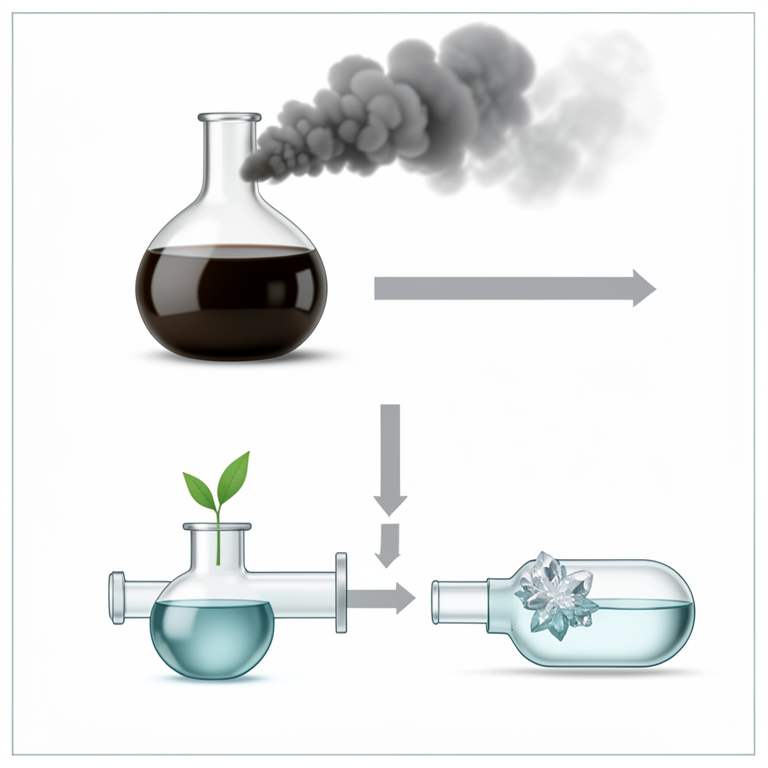
Traditional vs. Green Synthesis Comparison
AI-generated conceptual illustration (chemical laboratory glassware and organic molecules). It explains the idea and does not show study data.
View source evidence ↗Introduction
The increasing awareness of environmental issues and the need for sustainable development have driven the chemical industry to adopt greener practices. Traditional organic synthesis often involves hazardous reagents, toxic solvents, and energy-intensive processes, which contribute to environmental pollution and pose significant health risks. The chemical industry is a substantial contributor to global pollution, with traditional synthetic processes releasing large amounts of harmful byproducts into the environment. For example, the production of fine chemicals and pharmaceuticals generates between 25 to 100 kg of waste per kilogram of product. Green chemistry, a concept introduced by Paul Anastas and John Warner in the 1990s, aims to design chemical products and processes that minimize the use and generation of hazardous substances. The principles of green chemistry provide a framework for developing more sustainable chemical processes. These principles include waste prevention, atom economy, the use of safer solvents and reaction conditions, renewable feedstocks, and energy efficiency (Anastas & Warner, 1998) [1] . The adoption of green chemistry practices is not only beneficial for the environment but also economically advantageous. For instance, companies implementing green chemistry principles have reported significant cost savings due to reduced waste disposal costs and improved process efficiencies. A report by the American Chemical Society highlighted that green chemistry can lead to a 20-50% reduction in production costs (ACS Green Chemistry Institute, 2012). One of the primary focuses of green chemistry is the development of green synthetic routes for organic compounds. Organic compounds are crucial for various applications in pharmaceuticals, agrochemicals, and materials science. However, their traditional synthesis often involves the use of hazardous chemicals and generates substantial waste. The pharmaceutical industry, for example, is known for its complex synthetic processes that can be highly polluting. In 2006, the global pharmaceutical market was estimated to generate approximately 150,000 tons of hazardous waste annually. Advancements in green synthetic methodologies have shown promise in addressing these challenges. For example, the use of alternative solvents, such as water, supercritical fluids, and ionic liquids, has gained popularity due to their lower environmental impact compared to traditional organic solvents. Water, in particular, is an attractive solvent for green chemistry because it is non-toxic, abundant, and can offer unique reactivity for certain reactions. Studies have shown that using water as a solvent can enhance reaction rates and selectivity in organic synthesis. Biocatalysis is another green chemistry approach that utilizes natural catalysts, such as enzymes, to perform chemical reactions under mild conditions. Enzymatic reactions are highly specific, often operate under ambient conditions, and produce fewer byproducts. For instance, the use of lipases in esterification reactions has been widely adopted in the synthesis of fine chemicals and pharmaceuticals, offering a greener alternative to traditional acid-catalyzed methods.
Microwave-assisted synthesis is a technique that uses microwave radiation to heat reaction mixtures, significantly reducing reaction times and energy consumption. This method has been successfully applied in various organic transformations, including the synthesis of heterocycles and peptides. Microwave-assisted synthesis often results in higher yields and purities compared to conventional heating methods.
Flow chemistry, which involves the continuous flow of reactants through a reactor, offers several advantages over traditional batch processes. Flow reactors provide improved heat and mass transfer, precise control over reaction conditions, and scalability. This approach has been utilized in the synthesis of active pharmaceutical ingredients (APIs), enabling safer and more efficient production processes. The development of green synthetic routes is essential for reducing the environmental impact of chemical manufacturing. By adopting sustainable practices and innovative technologies, the chemical industry can produce organic compounds more efficiently and with fewer harmful byproducts. This research focuses on evaluating recent advancements in green synthetic methodologies and their applications in the synthesis of organic compounds. Through a detailed examination of case studies and emerging technologies, this paper aims to highlight the benefits and challenges of implementing green chemistry in organic synthesis and suggest future directions for research and application.
Objective of paper
The objective of this paper is to explore and evaluate the development of green synthetic routes for organic compounds, emphasizing sustainable practices and innovative technologies.
Principles of Green Chemistry
Green chemistry is a field focused on designing products and processes that minimize or eliminate the use and generation of hazardous substances. It seeks to reduce the environmental impact of chemical manufacturing and to make chemistry more sustainable. Paul Anastas and John Warner introduced the twelve principles of green chemistry to provide a framework for chemists to develop more environmentally friendly processes. These principles have since guided research and industrial practices aimed at reducing the ecological footprint of chemical synthesis and manufacturing.
Waste prevention emphasizes designing chemical processes to minimize the generation of waste at the source, rather than dealing with waste after it has been created. This principle aligns with the waste hierarchy that prioritizes waste prevention over recycling and disposal. For instance, research has shown that by optimizing reaction conditions and using catalytic processes, waste generation can be significantly reduced in industrial chemical processes.
Green synthetic strategies
Several strategies have been employed to develop green synthetic routes for organic compounds. These strategies include the use of alternative solvents, biocatalysis, microwave-assisted synthesis, and flow chemistry.
Alternative solvents: Traditional organic solvents are often volatile, toxic, and non-renewable. Green chemistry promotes the use of alternative solvents such as water, ionic liquids, and supercritical fluids. For instance, water, as a solvent, offers numerous advantages due to its non-toxicity, abundance, and unique reactivity. Ionic liquids, which are salts in the liquid state, provide a non-volatile and recyclable alternative to conventional solvents. Supercritical carbon dioxide, with its tunable properties, is another environmentally friendly solvent used in various organic transformations.
Biocatalysis: Enzymes, nature's catalysts, offer high specificity and mild reaction conditions. Biocatalysis utilizes enzymes or whole-cell systems to catalyze chemical reactions, providing a sustainable alternative to traditional chemical catalysts. For example, lipases are widely used in esterification and transesterification reactions, while oxidoreductases are employed in selective oxidations.
Microwave-assisted synthesis: Microwave irradiation can significantly accelerate chemical reactions by providing uniform and rapid heating. Microwave-assisted synthesis reduces reaction times and energy consumption while often enhancing yields and selectivity. This technique has been applied in various organic transformations, including the synthesis of heterocycles, peptides, and polymers.
Flow chemistry: Continuous flow chemistry offers several advantages over traditional batch processes, including improved heat and mass transfer, precise control over reaction conditions, and scalability. Flow reactors can be coupled with in-line analytical techniques for real-time monitoring and optimization of reactions. This approach has been successfully applied in the synthesis of pharmaceuticals, fine chemicals, and natural products.
Case studies
Several case studies illustrate the successful implementation of green synthetic routes for organic compounds.
Synthesis of ibuprofen:
The traditional synthesis of ibuprofen involves multiple steps with hazardous reagents and generates significant waste. A greener synthetic route developed by BHC Company (now part of BASF) uses a catalytic process that reduces waste and improves atom economy. This process employs a hydrogenation step and avoids the use of toxic reagents, making it more environmentally friendly.
Production of artemisinin: Artemisinin, an antimalarial drug, is traditionally extracted from the plant Artemisia annua. Synthetic biology approaches have enabled the production of artemisinin through the fermentation of genetically engineered yeast. This biotechnological route offers a sustainable and scalable alternative to plant extraction, ensuring a stable supply of the drug and reducing environmental impact.
Green synthesis of ionic liquids: Ionic liquids are versatile solvents with applications in catalysis, extraction, and electrochemistry. A green synthetic route for ionic liquids involves the use of benign starting materials and energyefficient processes. For instance, the synthesis of imidazolium-based ionic liquids can be achieved using microwave-assisted methods, reducing reaction times and energy consumption compared to conventional heating.
Sustainable polymerization processes:
Polymers are essential materials in various industries, but their production often involves toxic monomers and solvents. Green chemistry principles have been applied to develop sustainable polymerization processes. For example, the ringopening polymerization of lactide to produce polylactic acid (PLA), a biodegradable polymer, can be catalyzed by renewable catalysts such as tin octoate. Additionally, supercritical carbon dioxide has been used as a solvent for polymerization, eliminating the need for organic solvents.
Conclusion
The development of green synthetic routes for organic compounds is essential for addressing the environmental and health challenges posed by traditional chemical processes. By embracing the principles of green chemistry, researchers and industry professionals can design more sustainable and efficient synthetic methods that minimize waste, reduce the use of hazardous substances, and conserve energy and resources. The integration of alternative solvents, biocatalysis, microwave-assisted synthesis, and flow chemistry has demonstrated significant potential in creating greener chemical processes. Despite the progress made, further research and innovation are needed to overcome existing challenges and to scale these green methodologies for broader industrial applications. Continued collaboration between academia, industry, and policymakers will be crucial in driving the adoption of green chemistry practices, ultimately contributing to a more sustainable and environmentally friendly chemical industry.
References
6 in the original paper- Kolpin DW, Furlong ET, Meyer MT, Thurman EM, Zaugg SD, Barber LB, et al. Pharmaceuticals, hormones, and other organic wastewater contaminants in US streams, 1999-2000: A national reconnaissance. Environ Sci Technol. 2002;36(6):1202-1211.
- Martinez JL. Environmental pollution by antibiotics and by antibiotic resistance determinants. Environ Pollut. 2009;157(11):2893-2902.
- Morse GK, Brett SW, Guy JA, Lester JN. Review: Phosphorus removal and recovery technologies. Sci Total Environ. 1998;212(1):69-81.
- Smith VH, Tilman GD, Nekola JC. Eutrophication: Impacts of excess nutrient inputs on freshwater, marine, and terrestrial ecosystems. Environ Pollut. 1999;100(13):179-196.
- Snyder SA, Westerhoff P, Yoon Y, Sedlak DL. Pharmaceuticals, personal care products, and endocrine disruptors in water: Implications for the water industry. Environ Eng Sci. 2003;20(5):449-469.
- Vymazal J. Constructed wetlands for wastewater treatment: Five decades of experience. Environ Sci Technol. 2011;45(1):61-69.