
Research article · 2022 · Full text
International Journal of Advanced Chemistry ResearchThe impact of computational chemistry on modern drug discovery
Volume 4(2) · Pages 398–400 · DOI: 10.33545/26646781.2022.v4.i2f.195 ↗
Research areasComputational Drug Discovery MethodsGenetics, Bioinformatics, and Biomedical Research
Abstract
Author-writtenComputational chemistry has revolutionized modern drug discovery by enabling the prediction, simulation, and analysis of molecular structures and interactions at an unprecedented scale. This review provides a comprehensive overview of the key computational methods and tools used in drug discovery, including molecular docking, molecular dynamics simulations, quantum mechanics, and machine learning. The article discusses the application of these techniques in various stages of drug development, highlights recent advancements, and explores future directions in the field. The integration of computational chemistry into drug discovery processes has significantly accelerated the identification and optimization of new therapeutic candidates, offering substantial benefits in terms of cost, time, and efficacy.
Summary
Source-checkedPlain-language reading of the full paper, prepared with AI and checked against the text. Each point links to the authors' own words.
Why it matters
- Traditional experimental drug discovery is characterized by being costly, time-consuming, and labor-intensive. View evidence ↗
- Computational chemistry has transformed drug discovery by allowing the analysis and simulation of molecular interactions on a massive scale. View evidence ↗
- Integrating computational methods into the drug discovery process improves efficacy and reduces the time and cost required to identify and optimize therapeutic candidates. View evidence ↗
The question
- The paper aims to review how computational chemistry impacts modern drug discovery, focusing on its methodologies, applications, and recent progress. View evidence ↗
What they did
- The primary computational techniques discussed include molecular docking, molecular dynamics (MD) simulations, quantum mechanics (QM), and machine learning (ML). View evidence ↗
- Molecular docking utilizes software like AutoDock, Glide, and GOLD to predict how ligands bind to target proteins. View evidence ↗
- Quantum mechanics employs density functional theory (DFT) and ab initio calculations to provide high-accuracy descriptions of chemical reactivity and electronic structures. View evidence ↗
- Machine learning algorithms use experimental data to predict pharmacokinetic properties, including toxicity, solubility, and binding affinities. View evidence ↗
What they found
- Molecular docking was instrumental in identifying HIV protease inhibitors by optimizing binding interactions to improve antiviral activity. View evidence ↗
- Molecular dynamics (MD) simulations aided the development of kinase inhibitors by revealing critical binding pathways and conformational states. View evidence ↗
- Machine learning models have been applied to screen large libraries and analyze viral protein structures to predict potential COVID-19 therapeutics. View evidence ↗
- Virtual screening enabled the rapid development of COVID-19 therapeutics by identifying inhibitors of the SARS-CoV-2 main protease. View evidence ↗
- Computational chemistry has driven the lead optimization process for selective kinase inhibitors used in cancer therapy. View evidence ↗
- Computational toxicology models are used to predict adverse effects such as genotoxicity, cardiotoxicity, and hepatotoxicity. View evidence ↗
What it means
- The authors conclude that combining computational and experimental approaches will increase the success rate, cost-effectiveness, and efficiency of developing new drugs. View evidence ↗
- The authors state that full realization of computational chemistry's potential requires essential collaboration between regulatory agencies, industry, and academia. View evidence ↗
Visual summary
1 visualsIllustrations explain the paper; they do not show study data.
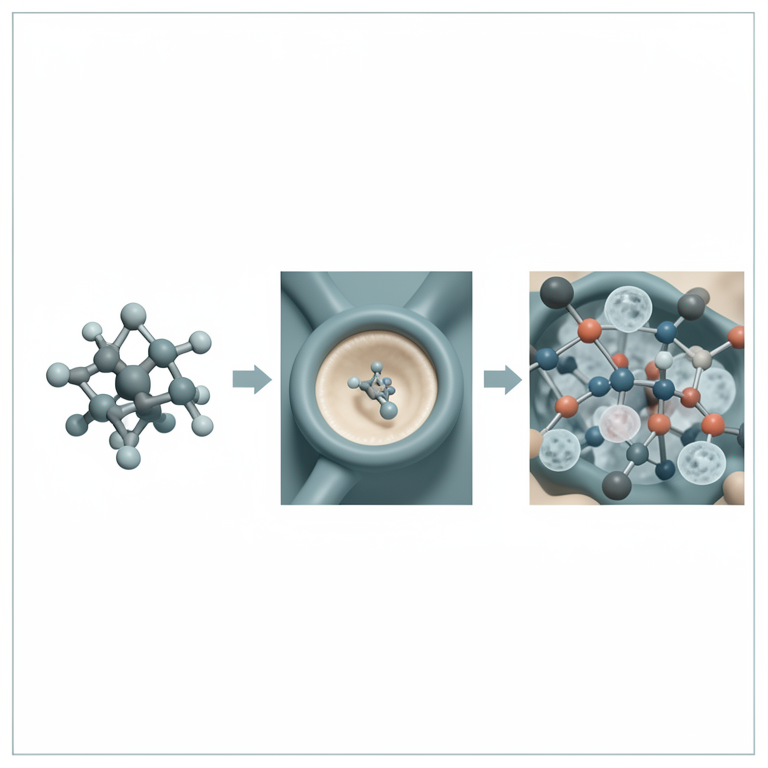
Computational Chemistry Toolkit
AI-generated conceptual illustration (a small molecule drug candidate and a protein receptor). It explains the idea and does not show study data.
View source evidence ↗Introduction
The pharmaceutical industry has traditionally relied on experimental approaches for drug discovery, a process that is often labor-intensive, time-consuming, and costly. The advent of computational chemistry has significantly transformed this landscape, providing powerful tools and methodologies to predict, simulate, and analyze the behavior of molecules in silico. This transformation has allowed researchers to explore vast chemical spaces, identify potential drug candidates, and optimize lead compounds with unprecedented efficiency and precision. Computational chemistry encompasses a variety of techniques, including molecular docking, molecular dynamics (MD) simulations, quantum mechanics (QM), and machine learning (ML). These methods enable scientists to understand molecular interactions at a fundamental level, predict the behavior of drug molecules, and optimize their properties for enhanced efficacy and safety. For instance, molecular docking helps predict how small molecules bind to their target proteins, providing insights into binding affinities and identifying promising drug candidates. MD simulations offer a dynamic view of molecular interactions, revealing the conformational flexibility and stability of proteinligand complexes over time. QM methods, although computationally intensive, provide highly accurate descriptions of electronic structures and chemical reactivity, essential for understanding reaction mechanisms and optimizing molecular geometries. The integration of ML and AI has further revolutionized the field, allowing for the analysis of large datasets and the prediction of molecular properties with high accuracy. These computational techniques are applied across various stages of drug discovery, from virtual screening and lead optimization to the analysis of drug-target interactions and predictive toxicology. Virtual screening leverages computational methods to sift through large chemical libraries, identifying compounds with the highest potential for biological activity. Lead optimization involves refining the properties of these compounds to enhance their pharmacokinetic and pharmacodynamic profiles, guided by insights gained from molecular docking, MD simulations, and QM calculations. Understanding the molecular basis of drug-target interactions is crucial for designing effective therapeutics, and computational chemistry provides the tools to elucidate these interactions at an atomic level. Additionally, predictive toxicology uses computational models to forecast potential toxicities, helping to mitigate safety risks early in the drug development process. The integration of computational chemistry into drug discovery processes offers significant benefits, including reduced costs and accelerated timelines. It allows for the systematic exploration of chemical modifications, guiding synthetic efforts and enhancing the efficiency of the drug development pipeline. The impact of computational chemistry is evident in numerous success stories, such as the rapid development of kinase inhibitors for cancer therapy, the identification of HIV protease inhibitors, and the discovery of potential COVID-19 therapeutics through virtual screening efforts. Recent advancements in highperformance computing (HPC), cloud computing, and algorithm development have further expanded the capabilities of computational chemistry. The advent of deep learning and neural networks has enhanced the predictive power of computational models, enabling more accurate predictions of molecular properties and biological activities.
The increasing availability of structural data from techniques like cryo-electron microscopy (cryo-EM) provides more accurate starting points for computational studies, enhancing the reliability of predictions. Looking forward, the future of computational chemistry in drug discovery appears promising. Continued advancements in AI and ML will likely further improve the predictive accuracy of computational models. The integration of multiscale modelling, which combines atomic-level simulations with systems biology approaches, will provide a more comprehensive understanding of drug actions. Collaborative efforts between academia, industry, and regulatory agencies will be essential to fully harness the potential of computational chemistry, driving innovation and improving the efficiency of drug development. In conclusion, computational chemistry has fundamentally changed the landscape of modern drug discovery, providing essential tools and methodologies that have significantly accelerated the identification and optimization of new therapeutic candidates. The continued advancement and integration of computational techniques will undoubtedly play a critical role in the future of drug discovery, offering substantial benefits in terms of cost, time, and efficacy.
Main objective
The main objective of this paper is to review the impact of computational chemistry on modern drug discovery, highlighting key methodologies, applications, and recent advancements in the field.
Computational methods in drug discovery
Molecular docking is a key computational technique used to predict the preferred orientation of a small molecule (ligand) when bound to a target protein (receptor). By simulating the docking process, researchers can estimate the binding affinity and identify potential drug candidates. Popular docking programs such as AutoDock, Glide, and GOLD use different algorithms to explore conformational space and generate binding poses. Docking studies provide insights into the molecular interactions between the ligand and the receptor, facilitating the rational design of more potent and selective compounds. For example, the successful identification of HIV protease inhibitors was significantly aided by molecular docking, which helped to optimize binding interactions and improve antiviral activity [1] . Molecular dynamics (MD) simulations offer a dynamic view of molecular interactions by simulating the physical movements of atoms and molecules over time. MD simulations provide detailed information on the conformational flexibility and stability of protein-ligand complexes, allowing researchers to understand the dynamic behavior of drug targets. MD simulations have been instrumental in studying protein folding, conformational changes, and the effect of mutations on protein function. For instance, the development of novel kinase inhibitors benefited from MD simulations, which revealed key conformational states and binding pathways critical for drug efficacy [2] . Quantum mechanics (QM) methods, including density functional theory (DFT) and ab initio calculations, provide accurate descriptions of electronic structures and chemical reactivity. QM methods are particularly useful for studying reaction mechanisms, calculating binding energies, and optimizing molecular geometries. Although QM calculations are computationally intensive, they offer unparalleled accuracy in predicting molecular properties.
The application of QM methods in drug discovery has led to the identification of new catalytic mechanisms and the design of enzyme inhibitors with high specificity [3] . Machine learning (ML) and artificial intelligence (AI) have emerged as powerful tools in computational chemistry, enabling the analysis of large datasets and the prediction of molecular properties. ML algorithms can be trained on experimental data to predict binding affinities, solubility, toxicity, and other pharmacokinetic properties. Recent advancements in ML, such as deep learning and neural networks, have further enhanced the predictive power of computational models. For example, ML models have been used to predict the activity of potential COVID-19 therapeutics by analyzing viral protein structures and screening large compound libraries [4] .
Applications of computational chemistry in drug discovery
Virtual screening is a computational technique used to identify potential drug candidates from large chemical libraries. By leveraging molecular docking, ML, and other computational methods, virtual screening can rapidly evaluate thousands of compounds and prioritize those with the highest likelihood of biological activity. Virtual screening has been successfully applied in the discovery of new antibiotics, anticancer agents, and antiviral drugs. For example, virtual screening played a crucial role in identifying potential inhibitors of the SARS-CoV-2 main protease, leading to the rapid development of COVID-19 therapeutics [5] . Once potential drug candidates are identified, computational chemistry techniques are used to optimize their pharmacokinetic and pharmacodynamic properties. Molecular docking and MD simulations help to refine binding interactions, while QM methods provide insights into electronic properties and reactivity. Lead optimization aims to improve the efficacy, selectivity, and safety of drug candidates. Computational tools enable the systematic exploration of chemical modifications, guiding synthetic efforts and accelerating the optimization process. The development of selective kinase inhibitors for cancer therapy is a prime example of how computational chemistry has driven lead optimization [6] . Understanding the molecular basis of drug-target interactions is crucial for the design of effective therapeutics. Computational chemistry provides detailed insights into the binding mechanisms, identifying key residues and interactions that contribute to binding affinity and specificity. MD simulations and QM calculations have been used to elucidate the binding modes of various drug targets, including G protein-coupled receptors (GPCRs), ion channels, and enzymes. These insights facilitate the rational design of drugs with improved binding properties and reduced off-target effects [7] .
Predicting the toxicity of drug candidates is a critical aspect of drug development. Computational models, including ML algorithms, can predict potential toxicities based on chemical structure and known toxicological data. These predictions help to identify and mitigate safety risks early in the drug development process. Computational toxicology has been applied to predict hepatotoxicity, cardiotoxicity, and genotoxicity, among other adverse effects. By integrating these predictions with experimental data, researchers can make informed decisions on the safety profiles of drug candidates [8] .
Recent advancements and future directions
Recent advancements in computational chemistry have significantly enhanced its impact on drug discovery. The integration of high-performance computing (HPC) and cloud computing has enabled the handling of larger datasets and more complex simulations. The development of new algorithms and software tools continues to push the boundaries of what can be achieved computationally.
Looking ahead, the future of computational chemistry in drug discovery is promising. The continued advancement of AI and ML techniques will further enhance the predictive power of computational models. The integration of multiscale modelling, combining atomic-level simulations with systems biology approaches, will provide a more comprehensive understanding of drug actions. Moreover, the increasing availability of structural data from techniques such as cryo-electron microscopy (cryo-EM) will provide more accurate starting points for computational studies.
Collaborative efforts between academia, industry, and regulatory agencies will be essential to fully realize the potential of computational chemistry in transforming drug discovery.
Conclusion
Computational chemistry has revolutionized modern drug discovery, providing powerful tools and techniques to predict and analyze molecular interactions. From virtual screening to lead optimization and toxicity prediction, computational methods have significantly accelerated the drug development process. Recent advancements in AI, ML, and high-performance computing continue to enhance the capabilities of computational chemistry, offering new opportunities for innovation in drug discovery. The integration of computational and experimental approaches promises to further improve the efficiency, costeffectiveness, and success rate of developing new therapeutics.
References
7 in the original paper- Morris GM, Huey R, Olson AJ. Using AutoDock for ligand-receptor docking. Current Protocols in Bioinformatics. 2008;24:8-14.
- Karplus M, McCammon JA. Molecular dynamics simulations of biomolecules. Nature Structural Biology. 2002;9(9):646-652.
- Chen H, Engkvist O, Wang Y, Olivecrona M, Blaschke T. The rise of deep learning in drug discovery. Drug Discovery Today. 2018;23(6):1241-1250.
- Trott O, Olson AJ. AutoDock Vina: Improving the speed and accuracy of docking with a new scoring function, efficient optimization, and multithreading. Journal of Computational Chemistry. 2010;31(2):455461.
- Wu P, Nielsen TE, Clausen MH. Small-molecule kinase inhibitors: an analysis of FDA-approved drugs. Drug Discovery Today. 2016;21(1):5-10.
- Dror RO, Dirks RM, Grossman JP, Xu H, Shaw DE. Biomolecular simulation: A computational microscope for molecular biology. Annual Review of Biophysics. 2012;41:429-452.
- Zhang Q, Matlock MK, LeBard DN, Li J, Amaro RE, McCammon JA et al. Accurate data-driven predictions of protein-protein interactions using random forests. Bioinformatics. 2019;35(15):2461-2468.
Cited by 1
From OpenAlex, OpenCitations and reference lists read by Scinovex
- Design and pharmacological assessment of naproxen–ibuprofen linked NSAIDs as selective COX-2 modulators in inflammatory pathways ↗
Tarun Chaudhary, Prabhat Kumar Upadhyay, Ritu Kataria · Inflammopharmacology · 2025
❝ 2