
Research article · 2022 · Full text
International Journal of Advanced Chemistry ResearchChemical characterization and environmental impact of atmospheric pollutants
Volume 4(2) · Pages 389–392 · DOI: 10.33545/26646781.2022.v4.i2f.192 ↗
Research areasAir Quality Monitoring and Forecasting
Abstract
Author-writtenAtmospheric pollutants pose significant threats to environmental and human health. This review article examines the chemical characterization of key atmospheric pollutants, their sources, and the environmental impacts they cause. The paper discusses recent advancements in analytical techniques used for pollutant detection and quantification, the role of atmospheric chemistry in the transformation and transport of pollutants, and the implications for air quality and climate change. The review also highlights strategies for mitigating the impact of atmospheric pollutants.
Summary
Source-checkedPlain-language reading of the full paper, prepared with AI and checked against the text. Each point links to the authors' own words.
Why it matters
- Atmospheric pollution is a critical environmental problem that impacts human health, air quality, the climate, and various ecosystems. View evidence ↗
- Analyzing the chemical behavior and composition of pollutants is necessary to evaluate their environmental effects and create strategies to mitigate them. View evidence ↗
The question
- The paper aims to review the sources, chemical characteristics, and environmental impacts of atmospheric pollutants, while discussing new analytical techniques and mitigation strategies. View evidence ↗
What they did
- The review focuses on six key pollutants: particulate matter (PM), nitrogen oxides (NOx), sulfur dioxide (SO2), volatile organic compounds (VOCs), ozone (O3), and carbon monoxide (CO). View evidence ↗
- Particulate matter is characterized using methods such as mass spectrometry, X-ray fluorescence, ion chromatography, and gravimetric analysis. View evidence ↗
- Nitrogen oxides are typically quantified and detected via gas chromatography, ultraviolet absorption spectroscopy, and chemiluminescence. View evidence ↗
What they found
- Particulate matter is categorized by aerodynamic diameter into three types: coarse (PM10), fine (PM2.5), and ultrafine (PM0.1). View evidence ↗
- Sulfur dioxide undergoes atmospheric oxidation to become sulfuric acid, which leads to the formation of secondary particulate matter and acid rain. View evidence ↗
- Ground-level ozone is a secondary pollutant created when nitrogen oxides (NOx) and volatile organic compounds (VOCs) react photochemically in sunlight. View evidence ↗
- Prolonged exposure to fine particulate matter (PM2.5) is associated with higher mortality rates due to respiratory and cardiovascular diseases. View evidence ↗
- Carbon monoxide reduces the blood's ability to carry oxygen by binding to hemoglobin, which results in tissue hypoxia. View evidence ↗
- Different aerosols affect climate differently: sulfate aerosols cause cooling by reflecting sunlight, whereas black carbon causes warming by absorbing it. View evidence ↗
- Vehicle emissions of PM, VOCs, CO, and NOx have been significantly lowered through the use of selective catalytic reduction (SCR) systems, particulate filters, and catalytic converters. View evidence ↗
What it means
- The authors conclude that the negative impacts of pollutants on the climate, ecosystems, and human health necessitate strict policies, public involvement, and comprehensive technologies for emission control. View evidence ↗
- The authors state that ongoing investment, collaboration, and research are essential to protect public health and the environment from atmospheric pollution. View evidence ↗
Visual summary
1 visualsIllustrations explain the paper; they do not show study data.
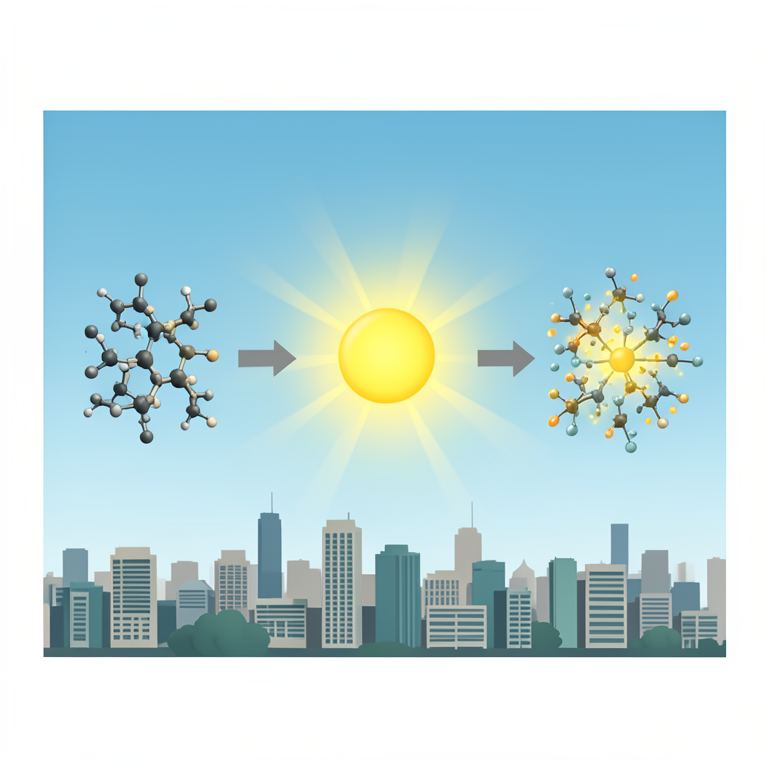
Ozone Formation Process
AI-generated conceptual illustration (Atmospheric gases and sunlight in a city skyline setting). It explains the idea and does not show study data.
View source evidence ↗Introduction
Atmospheric pollution is a pressing environmental issue, affecting air quality, human health, ecosystems, and climate. Key atmospheric pollutants include particulate matter (PM), nitrogen oxides (NOx), sulfur dioxide (SO 2 ), volatile organic compounds (VOCs), ozone (O 3 ), and carbon monoxide (CO). These pollutants originate from various natural and anthropogenic sources and undergo complex chemical transformations in the atmosphere. Understanding the chemical composition and behavior of these pollutants is crucial for assessing their environmental impact and developing effective mitigation strategies.
Objective of paper
The objective of this paper is to review the chemical characterization of atmospheric pollutants, their sources, and their environmental impacts, highlighting recent advancements in analytical techniques and strategies for mitigation.
Chemical characterization of key atmospheric pollutants Particulate Matter (PM)
Particulate matter consists of a mixture of solid particles and liquid droplets suspended in the air. PM is classified based on its aerodynamic diameter into coarse particles (PM10), fine particles (PM2.5), and ultrafine particles (PM0.1). The chemical composition of PM varies depending on the sources and atmospheric processes, including primary emissions and secondary formation. Sources and composition: Primary sources of PM include combustion processes (e.g., vehicle emissions, industrial activities), construction and demolition activities, and natural sources (e.g., dust storms, wildfires). Secondary PM forms through chemical reactions involving precursor gases such as SO 2 , NOx, and VOCs. The composition of PM includes organic carbon, elemental carbon, sulfates, nitrates, ammonium, metals, and trace elements [1] . Analytical techniques: Techniques for characterizing PM include gravimetric analysis, ion chromatography, X-ray fluorescence, and mass spectrometry. Recent advancements in high-resolution mass spectrometry and real-time monitoring techniques have improved the detection and quantification of PM components [2] .
Sources and Formation: NOx is primarily emitted from combustion processes, including vehicle engines, power plants, and industrial facilities. Natural sources include lightning and microbial activity in soils. NO 2 can be further oxidized in the atmosphere to form nitric acid (HNO 3 ), a precursor to nitrate aerosols [3] . Analytical techniques: Detection and quantification of NOx are typically performed using chemiluminescence, ultraviolet absorption spectroscopy, and gas chromatography. Advanced techniques such as differential optical absorption spectroscopy (DOAS) provide high spatial and temporal resolution measurements [4] .
Sulfur Dioxide (SO2)
Sulfur dioxide is a major pollutant emitted from fossil fuel combustion, industrial processes, and natural sources such as volcanic eruptions.
Sources and transformation: Major anthropogenic sources of SO 2 include coal-fired power plants, metal smelting, and oil refining. In the atmosphere, SO 2 is oxidized to sulfuric acid (H 2 SO 4 ), which contributes to acid rain and secondary PM formation [5] . Analytical Techniques: SO 2 is commonly measured using fluorescence spectroscopy, differential optical absorption spectroscopy (DOAS), and ion chromatography. Recent developments in remote sensing technologies, such as satellite-based measurements, have enhanced the monitoring of SO 2 emissions on a global scale [6] .
Volatile Organic Compounds (VOCs)
VOCs are a diverse group of organic chemicals that easily vaporize at room temperature and participate in atmospheric photochemical reactions. Sources and composition: VOCs originate from both anthropogenic sources (e.g., vehicle emissions, industrial processes, solvent use) and natural sources (e.g., vegetation, wildfires). Common VOCs include benzene, toluene, ethylbenzene, and xylene (BTEX), as well as biogenic compounds like isoprene and monoterpenes [7] . Analytical techniques: Techniques for VOC analysis include gas chromatography-mass spectrometry (GC-MS), proton transfer reaction-mass spectrometry (PTR-MS), and Fourier-transform infrared spectroscopy (FTIR). Innovations in portable and real-time monitoring devices have improved the detection and quantification of VOCs in the field [8] .
Ozone (O3)
Ozone is a secondary pollutant formed by the photochemical reactions of NOx and VOCs in the presence of sunlight.
Sources and formation: Ground-level ozone is formed through complex photochemical reactions involving precursors such as NOx and VOCs. Ozone formation is influenced by meteorological conditions, including temperature, sunlight, and wind patterns [9] . Analytical techniques: Ozone concentrations are typically measured using ultraviolet photometry, chemiluminescence, and electrochemical sensors.
Recent advancements in remote sensing technologies, such as satellite-based measurements and ground-based lidar, provide comprehensive data on ozone distribution and trends [10] .
Carbon Monoxide (CO)
Carbon monoxide is a colorless, odorless gas produced by incomplete combustion of carbon-containing fuels.
Sources and behavior: Major sources of CO include vehicle emissions, residential heating, wildfires, and industrial processes. CO acts as a precursor to ozone formation and affects the atmospheric concentrations of greenhouse gases such as methane (CH4) [11] . Analytical techniques: CO is commonly measured using non-dispersive infrared spectroscopy (NDIR), gas chromatography, and electrochemical sensors. Highprecision monitoring networks and satellite-based observations have enhanced the detection and analysis of CO on local and global scales [12] .
Environmental Impact of atmospheric pollutants Human health
Atmospheric pollutants have significant adverse effects on human health. Exposure to high levels of PM, NOx, SO 2 , O 3 , and CO is associated with respiratory and cardiovascular diseases, including asthma, chronic obstructive pulmonary disease (COPD), lung cancer, and heart attacks.
Particulate Matter (PM): Fine and ultrafine particles penetrate deep into the respiratory system, causing inflammation, oxidative stress, and damage to lung tissue. Long-term exposure to PM2.5 is linked to increased mortality from cardiovascular and respiratory diseases [13] . Nitrogen Oxides (NOx): NO 2 exposure is associated with respiratory symptoms, reduced lung function, and increased susceptibility to respiratory infections. NOx also contributes to the formation of ground-level ozone, which exacerbates asthma and other respiratory conditions [14] . Sulfur Dioxide (SO2): Short-term exposure to SO 2 can cause respiratory symptoms, bronchoconstriction, and increased asthma attacks. Long-term exposure is associated with chronic respiratory diseases and reduced lung function [15] . Volatile Organic Compounds (VOCs): Exposure to certain VOCs, such as benzene, is linked to cancer, neurological disorders, and liver and kidney damage.
VOCs also contribute to the formation of ground-level ozone and secondary PM, further impacting health [16] . Ozone (O3): Ground-level ozone causes respiratory symptoms, aggravates asthma, and reduces lung function. Long-term exposure is associated with increased mortality from respiratory and cardiovascular diseases [17] . Carbon Monoxide (CO): CO binds to hemoglobin in the blood, reducing the oxygen-carrying capacity and leading to tissue hypoxia. High levels of CO exposure can cause headaches, dizziness, impaired cognitive function, and, in severe cases, death [18] .
Ecosystems
Atmospheric pollutants also have detrimental effects on ecosystems, affecting vegetation, soil, and water quality. Acid deposition: SO 2 and NOx contribute to acid rain, which acidifies soils and water bodies, leading to nutrient imbalances and harming aquatic and terrestrial ecosystems. Acid deposition can damage vegetation, reduce biodiversity, and disrupt food webs [19] . Ozone damage: Ground-level ozone can cause visible injury to plant leaves, reduce photosynthesis, and impair plant growth. Ozone-sensitive species are particularly vulnerable, leading to changes in species composition and ecosystem structure [20] . Nutrient imbalance: Nitrogen deposition from NOx can lead to nutrient imbalances in soils and water bodies, promoting the growth of nitrogen-tolerant species and reducing biodiversity. Excess nitrogen can also cause eutrophication in aquatic ecosystems, leading to algal blooms and oxygen depletion [21] . Heavy Metal Contamination: PM can transport heavy metals, such as lead, mercury, and cadmium, to soils and water bodies. These metals can accumulate in the food chain, posing risks to wildlife and human health [22] .
Climate change
Atmospheric pollutants play a significant role in climate change by influencing radiative forcing and atmospheric chemistry.
Greenhouse gases: Pollutants such as CO and VOCs contribute to the formation of greenhouse gases like methane (CH4) and tropospheric ozone, which trap heat in the atmosphere and contribute to global warming [23] . Aerosols: PM, particularly sulfate and black carbon aerosols, can influence the Earth's radiative balance. Sulfate aerosols reflect sunlight, causing cooling, while black carbon absorbs sunlight, leading to warming. The net effect of aerosols on climate depends on their composition and distribution [24] . Atmospheric chemistry: Pollutants such as NOx, CO, and VOCs influence the chemical composition of the atmosphere, affecting the lifetime and concentration of greenhouse gases. For example, NOx and VOCs contribute to the formation of tropospheric ozone, a potent greenhouse gas [25] .
Mitigation strategies Emission control technologies
Effective mitigation of atmospheric pollution requires the implementation of advanced emission control technologies. Vehicle emission controls: Technologies such as catalytic converters, particulate filters, and selective catalytic reduction (SCR) systems have significantly reduced emissions of NOx, CO, VOCs, and PM from vehicles. The adoption of electric vehicles (EVs) and hybrid vehicles further reduces emissions from the transportation sector [26] . Industrial emission controls: Industries employ various technologies to reduce emissions, including flue gas desulfurization (FGD) for SO 2 control, selective non-catalytic reduction (SNCR) for NOx reduction, and electrostatic precipitators (ESP) for PM removal. The transition to cleaner fuels and renewable energy sources also reduces industrial emissions [27] .
Residential and commercial emission controls:
Improving energy efficiency, adopting cleaner heating technologies, and reducing the use of volatile organic compounds in household products can mitigate emissions from residential and commercial sources [28] .
Policy and regulation
Effective policies and regulations are crucial for controlling atmospheric pollution and protecting public health and the environment.
Air quality standards: Establishing and enforcing air quality standards for pollutants such as PM, NOx, SO 2 , O 3 , and CO is essential for protecting public health. Standards set by agencies like the U.S. Environmental Protection Agency (EPA) and the World Health Organization (WHO) provide guidelines for permissible levels of pollutants [29] .
Conclusion
Chemical characterization and understanding the environmental impact of atmospheric pollutants are critical for developing effective mitigation strategies. Advances in analytical techniques have improved our ability to detect and quantify pollutants, providing valuable insights into their sources, transformation, and behavior. The adverse effects of atmospheric pollutants on human health, ecosystems, and climate underscore the need for comprehensive emission control technologies, stringent policies, and public engagement. Continued research, collaboration, and investment are essential to address the challenges of atmospheric pollution and protect the environment and public health.
References
27 in the original paper- Pöschl U. Atmospheric aerosols: composition, transformation, climate and health effects. Angew Chem. Int. Ed Engl. 2005;44(46):7520-7540.
- Galloway JN, Dentener FJ, Capone DG, et al. Nitrogen cycles: past, present, and future. Biogeochemistry. 2004;70(2):153-226.
- Smith SJ, Bond TC. Two hundred fifty years of aerosols and climate: the end of the age of aerosols. Atmos Chem Phys. 2014;14(2):537-549.
- Carn SA, Fioletov VE, McLinden CA, et al. A decade of global volcanic SO 2 emissions measured from space. Sci. Rep. 2017;7:44095.
- Atkinson R, Arey J. Atmospheric degradation of volatile organic compounds. Chem. Rev. 2003;103(12):4605-4638.
- de Gouw JA, Warneke C. Measurements of volatile organic compounds in the earth's atmosphere using proton-transfer-reaction mass spectrometry. Mass Spectrom Rev. 2007;26(2):223-257.
- Monks PS, Granier C, Fuzzi S, et al. Atmospheric composition change -global and regional air quality. Atmos Environ. 2009;43(33):5268-5350.
- Liu J, Mauzerall DL, Horowitz LW, et al. Evaluating inter-continental transport of fine aerosols: (2) Global health impact. Atmos. Environ. 2009;43(28):43394347.
- Logan JA, Prather MJ, Wofsy SC, McElroy MB. Tropospheric chemistry: A global perspective. J Geophys Res. 1981;86(C8):7210-7254.
- Duncan BN, West JJ, Yoshida Y, et al. The observed response of ozone to NOx reductions in the United States. Atmos. Chem. Phys. 2010;10(21):10761-10775.
- Brook RD, Rajagopalan S, Pope CA, et al. Particulate matter air pollution and cardiovascular disease: An update to the scientific statement from the American Heart Association. Circulation. 2010;121(21):23312378.
- Shah ASV, Langrish JP, Nair H, et al. Global association of air pollution and heart failure: a systematic review and meta-analysis. Lancet. 2013;382(9897):1039-1048.
- Dockery DW, Pope CA, Xu X, et al. An association between air pollution and mortality in six U.S. cities. N Engl. J Med. 1993;329(24):1753-1759.
- Zhang JJ, Day DB, Coutts A, et al. Ambient air pollution and children's lung function in China. Am J Respir Crit Care Med. 2019;200(7):759-767.
- Jerrett M, Burnett RT, Pope CA, et al. Long-term ozone exposure and mortality. N Engl. J Med. 2009;360(11):1085-1095.
- Brunekreef B, Holgate ST. Air pollution and health. Lancet. 2002;360(9341):1233-1242.
- Driscoll CT, Lawrence GB, Bulger AJ, et al. Acidic deposition in the northeastern United States: sources and inputs, ecosystem effects, and management strategies. Bio. Science. 2001;51(3):180-198.
- Ashmore MR. Assessing the future global impacts of ozone on vegetation. Plant Cell Environ. 2005;28(8):949-964.
- Bobbink R, Hicks K, Galloway J, et al. Global assessment of nitrogen deposition effects on terrestrial plant diversity: A synthesis. Ecol. Appl. 2010;20(1):3059.
- Pacyna EG, Pacyna JM, Steenhuisen F, Wilson S. Global anthropogenic mercury emission inventory for 2000. Atmos. Environ. 2006;40(22):4048-4063.
- Myhre G, Shindell D, Bréon FM, et al. Anthropogenic and natural radiative forcing. In: Stocker TF, Qin D, Plattner GK, et al., editors. Climate Change 2013: The Physical Science Basis. Cambridge University Press; c2013.
- Bond TC, Doherty SJ, Fahey DW, et al. Bounding the role of black carbon in the climate system: A scientific assessment. J Geophys Res Atmos. 2013;118(11):53805552.
- Fiore AM, Dentener FJ, Wild O, et al. Multimodel estimates of intercontinental source-receptor relationships for ozone pollution. J Geophys. Res. Atmos, 2009, 114(D4).
- Anenberg SC, Miller J, Henze DK, et al. Impacts of intercontinental transport of anthropogenic fine particulate matter on human mortality. Air Qual. Atmos. Health. 2014;7(3):369-379.
- Fenger J. Urban air quality. Atmos. Environ. 1999;33(29):4877-4900.
- Jones AP. Indoor air quality and health. Atmos. Environ. 1999;33(28):4535-4564.
- Nemet GF, Holloway T, Meier P. Implications of incorporating air-quality co-benefits into climate change policymaking. Environ Res. Lett. 2010;5(1):014007.