
Research article · 2024 · Full text
International Journal of Research in AgronomyEvaluation of performance of cowpea genotypes (Vigna unguiculata L.) for growth, yield & quality under Prayagraj agro-climatic condition
Volume 7(7S) · Pages 247–250 · DOI: 10.33545/2618060x.2024.v7.i7sd.1034 ↗
Research areasAgricultural pest management studiesAgricultural Science and FertilizationGenetics and Plant Breeding
Abstract
Author-writtenThe experiment “Evaluation of performance of cowpea genotypes (Vigna unguiculata L.) for growth, yield & quality under Prayagraj agro-climatic condition” was conducted at Department of Horticulture, Naini Agricultural Institute, SHUATS, Prayagraj during 2023-24 in order to standardize the best genotype of Cowpea. IET2023/COPBVAR-6 (G6) found to be the earliest (4.91). The Cowpea genotypes IET2023/COPBVAR-6 (G6) had noticed more yields per plant (277 g), and per ha (285 Q/ha). Under Allahabad agro climatic conditions. These variety also recorded desirable values for pod parameters like length of pod (34.20cm), weight of 10 pod (158 g), which are parameters deciding a better market acceptability. Thus, on the basis of growth characters, flowering behavior (36.87), yield and yield attributing characters, pod parameters and Cowpea genotypes IET2023/COPBVAR-6 (G6) and Cowpea genotypes IET2023/COPBVAR-6 (G6) were found to be promising. The highest profit and maximum benefit cost ratio (4.91) were observed in cowpea genotypes IET2023/COPBVAR-6 (G6).
Summary
Source-checkedPlain-language reading of the full paper, prepared with AI and checked against the text. Each point links to the authors' own words.
Why it matters
- Cowpea is a significant pulse crop originating from West Africa, valued as a high-protein food source often referred to as 'poor man's meat'. View evidence ↗
- The crop is highly versatile, capable of growing in various soil types and tolerating both drought and high rainfall. View evidence ↗
- In India, cowpea is cultivated for multiple purposes, including its seeds for pulses, pods as vegetables, and foliage for fodder. View evidence ↗
The question
- The study aimed to evaluate various cowpea genotypes to identify and standardize the best performing variety for growth, yield, and quality in the Prayagraj agro-climatic region. View evidence ↗
What they did
- The research was conducted during the 2023 rabi season at the Crop Research Farm of the Department of Horticulture, SHUATS, in Prayagraj. View evidence ↗
- The study site featured sandy loam soil with a pH of 6.9, organic carbon of 0.358%, and available phosphorus and potassium levels of 150.5 kg/ha and 225.5 kg/ha, respectively. View evidence ↗
- Fertilization followed recommended doses of 25 t/ha of FYM or compost and NPK at 25:75:60 kg per ha. View evidence ↗
- The researchers measured plant height at 20, 40, and 60 days after sowing, recorded days to first flowering, and measured pod yield per plant and per hectare. View evidence ↗
What they found
- At 20 days after sowing, genotype IET2023/COPBVAR-6 had the maximum plant height (22.21 cm), while IET2023/COPBVAR-1 had the minimum (18.60 cm). View evidence ↗
- By 60 days after sowing, IET2023/COPBVAR-4 reached the maximum height of 57.06 cm, whereas Kashi Nidhi was the shortest at 50.10 cm. View evidence ↗
- Kashi Gouri flowered earliest at 32.00 days, while IET2023/COPBVAR-2 took the longest time to first flower at 56.6 days. View evidence ↗
- The highest first-picking pod yield per plant was found in IET2023/COPBVAR-6 (277.33 g), and the lowest in C.P.6 (156.67 g). View evidence ↗
- IET2023/COPBVAR-6 achieved the maximum green pod yield of 285.00 q/ha, while IET2023/COPBVAR-1 had the minimum yield of 5.98 q/ha. View evidence ↗
- Genotype IET2023/COPBVAR-6 showed desirable market quality traits, including a pod length of 34.20 cm and a weight of 158 g for 10 pods. View evidence ↗
- The genotype IET2023/COPBVAR-6 provided the highest profit and a maximum benefit-cost ratio of 4.91. View evidence ↗
What it means
- The authors conclude that IET2023/COPBVAR-6 is the most promising genotype due to its superior yield, genetic purity, and resistance to pests, diseases, and environmental stress. View evidence ↗
Visual summary
3 visualsIllustrations explain the paper; charts are replotted from the paper's own table values.
Genotype Performance Comparison
AI-generated conceptual illustration (cowpea plants (Vigna unguiculata L.)). It explains the idea and does not show study data.
View source evidence ↗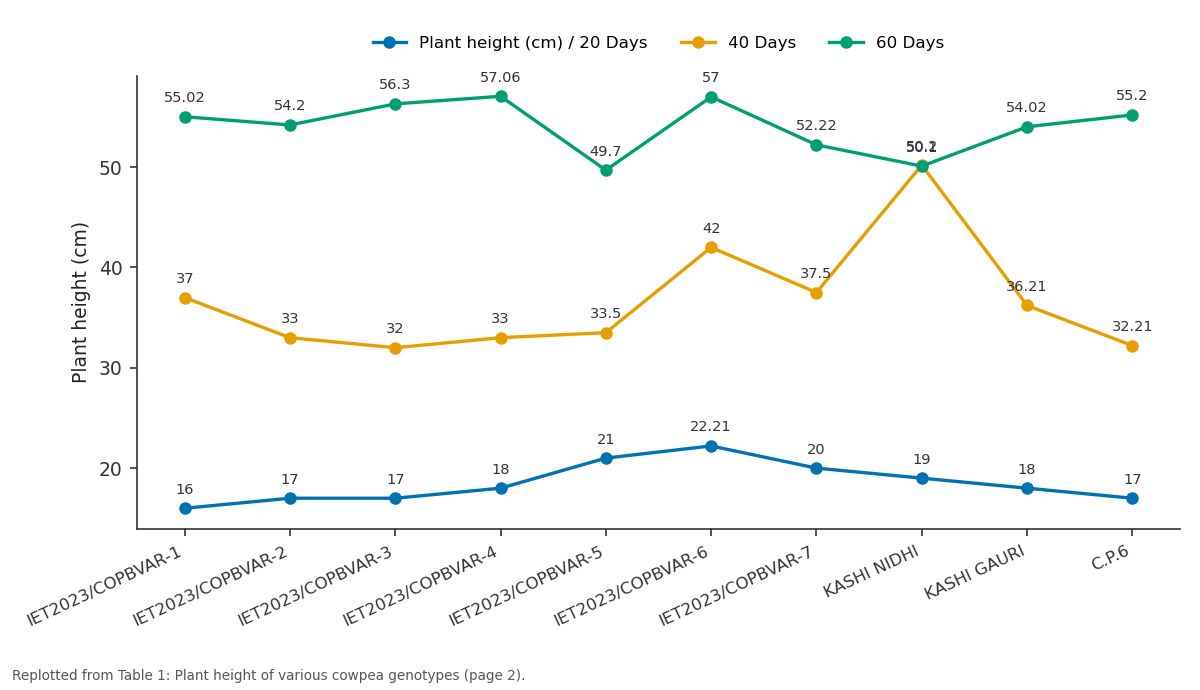
Plant height (cm) / 20 Days and 40 Days and more: IET2023/COPBVAR-1 vs IET2023/COPBVAR-2 vs IET2023/COPBVAR-3 vs IET2023/COPBVAR-4 vs IET2023/COPBVAR-5
Replotted from Table 1 (page 2) of the original paper. Every bar is the paper's own table value.
View source evidence ↗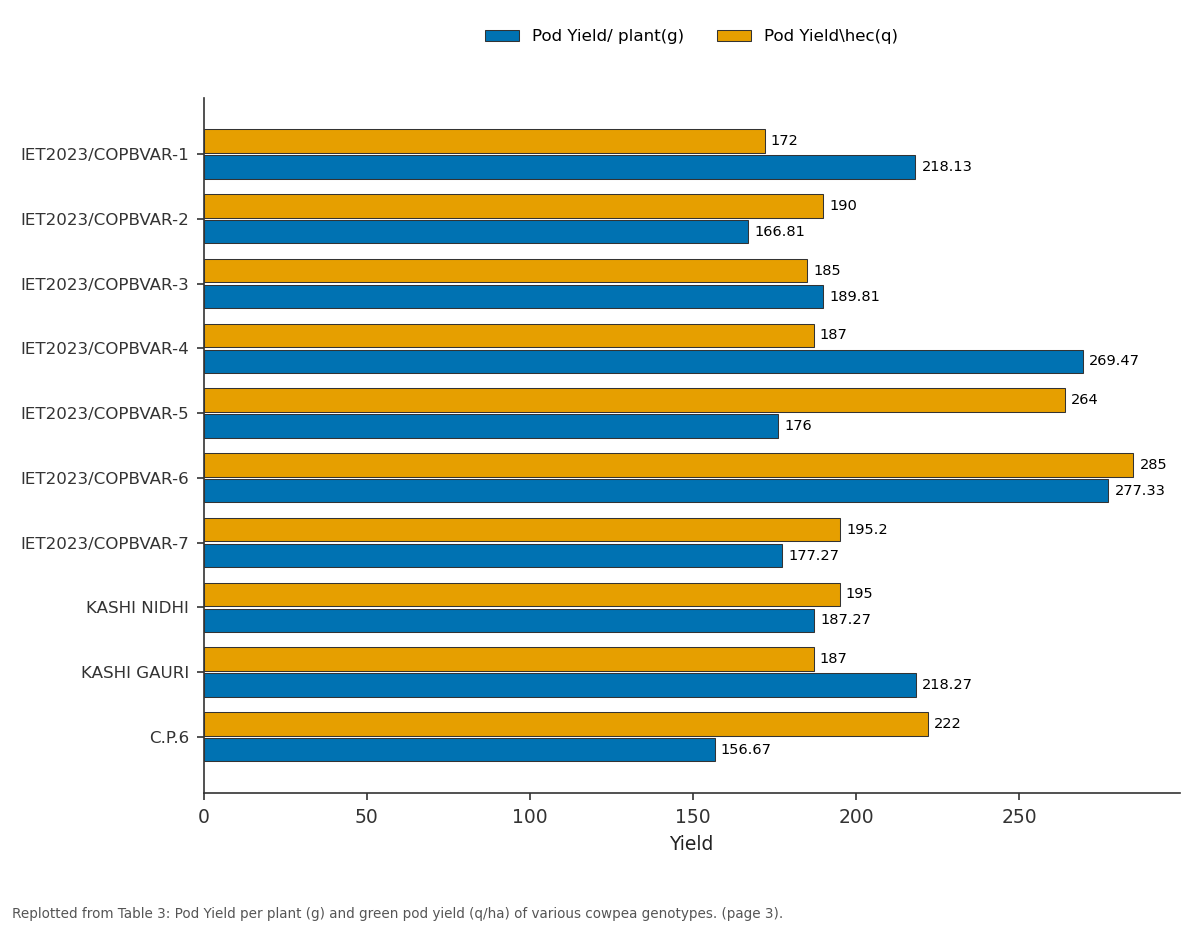
Pod Yield/ plant(g) and Pod Yield\hec(q): IET2023/COPBVAR-1 vs IET2023/COPBVAR-2 vs IET2023/COPBVAR-3 vs IET2023/COPBVAR-4 vs IET2023/COPBVAR-5
Replotted from Table 3 (page 3) of the original paper. Every bar is the paper's own table value.
View source evidence ↗Figures & tables
From the original paper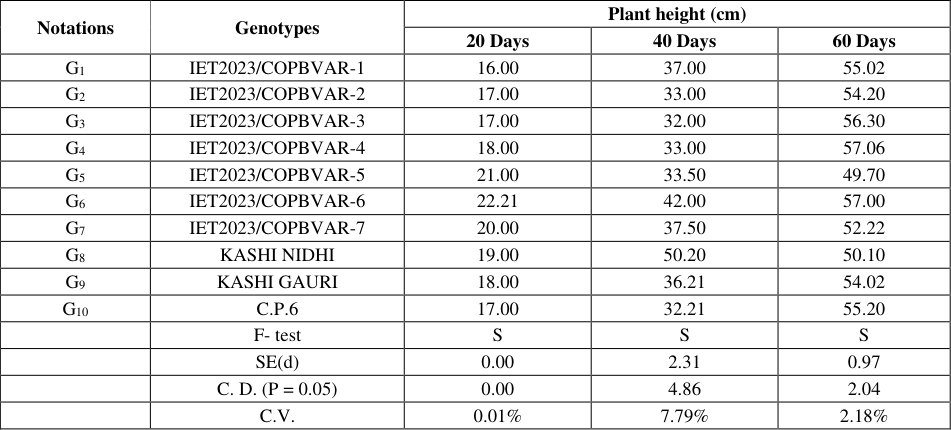 Table 1
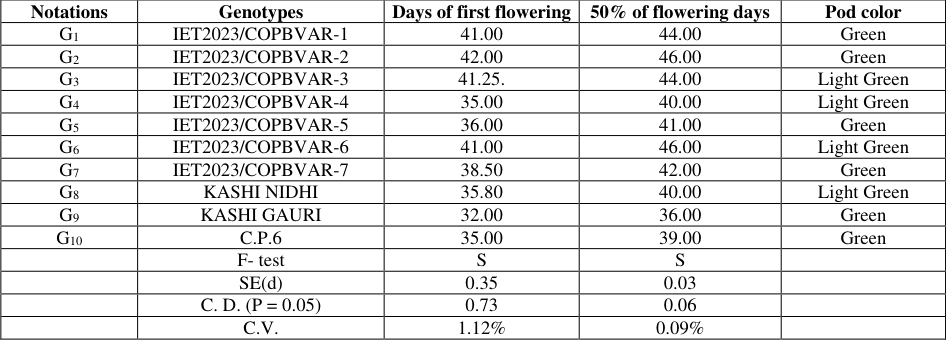 Table 2
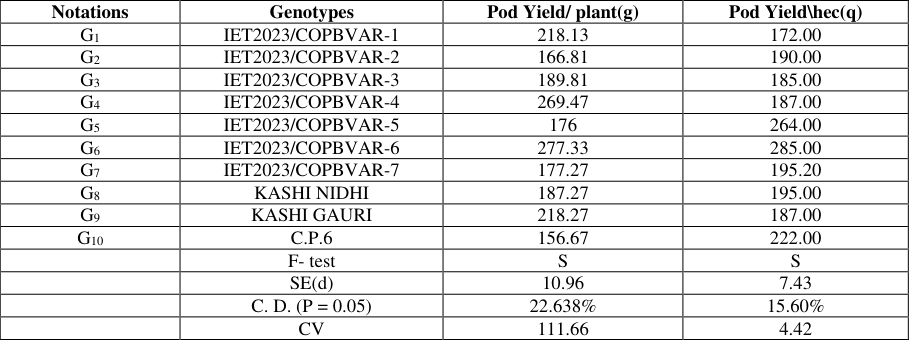 Table 3
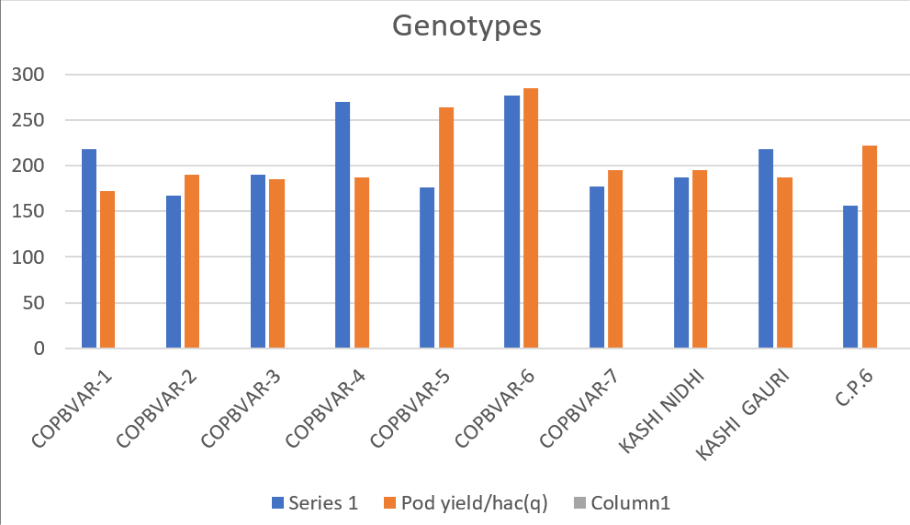 Figure 3
Introduction
Cowpea [Vigna unguiculata (L.) Walp.] is one of the several species of the widely cultivated genus Vigna. Cowpea is a diploid species with a somatic chromosome number 2n=22. It is one of the most important pulse crops native to West Africa Cowpea is called as a poor man"s meat or vegetable meat due to its high amount of protein. The young leaves, pods, and peas contain vitamins and minerals, which are used for human consumption and animal feed. Cowpea can withstand a considerable degree of drought and high rainfall and can be grown in almost all kinds of soils provided there is proper drainage. Cowpea is mainly grown in tropical and subtropical regions in the world for vegetable and grain purpose and to a lesser extent as a fodder crop. It is a most versatile pulse crop because of its smothering nature, drought tolerant characters, soil restoring properties and multi-purpose uses. As a pulse crop, cowpea fits well into most of the cropping systems. It is cultivated for its seed (green or dried), pods and/or leaves, which are consumed in a fresh form as a green vegetable, while snacks and main meal dishes are prepared from the dried grain (Kumar and Shrikant 2017) [9,10] . Cowpea is a warm-season, self-pollinated annual herb with a wide range of growth habit and response to photoperiod. It is grown throughout India for its long green pods as vegetable, seeds as pulse and foliage as vegetable and fodder. When grown for dry seeds, it is also known as black-eye pea, kaffir pea, china pea and southern bean. The cultivars grown for their immature green pods which are used as vegetable are variously known as yardlong bean, asparagus bean and snake bean.
Materials and Methods
Materials and Methods
Experimental Site
The experiment was conducted during the rabi season of 2023 at the Crop Research Farm, Department of Horticulture, SHUATS, Prayagraj. The Crop Research Farm is situated at 25 o 57" N latitude, 87 o 19" E longitude and 98 m altitude from the sea level. This area is situated on the right side of the river Yamuna and by the opposite side of Prayagraj city. All the facilities required for crop cultivation are available.
Climate and Soil
The climate of this region is typically sub-tropical and semi-arid with monsoon commencing by the third week of June and with drawing by end of September. The temperature reached up to 48 o C and in winter it goes down to as low as 2-3 o C. During the summer hot scorching winds known as "Loo" and frost during winter months are common features. The experimental site is levelled land with sandy loam soil of uniform fertility status with low clay and high sand percentage. Soil samples were collected randomly from depth of 0-30 cm and the soil was analysed for pH (6.9), electrical conductivity (0.36), organic carbon (0.358%), available nitrogen, available phosphorus (150.5kg/ha), and available potassium (225.5kg/ha).
Manure and Fertilizers
The quantity of manure and fertilizer were applied according to recommended doses for cowpea i.e., 25 t/ha FYM or compost along with fertilizers N: P: K @ 25:75:60 kg per ha. FYM was well incorporated in plots. Half dose of nitrogen, full dose of phosphorus and potash were applied as basal dose. The remaining half dose of nitrogen was applied at 3 rd week of sowing.
Observation Recorded: Growth Parameters, Reproductive Parameters and Yield parameters
Observation Recorded: Growth Parameters, Reproductive Parameters and Yield parameters
Results and Discussion Plant height in various cowpea genotypes
The Plant height of cowpea are presented in [11] in cowpea and Sawardekar (2007) [12] in yard long bean. Also Kumar et al., (2017) [9,10] .
Days of first flowering in various cowpea genotypes
The minimum number of Days of first flowering was observed in Kashi Gouri (32.00days), followed by C.P.6 with (35.00days) and whereas maximum was (56.6) recorded in IET2023/COPBVAR-2. Similar The genotypes of Kashi Gouri given minimum days to first flowering and observed due to the different location might be due to the favourable Agro-climatic condition and variation in studied genotypes. Similar results observed by Sharma P et al., (2019) [13] .
Days of 50% of flowering in various cowpea genotypes.
The minimum number of Days of first 50% flowering was recorded in Kashi Gouri (36.00 days), followed by C.P.6 with and (39.00 days) and whereas maximum was (46.00) recorded in IET2023/COPBVAR-6. The genotypes of Kashi Gouri given minimum days to 50% flowering and observed due to the different location might be due to the favourable Agro-climatic condition and variation in studied genotypes. Similar results observed by Sharma P et al., (2019) [13] .
Flower Colour in various cowpea genotypes.
The flower colour recorded as green colour was found IET 2023 / COPBVAR -1, IET 2023 / COPBVAR-2 IET 2023/COPBVAR-5, IET2023/COPBVAR-7, kashi gauri and C.P.6. Light color is found in IET2023/COPBVAR-3, IET2023/COPBVAR-4, IET2023/COPBVAR-6 and Kashi Nidhi.
The Pod Yield (q/ha) in plant of cowpea maximum was recorded in IET2023/COPBVAR-6 (285.00), followed by IET2023/COPBVAR-5(264.00) and minimum was (5.98) recorded in IET2023/COPBVAR-1.
Figures and tables from the paper
| Notations | Genotypes | Plant height (cm) | — | — |
|---|---|---|---|---|
| 20 Days | 40 Days | 60 Days | ||
| G1 | IET2023/COPBVAR-1 | 16.00 | 37.00 | 55.02 |
| G2 | IET2023/COPBVAR-2 | 17.00 | 33.00 | 54.20 |
| G3 | IET2023/COPBVAR-3 | 17.00 | 32.00 | 56.30 |
| G4 | IET2023/COPBVAR-4 | 18.00 | 33.00 | 57.06 |
| G5 | IET2023/COPBVAR-5 | 21.00 | 33.50 | 49.70 |
| G6 | IET2023/COPBVAR-6 | 22.21 | 42.00 | 57.00 |
| G7 | IET2023/COPBVAR-7 | 20.00 | 37.50 | 52.22 |
| G8 | KASHI NIDHI | 19.00 | 50.20 | 50.10 |
| G9 | KASHI GAURI | 18.00 | 36.21 | 54.02 |
| G10 | C.P.6 | 17.00 | 32.21 | 55.20 |
| F- test | S | S | S | |
| SE(d) | 0.00 | 2.31 | 0.97 | |
| C. D. (P = 0.05) | 0.00 | 4.86 | 2.04 | |
| C.V. | 0.01% | 7.79% | 2.18% |
Table text extracted from the original PDF; superscript letters are shown inline. The original table image is below.
View original table image
| Notations | Genotypes | Days of first flowering | 50% of flowering days | Pod color |
|---|---|---|---|---|
| G1 | IET2023/COPBVAR-1 | 41.00 | 44.00 | Green |
| G2 | IET2023/COPBVAR-2 | 42.00 | 46.00 | Green |
| G3 | IET2023/COPBVAR-3 | 41.25. | 44.00 | Light Green |
| G4 | IET2023/COPBVAR-4 | 35.00 | 40.00 | Light Green |
| G5 | IET2023/COPBVAR-5 | 36.00 | 41.00 | Green |
| G6 | IET2023/COPBVAR-6 | 41.00 | 46.00 | Light Green |
| G7 | IET2023/COPBVAR-7 | 38.50 | 42.00 | Green |
| G8 | KASHI NIDHI | 35.80 | 40.00 | Light Green |
| G9 | KASHI GAURI | 32.00 | 36.00 | Green |
| G10 | C.P.6 | 35.00 | 39.00 | Green |
| F- test | S | S | ||
| SE(d) | 0.35 | 0.03 | ||
| C. D. (P = 0.05) | 0.73 | 0.06 | ||
| C.V. | 1.12% | 0.09% |
Table text extracted from the original PDF; superscript letters are shown inline. The original table image is below.
View original table image
| Notations | Genotypes | Pod Yield/ plant(g) | Pod Yield\hec(q) |
|---|---|---|---|
| G1 | IET2023/COPBVAR-1 | 218.13 | 172.00 |
| G2 | IET2023/COPBVAR-2 | 166.81 | 190.00 |
| G3 | IET2023/COPBVAR-3 | 189.81 | 185.00 |
| G4 | IET2023/COPBVAR-4 | 269.47 | 187.00 |
| G5 | IET2023/COPBVAR-5 | 176 | 264.00 |
| G6 | IET2023/COPBVAR-6 | 277.33 | 285.00 |
| G7 | IET2023/COPBVAR-7 | 177.27 | 195.20 |
| G8 | KASHI NIDHI | 187.27 | 195.00 |
| G9 | KASHI GAURI | 218.27 | 187.00 |
| G10 | C.P.6 | 156.67 | 222.00 |
| F- test | S | S | |
| SE(d) | 10.96 | 7.43 | |
| C. D. (P = 0.05) | 22.638% | 15.60% | |
| CV | 111.66 | 4.42 |
Table text extracted from the original PDF; superscript letters are shown inline. The original table image is below.
View original table image
References
11 in the original paper- Dadson RB, et al. Phytoremediation of poultry manureenriched soils for phosphorus using cowpea genotypes. J Crop Improv. 2012;26(6):835-841.
- Dangi SS, et al. Evaluation and characterization of cowpea (Vigna unguiculata L. Walp) genotypes for growth, yield and quality parameters in Prayagraj agro climatic region. Int J Curr Microbiol Appl Sci. 2020;9(10):3069-3079.
- Ekpo I, et al. Evaluation of eight cowpea (Vigna unguiculata L. Walp) species for yield and associated traits. Int J Pure Appl Sci Technol. 2012;12(2):1.
- El-Nahrawy SM. Agro-morphological and genetic parameters of some cowpea genotypes. Alexandria Sci Exchange J. 2018;39:56-64.
- Reddy GPD, Bahadur V, Reddy SSP, Keddy MAN, Reddy GCM. Evaluation and characterization of cowpea (Vigna unguiculata (L.) Walp.) genotypes for growth, yield and quality parameters. Plant Arch. 2020;16(2):602-606.
- Haisirikul P, et al. Yield performance of early-maturity cowpea (Vigna unguiculata L.) elite lines under four varied environments. Thai J Agric Sci. 2020;53(3):165-177. https://doi.org/10.1016/j.heliyon.2021.e07890.
- Kumar NM, Gangaprasd S, Anjali MC, Sunil MG, Nagaraja LB. Correlation and path analysis for yield and yield contributing traits in cowpea (Vigna unguiculata L. Walp.). Res J Agric Sci. 2017;7(2):454-457.
- Kumar S, Srikant JN. Evaluation of cowpea cultivars using morphological indices. Asian J Multidiscip Stud. 2017;4(6):65-69.
- Nigude AD, Dumbre AD, Lad DB. Genetic diversity studies in cowpea. J Maharashtra Agric Univ. 2004;29(3):250-252.
- Verdcourt) under Konkan agroclimatic conditions of Maharashtra. M.Sc. Thesis, Konkan Krishi Vidyapeeth, Dapoli (M.S.). J Agric Sci. 2007;054(4):340-213.
- Sharma A, Mishra SP, Gour L. Heritable relationship and variability of yield and yield determinants in cowpea. Int J Chem Stud. 2019;7:3605-3611.