
Research article · 2024 · Full text
International Journal of Agriculture Extension and Social DevelopmentAttitude of the farmers towards Pradhan Mantri Krishi Sinchai Yojna in Handia tehsil of Prayagraj, Uttar Pradesh
Volume 7(7) · Pages 27–31 · DOI: 10.33545/26180723.2024.v7.i7a.782 ↗
Research areasAgricultural Economics and PracticesLivestock Management and Performance ImprovementAgricultural Systems and Practices
Abstract
Author-writtenResearch study entitled “Attitude of the Farmers towards Pradhan Mantri Krishi Sinchai Yojna in Handia Tehsil of Prayagraj, Uttar Pradesh” was under taken to study the profile characteristics of farmers, knowledge and adoption of the respondents towards PMKSY technique and aims to analyze the constraints in PMKSY.The study was taken up in Handia tehsil, Prayagraj district. 120 farmers are taken as respondents as size sample. The respondents interviewed personally by a well-structured interview schedule. The data was coded, tabulated and analyzed using suitable statistical tools.The profile of the respondents reveals that the majority of the PMKSY farmers belonged to medium age, OBC caste, high school & higher secondary level of education, nuclear family, agriculture and allied occupational status, medium level of annual income, medium level of economic motivation and risk orientation.It was revealed that majority of farmers had medium level of knowledge regarding PMKSY and majority of farmers had medium level of adoption regarding PMKSY. There is significant increase in the socio- economic status of the PMKSY after undergone various development of entrepreneurial qualities in farmers, the social freedom of farmers had increased they are allowed to mix with friends, their self- confidence increases, they joined social organization and literacy rate also improved. Majority of them had their own bank account, income increased, now they changes her social status and as well as improved yourself.While analyzing overall constraints given by the PMKSY for respondents are presented in table 1. Delay in sanctioning of equipment’s and fund Low premium paying capacity of member farmers of gram Panchayat 76.67 percent ranked first followed by Sometimes the equipments supplied by Lack of awareness regarding PMKSY (75.00%), More time required forgetting compensation (73.33%), Distance of commercial bank from village 69.17 percent, Individual assessment is not followed in the scheme (65.00%), Involvement of corruption while settling claims (70.00%), Procedural formalities are very difficult in availing PMKSY (63.33%), Subsidy amount of premium is very low and need to be Increased (60.83%), Lack of irrigation resources in the area(48.33%), Compulsory nature of PMKSY even though farmers are not Interested (40.00%), Inadequate payment of compensation (27.50%).
Summary
Source-checkedPlain-language reading of the full paper, prepared with AI and checked against the text. Each point links to the authors' own words.
Why it matters
- Water management is critical in India because the country supports 17.50% of the global population with only 4% of the world's renewable water resources. View evidence ↗
- Agriculture is the primary driver of water demand globally, utilizing an average of 70% of all freshwater withdrawals. View evidence ↗
- The Pradhan Mantri Krishi Sinchayi Yojana (PMKSY) was established by the Indian government to provide protective irrigation to all farms and increase water productivity. View evidence ↗
The question
- The study aimed to assess the knowledge and attitudes of farmers in the Handia tehsil of Prayagraj, Uttar Pradesh, regarding the PMKSY scheme. View evidence ↗
What they did
- The researchers used random sampling to select 120 respondents from five different villages. View evidence ↗
- Data was collected through personal interviews using a pre-tested, well-structured interview schedule. View evidence ↗
- The collected data were analyzed using SPSS 16 software. View evidence ↗
What they found
- The most recognized aspect of the scheme was that PMKSY is deducted from bank loans, known by 81.67% of respondents. View evidence ↗
- The primary constraint identified by farmers was the low premium paying capacity of members in the gram Panchayat, cited by 76.67% of respondents. View evidence ↗
- Other significant constraints included lack of awareness (75.00%), long wait times for compensation (73.33%), and the distance to commercial banks (69.17%). View evidence ↗
What it means
- The authors concluded that the sample group had a medium socio-economic profile and that half of the farmers possessed a medium level of knowledge about PMKSY. View evidence ↗
- The authors identified that farmer attitudes toward PMKSY are influenced by factors such as age, education, land holding size, media exposure, extension contacts, and economic motivation. View evidence ↗
Visual summary
2 visualsIllustrations explain the paper; charts are replotted from the paper's own table values.
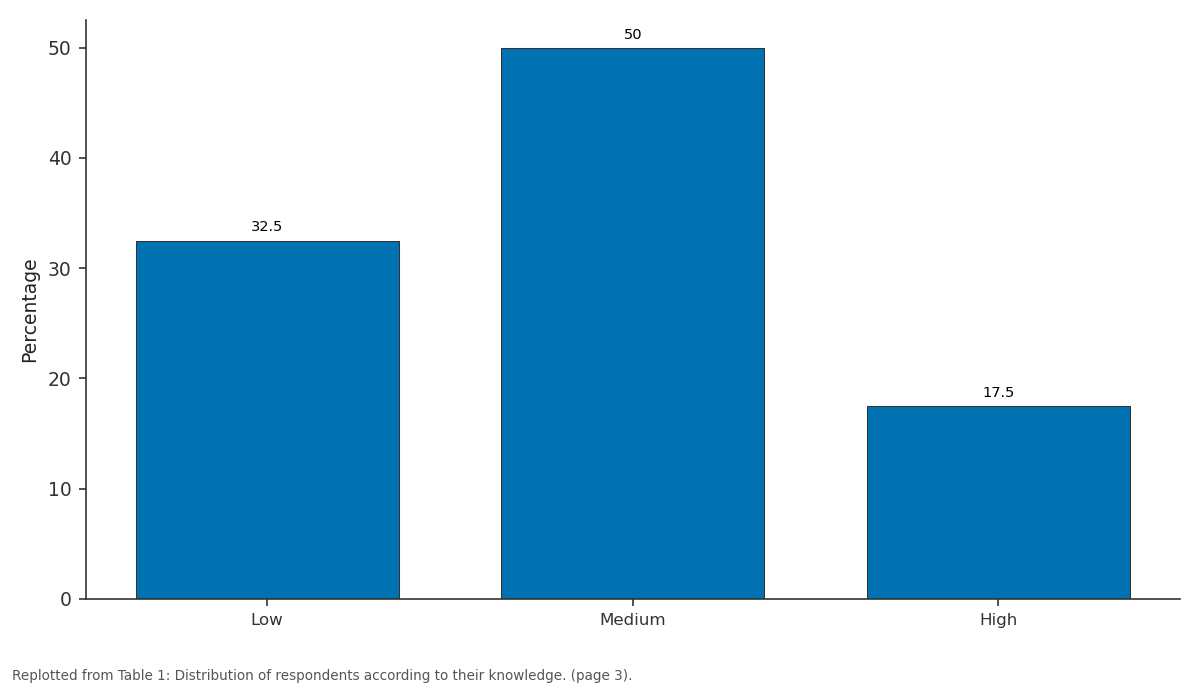
Percentage: Low vs Medium vs High
Replotted from Table 1 (page 3) of the original paper. Every bar is the paper's own table value.
View source evidence ↗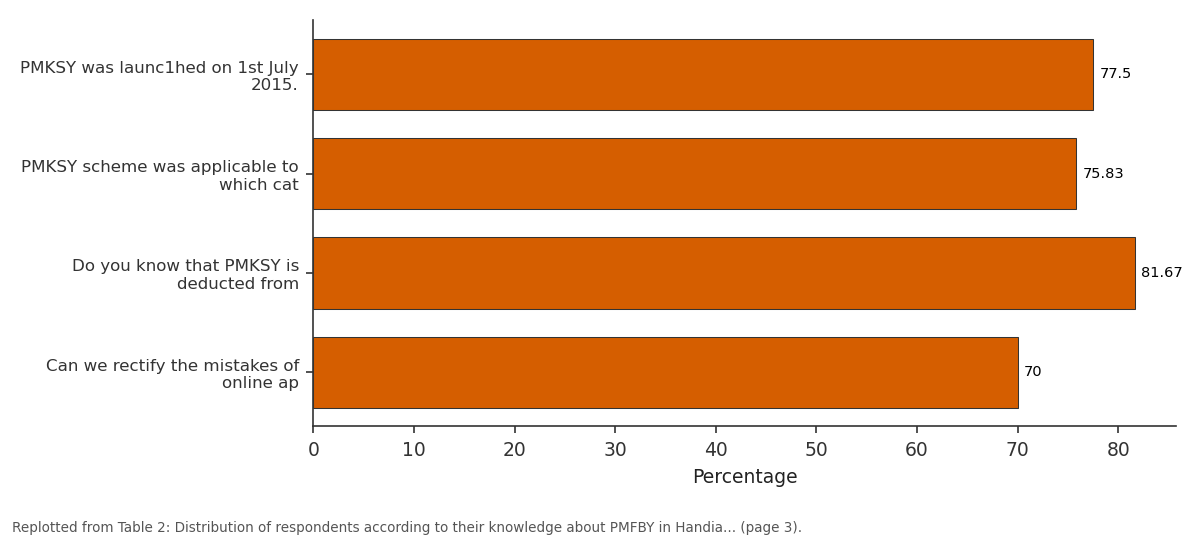
Percentage: PMKSY was launc1hed on... vs PMKSY scheme was... vs Do you know that PMKSY... vs Can we rectify the...
Replotted from Table 2 (page 3) of the original paper. Every bar is the paper's own table value.
View source evidence ↗Figures & tables
From the original paper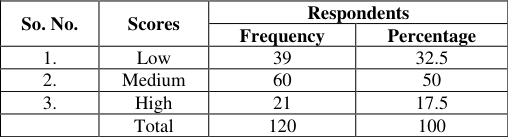 Table 1
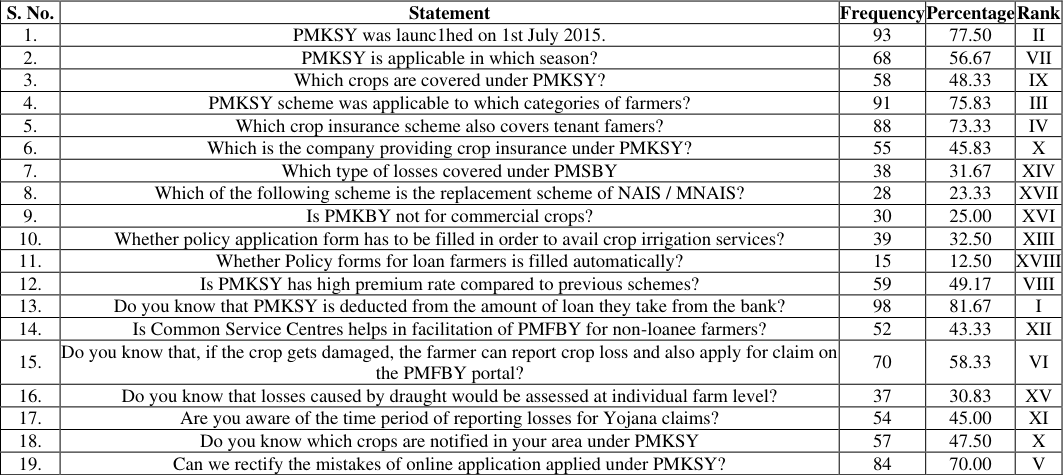 Table 2
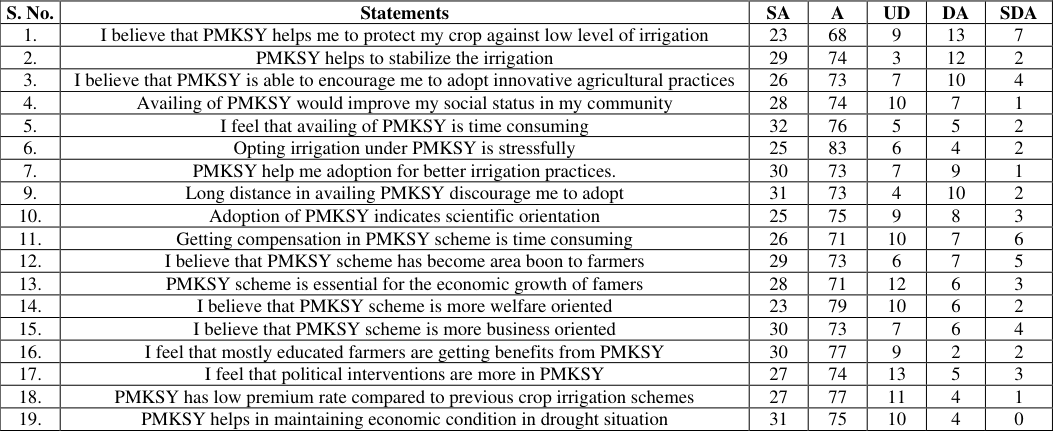 Table 3
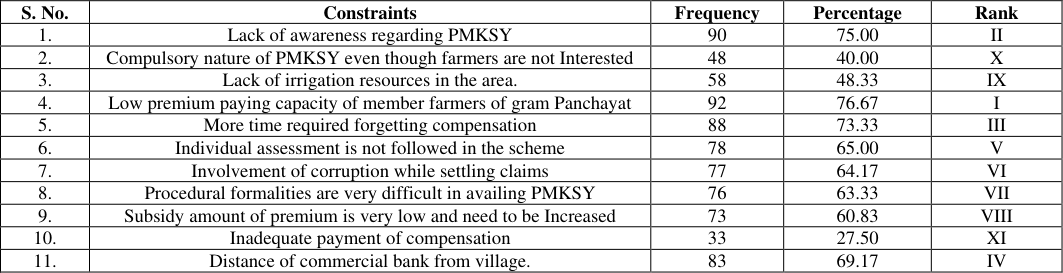 Table 4
Introduction
Water is a scarce natural resource which is inevitable for existence of life on earth. In larger perspective, water security is fundamental to poverty alleviation, and water resource management impacts almost all aspects of economic activity, including food production and security, industry, energy production, and transport (Word bank, 2009). In a developing nation like India, water management hold utmost importance as India is home to 17.50 percent of world population with only 2.5 percent of geographical land and 4 percent of the world's renewable water resources. In the present context, India is experiencing a very significant water crisis. As per FAO (2011), agriculture is the largest water user worldwide, accounting for 70 percent of total freshwater withdrawals on average. Therefore, if humanity is facing water crises at present, then its mismanagement in agriculture should be held responsible for it to a larger extent. Meanwhile, the overall development of the agriculture sector and the targeted growth in Gross Domestic Product is largely dependent on the availability and use of water in agriculture. At present, Pradhan Mantri Krishi Sinchayi Yojana (PMKSY), launched by Central Government, is aimed to ensure access to some means of protective irrigation for all agricultural farms in the country and to produce more output per unit of water. The scheme has been launched with budget of 50,000 crore for period of 5 years (2015-16 to 2019-20). The PMKSY (Per Drop More Crop) includes installation of micro-irrigation systems, use of efficient water conveyance and precision water application devices like drips, sprinklers, pivots and rain-guns in the farm "(Jal Sinchan)", and extension activities for promotion of scientific moisture conservation and agronomic measures including adoption of proper cropping patterns, to maximize use of available water including rainfall and minimize irrigation requirement "(Jal Sanrakshan)". Present study focused on studying the socio personal and communication profile of those farmers who got benefitted from the programme i.e., who received micro irrigation subsidy support under PMKSY-PDMC. Government of India is committed to accord high priority to water conservation and it management. To this effect Pradhan Mantri Krishi Sinchayi Yojana (PMKSY) has been formulated with the vision of extending the coverage of irrigation "Har Khet ko pani" and improving water use efficiency "More crop per drop" in a focused manner with end to end solution on source creation, distribution, management, field application and extension activities. The Cabinet Committee on Economic Affairs chaired by Honorable Prime Minister has accorded approval of Pradhan Mantri Krishi Sinchayi Yojana (PMKSY) in its meeting held on 1st July, 2015. Launched on 1st July, 2015 with the motto of "Har Khet Ko Paani", the Pradhan Mantri Krishi Sinchayee Yojana (PMKSY) is being implemented to expand cultivated area with assured irrigation, reduce wastage of water and improve water use efficiency. PMKSY not only focuses on creating sources for assured irrigation, but also creating protective irrigation by harnessing rain water at micro level through "Jal Sanchay" and "Jal Sinchan". Micro irrigation is also incentivized through subsidy to ensure "Per drop-More crop". PMKSY is supervised and monitored by an Inter-Ministerial National Steering Committee (NSC) which will be constituted under the Chairmanship of Prime Minister with Union Ministers from concerned Ministries. A National Executive Committee (NEC) has been constituted under the Chairmanship of Vice Chairman, NITI Aayog to oversee programme implementation, allocation of resources, interministerial coordination, monitoring & performance assessment, addressing administrative issues etc. Har Khet Ko Pani (HKKP) aims for enhancement of physical access on the farm and expansion of cultivable area under assured irrigation. Under HKKP, surface minor irrigation and repair-renovation-restoration of water bodies component of PMKSY is targeted to provide additional 4.5 lakh hectare irrigation. In view of importance of rejuvenation of water bodies, the Cabinet has approved a paradigm shift in funding of their rejuvenation in both urban and rural areas, with significant expansion of their inclusion criteria, and enhancement of central assistance from 25 to 60 percent in general area. Further, Ground Water component of HKKP, approved provisionally for 2021-22, targets creation of irrigation potential of 1.52 lakh hectare.
Per
Per
Research Methodology
The study entitled "Attitude of the Farmers towards Pradhan Mantri Krishi Sinchai Yojna in Handia tehsil of Prayagraj, Uttar Pradesh" was undertaken to assess the knowledge and attitude of the farmers about Pradhan Mantri Krishi Sinchai Yojana of Handia Teshsil, Prayagraj District, Uttar Pradesh.
Study Design
The design of the present study is descriptive one based on survey method. The study attempts to describe and analyse the role of a study on knowledge and attitude of farmers towards Pradhan Mantri Krishi Sinchai Yojana in Handia teshsil, Prayagraj District, Uttar Pradesh.
Place of the study
Handia teshsil will be selected purposively for the study. Handia teshsil, Prayagraj District, district is one among 75 districts of Bihar state, India. Handia teshsil, Prayagraj District, Uttar Pradesh is an administrative district in the state of Bihar in India.
Sample
From each village, 24 respondents were selected through random sampling method. Thus, constitutes the 120 respondents from 5 villages forms the respondents of the study.
Methods of data collection
Based on the objectives of the study, a pre-tested wellstructured interview schedule was prepared and used for collection of data from the respondents. The data was gathered with the help of pre-structured interview schedule. Each one of the respondents were interviewed personally based on the pre-planned meeting and their responses were recorded. The data collected from the respondents were categorized, tabulated and analyzed with suitable statistical tools in SPSS 16 software.
Results and Discussion
Results and Discussion
Knowledge level of respondents in Handia Tehsil, Prayagraj District
The status of knowledge of respondents of Handia Tehsil, Prayagraj District about Pradhan Mantri Krishi Sinchai Yojana (PMKSY). Knowledge as a body of understood information possessed by an individual is one of the important component of behavioral aspect. On this ground, it was realized imperative to examine the extent of knowledge of respondents about Pradhan Mantri Krishi Sinchai Yojana (PMKSY).
Distribution of respondents according to their knowledge about PMKSY in Handia Tehsil, Prayagraj District
To get an overview of the knowledge level of respondents about Pradhan Mantri Krishi Sinchai Yojana (PMKSY), the respondents were categorized in to low, medium and high level of knowledge group on the basis of calculated mean score and standard deviation. www.extensionjournal.com Individual aspect wise knowledge of respondents was also worked out for drawing a picture about the areas where respondents had good knowledge and where they were lacking, so that areas where respondents had low level of knowledge can be given more importance in future. This part of the chapter deals with the existing status of Attitude of respondents of Handia Tehsilabout Pradhan Mantri Krishi Sinchayee Yojana (PMKSY). Attitude as a body of understood information possessed by an individual is one of the important component of behavioral aspect. On this ground, it was realized imperative to examine the extent of Attitude of respondents about Pradhan Mantri Krishi Sinchayee Yojana (PMKSY).
It was observed from the Table 2 that among all 19 statement of attitude regarding government scheme i.e. Pradhan Mantri Krishi Sinchayi Yojana scheme for agricultural production. PMKSY were concerned with agree attitude regarding I believe that PMKSY helps me to protect my crop against low level of irrigation with strongly agree attitude (23), Agree attitude (68), undecided attitude (9), disagree attitude (13) and strongly disagree attitude (7) respectively And followed other statements such like PMKSY helps to stabilize the irrigation (with strongly agree attitude (29), Agree attitude (73), undecided attitude (7), disagree attitude (10) and strongly disagree attitude (4) respectively. I believe that PMKSY is able to encourage me to adopt innovative agricultural practices with strongly agree attitude (26), Agree attitude (73), undecided attitude (7), disagree attitude (10) and strongly disagree attitude (4) respectively. Availing of PMKSY would improve my social status in my community with strongly agree attitude (28), Agree attitude (74), undecided attitude (10), disagree attitude (7) and strongly disagree attitude (1) respectively. Thus, it may be concluded that the maximum respondents were having either agree or undecided attitude regarding Pradhan Mantri Krishi Sinchai Yojana. It was observed from the Table 2 that among all 19 statement of attitude regarding government scheme i.e. Pradhan Mantri Krishi Sinchayi Yojana scheme for agricultural production. PMKSY were concerned with agree attitude regarding I feel that availing of PMKSY is time consuming with strongly agree attitude (32), Agree attitude (76), undecided attitude (5), disagree attitude (5) and strongly disagree attitude (2) respectively And followed other statements such like Opting irrigation under PMKSY is stressfully with strongly agree attitude (25), Agree attitude (83), undecided attitude (6), disagree attitude (4) and strongly disagree attitude (2) respectively. Long distance in availing PMKSY discourage me to adopt with strongly agree attitude (31), Agree attitude (73), undecided attitude (4), disagree attitude (10) and strongly disagree attitude (2) respectively. Adoption of PMKSY indicates scientific orientation with strongly agree attitude (25), Agree attitude (75), undecided attitude (9), disagree attitude (8) and strongly disagree attitude (3) respectively.
| S. No. | Statement | Frequency | Percentage | Rank |
|---|---|---|---|---|
| 1. | PMKSY was launc1hed on 1st July 2015. | 93 | 77.50 | II |
| 2. | PMKSY is applicable in which season? | 68 | 56.67 | VII |
| 3. | Which crops are covered under PMKSY? | 58 | 48.33 | IX |
| 4. | PMKSY scheme was applicable to which categories of farmers? | 91 | 75.83 | III |
| 5. | Which crop insurance scheme also covers tenant famers? | 88 | 73.33 | IV |
| 6. | Which is the company providing crop insurance under PMKSY? | 55 | 45.83 | X |
| 7. | Which type of losses covered under PMSBY | 38 | 31.67 | XIV |
| 8. | Which of the following scheme is the replacement scheme of NAIS / MNAIS? | 28 | 23.33 | XVII |
| 9. | Is PMKBY not for commercial crops? | 30 | 25.00 | XVI |
| 10. | Whether policy application form has to be filled in order to avail crop irrigation services? | 39 | 32.50 | XIII |
| 11. | Whether Policy forms for loan farmers is filled automatically? | 15 | 12.50 | XVIII |
| 12. | Is PMKSY has high premium rate compared to previous schemes? | 59 | 49.17 | VIII |
| 13. | Do you know that PMKSY is deducted from the amount of loan they take from the bank? | 98 | 81.67 | I |
| 14. | Is Common Service Centres helps in facilitation of PMFBY for non-loanee farmers? | 52 | 43.33 | XII |
| 15. | Do you know that, if the crop gets damaged, the farmer can report crop loss and also apply for claim on the PMFBY portal? | 70 | 58.33 | VI |
| 16. | Do you know that losses caused by draught would be assessed at individual farm level? | 37 | 30.83 | XV |
| 17. | Are you aware of the time period of reporting losses for Yojana claims? | 54 | 45.00 | XI |
| 18. | Do you know which crops are notified in your area under PMKSY | 57 | 47.50 | X |
| 19. | Can we rectify the mistakes of online application applied under PMKSY? | 84 | 70.00 | V |
Table text extracted from the original PDF; superscript letters are shown inline. The original table image is below.
View original table image
It was observed from the Table 3 that among all 19 statement of attitude regarding government scheme i.e. Pradhan Mantri Krishi Sinchayi Yojana scheme for agricultural production. PMKSY were concerned with agree attitude regarding Getting compensation in PMKSY scheme is time consuming with strongly agree attitude (26), Agree attitude (71), undecided attitude (10), disagree attitude (7) and strongly disagree attitude (6) respectively And followed other statements such like I believe that PMKSY scheme has become area boon to farmers with strongly agree attitude (29), Agree attitude (73), undecided attitude (6), disagree attitude (7) and strongly disagree attitude (5) respectively. PMKSY scheme is essential for the economic growth of famers with strongly agree attitude (28), Agree attitude (71), undecided attitude (12), disagree attitude (6) and strongly disagree attitude (3) respectively. I believe that PMKSY scheme is more welfare oriented with strongly agree attitude (23), Agree attitude (79), undecided attitude (10), disagree attitude (6) and strongly disagree attitude (2) respectively It was observed from the Table 3 that among all 19 statement of attitude regarding government scheme i.e. Pradhan Mantri Krishi Sinchayi Yojana scheme for agricultural production. PMKSY were concerned with agree attitude regarding I believe that PMKSY scheme is more business oriented with strongly agree attitude (30), Agree attitude (73), undecided attitude (7), disagree attitude (6) and strongly disagree attitude (4) respectively And followed other statements such like I feel that mostly educated farmers are getting benefits from PMKSY with strongly agree attitude (30), Agree attitude (77), undecided attitude (9), disagree attitude (2) and strongly disagree attitude (2) respectively. PMKSY has low premium rate compared to previous crop irrigation schemes with strongly agree attitude www.extensionjournal.com (27), Agree attitude (77), undecided attitude (11), disagree attitude (4) and strongly disagree attitude (1) respectively. PMKSY helps in maintaining economic condition in drought situation with strongly agree attitude (31), Agree attitude (75), undecided attitude (10), disagree attitude (4) and strongly disagree attitude (2) respectively.
| S. No. | Statements | SA | A | UD | DA | SDA |
|---|---|---|---|---|---|---|
| 1. | I believe that PMKSY helps me to protect my crop against low level of irrigation | 23 | 68 | 9 | 13 | 7 |
| 2. | PMKSY helps to stabilize the irrigation | 29 | 74 | 3 | 12 | 2 |
| 3. | I believe that PMKSY is able to encourage me to adopt innovative agricultural practices | 26 | 73 | 7 | 10 | 4 |
| 4. | Availing of PMKSY would improve my social status in my community | 28 | 74 | 10 | 7 | 1 |
| 5. | I feel that availing of PMKSY is time consuming | 32 | 76 | 5 | 5 | 2 |
| 6. | Opting irrigation under PMKSY is stressfully | 25 | 83 | 6 | 4 | 2 |
| 7. | PMKSY help me adoption for better irrigation practices. | 30 | 73 | 7 | 9 | 1 |
| 9. | Long distance in availing PMKSY discourage me to adopt | 31 | 73 | 4 | 10 | 2 |
| 10. | Adoption of PMKSY indicates scientific orientation | 25 | 75 | 9 | 8 | 3 |
| 11. | Getting compensation in PMKSY scheme is time consuming | 26 | 71 | 10 | 7 | 6 |
| 12. | I believe that PMKSY scheme has become area boon to farmers | 29 | 73 | 6 | 7 | 5 |
| 13. | PMKSY scheme is essential for the economic growth of famers | 28 | 71 | 12 | 6 | 3 |
| 14. | I believe that PMKSY scheme is more welfare oriented | 23 | 79 | 10 | 6 | 2 |
| 15. | I believe that PMKSY scheme is more business oriented | 30 | 73 | 7 | 6 | 4 |
| 16. | I feel that mostly educated farmers are getting benefits from PMKSY | 30 | 77 | 9 | 2 | 2 |
| 17. | I feel that political interventions are more in PMKSY | 27 | 74 | 13 | 5 | 3 |
| 18. | PMKSY has low premium rate compared to previous crop irrigation schemes | 27 | 77 | 11 | 4 | 1 |
| 19. | PMKSY helps in maintaining economic condition in drought situation | 31 | 75 | 10 | 4 | 0 |
Table text extracted from the original PDF; superscript letters are shown inline. The original table image is below.
View original table image
The constraint faced by the farmers during availing that yojana
The constraint faced by the farmers during availing that yojana
Conclusion
It was concluded that the socio-economic profile of the sample group were medium level. It was evident that the knowledge of farmers towards PMKSY were found half of the respondents medium level. The data revealed that the more than half of the respondents (63.33%) had medium level involvement in government scheme for agriculture development, followed by (24.17%) of the respondents had low level involvement respectively, while (12.50%) of the respondents having high level involvement in govt. scheme for agriculture development.
The factors influencing attitude of farmers towards PMKSY are age, education, size of land holdings, mass media exposure, extension contacts, and economic motivation.
Figures and tables from the paper
| So. No. | Scores | Respondents | — |
|---|---|---|---|
| Frequency | Percentage | ||
| 1. | Low | 39 | 32.5 |
| 2. | Medium | 60 | 50 |
| 3. | High | 21 | 17.5 |
| Total | 120 | 100 |
Table text extracted from the original PDF; superscript letters are shown inline. The original table image is below.
View original table image
| S. No. | Constraints | Frequency | Percentage | Rank |
|---|---|---|---|---|
| 1. | Lack of awareness regarding PMKSY | 90 | 75.00 | II |
| 2. | Compulsory nature of PMKSY even though farmers are not Interested | 48 | 40.00 | X |
| 3. | Lack of irrigation resources in the area. | 58 | 48.33 | IX |
| 4. | Low premium paying capacity of member farmers of gram Panchayat | 92 | 76.67 | I |
| 5. | More time required forgetting compensation | 88 | 73.33 | III |
| 6. | Individual assessment is not followed in the scheme | 78 | 65.00 | V |
| 7. | Involvement of corruption while settling claims | 77 | 64.17 | VI |
| 8. | Procedural formalities are very difficult in availing PMKSY | 76 | 63.33 | VII |
| 9. | Subsidy amount of premium is very low and need to be Increased | 73 | 60.83 | VIII |
| 10. | Inadequate payment of compensation | 33 | 27.50 | XI |
| 11. | Distance of commercial bank from village. | 83 | 69.17 | IV |
Table text extracted from the original PDF; superscript letters are shown inline. The original table image is below.
View original table image
References
8 in the original paper- Basha PR, Prasad MS, Rao SVN, Rekha DVSRL, Mahesh M. Impact of PMKSY -watershed on landless, small and marginal farmers of Srikakulam district of Andhra Pradesh. Journal of Research ANGRAU. 2019;47(2):78-80.
- Jayasankar R, Sneha V, Muthukumar R. Technological and cultivational knowledge of the PMKSY beneficiaries about grape cultivation with drip irrigation in Tamil Nadu. Plant Archives. 2020;20(1):1589-1592.
- Kamraj R. Operational performance of Pradhan Mantri Jan Dhan Yojana account holders in Tiruchirappalli district. International Journal of Humanities and Social Science Research. 2018;4(1):50-55.
- Karthikeyan C, Naidu JYN. Perception of farmers about maintenance of drip irrigation system in Tamil Nadu. International Journal of Agriculture Innovations and Research. 2017;5(4):642-646.
- Kaur M, Misra S. A study on adoption of drip irrigation technology by sugarcane growers of Rajasthan. Indian Journal of Extension Education. 2019;55(2):74-79.
- Patel B, Patel MR, Patel A. Economic motivation and its relationship with level of knowledge about drip irrigation system of drip irrigated banana growers. Gujarat Journal of Extension Education. 2017;28(2):285-287.
- Patel B, Patel MR, Nayak JJ. Level of knowledge about drip irrigation system of drip irrigated banana growers. Gujarat Journal of Extension Education. 2018;29(2):218-219.
- Priyanka PA, Chandrasekaran M, Nandakumar K. Accounting cost of irrigation in sugarcane production in Tamil Nadu. Asian Journal of Agricultural Extension, Economics & Sociology. 2017;15(1):1-7.