
Research article · 2024 · Full text
International Journal of Agriculture Extension and Social DevelopmentTraining needs of women agriculture extension officers in Telangana state
Volume 7(7) · Pages 118–120 · DOI: 10.33545/26180723.2024.v7.i7b.775 ↗
Research areasLivestock Management and Performance ImprovementAgricultural Economics and Practices
Abstract
Author-writtenTraining is the process of gaining knowledge, abilities, and skills necessary to perform roles effectively in a job. The training needs for extension officers differ from person to person, crop to crop, agroclimatic zone, and from time to time as a result of the rapid advancements in technology. The present study deals with the training needs of Women Agriculture Extension Officers (AEO’s). The respondents from all the 33 districts of Telangana state were covered, making a total of 120 samples for the study. Hence, it was revealed that majority of the respondents had overall medium level of training needs in all the aspects of trainings. Individual aspects included Technical (65.83%), Managerial (67.50%), Extension (75.00%) and Frontier areas of agricultural sciences (49.17%), respectively. It was observed that the variables like family size, information seeking behaviour and achievement motivation were having significant and positive correlation with the training needs while age, education, total years of experience and access to trainings were having a significant and negative correlation with training needs.
Summary
Source-checkedPlain-language reading of the full paper, prepared with AI and checked against the text. Each point links to the authors' own words.
Why it matters
- Agriculture is a cornerstone of the Indian economy, supporting 70% of the rural population and contributing 14.5% to the GDP. View evidence ↗
- Agricultural extension services have historically focused on male workers, which has neglected the roles of women and hindered overall development. View evidence ↗
- Training needs for extension officers are dynamic and vary based on the individual, the specific crop, the agroclimatic zone, and technological advancements. View evidence ↗
The question
- The study aims to explore the training needs of women agriculture extension officers to help create more equitable and adaptable extension initiatives. View evidence ↗
What they did
- The study used an ex-post facto research design with a purposive sample of 120 women agriculture extension officers from all 33 districts of Telangana State. View evidence ↗
- Data was collected via a questionnaire focusing on four training areas: technical, managerial, extension, and frontier areas of agricultural sciences. View evidence ↗
- Correlation analysis was performed using SPSS software to evaluate the relationship between independent variables and training needs. View evidence ↗
What they found
- Overall, 45.83% of the women agriculture extension officers (AEOs) exhibited a medium level of training needs across all assessed areas. View evidence ↗
- A majority (65.83%) of respondents reported high technical training needs, specifically in areas such as soil testing and crop variety selection. View evidence ↗
- Most women extension officers (67.5%) had high managerial training needs, including time management, office management, and personality development. View evidence ↗
- The highest need was found in extension aspects, with 75.00% of respondents reporting high training needs in areas like audio-visual aids and documentation skills. View evidence ↗
- Regarding frontier areas of agricultural science (e.g., nanotechnology and climate change), 49.17% of respondents reported a medium training need. View evidence ↗
- Training needs were significantly and positively correlated with achievement motivation, family size, and information-seeking behavior. View evidence ↗
- Age, education, total years of experience, and prior access to training were significantly and negatively correlated with training needs. View evidence ↗
What it means
- The authors conclude that implementing comprehensive, context-specific training programs is essential to bridge training gaps and empower women agriculture extension officers. View evidence ↗
Figures & tables
From the original paper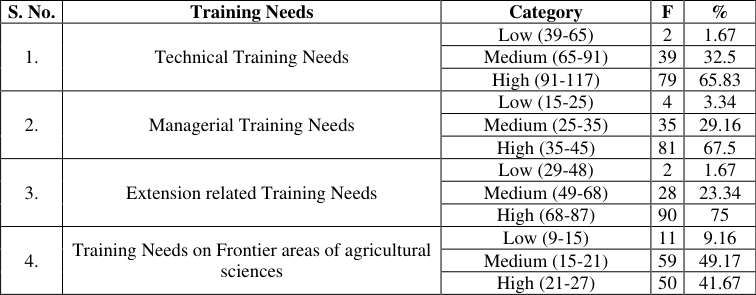 Table 1
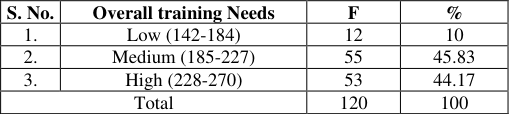 Table 2
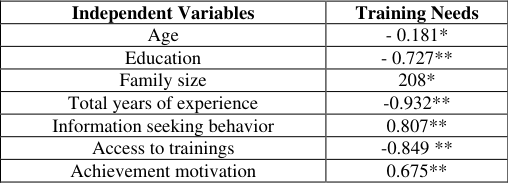 Table 3
Introduction
India's economy relies heavily on agriculture, which contributes 14.5% to the GDP and supports 70% of the rural population (Ministry of External Affairs, Government of India). The sector's progress, bolstered by the Green Revolution, is vital for economic development and poverty reduction. The Department of Agriculture, established in 1883, focuses on improving agricultural productivity through advanced technologies and extension programs. Extension services play a critical role by equipping farmers with the necessary knowledge and skills to enhance productivity, emphasizing the importance of empowering extension personnel (Yadav, 2013; Anand, 2014) [10,1] . The process of gaining specialized abilities to carry out a job more effectively is called Training (Jucious, 1963) [3] . It aids employees in becoming competent and skilled at their occupations (Dhama, 1979) [2] . The training needs for extension officers differ from person to person, crop to crop, agroclimatic zone, and from time to time as a result of the rapid advancements in information delivery systems and technology. Therefore, the first and most crucial step that needs to be taken before starting any training work is identifying the training need. Despite the crucial role of extension services, there are significant challenges, especially concerning gender equality. Historically, extension activities have prioritized male workers, neglecting the specific needs and roles of women in agriculture, thereby hindering overall development (World Bank and IBRD, 2009). Focussing on women extension officers and addressing their training needs is essential for sustainable agricultural growth. These needs include updated knowledge of modern agricultural practices and overcoming constraints such as limited resources, access to information, transport facilities, etc. Effective training and capacity building are vital for improving the performance and motivation of women extension officers, ensuring an equitable and efficient agricultural extension system (Patil, 2016) [8] . In this context, the study explores the training needs of women extension officers in the agricultural sector with the goal of offering guidance for the creation of more adaptable and fair extension initiatives.
Objective
Objective
To analyze the training needs of women extension
officers in agriculture sector. 2. To find out relationship between personal, socioeconomic and psychological characteristics and training www.extensionjournal.com needs of women extension officers in agriculture sector.
Methodology
The present study was conducted in Telangana State. Expost facto research design was used for the study. A sample of 120 women agriculture extension officers was purposively collected from all 33 districts. The questionnaire was designed to obtain relevant and accurate information about the four major areas of training i.e., technical training needs, managerial training needs, extension training needs and frontier areas of agriculture sciences. The data was collected by sharing the questionnaire to women agriculture extension officers via WhatsApp. The collected information was analyzed and tabulated. To assess the relationship between the selected independent and dependent variables, correlation analysis was conducted using the statistical software SPSS.
Results and Discussion
The present study addresses the training requirements for women agricultural extension officers. An attempt has been made to study their training needs in various broad areas viz., technical, managerial, extension related and frontier areas of agricultural sciences. The results in the It is observed from the data in Table 3 that the independent variables viz., age, education, total years of experience and access to trainings were having a significant and negative correlation with the dependent variable i.e. training needs. Information seeking behaviour, family size and achievement motivation of respondents was found to have a having significant and positive correlation with the training needs. The other variables like family type, number of years completed in present post, family income, membership in organization, mass-media exposure, sources of information, value orientation and cosmopoliteness were having no relation with the training needs. These findings were in line with the findings of Kharde (2014) [4] .
| Independent Variables | Training Needs |
|---|---|
| Age | - 0.181* |
| Education | - 0.727** |
| Family size | 208* |
| Total years of experience | -0.932** |
| Information seeking behavior | 0.807** |
| Access to trainings | -0.849 ** |
| Achievement motivation | 0.675** |
Table text extracted from the original PDF; superscript letters are shown inline. The original table image is below.
View original table image
Conclusion
The study indicated a significant need for technical, managerial, and extension-related training among women extension officers. This necessitates the formulation of comprehensive training programs to address these areas. The findings would be helpful to the department of agriculture, policy makers and training institutions in order to develop future strategies for enhancing the potential of the agriculture extension officers in all the aspects related to their job. So, to bridge the gap in training needs and enhance the performance of women agriculture extension officers, it is essential to develop and implement comprehensive, context-specific training programs that address their unique challenges and aspirations. This approach will not only empower the officers but also foster a more effective and equitable agricultural extension system, promoting sustainable agricultural development and rural prosperity.
Figures and tables from the paper
| S. No. | Training Needs | Category | F | % |
|---|---|---|---|---|
| 1. | Technical Training Needs | Low (39-65) | 2 | 1.67 |
| Medium (65-91) | 39 | 32.5 | ||
| High (91-117) | 79 | 65.83 | ||
| 2. | Managerial Training Needs | Low (15-25) | 4 | 3.34 |
| Medium (25-35) | 35 | 29.16 | ||
| High (35-45) | 81 | 67.5 | ||
| 3. | Extension related Training Needs | Low (29-48) | 2 | 1.67 |
| Medium (49-68) | 28 | 23.34 | ||
| High (68-87) | 90 | 75 | ||
| 4. | Training Needs on Frontier areas of agricultural sciences | Low (9-15) | 11 | 9.16 |
| Medium (15-21) | 59 | 49.17 | ||
| High (21-27) | 50 | 41.67 |
Table text extracted from the original PDF; superscript letters are shown inline. The original table image is below.
View original table image
| S. No. | Overall training Needs | F | % |
|---|---|---|---|
| 1. | Low (142-184) | 12 | 10 |
| 2. | Medium (185-227) | 55 | 45.83 |
| 3. | High (228-270) | 53 | 44.17 |
| Total | 120 | 100 |
Table text extracted from the original PDF; superscript letters are shown inline. The original table image is below.
View original table image
References
4 in the original paper- Kharde PB, Patil SD, Potawade BT. Training Needs of Scientists of Agricultural University. Indian Resource Journal Extension Education. 2014;14(3):103-107.
- Lego I, Bordoloi R, Meghwal PK, Buragohain M. A Study on Relationship between selected Independent Variables and Training Needs of Agricultural Extension Personnel in Arunachal Pradesh, India. Int J Curr Microbiol App Sci. 2018;7(2).
- Saleh JM. Systematic Review: Training Needs of Agriculture Extension Workers. Asian J Agric Ext Econ Sociol. 2019;34(2):1-13.
- Yadav DS, Sood P, Thakur SK, Choudhary AK. Assessing the training needs of Agricultural Extension workers about organic farming in the North-Western Himalayas. J Organ Syst. 2013;8(1):17-27.