
Research article · 2024 · Full text
International Journal of Research in AgronomyInfluence of planting patterns and weed control treatments on the growth and development of fennel (Foeniculum vulgare Mill.)
Volume 7(7) · Pages 217–224 · DOI: 10.33545/2618060x.2024.v7.i7c.1023 ↗
Research areasPlant Physiology and Cultivation StudiesFlowering Plant Growth and CultivationPlant tissue culture and regeneration
Abstract
Author-writtenThe present work serves as a review on influence of planting patterns and weed control treatments on the growth and development of fennel (Foeniculum vulgare Mill.). The current approach to planting patterns and weed control treatments has shifted its focus towards sustainability and environmental compatibility. Weeds have a detrimental effect on both the growth and production of crops. Implementing appropriate planting patterns and employing effective weed control measures enhances soil fertility, leading to increased crop yield and improved growth. Enhancing production can be achieved by implementing a highly efficient weed management technique. Planting patterns and weed control methods have a beneficial effect on the growth, productivity, yield, quality, and nutritional absorption of fennel crops.
Summary
Source-checkedPlain-language reading of the full paper, prepared with AI and checked against the text. Each point links to the authors' own words.
Why it matters
- Fennel is a significant seed spice crop grown in the rabi season, valued economically for the volatile and fixed oils found in its fruits. View evidence ↗
- In India, fennel is cultivated over 0.75 lakh hectares, producing 1.27 million tonnes with an average national yield of 1697 kg per hectare. View evidence ↗
- Fennel's slow initial growth makes it highly susceptible to weed infestation, which can reduce seed production by as much as 91.4%. View evidence ↗
The question
- The objective of this paper is to review how different planting patterns and weed control treatments affect the growth and development of fennel. View evidence ↗
What they did
- This study is a review paper that synthesizes findings from various existing research works regarding fennel management. View evidence ↗
- The reviewed methods for weed control include the use of herbicides like pendimethalin and fluazifop-p-butyl, as well as plastic or straw mulching. View evidence ↗
- The review examines planting layouts as a non-monetary strategy to optimize sunlight capture and reduce competition for resources. View evidence ↗
What they found
- One cited study found that planting on March 5th maximized grain yield (704.7 kg/ha), grain per head (199.8), and main branches (7.5). View evidence ↗
- A plant spacing of 3 cm was found to produce the highest grain output (702 kg/ha) and heads per plant (22.3) in a specific study. View evidence ↗
- In another study, a row spacing of 45 cm outperformed 30 cm, yielding 11.06 q/ha of seeds. View evidence ↗
- The use of herbicides is reported to increase fennel seed production by between 43.2% and 86.9%. View evidence ↗
- Manual weed removal was found to increase fruit output by 63% and oil yield by 78% compared to untreated controls. View evidence ↗
- Combining pendimethalin and fuazifop with a 2:1:1 biofertilizer ratio increased fruit output by 45% and oil yield by 83%. View evidence ↗
- Weed infestation can lead to a 28.5% reduction in the overall growth and productivity of the fennel crop. View evidence ↗
- Different weed species cause varying levels of loss, with Cyperus rotundus causing the highest loss at 25.3%, followed by Digera arvensis at 18.67%. View evidence ↗
What it means
- The authors conclude that implementing proper planting patterns and weed control is essential for improving the growth, production, and economic viability of fennel. View evidence ↗
- The authors recommend environmentally friendly weed management to enhance soil health, nutrient delivery, and agricultural production. View evidence ↗
Visual summary
1 visualsIllustrations explain the paper; they do not show study data.
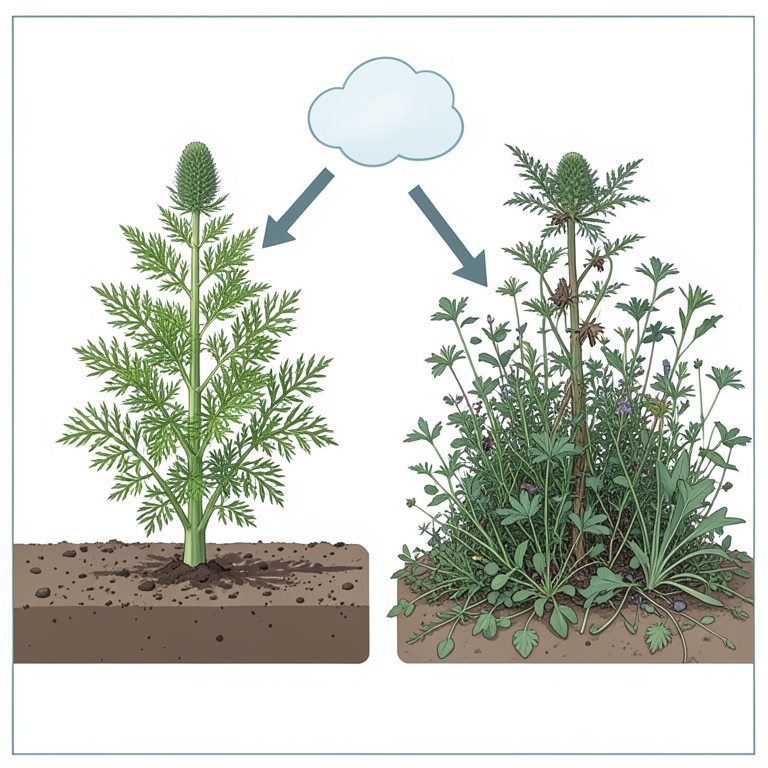
Impact of Weeds on Fennel
AI-generated conceptual illustration (fennel plants (Foeniculum vulgare) and common field weeds). It explains the idea and does not show study data.
View source evidence ↗Introduction
Fennel (Foeniculum vulgare Mill.), also known as saunf, is one of the most important seed spice grown during the rabi season. Fennel is a highly beneficial source of potassium, vitamin C, and dietary fiber. It is employed to enhance the taste of meat meals, soups, and other culinary preparations. The leaves of this plant are utilized as a component of salads or as a decorative addition to other dishes (Meena et al., 2023; Abdelkader et al., 2019) [31,2] . The economic importance of this crop mostly lies in the fruits, which contain both volatile and fixed oil (Jat et al., 2015) [20] . In India, the cultivation of this crop spans across an area of 0.75 lakh hectares, resulting in a production of 1.27 million tonnes. The national average yield is recorded at 1697 kg per hectare, as reported by Choudhary et al. in 2022 [13,15] . Primarily cultivated as a rabi season crop, it is predominantly farmed in the states of Rajasthan and Gujarat, with smaller cultivation areas in Karnataka, Uttar Pradesh, Punjab, Andhra Pradesh, and Madhya Pradesh. In Rajasthan, the output of a specific crop reached 0.28 lakh tons from an area of 0.27 lakh hectares, with an average yield of 1052 kg per hectare (Ranjbar et al., 2016) [42] . It belongs to the Apiaceae family. The production of fennel is influenced by several management strategies such as plant density, nutritional balance, optimal planting time, weed control, irrigation management, and plant protection measures. The importance of soil fertility and weed control in crop production is generally acknowledged, since they have a major impact on agricultural productivity (Meena et al., 2023; Ranjbar et al., 2016) [31,42] . Hence, it is important to attain a proper nutritional equilibrium for the crop in order to optimize crop output and preserve soil fertility (Al-Jubory et al., 2021; Mamatha et al., 2021) [6,[29][30] . To do this, it is necessary to consider the interplay between nutrients in a specific soil and crop agroclimatic zone. Weeds are universally recognized as the most major obstacle to agricultural yield (Kaur et al., 2022; Singh et al., 2021) [22] . Weeds often engage in competition with the primary crop for essential resources like as light, water, space, and nutrients. This ultimately leads to a decrease in the production of the primary crop. Due to the delayed initial development of fennel, there is a substantial proliferation of weeds in the region. This leads to a reduction in both the rate of growth and the quantity of yield generated (Mamatha et al., 2021; Singh et al., 2021) [29][30]47] .
Hence, it is crucial to determine a suitable and economical method of weed control to maintain a weed-free field during the crucial periods of crop-weed competition (Sharifi et al., 2022; Kumar et al., 2019) [44,25] . There are several non-chemical methods available for controlling pests, including physical control (such as mechanical weeding or flame control), cultural control (such as the stale or fake seedbed technique), and biological control (Sharma and Kumar, 2022; Abdallah et al., 2021) [46,1] . Conversely, fennel has a prolonged germination period, exhibits sluggish growth in the early phases of crop development, and is prone to severe weed infestation during its first growth phase (Abdelkader et al., 2019; Özel et al., 2019) [2,37] . Hence, it is crucial to manage weeds at the most opportune moment in order to enhance crop yield. Fennel is a slow-growing crop that has strong competition from weeds during its first growth period. Without proper management, it has the potential to reduce seed production by 91.4% (Makukha et al., 2018) [28] . Weeds cause the greatest amount of damage compared to other factors that cause losses, such as disease and insect pests. Weed control in fennel is often achieved by manual weeding. Regrettably, the primary obstacle to achieving efficient weed management in fennel is the scarcity of labor resources at the appropriate time and the substantial costs associated with weed control (Sharifi et al., 2022; Abdallah et al., 2021) [44,1] . Hence, it is important to seek a pre-emergence (PE) herbicide that can assist in managing weeds at their early and vulnerable stages. Fennel seeds have a lengthy germination period and initially develop at a sluggish pace, sometimes leading to a significant weed invasion. Weeds exert a detrimental influence on plant growth and can lead to reduced crop yields. Failure to properly manage weeds can also affect the essential oil content of the plants. The impact of weed infestations on yield losses in field and vegetable crops has been well investigated, both in terms of quantity and quality (Mishra et al., 2016) [35] . The utilization of herbicides has significantly transformed weed management and provided substantial advantages to farmers. Research has demonstrated that the application of herbicides effectively manages weed growth and can significantly increase fennel seed production by a range of 43.2% to 86.9%. Research has shown that cultural and mechanical weed management approaches are both costlier and less efficient, especially when there is a scarcity of labor. These strategies also decrease the availability of growth resources, such as nutrients and water, in the soil as a result of weed absorption (Arak et al., 2020; Zardak et al., 2017) [7,53] . Herbicides are mostly utilized for weed control due to their reliability, effectiveness, and cost-efficiency, which also contribute to increased seed production. When comparing herbicides to other tactics for managing weeds, they frequently provide a three to four times greater economic return. Applying herbicide efficiently inhibits the development of weeds and has the potential to enhance seed production by a range of 43.2 to 86.9%. Fluazifop-p-butyl and pendimethalin are commonly employed herbicides for the purpose of weed control (Pickett and Zheljazkov, 2016) [41] . Pendimethalin, a selective preemergence herbicide, may effectively manage annual grasses and broadleaf weeds in many agricultural crops. The over utilization of herbicides can lead to issues like as contamination, lingering effects, and the development of resistance. The utilization of mulches, such as plastic or straw, is an environmentally benign and cost-effective method for weed management (Avci, 2013) [8] . The application of herbicides has greatly revolutionized weed control and resulted in reduced production costs. Nevertheless, a significant proportion of farmers now lack information regarding the correct doses, timing of application, and cost-effectiveness of herbicides. Therefore, the successful management of weeds relies on the careful and strategic use of these compounds (Bhardwaj and Agrawal, 2014) [10] . Applying appropriate planting layouts is an important nonmonetary component that reduces rivalry between plants, encourages cooperation, and enables competitive interactions. These configurations are crucial in maximizing the capture of sunlight by the plant canopy. Efficiently managing a desirable plant population is essential for maximizing solar radiation absorption and limiting fertilizer and water competition, as well as weed growth (Arak et al., 2020) [7] . Nevertheless, plants that are planted with regular spacing will exhibit the highest population density per unit area. This creates optimal conditions for abundant crop development and a larger area of plant canopy compared to plants grown with wider spacing. This is because regular spacing allows for optimal light absorption, photosynthetic activity, assimilation, and the accumulation of additional photosynthates in the plant system. As a consequence, this leads to increased biological, seed, and straw production (Sharifi et al., 2022; Abdelkader et al., 2019) [44,2] . Therefore, the present paper is aimed to review the influence of planting patterns and weed control treatments on the growth and development of fennel (Foeniculum vulgare Mill.)
Effect of planting patterns and weed control on growth and yield characteristics of fennel
Plants required nutrients to germinate, grow, and to reproduce. Growth characteristics includes plant height, number of leaves, stalk length, leaf area etc. Nutrients play an essential role in the yield improvement of plants. Plants generally depend on nutrients available in the soil (Kumar et al., 2019) [25] . Also, fertilizers are used to supply these essential nutrients for plant yield improvement. Planting pattern and weed control treatments is required to improve the growth and yield characteristics of plant (Arak et al., 2020) [7] . Nada et al. (2022) [36] investigated the impact of planting pattern on the growth and production of fennel crop. The combination of applying NPK at 150% of the recommended dosage and using rabbit dung resulted in the most favorable outcomes in terms of branch quantity, bulb weight, bulb production, and proportions of total carbohydrates, nitrogen, phosphorus, and potassium. The bulbs exhibited superior hardness, total soluble solids, titratable acidity, vitamin C content, and essential oil concentration. The analysis revealed that the NPK levels were 150% more than the allowed quantity. Additionally, a significant concentration of estragole, a molecule that is considered undesirable, was detected, accounting for 9.65% of the total composition. The application of organic fertilizer (rabbit dung at a rate of 60 m 3 per feddan) and biofertilizer (Azos + Bm + Bc + VAM) resulted in the lowest concentrations of estragole, with levels of 4.09% and 5.64% respectively. When they were given rabbit dung, they received a greater quantity of bulbs (an increase of 11.76-21.99%) and a higher concentration of essential oils (an increase of 0.076-0.080%). Nevertheless, there was a significant decrease in the quantity of estragole, while the levels of crucial compounds such as α-pinene, ß-pinene, limonene, trans-anethole, and anisaldehyde exhibited an increase. Therefore, it is possible to cultivate a plentiful and superior yield of organic fennel bulbs, thereby endorsing the concept of natural and organic farming for this particular crop. In 2011-2012, Ahmad Lotfi et al. (2013) [26] performed an experiment at the Research Farm in Ilam, Iran to investigate the impact of planting date and plant spacing on the yield and yield components of fennel. The experiment followed a split plot design in a randomized full block design with three replications. The main plot consisted of three levels of planting date (5 March, 20 March, and 5 April), whereas the subplot consisted of four levels of plant spacing (2 cm, 3 cm, 4 cm, and 5 cm). The planting date had a substantial impact on the number of primary branches, number of secondary branches, number of grains per head, and grain yield. The planting date of 5 March resulted in the maximum number of main branches (7.5 branches), quantity of grain per head (199.8 grain), and grain yield (704.7 kg.ha -1 ). The highest number of heads per plant (22.3), number of grains per head (195), and grain output (702 kg/ha) were achieved with a plant spacing of 3 cm. The interaction impact of planting date and plant spacing on the number of major branches, 1000-grain weight, and grain production was statistically significant. The planting date of 5 March and plant spacing of 4 cm resulted in the greatest number of main branches, highest 1000-grain weight, and best grain yield. In this study, it was shown that fennel plants that were planted early had more favorable conditions for both vegetative and reproductive growth, resulting in higher output. Additionally, it was observed that a plant spacing of 3 cm had a greater influence on grain yield in the Ilam region. Tamboli et al. (2020) [49] examined how different cropping patterns and spacing influenced the growth and productivity of fennel crop. An experiment was conducted on loamy sand soil at Agronomy Instructional Farm during the rabi season of 2015-2016 to investigate the impact of sowing time (3 rd week of October, 1st week of November, and 3 rd week of November), variety (Gujarat Fennel-2, 11, and 12), and spacing (45 cm and 60 cm) on the growth, yield attributes, and yield of rabi fennel. The experiment was conducted using a split plot design with four replications. The primary plot was sowing time, while variety and spacing were considered as subplots. The crop planted during the third week of October (D1) achieved the maximum seed yield (1423 kg ha -1 ) and stover output (4080 kg ha -1 ). Variation GF-12 (V3) exhibited improved growth metrics, yield qualities, and achieved maximum seed and stover yields of 1411 and 4030 kg ha -1 , respectively. The harvest index was not significantly influenced by the date of planting and spacing, but it varied across different varieties. The study discovered that sowing GF-12 fennel during the third week of October with a row spacing of 45 cm leads to enhanced growth, yield, and quality. Patel et al. (2019) [40] examined the effects of incorporating weed management techniques on the fennel production system. According to their findings, the use of farm yard manure (FYM) at a rate of 20 t/ha and vermicompost at a rate of 8.0 t/ha resulted in the greatest and lowest weed densities at harvest, respectively. Nevertheless, the application of vermicompost at a rate of 8.0 t/ha yielded the largest fennel seed production, amounting to 2.09 t/ha. Applying paddy straw mulch at a rate of 10 tons per hectare, followed by manual weeding at 30 and 60 days after transplanting, resulted in notable increases in plant height, number of umbels per plant, and seed output. The results were similar to using paddy straw mulch at a rate of 5 tons per hectare followed by hand weeding at 30 and 60 days after transplanting, as well as two rounds of inter cultivation followed by hand weeding at 30 and 60 days after transplanting, and finally earthing-up at 75 days after transplanting. Jakhar et al. (2019) [19] investigated the impact of different planting dates and spacing on the morphological characteristics that influence the production and yield of fennel. The planting dates for the second week of November and the second week of January were different, and the spacing options were 30 cm, 45 cm, and 60 cm, respectively. The treatment including a combination of a 45 cm seeding depth and sowing on November 2nd had the most favorable results compared to the other treatments. The results indicated that a delay in seeding led to a decrease in both height and weight. Upon conducting observations, it was discovered that higher plant densities led to a decrease in many plant metrics, including plant height, umbel count, fresh weight, dried weight, and yield per plot. Waskela et al., (2017) [50] investigated the effects of different row spacing and NPK levels on the growth and yield of fennel. The experiment was carried out using a Split-Plot Design, with four replications. The experiment used three different row spacings (30 cm, 45 cm, and 60 cm) and four amounts of NPK fertilizer (0+0+0, 30+20+20, 60+40+40, and 120+60+60 kg/ha). When comparing row spacing of 30 cm to row spacing of 45 cm, the latter resulted in much stronger growth and production characteristics, with a reported seed yield of 11.06 q/ha. Out of the several NPK concentrations that were examined, the combination of 60 kg of nitrogen, 40 kg of phosphorus, and 40 kg of potassium per hectare demonstrated the most notable and substantial improvement in terms of growth, yield characteristics, overall yield, and quality of fennel. Contrary to the reduced levels of nitrogen, phosphorus, and potassium (NPK), further treatment resulted in a considerably higher seed yield of 12.29 quintals per hectare (q/ha) with a benefit-cost ratio (B:C ratio) of 3.45. Al-Dalain et al. (2012) assessed the cropping pattern's impact on fennel growth and yield. The aim of this study was to evaluate the influence of planting date and plant spacing, both individually and in combination, on the yield, yield components, and growth of Fennel under irrigated circumstances. Three distinct planting techniques and four varying plant spacing intervals (10, 20, 30, and 40 cm) were utilized, while keeping a constant row width of 60 cm. The use of early planting techniques led to a significant augmentation in fruit production, along with an increase in the number of branches, umbrellas, and fruits per plant, as well as the total height of the plants. The fruit and biological yields on October 1st showed a percentage increase of 34.4% and 32.2% respectively, compared to the yields observed on December 1st. The planting date has no discernible effect on the harvest index and thousand fruit weight. The use of a 30 cm plant spacing led to a substantial rise of more than 15% in both fruit and biological production. The experimental treatment involving planting the crops early and spacing them 30 cm apart resulted in a substantial increase in fruit yield, with a reported value of 4136 kg ha -1 . In addition, the treatment also demonstrated a greater biological output, measured at 10,114 kg ha -1 . In a study conducted by Yadav and Khurana (2000) [51] in Haryana, India, during the growing seasons of 1996-1997 and 1997-1998, the researchers investigated the effects of different plant populations (2.2, 1.7, 1.3 lacs plants/ha) and row spacing (30 and 45 cm) on the seed quality of main, primary, secondary, and tertiary order umbels of transplanted fennel. The tertiary umbels accounted for less than 10% of the seed output, whereas the primary umbel generated the largest amount (54.5%), followed by the secondary umbels (32.7%). The seed quality was maximum at a plant density of 111,111 plants per hectare, while the lowest seed quality was observed at a plant density of 222,222 plants per hectare. The row spacing did not have any impact on the quality of the seeds.
Effect of weed control methods on fennel
Weeds compete with crops for sunshine, water, nutrients, and available space. In addition, they host insects and illnesses that damage agricultural plants. Furthermore [29][30]47] . Baghbani et al. (2023) [9] evaluated a study on several methods of weed control in fennel cultivation. In 2019-2020, a study was carried out at the Faculty of Agriculture, Khuzestan University of Agricultural Sciences and Natural Resources, with the aim of evaluating the effectiveness of weed management and its influence on plant density. The factors encompassed the utilization of trifluralin herbicide, mechanical control, and fluctuations in plant density. The study analyzed the following components: mechanical control, with and without the use of a cultivator; plant density at three levels (6, 12, and 24 plants per square meter); and the application of trifluralin herbicide at three levels (zero, 1.5 liters per hectare, and 3 liters per hectare) for weed control. The results of this study showed that the treatment including a planting density of 24 plants per square meter of fennel, an application rate of 1.5 liters per hectare of trifluralin, and the employment of 2 cultivators did not result in any statistically significant differences. Paghadal et al. (2022) [38] conducted a field experiment on the fennel crop during the rabi season of 2019-20 to study weed control. The experiment consisted of ten treatments and was arranged in a randomized block design with three replicates. Compared to the condition where there were no weeds, the application of pendimethalin at a rate of 900 g/ha PE followed by the use of silver black plastic mulch at 20 days after sowing (DAS), pendimethalin at a rate of 900 g/ha PE followed by hand weeding and interculturing at 45 DAS, pendimethalin at a rate of 900 g/ha PE followed by fenoxapropethyl at a rate of 75 g/ha PoE at 45 DAS, and hand weeding and interculturing at both 20 and 45 DAS all had similar effectiveness in reducing the weed population until harvest. As a result, there was a reduction in the number of weeds, a decrease in the weed index, and an improvement in weed management. According to the findings of this field study, we can conclude that the successful management of weeds and achieving a high seed production of rabi fennel may be accomplished by employing either pendimethalin 900 g/ha PE followed by silver black plastic mulch at 20 days after sowing (DAS), or pendimethalin 900 g/ha PE followed by hand weeding and intercultivation at 45 DAS. Abdallah et al. (2021) [1] documented the techniques used to manage weeds in fennel cultivation. A two-season field research was conducted to examine the response of the fennel crop to two distinct herbicides in the presence of biofertilizers. The two pesticides used are pendimethalin (at a lesser dosage) and fuazifop-p butyl. They are applied in sequence, with one being applied after the other. Three distinct ratios of biofertilizers were employed: 1:1:1, 2:1:1, and 1:1:2 (volume/volume/volume). These originated from bacterial strains that have the ability to convert atmospheric nitrogen into a usable form, break down phosphorous, and break down potassium. The results indicated that the individual application of the two pesticides significantly impacted the development of the fennel plant, regardless of the varying quantities of biofertilizers employed. Compared to the control group without weed removal, manually removing weeds resulted in a 63% increase in fruit output and a 78% increase in oil yield. The combined application of pendimethalin and fuazifop resulted in a 45% increase in fruit output and an 83% increase in oil yield when used in conjunction with a 2:1:1 ratio of biofertilizers. According to the findings, the optimal application of biofertilizer in conjunction with pesticides will enhance the yield and oil content of fennel seeds. In their study, Mamatha et al. (2021) [29][30] found that the hand-weeded plot exhibited the greatest plant height (172.20 cm), number of branches (23.56/plant), spread (63.36 cm), umbel count (32.34/umbel), number of umbellates (24.22/umbel), yield of seeds (2205.53 kg/ha), yield of straw (6100.24 kg/ha), and harvest index (36.15%) for fennel. The characteristics shown were similar to those achieved with the use of pendimethalin 30% EC at a rate of 1.00 kg/ha before emergence, followed by the application of quizalopfop-ethyl 5% EC at a rate of 40g/ha after emergence. Choudhary et al. (2021) [15] studied an experiment to assess the growth and yield of fennel under different weed control treatments. The treatments included a weedy check (W0), two manual weedings at 25 and 50 days after sowing (HW), application of pendimethalin at a rate of 0.75 kg/ha before the emergence of weeds (PE), application of oxadiargyl at a rate of 75 g/ha before the emergence of weeds (PE), and application of pendimethalin at a rate of 0.75 kg/ha before the emergence of weeds, followed by one manual weeding at 30 days after sowing (W5). Based on the results, applying HW twice at 25 and 50 days after sowing (DAS) resulted in the maximum seed yield (2.23 t/ha), straw production (7.28 t/ha), net returns (99,945/ha), and benefit: cost ratio (4.31). Yousefi and Rahimi (2014) [52] reported to manage weed infestations on fennel crops. The study conducted consecutive experiments over two growing seasons to assess the efficacy of soil-applied herbicides at reduced rates when combined with physical control methods for weed management and enhancing fennel yield. The treatments comprised several herbicides (trifluralin and pendimethalin), varied application dosages (recommended dose (R), 75% R, 50% R, and 0% R), and different methods of manual weed management (none, one hand-weeding at 50 days after planting (DAP), and wheat straw mulch). The study revealed that the use of pesticides on the soil led to a decrease in the weed biomass. Pendimethalin provided more effective weed suppression compared to trifluralin in both growth seasons. The experimental results demonstrated that increasing the herbicide rate by a factor of one resulted in a 17.5% increase in seed production in 2012 and a 7.5% increase in 2013. These improvements were observed when one handweeding and mulching were used as supplementary control measures, respectively. In general, using 75% of the recommended amount of herbicides as stated on the label, and then manually removing weeds 50 days after planting, typically resulted in high crop yields and a decrease in the amount of weed biomass. Similarly, Gohil et al., (2014) [18] found that the treatment without weeds, together with manual weeding at 15 and 45 days after sowing, resulted in the lowest weed population. This treatment is equivalent to using pendimethalin as a pre-emergent herbicide plus hand weeding at 45 days after sowing, and using pendimethalin as a pre-emergent herbicide plus fenoxaprop-ethyl as a post-emergent herbicide at 45 days after sowing. In a study conducted by Carrubba et al. (2007) [12] , the performance of four non-chemical weed management approaches, namely fake seeding, burning, mechanical weeding, and manual weeding, were examined in coriander (Coriandrum sativum L.) and fennel (Foeniculum vulgare Mill.). These methods were compared to two untreated controls. Manual weeding yielded optimal results in weed control as it effectively managed the majority of weeds in these crops.
Effect of weed flora and losses due to weeds on fennel
Weed presence affects crop output independent of resource availability, as determined by the crucial period for weed management, resource supplementation, and weed density studies. Weeds affect crop developmental trajectories early in the growing season, resulting in lower yields (Mamatha et [29][30]47] . El Amri et al. (2023) [26] found that the production of fennel crops is greatly reduced by various living organisms, with the most notable being the presence of holoparasitic broomrape weeds, specifically Orobanche and Phelipanche species. The study was undertaken in several locations of Morocco during the 2019-2020 farming season. The occurrence of parasitism caused by several species of the Phelipanche genus is acknowledged as a substantial hazard, particularly in the Mediterranean area. The recovered sequences exhibited a similarity of almost 99% with the P. schultzii sequence (MT026593). The species of broomrape responsible for harming fennel was identified as P. schultzii by DNA analysis. Sharifi et al. (2023) [45] examined an experiment carried out at the Agricultural Sciences and Natural Resources University of Khuzestan between the years 2019-2020. The weeds commonly found in fennel include Chenopodium album L., Convolvulus arvensis L., Echinochloa crus-galli (L.), Erodium cicutarium L., Glycyrrhiza aspera Pall., Goldbachia laevigata (M. Bieb) DC., Malva neglecta wallr., Salsola kali L., Solanum nigrum L., Sonchus oleraceus L., Xanthium strumarium L., Rumex crispus L., and Tragopogon spp. The utilization of different herbicides at different concentrations and the application of variable quantities of mulch had a significant influence on the overall weed biomass and the efficacy of weed control. While the Linuron herbicide alone may not be highly effective for weed control, its efficacy can be significantly enhanced when used in combination with mulch. Paghadal et al. (2022) [38] documented the negative impact of weed competition on fennel production, resulting in losses. The findings indicate that the growth rate of the fennel crop is sluggish and it is heavily infested with weeds. The presence of weeds in the fennel crop leads to reduced output and hindered growth. The results showed that the use of pendimethalin at a rate of 900 g/ha with polyethylene (PE) followed by silver black plastic mulch at 20 days after sowing (DAS), pendimethalin at a rate of 900 g/ha with PE followed by hand weeding and interculturing at 45 DAS, pendimethalin at a rate of 900 g/ha with PE followed by fenoxapropethyl at a rate of 75 g/ha with polyethylene (PoE) at 45 DAS, and hand weeding and interculturing at 20 and 45 DAS were equally effective as the weed-free condition in reducing weed population until harvest. Furthermore, these treatments led to a significant reduction in the dry weight of weeds, a decrease in the weed index, and an increase in both weed control effectiveness and herbicidal efficiency index. Abdallah et al. (2021) [1] conducted an experiment to assess the impact of biofertilizer and herbicides on the productivity and quality of fennel. It was discovered that fennel has a slow growth rate and requires a significant amount of time to begin the process of germination in the presence of a major infestation of weeds. Research has shown that cultural and mechanical weed management techniques are less effective and more costly, especially in situations when there is a shortage of labor and costs are elevated. In addition, the utilization of pendimethalin + fluazifop resulted in a 45% increase in fruit production and an 83% increase in oil yield. The combination of pendimethalin and fluazifop resulted in a little reduction in protein content, with levels of 12.94% and 12.96%, compared to 13.56% for manual weeding. Patel et al. (2019) [40] studied the impact of weed infestation on fennel crop yield. Weeds might result in a 28.5% decrease in the growth and productivity of fennel. Nevertheless, the task of controlling weeds in medicinal plants, such as fennel, seems to be more challenging when compared to other crops. The impact of herbicides used in combination with biofertilizer on the amount and quality of fennel. The application of farm yard manure (FYM) at a rate of 20 t/ha and vermicompost at a rate of 8.0 t/ha improves the fennel seed production to 2.09 t/ha. The use of mulching treatments resulted in higher seed production of subsequent fennel plants, whereas the use of farmyard manure (FYM) and vermicompost showed comparable positive effects. Patel et al. (2019) [40] conducted a study on fennel cultivation during the 2016-17 and 2017-18 Rabi seasons. The study took place on loamy sand soil at AICRP-Weed Management. The fennel plant was found to have many types of weed flora, including Chenopodium murale, Chenopodium album, Amaranthus viridis, Cyprus rotundus, and Phalaris minor. The presence of several weed species leads to reduced productivity and profitability of fennel cultivation. Various interventions are necessary to improve the efficiency and control of weeds in fennel cultivation. In their 2014 [18] study, Gohil et al. investigated an experiment at the Instructional Farm of Junagadh Agricultural University in Junagadh, Gujarat. They found that the experimental field was infested with various types of weeds, including Brachiaria sp, Indigoflora glandulosa, Asphodelus tenuifolius, Dactyloctenium aegyptium, dicot weeds such as Digera arvensis, Chenopodium album L., Physalis minima, Portulaca oleracea L, Euphorbia hirta, and Leucas aspera, as well as the sedge Cyperus rotundus. Yousefi and Rahimi (2014) [52] documented the weed flora found in fennel, which includes the following species: Amaranthus blitoides S. Wats., Amaranthus retroflexus L., Chenopodium album L., Convolvulus arvensis L., Echinochloa crus-galli (L.) P. Beauv., Erodium cicutarium L., Glycyrrhiza aspera Pall., Goldbachia laevigata (M. Bieb) DC., Malva neglecta wallr., Salsola kali L., Setaria viridis (L.) P. Beauv., Solanum nigrum L., Sonchus oleraceus L., Xanthium strumarium L., Rumex crispus L., Sisymbrium irio L., and Tragopogon spp. The experiment was carried out in the Research Farm of the University of Zanjan, located in Zanjan, Iran, between the years 2012 and 2013. Gohil et al. (2014) [18] stated the reduction of several weed species in fennel. The reported percentage of crop loss due to specific weed species is as follows: Brachiaria sp. (7.67%), Indigoflora glandulosa (7.00%), Asphodelus tenuifolius (5.00%), Dactyloctenium aegyptium (1.33%), dicot weeds including Digera arvensis (18.67%), Chenopodium album L. (16.3%), Physalis minima (7.67%), Portulaca oleracea L. (5.67%), Euphorbia hirta (4.00%), and Leucas aspera (1.33%). Additionally, the sedge species Cyperus rotundus (25.3%) was also found to be infesting the experimental field. In their study, Meena and Mehta (2009) [35] studied the presence of five specific weed species in fennel crops, namely Chenopodium murale, Chenopodium album, Amaranthus viridis, Cyprus rotundus, and Phalaris minor. The experiment was carried out throughout the rabi seasons of 2007-08 and 2008-09 at the research farm of NRCSS, Ajmer in Rajasthan. According to Meena and Mehta (2009) [35] , the utilization of weed management techniques had a notable influence on the dry mass of weeds, the efficacy of weed control, and the weed index. The weed-free treatment using oxadiargyl at a rate of 75 g/ha in combination with hand weeding (HW) showed similar results to the treatment using pendimethalin at a rate of 1.0 kg/ha in combination with hand weeding (HW) at 45 days after sowing (DAS). This resulted in the lowest dry weight of weeds (3.97 q/ha), weed index (3.54%), and weed control efficiency (WCE) of 95.48%. Khuram et al. (2009) [23] documented the extent of weed damage in fennel crops during the Rabi season of 2005-2006. The experiment had seven treatments, including different levels of competition. The treatments consisted of a control group without any competition, along with weed-crop competition lasting for periods of 40, 50, 60, 70, and 80 days after the plants emerged. Data were obtained on the weed density, weed dry weight, and several parameters associated with crop yield. The data collected shows a clear positive relationship between the length of the competition session and both the overall density and dry weight of weeds. The seed yield shown a consistent decrease as the duration of the competition between the weed and fennel grew. The maximum seed yield was attained in situations characterized by the absence of weedcrop competition. Subsequently, there was a period of competition between the weed and crop that lasted for 40 and 50 days after emergence (DAE), and these durations were shown to be statistically indistinguishable. Ultimately, it is advised to apply weed control strategies in fennel fields during 50 days of the plants' appearance, since this critical period of competition was observed in the performed experiment.
Effect of planting patterns and weed control treatments quality parameter and uptake of nutrients on fennel
The development and yield of the fennel crop depend on the quality criteria and the absorption of nutrients. The planting patterns and weed control techniques significantly affect the quality metrics and nutrient absorption of fennel, as demonstrated by Arak et al. (2020) [7] . In their study, Meena et al. (2022) [34] assessed the effects of different degrees of drip irrigation, crop design, and mulching on the root parameters, quality metrics, yield, and nutritional content of fennel. The experiment was carried out utilizing a split-split plot design, comprising of four irrigation levels in the main plot, three crop geometries in the sub-plot, and two mulch treatments in the subsub plot. The experiment was replicated thrice. The results showed that using a drip irrigation level of 0.8 ETc led to the highest fresh weight of root (8.16 g plant -1 ), dry weight of root (2.98 g plant -1 ), root volume (8.44 cubic cm plant -1 ), and root: shoot ratio (0.123) of fennel at 100 days after sowing (DAS). Furthermore, the analysis of the data indicated that higher values of quality parameters, nutrient content, and their absorption by fennel were seen when the irrigation level was set at 1.0 ETc. The values of all these parameters were determined to be statistically indistinguishable when employing both 0.8 and 1.0 ETc. The inclusion of supplementary information indicated that utilizing paired row sowing with a spacing of 40 x 60 cm yielded the highest measures for fresh root weight, dried root weight, root volume, and overall crop yield. In Haryana, India, Yadav and Khurana (2000) [51] performed field research throughout the growth seasons of 1996-1997 and 1997-1998. To assess the influence of plant population (2.2, 1.7, 1.3 lacs plants/ha) and row spacing (30 and 45 cm) on the seed quality of main, primary, secondary, and tertiary order umbels of transplanted fennel, field experiments were carried out in Haryana. The tertiary umbels accounted for less than 10% of the seed output, whereas the primary umbel generated the largest amount (54.5%), followed by the secondary umbels (32.7%). The seed quality was best at a plant density of 111,111 plants per hectare, while it was lowest at a plant density of 222,222 plants per hectare. The row spacing has no impact on the quality of the seeds. The seeds derived from primary umbels exhibited a better germination rate and vigor compared to those derived from tertiary umbels. In their study, Yadav and Khurana (2000) [51] observed that the seed quality was best when the plant density was lowest, with 111,111 plants per hectare. Conversely, the lowest seed quality was seen when the plant density was highest, with 222,222 plants per hectare. The row spacing did not have any impact on the quality of the seeds. The seeds derived from primary umbels exhibited a better germination rate and vigor compared to those derived from tertiary umbels.
Conclusion
The findings of the analysis revealed that various planting patterns and weed control treatments lead to improved growth characteristics and yield-contributing qualities. This was obtained as a consequence of the inquiry. It is necessary for plant development and enhanced production to have proper maintenance of weeds and planting patterns. A number of advantages may be gained from employing environmentally friendly methods of weed management, including enhanced plant nutrient delivery, higher agricultural production, and enhanced soil health. In order to increase the overall growth, production, nutrients, and economics of the fennel crop, proper planting patterns and management of weed control is essential. In order to maximize the yield of the fennel crop, it will be beneficial for the farmer to implement planting patterns and weed control measures.
References
49 in the original paper- Abdallah I, Amer A, El-Hefny D. Influence of herbicides under biofertilizer application on fennel (Foeniculum vulgare) yield and quality with special reference to herbicide residues. Bulletin of the National Research Centre. 2021;45(1):1-13.
- Abdelkader MAI, Ibrahim FR, Metwaly EE. Growth and productivity of fennel (Foeniculum vulgare Mill.) plants as affected by phosphorus rate and nano-micronutrients concentration. Journal of Plant Production. 2019;10(7):483488.
- Abdelkader MAI, Mohsen AAM. Effect of intercropping patterns on growth, yield components, chemical constituents and competition indices of onion, fennel, and coriander plants. Zagazig Journal of Agricultural Research. 2016;43(1):67-83.
- Aishwath OP. Nutrients uptake pattern in some important cultivars of fennel under Typic Haplustepts for their management precisely and farm gate budgeting. International Journal of Seed Spices. 2017;7(2):19-25.
- Al-Dalain SA, Abdel-Ghani AH, Al-Dala'een JA, Thalaen HA. Effect of planting date and spacing on growth and yield of fennel (Foeniculum vulgare Mill.) under irrigated conditions. Pakistan Journal of Biological Sciences: PJBS. 2012;15(23):1126-1132.
- Al-Jubory WH, Al-Jubory AB, Mohammdedi ANA. Effect of plant spacing and spraying with zinc in the growth and yield of the fennel (Foeniculum vulgare). In: IOP Conference Series: Earth and Environmental Science. 2021 Nov;910(1):012112. IOP Publishing.
- Arak RR, Jader JJ, Hussain MH. Effect of bio-fertilizers and phosphate fertilization on the vegetative and flowering growth of the fennel fruits (Foeniculum vulgare Mill.). Journal of Kerbala for Agricultural Sciences. 2020;7(3):1322.
- Avci AB. Effect of seeding rate on yield and quality of nonchemical fennel (Foeniculum vulgare Mill.) cultivation. Turkish Journal of Field Crops. 2013;18(1):27-33.
- Baghbani MR, Siahpoosh A, Shafeinia A, Elahifard E. Effect of plant density, trifluralin and mechanical control on weed control and fennel yield in Khuzestan province. Journal of Crops Improvement. 2023;25(3):685-702.
- Bhardwaj RL, Agrawal SK. Effect of irrigation and crop geometry on growth, yield, quality and profitability of transplanted fennel (Foeniculum vulgare Mill.). Journal of Spices and Aromatic Crops. 2014;23(1):62-67.
- Bhunia SR, Chauhan RPS, Yadav BS. Effect of nitrogen and irrigation on water use, moisture-extraction pattern, nutrient uptake and yield of fennel (Foeniculum vulgare). Indian Journal of Agronomy. 2005;50(1):73-76.
- Carrubba A, Calabrese I, Ascolillo V. Non-chemical weed management in two Mediterranean culinary herbs. In: I International Medicinal and Aromatic Plants Conference on Culinary Herbs 826. 2007. p. 51-58.
- Choudhary M, Shivran AC, Kakraliya M, Choudhary S, Doodhwal K. Dry matter accumulation and growth indices of fennel (Foeniculum vulgare Mill.) as affected by different weed management practices and plant geometry. International Journal of Plant and Soil Science. 2022;34(1):71-79.
- Choudhary M, Shivran AC, Lakhran H, Verma HP, Choudhary S, Doodhwal K, et al. Effect of plant geometry and weed management on growth and yield of fennel (Foeniculum vulgare Mill.) under semi-arid conditions of Rajasthan. Indian Journal of Agronomy. 2021;66(2):111117.
- Doodhwal K, Choudhary S, Kakraliya M, Shivran AC, Choudhary M. Dry matter accumulation and growth indices of fennel (Foeniculum vulgare Mill.) as affected by different weed management practices and plant geometry. International Journal of Plant and Soil Science. 2022;34(1):71-79.
- El Amri M, Amri M, Kadir EM, Triqui ZEA, Khayi S, Mentag R, et al. First report of the branched broomrape (Phelipanche schultzii (Mutel) Pomel) on fennel (Foeniculum vulgare Mill.) in Morocco. Horticulturae. 2023;9(5):567.
- Ghaderimokri L, Rezaei-Chiyaneh E, Ghiyasi M, Gheshlaghi M, Battaglia ML, Siddique KH, et al. Application of humic acid and biofertilizers changes oil and phenolic compounds of fennel and fenugreek in intercropping systems. Scientific Reports. 2022;12(1):1-14.
- Gohil BS, Mathukia RK, Dobariya VK, Chhodavadia SK. Weed management and dynamics of weed seed bank in fennel. Indian Journal of Weed Science. 2014;46(4):399400.
- Jakhar S, Tinna D, Gandhi N. Effect of different sowing dates and different spacing on morphology, yield contributing characters and yield of fennel (Foeniculum vulgare). Journal of Pharmacognosy and Phytochemistry. 2019;8(1S):166-168.
- Jat ML, Shivran AC, Dhaka MS, Jeetarwal RL, Naga SD. Performance of fennel (Foeniculum vulgare) as influenced by micro irrigation under different planting patterns. Environment and Ecology. 2015;33(3A):1310-1313.
- Karavidas I, Ntatsi G, Vougeleka V, Karkanis A, Ntanasi T, Saitanis C, et al. Agronomic practices to increase the yield and quality of common bean (Phaseolus vulgaris L.): A systematic review. Agronomy. 2022;12(2):271.
- Kaur C, Lal M, Singh S, Kumar K. Effect of different weed management practices on growth and yield of fennel (Foeniculum vulgare Mill.). International Journal of Agricultural Science. 2022;7:35-43.
- Khuram M, Tanveer A, Nadeem MA, Sarwar N, Shahzad M. Critical period of weed-crop competition in fennel (Foeniculum vulgare Mill.). Pakistan Journal of Weed Science Research. 2009;15(2/3):171-181.
- Kucha HC, Sakarvadia HL, Vekaria LC, Jadeja AS, Ponkia HP. Effect of nitrogen and sulphur levels on yield attributes, yield and quality of fennel (Foeniculum vulgare Mill.). International Journal of Current Science. 2019;7(4):881884.
- Kumar V, Malik TP, Kumar V, Mor VS. Effect of integrated nutrient management on seed quality of fennel (Foeniculum vulgare Mill.). Journal of Pharmacognosy and Phytochemistry. 2019;8(1):511-515.
- Lotfi A, Frnia A, Maleki A, Naseri R, Moradi M, Ghasemi M, et al. The effects of planting date and plant spacing on yield and yield components of fennel. Bulletin of Environment, Pharmacology and Life Sciences. 2013;2(7):78-84.
- Machiani MA, Rezaei-Chiyaneh E, Javanmard A, Maggi F, Morshedloo MR. Evaluation of common bean (Phaseolus vulgaris L.) seed yield and quali-quantitative production of the essential oils from fennel (Foeniculum vulgare Mill.) and dragonhead (Dracocephalum moldavica L.) in intercropping system under humic acid application. Journal of Cleaner Production. 2019;235:112-122.
- Makukha OV, Markovska OY, Mynkina HO, Chernyshova YO. The impact of seeding dates and depth on the productivity of common fennel (Foeniculum vulgare Mill.) under the conditions of the southern steppe of Ukraine. Ukrainian Journal of Ecology. 2018;8(3):86-92.
- Mamatha H, Biradar IB, Hiremath JS, Srikantaprasad D, Masuthi DA, Desai S, et al. Studies on weed management practices in fennel (Foeniculum vulgare Mill.). The Pharma Innovation Journal. 2021;10(9):986-989.
- Mamatha H, Biradar IB, Hiremath JS, Srikantaprasad D, Masuthi DA, Desai S, et al. Studies on weed management practices in fennel (Foeniculum vulgare Mill.). The Pharma Innovation Journal. 2021;10(9):986-989.
- Meena PK, Bairwa RC, Yadav A, Sharma C. Influence of weed control measures and nutrient management on growth of fennel (Foeniculum vulgare Mill.). Journal of Plant Science and Research. 2023;9(2):123-130.
- Meena RD, Singh R, Lal G, Sharma YK, Kumar N, Meena NK, et al. Effect of weed invasion on Ramularia blight disease incidence in fennel (Foeniculum vulgare Mill.). International Journal of Seed Spices. 2017;7(1):65-67.
- Meena RK, Bhunia SR, Meena RS, Naik BS, Kumawat N, Meena BL, et al. Root parameters, quality parameter, yield, and nutrient content of rabi fennel (Foeniculum vulgare Mill.) as influenced by different drip irrigation levels, crop geometry and mulching. Journal of the Saudi Society of Agricultural Sciences. 2022;21(5):332-341.
- Meena SS, Mehta RS. Effect of weed management practices on weed indices, yield and economics of fennel (Foeniculum vulgare Mill.). Indian Journal of Weed Science. 2009;41(3&4):195-198.
- Mishra BK, Meena KK, Dubey PN, Aishwath OP, Kant K, Sorty AM, et al. Influence on yield and quality of fennel (Foeniculum vulgare Mill.) grown under semiarid saline soil, due to application of native phosphate solubilizing rhizobacterial isolates. Ecological Engineering. 2016;97:327-333.
- Nada RS, Ashmawi AE, Mady E, Randhir TO, Elateeq AA. Effect of organic manure and plant growth promoting microbes on yield, quality and essential oil constituents of fennel bulb (Foeniculum vulgare Mill.). Journal of Ecological Engineering. 2022;23(5):234-242.
- Özel A, Koşar İ, Demirbilek T, Erden K. Changes in yields and volatile oil composition of fennel (Foeniculum vulgare Mill.) in high plant populations. Italian Journal of Agronomy. 2019;14(3):147-152.
- Paghadal AH, Laxman K, Ninama AR, Jadeja JP. Economics and weed indices under different weed management treatments in fennel (Foeniculum vulgare Mill.). The Pharma Innovation Journal. 2022;11(2):17511754.
- Patel BD, Chaudhari DD, Patel HK, Mishra A, Patel VJ, Parmar DJ, et al. Effect of organic manures and weed management practices on weeds, yield and soil microbial properties in fennel. Crop Research. 2018;53(5/6):247-251.
- Ranjbar F, Koocheki A, Nasiri Mahalati M. Effect of intercropping patterns of fennel (Foeniculum vulgare Mill), sesame (Sesamum indicum), and bean (Phaseolus vulgaris L) on growth, qualitative and quantitative characters and yield components. Journal of Horticultural Science. 2016;30(3):406-416.
- Rezaei-Chiyaneh E, Amirnia R, Machiani MA, Javanmard A, Maggi F, Morshedloo MR, et al. Intercropping fennel (Foeniculum vulgare L.) with common bean (Phaseolus vulgaris L.) as affected by PGPR inoculation: A strategy for improving yield, essential oil and fatty acid composition. Scientia Horticulturae. 2020;261:108951.
- Sharma N, Kumar A. Effect of integrated nutrient management on growth and yield of fennel (Foeniculum vulgare). Indian Journal of Agricultural Sciences, 2022, 92(1).
- Singh A, Narolia RK, Yadav PK, Rakesh S, Kumar D. Performance of fennel (Foeniculum vulgare Mill.) cultivars under different irrigation levels. The Pharma Innovation Journal. 2021;10:1478-1481.
- Singh R, Choudhary S, Mehta RS, Aishwath OP, Lal G. Yield losses due to weeds, critical period for weed-crop competition in fenugreek (Trigonella foenum-graecum L.). Legume Research-An International Journal. 2022;45(10):1317-1324.
- Tamboli YA, Amin AU, Patil JK, Birla J. Growth, yield attributes and yield of rabi fennel (Foeniculum vulgare Mill.) as influenced by different time of sowing, variety and spacing. International Journal of Current Microbiology and Applied Sciences. 2020;9(4):339-345.
- Waskela P, Naruka IS, Shaktawat RPS. Effect of row spacing and level of NPK on growth and yield of fennel (Foeniculum vulgare). Journal of Krishi Vigyan. 2017;6(1):78-82.
- Yadav BD, Khurana SC. Effect of plant population and row spacing on quality of seed produced by different order umbels in transplanted fennel. Haryana Journal of Horticultural Sciences. 2000;29(3/4):233-235.
- Yousefi AR, Rahimi MR. Integration of soil-applied herbicides at the reduced rates with physical control for weed management in fennel (Foeniculum vulgare Mill.). Crop Protection. 2014;63:107-112.
- Zardak SG, Dehnavi MM, Salehi A, Gholamhoseini M. Responses of field grown fennel (Foeniculum vulgare Mill.) to different mycorrhiza species under varying intensities of drought stress. Journal of Applied Research on Medicinal and Aromatic Plants. 2017;5:16-25.