
Research article · 2024 · Full text
International Journal of Research in AgronomyEvaluation on different hybrids of chilli (Capsicum annum L.) for growth, fruit yield and quality
Volume 7(7) · Pages 198–201 · DOI: 10.33545/2618060x.2024.v7.i7c.1018 ↗
Research areasAgricultural Practices and Plant Genetics
Abstract
Author-writtenIn Sam Higginbottom University of Agriculture, Technology, and Sciences (SHUATS) horticulture research farms hosted a field study to assess the quality, productivity, and growth of ten hybrid cultivars of chilli (Capsicum annuum L.).Finding the variety that performed the best in terms of agronomic features was the main goal.The most promising variety to cultivate was H8 (Chilli NS 1701 DG F1 Hybrid), which showed the highest growth, yield, and quality metrics of all the types assessed.H2 (Chilli F1 hybrid Sonali), on the other hand, had the lowest performance across these metrics.These results highlight the need of choosing the right variety to maximize production and quality in chilli agriculture since they indicate considerable diversity among hybrid chilli varieties.It is advised that more research be done to determine the fundamental causes of H8 (Chilli NS 1701 DG F1 Hybrid) 's higher performance.
Summary
Source-checkedPlain-language reading of the full paper, prepared with AI and checked against the text. Each point links to the authors' own words.
Why it matters
- Chilli is a high-value crop in India, valued for its nutritional content, including ascorbic acid, vitamins, and minerals, as well as its culinary importance. View evidence ↗
- Hybrid chilli varieties are advantageous in agriculture because they can offer higher yields, better disease resistance, and increased financial returns for farmers. View evidence ↗
The question
- The primary objective of the study was to identify which hybrid chilli variety performed best regarding its agronomic features. View evidence ↗
What they did
- The field experiment was conducted at the Horticulture Research Farm of Sam Higginbottom University of Agriculture, Sciences, and Technology in Allahabad, Uttar Pradesh. View evidence ↗
- The study evaluated ten different hybrid cultivars of Capsicum annuum L. to assess their growth, productivity, and quality. View evidence ↗
What they found
- At 90 days after transplanting (DAT), the Chilli NS 1701 DG F1 hybrid had the maximum plant height (65.66 cm), while the F1 hybrid Sonali had the minimum (26.33 cm). View evidence ↗
- At 120 DAT, the Chilli NS 1701 DG F1 hybrid produced the most branches (13.22), whereas the F1 hybrid Sonali produced the fewest (9.12). View evidence ↗
- The Naga chilli hybrid was the earliest to flower, requiring the minimum number of days (46.33) to first flowering. View evidence ↗
- Hot pepper Hana ts14 produced the highest number of fruits per plant (52.85), while the Sonali hybrid produced the lowest (37.80). View evidence ↗
- The Chilli NS 1701 DG F1 hybrid achieved the highest fruit yield per plant (774.50 g), significantly outperforming the Sonali hybrid, which had the lowest yield (161.91 g). View evidence ↗
- In terms of area productivity, the Chilli NS 1701 DG F1 hybrid yielded the most at 88.60 q/ha, compared to the lowest yield of 49.07 q/ha from the Sonali hybrid. View evidence ↗
- Economically, the Chilli NS 1701 DG F1 hybrid (H8) was the most profitable with a cost-benefit ratio of 2.16 and gross returns of Rs. 481,920.00, while the Sonali hybrid (H2) was the least profitable with a ratio of 1.17. View evidence ↗
- The Chilli NS 1701 DG F1 hybrid showed the lowest disease incidence (30.9%), whereas the Sonali hybrid had the highest incidence (47.5%). View evidence ↗
What it means
- The authors conclude that the Chilli NS 1701 DG F1 hybrid (H8) is the superior variety due to its outstanding growth, quality, and highest yield of 88.60 q/ha. View evidence ↗
- The authors suggest that further research is needed to understand the underlying reasons why the Chilli NS 1701 DG F1 hybrid performed better than the other varieties. View evidence ↗
Visual summary
3 visualsIllustrations explain the paper; charts are replotted from the paper's own table values.
Performance Comparison of Chilli Hybrids
AI-generated conceptual illustration (chilli plants (Capsicum annum L.)). It explains the idea and does not show study data.
View source evidence ↗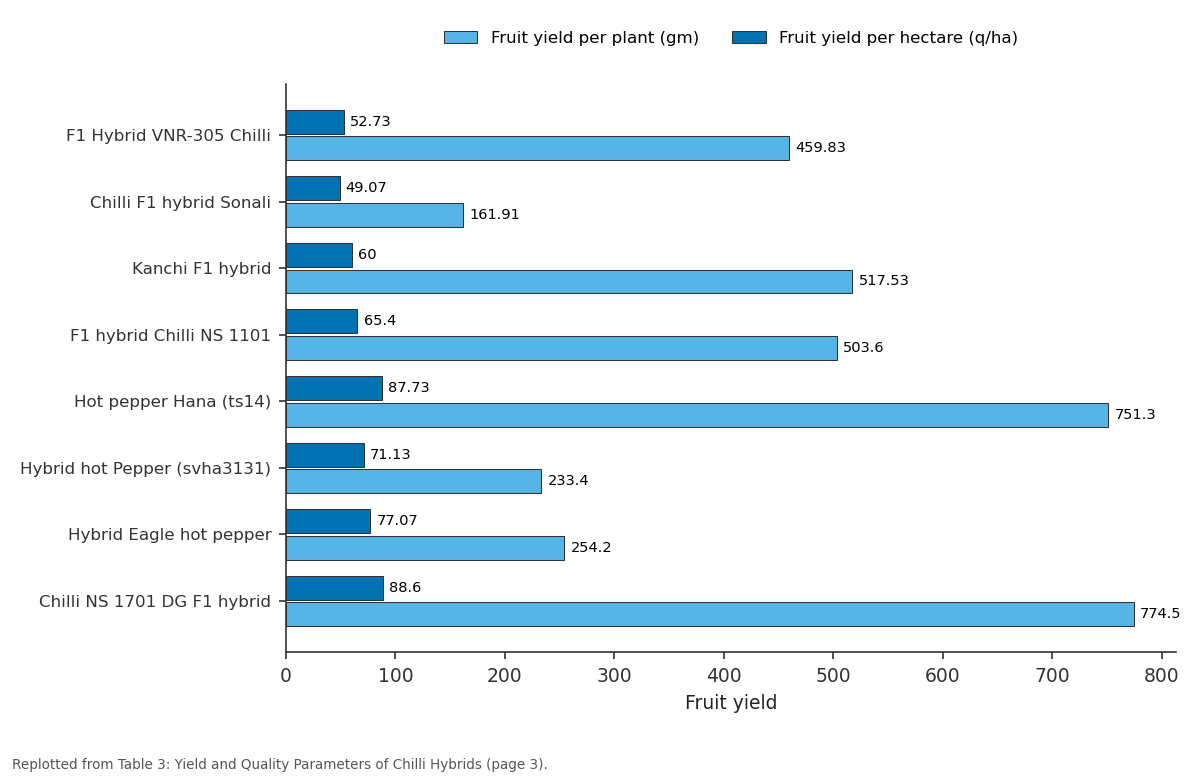
Fruit yield per plant (gm) and Fruit yield per hectare (q/ha): F1 Hybrid VNR-305 Chilli vs Chilli F1 hybrid Sonali vs Kanchi F1 hybrid vs F1 hybrid Chilli NS 1101 vs Hot pepper Hana (ts14)
Replotted from Table 3 (page 3) of the original paper. Every bar is the paper's own table value.
View source evidence ↗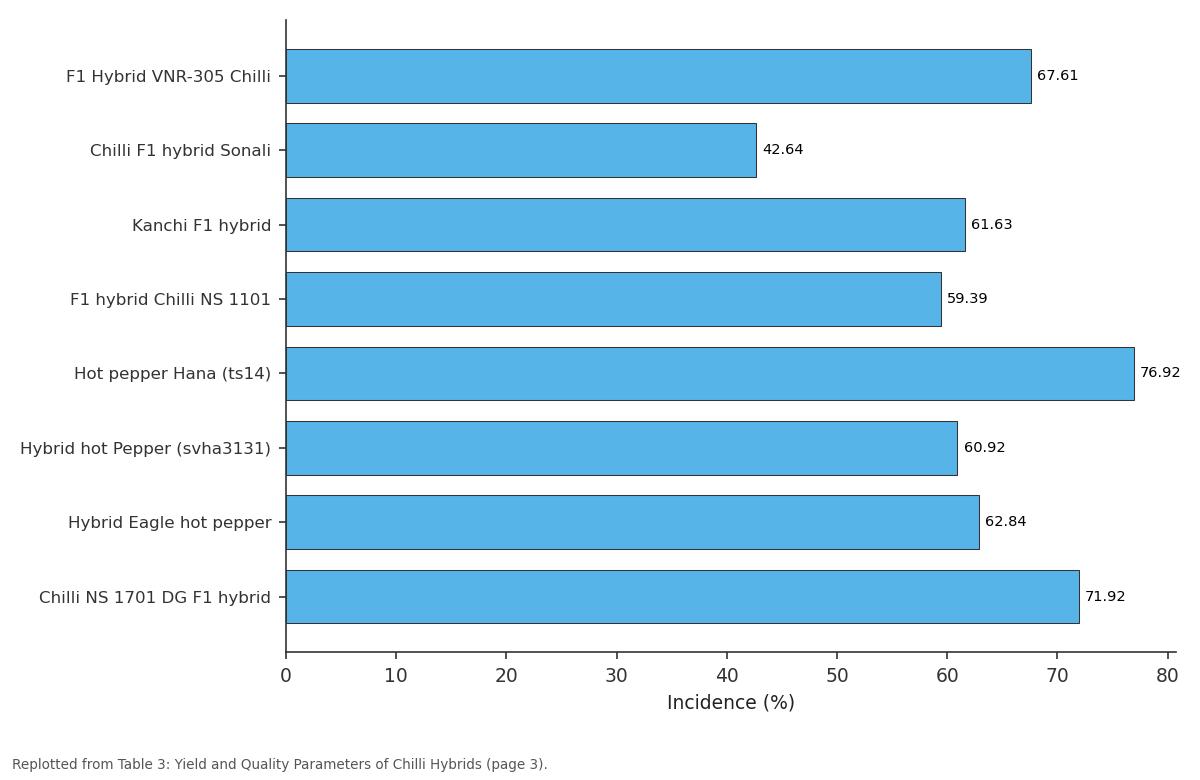
Seeds per fruit: F1 Hybrid VNR-305 Chilli vs Chilli F1 hybrid Sonali vs Kanchi F1 hybrid vs F1 hybrid Chilli NS 1101 vs Hot pepper Hana (ts14)
Replotted from Table 3 (page 3) of the original paper. Every bar is the paper's own table value.
View source evidence ↗Figures & tables
From the original paper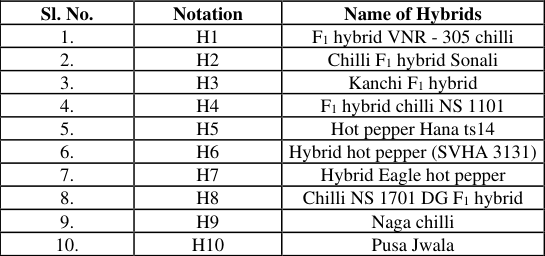 Table 1
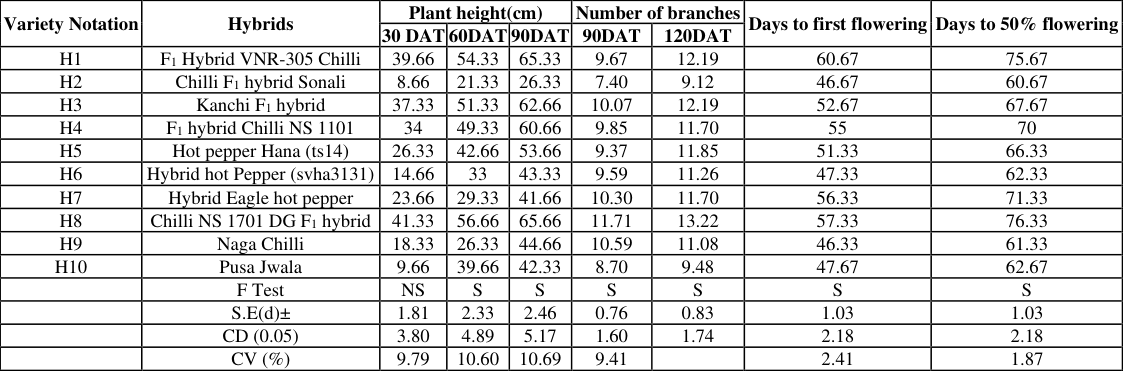 Table 2
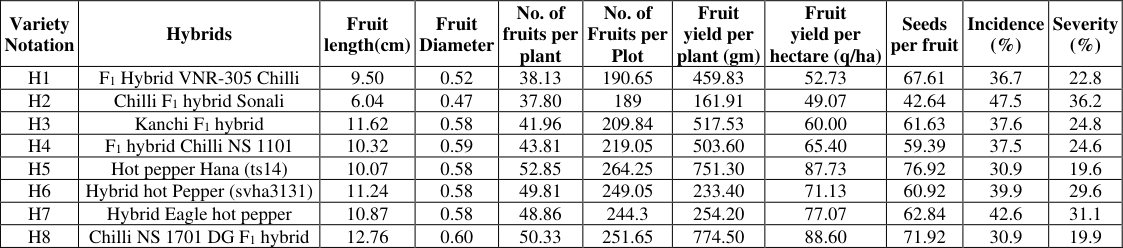 Table 3
Introduction
With chromosomal number 2n-24, the chili (Capsicum annum L.) is one of the most prominent vegetables and spice crops in the Solanaceae family. Domesticated approximately 5000 BC, chilies are native to Tropical America. Because of its mild flavour and agreeable taste as well as its high ascorbic acid and other vitamin and mineral content, chilli has become a high-value crop in India and holds a special place among other vegetables in Indian cuisine. In addition to being farmed domestically, chillies are exported. About 33% of India's total spice exports come from the spice the business world, whilst about 16% of global trade involves chilies. The genus Capsicum contains five domesticated species: C. annum, C. frutescent, C. Chinese, C. pubescents, and C. baccatum. of these, C. annum is the most frequently farmed species worldwide, with approximately 400 distinct cultivars found all over the world. The world's hottest chilli, the Naga Jolokia, was brought to Europe by Christopher Columbus and other early explorers in the fifteenth century, and pepper cultivation quickly expanded over the globe. In the Indian town of Tezpur, boot jolokia is grown in the mountainous regions near Assam. Pickles, spices, condiments, sauces, and veggies are all grown in different varieties (https://armarknet.gov.in). Chilli is an annual or perennial herbaceous plant with branches. The lone blossoms have an off-white hue. Berries make up the fruit, which can be green, yellow, orange, or red depending on maturity. A number of factors make hybrid chilies useful in agriculture, including higher yields, resistance to disease, consistency, improved quality, adaptability, financial advantages, and efficient use of resources. In general, hybrid chilies contribute significantly to increased profitability, sustainability, and productivity in the field of chili cultivation. Farmers benefit from a number of advantages provided by hybrid chili cultivars, including increased agricultural output and financial rewards. Higher yield, disease resistance, consistency, superior quality, adaptability, early maturity, and financial benefits are a few of the main benefits. All things considered, the introduction of hybrid chili types can greatly increase the production and profitability of chili farming, improving farmers' quality of life.
Materials and Methods
The Horticulture Research Farm, Department of Horticulture, Sam Higginbottom University of Agriculture, Sciences, and Technology was the site of the field experiment. Uttar Pradesh's Allahabad. It is located at 25.870N latitude and 81.150E longitude, which is 78 meters above sea level. This area has a subtropical climate with frigid winters, intense summer heat waves, and moderate rainfall. Growth parameters such as plant height, number of branches per plant, days to flower initiation and days to 50% flowering, number of fruits per plant, fruit diameter, length, weight, fruits per plant, fruits per plot, and seeds per fruit were examined based on observations made at various stages of the growth period. Net profit, benefit-cost ratio, and disease infestation costs associated with cultivation of Severity and Incidence. Table 1 provides information on the hybrids that were used. At 30, 60, and 90 DAT stages, the height of five randomly chosen plants from each plot was measured in centimetres using a 100 cm scale from the base of the plant to the tip of the shoot. Five randomly chosen plants were counted and their numbers of branches per plant were averaged to indicate the number of principal branches per plant. The plants were then allowed to grow to maturity. At 30, 60, and 90 days after planting, the number of branches per plant was counted. Days to first flowering is the total number of days from the date of sowing to the date on which the plants begin to bloom or the date on which the plants begin to bloom throughout the entire plot. And days to 50% flowering.
| Sl. No. | Notation | Name of Hybrids |
|---|---|---|
| 1. | H1 | F1 hybrid VNR - 305 chilli |
| 2. | H2 | Chilli F1 hybrid Sonali |
| 3. | H3 | Kanchi F1 hybrid |
| 4. | H4 | F1 hybrid chilli NS 1101 |
| 5. | H5 | Hot pepper Hana ts14 |
| 6. | H6 | Hybrid hot pepper (SVHA 3131) |
| 7. | H7 | Hybrid Eagle hot pepper |
| 8. | H8 | Chilli NS 1701 DG F1 hybrid |
| 9. | H9 | Naga chilli |
| 10. | H10 | Pusa Jwala |
Table text extracted from the original PDF; superscript letters are shown inline. The original table image is below.
View original table image
The maximum plant height at 90 DAT (65.66cm) was recorded in the Chilli NS 1701 DG F1 hybrid followed by F1 hybrid VNR -305 Chilli (65.33cm). Plant height was found in minimum (26.33 cm) in the F1 hybrid Sonali.
Number of branches per plant
The maximum number of branches at 90 DAT (
Average fruit length ranged from Chilli F1 hybrid Sonali (6.04cm) to Chilli NS 1701 DG F1 hybrid (12.76cm) with a mean of 9.63. Maximum average fruit length was observed in hybrid Chilli NS 1701 DG F1 hybrid with 12.76cm fruits and was superior to rest of the hybrids, followed by Kanchi F1 hybrid with 11.62cm, while the minimum average fruit length was observed in hybrid Chilli F1 hybrid Sonali with 6.04cm fruits. The hybrid Chilli NS 1791 DG F1 hybrid gives maximum average fruit length due to favourable conditions, and genetic makeup of the hybrid to have wide adaptability.
Fruit diameter
Average fruit diameter ranged from Chilli F1 hybrid Sonali (0.47cm) to Chilli NS 1701 DG F1 hybrid (0.60cm) with a mean of 0.523. Maximum average fruit diameter was observed in hybrid Chilli NS 1701 DG F1 hybrid with 0.60cm and was superior to rest of the hybrids, followed by Naga Chilli with 0.59cm, while the minimum average fruit diameter was observed in hybrid Chilli F1 hybrid Sonali with 0.47cm fruits. The hybrid Chilli NS 1791 DG F1 hybrid gives maximum average fruit length due to favourable conditions, and genetic makeup of the hybrid to have wide adaptability.
Number of fruits per plot
Number of fruits per plot
Figures and tables from the paper
| Variety Notation | Hybrids | Plant height(cm) | — | — | Number of branches | — | Days to first flowering | Days to 50% flowering |
|---|---|---|---|---|---|---|---|---|
| 30 DAT | 60DAT | 90DAT | 90DAT | 120DAT | ||||
| H1 | F1 Hybrid VNR-305 Chilli | 39.66 | 54.33 | 65.33 | 9.67 | 12.19 | 60.67 | 75.67 |
| H2 | Chilli F1 hybrid Sonali | 8.66 | 21.33 | 26.33 | 7.40 | 9.12 | 46.67 | 60.67 |
| H3 | Kanchi F1 hybrid | 37.33 | 51.33 | 62.66 | 10.07 | 12.19 | 52.67 | 67.67 |
| H4 | F1 hybrid Chilli NS 1101 | 34 | 49.33 | 60.66 | 9.85 | 11.70 | 55 | 70 |
| H5 | Hot pepper Hana (ts14) | 26.33 | 42.66 | 53.66 | 9.37 | 11.85 | 51.33 | 66.33 |
| H6 | Hybrid hot Pepper (svha3131) | 14.66 | 33 | 43.33 | 9.59 | 11.26 | 47.33 | 62.33 |
| H7 | Hybrid Eagle hot pepper | 23.66 | 29.33 | 41.66 | 10.30 | 11.70 | 56.33 | 71.33 |
| H8 | Chilli NS 1701 DG F1 hybrid | 41.33 | 56.66 | 65.66 | 11.71 | 13.22 | 57.33 | 76.33 |
| H9 | Naga Chilli | 18.33 | 26.33 | 44.66 | 10.59 | 11.08 | 46.33 | 61.33 |
| H10 | Pusa Jwala | 9.66 | 39.66 | 42.33 | 8.70 | 9.48 | 47.67 | 62.67 |
| F Test | NS | S | S | S | S | S | S | |
| S.E(d)± | 1.81 | 2.33 | 2.46 | 0.76 | 0.83 | 1.03 | 1.03 | |
| CD (0.05) | 3.80 | 4.89 | 5.17 | 1.60 | 1.74 | 2.18 | 2.18 | |
| CV (%) | 9.79 | 10.60 | 10.69 | 9.41 | 2.41 | 1.87 |
Table text extracted from the original PDF; superscript letters are shown inline. The original table image is below.
View original table image
| Variety Notation | Hybrids | Fruit length(cm) | Fruit Diameter | No. of fruits per plant | No. of Fruits per Plot | Fruit yield per plant (gm) | Fruit yield per hectare (q/ha) | Seeds per fruit | Incidence (%) | Severity (%) |
|---|---|---|---|---|---|---|---|---|---|---|
| H1 | F1 Hybrid VNR-305 Chilli | 9.50 | 0.52 | 38.13 | 190.65 | 459.83 | 52.73 | 67.61 | 36.7 | 22.8 |
| H2 | Chilli F1 hybrid Sonali | 6.04 | 0.47 | 37.80 | 189 | 161.91 | 49.07 | 42.64 | 47.5 | 36.2 |
| H3 | Kanchi F1 hybrid | 11.62 | 0.58 | 41.96 | 209.84 | 517.53 | 60.00 | 61.63 | 37.6 | 24.8 |
| H4 | F1 hybrid Chilli NS 1101 | 10.32 | 0.59 | 43.81 | 219.05 | 503.60 | 65.40 | 59.39 | 37.5 | 24.6 |
| H5 | Hot pepper Hana (ts14) | 10.07 | 0.58 | 52.85 | 264.25 | 751.30 | 87.73 | 76.92 | 30.9 | 19.6 |
| H6 | Hybrid hot Pepper (svha3131) | 11.24 | 0.58 | 49.81 | 249.05 | 233.40 | 71.13 | 60.92 | 39.9 | 29.6 |
| H7 | Hybrid Eagle hot pepper | 10.87 | 0.58 | 48.86 | 244.3 | 254.20 | 77.07 | 62.84 | 42.6 | 31.1 |
| H8 | Chilli NS 1701 DG F1 hybrid | 12.76 | 0.60 | 50.33 | 251.65 | 774.50 | 88.60 | 71.92 | 30.9 | 19.9 |
Table text extracted from the original PDF; superscript letters are shown inline. The original table image is below.
View original table image
References
11 in the original paper- Bharadwaj DN, Singh H, Yadav RK. Genetic variability and association of component characters for yield in chilli (Capsicum annuum L.). 2007;7(1/2):72-74.
- Datta S, Jana JC. Stability of chilli genotypes for different seasons at terai zone of West Bengal. 2012;21(1):71-75.
- Kameshwari PL, Padma SSV, Venkataramana KT. Evaluation of chilli (Capsicum annum L.) varieties in high altitude and tribal zone of Andhra Pradesh. 2006;34(2):103105.
- Karak PK, Pariari A, Karak C. Varietal evaluation of chilli in the saline belt of West Bengal. 2015;11:86-89.
- Katheek Bharadwaza R, Prasad VM, Adi Narayana M, Narayana GS. Evaluation of Chilli (Capsicum annuum L.) Genotypes for Yield and Yield Attributes in Allahabad Agro-Climatic Conditions. 2018;7:773-776.
- Krishna CU, Madalageri MB, Patil MP, Mulgae R, Kotikal YK. Variability Studies in Green Chilli (Capsicum annum L.). 2007;20(1):(102-104).
- Munshi AD, Kumar BK, Sureja AK, Joshi S. Genetic variability, heritability, and genetic advance for growth, yield and quality traits in chilli. 2010;67(1):114-116.
- Prasad PB, Usha Nandhini DH, Arumugam T, Karthikeyan M. Growth and performance of different chilli genotypes for yield and yield attributing characters. 2019;8(4):210213.
- Sharma IJ, Samnotra RK, Kumar V, Dhotra B. Rainfed Research Substation for Sub-tropical Fruits, Raya, S.K. University of Agricultural Sciences and Technology, Jammu (J. &K.). 2014;9(2):192-195.
- Sha K, Madhavan S. Evaluation of Growth and Yield of Chilli (Capsicum Annuum. L) for the Coastal Region of Cuddalore District. 2016;1(1):252-253.
- Shirshat SS, Giritammannavar VA, Patil SJ. Analysis of Genetic Variability for Quantitative Traits in Chilli. 2006;20(1):29-32.