
Research article · 2024 · Full text
International Journal of Agriculture Extension and Social DevelopmentFarmers’ preferences for privatization of agricultural extension services
Volume 7(7) · Pages 19–22 · DOI: 10.33545/26180723.2024.v7.i7a.762 ↗
Research areasAgricultural Economics and PracticesLivestock Management and Performance ImprovementAgricultural Innovations and Practices
Abstract
Author-writtenA lot has been changed since green revolution, in terms of technology and its dissemination in Indian agriculture. Public extension system is being condemned for not able to deliver as per the belief of the people. Meanwhile, privatization has come up as an alternative of public extension system across the country. However, its acceptance among the farmers remained a subject of analysis. A study was thus conducted to determine the preferences of farmers towards various aspects of privatization of agricultural extension services in North Bengal. A multistage, purposive and random sampling method was followed in selecting the study area and the respondents of the study. Total 100 farmers were selected randomly from two districts namely Cooch Behar and Malda. Total four blocks, two from each district and one village from each block were selected randomly. Data was collected from farmers with the help of structured interview schedule through personal interview method. Farmers were asked about their preferences against various aspects of privatization of agricultural extension services and conclusion was drawn by using statistical tools like frequency, percentage, mean etc. It has been found that private agricultural extension interferences were more accepted for irrigation, post-harvest, marketing and credit related areas by the farmers in the study area. Privatization of agricultural extension services was more in demand when it comes to inputs supply like fertilizers, agro-chemicals, technological know-how, information kiosk and food processing among others. Large farmers, commercial crop growers and progressive famers were found to be the most preferred clientele group for privatized agricultural extension services. Consultancy firms, Agri business companies, Farmer association and NGO’s like approaches of Private agriculture extension services were found to be well accepted by the selected farmers of the study area.
Summary
Source-checkedPlain-language reading of the full paper, prepared with AI and checked against the text. Each point links to the authors' own words.
Why it matters
- The public agricultural extension system in India is perceived by some as failing to deliver, leading to the emergence of privatization as an alternative. View evidence ↗
- Privatization of extension services in India has been driven by factors such as poor public sector performance, low coverage, and the commercialization of agriculture. View evidence ↗
The question
- The study aimed to determine the preferences of farmers in North Bengal regarding various aspects of privatized agricultural extension services. View evidence ↗
What they did
- The research was conducted in the Cooch Behar and Malda districts of West Bengal, chosen because of the high number of private extension agencies present there. View evidence ↗
- Data collection was performed using a structured interview schedule administered through personal interviews. View evidence ↗
What they found
- A majority of farmers (74%) preferred private extension agencies for post-harvest technology services. View evidence ↗
- Credit facilities were highly preferred through private agencies, with 79% of respondents choosing them over public services. View evidence ↗
- Farmers showed a willingness to pay for several private services, most notably for irrigation technology and management (84%) and post-harvest technology (75%). View evidence ↗
- Public extension services remained preferred for land development, seed production technology, and general cultivation practices for agricultural and horticultural crops. View evidence ↗
- Large farmers and commercial crop growers showed the strongest preference for privatized services, both achieving a weighted mean score of 3.0. View evidence ↗
- Progressive farmers (2.82 weighted mean score) and high-income farmers (2.74 weighted mean score) also preferred private extension services. View evidence ↗
- Among the various private approaches, farmers' associations were the most preferred provider of extension services. View evidence ↗
What it means
- The authors conclude that a public-private partnership is likely the best solution for the current agricultural system given the contribution of private providers. View evidence ↗
- The study recommends strengthening NGOs, farmers' organizations, and consultancy firms to improve the agricultural knowledge information system. View evidence ↗
- The authors note that the study should be extended to other districts with larger farmer populations to reach more generalized conclusions. View evidence ↗
Visual summary
2 visualsIllustrations explain the paper; charts are replotted from the paper's own table values.
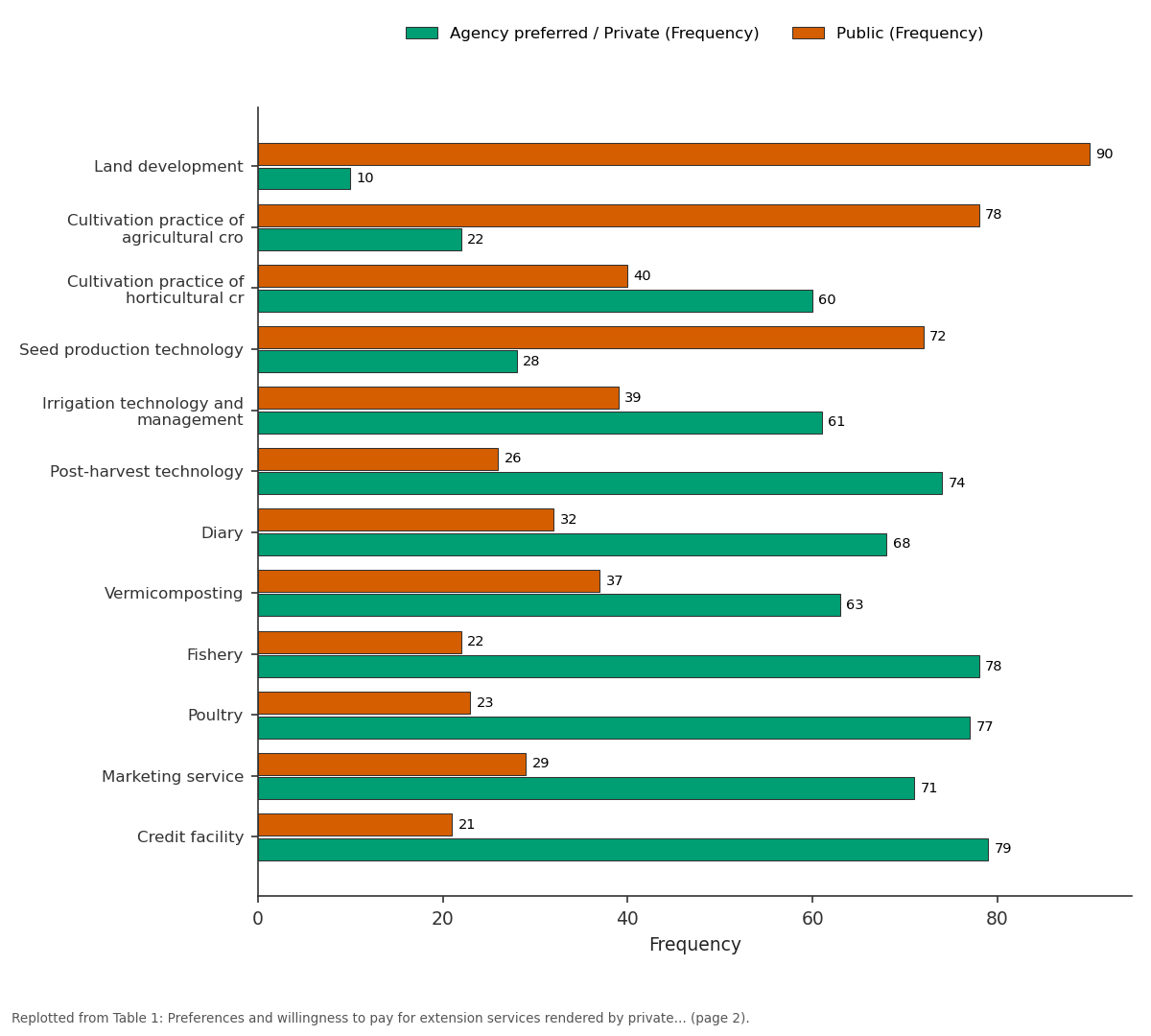
Agency preferred / Private (Frequency) and Public (Frequency): Land development vs Cultivation practice of... vs Cultivation practice of... vs Seed production... vs Irrigation technology...
Replotted from Table 1 (page 2) of the original paper. Every bar is the paper's own table value.
View source evidence ↗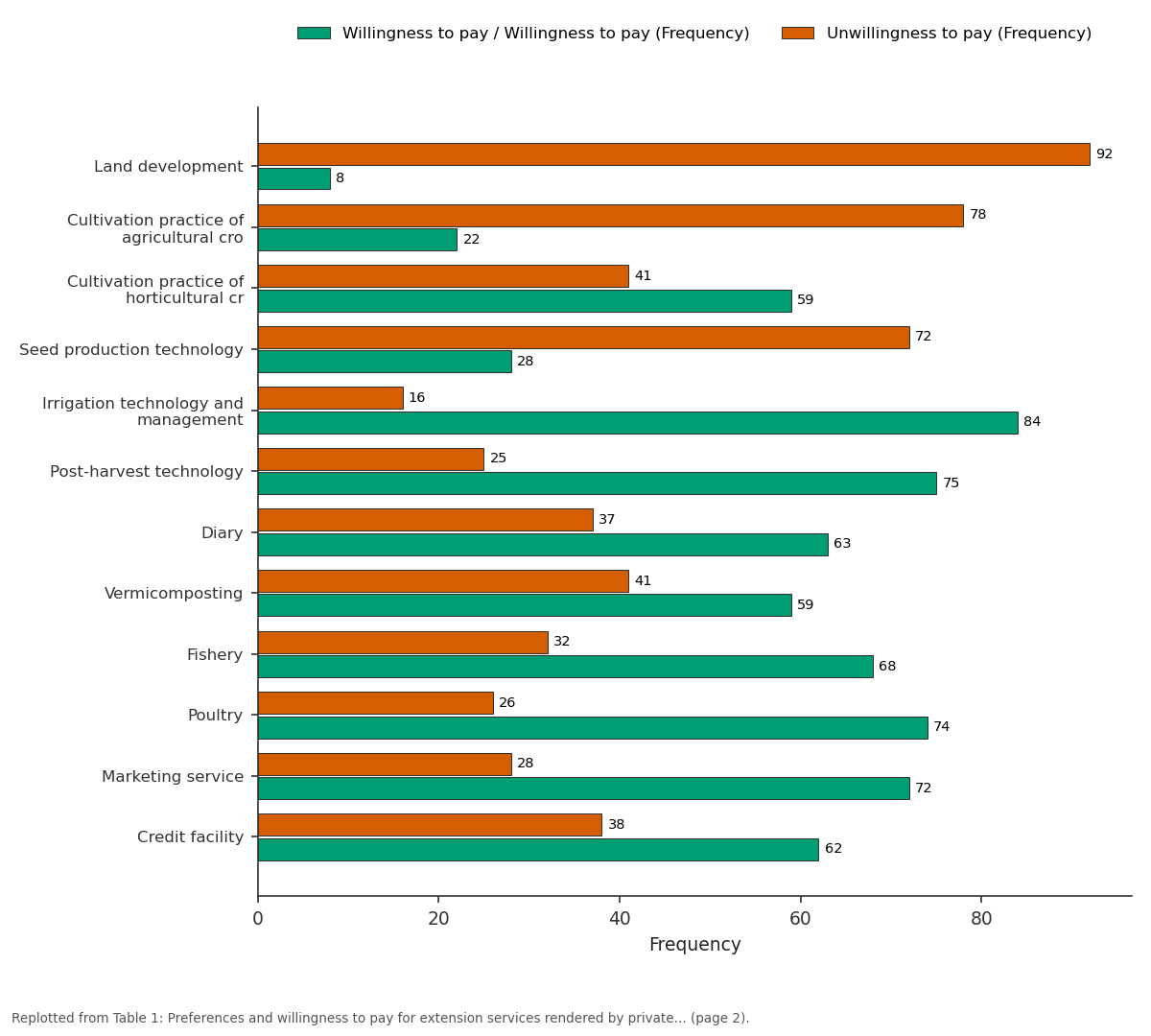
Willingness to pay / Willingness to pay... and Unwillingness to pay (Frequency): Land development vs Cultivation practice of... vs Cultivation practice of... vs Seed production... vs Irrigation techno
Replotted from Table 1 (page 2) of the original paper. Every bar is the paper's own table value.
View source evidence ↗Figures & tables
From the original paper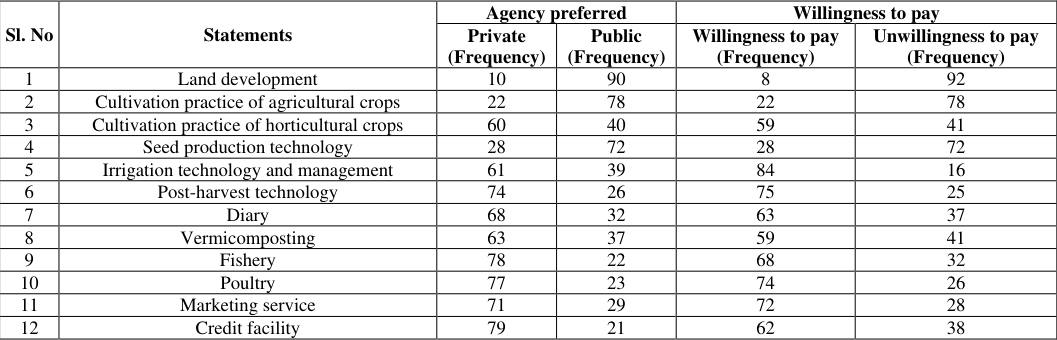 Table 1
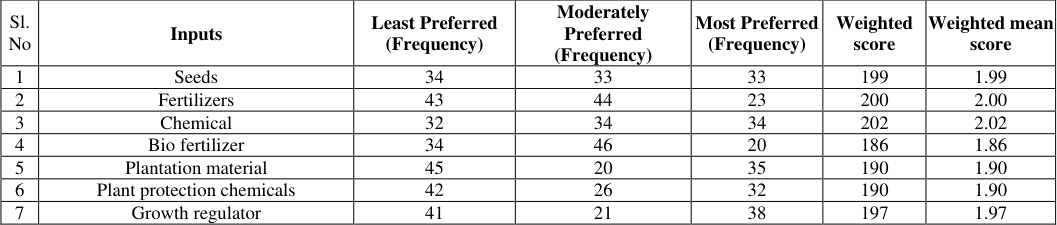 Table 2
 Table 3
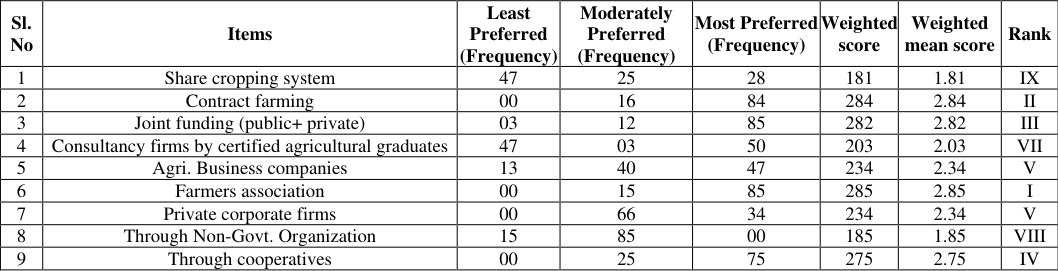 Table 4
Introduction
In recent years, the Private sector extension efforts are being increasingly recognized in India in complementing and supplementing public sector extension efforts. Presently, almost every developing country has public, NGO as well as private firms for delivering extension services to the farmers. The reason might be the reduced governments' expenditures for extension in many countries over the last few decades. Further, poor performance, low coverage, wider public extension worker: farmer ratio, limited role of village extension workers, commercialization of agriculture and many other existing market problems have given birth to the privatization of agricultural extension services in India as well. India is a developing country, where agriculture is the primary occupation, farmers are either small or marginal. Question therefore, arises on the acceptance and preferences for privatization of agricultural extension services by the farmers who earlier thought that agricultural extension services are the responsibility of the government and its cost incurring. A study thus has been conducted to find out the preferences of farmers towards privatization of agricultural extension services in North Bengal. The study was the part of a PhD program, thus time and resources were some of the constraints. The findings are based on the responses of the farmers of the study area. The study may further be extended to different districts of the state with larger population of farmers, to come to a more generalized conclusion. It can also be conducted to find out the preferences of extension professionals and functionaries.
Material and Methods
The study was conducted in Cooch Behar and Malda districts of West Bengal, selected purposively due to the presence of abundant number of private extension agencies in the area. Four blocks namely Cooch Behar-II, Mathabhanga-II, Ratua-II, and Gazole were randomly selected out of twelve blocks of Cooch Behar district and fifteen blocks of Malda district. From these selected blocks, one village from each block was taken randomly. From Cooch Behar-II block, Tenganmari village was selected. The village namely Angrakata Paradubi was selected from Mathabhanga-II block. Villages namely Sreepur and Doas were selected from Ratua II and Gazole block respectively. www.extensionjournal.com Total 100 farmers were selected through multi stage random sampling technique.25 farmers were selected with simple random sampling technique from each village. A pilot study has been done before conducting the actual survey. A structured interview schedule was prepared and pre tested with the farmers of the study area, based on which necessary modifications were made in the interview schedule. The data were than collected through physical interview method with the help of the interview schedule. Care was taken for not to include the farmers with whom the schedule was pretested. The schedule was prepared in vernacular and responses were recorded by the researcher. Later the data were processed with the help of Microsoft excel and analyzed with the help SPSS software.
Results and discussion 1. Preferences of farmers towards privatization of extension services.
It is evident from the table that majority of the respondents (74%) have favored the private extension agencies for services related to post-harvest technology. A big percent (78%) of respondents have preferred private extension agencies to provide the technical services related to fisheries, followed by respondents (77%), preferred privatized services for poultry. A huge number of respondents (79%) have opted for private agencies over public extension services for credit facilities. Post harvest technology, marketing and credit facility are some of the most important areas in agriculture which directly impacts the profit obtained from agriculture. However, these services demand for quick, up to date and modern technology which perhaps private agencies may offer effectively in need. Whereas, Land development, Cultivation practice of agricultural crops, Cultivation practice of horticultural crops, Seed production technology, Dairy and Poultry are some of the areas where public extension services were preferred more. It might be due to the fact that by KVKs, research centers, agricultural universities etc present in the study area, provides frequent trainings, workshop and exposures to the farmers etc. The table also reveals the percent of respondents willing to pay for the services rendered by extension agencies in the field of agriculture. Irrigation technology and management, Post-harvest technology, Fishery, Poultry and Marketing service are the areas were farmers have shown their willingness to pay and the percent of such respondent farmers are 84%, 75%, 68%, 74% and 72% respectively.
Preference for extension service providers with respect to various approaches of extension services.
It has been found that extension services through various Farmers' association followed by Consultancy firms, Agri business companies, NGOs etc were the most preferred and thus score ranks as per their weighted mean score viz I, II, III, IV respectively. This indicates that farmers have well accepted these private agencies in spite of being private agencies.
Conclusion and recommendation
The study concludes that private extension service providers are deep rooting day by day through their multidimensional activities. It has become crucial for national food security and effective service delivery system in the country.
Understanding the significant contribution of private service providers, the public-private partnership may be the answer in the present agriculture system. Thus, the study recommends strengthening the NGOs, Farmer's organisations, Consultancy firms etc for better agricultural knowledge information system. Unemployed agricultural graduates to be supported and trained, who wish to become agricultural consultants so that knowledgeable and efficient people are there to support the extension system.
Figures and tables from the paper
| Sl. No | Statements | Agency preferred | — | Willingness to pay | — |
|---|---|---|---|---|---|
| Private (Frequency) | Public (Frequency) | Willingness to pay (Frequency) | Unwillingness to pay (Frequency) | ||
| 1 | Land development | 10 | 90 | 8 | 92 |
| 2 | Cultivation practice of agricultural crops | 22 | 78 | 22 | 78 |
| 3 | Cultivation practice of horticultural crops | 60 | 40 | 59 | 41 |
| 4 | Seed production technology | 28 | 72 | 28 | 72 |
| 5 | Irrigation technology and management | 61 | 39 | 84 | 16 |
| 6 | Post-harvest technology | 74 | 26 | 75 | 25 |
| 7 | Diary | 68 | 32 | 63 | 37 |
| 8 | Vermicomposting | 63 | 37 | 59 | 41 |
| 9 | Fishery | 78 | 22 | 68 | 32 |
| 10 | Poultry | 77 | 23 | 74 | 26 |
| 11 | Marketing service | 71 | 29 | 72 | 28 |
| 12 | Credit facility | 79 | 21 | 62 | 38 |
Table text extracted from the original PDF; superscript letters are shown inline. The original table image is below.
View original table image
| Sl. No | Items | Least Preferred (Frequency) | Moderately Preferred (Frequency) | Most Preferred (Frequency) | Weighted score | Weighted mean score | Rank |
|---|---|---|---|---|---|---|---|
| 1 | Share cropping system | 47 | 25 | 28 | 181 | 1.81 | IX |
| 2 | Contract farming | 00 | 16 | 84 | 284 | 2.84 | II |
| 3 | Joint funding (public+ private) | 03 | 12 | 85 | 282 | 2.82 | III |
| 4 | Consultancy firms by certified agricultural graduates | 47 | 03 | 50 | 203 | 2.03 | VII |
| 5 | Agri. Business companies | 13 | 40 | 47 | 234 | 2.34 | V |
| 6 | Farmers association | 00 | 15 | 85 | 285 | 2.85 | I |
| 7 | Private corporate firms | 00 | 66 | 34 | 234 | 2.34 | V |
| 8 | Through Non-Govt. Organization | 15 | 85 | 00 | 185 | 1.85 | VIII |
| 9 | Through cooperatives | 00 | 25 | 75 | 275 | 2.75 | IV |
Table text extracted from the original PDF; superscript letters are shown inline. The original table image is below.
View original table image
References
7 in the original paper- Adhiguru P, Birthal PS, Ganesh Kumar B. Strengthening pluralistic agricultural information delivery systems in India. Agricultural Economics Research Review. 2009;22(1):71-79.
- Ali S, Ahmad M, Ali T, Hassan SW, Luqman M. Role of private extension system in agricultural development through advisory services in the Punjab, Pakistan. Pakistan Journal of Science. 2011;63(2):70-73.
- Bawa DB, Ani AO, Nuhu HS. Perception of www.extensionjournal.com privatization and commercialization of agricultural extension services in Adamawa State, Nigeria. American-Eurasian Journal of Sustainable Agriculture. 2009;3(3):375-380.
- Idrisa YL, Gwary MM, Ogunbameru BO. Analysis of farmers' access to and perception of extension service delivery in Borno State, Nigeria. Journal of Agricultural Extension. 2008;12(1):50-58.
- Kumar A, Vijayaragavan K. Effectiveness of privatized agricultural extension services: A case of Tata Kisan Sansar. Indian Journal of Extension Education. 2007;43:68-73.
- Singh AK, Narain S, Chauhan J. Capacity of farmers to pay for extension services. Indian Journal of Extension Education. 2011;11(3):60-62.
- Singh KM, Swanson BE. Development of supply chains for medicinal plants: A case study involving the production of Vinca rosa by small farmers in the Patna district of Bihar, India. Paper presented in 2005-Post IAMA Workshop: Building New Partnerships in Global Food Chains-Experiences from North Africa, the Near East and Asia. June 29-30, Allerton Crowne Plaza Hotel, Chicago, IL; c2005.