
Research article · 2024 · Full text
International Journal of Veterinary Sciences and Animal HusbandryStudies on detrimental effect of cryopreservation on sperm progressive motility, viability, plasma membrane integrity and oxidative stress in Frieswal bull semen
Volume 9(4) · Pages 25–28 · DOI: 10.22271/veterinary.2024.v9.i4a.1502 ↗
Research areasSperm and Testicular FunctionReproductive Biology and FertilitySelenium in Biological Systems
Abstract
Author-writtenThis experiment was designed to study the effect of cryopreservation on post-thaw sperm quality and oxidative stress in Frieswal bull semen. For this purpose, 18 ejaculates were collected from three Frieswal bulls using artificial vagina at biweekly intervals. The semen sample which possesses more than 70% progressive motility and above 600 million/ml spermatozoa concentration was subsequently subjected to a process for LN¬2 vapour freezing. Semen samples were extended in the GEYT extender. At the fresh stage, semen was evaluated for percent live spermatozoa, percent progressive motility, percent intact acrosome, and percent HOST reactive spermatozoa. At the post-thaw stage, semen was evaluated for percent progressive motility, percent live spermatozoa, percent intact acrosome, percent HOST reactive spermatozoa. Post-thaw semen, showed a significant (p
Summary
Source-checkedPlain-language reading of the full paper, prepared with AI and checked against the text. Each point links to the authors' own words.
Why it matters
- Propagating elite germplasm to ensure a calf per cow per year is a key strategy for improving cattle production and food security in developing nations. View evidence ↗
- Cryopreservation is essential for making spermatozoa widely available for artificial insemination procedures. View evidence ↗
- Cryo-injury is caused by temperature changes, osmotic stress, and ice crystal formation, which can irreversibly damage the physiology and structure of sperm cells. View evidence ↗
The question
- The study aimed to evaluate how cryopreservation affects the quality of Frieswal bull sperm and the resulting oxidative stress after thawing. View evidence ↗
What they did
- The researchers collected 18 ejaculates from three Frieswal bulls using an artificial vagina at biweekly intervals. View evidence ↗
- Only semen samples with over 70% progressive motility and a concentration above 600 million/ml were used for liquid nitrogen vapour freezing. View evidence ↗
- The semen samples were processed using a glycerol egg yolk tris (GEYT) extender. View evidence ↗
- The 18 ejaculates were evaluated for viability, acrosomal integrity, progressive motility, and plasma membrane integrity (via HOST test) at both fresh and post-thaw stages. View evidence ↗
- Tests for oxidative stress, specifically the assessment of reactive oxygen species (ROS), were performed only after the thawing process was complete. View evidence ↗
What they found
- Post-thaw semen exhibited a reactive oxygen species (ROS) level of 212.91±3.17 units of H2O2. View evidence ↗
What it means
- The authors concluded that cryopreservation has a detrimental effect on spermatozoa, which is driven by oxidative stress (OS). View evidence ↗
- To improve artificial insemination procedures, the authors recommend targeting the mitigation of DNA and plasma membrane damage during the equilibration and freezing stages. View evidence ↗
Visual summary
1 visualsIllustrations explain the paper; they do not show study data.
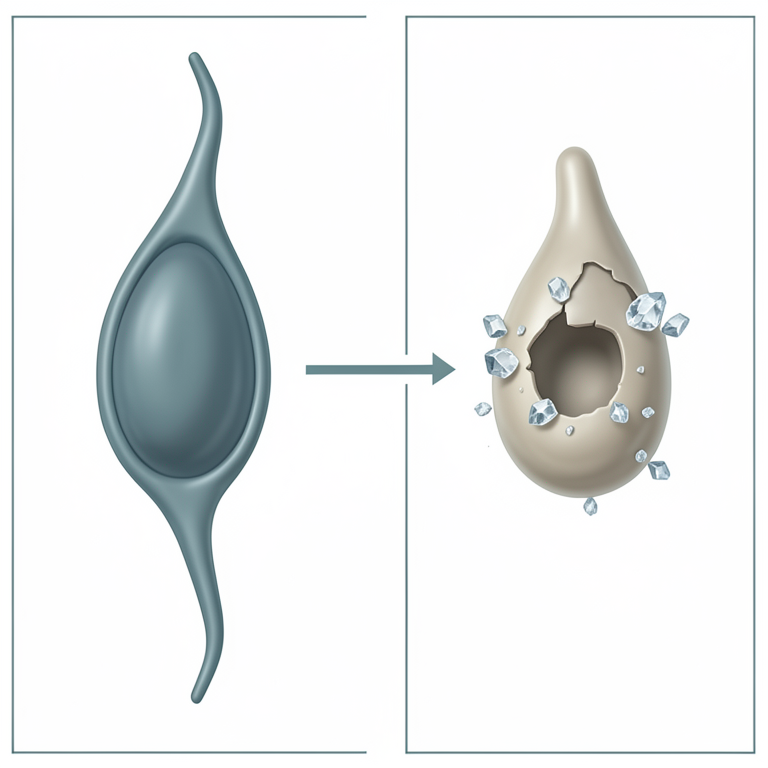
Mechanism of Cryo-injury
AI-generated conceptual illustration (Frieswal bull spermatozoa). It explains the idea and does not show study data.
View source evidence ↗Figures & tables
From the original paper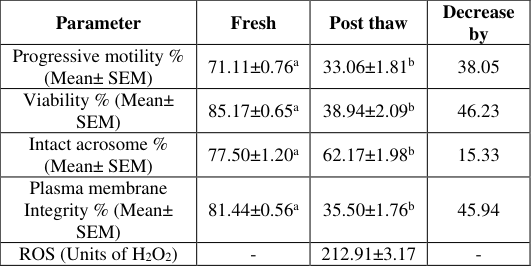 Table 1
Introduction
Overall production of developing nations is quite low, despite having abundant genetic resources for cattle. For dairying to continue to be successful and to ensure food security for the growing population, this must be accelerated. Propagating elite germplasm and relying on the idea of producing "a calf per cow per year" through timely insemination and successful conception are the best approaches. An important step in this direction has been the cryopreservation of spermatozoa, which has made cryopreserved spermatozoa widely available for use in artificial insemination (AI) procedures (Ugur et al., 2019) [25] . However, insemination with low fertilising capacity cryo injured spermatozoa is responsible for a large loss to the dairy industry (Chung et al., 2019; Dewry et al., 2020; Singh et al., 2020) [9,10,23] . The main factors that lead to cryo-injury include temperature changes, the creation of osmotic stress, and the formation of ice crystals, which modify the sperm cell's physiology and structure and cause irreversible damage (Ahmed et al., 2019; Upadhyay et al., 2021) [2,26] . While cryopreservation extends the shelf life of spermatozoa, the process can also cause cryoinjury that can lead to changes in plasma membrane permeability, acrosomal destruction, mitochondrial membrane depolarization, and loss of sperm motility (Upadhyay et al., 2021) [26] . These elements play a role in the inability of spermatozoa to engage with the female reproductive tract, which leads to the failure of fertilization (Ezzati et al., 2020) [11] . The freezing-thawing process alters the physiology and deforms the structure of spermatozoa by causing alterations in the osmotic balance, producing an excessive amount of reactive oxygen species, and forming intracellular ice crystals (Ugur et al., 2019) [25] . Numerous factors, including elevated oxidative metabolism and osmotic stress, can cause oxidative stress. A state of oxidative stress develops Because of an imbalance between the sperm cells' capacity to produce reactive oxygen species (ROS) and their antioxidant capacity.
It is distinguished by the presence of DNA breaks in the cryopreserved male gametes and the induction of changes to the sperm membrane. Seminal plasma's antioxidant qualities act as a natural defence against reactive oxygen species (ROS) and control the intracellular redox potential, particularly in stressful situations like low temperatures during cryopreservation. The production of NADPH oxidase in the plasma membrane and modifications to the electron transport chain located in the mitochondria are brought about by the enhanced formation of ROS (Len et al., 2019; Peris-Frau et al., 2020) [17,21] . Because of this, oxidative stress is regarded as one of the primary factors that lead to structural and molecular cell damage. Before the freezing procedure, the seminal plasma is completely removed or diluted, which results in a loss in the antioxidant potential. Lipid peroxidation is another oxidative stress-related consequence. Polyunsaturated fatty acids, which are susceptible to ROSinduced peroxidation, are present in relatively high concentrations in sperm membranes. The major cell respiratory system is located in the middle (mitochondrial) region of the sperm flagellum, which is where lipid peroxidation mostly occurs. DNA damage, ATP production reduction, motility loss, and lipid layer damage to cell membranes are possible outcomes of this (Benko et al., 2021) [6] . Objective of this study was to study the detrimental effect of Cryopreservation on Frieswal bull spermatozoa.
Materials and Methods
The present study was undertaken at the Semen Freezing Laboratory, Division of Cattle Physiology and Reproduction, ICAR-Central Institute for Research on Cattle, Meerut Cantt., India (29º N, 78° E and altitude 270 m). It has a monsooninfluenced humid subtropical climate characterized by hot summers and cold winters. For this study, three healthy Frieswal (Holstein-Friesian × Sahiwal) breeding bulls with an average weight of 500-600 kg were kept in uniform housing and fed. Regular normal procedure was followed, and the ejaculates were collected twice a week in the early morning between 8 and 9 AM in graded glass tubes attached to the artificial vagina. Prior to actual collection, each bull was given one false mount. Study samples were chosen based on three criteria: ≥ 2 ml volume, ≥ 600 million spermatozoa per ml concentration, and ≥ 70% individual progressive motility (IPM). Volume was measured by graduated Collecting tube. The Concentration of the spermatozoa (millions/ml) was determined by Accucell Photometer (IMV Technologies, France). Following the initial evaluation of the semen, the selected samples were extended using a pre-heated (37 °C) glycerol egg yolk tris (GEYT) extender containing the following: tris (3.02 g), citric acid (1.67 g), fructose (1.25 g), penicillin (100,000 IU), streptomycin (100 mg), glycerol (7 ml), and egg yolk (20 ml) in Millipore water. Approximately 80 million progressive motile sperm cells/ml were maintained as the sperm cell concentration. Four characteristics were evaluated at the fresh stage: a) initial progressive motility; b) the percentage of viability of spermatozoa; and c) the integrity of the acrosomes and d) the integrity of the plasma membrane. Progressive motility, live spermatozoa and Acrosome integrity were assessed as per Salisbury et al., (1978) [22] ; HOST test was performed as described by Jeyendran et al., (1984) [13] . Following the filling and sealing of 0.25 Ml French micro straws, the prolonged semen was allowed to acclimate for four hours in a horizontal cold handling cabinet (Minitube).
A programmable automated freezing system (IMV, France) was used to freeze the samples. It had a rate freezing range of 4 °C to -10 °C @ 5 °C, -10 °C to -100 °C @ 40 °C, and -100 °C to -140 °C @ 20 °C once the temperature reached -140 °C. The straws were frozen and then kept until they were tested in cryogenic containers submerged in liquid nitrogen (-196 °C). In a thawing unit (CITO thawer 12/220V, IMV), frozen samples were thawed for at least 30 seconds at 37 °C. At the post-dilution and post-thaw stages of the semen processing, total ejaculates (n = 18) were assessed for percentage Live spermatozoa, acrosomal integrity, progressive motility, and hypo-osmotic swelling test. However, only when thawing is complete test for oxidative stress (ROS) was performed. Oxidative Stress test viz. ROS assessment in seminal plasma was done via a procedure described by Hayashi et al. (2007) [12] . The Results were analysed statistically using Analysis of Variance (ANOVA) (Snedecor And Cochran, 1989) [24] .
Results
The range of initial progressive motility of spermatozoa, percentage of live spermatozoa, acrosome integrity, plasma membrane integrity were with a mean value of 71.11±0.76%, 85.170.65%, 77.50±1.20% and 81.44±0.56%, respectively. As compared to the fresh, the progressive motility was found to be significantly (p<0.001) reducedat post-thaw stage (33.06±1.81), the viability was found to be significantly (p<0.05) reduced at the post-thaw stage (38.94±2.09) & the mean percentage of spermatozoa with intact acrosome was significantly reduced (62.17±1.98) after freeze-thaw process & mean percentage of spermatozoa with intact plasma membrane was significantly reduced (35.50±1.76) after freeze-thaw process. Percent decrease in progressive motility, viability, acrosome integrity and plasma membrane integrity after thawed semen were in accordance with Pande et al., (2019) [19] . Reactive oxygen species value was 212.91±3.17 (unit of H 2 O 2 ) in post thaw semen.
Discussion
Numerous factors contribute to the cryopreservation of semen, which is known to harm sperm in various ways. Reduced survival rates, motility, changes to the plasma membrane, mitochondria, acrosomes, DNA integrity, and oxidative stress are the results of such damages (Lemma, 2011; Upadhyay et al., 2021) [16,26] . Thus, it is not unexpected that in our investigation, frozen semen samples had lower values of the sperm parameters progressive motilityl, viability, acrosome integrity, and plasma membrane integrity than fresh semen samples. One of the main underlying causes of sperm damage in cryopreservation is the production of ROS, which subsequently affects sperm characteristics such as viability and post-thaw motility. The precise role that superoxide anion (SO) and H 2 O 2 play in male fertility is yet unknown (Cheng et al., 2022) [8] . [11,15,3,27] . There is strong evidence indicating that the freezing-thawing process induces oxidative stress associated with free radicalmediated damage to sperm nuclear DNA (Ozimic et al., 2023; Abdulkareem et al., 2024) [18,1] . Our present study was in accordance with the he previous studies from our laboratory also reported a reduction in postthaw sperm motility, viability, acrosome integrity and plasma membrane integrity with elevation of oxidative stress markers likereactive oxygen species (Pande et al., 2018; Pande et al., 2019) [20,19] .
Conclusion
We observed that dilution, equilibration and freezing with cryoprotectants do not produce ultrastructural damage despite lowering sperm motility, viability, acrosome integrity and plasma membrane integrity using conventional cryopreservation technique. The structure of the plasma membrane showed the most obvious damage, with more enlarged and missing membranes during the freeze-thawing phase. Following freezing, there was also noticeable chromatin, mitochondrial, and acrosomal damage. In order to improve the cryopreservation procedures for bull semen used in artificial intelligence, we have emphasized that mitigating damage to the sperm plasma membrane, and DNA should be evaluated and targeted during equilibration and upon freezing, before the majority of the damage is began. It is concluded that the process of freezing and thawing significantly reduced semen quality of Frieswal bull in terms of various functional parameters including motilities, plasma membrane integrity, acrosome integrity of Frieswal bull spermatozoa.
Acknowledgement
AcknowledgementAuthors are thankful to the Department of Veterinary Gynaecology and Obstetrics at College of Veterinary and Animal Sciences, SVPUAT, Meerut (India) and ICAR-Central Institute for Research on Cattle, Meerut Cantt., (India) for providing the facilities.
Figures and tables from the paper
| Parameter | Fresh | Post thaw | Decrease by |
|---|---|---|---|
| Progressive motility % (Mean± SEM) | 71.11±0.76a | 33.06±1.81b | 38.05 |
| Viability % (Mean± SEM) | 85.17±0.65a | 38.94±2.09b | 46.23 |
| Intact acrosome % (Mean± SEM) | 77.50±1.20a | 62.17±1.98b | 15.33 |
| Plasma membrane Integrity % (Mean± SEM) | 81.44±0.56a | 35.50±1.76b | 45.94 |
| ROS (Units of H2O2) | - | 212.91±3.17 | - |
Table text extracted from the original PDF; superscript letters are shown inline. The original table image is below.
View original table image
References
27 in the original paper- Abdulkareem TA, Khalil RI, Al-Ezzi MAO. Effect of sperms freezability on some semen attributes and amino acid concentrations in seminal plasma of Holstein bulls. Iraqi Journal of Agricultural Sciences. 2024;55(2):665674.
- Ahmed H, Shah SAH, Jahan S. Effect of cryopreservation On CASA characteristics, mitochondrial transmembrane potential, Plasma and acrosome integrities, morphology and in vivo fertility of Buffalo bull spermatozoa. CryoLetters. 2019;40(3):173-180.
- Aitken RJ, Bakos HW. Should we be measuring DNA damage in human spermatozoa? New light on an old question. Human Reproduction. 2021;36(5):1175-1185.
- Amidi F, Pazhohan A, Nashtaei MS, Khodarahmian M, Nekoonam S. The role of antioxidants in sperm freezing: A review. Cell and Tissue Banking. 2016;17(4):745-756.
- Amin BY, Prasad JK, Ghosh SK, Lone SA, Kumar A, Mustapha AR, et al. Effect of various levels of dissolved oxygen on reactive oxygen species and cryocapacitationlike Changes in bull sperm. Reproduction in Domestic Animals. 2018;53(5):1033-1040.
- Benko F, Lenický M, Lukáč N, Tvrdá E. Negative impact of cryopreservation and cryodamage on bovine spermatozoa: a review: a review. Slovak Journal of Animal Science. 2021;54(03):151-156.
- Chen X, Wang Y, Zhu H, Hao H, Zhao X, Qin T, et al. Comparative transcript profiling of gene expression of fresh and Frozen-thawed bull sperm. Theriogenology. 2015;83(4):504-511.
- Cheng Q, Li L, Jiang M, Liu B, Xian Y, Liu S, et al. Extend the survival of human sperm in vitro in nonfreezing conditions: damage mechanisms, preservation technologies, and clinical applications. Cells. 2022;11(18):2845.
- Chung ELT, Nayan N, Nasir NSM, Hing PSA, Ramli S, Rahman MHA, et al. Effect of honey as an additive for Cryopreservation on bull semen quality from different cattle breeds Under tropical condition. Journal of Animal Health and Production. 2019;7(4):171-178.
- Dewry RK, Deka BC, Biswas RK, Bhuyan D, Borah P, Mahanta N, et al. Effect of Butylated Hydroxy Toluene and Vitamin E on The Cryosurvivability of Buck Semen. CryoLetters. 2020;41(2):68-74.
- Ezzati M, Shanehbandi D, Hamdi K, Rahbar S, Pashaiasl M. Influence of cryopreservation on structure and function of mammalian spermatozoa: An overview. Cell and Tissue Banking, 2020;21(1):1-15. https://doi.org/10.1007/s10561-019-09797-0.
- Hayashi I, Morishita Y, Imai K, Nakamura M, Nakachi K, Hayashi T. High-throughput spectrophotometric assay of reactive oxygen species in serum. Mutation Research/Genetic Toxicology and Environmental Mutagenesis. 2007;631(1):55-61.
- Jeyendran RS, Van der Ven HH, Perez-Pelaez M, Crabo BG, Zaneveld LJD. Development of an assay to assess the functional integrity of the human sperm membrane and its relationship to other semen characteristics. Reproduction. 1984;70(1):219-228.
- Jovičić M, Chmelíková E, Sedmíková M. Cryopreservation of boar semen. Czech Journal of Animal Science, 2020, 65(4).
- Keskin N, Erdogan C, Bucak MN, Ozturk AE, Bodu M, Ili P, et al. Cryopreservation effects on ram sperm ultrastructure. Biopreservation and biobanking, 2020;18(5):441-448.
- Lemma A. Effect of cryopreservation on sperm quality and fertility. Artificial insemination in farm animals. 2011;12:191-216.
- Len JS, Koh WSD, Tan S. The roles of reactive Oxygen species and antioxidants in cryopreservation. Bioscience Reports. 2019;39(8):1-25.
- Ozimic S, Ban-Frangez H, Stimpfel M. Sperm cryopreservation today: approaches, efficiency, and pitfalls. Current Issues in Molecular Biology. 2023;45(6):4716-4734.
- Pande M, Srivastava N, Kumar S, Soni YK, Kumar M, Tyagi S, et al. Greater potentiality of sperm membrane bound fertility associated antigen to withstand oxidative stress ensuing improved sperm function of cryopreserved bull spermatozoa. Indian Journal of Animal Research. 2019;53(5):572-577.
- Pande M, Srivastava N, Soni YK, Omerdin Kumar M, Tyagi S, Sharma A, et al. Presence of Fertility-associated antigen on sperm membrane corresponds to greater freezability potential of Frieswal bull semen. Indian J Anim. Sci. 2018;88(1):39-45.
- Peris-Frau P, Soler AJ, Iniesta-Cuerda M, MartínMaestro A, Sánchez-Ajofrín I, Medina-Chávez DA, et al. Sperm Cryodamage In Ruminants: Understanding the Molecular Changes Induced by the cryopreservation Process to Optimize Sperm Quality. International Journal of Molecular Sciences. 2020;21(8):2781.
- Salisbury GW, Van-Demark NL, Lodge JR. Physiology of reproduction and artificial insemination of cattle 2 nd ed. By W.H. Freeman and Company. 1978, P. 259-260.
- Singh P, Agarwal S, Singh H, Singh S, Verma PK, Butt MS, et al. Effects of ascorbic acid as antioxidant semen Additive in cryopreservation of cross-bred Cattle bull semen. International Journal of Current Microbiology and Applied Sciences. 2020;9(7):3089-3099.
- Snedecor GW, Cochran WG. Statistical methods, 8 th Edn. Iowa State University Press, Ames, 1989.
- Ugur MR, Saber Abdelrahman A, Evans HC, Gilmore AA, Hitit M, Arifiantini RL, et al. Advances in cryopreservation of bull sperm. Frontiers in Veterinary Science. 2019;6:268.
- Upadhyay VR, Ramesh V, Dewry RK, Kumar G, Raval K, Patoliya P. Implications of cryopreservation on structural and functional attributes of bovine spermatozoa: An overview. Andrologia. 2021;53(8):e14154.
- Yánez-Ortiz I, Catalán J, Rodríguez-Gil JE, Miró J, Yeste M. Advances in sperm cryopreservation in farm animals: Cattle, horse, pig and sheep. Animal Reproduction Science. 2022;246:106904.
Cited by 1
From OpenAlex, OpenCitations and reference lists read by Scinovex
- Comparative evaluation of quality parameters in cryopreserved conventional and sex-sorted semen of Sahiwal
Ankur Singh, Kush Shrivastava, Parul Dixit, Mohan Singh Thakur, Ajit Pratap Singh, Tripti Jain · International Journal of Veterinary Sciences and Animal Husbandry · 2026
This study evaluated the potential effect of sex-sorting procedure on post thaw structural and functional attributes of Sahiwal bull spermatozoa. Cryopreserved semen samples were examined after thawing for quality parameters like viability, motility, acrosomal integrity, and combined morphological abnormalities. Hierarchical clustering distinguished two groups: structural parameters (acrosomal integrity and abnormalities) and functional parameters (motility and live sperm count). Spearman correlation analysis revealed a moderate positive correlation between motility and viability, while both e