
Research article · 2023 · Full text
International Journal of Horticulture and Food ScienceComparative analysis of open-field and protected vegetable cultivation in Arusha, Tanzania
Volume 5(1) · Pages 120–124 · DOI: 10.33545/26631067.2023.v5.i1b.206 ↗
Research areasUrban Agriculture and Sustainability
Abstract
Author-writtenThis research paper examines the comparative benefits, challenges, and economic viability of open-field and protected vegetable cultivation methods in Arusha, Tanzania. Protected environment structures (PES), such as greenhouses, polyhouses, and net houses, offer enhanced control over environmental factors, leading to improved yields and quality. This study provides a comprehensive analysis based on field data, and existing literature, highlighting the differences in productivity, resource efficiency, and sustainability between the two cultivation methods.
Summary
Source-checkedPlain-language reading of the full paper, prepared with AI and checked against the text. Each point links to the authors' own words.
Why it matters
- Agriculture is a fundamental part of the economy in Arusha, Tanzania, supporting many people's livelihoods. View evidence ↗
- Traditional open-field farming in the region is hindered by soil degradation, pest infestations, and unpredictable weather. View evidence ↗
- Protected environment structures (PES), including net houses, polyhouses, and greenhouses, are used to reduce the risks inherent in open-field farming. View evidence ↗
The question
- The study aims to compare open-field and protected vegetable cultivation methods in Arusha, Tanzania. View evidence ↗
What they did
- The researchers used a mixed-method approach, integrating qualitative farmer interviews with quantitative agricultural records. View evidence ↗
- The analysis focused on three specific crops: lettuce, cucumbers, and tomatoes. View evidence ↗
- T-tests and other statistical methods were used to determine if the differences between the two cultivation methods were significant. View evidence ↗
What they found
- Tomato yields were three times higher in protected cultivation (45 tons/ha) compared to open-field cultivation (15 tons/ha). View evidence ↗
- Yields for cucumbers and lettuce also nearly tripled in protected environments, increasing from 12 to 35 tons/ha and 10 to 30 tons/ha, respectively. View evidence ↗
- Protected cultivation showed high water use efficiency and low pesticide use, whereas open-field cultivation showed low water efficiency and high pesticide use. View evidence ↗
- Annual income for protected cultivation (6,000-8,000 USD) was significantly higher than for open-field cultivation (3,000-5,000 USD). View evidence ↗
- The return on investment (ROI) for protected cultivation was 100-150%, compared to 50-100% for open-field methods. View evidence ↗
- Protected cultivation resulted in low soil degradation and low biodiversity impact, while open-field cultivation resulted in high levels of both. View evidence ↗
- Farmers perceived protected cultivation as having higher risks and requiring more technical expertise than open-field farming. View evidence ↗
What it means
- The authors recommend providing financial support and training to smallholder farmers to help them overcome the barriers to adopting protected cultivation. View evidence ↗
- The authors note that energy use in protected environments needs attention, as the carbon footprint remains moderate. View evidence ↗
Visual summary
2 visualsIllustrations explain the paper; charts are replotted from the paper's own table values.
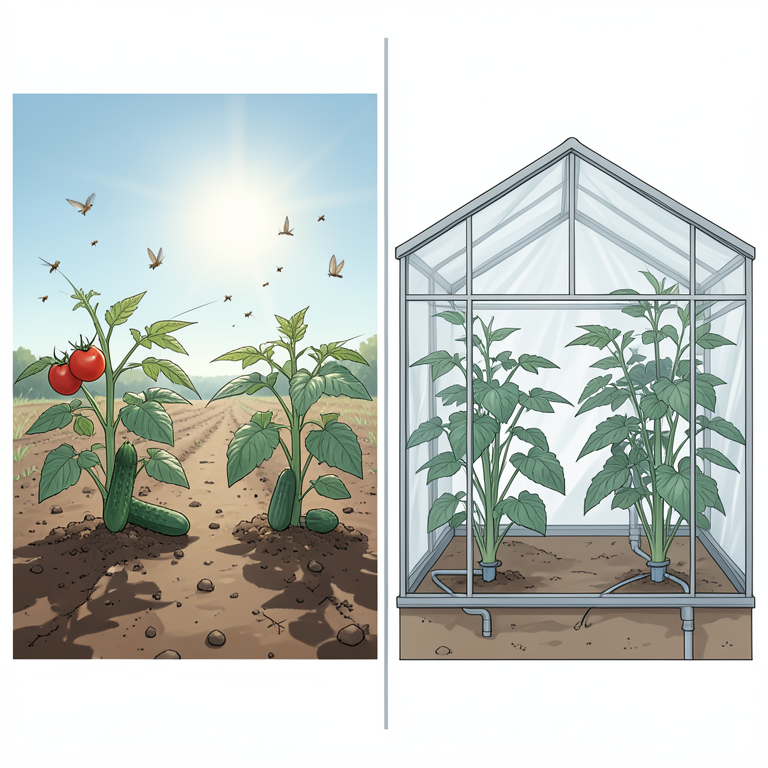
Comparison of Cultivation Impacts
AI-generated conceptual illustration (Tomato, cucumber, and lettuce plants in open-field and greenhouse settings). It explains the idea and does not show study data.
View source evidence ↗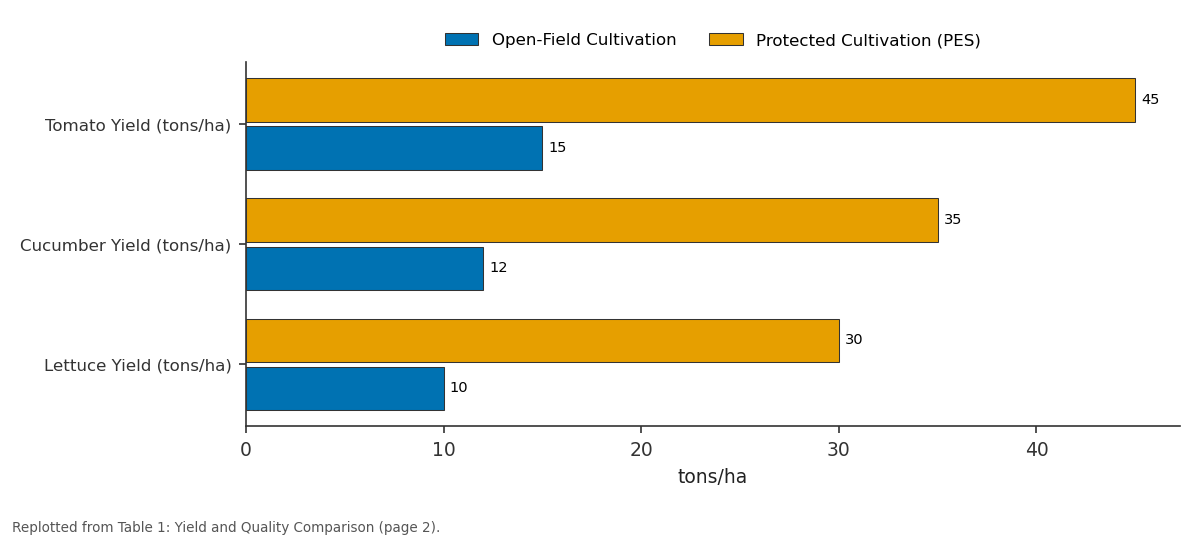
Open-Field Cultivation and Protected Cultivation (PES): Tomato Yield (tons/ha) vs Cucumber Yield (tons/ha) vs Lettuce Yield (tons/ha)
Replotted from Table 1 (page 2) of the original paper. Every bar is the paper's own table value.
View source evidence ↗Figures & tables
From the original paper Table 1
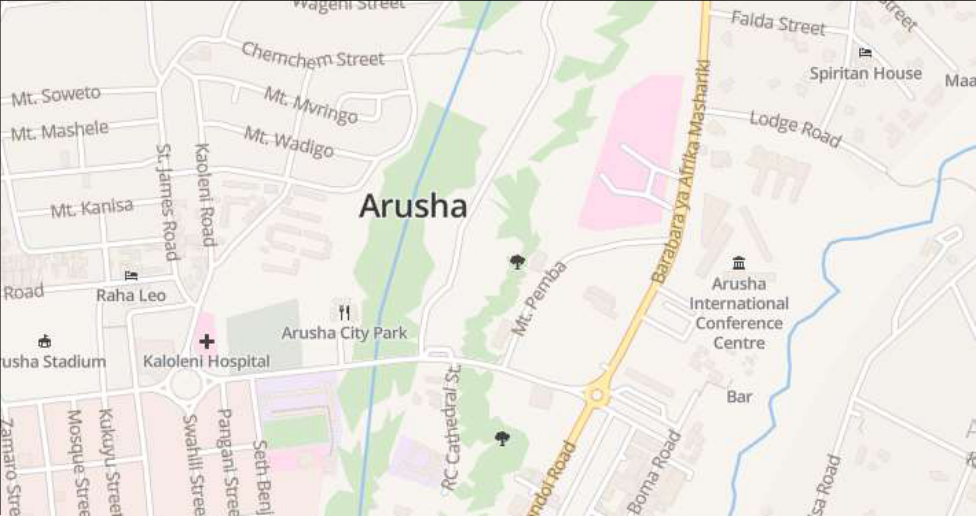 Figure 1
 Table 2
 Table 3
 Table 4
 Table 5
Introduction
Agriculture is a cornerstone of the economy in Arusha, Tanzania, providing livelihoods for a significant portion of the population. Arusha, located in the northern part of Tanzania, is known for its fertile lands and favorable climate, making it a key region for agricultural activities. The region's agriculture sector primarily focuses on crops such as maize, beans, coffee, and horticultural crops, including a variety of vegetables. In recent years, vegetable cultivation in Arusha has seen considerable development due to increasing demand from both local and international markets. Vegetables such as tomatoes, cucumbers, lettuce, and bell peppers are among the most commonly cultivated crops. The adoption of advanced agricultural practices and technologies has played a crucial role in enhancing productivity and ensuring food security in the region. However, traditional open-field farming methods face significant challenges, including erratic weather patterns, pest infestations, and soil degradation. These issues often result in inconsistent yields and economic instability for farmers. For instance, the region experiences fluctuating rainfall patterns, which can lead to periods of drought or excessive rain, adversely affecting crop yields. Additionally, pest and disease outbreaks are common, further exacerbating the challenges faced by farmers. To address these challenges and enhance productivity, innovative agricultural practices like protected environment structures (PES) have been introduced in Arusha. PES, such as greenhouses, polyhouses, and net houses, create controlled environments that mitigate the risks associated with open-field farming. By regulating factors such as temperature, humidity, light, and pest exposure, PES can significantly enhance crop growth and productivity. The government of Tanzania, along with various non-governmental organizations (NGOs), has been promoting the adoption of PES through subsidies, training programs, and financial assistance. These initiatives aim to support farmers in transitioning to more sustainable and resilient farming practices. For example, the Tanzanian Horticultural Association (TAHA) has been actively involved in providing technical support and training to farmers on the use of PES. Despite these efforts, the adoption of PES in Arusha is still in its nascent stages, with many farmers hesitant due to the high initial costs and technical expertise required. However, the success stories of early adopters have demonstrated the potential of PES to transform vegetable cultivation in the region. Farmers who have adopted PES have reported significant increases in yields, improved quality of produce, and higher income levels.
Objective of study
The objective of this study is to conduct a comparative analysis of open-field and protected vegetable cultivation in Arusha, Tanzania.
Methods and Materials Study Area
The study was conducted in Arusha, Tanzania, a region known for its agricultural activities, particularly in vegetable cultivation. The climate in Arusha is conducive to agriculture with its moderate temperatures and sufficient rainfall, though it also faces challenges like unpredictable weather patterns and pest infestations.
Source: Google Map
Source: Google Map
Study Design
The study was performed between open-field and protected vegetable cultivation methods. Data was collected from multiple farms in the Arusha region that practice both types of cultivation. The study employed a mixed-method approach, combining quantitative data from agricultural records with qualitative insights from farmer interviews.
Materials
Crops Studied: Tomatoes, Cucumbers, Lettuce Data Collection Tools: Yield measurement tools (scales, measuring tapes), Water and fertilizer usage logs, and Survey questionnaires for farmer interviews.
Data Collection
Yield and Quality: Quantitative data on crop yields (tons per hectare) and quality ratings were collected from both open-field and PES farms. Resource Use Efficiency: Data on water, fertilizer, and pesticide usage were recorded to assess resource efficiency. Economic Analysis: Financial records were reviewed to determine initial investment, annual maintenance costs, and income from both cultivation methods.
Farmer Perception: Surveys and interviews were conducted with farmers to gather qualitative data on their experiences, satisfaction levels, and perceived challenges with both methods.
Statistical Analysis
Descriptive statistics were used to summarize the data. Comparative analysis was performed to identify significant differences in yields, resource use efficiency, and economic viability between the two cultivation methods. Statistical tests (e.g., t-tests) were conducted to assess the significance of the observed differences.
Environmental Impact Assessment
Soil samples were collected and analyzed to assess soil degradation. Water usage records were reviewed to evaluate water consumption. Observations and farmer reports were used to assess the impact on local biodiversity. Table 4 summarizes farmer perceptions and the barriers to adopting PES. While PES requires higher technical expertise and has perceived higher risks, overall satisfaction among adopters is higher due to better yields and income.
| Parameter | Open-Field Cultivation | Protected Cultivation (PES) |
|---|---|---|
| Ease of Adoption | High | Moderate to Low |
| Technical Expertise Required | Low | High |
| Perceived Risk | Low | Moderate to High |
| Overall Satisfaction | Moderate | High |
Table text extracted from the original PDF; superscript letters are shown inline. The original table image is below.
View original table image
Results and Discussion
Results and Discussion
Discussion
The data in Table 1 clearly indicates that protected cultivation methods, such as greenhouses, polyhouses, and net houses, result in significantly higher yields compared to open-field cultivation. Tomato yields in PES are three times higher than those in open fields, while cucumber and lettuce yields are nearly tripled. This substantial increase in productivity can be attributed to the controlled environment provided by PES, which optimizes growing conditions by regulating temperature, humidity, and light. Additionally, the quality of produce in PES is notably superior, as evidenced by higher average quality ratings. This is likely due to reduced pest and disease exposure and better nutrient management within these structures. NGO support further enhance the feasibility of adopting PES. Table 4 summarizes farmer perceptions and the barriers to adopting PES. While the ease of adoption for open-field cultivation is higher, PES requires more technical expertise and carries perceived higher risks. However, farmers who have adopted PES report higher overall satisfaction due to the benefits of increased productivity and income. The main barriers to adoption include high initial costs and the need for specialized knowledge. Addressing these barriers through training programs and financial support is crucial for wider adoption. The data suggests that with proper support, the adoption of PES could significantly improve agricultural outcomes in Arusha. The data in Table 5 demonstrates a significant reduction in soil degradation when using Protected Environment Structures (PES) compared to open-field cultivation. Open-field farming often leads to soil erosion, nutrient depletion, and compaction due to continuous exposure to adverse weather conditions and intensive farming practices. In contrast, PES provides a controlled environment that minimizes soil disturbance and maintains soil health by protecting it from erosion and overexploitation. This not only preserves soil fertility but also enhances the long-term sustainability of agricultural practices.
| Parameter | Open-Field Cultivation | Protected Cultivation (PES) |
|---|---|---|
| Soil Degradation | High | Low |
| Water Consumption | High | Low |
| Carbon Footprint | Moderate | Moderate |
| Biodiversity Impact | High | Low |
Table text extracted from the original PDF; superscript letters are shown inline. The original table image is below.
View original table image
| Parameter | Open-Field Cultivation | Protected Cultivation (PES) |
|---|---|---|
| Tomato Yield (tons/ha) | 15 | 45 |
| Cucumber Yield (tons/ha) | 12 | 35 |
| Lettuce Yield (tons/ha) | 10 | 30 |
| Average Quality Rating | Moderate | High |
Table text extracted from the original PDF; superscript letters are shown inline. The original table image is below.
View original table image
Figures and tables from the paper
| Parameter | Open-Field Cultivation | Protected Cultivation (PES) |
|---|---|---|
| Water use efficiency | Low | High |
| Fertilizer use efficiency | Moderate | High |
| Pesticide use | High | Low |
Table text extracted from the original PDF; superscript letters are shown inline. The original table image is below.
View original table image
| Parameter | Open-Field Cultivation | Protected Cultivation (PES) |
|---|---|---|
| Initial Investment (USD) | 1,000-2,000 | 10,000-20,000 |
| Annual Maintenance (USD) | 200-400 | 2,000-4,000 |
| Annual Income (USD) | 3,000-5,000 | 6,000-8,000 |
| ROI (%) | 50-100 | 100-150 |
Table text extracted from the original PDF; superscript letters are shown inline. The original table image is below.
View original table image
References
5 in the original paper- Despretz H, Nordey T, Mensah AC. Protected cultivation of vegetables in Sub-Saharan Africa: Scope and impacts. In the Bio-economy Approach 2020 Mar 10 (pp. 130-148). Routledge.
- Shango AJ, Maswi PB, Malya RB, Maro JF, Mwaipopo RE, Majubwa RO, et al. Advances and trends in ecological organic agriculture (EOA) technologies and research on fruit vegetables produced in Tanzania. CABI Reviews. 2022 Jul 15.
- Nordey T, Basset-Mens C, De Bon H, Martin T, Déletré E, Simon S, et al. Protected cultivation of vegetable crops in sub-Saharan Africa: Limits and prospects for smallholders. A review. Agronomy for sustainable development. 2017 Dec;37:11-20.
- Nordey T, Faye E, Chailleux A, Parrot L, Simon S, Mlowe N, Fernandes P. Mitigation of climatic conditions and pest protection provided by insect-proof nets for cabbage cultivation in East Africa. Experimental Agriculture. 2020 Aug;56(4):608-19.
- Mbogho AY, Mwashimaha R, Mbwambo O, Boni SB, Yarro J, Nyundo B, Zalucki MP, Ramasamy S. Comparative effects of Plutella xylostella (L.) (Lepidoptera: Plutellidae) and Crocidolomia pavonana (F.) (Lepidoptera: Crambidae) on cabbage yield in Tanzania. International Journal of Tropical Insect Science. 2021 Dec;41:2733-2738.
Cited by 1
From OpenAlex, OpenCitations and reference lists read by Scinovex
- Development of techniques for accelerated propagation of perspective citrus rootstocks for protected ground using green cuttings ↗
Pavel Kazakov, Svetlana V. Akimova, Ivan Nechiporenko, D. P. Palamarchuk, A. V. Solovyev, A. V. Zubkov et al. · VEGETABLE CROPS OF RUSSIA · 2026
Relevance. Currently, citrus crops occupy a leading position in the world in terms of production. An alternative to industrial cultivation of citrus fruits in open ground can be intensive cultivation technologies in protected ground, for which it is important to develop methods for accelerated production of planting material. Therefore, the aim of our research was to identify the optimal components…
❝ 0PDF